Saito, Kazuya and Akiyama, Y. (2018) Effects of video-based interaction
on the development of second language listening comprehension ability: a
longitudinal study. TESOL Quarterly 52 (1), pp. 163-176. ISSN 0039-8322.
Downloaded from:
Usage Guidelines:
Please refer to usage guidelines at or alternatively
Effects of Video-Based Interaction on the Development of Second Language Listening Comprehension Ability: A Longitudinal Study
Kazuya Saito & Yuka Akiyama
One of the most extensively researched topics in the field of second language acquisition
(SLA) concerns the relationship between interaction, negotiation for meaning and second
language (L2) development. According to the interaction hypothesis (e.g., Long, 1996), much
learning happens precisely when non-native speakers (NNSs) engage in meaningful
conversations with native speakers (NSs), and encounter communication breakdowns for
language-related reasons. To retrieve impaired meaning, NSs must make an intuitive and/or a
conscious effort to facilitate NNSs’ comprehension by way of negotiation strategies—
clarification requests, confirmation checks and repetition—in addition to recasting NNSs’
erroneous production (i.e., comprehensible input). As a result of negotiation for meaning, NNSs
are induced to notice and understand the gap between their own interlanguage systems and the
incoming input, and then produce more targetlike forms (i.e., comprehensible output).
To date, many researchers have claimed that opportunities to negotiate meaning through
interaction facilitate comprehension (e.g., Ellis, Tanaka, & Yamazaki, 1994). In light of an L2
listening research perspective, negotiation for meaning can provide acquisitionally-rich contexts
for the development of bottom-up processing (drawing on phonological, temporal, lexical and
grammatical information) as well as top-down processing (connecting the linguistic knowledge
with world knowledge) (Rost, 2011). In the face of communication breakdowns, NNSs can
According to observational studies (e.g., Long, 1983), such interactionally modified speech
typically contains linguistic characteristics beneficial for L2 comprehension, including the
repetition, paraphrasing and simplification of original utterances (Jensen &Vinther, 2003) with
slower speech rate (Zhao 1997). To avoid and/or repair communication breakdowns during L2
interaction, NNSs obtain successful comprehension by searching for the most logical
possibilities via the effective use of context and prior knowledge (e.g., topic familiarity, cultural
background) (Goh, 2002). Through this, these learners are assumed to become more aware of the
importance of using various comprehension strategies, such as selective attention, problem
solving, planning, evaluation and monitoring, all of which are essential for the development of
listening ability (Vandergrift & Tafaghodtari, 2010).
Over the past 50 years, a number of empirical studies have extensively expounded the
effect of interaction on L2 comprehension development with pre- and post-test designs. There is
ample evidence showing that L2 learners who negotiate for meaning through actual interaction
with NSs tend to show relatively immediate and large gains in language ability, especially
compared to learners who are merely exposed to pre-modified and simplified input (for a
comprehensive review, Mackey, 2012). Though revealing, these previous studies have brought to
light several methodological problems which make further investigation worthwhile. According
to Mackey and Goo’s (2007) research synthesis, for example, most of studies have involved a
very brief amount of interactional treatment (< one hour), corresponding to a general lack of
longitudinal work in the field of SLA (Ortega & Byrnes, 2008). Furthermore, these studies have
exclusively focused on the acquisition of specific L2 vocabulary and grammar features, without
giving much attention to the development of pronunciation, fluency and listening comprehension
form via explicit instruction, form-focused tasks and interactional feedback (Saito, 2012;
Vandergrift & Tafaghodtari, 2010), it remains unclear how L2 learners can improve their global
oral and listening proficiency through negotiation for meaning during natural conversations with
NSs.
To advance the existing literature on this topic, we conducted an experimental research
with a pre/post-test design focusing on inexperienced Japanese college students’ L2 English
speech learning (comprehension, production) in a foreign language context, where L2 use is
extremely limited outside of classrooms. To create communicatively authentic conversational
opportunities under such restricted L2 learning conditions, the participants engaged in weekly,
dyadic conversation exchanges with NSs in the US by way of a video-conferencing tool (i.e.,
Google Hangouts) beyond the regular curriculum over one academic semester (12 weeks).
Unlike naturalistic environments, where L2 learners have access to a great deal of input and
interaction on a daily basis (e.g., study-abroad), this specific research setting—video-based
interaction in foreign language classrooms—could be considered as an interesting testing ground,
particularly for longitudinal analysis of L2 interaction, as it allowed us to monitor the quality and
quantity of their conversational experience throughout the experiments (see below).
In our precursor research (Saito & Akiyama, 2016), we reported that one academic
semester of video-based L2 interaction activity was facilitative of various dimensions of the
Japanese learners’ spontaneous production ability development (e.g., comprehensibility, fluency
and vocabulary). In this paper, we aimed to revisit the dataset to examine the effects of long-term
interaction on the development of L2 comprehension ability. Following the interactionist account
of L2 comprehension ability development (e.g., Ellis et al., 1994), we predicted that longitudinal
proficiency test), as it could provide opportunities for comprehensible input and output during
meaning-oriented discourse.
Method
Participants
A total of 30 freshman and sophomore Japanese students at a university in Japan (NNS
learners), and 15 native speakers of English (NS interlocutors) participated in the current study.
NNS learners. For the purpose of recruitment, we created two kinds of flyers: (a) one on
conversational activities through conversational exchanges with college students in the US; and
(b) the other on vocabulary/grammar activities with the goal of attaining higher scores in Test of
English for International Communication (TOEIC)—the same test format as the pre-/post-test
measures. Among the interested participants, a total of 30 students were selected based on their
relatively homogeneous L2 English backgrounds and status as conversationally inexperienced L2
learners.
First, they had studied English for six years only through foreign language education
(typically with grammar-translation methods) since Grade 7 before entering the university
without any extensive experience overseas (< 1 month). Second, the learners’ exposure to L2
English was highly limited. All of them belonged to the same program (business and marketing)
and were required to take three hours of language-focused lessons per week. As specified in the
department syllabus, our casual classroom observations confirmed that the content of these
lessons mainly consisted of reading and listening activities. Finally, all participants reported
lacking any experience at private, conversational English language schools during the project,
NS interlocutors. The NS interlocutors were L2 Japanese learners at several universities
in the US who volunteered for conversational exchanges. Their L2 Japanese proficiency widely
varied (beginner to advanced).
Research Design
First, the NNS learners individually took the pre-test in the researchers’ office (Week 1),
and were assigned to either the experimental group (n = 15) or the comparison group (n = 15)
based on their preference (videoconferencing for intercultural interaction with NSs vs.
vocabulary/grammar exercise as prep for TOEIC). Next, they proceeded to an orientation session
(Week 2) during which they received explanation on the procedure for the video-based
conversation activities (for the experimental group) and the vocabulary/grammar exercise
activities (for the comparison group) (Weeks 3-11). After finishing all sessions, they revisited the
researchers’ office to take the post-test (Week 12).
Experimental Group
The experimental treatment was organized as a language-exchange program. Each
session lasted for 60 minutes with the first part in English (30 min) and the second part in
Japanese (30 min). For both parts, a two-way information exchange task was used: NNSs
prepared two visuals corresponding to a different theme each week (e.g., education, food) which
they thought represented Japan and the US, and prepared two discussion questions for each
visual. This task was chosen following Lee’s (2002) suggestion that two-way exchanges of
information on real-life topics that are thematic and minimally structured allow L2 learners to
recycle ideas and reinforce language skills. Respecting the principle of learner autonomy in
language exchange, we did not provide pre-determined visuals. Instead, NNSs were responsible
Due to the time difference between Japan and the US, the participants were allowed to
arrange the sessions according to their individual schedules, and engaged in the activities using
their own computers. To keep track of their attendance and participation, the participants were
required to record and submit their own sessions to the researchers (by using a function of
Google Hangouts) upon the completion of every session.
As operationalized in previous L2 interaction research (e.g., Mackey, 2012), NS
interlocutors were trained to provide interactional feedback in the form of recasts, but only when
they perceived the NNSs’ errors to hinder the comprehensibility of their L2 speech. To maintain
the communicative nature of the interaction, the interlocutors were told to pay primary attention
to completing the tasks successfully, providing interactional feedback where natural and
appropriate.
The quality of the L2 interaction treatment during the project was analyzed at the onset
(T1: the second session/Week 4) and endpoint (T2: the eighth session/Week 8) by tallying three
key elements of interaction: (a) the number of linguistic errors made by the NNSs; (b) the
amount of feedback provided by the NS interlocutors in the form of negotiation strategies (after
communication breakdowns) and recasts (following communicatively harmful errors); and (c)
the number of attempts made by NNSs to correct their own errors (i.e., self-modified output)
(e.g., Mackey, 2012).
Comparison Group
The 15 NNS learners in the comparison group were asked to complete weekly take-home
assignments which consisted of a variety of vocabulary/grammar exercise activities, such as
vocabulary recall tests (i.e., comprehension practice) and fill-in-the-blank grammar questions
took approximately 30 minutes. The learners submitted the assignment to the researchers for
grading every week.
The purpose of including the comparison group in the current study was two-fold. First,
given that similar tests were used during the pre/post-test sessions (see below), examining the
comparison group’s performance was expected to reveal any test-retest effects. Second, since all
of the NNS learners were enrolled in three-hour English lessons during the project, the
comparison group served as a baseline to reveal the gains which Japanese learners typically
exhibit after one semester of foreign language learning without any opportunities for L2
interaction.
Outcome Measures
Materials. In line with the L2 listening literature (e.g., Vandergrift & Tafaghodtari,
2010), the participants’ comprehension was measured via a composite proficiency test (TOEIC).
This type of assessment is assumed to tap into L2 learners’ ability to process various kinds of
realistic spoken language in order to “understand linguistic information unequivocally included
in the text and to make inferences implicated by the content of the text” (Vandergrift &
Tafaghodtari, 2010, p. 477), and is thus are as a good fit for the current project, whose main
objective was to examine the impact of interaction as a whole (comprehensible input and output)
on L2 learners’ overall listening proficiency.
Two versions (A, B) of the TOEIC test were chosen from the New Official Workbook
(Educational Testing Service, Vol.4), with Version A used for the pre-tests and Version B for the
post-tests.1 The participants marked their answers on a score sheet. Each test lasted for
1 The materials were reprinted by permission of Educational Testing Service. No endorsement of any kind
approximately 50 minutes. Each version consisted of three components—Part 2
Question-Response, Part 3 Conversations, and Part 4 Talks.
1. Question-Response (30 questions): The participants selected the best response (out of
three options) for a single-sentence question (5-10 words). Their performance on this
section was assumed to reflect basic-level L2 comprehension proficiency (understanding
linguistically and semantically simple input).
2. Conversations (30 questions): The participants listened to a dialogue between a male
and a female speaker (80-100 words), and selected the best response (out of four options)
to three comprehension questions, respectively. This section was assumed to measure L2
learners’ comprehension ability of interactional speech with frequent turn taking (20-25
words per turn).
3. Talks (30 questions): The participants listened to a business announcement spoken by a
single person (80-100 words), and selected the best response (out of four options) to three
comprehension questions, respectively. This section was assumed to tap into the NNS
learners’ advanced comprehension proficiency (understanding of linguistically and
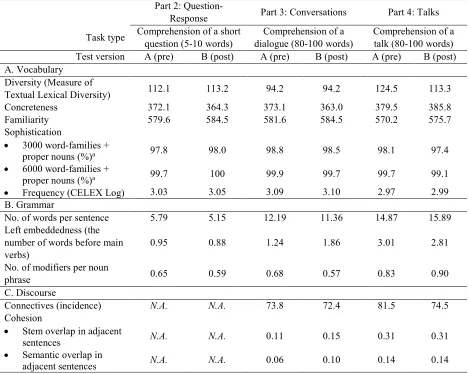
Table 1. Lexical, Grammatical and Discoursal Characteristics of Aural Texts in the Comprehension Test
Part 2:
Question-Response Part 3: Conversations Part 4: Talks
Task type Comprehension of a short question (5-10 words)
Comprehension of a dialogue (80-100 words)
Comprehension of a talk (80-100 words) Test version A (pre) B (post) A (pre) B (post) A (pre) B (post) A. Vocabulary
Diversity (Measure of
Textual Lexical Diversity) 112.1 113.2 94.2 94.2 124.5 113.3
Concreteness 372.1 364.3 373.1 363.0 379.5 385.8
Familiarity 579.6 584.5 581.6 584.5 570.2 575.7
Sophistication
• 3000 word-families +
proper nouns (%)a 97.8 98.0 98.8 98.5 98.1 97.4
• 6000 word-families +
proper nouns (%)a 99.7 100 99.9 99.7 99.7 99.1
• Frequency (CELEX Log) 3.03 3.05 3.09 3.10 2.97 2.99 B. Grammar
No. of words per sentence 5.79 5.15 12.19 11.36 14.87 15.89 Left embeddedness (the
number of words before main verbs)
0.95 0.88 1.24 1.86 3.01 2.81
No. of modifiers per noun
phrase 0.65 0.59 0.68 0.57 0.83 0.90
C. Discourse
Connectives (incidence) N.A. N.A. 73.8 72.4 81.5 74.5 Cohesion
• Stem overlap in adjacent
sentences N.A. N.A. 0.11 0.15 0.31 0.31
• Semantic overlap in
adjacent sentences N.A. N.A. 0.06 0.10 0.14 0.14
Following the research framework of Révész and Brunfaut (2013), the processing
difficulty of the aural text (versions A, B) was analyzed via Coh-Metrix (McNamara, Graesser,
McCarthy, & Cai, 2014) and Vocab Profiler (Cobb, 2015). As summarized in Table 1, the three
tasks—Question-Response, Conversations, Talks—noted somewhat similar lexical profiles of
spontaneous spoken in English especially in terms of lexical frequency: 97-98% lexical coverage
by 3000 word-families and proper nouns and 98-99% lexical coverage by 6000-word families
and proper nouns (Nation, 2006).
At the same time, the three tasks differed in terms of the complexity of grammar and
discourse. Question-Response featured less complex grammar structures than Conversations and
Talks according to the number of words per sentence (5-6 vs. 12-16) and the number of words
before main verbs (0.9-1 vs. 1-3). Conversations and Talks were also different in several
respects. Not only did Conversations contain more frequent words than Talks, but the aural text
of the former was less complex than that of the latter according to all grammatical complexity
and discourse connective/cohesion factors.
In terms of the different levels of difficulty between the two test versions, Version A used
slightly less familiar words than Version B did in Parts 1, 2 and 3 (familiar ratings: M =
570.2-581.6 vs. M = 575.7-584.5). However, no other consistent patterns were observed in terms of the
other domains of the aural texts (lexical, grammatical features and discourse complexity).
Taken together, the three components (Question-Response, Conversations, Talks) had a
lexical frequency range similar to that typically found in English conversational interactions
(3000-6000 word families) (Nation, 2006), but at the same time were ranked by cognitive
demand as follows: Talks > Conversations > Question-Response. The results of the text analyses
the tentative pattern of test difficulty (Version A > Version B), we used the comparison group’s
performance as baseline data (see below).
Results
Based on the video-coded data at the outset and end of the project, we first explored the
nature of the interaction treatment that the experimental group received. According to the
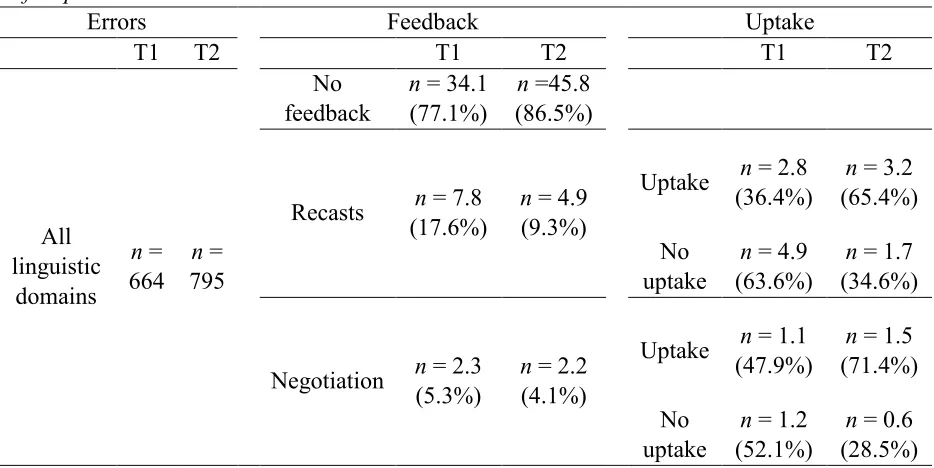
descriptive statistics (summarized in Table 2), negotiation for meaning episodes (as a result of
communication breakdowns) occurred only a few times per session (M = 2.3 times [5.3%] for
T1, 2.2 times [4.1%] for T2), and the NS interlocutors selectively recasted only salient linguistic
errors (M = 7.8 errors [17.6%], 4.9 errors [9.3%] per session). In response to such feedback
moves, the NNSs attempted to modify their own errors with relatively high uptake ratio
(47.9-71.4% for negotiation; 36.4-65.4 for recasts). The results here indicated that the NNS learners
processed a certain amount of comprehensible input and output while maintaining their primary
[image:12.612.74.541.477.711.2]focus on meaning throughout the sessions.
Table 2
Overall Interaction Patterns of Total Errors, Negotiation Strategies and Recasts, and Attempts to Self-Repair
Errors Feedback Uptake
T1 T2 T1 T2 T1 T2
All linguistic
domains
n = 664
n = 795
No feedback
n = 34.1 (77.1%)
n =45.8 (86.5%)
Recasts n = 7.8 (17.6%)
n = 4.9 (9.3%)
Uptake n = 2.8 (36.4%)
n = 3.2 (65.4%)
No uptake
n = 4.9 (63.6%)
n = 1.7 (34.6%)
Negotiation n = 2.3 (5.3%)
n = 2.2 (4.1%)
Uptake n = 1.1 (47.9%)
n = 1.5 (71.4%)
No uptake
n = 1.2 (52.1%)
Note. T1 = 2nd session, T2 = 8th session out of 9 sessions over one academic semester Next, we investigated the longitudinal development of comprehension skills by the
participating students in the experimental group, and compared it with those in the comparison
group. Due to the relatively small size of the dataset (n = 15 per groups), a series of
nonparametric tests were conducted. The alpha level was set at p < .05 and adjusted to p < .0.25
via Bonferroni correction. With respect to pre-existing differences between the two groups, the
results of Mann-Whitney tests showed that they were found comparable for Question-Response
(z = -1.33, p = .187), Conversations (z = -1.91, p = .056), and Talks (z = -1.97, p = .202) at the
[image:13.612.71.528.342.482.2]beginning of the project.
Table 3
Descriptive Results of the Comprehension Test Scores over Time
Pre-test (30 points)
Post-test (30 points)
Improvement (pre →post)
M SD M SD z p d
Question-Response Experimental Group 19.6 3.45 23.1 2.79 -2.85 .004* 1.15 Comparison Group 18.0 3.76 19.6 3.77 -1.96 .049 0.42
Conversations Experimental Group 18.6 4.80 23.5 3.44 -3.30 .001* 1.17 Comparison Group 15.4 4.23 19.9 5.00 -3.01 .003* 0.97
Talks Experimental Group 14.8 5.09 21.6 4.86 -3.18 .001* 1.36 Comparison Group 13.0 3.96 16.8 6.63 -2.51 .011* 0.63
Note. * stands for a statistically significant improvement at a p < .025 level.
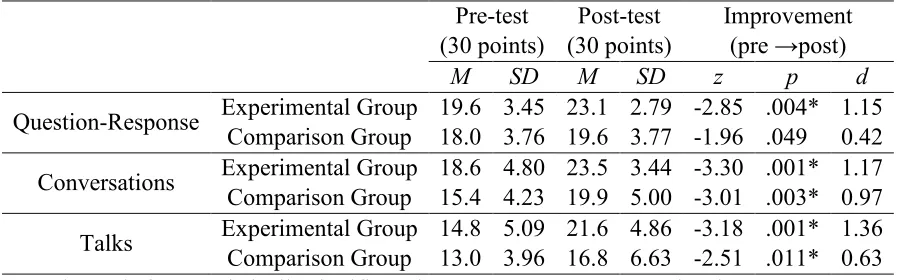
To examine the presence/absence of any significant improvement over time, a set of
nonparametric Wilcoxon Signed Ranks tests were then performed for the experimental and
comparison groups, respectively. The magnitude of their improvement over time (pre → post)
was measured by Cohen’s d analysis, as suggested by Plonsky and Oswald (2014). As
summarized in Table 3, the comparison group noted somewhat limited improvement in their
comprehension scores from pre- to post-tests (a significant gain was found in Conversations and
Talks but not in Question-Response). In contrast, the experimental group significantly increased
improvement could be interpreted as relatively large (d > 1.00) in keeping with the research
standards in instructed SLA research (Plonsky & Oswald, 2014).
Discussion and Conclusion
The current study took a first step towards examining the effectiveness of video-based
interaction on the longitudinal development (one academic semester) of Japanese college
students’ L2 English comprehension skills in a foreign language setting. Building on recent L2
listening research (e.g., Révész & Brunfaut, 2013; Vandergrift & Tafaghodtari, 2010),
participants’ performance was analyzed via a composite test tapping into various dimensions of
L2 comprehension proficiency, such as the processing of short and simple input
(Question-Response), interactional input with frequent turn taking (Conversations), and long and complex
input (Talks). According to the results of the pre-/post-test data, both the experimental and
comparison groups equally developed their listening skills over time. Yet, analysis of the effect
sizes revealed that the amount of the experimental group’s improvement was equally large under
all task conditions (d > 1), although the comparison group’s improvement was limited in two out
of three tasks (Conversations, Talks) with small-to-medium effects (d < 1) (Plonsky & Oswald,
2014).
The results presented here allow us to assume that the extracurricular drill activities and
classroom listening activities received by the comparison group may be effective for L2
lexicogrammar learning, which could in turn help develop L2 listening skills to some degree,
even without any opportunities to interact with NSs. Other interpretations could be
methodological: (a) the gains resulting from the comparison group may simply indicate
frequently reported in many English proficiency test settings (Liao & Qu, 2010)2; and/or (b) the
pre-test materials (Version A) could have been more difficult than the post-test materials
(Version B), as suggested by our text analysis presented earlier.
Compared to the comparison group’s performance as a baseline, it is crucial to emphasize
that the participants in the experimental group attained significant and robust comprehension
skill acquisition with large effects regardless of task condition (i.e., different levels of processing
difficulty: Question-Response < Conversations < Talks). As shown in the video-coded data of
the experimental group, the participants received feedback (recasts, negotiation) approximately
10 times per session (30 min). The nature of interaction could be comparable to other
observation studies which descriptively looked at the feedback frequency during
meaning-oriented interaction (e.g., Mackey, 2012). This in turn suggests that the NNS learners could work
on the development of their L2 listening skills with constant and immediate assistance from their
NS partners for prolonged periods of time. That is, the NS interlocutors occasionally led the
NNS learners to attain better comprehension via negotiation strategies in the case of
communication breakdowns (i.e., comprehensible input). Different from existing L2 listening
studies (e.g., Vandergrift & Tafaghodtari, 2010), where L2 learners focus on incoming input in a
receptive mode, the NS interlocutors also encouraged the NNS learners to repair certain
communicatively-harmful errors in production via recasts (i.e., comprehensible output).
Self-modified output is believed to push NNSs to align their linguistic representations more closely
with native speakers’ models (Swain, 2005), which will, in theory, stimulate the development of
more advanced and robust comprehension ability in a complementary fashion (Field, 2008).
Whereas our study shed some light on the acquisitional value of video-based interaction
as a whole from a longitudinal perspective, the findings should be considered as tentative in
nature, and thus need to be replicated with a larger sample size in different L1/L2 contexts. In
particular, future studies need to scrutinize precisely which aspects of L2 interaction treatment
are relatively important for L2 speech learning in the long run by controlling a range of affecting
factors, such as different types of interactional feedback (recasts, negotiation), opportunities for
repair, quality and quantity of turn taking, NSs’ specific linguistic use, and NNS learners’
proficiency levels (see Mackey, 2012). Additionally, the experimental group’s gain could be
related to L2 learners’ individual differences in motivation, willingness to communicate,
aptitude, cognition (working and phonological memory), and personality traits (extroversion vs.
introversion). Finally, more qualitative analyses may be needed to examine whether certain
students particularly benefit from L2 interaction of this kind, because they have practiced, or
References
Cobb, T. (2015). The compleat lexical tutor. Retrieved from http://www.lextutor.ca/vp/
Ellis, R., Tanaka, Y., & Yamazaki, A. (1994). Classroom interaction, comprehension and the
acquisition of word meanings. Language Learning, 44, 449–491.
Field, J. (2008). Emergent and divergent: A view of second language listening research. System,
36, 2–9.
Goh, C. (2002). Exploring listening comprehension tactics and their interaction patterns. System
30, 185–206.
Jensen, E., & Vinther, T. (2003). Exact repetition as input enhancement in second language
acquisition. Language Learning, 53, 373–428.
Kim, Y., & Tracy-Ventura, N. (2013). The role of task repetition in L2 performance
development: What needs to be repeated during task-based interaction? System, 41,
829-840.
Lee, L. (2002). Enhancing learners’ communication skills through synchronous electronic
interaction and task-based instruction. Foreign Language Annals, 35, 16-24.
Liao, C. W., & Qu, Y. (2010). Alternate forms test-retest reliability and test score changes for the
TOEIC speaking and writing tests. TOEIC Compendium.
Long, M. H. (1983). Native speaker/non-native speaker conversation and the negotiation of
comprehensible input. Applied Linguistics, 4, 126-141.
Long, M. H. (1996). The role of the linguistic environment in second language acquisition. In W.
C. Ritchie & T. K. Bhatia (Eds.), Handbook of language acquisition. Vol. 2:Second
Mackey, A. (2012). Input, interaction, and corrective feedback in L2 learning. Oxford, UK:
Oxford University Press.
Mackey, A., & Goo, J. (2007). Interaction research in SLA: A meta-analysis and research
synthesis. In A. Mackey (Ed.), Conversational interaction in second language
acquisition: A collection of empirical studies (pp. 407–452). Oxford: Oxford University
Press.
McNamara, D. S., Graesser, A. C., McCarthy, P. M., & Cai, Z. (2014). Automated evaluation of
text and discourse with Coh-Metrix. Cambridge University Press.
Nation, I. S. P. (2006). How large a vocabulary is needed for reading and listening? Canadian
Modern Language Review, 63, 59–82.
Ortega, L., & Byrnes, H. (Eds.). (2008). The longitudinal study of advanced L2 capacities. New
York: Routledge.
Plonsky, L., & Oswald, F. L. (2014). How big is ‘big’? Interpreting effect sizes in L2 research.
Language Learning, 64, 878-912.
Révész, A., & Brunfaut, T. (2013). Text characteristics of task input and difficulty in second
language listening comprehension. Studies in Second Language Acquisition, 35, 31-65.
Rost, M. (2011). Teaching and researching listening. London: Longman.
Saito, K. (2012). Effects of instruction on L2 pronunciation development: A synthesis of 15
quasi-experimental intervention studies. TESOL Quarterly, 842-854.
Saito, K., & Akiyama, Y. (2017). Video-based interaction, negotiation for comprehensibility,
and second language speech learning: A longitudinal study. Language Learning, 67(1).
Vandergrift, L., & Tafaghodtari, M. (2010). Teaching L2 learners how to listen does make a
Zhao, Y. (1997). The effects of listeners’ control of speech rate on second language