Brown, J. and Gamblin, David and Hunter, Gillian and McDowall, Almuth
and McGinley, B. and May, Tiggey and Tompson, L. (2018) Developing an
evidence based police degree-holder entry programme.
Project Report.
Mayor of London Office for Policing and Crime.
Downloaded from:
Usage Guidelines:
Final Report
Home Office Police Innovation Fund 2016-18
Edited by Mike Hough & Betsy Stanko
Contributing authors Winifred Agnew-Pauley
Jyoti Belur
Jennifer Brown
David Gamblin
Gillian Hunter
Almuth McDowall
Brendan McGinley
Tiggey May
MOPAC and its academic partners would like to thank the Home Office for
providing a grant for this work from its Police Innovation Fund.
We would like to thank the staff of the Police Now programme for offering
themselves as a test bed for research. We are also grateful to the second and third Police Now cohorts for participating in the research. Research can make
unwelcome demands on those who agree to submit themselves to the research process, and we appreciate their forbearance.
We would also like to thank all those staff from police forces, social work
departments and teaching institutions who made valuable contributions of their knowledge and time to this project. For their thorough and illuminating peer reviewing, we would like to thank Chief Constable Andy Rhodes and Professor Ken Pease.
Thanks are also due to the College of Policing, which became an increasingly important partner and stakeholder in this project as it evolved. The College has provided us with a great deal of
encouragement and practical help throughout the life of the project.
We would like to thank Betsy Stanko for the vision to initiate this project, and for providing strategic advice throughout. Finally, we should thank the MOPAC project director, Robin Merrett, and the project coordinator, Lizzie Peters, who both did exceptional jobs at keeping a complex and ever-evolving project on schedule. Lizzie Peters was also involved in aspects of the research design and in fieldwork interviews.
Winifred Agnew-Pauley Jyoti Belur
Jennifer Brown David Gamblin Mike Hough Gillian Hunter Almuth McDowall Brendan McGinley Tiggey May
CONTENTS
Acknowledgements 2
Contents 3
Foreword by the Mayor’s Office for Policing and Crime 4
Foreword by the College of Policing 5
Summary 6
Introduction 12 Chapter 2:
The evidence on conversion courses 26
Chapter 3:
The systematic review on effective police training 34
Chapter 4:
Organisational readiness for the
Degree Holder Entry Programme 46
Chapter 5:
Motivations and appreciation of evidence based
policing amongst Police Now participants 58
Chapter 6:
View from the shop-floor: perspectives
on the Police Now programme 76
Chapter 7:
Insight from the research 92
References 100
Appendix A: Stakeholder interviews
The safety of Londoners is the key priority for the Mayor. It is one of the essential foundations of London’s success as a global city. Our Police and Crime Plan provides a strong pathway for progress, and sets out MOPAC’s role in ensuring the Plan is delivered. However, I recognise that if we are to move forward effectively, we need to place the officers, staff and volunteers within the Met at the core of our plans. People are central to all we do; we need to recruit the right people, and properly support them to learn and develop. As part of the Plan, MOPAC and its partners aim to transform police learning in London, ensuring that we deliver a service to the public that is fit for current and future challenges. Having police officers with the right skills,
knowledge and behaviours is absolutely fundamental to effective policing. MOPAC created this project to develop the
evidence base for future training, learning and development of police officers. One of the key pathways is to transform the police service into a learning
organisation that fully embraces evidence based practice, and this is consistent with the National Police Chiefs Council’s
Vision 2025. As part of this the College of Policing has set out the Policing
Educational Qualifications Framework (PEQF).
The project findings presented here are one element in this process of change. MOPAC led this collaborative project, working with the Metropolitan Police Service and other forces nationally, the College of Policing, two universities and Police Now. The ambition was to provide support in developing the Degree Holder Entry Programme, one of the three PEQF initial entry routes to policing - whereby on joining the police service graduates embark on a programme to convert their degree into a policing qualification. These research findings have already informed the development of this programme, which police forces need to implement by 2020.
The project was made possible through a grant from the Home Office Police
Innovation Fund. The fund is intended to drive innovation in policing through collaboration, and this report is ample proof that the project has been
successful in achieving this.
SOPHIE LINDEN
Modern policing is changing. Crime is taking on new forms, generating a new set of challenges to which the police service must respond. More than ever, those working in policing are required to engage in critical thinking, deal with complex policing situations and
environments, work with a high degree of autonomy, make decisions independently, communicate and negotiate successfully, engage in professional reflection, and contribute in visible ways to supporting and protecting the public.
The role of police constable remains the bedrock of effective policing, but
increasingly it requires knowledge and skills to be applied across a range of different situations, as well as behaviours consistent with efficient, appropriate and supportive policing. The College of
Policing is working with the police service to introduce three new degree-based entry routes into policing at the rank of police constable. We are determined that programmes of education within policing will foster the highest standards of
educational and professional
development, enhancing knowledge, skills and competence within the service. The way in which we equip those working in this key role must reflect its
wide-ranging responsibilities and support them to succeed.
In this regard, policing has much to gain from partnership working with those in the education sector who are directly engaged in policing-related research, in ways that can improve police learning and development and, ultimately, practice.
We welcome the publication of the research findings of this MOPAC project as a significant contribution to the research base on the education of new recruits to the police service.
Although the report concentrates upon graduate entry into policing, many of the research findings have a broader
relevance to policing education.
Emphasised throughout the report is the importance of full integration of
theoretical and practical elements within policing education. As the professional body setting the national education standards for the police, we are committed to ensuring that the new degree-based entry programmes for the Police Constable (PC) role are
fundamentally based upon demonstration of effective, evidence-based professional practice in the workplace. Delivery of a new framework of practice-based education for the police constable will play an important part in the service’s delivery of what the Policing Vision 2025 describes as ‘a more sophisticated response to the challenges we face now and in the future’. The MOPAC report will help the service to frame that response, supporting us to deliver a better policing service to the public.
MIKE CUNNINGHAM
The College of Policing launched a consultation in 2016 on plans to require all police recruits to hold a policing qualification at degree level. The plans were agreed in 2017 as part of the
College’s PEQF with the expectation that the degree requirement would take effect from 2020. The PEQF provided for three entry routes for police constables: • the Police Constable Degree
Apprenticeship (PCDA), introduced from April 2018, involving academic study in parallel with operational work • the pre-join degree in professional
policing, introduced from 2020, where prospective recruits acquire their degree in policing in advance of recruitment
• the Degree Holder Entry Programme (DHEP), introduced from 2020 – the focus of this report.
The aim of the project reported here, funded by the Home Office Innovation Programme, was to contribute to an evidence-informed dialogue about the nature, quality and purpose of police education.
More specifically the project examines questions that relate to the development of the DHEP:
• How do graduate police recruits learn about the standards for policing and the public expectations of a police officer?
• How do graduate police recruits apply their critical skills (gleaned from their university study) to their decision-making as a police office? What is the role of evidence here?
• How do graduate police officers learn the essential skills/craft of policing? Do they have different learning styles from non-graduate recruits? What is the role of evidence here?
• What is the theory of change for
requiring graduate entry – that is, what are the key elements of policing that are expected to result from graduate training, and how?
The project involved several separate elements, carried out by researchers at Birkbeck, University of London and University College London. The team conducted a review of the UK research literature on analogous conversion courses provided for graduates entering law, teaching, and the social work
profession, and a further review of the international literature about effective police training. Team members
interviewed staff in police force Learning and Development (L&D) Departments to assess readiness to introduce the DHEP from 2020. They also interviewed recruits undergoing a graduate-entry programme designed and delivered by Police Now (PN), to track experiences of the pre-existing graduate programme that is closest to DHEP.
The learning from analogous conversion courses
The single most important aspect of a successful professional conversion course is its ability to integrate
theoretical learning and the learning of practical skills. This can be achieved through a variety of teaching tools, resources and opportunities to put theoretical learning into practice under the supervision of a capable mentor or tutor as well as providing the space for reflection on the experience and how practice can be improved.
It is also important to be clear about the assumptions being made about graduate recruits’ critical thinking abilities, relevant skills and preconceptions about policing. This would sensitise curriculum
developers and those involved in delivering education to understand the needs of graduates from the outset. However, it is equally important to
understand that different individuals have different learning styles – and adapting suitable teaching methods for adults is needed for the delivery of both
theoretical learning and practical skills. Another critical aspect of curriculum design and delivery is to put in place appropriate forms of assessment. These should serve as tools not only to test but also to enable learning. Assessment needs should be properly quality-assured and validated by experts.
Finally, and fundamentally, outcomes which learning should achieve both in terms of practical skills (getting the job done) and practice skills (ensuring that behaviour promotes the proper goals of the organisation) must be specified.
Focusing on practical day-to-day competence whilst losing sight of what makes for good policing is counter-productive.
Research on effective police learning
A thorough review of the international English-language research on police training identified 33 high-quality studies of police recruit training. Some very consistent messages emerge.
The first is that teaching and learning methods have to be tailored to adult learning styles, and where recruits are degree holders, teaching methods appropriate to graduates are required. The principles of andragogy (adult learning) and of problem-based
approaches need to be followed if deeper learning is to remain with recruits beyond the classroom and to survive the more corrosive elements of the police
occupational culture.
The theoretical and practical parts of programmes must be properly integrated if the theoretical elements are not to be jettisoned as soon as recruits arrive in the field and become inculcated with the occupational culture. This is essential but challenging to achieve. Related to this point, several studies stressed the importance of organisational buy-in to the aims of the learning programmes, and in particular in ensuring that teachers and mentors in the field are appropriately qualified and provide proper support for recruits when they acquire skills.
Findings on programme aims and
Aims were often poorly articulated and we have been unable to say much of significance about outcomes. Clearly the PEQF provides an important opportunity, that should be firmly grasped, to evaluate the outcomes of the three new training routes into the police in England and Wales. Any such evaluations would need to state fully and carefully, the aims of the graduate entry programme in terms of the qualities and skills that recruits should acquire.
Police forces’ readiness to implement the DHEP and other parts of the PEQF
There needs to be a significant shift in organisational culture to recognise and accept the value of graduate training for recruit officers. The workforce needs to accept the case for the PEQF. For this to happen, police leaders and the College of Policing need to articulate the rationale – and the benefits for the workforce – of professionalisation and graduate level education. Forces’ senior management teams need to support, and have the full support of, their L&D staff in this process. So too do forces need to think holistically about the changes to learning that
require additional support. As this report makes clear, mentors are critical to the success of transferring new knowledge into practice. How mentors learn their role, and are supported in doing so in situ, must be considered as a fundamental part of the graduate entry programme. The daunting logistical challenges, such as getting contractual arrangements in place with Higher Education Institutions (HEIs), upskilling in-house learning staff and mentors and bringing the changes in on budget may distract L&D units from finding solutions to the difficult
intellectual and pedagogic/andragogic challenges in designing and implementing
a conversion course that equips recruits with complementary practical and
intellectual skills.
Tight budgets increase the risks of making false economies. The cheapest and quickest routes to learning how to be a police officer and bringing recruits to the level of independent patrol status may not be the best long-term
investment for a police service. Without more careful thought about how all recruit officers achieve the competence of
independent patrol status (regardless of which entry route recruits choose into policing in England and Wales), changes introduced may undermine the
aspirations of professionalisation. Given the complexities of setting up partnerships between forces and
universities and sharing the design and delivery of learning, there is a need for an independent body – with expertise in both the theoretical and practical aspects of police learning – to oversee these arrangements and to quality-appraise and assess the various training programmes on a national level. The College of
Policing could take on this role, or an independent assessor could be found or set up.
Finally, there is little evidence to date about the impact that making policing a graduate profession has on people’s experience of their police. The PEQF promises to achieve a radical
Motivation and appreciation of evidence based policing practice amongst Police Now participants
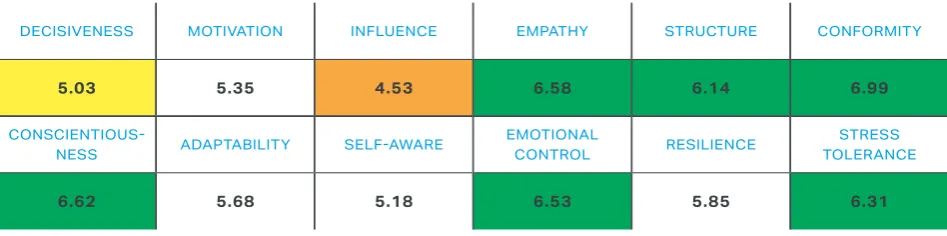
This part of the project involved psychometric data collected from PN participants. They emerged as a highly motivated and able group of graduates, with a clear commitment to ‘making a difference’. Measured on their emotional intelligence, they scored higher on
empathy, emotional control,
conscientiousness and structure than a benchmark group of comparable
professionals, but lower in decisiveness and influence.
Other key points relate to the way recruits learn about evidence-based policing practice.
• Repeated exposure to examples of evidence based practice for the PN participants reaped rewards by increasing knowledge of basic
principles and increased the likelihood of a more focused approach to
addressing real-life policing problems. • Enabling PN participants to frame
stronger research designs together with a greater appreciation of some basic tests of statistical significance, or appropriate qualitative
methodological approaches, may reap earlier rewards for adopting evidence based practice.
• There was little evidence to suggest that when PN participants undertook systematic problem solving
approaches, these ideas were taken up elsewhere within force or the learning exploited for trialling elsewhere.
• Further research is needed to show how graduate recruits learn about policing – as a craft as well as through better exposure to evidence based practice – and how better to transfer this knowledge to the whole of the workplace.
In-depth interviews with Police Now participants
Our interviews with PN participants and their police line managers about their experiences of this programme highlight some important learning points for developing the DHEP
• While our interviewees could largely cope with learning over a condensed period of time and were happy to complete some of these elements independently, there was a general call for more discussion and reflection alongside lecture-style learning. This might also help reinforce the
connection between the more theoretical or ‘soft-skills’ aspects of the training curriculum and policing practice. Common concerns about a lack of practical knowledge or skill on completion of learning the curriculum components could be addressed through better coordination in the immersion and mentoring period and clearer plans for how graduates’
practice will be developed in force and through top-up learning and reflection opportunities.
However, interviewees met with various obstacles, including the lack of support for Evidence Based Practice (EBP) in participants’ local forces, and this would need to be addressed in readiness for the DHEP as well as the other two entry routes. • The PN impact presentations could be
viewed as one opportunity for reflective practice, and these are promising practice for PN. The 100-day assessment process used by PN has several objectives including: to enhance participants’ problem-solving skills and to inspire reflective
innovation and creative problem solving. There is clear scope for thinking further about how these presentations test and improve the police knowledge base, not only for PN, but across the developments in recruit education.
Evidence based practice: researching police learning
This project was fortunate to have the cooperation of Police Now (PN), whose participants, force based mentors and staff agreed to be interviewed and observed. The research on police
learning across the globe is thin, and the establishment of the PEQF provides the opportunity to learn more about how police learn. This report is not an evaluation of Police Now. Police Now’s participants who took part in this
research did so with expressed research consent and we thank these participants for taking the time to contribute to
making police education better. The issues identified here are issues relevant to all the forces across England and Wales who will be adopting the DHEP.
Fundamental issues and principles arising from this project’s research
A number of key issues and fundamental principles need to be addressed for successful implementation of the DHEP:
• There is a need to achieve clarity on the model of police professionalism to be adopted
• The model of professionalism steers the respective underpinning principles for education and continuous
professional development and should draw on learning gleaned from other occupations’ experience
• There is a need to refine on an
ongoing basis the operationalisation of evidence based policing practice, integrating the recognition and inclusion of craft-based practice • There remains a suspicion of the
added value of graduate officers, and for the sake of those entering the police service through the DHEP, there is a need to address continuously the service’s receptivity to graduate officers so that they experience the welcome they deserve in the job • There is a need to support stronger
and more collaborative engagement with HEIs to ensure best fusion of theory and practice as well as coherent standards and delivery across forces
Recommendations of this report for the College of Policing in developing the DHEP
There are key findings that the College of Policing may wish to consider in the iterative development of the DHEP:
• To articulate clearly the desired
outcomes of graduate entry education with explicit criteria for becoming a ‘good police officer’ and for achieving ‘good policing’
• To articulate the aspired model of professionalism that underpins the PEQF by drawing on learning from other professions
• To review the published curriculum for the PCDA and concentrate on fusing theory and practice in the different modules including explicit
consideration of applying EBP principles to practice
• To provide specific guidance for forces on working collaboratively with HEIs – especially in creating new ways of co-producing learning and integrating HEIs’ contribution to this new curriculum
• To give more consideration to the candidate (learner) perspective in policing education from their initial selection; including the consideration of personal motivation and other characteristics, and through ongoing support and monitoring
• To highlight the receptivity of the Police Service as a whole to the creation of a graduate profession of policing as an ongoing issue
• To support the undertaking of an on-going major evaluation of the DHEP, alongside its evaluation of the PCDA
The context of policing in England and Wales is continually and rapidly evolving, as is the profession itself. There are 43 police forces in England and Wales. The professional body developing the standards for the skills and knowledge necessary to prevent crime, protect the public and secure public trust is the College of Policing (COP), established in 2012. The College sets standards for the police service on training, development, skills and qualifications, and provides support to help the service implement these standards.1
A significant development has been the introduction, by the College, of the PEQF. Whilst this is ultimately designed to cover a wide range of the service’s educational needs, a key element of the PEQF, which has been first for implementation, is the requirement that all new recruits should acquire a degree level policing
qualification either before recruitment, upon entry or in the first years of service. The project summarised in this
report2 supported the COP in the development of one of the three entry routes, the DHEP, which is envisaged as a conversion course akin to those for graduate entrants to law, teaching or social work.
The project addressed four sets of questions:
1. How do graduate police recruits learn about the standards for policing and the public expectations of a police officer? Is there relevant learning from academic research on other graduate entry professional conversion
programmes?
2. How do graduate police recruits apply their critical skills (gleaned from their university study) to their decision-making as a police officer? What is the role of evidence based policing here? 3. How do graduate police officers learn
essential skills/craft of policing? Do they have different learning styles from non-graduate recruits? What is the role of evidence here?
4. What is the Theory of Change for requiring police entrants to have degrees – that is, what are the key elements of policing that should be instituted by effective police training and education, and what are the key steps in making this happen?
INTRODUCTION
1. www.college.police.uk/aboutus
2. Fuller – and fully referenced – reports are available relating to each chapter. Contact details for the relevant academics are provided in each chapter.
3. http://www.college.police.uk/What-we-do/Learning/Curriculum/Initial-learning/pages/initial-learning.aspx
The Policing Education Qualifications Framework (PEQF)
For much of the post-war period the training of police recruits was in Regional Training Centres, such as those at
Ashford, Bruche, and Hendon, with a focus on learning the policing ’craft’ and the law as it related to policing. The regional framework was reviewed in 2003 and abandoned in 2006, with training provided thereafter through a patchwork of local provision, known as the Initial Police Learning and
Development Programme (IPLDP). The IPLDP is pitched at Level 3 of the National Qualifications framework, equivalent to A-levels, and is delivered by police
training centres, supported by mentoring arrangements in police divisions.3 Former Chief Constable Peter Neyroud’s (2010) review of police leadership and training reset the direction of travel of police learning on a path towards
professionalisation. He argued that policing should move from being a service that ‘acts professionally’ to becoming a ‘professional service’. He proposed (amongst many other recommendations) a Level 4 (i.e. sub-graduate) Point of Entry Qualification along with a range of additional
provisions to provide for better qualified managers and leaders.
The College of Policing’s draft PEQF, published in 2015, following the Neyroud Review, went further in its
recommendations. Firm proposals, published in 20164 after consultation, stated that a point of entry qualification would be required, at Level 6,
commensurate with a university degree.
The PEQF provided for three entry routes for police constables:
• the PCDA (introduced from April
2018), involving three years of study in parallel with operational work
• the pre-join degree in professional policing, introduced from 2020, where prospective recruits acquire their degree in policing in advance of recruitment
• the DHEP (introduced from 2020) – the focus of this report.
The PEQF sets out a consistent, national approach for the training of police
recruits. This forms part of a programme of police practitioner accreditation across the ranks, which is ultimately intended to achieve a level of
professionalisation in policing that has only really existed in the past as an aspiration (cf Holdaway, 2017). Key features in this professionalisation process include:
• the establishment of a professional membership body
• the specification of an organised body of knowledge which is central to
learning the skills of the occupation • making a professional qualification,
usually at degree level, a precondition for practice
Rationales for professionalisation
It is important to ask not only whether the current push towards police
professionalisation exhibits the recognised traits or criteria that
constitute professional status, but why such policies are in place. There have been calls for the greater
professionalisation of policing from the 1960s and 1970s onwards, notably by Sir Robert Mark (1977). Sometimes these were clearly intended to address conduct that was clearly unprofessional,
especially corruption. Other calls were for improvements in quality – to ensure that the workforce simply do the best possible job. And of course, underlying both these impulses for professionalisation was a hope that policing could thereby acquire more professional status.
Beyond these justifications is a more significant one, that professionalisation provides the key to an alternative form of institutional regulation.
Historically the structures of professional bodies emerged in the 19th century as a specific mode of regulation for
occupations requiring skill, judgment and integrity, involving geographically
dispersed and autonomous, generalist practitioners, where incompetence carries high social costs.5 This mode of regulation is distinctively different from others, such as military hierarchy,
Taylorian scientific management systems and Weberian administrative
bureaucracies. These all place more emphasis on authority structures, and the latter two also involve well-defined
divisions of labour.
The burden of knowledge in these more hierarchical forms of accountability fall upon senior commanders or managers, with the requirements of obedience falling upon less skilled front-line staff. Different professions place different weight on the various elements of professionalisation. Professional knowledge carries particular weight in the case of the traditional “learned professions” of medicine and law. The same is true for those ‘helping professions’ whose practitioners are geographically dispersed, and often unbureaucratised, such as
psychotherapists and physiotherapists. It is their claim to have a specific body of knowledge that legitimates their authority to practice.
Amongst the functions of their various professional bodies, ensuring that practitioners remain ‘up to speed’ with new developments in the knowledge base (continuous professional development) is important – unsurprising, given that the body of knowledge of these professions is constantly developing. Another
important function is the enforcement by the relevant professional body of their code of ethics. For other professions, the requirement that practitioners have at entry a degree-level qualification is better understood as a strategy for attracting people into the workforce with particular intellectual abilities: analytic skills, the ability to think independently and critically, and the acquisition of a theoretical understanding of the problems that they address, essential for problem solving (Tilley and Laycock, 2017).
If professionalisation emerged as a form of regulating uncoordinated, independent practitioners in the 19th Century, many of the occupations now recognised as
professions have been bureaucratised. Most teachers, academics, and social workers, and many medical professionals, work in state bureaucracies. Some
professionals in the private sector now work in very large – often national or multi-national – organisations:
accountants, architects, and engineers, for example. In these cases, the
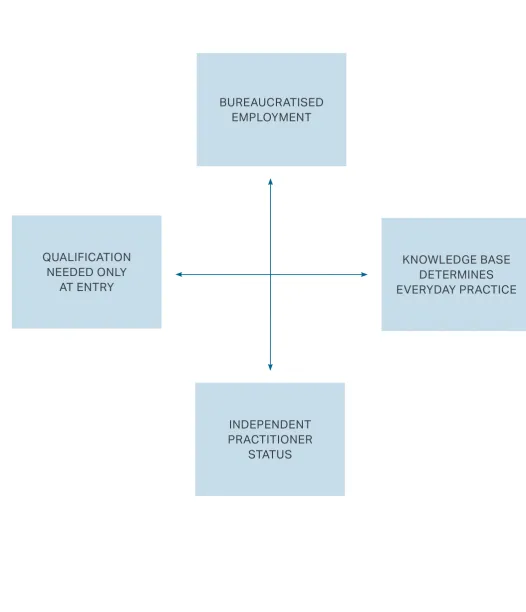
bureaucracy provides a further layer of regulation, specifying functions and best practice, and enforcing standards. These two dimensions – the salience of the professional body of knowledge and the extent of bureaucratisation – form a matrix in which the various professions can be located, as in Figure 1. There is obviously room for argument about precisely where each profession should be located. We leave it to readers to make their own judgments about where in the matrix they would locate teachers, for example, or lawyers, GPs, surgeons, engineers, architects and other
professionals. However, we hope that it is clear that different occupations belong in different quadrants. What is less clear is where the police would sit in the various prescriptions for professionalisation.
It is obvious where the police were located on the matrix in the past: in the top of the top-left quadrant. There was no requirement for any entry qualification, no conception that formal knowledge, rather than skill and craft, should guide front-line practice, and no expectation that front-line staff should operate fully autonomously. Of course front-line staff have always operated with considerable discretion, and one reading of the
hierarchical nature of policing is that it is precisely a system for regulating
discretion.
It remains unclear – at least to us – precisely where the current
professionalisation process will relocate policing on the matrix. It is clearly
intended to transform policing into a knowledge-based profession to some considerable extent. It can also be seen as part of a process for establishing what Holdaway (2017: 591) has called “a
hybrid, fragmented form of regulatory governance”, which will certainly distance the police service from the Home Office, and arguably loosen the grip of police force hierarchies on their workforces. The medical model of professionalisation, if that is to be followed, would certainly confer more autonomy on front-line staff – akin to GPs, who make significant treatment decisions by reference largely to the medical knowledge base. On the other hand, the sort of
FIGURE 1: STYLES OF PROFESSIONALISATION
BUREAUCRATISED EMPLOYMENT
INDEPENDENT PRACTITIONER
STATUS QUALIFICATION
NEEDED ONLY AT ENTRY
The authors of this report encourage the College of Policing to articulate more clearly the style of professionalisation it envisages, on these dimensions of hierarchical accountability and
professional knowledge. There may be a case for retaining some constructive ambiguity about this, because it remains unclear how far down the route to
evidence-based policy and practice the police service can realistically travel, and over what time period. Clearly it can make greater use of evidence, but defining the boundaries of policing’s professional body of knowledge – and filling the gaps within this boundary – is a significant undertaking that is likely to take decades. And the degree to which policing can be transformed into an evidence-driven institution in turn determines whether loosening of the hierarchical structure of police accountability is possible or desirable.
On the other hand, designing the shape of the entry level qualification, and the routes by which it may be acquired, does require some clarity, both about the relationship of the knowledge base to policy and practice and about changes envisaged in the
FIGURE 2: THE LOGIC MODEL AND THEORY OF CHANGE UNDERPINNING THE GRADUATE ENTRY PROGRAMME
Graduate entry:
Academic
degree
harnessed
and accelerates
learning /
training in
becoming a
Police Officer
in England
and Wales
Uplift approach to
recruit training and
integrate HEI content
to assure functional
equivalence of three
entry routes into
policing
Focus on police
Entry programmes cross-fertilise field and knowledge; iterative approach to the balance of field and learning; integrate police cultures within three entry routes; recruits use information and evidence to improve constable ways of working
Achieving independent patrol status; creating independent decision makers who can draw on best knowledge at beginning of career; foster high professional standards What does success look like?
Police officers are trained in EBP techniques and methodologies; knowledge is applied to everyday policing in a everyday context; uplift in police officers using EBP approaches;
Police training materials reflect evidence base; Recruits embed an approach to
policing that enables improvement in managing local problems;
Gaps in knowledge base of transmitting policing practice are continually identified and proactively addressed
Researching the value of a degree for police work
Clearly the remit for this research took as given that degree entry would confer considerable benefits on policing, and we were not asked to review the research evidence in support of this. Nevertheless we should say something about the supporting evidence. First, we should stress that there are different versions of the argument for graduate entry. One is that a degree qualification – regardless of subject – serves as a guarantee that the holder will have certain qualities, such as analytic skills and independence of mind. A more narrow claim, and one implicit in the PEQF, is that providing recruits with relevant skills and knowledge to degree level will help them do a better job. Secondly, research evidence in support of either proposition is unlikely to be clinching. Some differences are likely to be subtle, with the desired effects accruing in the long-term; and in the short-term, degree-holders have had to find their place in a workforce whose culture has not been positive towards higher education (Lee and Punch 2004; Silvester, 1989, Hallenberg and
Cockcroft, 2017). There is research, mainly from the United States and much of it dated, on the value of in-service acquisition of degrees. Paterson (2011), reviewing the 1970s American research, found graduate officers were less
authoritarian, less cynical, and behaved more ethically and professionally than non-graduates. This body of research concluded that it was not so much a particular course but the overall university experience that made the difference.
Paterson’s review of research in the 1990s found that graduate officers had improved knowledge of the criminal justice system, made better sense of managerial issues and were less likely to use coercive force.
On the other hand, in a separate review, Paoline, Terrill and Rossler, (2014) found few differences between graduate officers and others in terms of attitudes and professionalism, job satisfaction and stress, a conclusion supported by their own more contemporary study. They put the lack of difference down to the
overriding effects of socialisation into the police occupational culture, and graduate officers’ frustration at being assigned to low level policing tasks.
The safest conclusion to draw from the available research is that the outcomes of decisions about professionalisation and graduate entry are likely to be highly context-specific, and in particular that desired effects can be undermined by staff resistance – but that there are real potential benefits to be grasped by requiring a degree-level qualification at the point of entry into the police service.
Different professional knowledges: what counts as the policing evidence base?
In reality research evidence has charted the wider range of police functions, from tackling crime to public protection,
maintaining public order, and dealing with emergencies that need an immediate response. There is a growing but very incomplete body of knowledge derived from experimental research about what works best in discharging all these functions.
Overlaying this work is a more reflective body of academic research that offers various ‘theories of policing’ that
characterises how public order and the rule of law is best maintained.7 Abutting
this work are studies of the police as an
occupation, charting the policing culture(s) and exploring how best to secure organisational commitment and compliance (and all this leaves to one side the more scientific body of
knowledge associated with issues such as forensics).
The key point here is that the evidence base can be conceptualised as sitting on a continuum. At one end of the
continuum, it can be thought of as reliable
what works knowledge,8 formulated at a
high degree of granularity, that provides evidence-based solutions to the vast majority of problems that a patrol officer (or neighbourhood officer or detective) will encounter. At the other end of the continuum the core elements of the evidence base can be thought of as theories or perspectives that provide police officers with principles against
which they can test different solutions to the problems they have to tackle. This sort of knowledge will generally be more provisional and contestable than the highly granular knowledge that one might expect to find in a well-developed ‘what works’ warehouse, but with a much wider range of applicability. Our own view is that police too often want and expect the policing evidence-base to yield
unambiguous solutions to specific problems; whilst what they need is a set of well-thought-through principles from which they can derive the solutions they seek. The latter is severely lacking in police learning.
Whichever characterisation of research evidence is judged more appropriate for policing, both are in tension with the assumptions firmly embedded in current learning approaches for today’s police recruits. These assumptions are that policing is a craft, and that training police recruits in ‘what police do, when they do it, and how they do it’ is best done by former or serving police officers who hand on the knowledge in a practical apprenticeship. In this report we are making a distinction between ‘training’ and learning. PEQF, we suggest, requires learning strategies and learning
outcomes.
The PEQF gives HEIs a central role as a co-producer, together with police forces, of learning delivery and assessment of competence. The contribution that HEIs will make to the creation of innovative
6. https://www.nice.org.uk
7. Much of the sociology of policing from the 1960s and 1970s remains relevant, e.g., Banton’s work on police and community, Packer’s models of crime control and due process policing, and Bittner’s work on the functions of the police. More recent work such as procedural justice theory, is also of central importance.
approaches to useful principles and learning frameworks is not a simple ‘add and stir’ formula. Bringing academic approaches to learning in this new PEQF approach to police recruit induction to the profession will present challenges to HEIs and current police training centres who are more attuned to traditional models held by each. Both sets of learning professionals are not yet ready to translate operational craft or scholarly knowledge into grounded, blended
teaching and assessment. As this
research strongly suggests, for the PEQF to succeed, HEIs and police must collaborate on a novel hybrid approach to learning – one that grounds scholarly ‘what works’ knowledge into principles which guide new ways of thinking, decision making and practice.
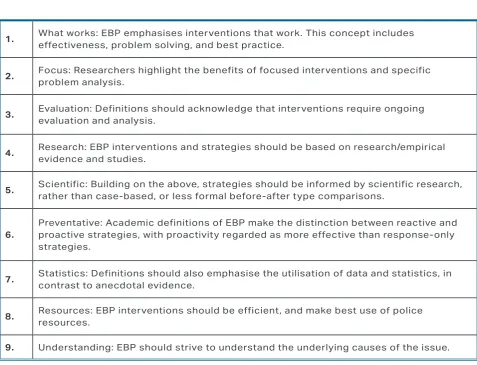
So at this critical juncture in the journey of PEQF, intelligent strategies are needed for blending into the curriculum the craft skills and professional knowledge of experienced officers with the more formal research evidence that is generated within universities and other research centres. This takes us to one of the golden threads – the introduction of EBP – that must be welded into the PEQF curriculums for police officer recruit entry. The College of Policing offers a definition of evidence based policing as a way of working that ‘creates, reviews and uses the best available evidence to inform and challenge polices, practices and decisions.’9 This approach
recognises both knowledge that is generated through collaboration with academics and other partners. It also recognises that evidence – such as professional consensus and peer review – may be regarded as the ‘best available’, if this is gathered and documented in a careful and transparent way.
Evidence based policing practice (EBP) is a required part of the curriculum for all entry routes to become a police
constable.
At the risk of oversimplification, the curriculum for the policing entry
qualification, regardless of which route is taken, will need to synthesise, in the right quantities, three rather different forms of evidence:
a. The practical craft knowledge acquired through experience and tested against professional judgment, held within the organisational culture and transmitted through the
organisation by formal and informal mentoring and training;
b. Where the research already exists, the experimental ‘what works’ evidence that addresses questions framed at a very granular level about
effectiveness and cost-effectiveness of different interventions;
c. Research that offers theoretical understanding, or perspective, on the police role, including theories of crime, victimisation and offending, that will guide officers in their problem-solving roles.
Under the PEQF, these three conceptions of evidence imply different approaches to teaching and learning, and how learning and development units approach the preparation of modules and materials covering ‘basic policing’. The
but does not privilege analytic ability and conceptual grasp of the nature of policing in the way that the third model does. Policing training, learning and
development has traditionally worked with model (a), although police
management now has quite a long history of engagement with research both in the hard and social sciences. The EBP
movement has given much more priority to the second type of evidence –
experimental evaluative research – and has tended to assume that this is the model applied in the archetypal
profession of medicine. Critiques of the experimental approach are numerous and sustainable: not enough Randomised Control Trial (RCT) knowledge as yet; limited sensitivity to context or
mechanisms; and insufficient recognition of problems of reflexivity/adaptation. The third sort of evidence fits in to a somewhat different model of evidence based practice, described well by Tilley and Laycock (2017) as the ‘engineering model’ of evidence based trial and error, which they see as highly applicable to policing.
Finding a test-bed for new knowledge: Police Now
Police Now (PN) is not a graduate conversion programme, but there are similarities between it and the proposed DHEP. Like the DHEP, PN trains graduates for a career in policing, using a different approach to traditional recruit training, and placing a greater emphasis on promoting an evidence-based approach to policing.
PN was designed, using the COP’s recruit training syllabus, to train outstanding recruits over a two-year period. It exists to ‘transform communities, reduce crime and increase the public’s confidence in policing’, and its aim is to recruit and develop ‘an outstanding and diverse group of individuals to be police officers and leaders, working on the front line and contributing to wider society’.10
The programme consists of an eight-week Summer Academy (SA) ‘designed and delivered by outstanding, high performing frontline police officers... it is underpinned by a comprehensive pre-learn course so that participants have the legal and procedural knowledge they need to hit the ground running as well as a period of one-to-one mentoring afterwards’. For the remainder of the
two-year training period, most PN recruits work in a neighbourhood policing team. Police Now describes the Academy as ‘innovative, dynamic, inspiring and challenging’. Police Now initially worked only with the Metropolitan Police Service (MPS), expanding to work with 7 forces in 2016, 19 forces in 2017, and 17 forces throughout England and Wales in 2018.11 The project has much to thank Police Now for in its willingness to be a test-bed for the ideas and challenges discussed in this report. None of these findings are meant to evaluate Police Now as a
programme. The curriculum for inducting recruits into policing is set by the College of Policing, adapted and applied by 43 police forces across the UK.
9. https://www.whatworks.college.police.uk
Police Now relies on the IPLDP curriculum in its current approach. The project team had frequent and continuous
conversations with various PN staff, and the findings of the studies were fed back routinely to PN over the course of the project. The project reported here
explores what the challenges are not only for Police Now, but for all the 43 forces across the country when they will transition to the PEQF curriculum.
The project
This project’s origins predated the College’s announcement of the PEQF. MOPAC, with UCL and Birkbeck as academic partners and Police Now as a key stakeholder, secured a grant from the Home Office Police Innovation Fund. Its aims were to: “Enhance the effectiveness and professionalism of police officers by developing and testing a syllabus to embed evidenced ‘what works’ knowledge on tactics and styles of policing into police recruit training.” Police Now agreed that its graduate entry programme could be used as a test-bed for research to enable the development of its syllabus to include a sharper focus on ‘what works’ evidence.
The College had started its consultation over the PEQF at about the time that the project formally began in Spring 2016, and it was clear at that point that the project would be particularly relevant to PEQF’s graduate entry route.
The College of Policing was a formal project partner; and progressively over the first few months, the project was reshaped to provide whatever support it could for the development of the DHEP, which is, in essence, a two-year graduate conversion course that will provide
existing graduates with a Level 6 Graduate Diploma in Professional Policing Practice.
Police Now remained a central stakeholder for the project, as the
graduate participants on its three cohorts have experiences and aspirations which are likely to be closely comparable to those enrolling in any graduate
The key elements were:
1. A rapid evidence assessment of what can be gleaned from other graduate conversion courses for the PEQF graduate entry route, supplemented by interviews with experts.
2. An international systematic review of what is known about effective police training methods.
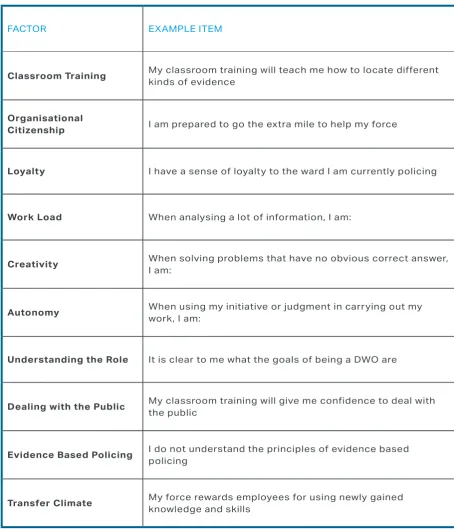
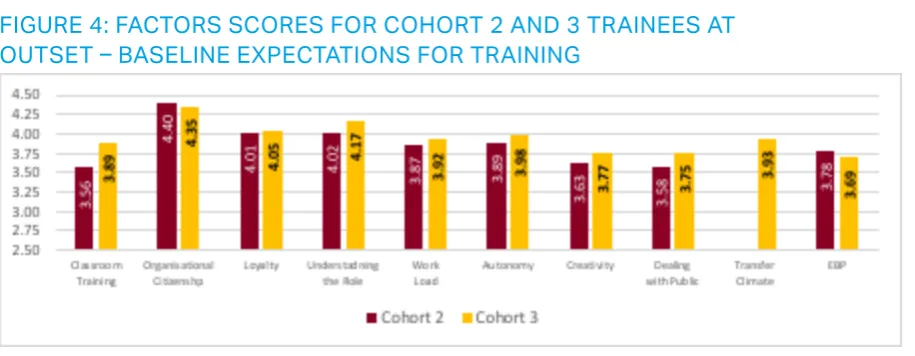
3. Completion by recruits of: a ‘tracker survey’, a psychometric instrument completed at three points in time during the course; a tool assessing recruits’ emotional intelligence; and an ‘evidence based policing toolkit’
assessing understanding of, and commitment to EBP.
4. In-depth qualitative interviews with Police Now participants in cohorts 2 and 3 of the programme,
complementing the quantitative material collected at (3), tracking progress on the course, assessing reactions to it, and levels of
commitment and satisfaction. 5. Interviews with Learning and
Development (L&D) Unit staff across the country to capture their understanding of the DHEP and their readiness to implement the significant changes to learning approaches required by the PEQF.
The shape of this report
This report is structured as follows.
Chapter 2 present the results of the rapid
evidence assessment on graduate conversion courses in other fields.
Chapter 3 summarises the results of the
systematic review about effective police training.
Chapter 4 deals with findings about
forces readiness to implement PEQF.
Chapter 5 uses three quantitative
monitoring tools to describe the experience of Police Now graduates.
Chapter 6 provides qualitative findings
on the experiences of Police Now graduates.
Chapter 2
The evidence
on conversion courses
This chapter presents the results of a rapid evidence assessment (REA) carried out by UCL, examining effective practice in graduate conversion courses for other occupations. The objective was to inform the development of this route in the PEQF. Fifty-one studies were identified and summarised. The main themes emerging from the review concerned:
• learning styles
• translating theory into practice • teaching methods
• assessment
• reflective practice.
Inclusion in the REA was based on three criteria: that the study should relate to a graduate conversion programme for a professional qualification for entry into an occupational role; should have some description of programme content, pedagogy, duration, modes of delivery, outcomes, trainee experience or
theoretical content; and should be in English.
Over half of the REA studies were from the United Kingdom (n = 30), mostly from England (n = 14). Research was
predominately within the teaching discipline (n = 40) with other studies relating to either law (n = 6) or social work (n = 5). Many of the conversion courses ranged between 36 weeks and one year (n = 29). Three courses were between 18 months or two years. Eighteen courses either did not provide any information or had a variable or unclear course length.
Cross-cutting sub-themes were: the use of information technology (IT) or virtual learning environments (VLE); collaborative learning. The REA
highlighted a number of more detailed questions worth examining in more detail, and e-interviews were conducted with seven people selected for their
knowledge of conversion courses in education, law and social work. The results are presented at Appendix A. A full report of the findings in this chapter is available from [email protected]
Course structure
Graduate conversion courses in teaching, such as the UK Postgraduate Certificate in Education (PGCE), tend to structure their practical training alongside the educational aspects of the course, with periods of university teaching
interspersed with periods of practical training. This training is most often in the form of ‘placements’ made possible through partnerships between schools and higher education institutions.
Teaching placements range from around 4 weeks to 24 weeks. The most common arrangement within the reviewed 51 studies specified that the teaching placement would comprise two thirds of the course (for example, 24 weeks of a 36 week course). The remaining studies examined shorter placements (for example, 12 weeks) or had variable arrangements. Graduate conversion courses for law tended to structure their courses as stand-alone training
preceding practical training. Hannibal and Pope (2005: 237) state that the Legal Practice Course (LPC) is “an intensive nine-month full-time
Therefore, the acquisition of professional skills and practical experience comes at a later stage in the process and is not included on the graduate conversion course for law. Most of the social work studies relating to graduate conversion programmes gave no details on course structure, but according to the ‘Evaluation of Social Work Degree Qualification in England’ Team (2008: 95) the
requirements for Social Work Training set the minimum standard for students as being at least 200 days in academic learning and 200 days in practical training, at either undergraduate or postgraduate level.
All these courses involve partnerships between training institutions and HEIs. Six of the studies made specific
reference to partnership arrangements. There are various partnership models, with some courses having informal arrangements, or arrangements in the early stage of development, and others having formalised partnerships. One study (Carter 2015) found that
partnership arrangements that follow the ‘clinical practice’ model are considered to be best practice, whereby students
spend sustained periods of time in the same policing setting under the
supervision of an experienced mentor. Furlong et al. (1996) differentiate three models of partnerships in teacher education: collaborative, HEI-led and separatist:
“In ‘collaborative’ partnerships, teachers and HEI tutors work together in planning and discussing professional issues. The process is characterised by a genuine search for shared understanding and mutual respect. In an ‘HEI-led’ partnership, assessment and the content of the
placement and planning is designed by
the HEI with, at most, consultation with small groups of teachers. In the ‘separatist’ model, each sector is seen to have its own responsibilities without any attempt at dialogue and with integration being achieved by the students themselves.”
Ideally, the REA suggests that graduate conversion courses should have
formalised partnership models in place between learning and development and HEIs that are collaborative and based on the ‘clinical practice’ model.
Learning styles
Graduate conversion courses need to acknowledge that applicants, as adult learners, come with a diverse range of educational and academic experiences and work or practical expertise. This should inform course design and the range of teaching methods used, as it is important to take account of the starting point of trainees. The literature on
learning styles stressed three key points: understanding that students learn in different ways and have different learning styles; the importance of acknowledging past learning and experiences; and taking into consideration prior perspectives and concerns. Students of graduate
conversion courses not only bring prior experiences, but also concerns and fears surrounding entering the workforce. Students starting initial teacher
education courses have different levels of knowledge, understanding and
experience about teaching, schools and pupils which may result in different causes of concern for students. It is important for courses, and educators, to provide opportunities for students to identify and address individual concerns so that they might develop as
The take away message is that conversion courses are designed for adult learners and must consider
individual learning styles of students as well as their prior experience,
preconceptions and concerns about the profession. One potential way forward, addressed later in this report, is for course tutors to identify these concerns and preconceptions about the profession early on and address them by focusing on the theory and conceptual knowledge underlying the practice elements of the profession.
Translating theory into practice
This theme refers to the relationship between the educational, academic or conceptual components of a course and its practical or field training aspects. While these two components are often referred to as separate entities, both are integral and (ideally) interconnected. The practical components of a course are the practical tools introduced in both the fieldwork and classroom settings, whereas the conceptual theoretical components involve the “conceptual tools which facilitate teachers framing and interpretations of practice, but they do not offer specific solutions for
practice” (Tang et al. 2016: 55). Within practically orientated professions, such as teaching, social work, or policing, there is a consensus that the practical
components of the courses provide students with the essential skills to be a competent professional. Furthermore, studies have shown that students tend to privilege the practical elements of the courses over conceptual or theoretical aspects, as this is where ‘job
preparedness’ is established. However, as outlined above, it is the conceptual or theoretical components of training that
inform these skills and provide the foundational guidelines that underpin practice. It is therefore essential that courses emphasise the integration of theory and practice, or devise innovative ways to translate what is learnt in the conceptual components of the course to the skills acquired during practical
components.
Theoretical components of a course stimulate higher order thinking, debate, theory building and discussion. Costello and Aung (2015: 590), discussing social work education in Myanmar, outlined that social work education is “guided by principles of social justice, human rights and ethical practice and their
development of critical thinking, reflection, and analysis of power,
inequality and disadvantage guides their practice”. This demonstration of how conceptual components guide ethical practices and alternative perspectives is particularly important for graduate
conversion courses, as students may come into the course with certain
perspectives or understandings, that new knowledge has the ability to challenge. This is referred to as conceptual change, which can be made possible when
“students feel dissatisfied with their current conceptions and have access to alternatives they perceive as intelligible, plausible and fruitful” (Wong et al. 2006: 2). Without these stimulating elements of conceptual learning, students are more at risk of succumbing to institutionalised professional culture and losing their enthusiasm: “without a robust theoretical knowledge, student-teachers are ill-equipped to resist institutional
This is not to say that students’ prior experiences are wrong, or need to be disproven, however it is important that prior learning is acknowledged,
alternative perspectives are offered, opportunities to reflect are built in, and tools are provided to translate attitudes, beliefs and values into actions.
The take away message is that the integration of the practical elements of training and the theoretical elements are achieved in order to ensure that the practical element, as it is considered to be indicative of job worthiness, is not privileged over the theoretical elements, which underpin the ethos of the
profession relevant to the context it is practised.
Teaching methods
Methods of teaching were noted by a majority of the studies. A wide number of teaching methods were discussed, all linked to different pedagogical theories. These included IT/VLE, the use of videos or video-papers,12 academic teaching methods such as exams and written assignments, peer review, lesson planning or lesson study, portfolios, critical incident analysis, oral
presentations, role play, blogs and interviews. Overall teaching methods ought to “promote cooperative, active, inquiry-based learning” (De Jong and Chadbourne 2007: 15), and utilise the best available evidence when it comes to innovative and diversified teaching
methods, utilising tools such as IT, and framing methods with pedagogical practice.
Where possible, it is important to shift focus away from the traditional
classroom-based model of teaching, and encourage collaborative learning and critical thinking through engagement between student and teacher as well as among peers. Methods of teaching must have “a strong emphasis on inclusion, active and participative learning, student empowerment and cooperative
approaches” (Ofsted 2005). Equally important is a diverse range of teaching and learning activities to stimulate interest and keep students engaged. Optimally courses should be designed around a blended model of face-to-face teaching and traditional lectures and tutorials with online, collaborative components. The main pedagogical practices in the literature were reflective practice, communities of practice, IT/VLE, peer learning and mentoring. These are discussed in more detail below.
The main take away message is that teaching methods ought to be innovative, engaging and appropriate for adults; should integrate theory and practice; encourage reflection, and include a diverse range of teaching methods in order to take into account students’ different learning styles.
Assessment
The evidence indicated that, like
choosing appropriate teaching methods, assessments of students should be based on pedagogical principles that incorporate a diverse mix of innovative methods. Aside from the necessary evaluation of student competence, assessment should also be a learning experience, have practical relevance and, as noted, be guided by pedagogical principles.
As outlined above, graduate conversion courses consist of the two essential components of theory and practice, both of which need assessment. When this is focused on the theoretical aspect, it should be closely linked to innovative learning methods; when addressing practical competency, it should be practically relevant.
As with effective teaching methods, measures of assessment ought to shift away from a heavy dependence on traditional methods (such as written assessments and exams), and
incorporate a diverse and innovative mix of assessments that promote learning and are practically relevant. As Roness and Smith (2010: 180) remark: “Students may get frustrated if they experience heavy demands for written assignments that lack relevance to their practical teaching”. Practices identified as effective for assessment that also encourage learning include: “effective questioning, sharing learning objectives and assessment criteria, providing
effective feedback about how to improve self-assessment and peer assessment” (Winterbottom et al. 2008: 194).
Studies provided several examples of effective methods of assessment. Portfolios, as both a teaching and
assessment method, reoccur as a tool for showing how students integrate theory and practice, reflect critically on their learning, and demonstrate the breadth and depth of their learning. Concept mapping, where students visually represent concepts and how they are linked together, has been shown as effective in measuring not only students’ content knowledge, but also for
“promoting and assessing conceptual change” (Reitano and Green 2013).
Assessing a student’s practical
competency is of equal importance. The most common method is observation of trainee professional performance.
The important take home learning from the evidence is that assessments, when used innovatively can both promote learning (assessment for learning) as well as evaluate student learning (Assessment of learning), especially if it encourages critical reflection.
Reflective practice
Reflective practice emerged as an integral theme across most of the included studies. Reflective practice is fundamental to producing competent professionals. The literature revealed that infusing graduate courses with reflective practice would produce a range of
benefits essential to enhancing the learning experience, integrating theory and practice and developing good practice, higher order thinking, and
professional development. Reflection can take place through a range of different tasks or observations. At the simplest level “these processes of reflection are often understood to be triggered through completion of various administrative and technocratic mechanisms”, for example planning lessons in teaching (Lamb and Aldous 2016: 100). However, the key to these reflective tasks is to engage with individual reflexive processes and employ a cyclical process of planning, practice, reflection and revision. Reflexivity can be understood as a “set of meaningful
processes in which the individual agent reaches a heightened point of awareness regarding their own reflective practice” and their understanding of how
Reflective processes should occur continually throughout education and training, in particular before, during and after practical placements, in order to ‘scaffold’ or continually build on
professional development. The different stages of reflection are referred to as reflection-on-action and reflection-in-action: “Reflection on-action can be defined as the self-evaluative thinking that teachers engage in after most lessons. Killen (2007: 96) regards reflection-on-action as a deliberate attempt by the teacher to understand past events in order to shape future actions” (Taloe 2012). Furthermore, reflection should occur both individually, and among peers as an outcome of collaborative learning.
The concept of reflection has been embedded in all themes that emerged from the qualitative synthesis, and while it is presented here separately, it is also a unifying theme throughout the literature on graduate conversion courses. Allowing time for reflection gives space for both students and trainers to consider how prior experience and learning styles will impact on the understanding of new knowledge. This space to reflect also helps develop the capacity to build on and integrate both old and new
knowledge and to translate theory into practice. As put forth by Lamb (2015: 344), “acknowledging uncertainties and complexities in practice and engaging in meaningful deliberation are necessary for generating insights and for interrogating one’s practice in a way that leads to sustained change”. This process of reflection is also an integral element of higher order thinking and critical thinking: ability to compartmentalise knowledge and draw on different forms of knowledge and experience in different contexts is the mark of a competent professional.
The message here about reflective
practice is critical to elevating training to learning, the central argument throughout this report.
The use of IT/Virtual Learning Environment (VLE)
VLE is a teaching method that featured in many studies as a tool to facilitate the teaching/learning process and foster reflective practices.13 Some examples of use included: online platforms such as Blackboard or Moodle, electronic
discussion boards, using videos or video-papers and blogs. Online platforms
create spaces for formal and informal interaction between students and
between the students and the tutor. It is also a useful tool for distance learning and can reduce isolation while students are on placement. Falloon (2012: 9) suggests that there is a “need to blend significant offline preparation with synchronous online interaction, so that what goes on in classrooms represents deeper, more meaningful learning, rather than shallow, superficial interaction”.
Collaborative learning acts
This is an umbrella term covering:
mentoring, communities of practice, peer learning and placements. These sub-themes are all examples of active engagement in the learning process between students and their peers or educators. While each of these sub-themes can be discussed as separate concepts, they are all linked by this
guiding principle of collaborative learning. Mentoring is a crucial element in the teaching and learning process. The role of mentors is to observe, guide, support, motivate and evaluate recruits. In