BIROn - Birkbeck Institutional Research Online
Coyle, A. and Heard, Catherine and Fair, Helen (2016) Current trends and
practices in the use of imprisonment. International Review of the Red Cross
98 (903), pp. 761-781. ISSN 1816-3831.
Downloaded from:
Usage Guidelines:
Please refer to usage guidelines at or alternatively
1
Current trends and practices in the
use of imprisonment
Andrew Coyle, Catherine Heard and Helen Fair
Andrew Coyle is Emeritus Professor of Prison Studies at King’s College, University of London and was founding Director of the International Centre for Prison Studies, which merged with the Institute for Criminal Policy Research at Birkbeck, University of London, in 2014.
Catherine Heard is Director of the World Prison
Research Programme at the Institute for Criminal Policy Research.
Helen Fair is a Research Fellow at the Institute for Criminal Policy Research working on the World Prison Research Programme and the World Prison Brief website.
Abstract
This article charts the rapid rise in the use of imprisonment in recent decades before considering some of the most pressing issues of concern in the use of imprisonment today. First among these is prison overcrowding, which continues to blight the record of many countries in their treatment of prisoners. To illustrate the potentially dire consequences of overcrowding – a problem common to many other countries and regions – an account is given of a recent visit to a prison in El Salvador. The article then provides an overview of the relevant regional and international standards on the treatment of prisoners, referring also to the role of judicial bodies in ensuring implementation.
Keywords: Prison, overcrowding, conditions of detention, prison populations, women
prisoners, use of imprisonment, criminal justice policy
* * *
[heading level 1]Introduction
Imprisonment is used as a tool of criminal justice policy in every country of the modern world. The World Prison Brief online database1 holds statistics on the prison populations of 223 independent countries and dependent territories.2
1 www.prisonstudies.org. The World Prison Brief was established by Roy Walmsley and launched by the
International Centre for Prison Studies in September 2000. Since November 2014 the Brief has been hosted by the Institute for Criminal Policy Research at Birkbeck, University of London. Prison statistics derive largely from national prison administrations or responsible ministries.
2 This article draws in several areas from comparative data compiled for the book Imprisonment Worldwide: The
2
Levels of imprisonment have risen rapidly in the post-war period, though more dramatically in some jurisdictions and regions than in others. There is striking diversity – in terms of geographic location, national population size and levels of development – among states at the highest and the lowest end of the incarceration scale. This makes it difficult to provide clear-cut explanations for trends and variations. Several inter-related socio-political and economic pressures – variously operating at national, regional and global levels – have contributed to today’s diverse picture of global imprisonment.
This article begins by charting the rapid rise in the use of imprisonment in recent decades – a rise more dramatic in some jurisdictions and regions than in others. First, a brief account is given of prison populations worldwide. Information is broken down by continent and region to provide a general picture of geographic spread for the general global prisoner population, remand prisoners and female prisoners. Trends in prisoner population growth since 2000 are then discussed. The second and final section is devoted to consideration of some of the most pressing issues of concern in the use of imprisonment today, many of these being particularly relevant to the ICRC’s work to uphold international standards and promote humanitarian principles in the treatment of detainees.
[Heading level 1]Imprisonment worldwide: A diverse and changing picture
In this section the authors give a brief account of prison populations worldwide and outline important recent statistical trends. The authors draw on data held on the World Prison Brief online database, which holds statistics on the prison populations of 223 independent countries and dependent territories.
The authors use the terms ‘prisoners’ and ‘prisons’ in a broad sense. The word ‘prisoners’ is used to refer to individuals who have been placed in custody by a competent judicial or legal authority having been convicted of one (or more) offence(s) and sentenced to custody or, alternatively, where a criminal case against them is being pursued but they have not yet been tried and convicted or definitively sentenced. It should be noted that this generic definition of ‘prisoners’ differs from the practice in some jurisdictions in which the word usually translated as ‘prisoner’ is used to refer only to those in custody after sentencing, while another word such as ‘detainee’ denotes those being held pre-trial and/or pre-sentence. In the present context our use of the terms ‘detainee’ and ‘detention’ similarly refer to custodial deprivation of liberty in this criminal justice context, whatever stage the proceedings have reached.
Clearly there are many contexts in which individuals can be detained by the state outside the criminal justice system or on a borderline where distinctions are blurred. Detention might relate to a person’s immigration status, their pending deportation, or a risk that they are deemed to pose to national security or military interests.3 In some countries, notably China,4
Press, 2016. Data on World Prison Brief are updated monthly and we would encourage readers to check the site for the most recent information available. World Prison Brief online database, available at:
http://www.prisonstudies.org/world-prison-brief-data.
3 It should be noted, however, that small numbers of non-criminal justice detainees are counted in prison
statistics in some jurisdictions.
4 China’s system of ‘Re-education Through Labour’, which saw large numbers of offenders administratively
3
relatively minor criminal offences and certain social, moral or political infractions are commonly dealt with through ‘administrative detention’, a system separate from mainstream criminal justice.5 In some states, detention is used for ‘treatment’ for drug dependency, or ‘protection’ due to some perceived vulnerability. All these categories of detention engage important fundamental rights questions, but are beyond the scope of the World Prison Brief database and are not addressed here.
[Heading level 2]Numbers incarcerated
Today, there are well over 10 million prisoners worldwide, of whom around half are in the United States of America, China, Russia and Brazil. The number is likely to be closer to 11 million, given that: (a) the World Prison Brief holds no prisoner statistics for Eritrea, North Korea or Somalia, because of the difficulty of accessing data on these states; and (b) it holds no data on some states’ remand or pre-trial detainees, most significantly, China’s (these data are not published).
This estimated 10 to 11 million does not include people detained in police or other administrative detention where there has been no formal decision to charge or prosecute. Time limits for police detention vary between jurisdictions, as do levels of compliance with them; there is often no routine recording of how many people are held in such circumstances. In view of the limited available data on this category of detainee, reporting on such data is beyond the scope of the World Prison Brief.
[Heading level 2]Breakdown by continent and region
Asia holds around 3.9 million of the world’s prisoners and the Americas about 3.8 million. In Europe there are around 1.6 million prisoners and Africa has around one million. The far smaller continent of Oceania has a total prison population of about 55,000.6
While these numbers give a sense of how unevenly distributed prison populations are globally, greater insight can be gained from prison population rates, usually measured by the number of prisoners per 100,000 of the national population.7 The median rate worldwide is 142. A comparison of the median rates of geographic regions reveals that five regions have a rate of over 200: namely, Northern America, Central America, South America and the Caribbean, plus Europe/Asia (encompassing Russia, Turkey, Armenia, Azerbaijan and
119; Office of the UN High Commissioner for Human Rights (2016), available at:
http://docstore.ohchr.org/SelfServices/FilesHandler.ashx?enc=6QkG1d%2FPPRiCAqhKb7yhslEE2YuVt8GA5 WKG3GEX%2BZEXqjnsVnWP%2BkQ6f9cmzWcEPJYdFWEXvIFmDTE3WtKbIKZXAKr5OVTwnh86Q4G NZXSmrqMf55xyaMPMcFusW3o2; Concluding observations on the fifth periodic report of China. Geneva; US State Department (2015) Country Reports on Human Rights Practices for 2014: China (includes Tibet, Hong Kong and Macau). Washington DC: US Department of State, available at:
https://www.state.gov/documents/organization/265540.pdf.
5 Administrative detention is usually understood to mean detention ‘ordered by the executive [where] the power
of the decision rests solely with the administrative or ministerial authority, even if a remedy a posteriori (after the event) does exist in the courts against such a decision’ (Louis Joinet, Rapporteur of the Sub-Commission on the Fight against Discriminatory Measures and Protection of Minorities, Report on the Practice of Administrative Detention, U.N. Doc. E/CN.4/sub.2/1989/27., cited in Open Society Justice Initiative (2014) I.
New York: Open Society Foundations, available at
https://www.opensocietyfoundations.org/publications/presumption-guilt-global-overuse-pretrial-detention, at page 13.)
6 Roy Walmsley, World Prison Population List, 11th edition. London, ICPR, 2016 at p. 14.
7 The prison population rates calculated for the World Prison Brief – and reported in this article – are based on
4
Georgia). By contrast, the regions of Central Africa, Western Africa, Southern Asia, Northern Europe and Western Europe all have median rates of under 100.
Countries with highest prison population rates
Country Prison total* population National population* Prison rate population
1. Seychelles 735 92,000 799
2. USA 2,217,000 317.8 million 698
3. St Kitts &
Nevis 334 55,000 607
4.
Turkmenistan 30,568 5.24 million 583
5. US Virgin
Islands 577 106,700 542
6. Cuba 57,337 11.25 million 510
7. El Salvador 31,686 6.44 million 492
8. Guam 797 170,000 469
9. Thailand 311,036 67.45 million 461
10. Belize 1,545 344,000 449
11. Russia 642,470 144.4 million 445
12. Rwanda 54,279 12.5 million 434
13. UK Virgin
Islands 119 28,000 425
14. Grenada 424 106,500 398
15. Panama 15,508 3.96 million 392
16. American
Samoa 214 56,000 382
17. St Vincent
& Grenadines 412 109,000 378
18. Cayman
Islands 205 54,600 375
19. Antigua &
Barbuda 343 92,000 373
20. Bahamas 1,396 385,000 363
*Figures for prison population total and estimated national population are based on data available in November 2015. See Coyle et al, Imprisonment worldwide: the current situation and an alternative future,
Bristol, Policy Press, 2016.
[Heading level 2] Remand prisoners
5
Pre-court: a decision has been made to proceed but investigations are continuing or the case is awaiting trial or other court process;
Trial: the case is being heard at court to determine guilt;
Pre-sentence: the offender has been convicted but awaits sentence;
Awaiting final sentence: the offender has been provisionally sentenced but this will only become final when appeal periods have expired and the sentence becomes definitive.
The World Prison Brief holds data on the remand populations of 216 jurisdictions. Remand data are unavailable for China and Rwanda (as well as for Eritrea, North Korea and Somalia, in relation to which no prisons statistics are available at all, and some other very small jurisdictions). Taking into account the missing data, particularly from China, it is likely that the total worldwide remand population is around three million. This means that over a quarter of the world’s prisoners are on remand.
Among the states with the highest proportions of remand prisoners, those that have recently experienced war and conflict feature highly, notably, Libya, where the available data suggest that up to 90% of the prison population are on remand. Liberia and the Democratic Republic of Congo have exceptionally high proportions of prisoners on remand. Another feature common among states with high remand figures is widespread poverty and inequality, often combined with over-stretched and under-resourced justice systems: examples include Paraguay, Haiti, Benin and Bangladesh, which all have proportions over 70%. In India, where 67% of prisoners are on remand, Dalits, Adivasis and Muslims are disproportionately represented.8
In many countries, remand prisoners make up a large proportion of the total prison population. Regions with strikingly high remand figures include: Central Africa (60%), Western Africa (56%) and Southern Asia (55%). The proportions are also high in the Caribbean, South America, Central America and Western Asia, regions with remand proportions of 40 to 50%. In contrast, in Central Asia, Eastern Asia, Northern Europe, Europe/Asia and Central and Eastern Europe, less than one-fifth of prisoners are on remand. The worldwide median is 27%.
Unfortunately, data showing the lengths of time for which people are held on remand are generally not collected or published in any systematic way. Research suggests that remand prisoners are typically detained for excessive periods (often out of all proportion to the sentence they would receive if found guilty) in countries with larger proportions of remand prisoners. In India, the proportion of prisoners who have spent more than three years on remand is estimated to have doubled since 2000.9 In Nigeria (where nearly 70% of prisoners are awaiting trial), half the country’s pre-trial detainees had been detained for between 5 and 17 years in 2010, with some detained for up to 20 years.
[Heading level 2] Female prisoners
The World Prison Brief has information on female prisoner numbers for all countries on which it has national prison population data except Cuba and Uzbekistan. The total number
8 Amnesty International, Amnesty International Report 2015/16: The State of the World's Human Rights,
London, Amnesty International, 2016 at p. 185.
9 National Crime Records Bureau, Prison Statistics India 2000, New Delhi, NCRB, 2002; National Crime
6
of women in prison currently stands at about 700,000 – meaning that women make up less than 7% of the total worldwide prison population. The proportion grew from 5.4% in the year 2000 to 6.8% in 2015.
Of the states with the biggest proportions of women prisoners, Eastern and South Eastern Asian states predominate. Hong Kong tops the list with around 21%. Also high on the list are Qatar (15%), Kuwait (14%) and the United Arab Emirates (11%). One major factor here is these states’ harsh enforcement and sentencing policies for drug offences; particularly the harsh sentencing of low-level trafficking offences which has a disproportionate impact on women offenders.10
[Heading level 2] Trends
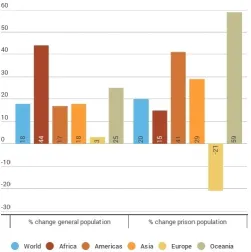
Between the years 2000 and 2015 the world prison population total increased by almost 20%, slightly above the estimated 18% increase in the general population over that period. Europe is the only continent whose total prison population fell during this period (though Europe’s share of women prisoners increased). The world’s female prison population increased by 50% over this period, and its male prison population by 18%.11
There are considerable differences between trends across continents, and much variation within continents, over this fifteen year period. Some key points are discussed below.
[Heading level 3] Africa
Africa’s overall prison population has increased by 15% since 2000, while its general population has increased by 44%. While having the lowest median prison population rate of all continents, 77, Africa displays great variation across its regions: by way of the starkest examples, the median rate is 52 in Western Africa and 188 in Southern Africa. The picture for Africa as a whole is complicated by the effect of Rwanda’s genocide prosecutions, which pushed the number of prisoners to a peak of 145,000 in 1998 and the prison population rate to 1,947. Despite having since adopted measures to reduce prisoner numbers, Rwanda still has the second highest prison population rate in Africa (434),after the small island nation of the Seychelles. Notable among African states for reducing prisoner numbers is Botswana, which adopted alternatives to custody to relieve severe prison overcrowding. Botswana’s prison population rate dropped from 325 (in 2008) to 190 in 2015 - its lowest recorded level in 30 years.
[Heading level 3] The Americas
The Americas have 3.8 million prisoners – nearly 40% of the world’s total prison population, despite having only 14% of its general population. Since 2000, prison populations have sharply increased across the continent, most dramatically in South America.
The United States of America remains the starkest example of this continent’s disproportionate use of prison: it has 4.3% of the world’s general population but 21% of its
10 Increasingly punitive sentencing of drug offences, and particularly lower-level drug offences, is widely seen
as a major driver of women’s imprisonment (see United Nations Office on Drugs and Crime (2014) Handbook on Women and Imprisonment (2nd Edition),Vienna, UNODC; Penal Reform International 1989-2014: 25 years of promoting fair and effective criminal justice worldwide, London (2015), Penal Reform International).
7
prisoners. The upward trend started in the 1970s, and became more marked over the 1980s and early 1990s. This was followed by a period of slower growth up to 2008 when the prison population peaked at over 2.3 million. Since then the numbers have fallen year on year in the face of mounting evidence of the harms of mass incarceration, and their disproportionately impact on America’s black population. On 31 December 2014, 6% (or one in 17) of all 30 to 39-year-old black men were in prison, compared to 2% of Hispanic and 1% of white men in the same age group. Underlying the growth in levels of incarceration were ever tougher sentencing policies, leading to: prison being used more frequently; terms becoming longer, notably for drug offences; mandatory minimum terms; and reduced opportunities for parole. Driven in part by fiscal constraints, steps have been taken towards reform over the past 15 years. These include a loosening of mandatory sentencing provisions and the expansion of community-based alternatives to custody. Recent falls in the United States’ prison population rate reflect large declines in prisoner numbers in the populous states of New York (from 1999), California (from 2006) and Texas (from 2010).
The total prison population of Central American countries has risen by more than 80% since 2000, led by El Salvador, whose prison population rate is now the seventh highest in the world. The country has a very high homicide rate and significant gang-related conflict. The authors return to discuss El Salvador in the following section.
In South America, the biggest contributor to the region’s increased prison population is Brazil. Now at over 600,000 (up from 230,000 in 2000), Brazil’s is the world’s fourth largest total prison population. Its prison population rate has more than doubled, driven mainly by tougher drug laws. Numbers incarcerated for drug trafficking increased fourfold between 2005 and 2013 and are estimated to represent about 25% of all Brazil’s prisoners.12 The country’s judicial and prisons systems exhibit various problems (by no means exclusive to Brazil): racial disparity in numbers prosecuted and sentenced; prison overcrowding; and inefficiencies in the judicial process.1314
[Heading level 3] Asia
With around 3.9 million prisoners across the continent, Asia is on a par with the Americas, but its general population is more than four times greater. The median prison population rate of Asian jurisdictions is comparatively low, at 121. One striking feature is the high proportion of women prisoners.
The trend across most Asian states has been upwards since the 1980s. Most notably, Thailand’s prison population of nearly 290,000 is the sixth largest in the world and its prison population rate is the tenth highest, at 428. Again, tough drugs policies underlie this, including extremely long sentences for more serious drug offences. Thailand’s high proportion of female prisoners, at 13.6%, is one consequence – 85% of Thailand’s women prisoners are held for drug offences.15 Thailand has tried recently to curb prisoner numbers by controlling numbers held on remand, granting royal pardons, and expanding available alternatives to imprisonment.
12 Telesur “Brazil’s Supreme Court to Discuss Drug Decriminalization” 19 June 2015
13 US State Department (2017) Country Reports on Human Rights Practices for 2016: Brazil. Washington DC:
US Department of State.
14 Further discussion of the overuse of imprisonment in Brazil and in Latin America more widely can be seen in
the article The crisis of detention and the politics of denial in Latin America at ppxx of this issue
8
India has the lowest prisoner population rate in Asia and this has remained fairly stable, having risen from 21 in 1993 to 33 in 2015. The country still has nearly 420,000 prisoners, however, the majority are held on remand as discussed above.
[Heading level 3] Europe
Europe has 15% of the world’s prisoners, and 12% of the world’s general population. This is the only continent whose total prison population has fallen since 2000, with the most significant reduction having been in Russia. There, criminal justice reforms were introduced in the 1990s to reduce the use of imprisonment and promote alternatives. Russia’s prison population rate remains high, however, at 436. Finland, too, has brought its prison population down significantly (from a high of 187 in the 1950s to 55 today). This was the result of reforms designed to make greater use of community and suspended sentences and reduce custodial terms.
In Turkey, an increasingly punitive justice system has seen the opposite trend since 2000, leading to a threefold increase in the prison rate. In England and Wales the years 1993 to 2012 saw the total prison population almost double from under 45,000 to almost 87,000, while the prison population rate steadily climbed to a high of 153, due largely to more convicted offenders being sentenced to immediate custody, to custodial terms growing longer and to a reduced use of early conditional release. Several European states have greatly reduced their remand populations since the 1990s, including by greater use of electronic monitoring, bail and other conditions. This has helped drive Europe’s overall prison rates down.
[Heading level 3]Oceania
9
Figure 1: % change in general population and prison population totals, 2000 to 2015: entire world and continents. See Coyle et al,, Imprisonment worldwide: the current situation and an alternative future, Bristol, Policy Press, 2016.
[Heading level 1]Current and emerging issues of concern
Having presented the data on changes in the use of imprisonment worldwide since 2000, the authors now turn to consider some of the most pressing issues of concern, some of which are long standing and affect many prisoners, notably, overcrowding and the resultant poor conditions and health risks, while others are more recent and affect specific groups of prisoners. These issues include the over-representation of foreign nationals and other minority groups in prison populations, and concerns about how to manage higher risk prisoners and about the need to prevent violent extremism from spreading in prisons.
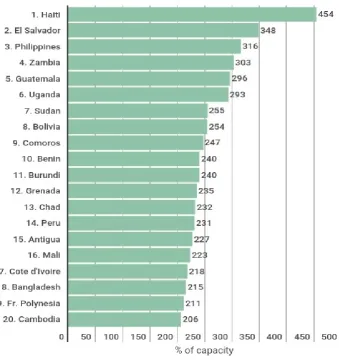
We devote our attention here principally to the problem of prison overcrowding, the consequences of which are graphically illustrated by a case study describing conditions in a Salvadoran prison visited by one of us in 2016. Overcrowding continues to be a severe blight on the record of many countries in their treatment of prisoners, with 116 countries having prison occupancy rates of over 100 per cent. Particularly concerning are Haiti, which has over 400 per cent overcrowding; and the Philippines and El Salvador, which have over 300 per cent.
[Heading level 2]Occupancy levels and overcrowding
10
are held in each cell and the administration will decide what it considers to be an appropriate number, based on a variety of disparate factors such as the number of sleeping spaces which can be provided in the space available. Multiple occupancy can vary between the situation in which two persons share one room to conditions in which a hundred or more are held prisoners in large dormitories.
For the purposes of this article it is important to point out that while official occupancy figures may give some indication as to whether a prison is overcrowded they are unlikely to provide a definitive measure. It is probable that a prison which holds more prisoners than its official capacity will be overcrowded. The World Prison Brief details occupancy levels for national prison systems. A prison system may have an overall occupancy rate below 100 per cent but might include individual prisons that exceed their capacity, some of which are severely overcrowded. Similarly, a system in which the overall occupancy rate exceeds the spaces available may well include individual prisons that do not exceed their official capacity.
For the most part the official capacity of each prison system is set according to criteria determined by the country concerned and in many instances this will not be dictated by the amount of living space available for each prisoner. There is no internationally accepted minimum standard for the physical space which each prisoner should have for living accommodation. However, in recent years a number of international bodies have specified the minimum living space that should be provided for each prisoner. For example, the Council of Europe Committee for the Prevention of Torture has published standards on ‘living space per prisoner in prison establishments’.16 These are six metres square for a single-occupancy cell and four metres square per prisoner in a multi-occupancy cell. The International Committee of the Red Cross has recommended that 5.4 metres square should be allowed per person in single cell accommodation and 3.4 metres square in shared or dormitory accommodation, including where bunk-beds are used.17
Allowing for all these nuances, in broad terms it is generally safe to conclude that there is likely to be overcrowding in any prison system which has an occupancy rate of over one hundred per cent; and the higher the rate, the greater the level of overcrowding. According to the latest data available on World Prison Brief18 a total of 116 countries have prison occupancy rates of over 100 per cent. Haiti has the highest rate of overcrowding in the world at 454 per cent, followed by El Salvador at 348, the Philippines at 316 and Zambia at 303. A further 18 countries have over 200 percent; and an additional 97 have over 100 per cent overcrowding.19
16 Committee for the Prevention of Torture. Living space per prisoner in prison establishments: CPT standards,
Strasbourg, Council of Europe at p 1, 2015.
17 International Committee of the Red Cross, Water, Sanitation, Hygiene And Habitat In Prisons:
Supplementary Guidance, Geneva, ICRC, 2012, at p. 33.
18 World Prison Brief, “Highest to Lowest – Occupancy level (based on official capacity)”, available at
http://www.prisonstudies.org/highest-to-lowest/occupancy-level?field_region_taxonomy_tid=All accessed at 13.07.17
11
Figure 2: Countries with highest occupancy rates. Figures from World Prison Brief, “Highest to Lowest—Occupancy level (based on official capacity)”, available at:
http://www.prisonstudies.org/highest-to-lowest/occupancy-level?field_region_taxonomy_tid=All#tabletop .
[Heading level 3]The consequences of overcrowding: A case study
One example of what overcrowding can mean in practice is to be found in the prisons of El Salvador. El Salvador was chosen because, as noted above, it now has the second highest occupancy rate in the world: the shocking consequences of this are clear from the case study. One of the authors of this article visited El Salvador in 1999 and again in 2016 and was therefore able to observe at first hand some of the consequences of the overcrowding and shortage of resources in the country’s prisons.
In 1999 there were 7,500 prisoners in El Salvador. According to the Directorate General of Prisons, at the end of January 2017 the number of prisoners was over 37,000, almost a fivefold increase.20 None of the financial, personnel or accommodation resources in the prison system has had anything approaching comparable increases.
12
As a result of the overpopulation many prisoners are accommodated in very large factory-like buildings with minimal facilities. Few beds are provided and numbers of prisoners sleep on makeshift bedding on the floor. The roof struts and upper fencing are festooned with rudimentary hammocks where prisoners perch perilously. The staff presence in the accommodation units is minimal, meaning that the gang leaders in each unit exercise their own authority over other prisoners.21 Prisoners have to pay for many of the basic necessities of life, including space to sleep.
For a number of years the government has imposed what it terms ‘exceptional measures’ in prisons, part of the official policy of using a ‘heavy hand’ (mano dura) in its efforts to control the influence of gang members both in the prisons and in civil society22. These measures involve holding some prisoners in particularly repressive conditions. In a prison which the author visited in 2016 one section included a number of small cells with very little natural light provided through the grilled gates onto the corridor which fronted the cells. Each cell held up to 20 prisoners who were obliged to stand or crouch most of the day because of shortage of space. Pieces of cloth and rope were strung from the ceiling to provide makeshift hammocks. According to the prisoners they were allowed out of the cells for a short period once every one or two weeks to walk in a tiny yard area abutting the living accommodation. Visits were not allowed.
The conditions in these cells were reminiscent of what the UN Special Rapporteur on Torture found when he paid his first visit to Russian prisons in 1994 and observed graphically that he ‘would need the poetic skills of a Dante or the artistic skills of a Bosch adequately to describe the infernal conditions he found in these cells’23. Conditions such as these carry other serious dangers, not least as regards the health of the prisoners, and one of the greatest of these risks is the inevitability of infectious diseases. It is no surprise that this danger is now being realised in the prisons of El Salvador. In the latter part of 2016 the authorities carried out a tuberculosis screening exercise in prisons which were under the ‘exceptional measures’. The results of the screening have not been published but the indications are that there has been a dramatic increase in the prevalence of tuberculosis in these prisons. Infectious disease is not a respecter of prison walls and if this epidemic is not halted urgently there will be a real danger to public health outside the prisons, as was the case in a number of prisons in countries of the former Soviet Union throughout the 1990s.
The shocking conditions in Salvadoran prisons are by no means unique. In Latin America there are similarly drastic environments to be found in prisons in Brazil,24 in Venezuela25 and in Honduras.26 In Africa inhuman conditions exist in countries such as South Africa,27
21 See Sonja Wolf, “Central American street gangs: their role in communities and prisons”, European Review of
Latin American and Caribbean Studies, Apr 2014, Vol. 96, pp.127-14; Chris Van der Borgh and Wim Savenije, “Desecuritising and re-securitising gang policies: the Funes government and gangs in El Salvador”, Journal of Latin American Studies, vol. 47, no. 1, pp. 149-176..
22 See, for example https://sustainablesecurity.org/2011/03/01/mano-dura-gang-suppression-in-el-salvador/ 23 United Nations Economic And Social Council, Question Of The Human Rights Of All Persons Subjected To
Any Form Of Detention Or Imprisonment, In Particular: Torture And Other Cruel, Inhuman Or Degrading Treatment Or Punishment: Report Of The Special Rapporteur, E/CN.4/1995/34, 12 January 1995.
24 See, for example,
https://www.washingtonpost.com/news/morning-mix/wp/2017/01/18/grisly-gang-massacres-sweep-brazils-prisons-100-inmates-killed-in-recent-weeks/
25 See, for example, http://www.mirror.co.uk/news/world-news/prisoners-left-die-concentration-camp-9016760 26 See, for example,
http://www.insightcrime.org/news-analysis/honduras-prisons-put-inmates-at-risk-fuel-gang-violence-oas
27 See, for example,
13
Nigeria28 and Malawi.29 In Asia there has been severe criticism of prisons in several countries. In relative terms physical conditions in prisons in Europe are generally not so extreme, yet there can be no room for complacency as can be seen from even a cursory study of the judgements of the European Court of Human Rights on violations of the European Convention of Human Rights in prisons in the 47 member states of the Council of Europe.30 When giving evidence to a United Kingdom parliamentary committee in January 2017 the independent chief inspector of prisons for England and Wales was asked ‘what is wrong with our prisons?’ His reply was trenchant: ‘Basically, they are unsafe; they are full of drugs; we have an ageing population; the physical environment is appalling; and there are far too many people in our prisons who are suffering from mental health issues’.31
Other critical and topical issues
In respect of the way that imprisonment is used today in many countries there are a number of issues which have become particularly critical in recent years.
[Heading level 3]Race and ethnicity
In virtually every country on the world minority groups are over-represented within prison walls. One obvious example of this is in respect of race and ethnicity. The situation in Australasia demonstrates this fact. In Australia, for example, Aboriginal and Torres Strait Islanders make up 27 per cent of the prison population despite the fact that they constitute only some two per cent of the adult population32. This proportion varies from state to state, with eight per cent in Victoria in contrast to 84 per cent in Northern Territory 33. In New Zealand 15 per cent of the country’s population identify with Māori ethnic groups but they constitute almost 51 per cent of the prison population with another 11.3 per cent of prisoners being Pacific People34. A similar disproportion is to be found in Canada where aboriginal people account for only three per cent of the adult population but make up 24 per cent of admissions to provincial and territorial correctional services and 20 per cent of sentenced admissions to federal institutions.35
Similar disparities exist in the United States of America. The overall rate of imprisonment in the United States is 698 per 100,000 of the population; however, within this total figure there is a considerable racial disparity. The rate of imprisonment for white males is 465 per 100,000, while that of black males is 2,724 and that of Hispanic males 1,090 per 100,000. In addition, official figures also show that black females are significantly more likely to be imprisoned than white females.36 In total 13 per cent of the national population is African
28 See, for example, http://www.leadership.ng/news/548537/awaiting-trial-inmates-figure-hits-72
29 See, for example,
http://www.news24.com/Africa/News/hunger-reduces-prisoners-to-living-skeletons-in-malawi-20160912
30http://hudoc.echr.coe.int
31 Justice Committee Prison Reform Inquiry Oral Evidence 31 January 2017, HC 548, available at
http://data.parliament.uk/writtenevidence/committeeevidence.svc/evidencedocument/justice-committee/prison-reform/oral/46581.html.
32 Australian Bureau of Statistics, “Prisoners in Australia, 2015”, Canberra, ABS, 2015. 33Ibid.
34 Office of the UN High Commissioner for Human Rights “Statement at the conclusion of its visit to New
Zealand (24 March – 7 April 2014) by the United Nations Working Group on Arbitrary Detention”, available at http://www.ohchr.org/EN/NewsEvents/Pages/DisplayNews.aspx?NewsID=14563&LangID=E.
35 Statistics Canada, “Adult Correctional Statistics in Canada, 2013/2014,”
https://www.statcan.gc.ca/pub/85-002-x/2015001/article/14163-eng.htm#a8
14
American whereas 37 per cent of the male prison population comes from this ethnic grouping. A similar phenomenon exists in England and Wales where Black, Asian and Minority Ethnic individuals make up 14 per cent of the national population but account for over a quarter of all prisoners. In 2010 the United Kingdom Equality and Human Rights Commission reported that the disproportion of black people in prison in the United Kingdom is higher than that in the United States of America.37
There is not space in this article to analyse in detail the reasons for these striking disparities but it is important to point out that answers will not be found solely within the world’s criminal justice systems. Rather, the disparities underline a wider reality, which is that in many countries prisons are populated largely by men and women who are at the margins of society, socially, economically, culturally and, in this case, racially and ethnically.
[Heading level 3]Foreign nationals
Given the globalised nature of the modern world and the increasing international movement of peoples it is unsurprising that these phenomena are increasingly reflected in prison populations in many countries, which now have a significant proportion of foreign national prisoners. Available data from the World Prison Brief show that prisoners of foreign nationality now make up over 10 per cent of the prison population in 63 jurisdictions, with 29 of these in the greater European region.38 The term ‘foreign national’ covers a wide range of different circumstances. It may apply to those who have come from their home country and are then convicted and imprisoned in another country. It can also apply to those who have had a long relationship with the country in which they are imprisoned and may even be permanently resident but do not have citizenship of that country. It may apply to those who are imprisoned for immigration or other civil reasons rather than under criminal law.
Special provision may have to be made for foreign national prisoners in a variety of matters. In terms of legal safeguards they may require access to their home country’s diplomatic representatives as set out in the Vienna Convention on Consular Relations.39 If they do not speak or understand the language of the country in which they are being held both they and the prison administration may need assistance from interpreters. If their families remain in their country of citizenship there may have to be special arrangements to enable them to keep in contact.
There is a variation of this issue in several countries, for example, in Central America where prisoners have never lived in their country of citizenship but have been brought up and perhaps even been born in another country, for example, the United States of America. Having been imprisoned initially in the second country they are then deported back to their country of citizenship even though their social and family links with that country may be tenuous at best.
[heading level 3]Violent extremism
37 Equality and Human Rights Commission, How fair is Britain? Equality, Human Rights and Good Relations in
2010, London, EHRC, 2010.
38 World Prison Brief, “Highest to Lowest – Foreign Prisoners (percentage of prison population), available at
http://www.prisonstudies.org/highest-to-lowest/foreign-prisoners?field_region_taxonomy_tid=All accessed at 13.2.17
39 Vienna Convention on Consular Relations, 596 UNTS 561, 24 April 1963, (entered into force 19 March
15
For the last two decades there has been concern in a number of jurisdictions about the danger of violent extremism spreading in prisons. In recent years the focus of attention, particularly in Europe, has been on so-called Islamist extremism. In other countries there has been concern about far right extremism, while elsewhere the concern has been for prisoners who hold political views which are at odds with the governing authorities. For centuries prisons have been used to detain persons who have been convicted of violent extremist behaviour based on political opinions or religious beliefs and prison administrations have managed the detention of these prisoners in a variety of ways. Some of the official responses to violent extremist prisoners have themselves violated international and domestic law.
Some countries use the description ‘violent extremism’ in preference to ‘radicalisation’, since the latter term can be subject to different interpretations. A violent extremist is someone allied to a group which spreads radical views and justifies the use of violence or illegal conduct in pursuit of its objectives. This definition is a generic one, which needs to be further distilled. At the top end it is likely to include a small number of key plotters and planners, including those whose ambition is to radicalise other prisoners. At the next level down there will be a group who include those who facilitate the work of other extremists, who may provide or have access to finance or who are dedicated followers. A third level spreads out to include followers in the wider prison population, who may be less committed. After them come those who are on the margins of the group but open to being attracted to it. Finally, there will be some who are vulnerable, either psychologically or for other personal reasons, and who may seek companionship in the group. The distinction among these groups needs to be recognised and different tactics need to be developed to deal with them. One thing which needs to be avoided is to regard them all in the same light and to deal with them as a homogenous group.
There is now extensive case law, a raft of reports from international inspection bodies as well as rigorous academic studies on how states and other official parties can deal with violent extremism in prisons in an efficient and humane manner.40
[heading level 3]Increasing use of very high security imprisonment for particular groups of prisoners
A small number of prisoners may be so dangerous and disruptive that they have to be held apart from the general prison population, even in high security prisons. The care and control of these prisoners needs to be carefully structured in a way which observes the general principles of good prison management. Solitary confinement should only be used as a last resort and only in extreme cases. Where its use is deemed necessary it should be used for short periods and be managed within established guidelines and strict safeguards.41 There is a growing international consensus that the isolation of individuals in conditions of solitary
40 See, for example, UN Office on Drugs and Crime Handbook on the Management of Violent Extremist
Prisoners and the Prevention of Radicalization to Violence in Prisons, 2016; The International Centre for the Study of Radicalisation and Political Violence Prisons and Terrorism: Radicalisation and De-radicalisation in 15 countries (2010) ; Tinka Veldhuis Prisoner Radicalization and Terrorism Detention, Routledge, 2016.
41 Sharon Shalev A Sourcebook on Solitary Confinement, LSE, 2008
16
confinement should not be imposed for longer than 15 days.42 There are generally other options for the management, even of highly dangerous prisoners.
As a general rule, high security conditions should only be used where a prisoner’s behaviour means that a less restrictive regime would be inappropriate and would pose a direct threat to safety and security. Time spent in such restrictive conditions should be the minimum possible and should be subject to continuous review.
In well managed prisons there will be a balance between security, control and justice. The premise that treating prisoners in a humane and just manner will lead to a reduction in security and control is quite wrong. On the contrary, prevention of escapes and the maintenance of control and good order can best be achieved within a well ordered
environment. Prison systems which restrict the use of very high security conditions to the minimum necessary are likely to be safer for both prisoners and staff.
In recent years it has been suggested in some quarters that there is a new type of prisoner who is so dangerous and such a threat to society that they will require to be held in isolation for lengthy period of time, in some cases for their natural life. This is a dangerous assumption. Jurisdictions across the globe have been faced with the issues of how to deal with individuals who face a serious and continuing threat to the state over long periods of time, and they have always been required to do so within the parameters of domestic and international law. The way in which such prisoners are held and treated is one of the greatest tests of a professional prison system. Failure to treat them decently and humanely is wrong on a number of levels. It is wrong as a matter of principle and in respect of the way a professional prison
administration should conduct itself. It also breaches the requirements of a democratic state.
[Heading level 2]International and regional standards
Over the last fifty or more years a comprehensive set of standards has been established defining what is required to ensure that prisoners and other detained persons are held in conditions which are decent and humane. These standards are grounded in a set of clear principles which can be applied in all countries and which have been agreed by the international community, usually through the United Nations.
Key among these are the International Covenant on Civil and Political Rights43 and the International Covenant on Economic, Social and Cultural Rights. States which have ratified or acceded to these treaties are legally bound by them.
In addition to the over-arching international human rights standards, there are also a number of instruments which deal specifically with prisoners and the conditions in which they are held. Key among these are the Standard Minimum Rules for the Treatment of Prisoners (1957) updated as the Nelson Mandela Rules (2015),44 and the United Nations Rules for the Treatment
42See, for example, Solitary confinement should be banned in most cases, UN expert says
http://www.un.org/apps/news/story.asp?NewsID=40097#.WgHnh1u0OUk ; Liberal Government to impose 15-day limits on solitary confinement https://beta.theglobeandmail.com/news/national/liberal-government-to-impose-15-day-limits-on-solitary-confinement/article35369982/?ref=http://www.theglobeandmail.com&
43http://www.ohchr.org/EN/ProfessionalInterest/Pages/CCPR.aspx
17
of Women Prisoners and Non-custodial Measures for Women Offenders (the Bangkok Rules, 2010).45 The international standards are supported by regional instruments such as the European Prison Rules (2006).46
The extent to which individual states implement the international standards can be seen through the work of regional judicial bodies such as the European Court of Human Rights and the Inter-American Court of human rights. In addition, conditions of detention in the member states of the Council of Europe are monitored by the European Committee for the Prevention of Torture and Inhuman or Degrading Treatment or Punishment,47 and in 1997 the African Commission on Human and People’s Rights appointed a Special Rapporteur on Prison Conditions. 48
In 2002 the United Nations adopted the Optional Protocol to the Convention against Torture.49 This entered into force in 2006 and established a system of regular visits to places of detention by a sub-committee appointed by the UN Committee against Torture (SPT), complemented by sustained regular visits conducted by national independent inspection groups known as National Preventive Mechanisms.
A full list of the international and regional human rights standards relating to prisons and the use of imprisonment can be found in ICPR’s recent publication Imprisonment Worldwide: The Current Situation and an Alternative Future.50 Further details on how the standards can be practically applied in the prison setting can be found in the text A Human Rights Approach to Prison Management: Handbook for Prison Staff (second edition, 2009),51 a third edition of which will be published in early 2018.
While the international and regional standards form a broad framework on how prisoners should be treated and the conditions in which they should be kept, the extent to which states comply with these standards varies widely. Pressures which can undermine a state’s
compliance include a lack of resources, the over use of imprisonment, a lack of political will, outdated legislation and weak monitoring systems. The United Nations Office on Drugs and Crime makes clear that
“Prison authorities have a responsibility to ensure that the supervision and treatment of prisoners is in line with the rule of law, with respect to individuals' human rights, and that the period of imprisonment is used to prepare individuals for life outside prison following release” and that the pressures detailed above are not justifications for non-compliance.52
[heading level 1]Concluding remarks
45https://www.unodc.org/documents/justice-and-prison-reform/Bangkok_Rules_ENG_22032015.pdf 46https://rm.coe.int/european-prison-rules-978-92-871-5982-3/16806ab9ae
47https://www.coe.int/mk/web/cpt/home
48http://www.achpr.org/mechanisms/prisons-and-conditions-of-detention/ 49http://www.ohchr.org/EN/ProfessionalInterest/Pages/OPCAT.aspx
50 Coyle et al,, Imprisonment worldwide: the current situation and an alternative future, Bristol, Policy Press,
2016
51http://www.prisonstudies.org/sites/default/files/resources/downloads/handbook_2nd_ed_eng_8.pdf
52 UNODC “Why promote prison reform ?”
18
In many countries, prison conditions remain inhuman and degrading. Despite all the efforts of intergovernmental and governmental bodies and also of well-intentioned individuals and non-governmental bodies, the prison as an institution remains stubbornly resistant to reform. Notwithstanding this fact, in many countries courts continue to send more people to prison for longer periods of time, taking no account of the fact that one of the surest predictors as to whether someone is likely to end up in prison is the fact that he or she has been there previously, particularly if sent to prison at a young age53.
We appear to be a long way away from a world in which the practice of imprisonment becomes as unthinkable as, for example, sending people to the workhouse. It remains difficult to imagine a time when the prison will have ceased to exist, replaced by some other form of response to crime. This is so despite mounting evidence that non-custodial alternatives offer better prospects of rehabilitation, carry less risk of recidivism and provide better value for money. Perhaps there really is no alternative to prison, at least none that could provide the necessary response to – and protection from – crimes of the most serious kind.
Yet the world’s prisons today are populated mainly by people who have not been convicted of a serious crime and who do not present any appreciable risk to public safety.Among those prisoners who are serving a custodial sentence, only a minority fall into either of these categories.54 As for the majority, a high proportion of them will have come to prison from lives largely spent at the margins of society as a result of poverty, abuse, neglect, mental illness, alcohol or drug dependency – or a combination of all these factors.55 We are, it seems, just as ready as we were in the 19th and 20th centuries to shut away from view those people who represent ‘the other’ – who appear different in some way or other from the majority.56
“The increased use of imprisonment in many countries is a reflection of new insecurities in a changing world order.”57 In looking to the future it is likely that any hope of increased security will come only if there is a move away from seeking criminal justice solutions to deep and underlying political, social and economic problems. That is a debate which will take us beyond the parameters of this article.58
53 See, for example, Anna Aizer and Joseph J. Doyle, Jr, Juvenile Incarceration, Human Capital And Future
Crime: Evidence From Randomly-Assigned Judges, Cambridge, Massachusetts, National Bureau Of Economic Research, 2013
54 13th United Nations Congress on Crime Prevention and Criminal Justice, The State of Crime and Criminal
Justice Worldwide, 2015
55 See, for example, Loïc Wacquant, Punishing the Poor: The Neoliberal Government of Social Insecurity,
Durham, NC, Duke University Press, 2009. Wacquant argues that America’s neoliberal policies have replaced poor relief programmes, workhouses and debtors’ prisons with modern variants – prison, probation and surveillance – which work to ‘regulate’ (or socially exclude) populations that have become economically redundant.
56 As discussed in James M. Byrne, April Pattavina and Faye S. Taxman, “International trends in prison upsizing
and downsizing: In search of evidence of a global rehabilitation revolution”, Victims and Offenders: An International Journal of Evidence-based Research, Policy, and Practice, vol. 10, no. 4, pp. 420-451.
57 Andrew Coyle, “Prisons in context” in Yvonne Jewkes, Ben Crewe and Jamie Bennett, Handbook on prisons,
2nd ed., Routledge, New York, NY, 2016.
58 Mauer reviews research literature on this topic, much of which has emerged from America in response to that