PROFITABILITY OF CASSAVA PROCESSING (PUPURU FLOUR) IN
ONDO STATE, NIGERIA
Oladejo, J. A., Ojedokun, I. K., Oladiran J. O. and Adeyemi A. A.
Department of Agricultural Economics
Ladoke Akintola University of Technology, Ogbomoso, Oyo State, Nigeria.
ABSTRACT
This study analyzed the profitability of cassava processing (Pupuru flour) in Ondo State of Nigeria. Multi - stage sampling technique was used to select one hundred and eleven (111) pupuru processors in the study area. A well structured interview schedule was employed to collect data from respondents. Descriptive and inferential statistical tools were employed to analyze the data. Budgetary analysis was carried out to estimate profitability of the enterprise. The result revealed that average age of respondents was 43.78 years, average household size was 7.81, while average years of experience was 13.02. Result further revealed that 87.4% were married and 31.5% claimed to have no access at all to formal education. Budgetary analysis revealed that cassava processing to pupuru flour is a profitable enterprise with benefit cost ratio (BCR) of greater than one (>1). Regression analysis revealed that there is significant relationship between processing cost and revenue generated by the processors. Challenges facing cassava processors in the study area include inadequate finance and storage facilities. Keywords: Cassava processing, Cassava product, Pupuru flour, Budgetary analysis
INTRODUCTION
Cassava originated from Brazil, from where it spreads to other part of Latin American
and post Columbia time to other region of the tropics.According to the Raw Materials Research
years ago although its systematic cultivation was never generally accepted and practiced until
many years later. It became generally accepted and fully integrated into the farming system of
Southern Nigeria a little over 150 years ago (RMRDC, 2004). Cassava is extremely perishable,
harvested tubers must be processed to curb post harvest losses. Its production and processing
must be taken seriously because of its importance for national and household food security
.Cassava require more processing than any other food crop in Nigeria. Its processing is simple,
does not require sophisticated tools and equipment or much capital input for processing. Cassava
processing is constrained by a lack of steady supply of tubers throughout the years, high
transport cost to processing centers and low returns from small scale processing. According to
FAO (2000), it is a surprising thing to note that here in Nigeria where about 60% -70% of the
country’s population are said to engage in farming, her self sufficiency dream in food production
is yet to become reality, whereas it has shown that in developed countries like the United States
of America, less than 7% of the total work force is actually involved in agriculture. Yet they
produced enough food and fiber to meet home demand and have surplus for sale, some of their
agricultural products are even given away freely as aids to some needy countries.
In Nigeria cassava is a common food crop item. In general, 69-80% of the average bulk
of diet of a Nigerian is made of starchy food. Cassava alone makes up of about 54-55% of the
bulk and provides an average of 347 calories daily for each individual (FAO, 2000). Cassava is
simply one of the most important staple food crop grown and consumed in the western region of
Nigeria.Cassava provides a basic daily source of dietary energy. Its food products are part of the
most importance staples of rural and urban households in southern Nigeria. Current estimates
show that the dietary calorie equivalent of per capital consumption of cassava in the country
amounts to 235Kcal (Purseglove, 2009). Cassava can be peeled, boiled and processed into
cassava vegetable, lafun, starch, fufu, pupuru and gaari. It can also be processed into flour for
making bread, puff-puff and chin-chin. Its importance in feeding livestock can also not be
overlooked. Cassava is processed into different products to minimize loss due to storage
problems. It also increases food availability through expansion of marketing opportunities by
per unit weight (Ayinde et al, 2004). Cassava processing was observed to be one of the ways of
improving the revenue base of the rural population and meeting the demand of the urban food
needs in the country. Processing of cassava provides an avenue for diversification of farming
activities for farmers which has been identified as a strong panacea towards alleviating poverty
from rural farming community (Ayinde et al, 2003).
Pupuru is the local name of fine white flour obtained from processed cassava tubers. It
originates from Ilaje people of riverine area in Ondo State. The traditional method of processing
pupuru require some materials such as knives, cutlasses, baskets, pots, drums, (cemented inside)
sieve, nylon, and used feed or fertilizer bags. The stages involved are: Peeling, Washing,
Soaking, Mashing, Molding, Smoking, Peeling, Milling Sieving and Packing. According to
Adeyemi (2013), the brownish outer layer of the cassava tubers are peeled off with the aid of
knives, and peeling is also done to remove the stalky, woodly tips and any fibrous roots using
sharp knife. Failure to peel properly will result in off coloring the final stage of production. A
few processor do not peel their cassava before soaking in water, it has some implication in that
pupuru flour produced from such method is not as white as those got from peeled tubers. The
peeling and washing is in most cases done by the processor using hired labour and family labour.
Where hired labour is used, it cost between N 100 and N150 to peel a basket of about 220-290
tubers of cassava, and not every pupuru producer and undergoing the peeling section, some
soaked into water and then remove the brown outer layer of the cassava. The washing is done
with clean water to remove any dirt including sand, soiled leaves, and other impurities from the
cassava tubers. This is done for about two to three days depending on the quantity Soaking is
done in large pots, and where drum are used, it should be cemented inside, so as that the water
does not become coloured as a result of rusting of the drum, pots or drum used should be covered
to prevent colouring. All that matter most in this stage is that nothing should be allowed to stain
the soaked cassava as one of the physical factors used in detecting good pupuru is its white
colour. Soaking helps to remove most of the poisonous hydrogen cyanides (HCN) in cassava
Adeyemi (2013) further gathered that the mashing is done manually with the use of hands to
make the fermented chips into mashed pulp. There after the moisture content of the cassava mash
was determined and the traces of stick like materials are then removed to remain a fine white
content. It is then left to dewater. The mashed cassava is then molded into balls, shaped by hand.
The molded balls are then kept in a cabin to smoke dry on a raised platform laid with a mashed
surface locally constructed from metallic or raffia materials. After smoking the ball are left to
cool by natural air convention. After cooling the dark cover is removed, the dirty outer crusts of
the smoked balls are scrapped with the use of knife, leaving the white content. In the final stage
of processing pupuru, the already peeled cassava balls are milled to fine particles. This does not
require much time since milling takes place between 10-15 minutes can be done using a hammer
mill. Sieving is later done with the use of locally made sieves to separate the large particles from
the fine particles. The most common packing material used is nylon. Enough pupuru flour is then
poured to fill the bag either 1kg or 2kg nylon and a machine known as sealer is used to seal the
nylon. The product can then be moved from one place to another for marketing. It can also be
stored for as long as the processor wishes. Pupuru processing is unique among other cassava
products as a result of smoking it undergoes. It should be noted that no part of the cassava tubers
is useless from the peeling to the milling stage. The peels are used for feeding ruminants animals
like goat, sheep, and even pigs. The stem is used for future propagation while the end product is
used as food by man, and source of income to the processor.
It is not surprising but unfortunate to discover that relatively little research work has
been done on cassava processing to pupuru flour in Nigeria. Most of the work done recently has
focused on processing of cassava to garri (Fahusoro, 2005). There is however the need for
diversification and exploration. In the light of the above, it is very crucial to conduct the study on
profitability analysis of cassava processing to Pupuru flour. The specific objectives of the study
are to describe the socio economic characteristics of the processors, investigate the processing
activities of the respondents, examine the cost and returns of the enterprise and identify various
follow: there is no significant relationship between processing cost and revenue generated by
respondents.
METHODOLOGY
The study was carried out in Ondo State, Nigeria. Ondo state is one of the most popular
states in Nigeria with a total human population of 401,147 (National Population Commission,
2006). The state falls under the rainforest vegetation zone with a mean annual rainfall of
1500mm. It has an area of 14606km2 and lies on latitude 7010’ N and longitude 50 05’E of the equator. It has 18 local government areas. Odigbo local government area of Ondo State was
selected because the place is popular for pupuru processing and consumption. The main
occupation in this community is farming. Food crops like cassava, yam and cash crops like
cocoa, kola nut and oil palm are cultivated. Population of the study comprised of all pupuru
processors in the study area. A multi-stage sampling procedure was employed. The first stage
involved a purposive selection of Odigbo local government area because of the reason provided
above. The second stage also entailed purposive selection of four (4) villages within Odigbo
local government area of Ondo State. The villages covered are Monmukuyo, Araromi-Obu,
Oni-paraga, and Kajola. The selection was based on the fact that pupuru processing is a common
enterprise within the villages (Monmukuyo, Araromi-Obu, Oni-paraga, and Kajola). In the third
stage, Cluster sampling technique was employed to select the pupuru processors which are
always found in groups carrying out their processing activities. Most of the respondents sampled
are cassava farmers and processors. In all, one hundred and eleven (111) were selected for the
study. Primary data were collected through administration of a well structured interview
schedule. Analytical techniques used include descriptive, budgetary the regression analysis.
Objectives 1, 2 and 4 were analyzed and discussed using descriptive statistics (mean, frequency
and percentages). The budgetary analysis investigated cost and returns to pupuru processing
(objective 3) while the regression analysis estimated the relationship between the dependent and
independent variables of the study (hypothesis). The regression model was specified as follows:
Y = bo + b1X1 + b2X2 + b3X3 + b4X4 + b5X5 + b6X6 + b7X7 + b8X8 + e
Where, the dependent variable (Y) is the revenue generated by the respondents.
The independent variables are:
X1= Labour cost (#)
X2=Cost of Cassava (#)
X3= Transportation cost (#)
X4= Cost of grinding (#)
X5= Age (years)
X6= Sex (dummy)
X7= Household size (actual)
X8= Level of education (years)
bo = constant
b1---b8 = Co-efficient of independent variables
e= Error term
The a-priori expectation is that an inverse relationship exists between revenue and processing
cost.
PRESENTATION AND DISCUSSION OF RESULTS
Socio-economic Characteristics of Pupuru Processors (Table 1)
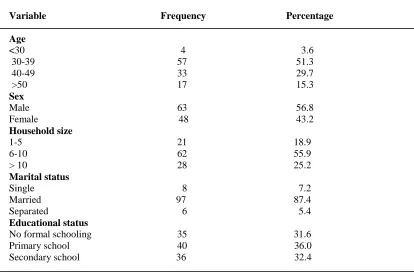
Table 1 indicated that 51.3% of the respondents were aged between 30-39 years. This implies
that they were active, mature and they involve themselves in this aspect of agricultural
production. The analysis also shows that 56.8% of the respondents sampled were male. It implies
that pupuru production has no gender discrimination and males engaged in the processing than
females. This may be due to the facts that the processing activities are energy tasking. The result
indicates that 55.9% of them have between the family size of 6-10 members. This implies that
activities in the study area. Majority of the processors were married (87.4%). It revealed that
there is no marital status discrimination. The distribution of respondents according to level of
education shows that 36.0% of them are primary school leavers. The result showed that a large
[image:7.612.63.477.211.483.2]proportion of the pupuru producers are illiterates and semi-literates with low level of education.
Table 1: Socio-Economic Characteristics Distribution of Pupuru Processors, n = 111
Variable Frequency Percentage
Age
<30 4 3.6 30-39 57 51.3 40-49 33 29.7 >50 17 15.3
Sex
Male 63 56.8 Female 48 43.2
Household size
1-5 21 18.9 6-10 62 55.9 > 10 28 25.2
Marital status
Single 8 7.2 Married 97 87.4 Separated 6 5.4
Educational status
No formal schooling 35 31.6 Primary school 40 36.0 Secondary school 36 32.4
Source: Field Survey, 2013
Processing Activities of Pupuru Processors (Table 2)
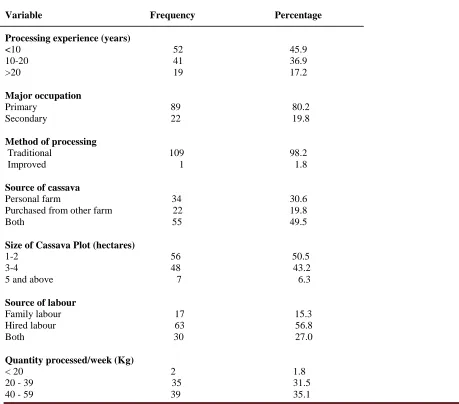
Result of analysis as presented in table 2 indicated that 45.9% of the respondents have
been involved in processing of pupuru for less than 10yrs while 17.2% claimed more than twenty
years of experience. The mean value was 13.02 years. This implies that on the average,
respondents have adequate knowledge and exposure concerning the enterprise. According to
result presented on the table, 80% of the respondents engaged in cassava processing as primary
the enterprise is profitable enough in the study area for this large proportion of respondents to be
comfortable with it as primary occupation. Result further indicated that 98.2% of the processors
engage in traditional method of processing while only 1% claimed to employ improved method
of processing. About 50% obtained the raw material (cassava) from personal farm as well as
neighbourimg farms. Average farm size was 2.74 hectares. More than half of the respondents
(56.8%) were found to rely solely on hired labour. Analysis revealed that on the average,
[image:8.612.67.526.298.702.2]respondents processed 48.37 kg of pupuru flour per week.
Table 2: Processing Activities of Respondents, n = 111
Variable Frequency Percentage
Processing experience (years)
<10 52 45.9 10-20 41 36.9 >20 19 17.2
Major occupation
Primary 89 80.2 Secondary 22 19.8
Method of processing
Traditional 109 98.2
Improved 1 1.8
Source of cassava
Personal farm 34 30.6 Purchased from other farm 22 19.8 Both 55 49.5
Size of Cassava Plot (hectares)
1-2 56 50.5
3-4 48 43.2
5 and above 7 6.3
Source of labour
Family labour 17 15.3 Hired labour 63 56.8 Both 30 27.0
Quantity processed/week (Kg)
< 20 2 1.8
20 - 39 35 31.5
60 - 79 22 19.8 80 and above 13 11.7
Source: Field Survey, 2013
Profitability Analysis
Total Revenue (TR) = Price per kg * Quantity of the product sold per week
= N 470.8 *48.37kg
= N22, 773.47
Total Cost (TC) = Total variable cost (TVC) + Depreciated fixed cost (DFC)
(Variable cost include cost of all variable items i.e. Cassava tubers +Transport + labour
Depreciated fixed cost is equal to the depreciated cost of fixed items i.e. Revenue - Total variable
cost)
= N18, 234.888 + N713.97
= N 18, 948.852
Gross Margin (GM) = Total Revenue - Total variable cost
= N22, 773.47 - N 18, 234.888
= N4, 538.58 per week
= N93.83 per kilogram of pupuru flour processed
Profit (Net return) = Gross Margin – Total Fixed Cost
= N4, 538.58 – N713.97
= N3, 824.61 per week
= N 79.07 per kilogram of pupuru flour processed
If BCR>1, then the business is profitable
If BCR<1, then the business is not profitable.
= N 22, 773.47
N 18, 948.852
= 1.2
The business is profitable since BCR is > 1
Result of Regression Analysis
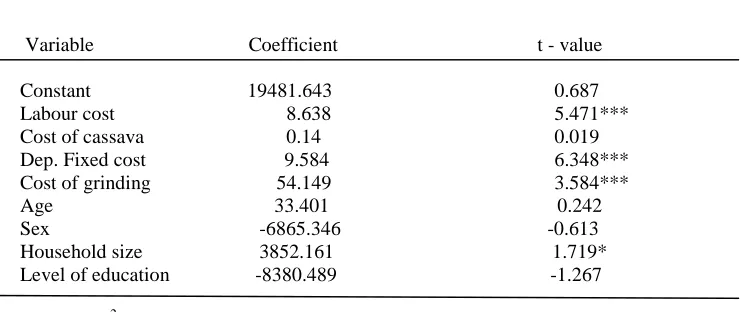
Result of the regression analysis (table 3) revealed the statistical relationship between cost of
cassava processing (independent variables) and revenue generated by respondents (dependent
variable). Result indicated that four of the estimated variables were statistically significant.
These are labour cost (significant at 1%), depreciated fixed cost (significant at 1%), cassava
grinding cost (significant at 1%) and household size which is (significant at 10%). Adjusted R2 was 0.617 indicating that 61.7% of variation in revenue was explained by the estimated
independent variables. F-value was 23.134 and significant at 1%. This implies that significant
relationship exists between pupuru processing cost and the revenue generated by respondents,
that is, processing cost have decisive influence on the revenue generated by the processors in the
[image:10.612.62.433.501.657.2]area.
Table 3: Result of regression analysis showing the statistical relationship
between dependent and independent variables of the study, Y = Revenue
Variable Coefficient t - value
Constant 19481.643 0.687 Labour cost 8.638 5.471***
Cost of cassava 0.14 0.019
Dep. Fixed cost 9.584 6.348*** Cost of grinding 54.149 3.584*** Age 33.401 0.242 Sex -6865.346 -0.613 Household size 3852.161 1.719* Level of education -8380.489 -1.267
*** Significant at 1% * Significant at 10% Source: Data Analysis, 2013
Challenges Identified by the Processors (Table 4)
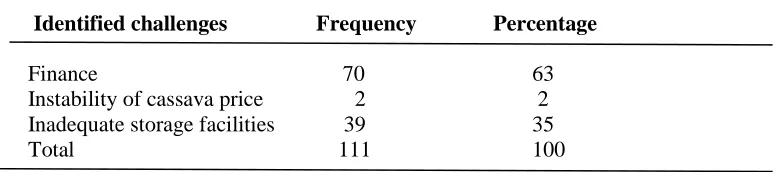
Table 4 showed the challenges militating against pupuru processing enterprise in the study
area. According to the result, 63% of the respondents indicated that the major challenge being
encountered was financial problem. In addition, 35% complained of storage facilities while 2%
[image:11.612.58.446.340.426.2]signified unstable cassava tubers price as a challenge.
Table 4: Challenges to Pupuru Processing Enterprise
Identified challenges Frequency Percentage
Finance 70 63
Instability of cassava price 2 2
Inadequate storage facilities 39 35
Total 111 100
Source: Field survey, 2013
Conclusion and Recommendation
The study concluded that
- Cassava processing (Pupuru) enterprise is profitable in the study area.
- Processing cost has decisive influence on the revenue generated by the processors in the area.
- Challenges facing cassava processors in the study area include inadequate finance and storage facilities.
REFERENCES
1. Adeyemi, A.A. (2013): Oral interview, Ondo state, Nigeria.
2. Ayinde, I.A., Afolami C. A. and Aromolaran, A. B. (2003): Intrazonal Poverty Situation
among Farmers in Ogun State. Moore Journal of Agricultural Research, 3 (2): 306-312.
3. Ayinde, I. A., Dipeolu, K. A.; Oyewole, O.B.; Sanni, L.O; Adusei, J.A. and Wesby, A.
(2004): “Cost- Benefit Analysis of the Processing of a Shelf Stable Cassava Fufu in
Nigeria.” Proceedings of the Sixth International Scientific Meeting of the Cassava
Biotechnology Network, held at International Centre for Tropical Agriculture, Cali,
Columbia.
4. Fahusoro, E (2005): “Analysis of socio-economic and spatial factors in livelihood
diversification in Ogun state Nigeria. An Unpublished Thesis.
5. FAO Report (2000): www. Fao. Org
6. Raw Materials Research and Development Council (RMRDC) (2004): Report on Survey