2019 International Conference on Computation and Information Sciences (ICCIS 2019) ISBN: 978-1-60595-644-2
Design of Address Management Protocol for
Large-scale Wireless Sensor Network
Based on DHCPV6
Yu Luo, Dongmei Li and Weichao Yang
ABSTRACT
As the current IPv4 gradually migrated to IPV6, the research on DHCP (Dynamic Host Configuration Protocol) based on IPV6 mechanism has increased. DHCPV6 Communication is the client/server mode. The client is responsible for configuring the IPV6 address, network configuration parameters and so on by server. This paper first analyzes the design of address management protocol. Secondly, it probes into the execution process of address management protocol.
1. INTRODUCTION
Wireless sensor networks are usually composed of several sensor nodes, which use sensor nodes to measure the chemical parameters and physical parameters around them, and then transmit the measurement data to the remote center through a wired network or wireless network. In order to meet the needs of current applications and large-scale networking, other wide-area networks are often used as carriers to effectively connect different types of wireless sensor networks. At present, the TCP/IP protocol is the best choice for organic fusion between the current IP network and the Wireless sensor network.
Generally speaking, the application of wireless sensor network will take node or data as center, in which the application of the former not only to pay attention to the data, but also to the node generated by data. If it is difficult to identify the source of data generation, then the collected data has no application value. Given the situation, the nodes need identifying by identifications which are unique. Therefore, wireless sensor network applications require location-aware capabilities. For large-scale sensor networks, the identification of sensor nodes often needs to be equipped with network addresses. In other words, the length of network addresses often needs to grow with the growth of sensor nodes. Because IPV6 provides users with a large number of IP addresses (128 bits) with significantly more IP addresses than IPV4, there is no doubt that the IP addresses owned by each device connected to the network are unique. As the current IPv4 gradually migrated to IPV6, the research on DHCP (Dynamic Host
Configuration Protocol) based on IPV6 mechanism has increased. DHCPV6 Communication mode is the client/server, and the client will be responsible for the server to configure the IPV6 address, network configuration parameters and so on. In this paper, the design of Address management protocol for large-scale wireless sensor network based on DHCPV6 is analyzed.
2. DESIGN OF ADDRESS MANAGEMENT PROTOCOL
The scheme establishes the corresponding join between the server node and the client through the request and the final scheme, in which the sensor node acts as the client and the convergent node acts as the server.
2.1 Address Assignment Message Interaction
Generally speaking, there are two kinds of interaction processes of address assignment, namely, three-message interaction process and rapid allocation process.
(1) The quick distribution process
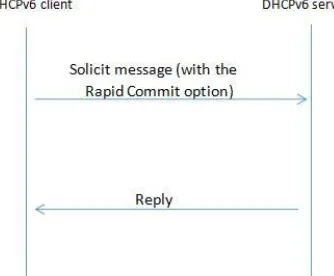
[image:2.612.219.386.433.571.2]Firstly, the client sends a solicit message (with the rapid commit option) to the server so that the server can assign network configuration parameters and network addresses to it within a short period of time. In the second step, if the server can work with fast allocation, the reply message can be returned right away, and the server can also be assigned IPV6 address, and so on. It is worth noting that the rapid distribution process usually requires that there are only 1 DHCPV6 server in the wireless sensor network system, but actually multiple DHCPV6 servers exist in the system. Thus only the three-message interaction process can be selected.
Figure 1. The quick distribution process.
(2) The three-message interaction process
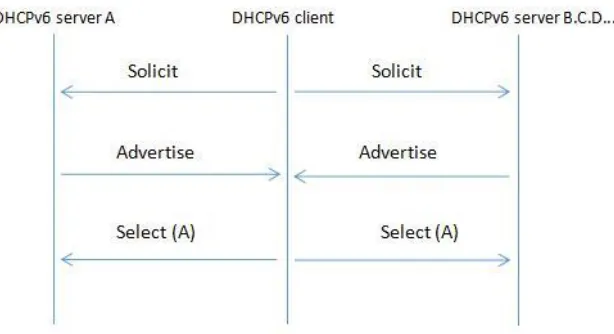
after the client obtains the advertise messages, the address information contained will be timely analyzed, extracted, and also send the server feedback information, to show that the network address has been successfully obtained. In the fourth step, if the client gets multiple advertise messages at the same time (answered by multiple servers), it will be sorted based on the priority level of the server and the specific receive time (accurate to second) of the advertise message. The highest-priority server sends the select message, and the select message contains information such as the IPV6 address assigned to the server. Once the select message is sent, all servers in the wireless sensor network system can get the select message in the first place, and they can also know which server is the network on which the select message ended up.
Figure 2. The three-message interaction process.
2.2 Address Release Message Interaction
If the client completes a series of communication tasks, or if the client is about to enter hibernation, the client will send the address release message to the server in order to release the IP address occupied by the client.
2.3 Recycling IP Addresses
3. EXECUTION PROCESS OF ADDRESS MANAGEMENT AGREEMENT
3.1 Client Main Process
Client nodes usually create new state variables in memory, which can not only improve the working activity of DHCP, but also record the sending State of messages. The clients usually have three states, namely Release_sent State, Ipin_use State, Solicit_ Sent state. When the client node is powered on, the solicit message is sent in the first place and the state is changed to the Solicit_sent state. The client node then becomes the receiving State, and once the solicit message is obtained, the identity carried in the solicit message is compared and analyzed with the local identity. If it matches each other, it will go to the next step, otherwise it will be discarded directly.
3.2 Server Main Process
Server end is mainly responsible for the recovery and allocation of IP addresses. Generally speaking, the server obtained the type of DHCPV6 messages including Online_ack, select, release, so-licit four categories. After the solicit message is obtained, it will be the first to query whether the MAC address is bound. If the query results are no, then the IP needs to be re-requested. Moreover, after binding the MAC address and IP, the reply message and advertise message need constructing, and timely delivered. When the release message is fed back to the server, the server address in the release message is extracted and compared with the local address. If the comparison results are equal, the IP address is retracted and the ACK message is responded to in the first time. If the comparison results are different, then it is not processed. When the Online_ ACK message is sent to the server, the server address is first extracted and compared with the local address. If the comparison result is equal, the message is considered to be sent to the destination.
ACKNOWLEDGEMENTS
This paper was supported by the Fundamental Research Funds of China West Normal University (No. 416531).
REFERENCES
1. R. Chellappa Doss, D. Chandra, L. Pan, W. Zhou, M. Chowdhury. 2006. “Address Reuse in Wireless Sensor Networks,” Australian Telecommunication Networks and Applications Conference, 329-333.
2. Network Working Group S. Deering et al.1998. “RFC2460 Internet Protocol, Version 6(IPv6) Specification,” https://tools.ietf.org/html/rfc2460.
3. Joseph Davies. 2012.“Understanding IPv6”.
4. Wang Xia, Gao Fei. 2016. “Design of address Management Protocol for large-scale Wireless Sensor Networks based on DHCPv6,” Journal of Yunnan University for nationalities (Natural Science Edition) the first issue of 2016.
6. Wen Song. 2007. “Wireless Sensor Networks Technology and Application,” Electronic Industry Press.
7. Zunyao Ke.2011. “Design and Implementation of DHCP Server Lease Management Scheme in<IPv4 and IPv6 Environments>,” Huazhong University of Science and Technology.