RC4 STREAM CIPHER CRYPTOGRAPHY ALGORITHM
Mr. A. Ravi Shankar (M.Tech ),
JNTU-HYD University Andhra pradesh , India.
ABSTRACT
In this paper, an efficient hardware implementation of the RC4 stream-cipher is proposed. In
contrary to previous designs, which support only fixed length key, the proposed implementation
integrates in the same hardware module an 8-bit up to 128-bit key length capability.
Independently of the key length, the proposed VLSI implementation achieves a data throughput
up to 22 MBytes/sec in a maximum frequency of64 MHz The whole design was captured by using
VHDL language and a FPGA device was used for the hardware implementation of the
architecture. A detailed analysis, in terms of performance, and covered area is shown.
I. INTRODUCTION
The main feature of cryptography is to work out with problems, which are associated with
secrecy, authentication and integrity. Cryptography also, is related with the meaning of protocol.
A protocol is sequences of actions, which are concern two or more sides, designed to fulfill a
goal. Thus, a cryptographic protocol is a protocol that uses cryptography. This protocol uses a
cryptographic algorithm and its intention is to prevent attempts of thefts and invasions.
Nowadays cryptography has been developed in a science strongly validated using terms of
Theory of Statistics and Theory of Numbers [1, 2].
In order to handle all the cryptographic problems many kinds of cryptographic algorithms have
been invented. The complexity of these problems made several categories of cryptographic
RC4 is a variable-key-size stream cipher developed in 1987 by Ron Rivest for RSA Data
Security, Inc. While some key weakness have been introduced [3], the RC4 is used for
encryption in the wired equivalent privacy (WEP) [4] protocol (part of the IEEE 802.1 lb
wireless LAN security standard), IEEE 802.11 i [5], Lotus Notes, Apple computer's AOCE and
Oracle secure SQL. The IEEE 802.11 i uses the Temporal Key Integrity Protocol (TKIP) and the
Advanced Encryption Standard (AES) [6]. TKIP uses the RC4 stream cipher as the encryption
and decryption algorithm and all involved parties must share the same secret key. The RC4
stream cipher works in two phases, key setup and ciphering. During an n-bit key setup (n is the
key length), the encryption key is used to generate an encrypting variable using two arrays, state
and key, and n number of mixing operations [I].
In this paper a new hardware implementation of the RC4 stream cipher. is presented. The
implementation is parameterized in order to support variable key lengths. The key length could
be 8-bit up to 128-bit opposed to the previous designs [7, 8, 9] that supports only fixed key
lengths. The proposed implementation needs three clock cycles per byte generation, in the key
setup phase, and three clock cycles per byte generation, in the ciphering phase. 768 + 3*n clock
cycles needs at total, (n is the number of bytes of the plaintext/cipher text), to complete the
whole operation. Comparing with the implementations in [7, 8] the proposed one is much faster.
The implementation in [9] needs the same time (768 + 3*n clock cycles) with the proposed one
but works with fixed key 40-bit in length. Finally, in [101 a RC4 stream cipher software
implementation is presented. In this implementation assembly language was used. On a 150
MHz Pentium achieves a throughput of 20 Mbytes/sec. The main disadvantage of this
implementation is that encrypts/decrypts one byte at every seven-clock cycles resulting a rapid
increment of the algorithmic latency.
The paper is organized as follows. Section 11 describes the RC4 stream cipher. In section III the
proposed architecture is presented and analyzed in details. The VLSI implementation results are
shown and discussed in section IV and finally conclusions are given in section V
RC4 uses a variable length key from I to 256 bytes to initialize a 256-byte array. The array is
used for subsequent generation of pseudo-random bytes and then generates a pseudorandom
stream, which is XORed with the plaintext/cipher text to give the cipher text/plaintext.
It works in Output Feedback (OFB) mode [II] of operation. There are two 256-byte arrays,
S-Box and S-Box. The S-array is filled linearly, such as S0=0, Sl=l, S2=2, .... S255=255. The
K-array consists of the key, repeating as necessary times, in order to fill the K-array. The RC4 stream
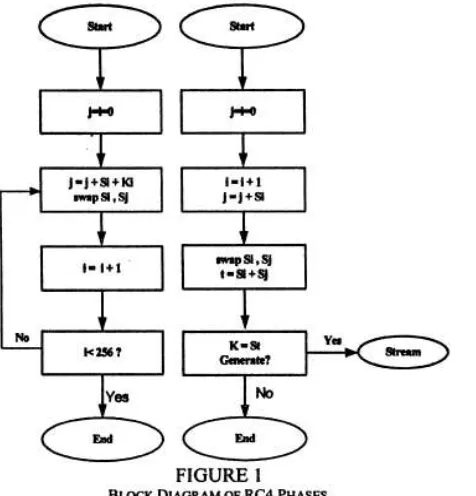
cipher works in two phases. The key setup phase and the pseudorandom key stream generator
[image:3.612.75.313.352.600.2]phase. Both phases must be performed for every new key.
Figure 1 shows the block diagram of the RC4 two phases.
RC4 uses two counters, i and j, which are initialized to zero. In the key setup phase the S-box is
being modified according to pseudo-code:
Key setup phase:
j = (j + Si + K1) mod 256
swap Si and Sj
Once the key setup phase is completed the second phase encrypts or decrypts a message. The
pseudorandom number generator (PRGN) phase is described by the following pseudo code:
Key stream generation phase:
i=(i+ 1)mod256
j = (j + S) mod 256
swap S, and Sj
t = (Si + Sj) mod 256
K = Si
The key stream K is XORed with the plaintext/cipher text to produce cipher text/plaintext.
III.PROPOSED ARCHITECTURE
Figure 2 shows the block diagram of the proposed architecture. It consists of a control and a
storage unit. The storage unit is responsible for the key setup and key stream generation.
The implementation of the storage unit is shown in Fig. 3. The storage unit contains memory
The block diagram of the S-box RAM is shown Fig. 4. It consists of three 256 bytes RAM
blocks. Each RAM block has four inputs and one output. The two inputs are the read and write
signals while the other two are the address and data signals. Also, all the three RAM boxes have
the same signals of clock and reset. The operation of RAM blocks is quite simple. If the reset
signal occurs the blocks are initialized linearly. For each block, if the write signal occurs new
data are stored in the address position, or if the read signal occurs the data in the address position
are available on the output of the block.
The two first blocks i, j (Fig. 4) are used for the swapping of the values of the third block t. The
final values that are used for the algorithm are produced by the t block.
First, the key setup phase is divided in two steps. In the first step the S-box is filled. The S-Box is initialized linearly, such as So=O, Sl=l, S2=2…S255=255 when the reset state occurs.
In the second step of the key setup, the S-Box is randomizely filled. For the S-box, 3x256-bytes
by the algorithm swappings. The j_ ant t_ registers are used in order to temporary store all the
intermediate variables that are produced.
At the first clock cycle the value of counter i (see Fig. 3) is used as address in the first RAM
block. The value of Si is used for the computation of the new value ofj as it is shown in Fig. 3. It
is stored in the Si-register. The two adders are used for the computation of the new value ofj.
is used as address for the second RAM block. The stored value in this address is temporary
stored in the Sj_register. At the third cycle the contents of the Si_register and Sj register are
written at the j and i addresses correspondingly. With this procedure, the swapping is achieved.
This step needs three clock cycles per iteration. So, the total cycles that are needed in the key
setup phase are 256 *3= 768.
The second phase is quite similar with the first phase and so; the same hardware is being used.
The difference in this phase is that the values of the K-Box are not used. After, the first phase
completion, the mux selects the zero value input. Also, the _register is initialized to zero -so as to
be ready for the second phase. After the two mentioned phases, the procedure of stream
generation can begin.
The operations at the first three steps are similar to those of the key setup phase except that the
S-Box is already initialized. At the first step the value of i is used as address in the first RAM
block, the value of Si is stored in the Si_register. Also the new value of j is computed. At the
second step the new value of j is used as address of the second RAM block and the value of Sj is
stored in the Sj]register. In this step the values of Si and Sj are being added and the result of the
addition is stored in the St_register. At the third step the contents of the Si register and Sj register
are written at the j and i addresses correspondingly and the value of the t_register is being used
as address for the third RAM block. So, the value of St is also produced in the third step. This
value of St is the stream-generated byte.
After the completion of this phase, each byte in the key stream can be generated and used for
encryption/decryption. The encryption/decryption is achieved by the bitwise XORing of the key
stream with the plaintext/cipher text.
The t6tal duration time of this phase is 3*n (n is the number of bytes of the plaintext or cipher
The operation of the storage unit is synchronized by the control unit. The control unit is
responsible for the generation of the clock and control signals.
IV. VLSI IMPLEMENTATION RESULTS
The proposed architecture was captured by using VHDL. All the system components were
described with structural architecture. The system tested using confirmed test vectors [12] in
order to examine its correctness. The whole design was synthesized, placed and routed by using
XILINX FPGA device [13]. Synthesis results for the proposed implementation are shown in
Table I.
The VIRTEX XILINX 2V250FG256 device has 18K bit select RAM blocks. Each block is
synchronous and can be easily configured in 256-byte RAM block. The proposed
implementation uses a 3*256-byte RAM blocks.
Comparison between the proposed RC4 implementation and other previous reported
The implementation results are referred for the same FPGA module. The rest of the previous
publications did not give information about the performance.
For the full execution of the algorithm the proposed implementation needs 768 + 3*n clock
cycles (n is the number of bytes of the plaintext/cipher text). The implementation in [8] needs
1280 + 4*n clock cycles. 256 cycles in order to fill linearly the S-Box, and 1024 cycles for the
key setup phase.
The implementation in [9] needs the same time (768 + 3*n clock cycles) with the proposed one
but works only with fixed key 40-bit in length. Finally, the software implementation in [101
encrypts/decrypts one byte at every seven clock cycles and of course increases the total latency
of the algorithm execution.
V. CONCLUSIONS
A VLSI implementation of the RC4 stream cipher is presented in this paper. The proposed
design provides high data throughput using 8-bit word and variable key length, from 8-bit to
128-bit, contrary to previous designs, which support only fixed length key. It provides flexibility
as it can be used in many applications with any key length from 8-bit to 128-bit. The proposed
system achieves a data throughput up to 22 MBytes/sec in a clock frequency of 64 MHz. The
measurement results and comparisons with previous implementations prove that the proposed
VI. REFERENCES
[1) B. Schneier, "Applied Cryptography - Protocols, Algorithms and Source Code in C", Second Edition, John Wiley and Sons, New York, 1996.
[21 A. Menezes, P. van Oorschot, and S. Vanstone, "Handbook ofApplied Cryptography", CRC Press, 1996.
[3] S. Fluhrer, I. Mantin, and A. Shamir. "Weaknesses in the key scheduling algorithm of RC4 ". In Proc. 8ih Workshop on Selected Areas in Cryptography, LNCS 2259. Springer Verlag, 2001. [4] Overview of IEEE 802.1 lb Security, Intel Technology Journal Q2, 2000.
[5] 802.1 1 i Overview Part I, Jesse Walker, Intel Corporation, http;//wwvw.ocate.edu/wirelcss 4.ppt
[6] "Advanced encryption standard", http://csrc.nist.gov
(7] P. Hamalainen, M. Hannikainen, T. Hamalainen and J. Snarinen, "Hardware Implementation of the Improved WEP and RC4 Encryption Algorithms for Wireless Terminals", The European Signal Processing Conference (EUSIPCO'2000), September 5-8, 2000, Tampere, Finland, pp. 2289-2292.
[8] P. D. Kundarewicl', S. J.E. Wilton, A. J. Hu,"'A CPLD- Based RC4 Cracking System",,The 1999 Canadian Conference on Electrical and Computer Engineering, May 1999.
[9] K.H Tsoi, K.H Lee and P.H.W Leong, "A Massively Parallel RC4 Key Search Engine", Proc. of the IOth Annual IEEE Symposium on Field-Programmable Custom Computing Machines (FCCM'02), September 22 - 24, 2002 Napa, California, pp. 13-21.
[101 B. Schneier, D. Whiting, "Fast Software Encryption: Designing Encryption Algorithms for Optimal Software Speed on the Intel Pentium Processor", Fast Software Encryption workshop (FSE97), LNCS, Vol. 1267, pp. 242-259, Springer-Verlag, Haifa, Israel, January 20-22, 1997.
1Il] "Recommendation for Block Cipher Modes of Operation. Methods and Techniques". National Institute of Standards and Technology, Technology Administration, U.S. Department of Commerce. http://csrc.nist.gov/publications/nistpubs/800-8a/sp800-38a.pdf
[12] Confirmed Test Vector for RC4, http://www.qrst.de/html/dsds/rc4.htm