JOURNAL OFCLINICALMICROBIOLOGY, July 2002, p. 2572–2583 Vol. 40, No. 7 0095-1137/02/$04.00⫹0 DOI: 10.1128/JCM.40.7.2572–2583.2002
Copyright © 2002, American Society for Microbiology. All Rights Reserved.
Genetic Diversity of the Outer Surface Protein C Gene of Southern
Borrelia
Isolates and Its Possible Epidemiological,
Clinical, and Pathogenetic Implications
Tao Lin, James H. Oliver, Jr.,* and Lihui Gao
Institute of Arthropodology and Parasitology, Georgia Southern University, Statesboro, Georgia 30460-8056 Received 27 November 2001/Returned for modification 25 January 2002/Accepted 15 April 2002
TheospCgenes of 20 southernBorreliastrains were sequenced. The strains consisted ofB. burgdorferisensu stricto,B. andersonii,B. bissettii, one undescribed genospecies, MI-8, and one probably newBorreliaspecies, TXW-1. A high degree of similarity exists betweenB. burgdorferisensu stricto andB. bissettiiand betweenB.
bissettiiandB. andersonii. Lateral transfers of theospCgene probably occurred betweenB. burgdorferisensu
stricto andB. bissettiiand betweenB. bissettiiandB. andersonii. Internal gene recombination appears to occur among them. The highest degree of genetic diversity among them was observed in the two variable domains (V1 and V2), semivariable domain (SV), and the species-specific epitopes (between amino acids 28 and 31). Dif-ferences inospCsequences among southern strains reflect diversity at the strain and genospecies levels. MI-8, which was recognized as an undescribed genospecies in our previous reports, remains distinguishable in our current analysis ofospCgenes and is distinct fromB. burgdorferisensu stricto. Interestingly, another unde-scribed southern isolate, TXW-1, was not amplified under various PCR conditions. Compared to EuropeanB.
burgdorferisensu stricto strains, AmericanB. burgdorferisensu stricto strains show greater genetic
heteroge-neity. SouthernB. burgdorferisensu stricto, B. andersonii, andB. bissettiiisolates were intermixed with each other in the phylogenetic trees. In the derived trees in our work, at least one southeastern strain ofB.
burg-dorferi, MI-2, most closely aligns with a so-called invasive cluster that possesses many proven human-invasive
strains. Transmission experiments show that MI-2 and the strains in this group of southern spirochetes are able to infect mice and hamsters and that the typical vector of Lyme disease,Ixodes scapularis, can acquire the spirochetes from infected mammals. Currently, strain MI-2 appears to be the only southern isolate among the 20 we analyzed that clusters with an OspC invasive group and thus might be invasive for humans.
Lyme disease is the most common vector-borne disease in humans in North America and Eurasia. There were 122,651 Lyme disease cases reported from 50 states and the District of Columbia from 1990 through 1999 in the United States (17), and about 50,000 cases are estimated to occur in Europe an-nually (40). Human Lyme disease may involve multiple organs or tissues, resulting in skin, cardiac, neurological, and muscu-loskeletal disorders. Multiple erythema migrans and Lyme ar-thritis are more common in the United States than in Europe, whereas neuroborreliosis occurs frequently in European pa-tients. Borrelial lymphocytoma and acrodermatitis chronica atrophicans are well documented in European Lyme disease patients but rarely recognized among Lyme disease patients in the United States.
The causative agent of Lyme disease, Borrelia burgdorferi sensu lato, is genetically highly divergent (8, 30, 35, 36, 40, 49; T. Lin, J. H. Oliver, Jr., T. M. Kollars, Jr., and K. L. Clark, Proc. VIII Int. Conf. Lyme Borreliosis Other Emerging Tick-Borne Dis., p. 8, 1999). DifferentBorreliagenospecies some-times have been associated with distinct clinical manifestations of Lyme disease, although there is often an overlap of symp-toms. Lyme arthritis is often related to B. burgdorferi sensu stricto, neuroborreliosis is often associated withB. garinii, and
acrodermatitis chronica atrophicans may occur in Lyme dis-ease patients infected withB. afzelii(5, 8, 13, 39, 47, 66).
Eleven genospecies or genomic groups within theB. burg-dorferisensu lato complex have been described based on their phenotypic and genetic characteristics since the discovery ofB. burgdorferiin 1982 (11) and its subsequent description (32). Three of them,B. burgdorferisensu stricto (8),B. andersonii(6, 37, 47), andB. bissettii(6, 47, 48), have been identified in the United States.B. burgdorferisensu stricto is widely distributed in the northeastern, southeastern, mid-Atlantic, and north cen-tral states and northern California (17, 35; Lin et al., Proc. VIII Int. Conf. Lyme Borreliosis Other Emerg. Tick-Borne Dis.). It is the only genospecies ofB. burgdorferi sensu lato that has been cultured from humans with Lyme borreliosis in North America. B. andersonii and B. bissettii were isolated mainly from ticks and small mammals from New York (2, 4), Califor-nia (48), Colorado (53), and the southeastern United States (35, 39; Lin et al., Proc. VIII Int. Conf. Lyme Borreliosis Other Emerg. Tick-Borne Dis.).B. andersonii occurs in the eastern half of the United States and appears to exist primarily in an enzootic cycle involving cottontail rabbits andIxodes dentatus. B. bissettiioccurs in the western and southern United States but infrequently in the northern region. It appears to be main-tained in several enzootic transmission cycles in California and the southeastern United States and involves several tick spe-cies, includingIxodes spinipalpisand the human-bitingI. pacifi-cus in the west, and Ixodes minor and the human-biting I. scapularisin the eastern half of the United States (10, 42; J. H.
* Corresponding author. Mailing address: Institute of Arthropodol-ogy and ParasitolArthropodol-ogy, P.O. Box 8056, Georgia Southern University, Statesboro, GA 30460-8056. Phone: (912) 5564. Fax: (912) 681-0559. E-mail: [email protected].
2572
on May 15, 2020 by guest
http://jcm.asm.org/
Oliver, Jr., Proc. II Int. Symp. Lyme Dis. Emerg. Re-emerg. Dis., p. 83–94, 1997).
Various phenotypic and genotypic techniques have been used to study variability and to identify genospecies in theB. burgdorferisensu lato complex. Analysis of theospCgene has yielded valuable information. The ospC gene, located in the 26-kb circular plasmid, has a high degree of heterogeneity (30, 51, 68). Its diversity has been described among and within genospecies (29, 30, 68, 70), and lateral transfer of theospC gene and internal gene recombination are reported to increase the variability amongospC sequences (20, 30, 38). Interest-ingly, the divergent sequences ofospCand the deduced amino acid sequences reported fromB. burgdorferi sensu lato have been correlated with the distribution of the genospecies (29, 68). A species-specific motif was found in the conserved amino terminus of the OspC protein (30, 70), and intergenic transfer and internal recombination have not been reported in the motif region except for a fewB. valaisianaisolates, which might have exchanged a complete ospC gene from B. gariniior B. afzelii(63).
Sequence analysis ofospCand its deduced amino acids ap-pears to be a useful tool for identification ofBorreliaspecies and for evaluating the divergence between and withinBorrelia species but not for assignment of Borrelia genospecies. We used this approach to analyze some representative southern Borreliastrains and to evaluate relationships among them and other genospecies.
MATERIALS AND METHODS
Spirochete isolates and culture conditions.The 20Borreliastrains described in
this study were isolated from ticks (I. scapularis, I. dentatus, I. minor,or Derma-centor variabilis) and animal reservoirs (cotton mouse [Peromyscus gossypinus], cotton rat [Sigmodon hispidus], and eastern woodrat [Neotoma floridana]) from Missouri, Georgia, Florida, South Carolina, and Texas. All analyzed isolates were third passage. Table 1 lists allBorreliastrains that were investigated and their origins. The cultures were incubated at 34°C for 1 to 2 weeks (to the stationary phase of growth) and checked under dark-field microscopy to ensure purification, and cells were counted before they were harvested.
Extraction of spirochete DNA.Whole DNA was isolated without separating
plasmid and chromosomal DNAs. Briefly, 30 ml of stationary-phase cultures were washed with 0.01 M phosphate-buffered saline (PBS) (pH 7.2) with 5 mM
MgCl2three times at 10,000 rpm (12,096⫻g) for 10 min. Washed pellets of the spirochetes were resuspended in 250l of TES (50 mM Tris [pH 8.0], 50 mM EDTA, 15% [wt/vol] sucrose). Subsequently, an equal volume of 5 M NaCl as well as 0.01% (vol/vol) sodium deoxycholate were added to the cell suspension. Samples were placed on ice for 30 min. The partially lysed cell suspension was then centrifuged at 10,000 rpm (12,096⫻g) for 10 min. After discarding the supernatant fraction, the pellet was resuspended in 250l of TES, followed by addition of 250l of 10% sodium dodecyl sulfate (SDS) and 3l of RNase.
After a 30-min incubation at 37°C, 50l of proteinase K (20 mg/ml) was added, and the tubes were incubated at 50°C for 30 min. This solution was subsequently phenol extracted twice, phenol-chloroform-isoamyl alcohol (25: 24:1) extracted once, and chloroform-isoamyl alcohol (24:1) extracted once. After the addition of 1/10 (vol/vol) volume of 3.0 M sodium acetate (pH 5.2), 2 volumes of cold ethanol were added to precipitate the nucleic acid. The DNA pellets were resuspended in 50l of TE buffer (10 mM Tris [pH 7.6], 1 mM EDTA). DNA samples were stored at⫺20°C until required for PCR experi-ments.
Amplification ofospCgenes.A 627- to 645-bp fragment ofospCwas amplified
by using a pair of primers,ospC3 (5⬘-AAGTGCAGATATTAATGACTTTA-3⬘) andospC4 (5⬘-TTTTTTGGACTTTCTGCCACA-3⬘), based on sequence data in GenBank and previously used primers (38). PCRs were performed in volumes of 50l containing 10 mM Tris-HCl (pH 9.0 at 25°C), 50 mM KCl, 1.5 mM MgCl2, 0.1% Triton X-100, 200M dATP, 200M dGTP, 200M dCTP, 200M dTTP, 1.5 U ofTaqDNA polymerase in storage buffer A (Promega, Madison, Wis.), 1M each primer, and 10 ng of extracted DNA. Reactions were per-formed in a GeneAmp PCR System 9700 (PE Biosystems) for 35 cycles of denaturation at 93°C for 1 min, annealing at 48°C for 1 min, and extension at 72°C for 1 min, and final extension was carried out at 72°C for 9 min. The PCR products were detected in a 1% agarose gel in 0.5⫻Tris-borate-EDTA contain-ing 0.5g of ethidium bromide/ml. The gel was photographed with an Eagle Eye II system (Stratagene).
Purification of PCR products, sequence analysis, and phylogenetic analysis.
The PCR products were purified by the Wizard PCR prep DNA purification system (Promega). The DNA sequence ofospCwas determined by using an ABI Prism (model 377). Sequences were aligned manually and by using Clustal W software (28), and phylogenetic trees were constructed by neighbor joining (52), maximum likelihood (22), parsimony methods (62), and unweighted pair group method with arithmetic means analysis (UPGMA) (58) by using phylogenetic analysis using parsimony (PAUP) (62), phylogeny inference package PHYLIP (22), and molecular evolutionary genetics analysis (MEGA) (34). The DNA sequences ofospC were translated into amino acid sequences using Protein Machine software, and each deduced amino acid sequence then was aligned using Clustal W as described above. The phylogenetic trees were generated by using PAUP, Clustal W, PHYLIP, and MEGA.
Retrieved sequences.To compare the relationship between our strains and the
strains in different genospecies and to conduct phylogenetic analyses,ospC se-quences of strains from the following genospecies (with strain names and data-TABLE 1. Origins ofB. burgdorferisensu lato strains in this study
Isolate Host Source Location Passage no. Genospecies
MI-2 Peromyscus gossypinus Bladder, ear clip Merritt Island, Brevard County, Fla. 3 Borrelia burgdorferisensu stricto
MI-5 Sigmodon hispidus Bladder, ear clip Merritt Island, Brevard County, Fla. 3 Borrelia burgdorferisensu stricto
SI-1 Peromyscus gossypinus Bladder Sapelo Island, McIntosh County, Ga. 3 Borrelia burgdorferisensu stricto
SM-1 Peromyscus gossypinus Ear clip St. Marys, Camden County, Ga. 3 Borrelia burgdorferisensu stricto
SCI-2 Peromyscus gossypinus Ear clip St. Catherines Island, Liberty County, Ga. 3 Borrelia burgdorferisensu stricto
MI-6 Sigmodon hispidus Ear clip Merritt Island, Brevard County, Fla. 3 Borrelia bissettii
MI-9 Peromyscus gossypinus Ear clip Merritt Island, Brevard County, Fla. 3 Borrelia bissettii
SCW-30h Ixodes minornymph Carolina wren Wedge Plantation, Charleston County, S.C. 3 Borrelia bissettii
SCGT-8a Ixodes minormale Woodrat Georgetown County, S.C. 3 Borrelia bissettii
SCGT-10 Neotoma floridana Ear clip Georgetown County, S.C. 3 Borrelia bissettii
AI-1 Sigmodon hispidus Bladder, ear clip Amelia Island, Nassau County, Fla. 3 Borrelia bissettii
FD-1 Sigmodon hispidus Bladder, ear clip Favor Dykes, Flagler County, Fla. 3 Borrelia bissettii
MOK-3a Ixodes dentatusnymph Rabbit Koch Farm, Bollinger County, Mo. 3 Borrelia andersonii
MOD-1 2Ixodes dentatusnymphs Rabbit Dowd Farm, Bollinger County, Mo. 3 Borrelia andersonii
MOD-5 Ixodes dentatusnymph Rabbit Dowd Farm, Bollinger County, Mo. 3 Borrelia andersonii
MOS-1b Ixodes dentatuslarva Rabbit Swinton, Stoddard County, Mo. 3 Borrelia andersonii
SI-10 Ixodes scapularisfemale Drag Sapelo Island, McIntosh County, Ga. 3 Borrelia andersonii
BC-1 Ixodes dentatusnymph Drag Macon, Bibb County, Ga. 3 Borrelia andersonii
MI-8 Sigmodon hispidus Ear clip Merritt Island, Brevard County, Fla. 3 Borreliasp.
TXW-1 Dermacentor variabilismale Coyote Webb County, Tex. 3 Borreliasp.
on May 15, 2020 by guest
http://jcm.asm.org/
[image:2.587.43.541.84.279.2]base accession numbers) were used. They includedB. burgdorferisensu stricto [X69596 (B31T), L81131 (CA4), U91792 (HII), U91799 (IP1), L42887 (IP2), U91797 (IP3), U91798(L5), U91801(P1F), X69589 (PKa), X84783 (TXGW), X84778 (DUN), X84765 (BUR), L42868 (ZS7), X81522 (PBre), X73625 (DK7), U91795 (61BV3), U91794 (35B808), U04281 (HB19), L42894 (Z8691), L42893 (297), U91790 (212), U91802 (MIL), X81524 (T255), L42899 (21347), U01892 (2591), U04240 (N40), L42894 (28691), L42895 (28354), X84779 (MUL), X84782 (KIPP), X84785 (272), L42897 (26815), L81130 (SON188), L42896 (27579), X83555 (Borrelia pacificus), U91793 (Z136), U91796 (20006), U91800 (NE56), U91791 (ESP-1), L25413 (CA11.2), AF029860 (OC1), AF029861 (OC2), AF029862 (OC3), AF029863 (OC4), AF029864 (OC5), AF029866 (OC7), AF029865 (OC6), AF029867 (OC8), AF029868 (OC9), AF029869 (OC10), AF029870 (OC11), AF029871 (OC12), AF029872 (OC13), AF065143 (OC16), and AF065144 (OC17)],B. afzelii[L42871 (VS461T), X84777 (DK9), L42892 (ACAI), X84775 (DK5), L42874 (Orth), L42884 (J1), X81523 (P1J7), L42888 (H9), L42873 (Simon), L42890 (E61), X84768 (DK15), X84774 (DK4), X84776 (DK8), X73624 (DK26), X84767 (DK21), L42883 (JSB), X81521 (PBo), X84771 (DK3), X84766 (DK2), X73627 (DK1), X84769 (DK22), X83552 (PLud), X62162 (PKo), X69590 (PWudI), X80255 (PLe), D49501 (HT10), D49502 (HT25), and D49503 (HT61)],B. garinii[X69595 (PBi), X73626 (DK6), X83554 (PTrob), L42800 (KL11), L42869 (W), X83553 (PHei), X81526 (WAB-Sou), X84770 (DK29), X73623 (DK27), X83556 (N34), L42879 (M57), X81525 (Tis1), L42889 (H13), L42900 (20047T), L42878 (NBS16), L42870 (VSDA), L42875 (NBS23), L42863 (153), X84773 (DK35), L42891 (BITS), L42882 (KL10), L42877 (NBSlab), L42886 (IP90), X69594 (pBr), X69593 (TN), X69592 (T25), D49499 (HT17), D49500 (JEM4), D49377 (HT57), and D49378 (HT64)], B. bissettii[U04280 (DN127T) and U04282 (25015)], B. andersonii [L42866 (21123T) and L42864 (19857)],B. valaisiana[L42872 (VS116T)], andBorrelia spp. [D49504 (HT22), D49505 (JEM1), D49506 (JEM2), D49381 (HT37), D49507 (HT19), D49508 (JEM3), and D49509 (HT55)].
Nucleotide sequence accession numbers.TheospCnucleotide sequences of
19B. burgdorferisensu lato isolates were deposited in the GenBank database, and their accession numbers are AF278582 (MI-2), AF278583 (SCW-30h), AF278584 (MI-9), AF278585 (MOK-3a), AF278586 (MOD-5), AF278587 (BC-1), AF278588 (SCGT-8a), AF278589 (SCGT-10), AF278590 (MI-8), AF278591 (AI-1), AF278592 (FD-1), AF278593 (SI-1), AF278594 (SM-1), AF278595 (SCI-2), AF278596 (MI-6), AF278597 (MOD-1), AF278598 (MOS-1b), AF278599 (SI-10), and AF278600 (MI-5).
RESULTS
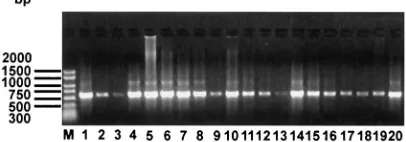
Amplification and sequencing of ospC genes. Excluding TXW-1, 606- to 624-bp coding regions of theospCgenes of the 19 southernB. burgdorferi sensu lato strains were amplified (Fig. 1) and sequenced. There was no suggestion of a relation-ship between the lengths of theospCgenes and the spirochete genospecies. However, the longest genes (624 bp) ofospCwere found in SCGT-8a, SCGT-10, MI-6, and MOD-1 and the shortest one in BC-1 (606 bp); most southern strains have an averageospCgene length of 609 to 621 bp. Although various PCR conditions were used to amplify theospCgene in strain
TXW-1, failure suggests that TXW-1 may lack this gene or that the undetected gene in this isolate is truncated or otherwise altered at the primer sites. To confirm our sequencing results, the ospC gene of reference strain B31 was sequenced and compared to the B31 sequence retrieved from GenBank; iden-tical results were obtained.
Analysis ofospCsequences of southern strains.A similarity matrix of OspC amino acid sequences indicated a high degree of heterogeneity, and amino acid identities ranged from 59.9 to 100%; OspC from most strains ranged from 60 to 80% identity (Table 2). The lowest degree of similarity (59.9%) was found between SM-1 (B. burgdorferi sensu stricto) and 20047 (B. garinii). The highest degrees of similarity were shown between strains ofB. burgdorferi sensu stricto, i.e., SM-1 and SI-1 or SCI-2 (99.5 and 100%), MI-2 and B31 (99.5%),B. andersonii strains MOS-1b and SI-10 (99.5%),B. bissettiistrain MI-9, and B. burgdorferisensu stricto strain MI-5 (99.5%),B. andersonii strain MOD-1 and B. bissettii strain MI-6 (99%), B. bissettii strains SCGT-8a and SCGT-10 (98.1%), MI-9 and FD-1 (95.6%), and B. burgdorferi sensu stricto strain MI-5 and B. bissettiistrain FD-1 (95.1%). As shown above, high degrees of similarity among strains were usually found in those from the same genospecies but also sometimes among strains in differ-ent genospecies (Table 2), for example, betweenB. burgdorferi sensu stricto andB. bissettiior betweenB. andersoniiandB. bis-settii. Results indicated thatB. burgdorferisensu stricto,B. bis-settii, and B. andersonii from North America are closely re-lated.
The amino acid sequences of species-specific epitopes of southern strains varied between positions 28 and 31. Most southern B. bissettii and B. andersonii strains have an S at position 28, but southern B. burgdorferi sensu stricto strains either have an A or lack an amino acid at this position. At positions 29 and 30, most southernB. andersoniiandB. bissettii strains have A and S, but southernB. burgdorferisensu stricto strains have T and S or S and V. At position 31, southern B. burgdorferisensu stricto strains have either an A or a gap; however, most southernB. bissettii and B. andersonii strains have T, and threeB. andersoniistrains have N.
Except for this region, each of the strains MOD-5, MOK-3a, SI-1, SM-1, SCI-2, SCW-30h, and AI-1 has a gap at position 70. Each of the strains SCGT-8a and SCGT-10 has an insertion of T at position 88. Strain BC-1 has a deletion at position 79, and strains MI-6 and MOD-1 have a 3-amino-acid insertion, G, L, and N. Strains BC-1, B31, MI-2, 25015, MI-5, MI-9, FD-1, MOD-5, and MOK-3a each have a deletion at position 115. Strains SCGT-8a and SCGT-10 have an insertion of N and G and strains SI-10 and MOS-1b have an insertion of D and G at positions 146 and 147. These differences in OspC sequences among southern strains reflect significant diversity at the geno-species level.
[image:3.587.61.264.77.148.2]An alignment of the deduced amino acid sequences indi-cated that both the C-terminal and N-terminal ends of OspC appear to be conserved. The amino acid sequence variation was observed in the internal part of this protein; a variable region was located from amino acids 72 to 191 among these southern strains. Two hypervariable regions were located be-tween amino acids 84 and 96 and bebe-tween amino acids 146 and 176. In comparison with the previously reported hypervariable regions in other strains (30), the first hypervariable region
FIG. 1. AmplifiedospCgenes of southern strains ofB. burgdorferi sensu lato. The PCR products were electrophoresed on a 1% agarose gel, stained with ethidium bromide, and visualized with a UV light transilluminator. Molecular size standards (in base pairs) are shown to the left of the gel. The 19 southern strains and the reference strain AI-1, FD-1, MI-6, MI-8, MI-9, MOD-1, SCW-30h, 8a, SCGT-10, SI-SCGT-10, BC-1, MOS-1b, MOD-5, MOK-3a, SI-1, SM-1, MI-2, MI-5, SCI-2, and B31 are shown in lanes 1 to 20, respectively.
2574 LIN ET AL. J. CLIN. MICROBIOL.
on May 15, 2020 by guest
http://jcm.asm.org/
among southern strains was located between amino acids 84 and 96 rather than between amino acids 83 and 95. The second hypervariable region among southern strains was located be-tween amino acids 146 and 164 and extended to amino acid 176 rather than between amino acids 143 and 162. There were three identical amino acids in the second hypervariable region. There are four domains in the OspC amino acid sequence according to a previous report (38): the conserved amino-terminal domain (C1), two variable domains (V1 and V2), and the semivariable domain (SV). For southern strains, C1 is located from amino acids 35 to 86, V1 from amino acids 86 to 99, SV from amino acids 99 to 118, and V2 from amino acids 118 to 191. The locations of these domains are shown in Ta-ble 3.
Lateral transfer and internal gene recombination of ospC
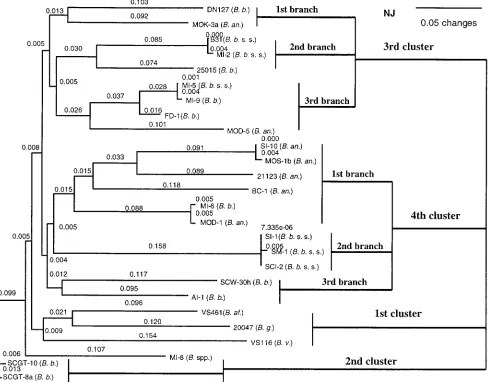
gene and OspC sequence diversity.A close identity was found betweenB. burgdorferisensu stricto andB. bissettiiand between B. bissettiiandB. andersonii(Tables 2 and 3). The close identity (indicated in Table 3) among some amino acid sequences of southern strains and other strains belonging to different B. burgdorferigenospecies suggests that a lateral transfer and in-ternal gene recombination of theospCgene may have occurred among the three genospecies. Both phylogenetic trees also suggest that lateral transfer and internal gene recombination of theospCgene occurred among these three genospecies (Fig. 2 and 3). Based on the result in which MI-6 (B. bissettii) was misplaced in the SI-10 cluster (B. andersonii) in the phyloge-netic tree (Fig. 2),B. andersoniiappears to be the donor and B. bissettii the recipient. However,B. andersonii might have obtained part of theospCsequence fromB. bissettiibased on the grouping in which MOD-5 (B. andersonii) was misplaced in the FD-1 group (B. bissettii). Genetic transfer could happen in both directions. Moreover, B31 and MI-2 were misplaced in the 25015 group (B. bissettii), suggesting that B. burgdorferi sensu stricto might have obtained part of theospCgene from B. bissettii.
Clinical and epidemiological implication of ospC groups.
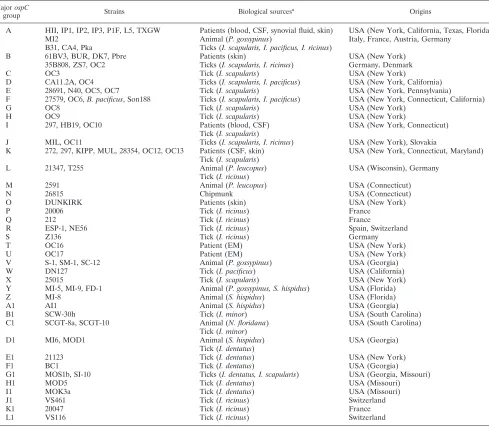
Each ospC type is a group of strains in which divergence is greater than 8% between groups and less than 1% within groups (27, 57, 64). A branch length of 0.04 corresponds to 8% divergence between two sequences and is the cutoff that de-fines theospCgroup (9, 21). Based on this definition, the 19 southern strains can be divided into 12ospCgroups (except for the MI-5, MI-9, and FD-1 group, whose branch length is 0.037 and is close to the cutoff) (Fig. 2, Table 4). Of the 12 southern strain ospC groups, two groups belong to the B. burgdorferi sensu stricto genospecies. One is the A group (Table 4) and contains MI-2 along with the IP1 group, all of which belong to a so-called invasive cluster (9, 57). MI-2 most closely aligns with a group that possesses proven human invasive strains.
Transmission experiments show that this group of southern spirochetes are able to infect mice and hamsters and that the typical vector of Lyme disease,I. scapularis, can acquire the spirochetes from infected mammals (J. H. Oliver et al., unpub-lished data). Another B. burgdorferi sensu stricto group (V group) contains three southern strains, SI-1, SM-1, and SCI-2, and is a typical southern B. burgdorferi sensu stricto group. MI-5 (B. burgdorferi sensu stricto) and MI-9 and FD-1 (B. bissettii) comprise a mixed group, Y. MI-8, the undescribed new genospecies, constitutes the Z group. There are threeB.
TABLE 2. Amino acid similarity between OspC sequences from dif ferent B. burgdorferi sensu lato isolates Isolate % Amino acid similarity with OspC sequence from isolate: DN127 VS116 21123 25015 VS416 20047 B31 SI-1 SI10 SM1 SCI2 SCW30h AI1 FD-1 MI-2 MI-5 MI-6 MI-8 MI-9 SCGT-8a SCGT-10 MOD-1 MOD-5 BC-1 MOK-3a MOS-1b DN127 100.0 67.3 69.8 69.1 69.3 69.3 68.0 67.0 70.2 66.5 67.0 73.0 70.7 75.0 67.5 73.0 70.2 73.1 72.6 75.1 76.6 71.2 70.0 69.3 75.9 69.8 VS116 100.0 66.8 66.3 69.8 63.4 68.8 63.9 64.9 63.3 63.9 63.3 68.3 69.3 68.3 67.3 70.3 69.3 66.8 66.8 68.8 70.8 62.4 62.9 65.3 64.4 21123 100.0 67.6 63.9 62.9 66.5 70.0 81.6 66.5 70.0 65.0 71.2 69.6 66.5 70.6 73.9 70.7 70.1 70.5 71.0 74.4 67.0 72.3 68.5 82.1 25015 100.0 70.8 64.4 82.8 69.5 68.6 69.0 69.5 71.4 73.5 81.4 82.3 80.4 75.0 75.5 80.0 74.0 73.5 75.0 77.8 68.8 79.8 68.1 VS461 100.0 74.8 73.8 67.8 63.9 67.3 67.8 70.8 70.8 70.8 73.3 69.8 69.3 70.3 69.3 69.8 69.8 69.3 67.8 65.3 68.3 63.4 20047 100.0 64.4 60.4 63.9 59.9 60.4 66.8 63.4 66.8 64.9 64.9 63.9 68.3 64.4 69.8 68.8 63.9 62.9 60.4 63.9 63.4 B31 100.0 69.0 65.0 68.5 69.0 72.4 70.0 77.3 99.5 76.4 71.9 73.4 75.9 68.5 67.5 71.4 72.4 66.3 74.4 64.5 SI-1 100.0 67.5 99.5 100.0 70.9 72.4 71.4 68.5 68.5 68.5 67.0 69.0 64.0 64.5 68.5 69.5 65.8 70.9 67.0 SI10 100.0 67.0 67.5 66.5 70.2 69.6 65.0 69.9 72.9 70.7 69.1 69.6 70.5 73.4 65.5 71.3 69.5 99.5 SM1 100.0 99.5 70.4 71.9 70.9 68.0 68.0 68.0 66.5 68.5 63.5 64.0 68.0 69.0 65.3 70.4 66.5 SCI2 100.0 70.9 72.4 71.4 68.5 68.5 68.5 67.0 69.0 64.0 64.5 68.5 69.5 65.8 70.9 67.0 SCW-30h 100.0 77.3 72.4 71.9 71.4 69.0 73.4 70.9 70.0 69.5 68.5 68.0 64.9 71.9 66.0 AI-1 100.0 76.5 69.5 73.5 75.1 75.1 73.0 68.8 70.2 74.6 71.4 68.3 76.4 69.8 FD-1 100.0 76.8 95.1 77.9 80.4 95.6 75.0 76.5 77.9 82.8 73.3 81.8 69.1 MI-2 100.0 75.9 71.4 72.9 75.4 68.0 67.0 70.9 71.9 66.3 74.0 64.5 MI-5 100.0 76.5 79.4 99.5 72.1 73.5 76.0 81.8 74.3 80.3 69.1 MI-6 100.0 75.6 76.0 73.6 74.5 99.0 70.4 73.3 73.4 72.5 MI-8 100.0 78.9 75.1 77.1 75.6 71.4 68.8 73.9 70.2 MI-9 100.0 72.5 74.0 75.5 82.3 73.8 79.8 68.6 SCGT-8a 100.0 98.1 73.6 68.5 67.8 70.0 69.6 SCGT-10 100.0 74.5 70.4 67.8 70.9 70.5 MOD-1 100.0 70.0 73.3 74.4 72.9 MOD-5 100.0 69.8 78.8 65.5 BC-1 100.0 71.3 70.8 MOK-3a 100.0 69.0 MOS-1b 100.0
on May 15, 2020 by guest
http://jcm.asm.org/
[image:4.587.48.274.53.733.2]bissettiigroups, AI-1 (A), SCW-30h (B1), and the SCGT-8a– SCGT-10 group (C1), and two mixed groups, the D1 group (MI-6 and MOD-1) and the Y group (FD-1, MI-9, and MI-5). TheB. andersoniigenospecies includes BC-1 (F1), the MOS-1b–SI-10 group (G1), MOD-5 (H1), and MOK-3a (I1). Except for the mixed groups, which comprise different genospecies, the neighbor-joining tree grouped MOK-3a with DN127, and the MI-2 group clustered with 25015 (Fig. 2). It appears that horizontal genetic transfer and internal gene recombination of the ospC gene occurred between B. burgdorferisensu stricto andB. bissettiiand betweenB. bissettiiandB. andersonii.
Except for the MI-2 strain, which is included in the invasive cluster (ospCgroup A), most southern strains formed separate groups (Fig. 3, Table 4). We identified them as majorospC groups including V to I1. Of the 12 southern major ospC groups, two wereB. burgdorferisensu stricto groups, three were B. bissettiigroups, four wereB. andersoniigroups, one was an undescribed genospecies group, and two were mixed groups (formed byB. burgdorferisensu stricto andB. bissettiiand by B. bissettiiandB. andersonii) (Fig. 3, Table 4).
Phylogenetic analysis ofospCgene.To compare and further investigate the phylogenetic relationships within and among southern strains and other genospecies available in GenBank, phylogenetic trees were constructed based on the almost com-plete amino acid sequences of OspC and partial nucleotide sequences ofospC. Comparison of phylogenetic trees based on these results indicated that all trees were consistent, with mi-nor variation (Fig. 2 and 3).
Phylogenetic trees inferred from 606 to 624 bp of nucleotide sequences ofospC(from nucleotides 18 to 643) and 202 to 208 corresponding amino acids of OspC (from amino acids 7 to 218) (Table 3) of southern strains and reference strains of B. burgdorferisensu stricto,B. andersonii,B. bissettii,B. garinii, B. afzelii, andB. valaisianawere exactly the same. There were four major clusters in the neighbor-joining tree (Fig. 2). Clearly, genetic diversity exists among southern strains, espe-ciallyB. bissettiiandB. andersonii, compared to United States B. burgdorferi sensu stricto strains. B. bissettii strains were present in six branches; in five of them,B. bissettiicombined withB. andersonii, B. burgdorferisensu stricto, and the unde-scribed genospecies MI-8. Also, diverse B. andersoniistrains were present in three branches.
The deduced OspC amino acid sequences of southern strains were aligned and compared with previously published OspC sequences of other genospecies (Table 3). Significant variability was observed among the OspC sequences present in the 19 southern B. burgdorferi sensu lato strains and other genospecies. According to a previous study of the OspC se-quence and its polymorphism inB. burgdorferi (69) and the N-terminal sequences of Vmp3 and Vmp33 ofB. hermsii(12, 16), a high degree of variation exists between the Vmps ofB. hermsiiand OspCs ofB. burgdorferisensu lato. Species-specific epitopes were found between amino acids 20 and 33, which is highly conserved amongB. afzeliiandB. gariniistrains but is significantly different compared with that of B. burgdorferi sensu stricto strains. The highest degree of genetic diversity among them was observed in the two variable domains (V1 and V2), the semivariable domain (SV), and the species-specific epitopes (between amino acids 28 and 31). Except for these regions, amino acid insertion, deletion, and replacement of OspC among the three genospecies occurred at many positions in the variable regions. These differences in OspC sequences
TABLE 3. Amino acid sequences of OspC proteins of southern B. burgdorferi sensu lato and other strains deduced from the nucleotide sequences of ospC s aligned with Clustal W a Isolate Species speci fic sequences C1 V1 SV V2 Š ————— ‹Š ———————————————————————————————— – ‹Š —————— –– ‹Š ————————— – ‹Š ——————————————————————————————————————————————————————— –– — ‹ SCGT –8a SAILMTLFLFISCNNSGKDGNSAST–NPADESVKGPNLTEISKKIMDSNTVVLAVKEVEA 59 LLSSIDELATKAIGKKIDANGSLVADATDFNTSLLAGAYAISSLITEKLN–––KLKNSEG 116 LKEKIAEAKKCSDDFTKKLKDSHQELGVANGAATADNAKKAILKTNATKDKGAEELEKLF 176 KAVESLSKAAQDMLTNSVKELTSPVVGKSPKX 208 SCGT –10 SAILMTLFLFISCNNSGKDGNSAST–NPADESAKGPNLTEISKKITDSNTVVLAVKEVET 59 LLASIDELATKAIGKKIDANGSLVADATDFNTSLLAGAYAISSLITEKLN–––KLKNSEG 116 LKEKIAEAKKCSDDFTKKLKDSHQELGVANGAATADNAKKAILKTNATKDKGAEELEKLF 176 KAVESLSKAAQDMLTNSVKELTSPVVGKSPKX 208 DN127 SAILMTLFLFISCNNSGKDGNSAST–NPADESAKGPNLTEISKKITDSNAIVLAVKEVET 59 LLLSIDELA–KAIGKKINNNG––LDVLQNFNASLLGGAHTISKLITEKLS–––KLNGSEE 113 LKEKIEAAKKCSDDFTKKLQSSHAELGVAGGATTDENAKKAILKSNADKTKGADELGKLF 173 ESVESLAKAAKEMLANSVKELTSPVVAETPKX 205 SI –10 SAILMTLFLFISCNNSGKDGNSAST–NPVDESVKGPNLIEISKKITDSNAVVLAVQEVET 59 LLASIDEIAKKAIGQRIAPGNTLTADA–SRNGSLIVGVYTISTLITGKLN–––GLKDLED 115 LKEKIEKAKKCSTEFTKKLLDSHAELGQADGAVTDDNAKRAILKTHNNTDKGAKELKDLS 175 ESVESLAKAAKEMLNNAVKELTKPVVAEAPKX 207 MOS –1b SAILMTLFLFISCNNSGKDGNSAST–NPVDESVKGPNLIEISKKITDSNAVVLAVQEVET 59 LLASIDEIAKKAIGQRIAPGNTLTADA–SRNGSLIVGVYTISTLITGKLN–––GLKDLED 115 LKEKIEKAKKCSTEFTKKLLDSHAELGQADGAVTDDNAKRAILKTHNNTDKGAKELKDLS 175 ESVESLAKAAKEMLNNAVKELTKPVVTEAPKX 207 21123 SAILMTLFLFISCNNSGKDGNSASN–NSADESVKGPNLVEISKKITDSNAVVLAVQEVET 59 LLASIDELAKKAIGQRIDQGNKLAVDA–DHNGSLLAGVYTISTLITEKLN–––SLKISEE 115 LKEKIEKAKKYSTEFTKKLSDSHGVLGQVGGNATDVNAKAAILKTNQTTDKGAKELKELS 175 ESVESLAKAAKEMLNDSIKELTKPVVTEAPKX 207 BC –1 SAILMTLFLFISCNNSGKDGNSASN–NSADESVKGPNLIEISKKITDSNVVVLAVKEIET 59 LLSSIDELGNKAIGKLIS–ANGLNVQA–GQNGSLLAGAHAISSLITQKLS–––ALN–SEE 113 LKEKIKDAKDCSEKFTKKLSESHADLGQN---ATDDNAKRAILKTHTDTDKGAKELKELS 170 ASVESLAKAAKELLNNAVKELTKPIVAESPKX 202 MI –6 SAILMTLFLFISCNNSGKDGNSAST–NPVDESVKGPNLTEISKKITDSNAVVLAVKEVET 59 LLASIDQLATKAIGKKIDQNNALGTQA–GQNGSLLAGAYTISTLITEKLSGLNALKNAEE 118 LKEKIKDAKKFSEDFTKKLSDNHADLSPA––AATDDNAKAAILKTNNTKDKGAKELKELS 176 ESVEALSKAAQAMLTNSVKELTSPVVAESPKX 208 MOD –1 SAILMTLFLFISCNNSGKDGNSAST–NPVDESVKGPNLTEISKKITDSNAVVLAVKEVET 59 LLASIDQLATKAIGKKIDQNNALGTQA–GQNGSLLAGAYTISTLITEKLSGLNALKNAEE 118 LKEKIKDAKKFSEDFTKKLSDSHADLSPA––AATDDNAKAAILKTNNTKDKGAKELKELS 176 ESVEALSKAAQAMLTNSVKELTSPVVAETPKX 208 831 SAILMTLFLFISCNNSGKDGN–TSA–NSADESVKGPNLTEISKKITDSNAVLLAVKEVEA 58 LLSSIDEIAAKAIGKKIHQNNGLDTEN–NHNGSLLAGAYAISTLIKQKLD–––GLK–NEG 113 LKEKIDAAKKCSETFTNKLKEKHTDLGKE––GVTDADAKEAILKTNGTKTKGAEELGKLF 171 ESVEVLSKAAKEMLANSVKELTSPVVAESPKX 203 MI –2 SAILMTLFLFISCNNSGKDGN–TSA–NSADESVKGPNLTEISKKITDSNAVLLAVKEVEA 58 LLSSIDEIAAKAIGKKIHQNNGLDTEN–NHNGSLLAGAYAISTLIKQKLD–––GLK–NEG 113 LKEKIDAAKKCSETFTNKLKEKHTDLGKE––GVTDADAKEAILKTNGTKTKGAEELGKLF 171 ESVEVLSKAAKEMLANSVKELTNPVVAESPKX 203 25015 SAILMTLFLFISCNNSGKDGNAAST–NPADESVKGPNLTEISKKITDSNAVVLAVKEVGA 59 LLTSIDELATKAIGKKIHQNNGLDTEN–NHNGSLLAGAYAISTLITQKLG–––GLK–NEE 114 LKEKIAAVKKCSEEFTNKLKSSHTELGKQ––DAQDDDAKKAILRTHNTKDKGAEELDKLF 172 KAVENLSKAAKEMLSNSVKELTSPVVAESPKX 204 MI –5 SAILMTLFLFISCNNSGKDGNSAST–NPADESTKGPNLTEISKKITDSNAVVLAVKEVET 59 LIASIDELADKAIGKKIQQNNGLGTEN–NHNGSLLAGVYAISTLITQKLS–––SLN–SEE 114 LKEKIKEAKDCSEKFTKKLETGHAELGKE––DATDDNAKKAVLKTNADKSKGAEELEKLF 172 KSVESLAKAAKESLNKSVKELTSPVVAESPKX 204 MI –9 SAILMTLFLFISCNNSGKDGNSAST–NPADESTKGPNLTEISKKITDSNAVVLAVKEVET 59 LIASIDELADKAIGKKIQQNNGLGTEN–NHNGSLLAGVYAISTLITQKLS–––SLN–SEE 114 LKEKIKEAKDCSEKFTKKLETGHAELGKE––DATDDNAKKAVLKTNADKSKGAEELEKLF 172 KSVESLAKAAKESLNKSVKELTSPVVAKSPKX 204 FD –1 SAILMTLFLFISCNNSGKVGNSAST–NPADESTKGPNLTEISKKITDSNAVVLAVKEVET 59 LIASIDELADKAIGKKIQQNNGLGTEN–NHNGSLLAGAYAISTLITQKLS–––KLN–SEE 114 LKEKIKEAKKCSEKFTKKLETGHAELGKE––DATDDNAKKAILKTNADKSKGAEELEKLF 172 KSVESLAKAAKEMLTNSVKELTSPVVAKNPKX 204 MOD –5 SAILMTLFLFISCNNSGKDGNSASN–NSADESAKGPNLIEISKKITDSNAVVLAVKEVET 59 LIASIDELA–KAIGKKIQQNNGLGTEN–NQNGSLLAGVHAISTLITEKLN–––ALN–SET 113 LKEKIKEVKKCSENFTNTLKQNHTELGKK––DANDDDAKKAILRTNGDKTKGAKELEDLF 171 KAVESLAKAAKEILNNSVKELTSPVVGKNPKX 203 MOK –3a SAILMTLFLFISCNNSGKDGNSAST–NPADESVKGPNLTEISKKITDSNAVVLAVKEVET 59 LIASIDELA–KAIGKKIEPTGGLGTDN–NHNGSLLSGAHAISTLITQKLS–––ALN–SEE 113 LKGKIEDVKKCSQEFTNQLKNSHTELGKQ––DATDENAKKAILKTNAAKDKGAEELGELF 171 ESVESLSKAAKEMLANAVKELTSPVVAETPKX 203 SI –1 SAILMTLFLFISCNNSGKDGNASV––NSADESVKGPNLVEISKKITDSNAVVIAVKEVET 58 LLVSIDELA–KAIGKKIEAGGTLGSDG–AHNGSLLAGAYKIATEITANLS–––KLKASED 113 LKEKITKAKECSEKFTDKLKSENAALGKQ––DASDDDAKKAILKTHNDITKGAKELKELS 171 ESVETLLKAAKEMLANSVKELTSPVVAKNPKX 203 SM –1 SAILMTLFLLISCNNSGKDGNASV––NSADESVKGPNLVEISKKITDSNAVVIAVKEVET 58 LLVSIDELA–KAIGKKIEAGGTLGSDG–AHNGSLLAGAYKIATEITANLS–––KLKASED 113 LKEKITKAKECSEKFTDKLKSENAALGKQ––DASDDDAKKAILKTHNDITKGAKELKELS 171 ESVETLLKAAKEMLANSVKELTSPVVAKNPKX 203 SCI –2 SAILMTLFLFISCNNSGKDGNASV––NSADESVKGPNLVEISKKITDSNAVVIAVKEVET 58 LLVSIDELA–KAIGKKIEAGGTLGSDG–AHNGSLLAGAYKIATEITANLS–––KLKASED 113 LKEKITKAKECSEKFTDLKSENAALGKQ--DASDDDAKKAILKTHNDITKGAKELKELS 171 ESVETLLKAAKEMLANSVKELTSPVVAKNPKX 203 SCW –30h SAILMTLFLFISCNNSGKDGNSAS––NTADESVKGPNLTEISKKIADSNAVVLAVKEVEA 58 LLASIDELA–KAIGKKIKNDGSLEAEA–NRNESLVAGAYTISALITQKLG–––KLKNSEE 113 LKEKISNAKDCAEAFTKKLKDNQAELGVQ––GVTDENSKKAILKTHGDKTKGAEELGKLF 171 ESVGNLSKAAKELLDNSVKELTSPVVAENPKX 203 AI –1 SAILMTLFLFISCNNSGKDGNSASTNNPADESTKGPNLTEISKKITDSNAVVLAVKEVVT 60 LIASIDELS–KAIGKKFNQNGGLDAEA–DHNGSLLSGAYTISTLITQKLG–––KLKNSEE 115 LKEKIENAKKCSEEFTKKLKDNQADLGKK––DATDENAKKAILKTHGTTDKGAKELKELS 173 ESVEILIKAAKDMLTNSVKALTSPVVAENPKX 205 MI –8 SAILMTLFLFISCNNSGKDGNSAST–NPADESAKGPNLTEISKKITDSNTVVLAVKEVET 59 LLASIDELATKAIGKKIQQNGGLAAEA–GHNGTLLAGAYTISKLITQKLD–––GLKNTEK 115 LKEIENAKKCSEDFTKKLEGEHVVLGIE––NVTDENAKKAILITDAAKDKGAAELEKLF 173 KSVESLAKAAQESLANSVKELTSPVVAENPKX 205 VS461 SAILMTLFLFISCNNSGKGGDIAST–NP–DESAKGPNLTEISKKITDSNAVVLAVKEVEA 58 LLSSIDELA–KTIGKKIEANG–LGNEA–DKNGSLLAGAYAISTLIKQKLD–––GLKGLEG 112 LNKEIAEAKKCSEAFTKKLQDSNADLGKHN––ATDADSKEAILKTNGTKTKGAKELEELF 170 KSVESLSKAAKEALSNSVKELTSPVVAESPKX 202 20047 SAILMTLFLFISCNNS––GGDTAST–NP–DESVKGPNLTEISKKITDSNAFVLAVKEVEA 56 LISSIDELA-KAIGQRIQQNG-LVADA-GHNSALLAGAHEISILITQKLD---GLKGLEG 110 LKAEIAEAKKYSEAFTKKLKDNHAQLGIQNGASLDDEAKKAILKTNVDKTKGAEELEKLF 170 KSVESLSKAAQEALTNSVKELTNPVVAETPKX 202 VS116 SAILMTLFLFISCNNS––GGDTAST–NPVDESAKGPNLTEISKKITDSNAIVLAVKEVET 57 LLASINEIANKGIGKKINQNG–LDNLT–DHNGSLIAGAYVISTLITEKLN–––NLKNSEG 112 LKEKIKKVKECSDKFTKKLTTSNGDLGKEN––VTDAHAQAAILKTNPTNDKGAKELGELF 170 ESVEILSKAAQEALTNSIAELTSPVVAENPKX 202 ********* ****** * * *** ***** ****** *** ** * * ** * ** * * * * * * * * * * * ** * * * * *** ** * * * *** * ** * * *** aDashes indicate gaps. The conserved amino-terminal (C1), variable (V1 and V2), and semivariable (SV) domains and species-speci fic motif of the OspC proteins are indicated. Identical amino acid sequences (indicated by asterisks) of strains suggest a lateral genetic transfer of part of the ospC genes within and between genospecies. 2576
on May 15, 2020 by guest
http://jcm.asm.org/
among southern strains reflect the diversity at the strain and genospecies levels.
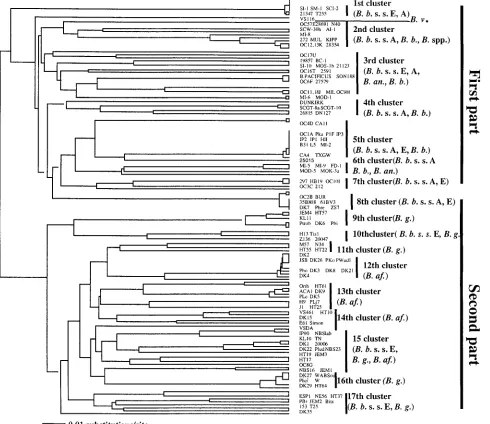
Phylogenetic trees were also derived from 344 bp of nucle-otide sequences (from nuclenucle-otides 108 to 552) ofospCgenes and 146 deduced amino acid sequences (from amino acids 36 to 184) of OspCs. This fragment included the variable regions ofospC. The southern strains were compared with some other strains available in GenBank, and two trees indicated similar results; one is presented in Fig. 3. There were 17 clusters in the UPGMA tree which could be divided into two parts. The first part consisted ofB. burgdorferi sensu stricto (including both North American and some European strains), B. andersonii, andB. bissettiistrains. The second part consisted of Eurasian B. garinii, B. afzelii, and some EuropeanB. burgdorferi sensu stricto strains. TheB. burgdorferisensu stricto strains separated into 11 clusters, 8 of them located in the first part of the tree; in fact, they were the major strains in that part. Three of them shared clusters withB. gariniiandB. afzeliiin the second part of the tree. Three strains in three clusters of the second part were European B. burgdorferi sensu stricto strains (20006,
Z136, ESP1, and NE56); no North American strains were found in that part.
[image:6.587.48.536.77.459.2]Compared to EuropeanB. burgdorferisensu stricto strains, North AmericanB. burgdorferisensu stricto strains appear to have greaterospCheterogeneity. North AmericanB. burgdor-ferisensu stricto strains were dispersed in all eight clusters in the B. burgdorferi sensu stricto part of the tree, and three clusters were exclusively North American strains, but Euro-peanB. burgdorferisensu stricto strains were included in only five clusters (Fig. 3). Several of the EuropeanB. burgdorferi sensu stricto strains were closely related to North AmericanB. burgdorferisensu stricto strains, inasmuch as they shared five clusters. Nevertheless, they were different. EuropeanB. burg-dorferisensu stricto strains appeared genetically closer to each other and grouped into two major clusters. For example, PKa, P1F, IP1, IP2, IP3, and HII were located in the same branch as strains 35B808, 61BV3, DK7, PBre, and ZS7. Interestingly, only EuropeanB. burgdorferisensu stricto strains were found in the European genospeciesB. gariniiandB. afzeliipart of the tree (Fig. 3).
FIG. 2. Phylogenetic tree derived from the deduced amino acid sequences of southern and reference strains ofBorrelia burgdorferisensu lato. The tree was constructed with PAUP software and was based on a comparison of 208 OspC amino acids.B. b.ss,Borrelia burgdorferisensu stricto;
B. b.,Borrelia bissettii;B. an.,Borrelia andersonii;B. g.,Borrelia garinii;B. af.,Borrelia afzelii;B. v.,Borrelia valaisiana.
on May 15, 2020 by guest
http://jcm.asm.org/
Greater genetic differences were observed among southern strains than northern strains in North America. Nineteen southern strains separated into all six clusters in theB. burg-dorferisensu stricto part of the tree and were dispersed into nine branches (Fig. 3). SouthernB. burgdorferi sensu stricto strains occupied three branches. The first branch consisted of SI-1, SM-1, and SCI-2, which shared the cluster with North American and European B. burgdorferi sensu stricto strains. The second branch contained southern strains MI-2 and North American strain B31 as well as several European strains that have the sameospCsequence. The third branch was shared by southernB. burgdorferisensu stricto strain MI-5, southernB. bissettii strains MI-9 and FD-1, and southern B. andersonii strains MOD-5 and MOK-3a. Southern B. andersoniistrains BC-1, SI-10, and MOS-1b and southern B. bissettii strains
SCW-30h and AI-1 occupy separate branches. However, south-ernB. bissettii strain MI-6 shared a branch with southern B. andersonii strain MOD-1. Interestingly, but not surprisingly, MI-8, as noted in our previous reports (35; Lin et al., Proc. VIII Int. Conf. Lyme Borreliosis Other Emerg. Tick-Borne Dis.), is present but distinct fromB. burgdorferi sensu stricto strains. As noted earlier, its taxonomic status remains uncer-tain, but it appears to be an undescribed genospecies.
DISCUSSION
[image:7.587.53.543.77.501.2]Usually, the greater the genetic diversity of a given species, the longer the time that was available for its evolution. When several phylogenetic trees derived from different genes or mo-lecular markers are compared, if the topologies of the trees are
FIG. 3. Phylogenetic tree determined from the DNA sequence of theospCgenes of southern and other genospecies strains ofB. burgdorferi sensu lato. The UPGMA tree was constructed with PAUP software and is based on a comparison of 344 bp ofospCgenes. The tree was compared with the trees produced by neighbor-joining, maximum-likelihood, and parsimony methods with PAUP software. The four methods produced similar results. Scale bar represents calculated distance value. The abbreviations are defined in the legend to Fig. 2. A and E, America and Europe, respectively (these letters indicate the geographic origins of the isolates).
2578 LIN ET AL. J. CLIN. MICROBIOL.
on May 15, 2020 by guest
http://jcm.asm.org/
different, this may suggest that genetic transfer or recombina-tion has occurred. The phylogenetic trees generated from the ospC gene of southern strains show greater differences than phylogenetic trees derived from therrf-rrlintergenetic spacers (35), pulsed-field gel electrophoresis (39; Lin et al., Proc. VIII Int. Conf. Lyme Borreliosis Other Emerg. Tick-Borne Dis.), and randomly amplified polymorphic DNA fingerprint (Lin et al., Proc. VIII Int. Conf. Lyme Borreliosis Other Emerg. Tick-Borne Dis.).
Similarity matrixes, amino acid sequences, phylogenetic trees, and majorospCgroups all suggest that lateral transfer and internal gene recombination of the ospC gene occurred betweenB. burgdorferisensu stricto andB. bissettiior between B. bissettiiandB. andersonii. OspC diversity may be promoted by several mechanisms, including host-stimulated immunolog-ical selection, gene transfer, intragenomic gene recombination, effects of environmental constraints, or other factors. Of these
factors, frequency-dependent selection might be the major force maintaining the variation inospC(21, 64).
[image:8.587.49.538.84.511.2]The great diversity of OspC compared to OspA (a single type in B. burgdorferisensu stricto and B. afzelii) (30, 70) is strong evidence that immunological selection and gene trans-fer happened frequently inB. burgdorferisensu stricto andB. afzelii. This frequency-dependent selection is created by the host immune system, because OspC is a major protective an-tigen and is expressed on the surface of spirochetes during tick feeding (54). It can cause a strong immunoglobulin M response at an early stage of disease (19). Interestingly, OspC can pro-tect animals against subsequent infection by the same strain (26) but not by heterologous strains (49). Also, injection with polyclonal and monoclonal antibodies to OspC can cure chron-ically infected mice and prevent reinfection with the same strain. It can also cure current infection (72). To escape selec-tive immunological pressure caused by hosts, spirochetes can
TABLE 4. Relationships betweenospCmajor groups and their biological sources and geographic origins MajorospC
group Strains Biological sourcesa Origins
A HII, IP1, IP2, IP3, P1F, L5, TXGW Patients (blood, CSF, synovial fluid, skin) USA (New York, California, Texas, Florida)
MI2 Animal (P. gossypinus) Italy, France, Austria, Germany
B31, CA4, Pka Ticks (I. scapularis, I. pacificus, I. ricinus)
B 61BV3, BUR, DK7, Pbre Patients (skin) USA (New York)
35B808, ZS7, OC2 Ticks (I. scapularis, I. ricinus) Germany, Denmark
C OC3 Tick (I. scapularis) USA (New York)
D CA11.2A, OC4 Ticks (I. scapularis, I. pacificus) USA (New York, California) E 28691, N40, OC5, OC7 Tick (I. scapularis) USA (New York, Pennsylvania) F 27579, OC6,B. pacificus, Son188 Ticks (I. scapularis, I. pacificus) USA (New York, Connecticut, California)
G OC8 Tick (I. scapularis) USA (New York)
H OC9 Tick (I. scapularis) USA (New York)
I 297, HB19, OC10 Patients (blood, CSF) USA (New York, Connecticut)
Tick (I. scapularis)
J MIL, OC11 Ticks (I. scapularis, I. ricinus) USA (New York), Slovakia
K 272, 297, KIPP, MUL, 28354, OC12, OC13 Patients (CSF, skin) USA (New York, Connecticut, Maryland) Tick (I. scapularis)
L 21347, T255 Animal (P. leucopus) USA (Wisconsin), Germany
Tick (I. ricinus)
M 2591 Animal (P. leucopus) USA (Connecticut)
N 26815 Chipmunk USA (Connecticut)
O DUNKIRK Patients (skin) USA (New York)
P 20006 Tick (I. ricinus) France
Q 212 Tick (I. ricinus) France
R ESP-1, NE56 Tick (I. ricinus) Spain, Switzerland
S Z136 Tick (I. ricinus) Germany
T OC16 Patient (EM) USA (New York)
U OC17 Patient (EM) USA (New York)
V S-1, SM-1, SC-12 Animal (P. gossypinus) USA (Georgia)
W DN127 Tick (I. pacificus) USA (California)
X 25015 Tick (I. scapularis) USA (New York)
Y MI-5, MI-9, FD-1 Animal (P. gossypinus, S. hispidus) USA (Florida)
Z MI-8 Animal (S. hispidus) USA (Florida)
A1 AI1 Animal (S. hispidus) USA (Georgia)
B1 SCW-30h Tick (I. minor) USA (South Carolina)
C1 SCGT-8a, SCGT-10 Animal (N. floridana) USA (South Carolina)
Tick (I. minor)
D1 MI6, MOD1 Animal (S. hispidus) USA (Georgia)
Tick (I. dentatus)
E1 21123 Tick (I. dentatus) USA (New York)
F1 BC1 Tick (I. dentatus) USA (Georgia)
G1 MOS1b, SI-10 Ticks (I. dentatus, I. scapularis) USA (Georgia, Missouri)
H1 MOD5 Tick (I. dentatus) USA (Missouri)
I1 MOK3a Tick (I. dentatus) USA (Missouri)
J1 VS461 Tick (I. ricinus) Switzerland
K1 20047 Tick (I. ricinus) France
L1 VS116 Tick (I. ricinus) Switzerland
aCSF, cerebrospinal fluid; EM, erythema migrans.
on May 15, 2020 by guest
http://jcm.asm.org/
change theirospC sequences and thus cause variation of the ospCgene.
In addition to immunological selection, there is another strategy for bacteria to escape immunological attack. The spi-rochetes which produce stable OspA are kept in the tick, and spirochetes which produce OspC or nothing are able to enter a host. Recent studies show that before the blood meal, spiro-chetes in the tick are a homogeneous population that mainly produce OspA. During the blood meal, the population be-comes more heterogeneous. Many spirochetes produce both OspA and OspC, whereas others produce only a single Osp, and a few produce neither Osp. Most of the spirochetes in the salivary glands and host dermis produce neither OspA nor OspC, and a significant minority produce only OspC. OspC may play a role in allowing the spirochetes to escape from the gut into the hemocoele. OspA serves to bind spirochetes in the tick midgut, and OspC facilitates transfer from the gut lumen to the hemocoele (41). By downregulating OspA, the spiro-chetes might free themselves to migrate through the midgut epithelium and out of the midgut (26, 46, 59, 60). Spirochetes change their expression pattern of Osps in ticks when they move from the gut to the salivary gland and host dermis (41). Isolate MI-8 was considered an undescribed genospecies in our previous report (35), and the currentospC analysis sup-ports this conclusion. It occupies a separate branch in both of the phylogenetic trees (Fig. 2 and 3) derived from amino acid sequences and partial nucleotide sequences ofospC. It shares a branch with southern B. bissettii strains SCGT-8a and SCGT-10 in the tree derived from amino acid sequences (Fig. 2). In the tree generated from partial nucleotide sequences, it is related but distinct fromB. burgdorferisensu stricto strains
272, 28354, MUL, KIPP, 28691, and N40 and southern B.
bissettiistrains AI-1 and SCW-30h (Fig. 3). Whole DNA-DNA hybridization analysis with a group of strains containing MI-8 did not allow a clear conclusion because the hybridization levels were in borderline positions (Guy Baranton, Pasteur Institute, Paris, France, personal communication).
Since the North AmericanB. burgdorferisensu stricto strains in the clusters noted above were isolated from human skin, the major tick vectorI. scapularis, or the common animal reservoir, P. gossypinus, perhaps the MI-8 strain and the southern B. bissettii strains SCW-30h and AI-1 in this cluster might be infective to humans (Fig. 3). Also needing further evaluation is another undescribed southern spirochete isolate, TXW-1. As noted in the Results, we were unable to amplify theospCgene under various PCR conditions. Whether it lacks theospCgene or the undetected gene in this isolate is truncated or otherwise altered at the primer sites remains to be determined. Although this strain appeared to be close toB. gariniiin our previous analysis (35) using PCR-restriction fragment length polymor-phism of therrf-rrlintergenic spacer, data in the present study suggest that it belongs to an undescribed species among re-lapsing fever borreliae.
OspC might play a direct role in determining the potential for a given isolate to cause disseminated disease. The major ospC groups of B. burgdorferi sensu stricto found in human erythema migrans lesions are only a subset of the groups found in ticks based on single-strand conformation polymorphism analysis (27, 64). Moreover, of the 58 definedospCgroups inB. burgdorferisensu stricto,B. garinii, andB. afzelii, only 10 groups
belong to known invasiveBorreliastrains that are able to cause disseminated infection in humans (9, 21).
Infectivity and pathogenicity of most southern strains re-main to be determined. Thus far, only B. burgdorferi sensu stricto has been confirmed to be pathogenic for humans in the United States.B. andersonii occurs in the eastern half of the United States and appears to exist primarily in an enzootic cycle involving cottontail rabbits andI. dentatus. Therefore,B. andersoniiis thought not to infect humans.B. bissettiihas been isolated only from ticks and nonhuman animals to date in the United States. Whether it is infectious or pathogenic for hu-mans is unknown; however, several isolates identified as B. bissettiihave been isolated from Slovenian patients (46). This suggests thatB. bissettii might cause human Lyme disease in the United States. Earlier, strain 25015 from New York, the reference strain for this genospecies, was thought to be infec-tious but nonpathogenic in mice (3). However, a later study reported it to cause mild arthritis (23).
Typical and atypical B. burgdorferisensu stricto strains are found among southern isolates (Fig. 2 and 3). Southern B. burgdorferi sensu stricto isolates appear in almost all of the branches in the North American part of the tree. This indicates great genetic diversity among southern B. burgdorferi sensu stricto. Typical southern B. burgdorferi sensu stricto strains, such as MI-2, are quite similar to the B31 reference strain and are located in the same branch (Fig. 2 and 3). Previous analyses based onrrf-rrlintergenic spacer sequences indicate the same association (35). Except for B31 which was isolated from the tickI. scapularis, all the strains in this branch of the tree were isolated from cerebrospinal fluid, blood, synovial fluid, and skin of patients in Europe (Fig. 2 and 3). MI-2 most closely aligns with a group that possesses many proven human-invasive strains (9, 57). TXGW and MI-2 are currently the only two known southern isolates that belong to this group.
The ospCgenotype is associated with invasiveness and in-fectivity ofB. burgdorferiand might determine the difference in pathogenicity between clones (9, 57). A given strain is defined as invasive if it is isolated from a secondary site in the body, for example, blood, joints, or the central nervous system. Although OspC is not expressed as a major protein inB. burgdorferiin culture, it is an immunodominant protein of the early humoral immune response in humans (1, 19, 65, 67; B. Wilske, V. Preac-Mursic, G. Schierz, G. Liegl, and W. Gueye, Proc. Lyme Borreliosis Update Europe, p. 299–309, 1987) and is a specific and sensitive marker for the early stage of Lyme disease (43, 68, 69). The expression pattern of ospC plays a role in the infection cycle of the spirochete (54, 59–61).ospCis expressed andospAis repressed when the ticks begin feeding on mice and humans (24, 54). Factors that regulate the switch from expres-sion of OspA to OspC are likely varied and complex. The switch is in part due to the change in temperature; ospC is induced at 32 to 37°C, but not at 24°C (54, 59–61). Other factors, such as cell density (18), growth phase (50), or a change in pH (14, 15), involve the expression regulation of OspC and OspA. OspC expression was shown to increase in cultures treated with hemolymph (31). Evidence suggests co-regulation of theospAandospCgenes (33).
The majorospCgroups found in human erythema migrans lesions are only a subset of theospCgroups found in ticks (57). Moreover, of the 22 majorospCgroups inB. burgdorferisensu
2580 LIN ET AL. J. CLIN. MICROBIOL.
on May 15, 2020 by guest
http://jcm.asm.org/
stricto, only four groups (A, B, I, and K) had higher frequen-cies in the primary infected sites than in ticks and were the only groups found in secondary sites. The frequency distribution of ospCgroups from ticks is significantly different from that from primary sites (erythema migrans lesion or skin rash), which in turn is significantly different from that in secondary sites (blood, joints, or the central nervous system) (57). Similarly, of the 14ospCmajor groups inB. afzelii, only 2 groups contain the putative invasive isolates, and of 22ospCgroups inB. garinii, 4 groups contain all the putative invasive isolates (9, 57). Thus, there are only a minority (10 of 58) ofospCgroups in the three genospecies (B. burgdorferisensu stricto,B. garinii, andB. af-zelii) that are invasive and able to colonize and persist in organs other than skin. Other groups may cause erythema migrans but do not appear to be invasive and disseminate to other organs.
Twelve major ospC groups are recognized among our 19 southern strains analyzed here. Likewise, of the 12 ospC groups, only one is considered to be in the invasive group (A). SouthernB. burgdorferisensu stricto strain MI-2, isolated from a cotton mouse from Florida, most closely aligns with a group that possesses many proven human invasive strains. Transmis-sion experiments showed that this group of southern spiro-chetes is able to infect mice and hamsters and thatI. scapularis can transmit it (J. H. Oliver et al., unpublished data). This suggests that typical B. burgdorferi sensu stricto strains with strong virulence and invasiveness exist in certain enzootic cy-cles in the southern United States and that MI-2 might be able to cause invasive human Lyme disease. Other southern B. burgdorferisensu stricto strains, such as SI-1, SM-1, and SCI-2, are genetically closely related to North AmericanB. burgdorferi sensu stricto strain 21347 (L) and European B. burgdorferi sensu stricto strain T255 (ospC group L), from the white-footed mouse andI. ricinus, respectively.
The diversity ofospCin one local population in New York was almost as great as the diversity worldwide (64). However, our results suggest that the distribution ofospCmajor groups might be associated with geographic sites. Of the threeospC groups containingB. burgdorferi sensu stricto isolates, two of them (SI-1 group and MI-5 mixture group) separated into different branches in the tree and formed differentospCgroups (Fig. 2, Table 4).
B. andersoniiandB. bissettiistrains were distributed through-out the clusters in theB. burgdorferisensu stricto part of the tree, suggesting that these three genospecies are closely related (Fig. 3). Perhaps genetic transfer or intragenomic gene recom-bination occurred among southern strains and also between southern and northern strains. Several methods can be used to determine genetic transfer or recombination based on se-quence data (21). The first method is to compare several gene trees generated from the same set of strains but different mo-lecular markers; a difference in branching order is evidence for recombination. Comparison of the phylogenetic trees gener-ated fromrrf-rrlintergenic spacer, fla,rrs, pulsed-field gel elec-trophoresis, and random amplified polymorphic DNA shows that the phylogenetic trees generated from theospCdata are different from the trees derived from others. This suggests that lateral transfer of theospCgene or intragenomic gene recom-bination occurred betweenB. burgdorferisensu stricto andB.
bissettiiand betweenB. bissettiiandB. andersonii, as mentioned in the Results.
Another method is to find significant similarities in se-quences among different genospecies. Close identity was ob-served between the ospC sequences of B. burgdorferi sensu stricto andB. bissettiiand betweenB. bissettiiandB. andersonii. All the differences between the phylogenetic trees generated fromospCdata and the trees generated from other genes and the close identity of ospC sequences among genospecies are caused by the introduction of a small piece of DNA (about 500 bp) into the central variable region of theospCgene (Table 3). Southern B. burgdorferi sensu stricto strain MI-5 shared a branch with southernB. bissettii strains MI-9 and FD-1, and this branch combined with southern B. andersonii strains MOD-5 and MOK-3a (Fig. 3). They were located in the fourth cluster of the tree, which contained most of the typical North American and European B. burgdorferi sensu stricto strains. This distribution adds additional evidence suggesting that the three southernB. burgdorferi genospecies are closely related. The evolutionary process continues, and the different levels of infectivity and virulence among the strains may be due to selection pressures in the tick vectors or animal hosts or to environmental conditions.
It is not strange that the southern B. andersonii strains MOD-1, BC-1, SI-10, and MOS-1b shared the same cluster as B. andersoniistrains 21123 and 19857 from the north. All of them belong to theB. andersoniigenospecies and were isolated from I. dentatus and/or cottontail rabbits except for SI-10, which was isolated fromI. scapularis. Unexpectedly, however, they were grouped into the same cluster as the southern B. bissettii strain MI-6 and the North American B. burgdorferi sensu stricto strains 27579,B. pacificus(strain name, not geno-species name), SON188, and the EuropeanB. burgdorferisensu stricto strain MIL (Fig. 3). The strains in the major ospC groups F, H, J, T, and U also grouped into this cluster (Fig. 3). Except for MI-6, which was isolated from a cotton rat in Flor-ida, all these strains were isolated from ticks in theI. ricinus species complex.B. pacificusand SON188 were isolated from I. pacificusticks in California, 27579 was isolated fromI. scapu-larisin Connecticut, MIL was isolated fromI. ricinusin Slova-kia, and strains inospCgroups F, H, J, T, and U were isolated fromI. scapularisfrom New York. The data suggest that the tick vector plays a role in the evolutionary process of theospC gene. This interaction is probably influenced by geographic lo-cation and the genospecies distribution ofBorreliastrains. That is probably whyBorreliastrains from different genospecies and different geographic locations occupy distinct branches in the same cluster in phylogenetic trees (Fig. 2 and 3).
ACKNOWLEDGMENTS
This research was supported in part by grant R37 AI-24899 from the National Institutes of Health and cooperative agreement U50/ CCU410282 from the Centers for Disease Control and Prevention.
We thank G. Baranton (Pasteur Institute, Paris, France), B. Wilske (Max von Pettenkofer Institut fur Hygiene und Medizinische Mikro-biologie, University of Munich, Munich, Germany), and M. Fukunaga (Fukuyama University, Fukuyama, Japan) for reviewing the manu-script and G. Teltow (Texas Department of Health) for sending us the
Dermacentor variabilistick from which we isolated the TXW-1
spiro-chete strain. We thank two anonymous reviewers for suggestions to improve the manuscript.