G
l o b a lP
r o c e s s e s a n dL
o c a lE
f f e c t s:
F
o o dP
r o c e s s i n gT
r a n s n a t io n a lC
o r p o r a t i o n s in t h eD
e v e l o p in gW
o r l dPamela Tortora
London School o f Economics
PhD Thesis
UMI Number: U164566
All rights reserved
INFORMATION TO ALL USERS
The quality of this reproduction is dependent upon the quality of the copy submitted.
In the unlikely event that the author did not send a complete manuscript and there are missing pages, these will be noted. Also, if material had to be removed,
a note will indicate the deletion.
Dissertation Publishing
UMI U164566
Published by ProQuest LLC 2014. Copyright in the Dissertation held by the Author. Microform Edition © ProQuest LLC.
All rights reserved. This work is protected against unauthorized copying under Title 17, United States Code.
ProQuest LLC
789 East Eisenhower Parkway P.O. Box 1346
/ H £ S £ S
F
795Z
^ OF .
P O U T IC A L
ABSTRACT
The physical manifestations of economic globalization are two fold: (i) there are global processes at work; and (ii) there are impacts from those processes. In conceptualizing what global processes really are, the primary agent of global economic activity, the transnational corporation (TNC), must be scrutinized. Since TNC operations between industries differ, assessments must be made on an industry-specific level. Accordingly, this thesis uses an interdisciplinary approach to uncover and evaluate the global workings of TNCs in one o f the largest worldwide industries - the food processing industry. Using as case studies the three largest TNCs in the industry (Nestle, Unilever and Philip Morris), an in-depth investigation is launched into how these institutions are global facilitators. A typology o f food processing TNC activity is developed which identifies three key areas of global firm activity - Global Production, Global Management and Global Partnershipping. This triad provides the analytical framework with which to assess food TNC global processes and to subsequently link these global processes to local impacts.
r
TABLE OF CONTENTS
Chapter 1: Introduction: Global Processes and Local Effects ... 9
Defining Globalization... 10 Perspectives on the ‘Global Economy’ ... 13
• Views on Global Processes and the Nation-State • Focusing on the Transnational Corporation • Connecting the ‘Global’ to the ‘Local’ Outline of Research Design:
A Framework for Evaluating Global Processes and Local E ffe c ts... 29 Appendix 1.1: List o f Developing Countries According to the UNDP ... 34
Chapter 2: The Transnational Corporation and the Food Industry:
Global Strategies for a Global In d u str y 35
Assessing the Transnational Corporation and the Global Food Industry... 36 • Studying the Transnational Corporation
• Understanding the Global Food Industry
Transnational Corporation Strategies...45 • Phases in TNC Growth
• Competing Views on ‘Global Strategies’
Global Processes Facilitated by Food Processing Transnationals ... 54 • Global Production ... 54
-Manufacturing and Operations -Distribution
-Product Design and Standardization
• Global Management... 61 -Corporate Policy and Structure
-Marketing Strategy
-Research & Development and Technology
• Global Partnershipping... 72 -Mergers and Acquisitions
-Strategic Alliances via Joint Ventures -Non-equity Partnershipping
Appendix 2.1: S.I.C. Classification of the Food Processing Industry (‘Food and Kindred
Products’) ... 80 Appendix 2.2: Selected Mergers & Acquisitions in the Food Processing
C hapter 3: The Global Food Processing Sector in the Developing World:
‘The Global’ and ‘the Local’ ... 83
Perspectives on Global Food and Agriculture...83
The Impact of Transnational Corporations Through Local Linkages and Spill-Over E ffe c ts 88 ^ • Assessing the Impact o f Transnational Corporations • Local Linkages and Spill-Over Effects Linking Food TNC Global Processes to Local Effects in the Developing W orld 93 v • Connecting Global Partnershipping to Local Effects ...93
-Effects From Subcontracting via Contract Farming (i) Linkages to Agriculture, Rural Community and Food Security (ii) Links to Technology, Employment, Labour Conditions and Environment (iii)Training, Local Incomes, Nutrition and Consumption Linkages -M&A and Joint Venture Linkages to Local Incomes, Labour Conditions, v Local Firms and Technology • Assessing Global Production and Local Effects... 105
-Primary Linkages to Employment, Education, Training, Labour Conditions, Technology and Local Incomes From Manufacturing, Distribution and Product Design • Examining Global Management and Local Effects... I l l -Marketing Strategy and Local Linkages to Nutrition, Consumption, Local Incomes and Environment -Research & Development Strategies are Linked to Local Firms, Nutrition, Training, Labour Conditions, Education and Technology -Corporate Policies and Structures are Linked to all Thirteen Key Local Impacts TNCs and Corporate Social Responsibility... 119^
Review of Framework... 121
C hapter 4: Applied Global Strategies: Nestle in R e v ie w ... .. 123 *
Nestle: A Brief H isto ry ... 124
Global Production at N estle... 129
• Production for Global Export and Local Markets • Globally-Standardized vs. Locally-Differentiated Products Nestle’s Use of Global Management ... 137
• Global Marketing Concepts Applied in Locally-Differentiated Markets • Global Networks of R&D, with Local Applications • Global Guidelines for Corporate Policy and Structure - Nestle’s Mission Statement in Practice V -Centralized Authority is used in Nestle’s Pursuit o f Global Corporate Guidelines Strategic Growth Through Nestle’s Global Partnershipping... 149 v • Mergers, Acquisitions and Joint Ventures Expand Global Operations • Non-Equity Global Partnershipping Used to Purchase Inputs Appendix 4.1: Geographic Breakdown of Nestle’s Worldwide Manufacture and Sale of Products... 157^
C hapter 5: Linking Global Processes to Local Effects:
Nestle in the Developing World ... 181
Nestle’s History in the Developing World ... 182 ^
Linkages through Nestle’s Global Partnershipping Strategies... 186
• Farm Technical Assistance Targets Technology, Agriculture and Rural Communities: The Case of the Moga Milk District in India & • Joint Venture Agreements which are Tied to the Development of Agriculture: The Case of Contract Farming in the Yunnan Province in China • Acquiring Local Firms Influences Local Industry, Technology and Training Linkages via Nestle’s Global Production N etw ork... 199 ^
• Production is Linked to Employment, Local Incomes, Labor Conditions, Local Firms and Training • Food Security, Exporting, Importing and Nestle’s Processed Foods Linkages From Nestle’s Global Management E ffo rts... 204
• Product Innovation through R&D is Linked to Nutrition and Education • Marketing Practices are Linked to Consumption and Nutrition: The Case of the Infant Formula Controversy • Beyond Infant Formula: Linkages From Nestle’s Marketing of Other Products • Corporate Policies are Linked to Energy, the Environment and Employees Summary Remarks on the Nestld Case Study Analysis...218
C hapter 6: Comparing Unilever and Philip Morris to Nestle: Evidence of Similar Global Processes, Suggestions of Possible Variable Local Effects . . . 219
Distinctive Structures, But Similar Histories: Comparing Unilever and Philip Morris to Nestle ...220
Similar TNC Global Processes Promote the Globalization of the Food Processing Industry... 224
• Global Expansion of the Food Processing Industry Through Global Partnershipping • Global Standards Exist Among Food Processing TNCs Through Global Production and Global Management Different TNC Corporate Policies Suggest Possible Variable Local Effects in the Developing W o rld ... 237
• TNC Corporate Policy Can Influence How Global Processes Impact Local Conditions • Corporate Social Responsibility Distinguishes TNCs within the Global Food Processing Industry Appendix 6.1: Sources on Unilever’s Activities in the Developing W orld... 256 *
Appendix 6.2: Sources on Philip Morris’ Activities in the Developing World ...268
Appendix 6.3: Profile of Source Quotes on Unilever’s Global Operations... 277^
C hapter 7: Conclusion...282 Global Processes - One Side o f the Globalization E q u atio n ... 284 Local Linkages and Effects - The Other Side of the Globalization Equation ... 289 Observable Trends and Influences - Assessing and Balancing
the Globalization Equation... 293 Final Remarks on Research Framework...298
BIBLIOGRAPHIES AND TABLES
Bibliographies: This thesis contains the following four separate and distinct bibliographies:
General Bibliography...302
Nestle Bibliography...335
Unilever Bibliography... 352
Philip Morris Bibliography... 361
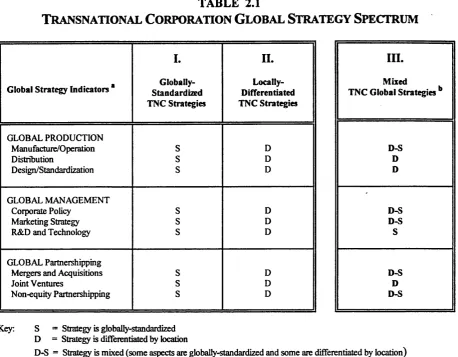
Tables: Table 2.1- Transnational Corporation Global Strategy S p ectru m ...52
Table 3.1- Matrix o f Global Processes and Local Linkages: The Case o f Food Processing TNCs in the Developing W o rld ...92
Table 4.1 - Nestle’s Financial Growth, 1966-1996 ... 128
Table 4.2 - Nestle’s Production Facility Growth Rate, 1966-1996 ... 131
Table 4.3 - The Growth in Nestle’s Global Partnershipping, 1986-1996... 151
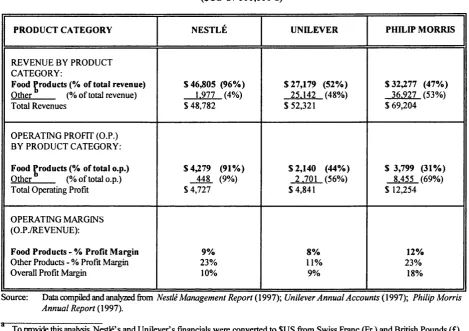
Table 6.1 - Global Product Category Financial Breakdown (Nestle/Unilever/ Philip M o rris)...221
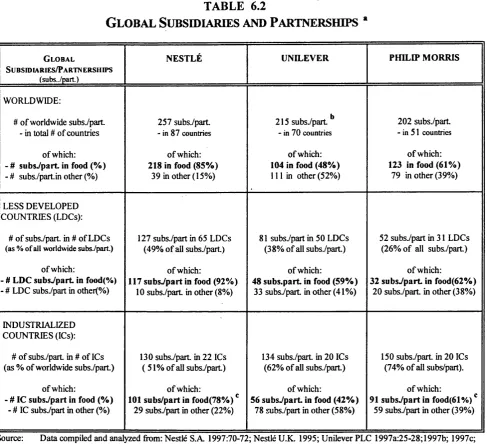
Table 6.2 - Global Subsidiaries and Partnerships (Nestle/Unilever/Philip Morris) . . . 228
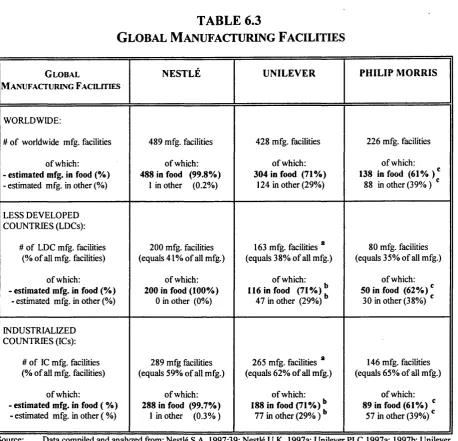
Table 6.3 - Global Manufacturing Facilities (Nestle/Unilever/Philip M orris)... 231
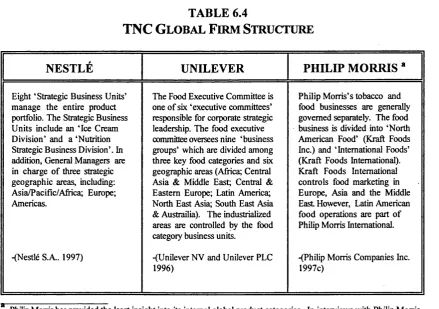
Table 6.4 - TNC Global Firm Structure (Nestle/Unilever/Philip Morris) ... 235
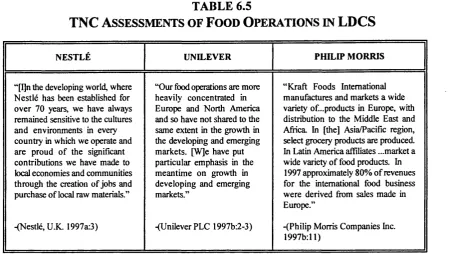
Table 6.5 - TNC Assessments o f Food Operations in LD C s... 243
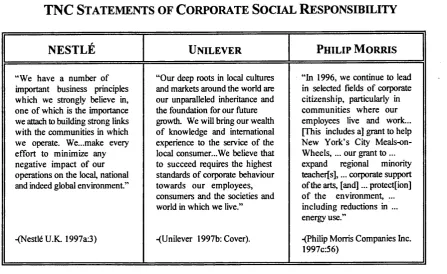
Table 6.6 - TNC Statements o f Corporate Social Responsibility ... 245
Table 6.7 - Indicative Quotes o f TNC Stated Aims and G o a ls... 248
Table 7.1- Summary of Key Nestle Global Strategies...288
Table 7.2 - A Snapshot of Selected Nestle Local Linkages ... 295
ABBREVIATIONS
$ - United States Dollar
EIU - Economist Intelligence Unit
ESCAP - Economic and Social Commission for Asia and the Pacific
DC - Developing Country
FAO - Food and Agriculture Organization
GNP - Gross National Product
IC - Industrialized Country
ILO - International Labour Organization
JV - Joint Venture
KJS - Kraft Jacobs Suchard
LDC - Less Developed Country
M&A - Merger and Acquisition
OECD - Organization for Economic Cooperation and Development
PM - Philip Morris
R&D - Research and Development
TNC - Transnational Corporation
UNCTAD - United Nations Conference on Trade and Development, Division on TNCs
UNCTC - United Nations Centre on Transnational Corporations
UNDP - United Nations Human Development Program
UNIDO - United Nations Industrial Development Organization
WHO - World Health Organization
Chapter 1
INTRODUCTION: GLOBAL PROCESSES AND LOCAL EFFECTS
As telecommunications and information technologies facilitate access to the globe, the term ‘global’ has become a popular descriptive marker. A number of different aspects o f society are perceived to be ‘globalizing’. Some scholars speak o f a global economy, others of a global culture, and others of the global environment. Processes within these areas are argued to be spreading throughout the globe and influencing attitudes, outcomes and structures. There are differing conceptions among scholars both within and between disciplines as to what globalization actually means. In order to pinpoint which, if any, aspects o f society might be globalizing it is necessary to first identify potential global processes at work.
Some claim that the economy is the driving force behind all types of globalization. According to this view, it is primarily the transnational corporation (TNC) which orchestrates global economic change. As production, distribution, marketing, research, development, mergers, acquisitions and joint ventures are integrated and spread throughout a wide geographic area, transnational corporations are argued to have become truly global institutions. These business institutions, which produce and market products worldwide, are considered to be key agents o f ‘global processes’.
Global processes facilitated by TNCs vary according to industry. Not only do different classes of consumer goods impact economic life in distinct ways, but TNC operations between industries obviously differ. For instance, a car is neither manufactured nor used in a similar way as a packaged food. The difference between the two is not least that almost
everybody on the planet has consumed a processed or packaged food, while relatively fewer have purchased a car. Since no single product is more widely purchased than food, and because the food processing industry transforms this commodity into a globally marketed and widely available consumer good, an analysis of food industry TNCs provides a useful case in the investigation o f global processes and local effects. How food processing TNCs affect local conditions is especially important in the developing world, where local impacts on food security, incomes, nutrition, training and agriculture are potentially far-reaching.
An explanatory methodology is developed in this thesis which not only identifies the ‘global processes’ o f food processing transnational corporations, but also identifies and evaluates how these processes are linked to ‘local effects’ in the developing world. This two- part research concern not only contributes to an analysis o f what global processes in economic life really are, but also contributes to an understanding o f the connection between the ‘global’ and the ‘local’. As introduced and developed in this chapter, while ideas about ‘global processes’ stem from the broader theoretical concern o f ‘globalization’, the notion o f ‘local effects’ is loosely extrapolated from the vast literature on ‘development’. An examination of these theoretical lines of inquiry is presented next.
DEFINING GLOBALIZATION
Using globalization as a theoretical framework is a relatively recent phenomenon (Sklair 1996; Waters 1995; Yearly 1996). Bonanno et al. (1994), writing specifically about the global food sector, note that aspects of globalization are often viewed along very specific disciplinary lines. For instance, an economist’s view o f globalization and a sociologist’s view will not necessarily conflict but may take quite different directions. Economists might focus on trade and investment issues, while sociologists might look more in-depth at production, consumption and cultural issues. This obviously does not come as a surprise, but emphasizes the fact that conceptions o f globalization certainly vary with one’s research interests.
Sklair (1996) notes that the study of globalization within the discipline o f sociology revolves around two main classes of phenomena. One group o f authors focus on the emergence o f new systems o f production, finance and consumption and point to qualitative changes within the ‘global economy’ (e.g. Ross and Trachte 1990; McMichael 1996; Sklair 1995). For another group o f authors the interest lies in identifying patterns and behaviour which signify a ‘global culture’ or ‘global society’ (e.g. Robertson 1992; Spybey 1996). As Sklair points out, “[w]hile not all globalization researchers entirely accept the existence o f a global economy or a global culture, most accept that local, national and regional economies are undergoing important changes as a result o f processes o f globalization” (Sklair 1996:6).
It is common for scholars writing on globalization to make a distinction between the ‘global’ and the ‘international’ (Dicken 1992; Sklair 1995; Hirst and Thompson 1996). When speaking of globalization and the economy, Dicken makes a functional distinction between the two terms:
The major theme is that...activity is becoming not only more internationalized but that, more significantly, it is becoming increasingly globalized. These terms are often used inter-changeably although they are not synonymous. ‘Internationalization’ refers simply to the increasing geographical spread of ..activities across national boundaries; as such it is not a new phenomenon^
‘Globalization ’...is qualitatively different. It is a more advanced and complex
form of internationalization which implies a degree o f functional integration between internationally dispersed...activities, (emphasis added, Dicken 1992:1)
Following the lead o f both Waters (1995:2) and Robertson (1992:9) in using the dictionary as a reference, I have found the American Heritage Dictionary: Second College Edition
(1995) definitions o f these terms extremely close to my own conceptions. International is defined as “o f relating to, or involving two or more nations” and “extending across the boundaries o f two or more nations” (i.e. specific to two or more nations). Globalization
means “the act, process, or policy of making something worldwide in scope or application”. Thus, ‘globalization’ need not mean that something covers the entire globe, but that
something is in the process of doing so or has the potential to do so (i.e. it is not specific to a selected number of nations).
In the literature, descriptions o f globalization vary according to focus. Waters (1995:5) views globalization as a “social process in which the constraints o f geography on social and cultural arrangements recede and in which people become increasingly aware that they are receding”. Waters is describing what he perceives to be the globalization o f culture and society. Others might doubt that cultural globalization is occurring and focus instead on the economy. Koc (1994:266), for one, describes globalization as “a process o f expansion o f commodity relations [and] integration o f domestic markets [which]...have created unbounded tendencies for the geographic expansion o f the accumulation process”. Koc is obviously describing globalization of the economy. In short, while the definitions o f these authors differ, both refer to globalization as a process.
Yearly (1996) divides the process o f globalization into the ‘subjective’ and the ‘objective’. Scholars researching global culture/society models examine the ‘subjective’ aspect of globalization. For example, subjective research evaluates how people in a globalized world view themselves in daily life and through individual choices and behaviour (Spybey 1996; Robertson 1992). Conversely, ‘objective’ processes of globalization are described as the identification and analysis of ‘global processes’ as manifested within the worldwide economy (Sklair 1995; McMichael 1996; Ross and Trachte 1990). Yearly identifies ‘the globalizing of business’ as a fundamental feature of globalization in the economy. Specifically, the transnational corporation is viewed as a primary vehicle through which global processes are facilitated.
However, as Sklair (1996:16) notes, while there has been a distinction between those who view globalization as a subjective or objective process, the interrelationship between both aspects o f globalization is important to consider. This becomes apparent further on when it is found that the global process of TNC marketing (objective process) affects local individual choices and behaviour (subjective process). Nevertheless, since this investigation focuses on
the global processes of TNCs, a review of perspectives on globalization and the economy (or global economy models) provides a necessary guiding framework.
PERSPECTIVES ON THE ‘GLOBAL ECONOMY’
Scholars writing on globalization have been grouped together based on when the phenomenon is believed to have originated (Water 1995:4). In terms o f those associated with global economy models, the distinction is between: (i) those who believe that globalization is a process which has been in operation for hundreds o f years, but which has recently accelerated through trade and liberalization; and (ii) those who believe it is connected to the development o f capitalism, in which global processes are characteristics o f new functionally- integrated structures, which are transforming the world economy into an increasingly globally integrated system.
In most trade journals and newspapers the term globalization is used to describe trade liberalization and government multilateral trade agreements.1 On the other hand, academically, globalization has been emphasized as a social process, signifying new functionally-integrated structures. These include global production, global business structures, global consumerism, global standardization and a global division o f labour. The changing nature of these processes is believed to be either contributing to, or reacting to, the globalization o f the economy. This thesis is theoretically connected to scholarly interpretations which tie globalization to global processes, rather than those that purely focus on national trade liberalization and deregulation. This is not to say that trade liberalization and deregulation are not important parts of the globalization process, but rather that this
!For example, trade publications writing on globalization and liberalization include The Economist ‘School’s B rief on globalization. Title articles include: ‘One world’ (Oct. 18,1997:134); ‘Capital goes global’ (Oct. 25,1997:139); ‘Workers of die world’ (Nov. 1,1997:115); ‘Trade winds’ (Nov. 8,1997:124); ‘Delivering the goods’ (Nov. 15, 1997); ‘Worldbeater, Inc. (Nov. 22,1997:132); ‘A world view’ (Nov.29, 1997); ‘Bearing the weight o f the market (Dec. 6,1997:14).
analysis evaluates the global processes and institutions which take advantage of a more integrated worldwide trading network.
The key issues raised by those researching globalization in the economy will be addressed in three sections. In the first section, competing positions on the status o f the nation-state in the globalization process are discussed. Following that, arguments which focus on the role of the transnational corporation as a global facilitator are introduced. Finally, in the context of development literature, an alternative framework for evaluating the effect of TNCs in the developing world is presented.
Vie w s o n Gl o b a l Pr o c e s s e s a n dt h e Na t io n-St a t e
Sklair (1995) and Ross and Trachte (1990) approach globalization from systemic frameworks. The focus of these authors is based on building a theory o f the ‘global system’ or ‘global capitalism’, respectively. Under these perspectives, a number o f processes or agents are identified which reinforce the view that globalization is a process which is
t
transforming the world-wide economic system into a globally-integrated system. Each views
2Yearly (1996:14) cites Wallerstein’s ‘world-systems’ theory as the first genuine ‘systemic’ attempt in sociology to understand “the development o f various individual societies in terms o f the broader world-historical context”. According to Wallerstein (1974), the modem world-system is represented by a ‘world-economy’, which is composed o f core, periphery, semi-periphery regions. Prior to the world-economy, the world-system is believed to have been comprised of a number of empires (or mini-systems) which functioned through a system of enhanced political power and control. While it is held that a number of world-empires have been created and destroyed through the centuries, the system of the world-economy has been more durable. The world-economy is described as experiencing periods of contraction and crisis which have invoked structural change and expansion. According to Wallerstein, once all areas of die world are ‘peripheralized’ into the capitalist world-economy a genuine change of the system will yield to world-socialism. Aside from the obvious criticisms o f Wallerstein’s prediction o f world- socialism, the belief that the world-system is hundreds of years old, as well as his dependence on identifying an hierarchical structure of nations, separates world-systems theory from contemporary views on globalization (Sklair 1996). In short, world-systems theory does not evaluate global institutions which facilitate global processes (Yearly 1996).
3As discussed below, Sklair (1995) identifies three agents of social change within the ‘global system’. This is in contrast to Ross and Trachte (1990), who are guided by Marxian ‘crisis theories’ in their assessment o f the ‘theory of global capitalism’. Crisis theories focus on why there is a tendency for the rate o f profit to decline domestically and consequently why capital seeks new outlets ‘internationally’ (see Baran and Sweezy 1996; Gottdiener and
(continued...)
the nation-state as having been substantially weakened from global processes. However, their arguments over the perceived weakness of the nation-state is a major point of contention for ‘anti-globalization’ authors who argue that the weakening o f the nation-state is a myth.
Hirst and Thompson (1996) point to the continuing existence o f nation-states as proof that globalization is not happening. Their assumption is that if globalization of the economy were taking place, it would signify the weakening o f the nation-state. Not only is this assumption flawed, but their criticism of globalization literature is weak, as no authors or positions are cited to prove a counter-argument. Instead, Hirst and Thompson fabricate a summary view o f what globalization means:
We deliberately chose not to write this book by summarizing and criticizing ...[globalization] literature, in part because that would be a never-ending enterprise...hence we decided to examine the evidence against [our own] concepts that could specify what a distinctive global economy would look like but which did not pre-suppose its existence. (ibid:3)
By not directing their criticisms at particular authors, one can only guess at which positions in the literature Hirst and Thompson are disputing. What is clear is that, in their description of the ‘ideal’ global economy, they concentrate on the relevance o f the nation-state. Hirst and Thompson argue that in a ‘true’ global economy “distinct national economies are subsumed and rearticulated into the system”, and transnational institutions can “no longer be controlled or even constrained by the policies of particular nation-states” (ibid: 10-11). They further argue that in order for globalization to be considered to be occurring there must be evidence that nation-states have become powerless. What Hirst and Thompson fail to recognize, in their reluctance to review the literature, is that few, if any, globalization authors claim that nation-states have become completely obsolete. The truth is that while globalization authors
3(...continued)
Kominos 1989; Shaikh 1978). However, it should be noted that while Ross and Trachte controversially use Marxist-inspired theories as a guiding framework, the case studies provided by the authors are empirically-based, focusing on the concrete local effects of selected global industries (as discussed below).
do often remark that the nation-state is affected by new global structures, its relative strength (not complete powerlessness) is only one among a number o f issues discussed.
As will become apparent, while it is not my view that the state has been rendered powerless due to new global processes, the nation-state is not this thesis’ primary unit of analysis. As Yearly (1996:9) remarks, “the scientific study o f society...has in practice long acted as though society was [entirely] found in the form o f nation-states”, thus complicating an investigation into largely independent global institutions. According to this viewpoint, focusing on the unit o f the nation-state can distract from an analysis o f global processes.
For instance, scholars such as Sklair are concerned with demonstrating that there are new actors within the global economy which have little connection to the nation-state:
. I distinguish between inter-national and transnational {...global) approaches / to the ‘global system’. This signals the difference between state-centrist approaches to an inter-national system based on the system o f nation-states and transnational approaches to a global system based on global forces and institutions. (Sklair 1995:4)
Sklair’s use o f the term ‘inter-national’ with a hyphen is meant to accentuate the point that the word means the interrelationship between nations, whereas ‘global’ is meant to signify a system o f social relations not founded on the relationship between nations. Hence, he describes ‘state-centrist’ approaches as those which prioritize the state or system of states as the unit o f analysis, while global approaches are those which focus on “transnational forces and institutions [in which] the ‘state’ is one among several key actors and...no longer the most important” (Sklair 1996b:4).
Sklair (1995) builds an analysis of the ‘global system’ by identifying a variety o f forces which are considered to be ‘transnational’ rather than ‘nationally’ based. His theory o f the ‘global system’ is founded on the identification of transnational practices (or global forces) which operate in the economic, political, and cultural spheres, as represented by the ‘TNC’, a ‘transnational capitalist class’, and ‘global consumerism’, respectively. Sklair argues that
these institutions and practices have transcended state boundaries and, as a result, there is limited connection to state agencies and actors. By concentrating on the strength o f the nation-state vis-a-vis global actors, Sklair’s global system theory is overshadowed by the necessity o f proving or disproving the relative strength o f the nation-state. While Sklair’s ‘global systems theory’ identifies global forces, his primary focus remains with proving that the agencies identified have transcended the nation-state. His thesis rests on proving globalization in a Wallerstein-like ‘systemic’ manner, rather than empirically testing global processes within an evolving system.
Reacting to arguments such as Sklair’s (1995) which claim that global institutions weaken the power of the nation-state, Hirst and Thompson (1996) understandably question whether institutions can in feet ever transcend state boundaries. In today’s world we continue to live in a grouping of nation-states and technically, in one way or another, business operations will always take place within distinct national boundaries. However, a fundamental weakness in Hirst and Thompson’s critique o f globalization literature is that they strictly equate the body o f literature with arguments which support the view that the nation-state is weakening. While examples throughout this thesis will confirm that governmental polices on industry do influence the actions of transnational corporations, simply because transnational corporations abide by national rules of law does not mean that they do not pursue global strategies. Studying the TNC and globalization does not necessarily force one to accept the view that either the nation-state is powerless or that the TNC maintains ultimate power.
In feet, some authors writing on globalization accept that the nation-state plays a key role in the globalization process. Dicken (1992:xiii) argues that global economic change is “the outcome o f the complex interaction between transnational corporations and nation
states set within the context of a volatile technological environment’. In his view, the nation
state contributes to the shaping and reshaping o f the global economic system. Likewise, Rodrik (1997) argues that while domestic norms and social institutions may be challenged by globalization, the role of government is not weakened, but needs to be re-thought and
strengthened to safeguard against social disintegration. Both o f these authors contend that the nation-state has an important role in the globalization o f the economy.
While perspectives on globalization processes offer a number o f consistent themes relating to global facilitators such as the TNC, opinions regarding the role or fete o f the nation-state in the global economy differ widely. In short, scholars studying globalization may or may not use the nation-state as a unit o f analysis, or they may or may not believe that the power o f the state is waning. As will be further elaborated on below, this thesis is interested in investigating local, not national, effects. Hence, the analysis to follow will focus on the impact global processes have on local communities and local peoples, rather than on entire nation-states. Nevertheless, while there are a number o f units o f analysis which authors researching the global economy focus on, one belief is that the transnational corporation acts as a key global facilitator.
F o c u s i n g o n t h e T r a n s n a t i o n a l C o r p o r a t i o n 4
It is not surprising that a wide variety of scholars consider the TNC to be a primary facilitator of global processes within the economy (Ross and Trachte 1990; McMichael 1996; Barnet and Cavanagh 1994; Dicken 1992). A key research area involves uncovering how these institutions both promote and react to social change in the global economy. Dicken (1992), for one, comments that the “TNC is the single most important force creating global shifts in economic activity” (ibid:47). As observed later in this thesis, the importance of TNCs in global economic life stems from their ability to regularly disperse operations globally and to efficiently shift resources between worldwide locations.
4This section serves as an introduction to the TNC in the context of globalization literature. A more detailed analysis of the theory and practice of the TNC will be provided in Chapter Two’s assessment of the food processing transnational corporation. In addition, Chapter Three will evaluate the impact food processing TNCs have in the developing world via ‘spill-overs’ and ‘linkages’ with local communities.
Scholars who argue that globalization is not happening refute claims that TNCs are global facilitators. For instance, Hirst and Thompson (1996) claim that if a TNC conducts a large amount of business within its ‘home markets’ then its global reach is limited. However, just because TNCs conduct business in ‘home markets’ does not mean they do not pursue global expansion. Moreover, measuring the extent o f geographic penetration is not the only indication o f global economic activity. Even Hirst and Thompson concede that there are ‘qualitative changes’ occurring in TNC business strategies which they do not consider (ibid:97). This thesis will argue that it is the qualitative changes in TNC activity which support new global processes.
In feet, new global business strategies are the primary vehicles through which TNC global expansion is taking place. Qualitative changes in TNC strategies are often reactions to changes in the business environment. For example, TNC global strategies have been nurtured a great deal by technological advancements. In turn, technological change is created and adopted by TNCs. As Guile and Brooks (1987) have argued, the ease with which technical knowledge is shared (i.e. between TNCs and affiliates) has nurtured the global integration o f economic activity. While technology enhances strategies available to TNCs, the role of technology in industrial change is influenced by the industry o f operation. As will be discussed in Chapters Two and Three, not all global strategies are technologically-inspired, especially in low-tech industries such as food processing.5
Focusing on industry differences, Barnet and Cavanagh (1994) demonstrate that transnational corporations support different areas of economic globalization according to specialization. For instance, through films, T.V., radio, music and magazines, TNCs in the global communications and entertainment industries are said to support the growth o f a ‘global culture’. On the other hand, advertising, distribution and marketing by TNC
^ h is is not to say that the food industry has not benefited from technological progress, but that industries such as electronics and automotives are more dependent on mechanical and mirco-electronic progress. On the other hand, as discussed throughout the next chapter, food processors benefit through improved communication, transport and production facilities, and are influenced by scientific advancements in biotechnology and genetic engineering (Connor 1988; Sorj and Wilkinson 1994; Goodman 1991).
manufacturers is believed to support the growth of ‘global brands’. While it is true that TNC manufacturers do support the growth o f ‘global brands’, each manufecturing industry achieves this through industry-specific global strategies. As will become apparent in Chapter Two, while there are certain similarities between the global operations o f different manufacturing industries, TNC activity will always be specific to the nature o f the product and the manner of production.
In order to mitigate against the tendency to make overall generalizations about the role of TNCs in the globalization process, it is important to select one industry o f study. Global processes facilitated by a food processing transnational corporation can greatly differ from those in other industries. There are many reasons for this, not least because the product lines between two industries can be diametrically opposed. For instance, when comparing the food and automotive industries, the following differences are apparent: (i) food is a consumer non durable, while cars are consumer durables; (ii) food is a low-value, high-volume commodity, while cars are high-value, low-volume commodities; (iii) food is consumed by everybody on the planet, while cars are purchased by a select few. TNCs from different industries will therefore invariably differ in terms o f both their role and impact on globalization processes. As a result, local effects will also vary depending on the unique global strategies pursued by TNCs in different industries.
Thus, lumping TNCs into one generic group does not allow for an in-depth study of the specific and unique global strategies of different manufacturing sector TNCs. For example, studying the automotive industry will not shed any light on global processes in the agriculture and consumer packaged goods sectors, but an analysis o f the food industry certainly will. Moreover, focusing on particular TNCs within an industry can only provide insight into the actions of those TNCs. Hence, while this thesis examines the food processing industry, the bulk o f empirical findings will be based on the case studies o f the three largest food processing TNCs worldwide. These include the principal case study o f Nestle and the
two comparative cases of Philip Morris and Unilever.6 However, studying the role o f food processing TNCs in economic globalization is one part of the equation. If food TNCs are globalizing, an important related question is how this affects local regions, local communities, and local people.
Co n n e c t in gt h e ‘Gl o b a l’ t ot h e ‘Lo c a l’
For Ross and Trachte (1990), TNCs are spearheading a new strategy in production based on ‘global spatial mobility’, in which low cost production areas in the developing world are argued to be a primary characteristic of the new ‘global capitalist system’. While noting that the global mobility o f firms has been an evolutionary process which is connected to past conceptions o f a changing division of labour (see the ‘new international division o f labour’ thesis discussed below), Ross and Trachte’s primary focus is on how this evolving global mobility affects wages, employment, and industrial movements. Examples o f abandoned factories in the once-thriving automotive industrial city of Detroit are used to demonstrate that the increased ability of firms to locate production sites globally weakens the power of labour unions and can depress wages.
Ross and Trachte are primarily concerned with the globalization o f business and its effect on labour. However, this is just one of many possible local effects. As will be
6According to Fortune magazine’s ‘global 500’ list, based on sales Nestld (Switzerland), Philip Morris (USA) and Unilever (U.K7Netherlands) are among the top forty corporations from all industries world-wide {Fortune,
August 1996; 1998). More specifically, at the time this empirical research was conducted, Nestle, Unilever and Philip Morris were consistently the three largest corporations within the food processing industry. When considering sales revenue attributed to the ‘food business’, Nestle is the largest ($46.8 billion), followed by Philip Morris ($32.3 billion), and then Unilever ($27.2 billion) (Nestle, S.A. 1997; Unilever 1997a; Phillip Morris 1997b). Unilever and Philip Morris both derive a large portion of sales from other industry categories (ie. tobacco and personal/home care products, respectively). As a result, Fortune magazine’s industry category for Philip Morris and Unilever sometimes varies from year to year, according to which industry the majority o f the TNCs’ revenue is earned. However, as detailed in Chapter Six, based on the annual reports o f these and other food industry TNCs, Nestle, Unilever, and Philip Morris consistently remain the top three generators o f revenue attributed to worldwide food processing activities. The next largest competitors, ConAgra (USA), Diageo (UK) and Sara Lee (USA) have total revenues in food processing significantly below the ‘big three’ food TNCs (ConAgra 1997; Diageo 1997; Sara Lee Corporation 1997; Fortune 1996; 1998).
discussed in Chapter Three, the global firm (or food processing TNC in our case) has instituted a number o f global processes via ‘global strategies’ which affect a range o f local conditions, including not only labour issues, but also local food security, consumption, nutrition, agriculture, rural community, technology, environment, nutrition and consumption. In short, this thesis’ socio-economic study of the ‘global’ will extend beyond simply evaluating global processes to also identify how TNC actions are linked to ‘local’ conditions.
For McMichael (1996), connecting the ‘global’ to the ‘local’ is an effective means by which to analyze how ‘globalization’ impacts ‘development’. The idea o f ‘development’ can be very subjective. As Harrison (1988:154-5) has observed:
[TJhere is no agreed definition of development. It is an inescapably normative term, which at various times has meant economic growth, structural economic change, autonomous industrialization...(etc.).
Perspectives on ‘development’ are most closely associated with the literature found in development economics and in the various theories associated with the sociology of development.7 These theories originated after the Second World War (hereafter referred to as the ‘post-war period’) following widespread decolonization. During that time, theorists from both sides o f the spectrum started to question the orthodox (classical and Marxist)
In the 1950s and 1960s, a group of scholars associated with the field o f development economics known as the ‘Pioneers of Development’ challenged neoclassical trade theory. Neoclassical theory supported the view that free trade and the absence o f governmental intervention would foster economic growth in the developing world. While not holding a unified position, the Pioneers of Development raised a number o f issues, such as ‘economic dualism’ and the ‘backwash effects’ o f international trade (see Marsden et al. 1987 and Toye et. al 1987). The Economic Commission for Latin America (ECLA) and the ‘structuralists’ (see Prebisch 1950 and Sunkel 1993) were associated with this school o f thought, which in turn influenced views in the ‘sociology of development’.
Theories associated with the sociology of development include the modernization school and the dependency school. Theories associated with these schools of thought were often the subject o f intense criticisms. The modernization school includes Parson’s (1966) typology of societies and Rostow’s (1960) stages o f growth (i.e. from ‘traditional’ to ‘modem’ society). The dependency school challenged the modernization school’s evolutionary view o f national development. Theorists associated with the dependency school viewed successive stages of growth as impossible due to the unequal structure of die capitalist system (see Blomstrom and Hettne 1984, Larrain 1989, Hulme and Turner 1990 for detailed reviews of competing positions). The ‘core’ countries o f the system were believed to hinder the development of the ‘periphery’ countries for a number o f reasons, including unequal exchange and unfair terms of trade (e.g. Emmanuel 1972), which reinforced a cycle o f ‘dependent development’ (Cardoso and Faletto 1979). The dependency school has been criticized for its systemic views of core, periphery and semi-periphery and ‘inaccurate’ theorizing (see criticisms from Warren 1980, Laclau 1977, Brenner 1977).
evolutionary views of industrialization. In response to orthodox views, various development prescriptions based on nationally-organized programs o f change were supported by development theorists.
For instance, import-substitution industrialization (ISI) was supported by the ‘structuralists’ in early development thinking (e.g. Prebisch 1959).8 Similarly, conceptions o f ‘de-linking’ advocated by ‘dependency’ inspired authors (e.g. Frank 1969) focused on the need for developing countries to achieve national self-sufficiency, thereby allowing them to sever ties with industrialized countries. In stark contrast to ISI proponents o f the day, at the other end o f the theoretical spectrum, neoclassical economists argued that developing countries should seek to follow ‘export-oriented industrialization’ (EOI) (e.g. Balassa 1981).9 A crucial aspect of post-war development theories (no matter what the perspective) was their historical tendency to view TNCs as ‘national’ rather than ‘local’ vehicles to ‘development’ or ‘underdevelopment’.
In feet, Gereffi (1989:517) finds the dogmatic classification o f development strategies oversimplified. He demonstrates that a single development path cannot summarize the post war period, but instead purports that a combination o f strategies have been followed during different periods o f worldwide economic expansion and decline. Likewise, Leys (1996b) holds the view that development theories are dated. He argues that the prescriptions supported by post-war theories o f development have not accurately considered a changing world economy. He points specifically to the 1970s/1980s, when the world was in the midst o f economic crises. During the 1970s, the world economic regulatory system, which was based on the post-war Bretton Wood’s institutions (Le. The World Bank and the International Monetary Fund), was on the brink of collapse.10 Changes within the Bretton Woods system
8While the role of the transnational corporation in import-substitution industrialization is discussed in Chapter Two, simply described, ISI is a policy where nations minimize the import o f manufactured goods and produce goods at home to facilitate domestic industrialization.
9While the role of die transnational corporation in ‘export-oriented industrialization’ (EOI) is discussed in Chapter Two, simply defined, EOI is a policy in which nations build an industrial base by encouraging TNCs to produce goods internally for the sole purpose of eventual export.
included the devaluation o f the dollar and the disbandment o f fixed exchange rates. Petrodollars were flooding the world market, with excess earnings from the oil cartel, OPEC, introducing great inflationary pressure into the global economy. Eventually, inflation without growth (stagflation) put the world economy into ‘crises’ and intense competition, which resulted in a prolonged worldwide recession into the 1980s (Chase-Dunn 1992; Gilpin 1987 McMichael 1996).
In the wake of these crises, Leys (1996b:40) argues that a new global market has changed development options available to nations:
...as the pace of technological change accelerates and...a ‘self-regulating’ global market becomes rapidly clearer...[w]hat is in crisis, or more accurately, what is no longer possible, thanks to that same global market, is development conceived o f as a project o f change undertaken collectively by the population of a single...country, acting through the state.
Development theory, Leys contends, needs to reassess the world economy to measure the effect o f “a now deregulated global market and the social forces that dominate it” (ibid:45). He argues that contemporary writing on development needs to act “not as a branch o f policy- oriented social science within the parameters o f an unquestioned... world order, but as a field of critical enquiry about the contemporary dynamics o f that order...”(ibid:56).11 However, while Leys critically assesses the failure o f development literature to consider new dynamics in the world economy, he neglects analyzing how globalization literature might assist in bringing the development debate forward. McMichael (1992a; 1996) fills this gap.
In his discussion o f globalization and development, McMichael (1992a) argues that a major problem with theories o f development has been the focus on country-comparative studies of development. Development literature’s use o f the nation-state as the primary unit
nLeys’ (1996b) reassessment of development theory can be considered a contribution to the ‘impasse’ debate in development thinking. Early contributions to the impasse debate raised questions over levels o f analysis. For instance, Sklair (1988) argues that development theories need to consider different levels o f analysis (i.e. meta- theory vs. theory vs. empirical research). Later contributions reassessed development based on specific concerns. For instance, the volume edited by Shuurman (1993) focuses on issues such as gender and ethics in development. Discussed below are Leys’ (1996b) andMcMichael’s (1992a) arguments that new global elements in the structure of the economy need to be added to perspectives on development.
of analysis is claimed to have “delimited the range of observable social processes to national arenas” (McMichael 1992a:356). McMichael does not argue that the nation-state is unimportant, but that comparative studies o f national development trajectories make it difficult to observe new global processes in the context of unique local circumstances. For instance, country-comparative studies rely largely on broad-based statistics, such as national trade figures, export/import ratios, foreign direct investment statistics, and gross national product figures. These statistics say little about specific local conditions - e.g. how local farmers are affected by TNC global strategies.
By using a ‘global’ / ‘local’ framework one can go beyond studying the effect institutions have on entire countries and avoid comparisons between developing and industrialized countries. Instead, the focus moves away from nationally-based theories o f development to an analysis o f how global actors affect local conditions. As expanded upon below, my focus is not the national industrialization paths which may or may not have been followed by developing nations, or which may or may not have been the policy prescriptions of development thinkers, but rather the examination of the local effects of TNCs. While TNCs do influence national statistics, real effects occur in local communities. Hence, the developmental effects of TNCs are best judged by adapting a micro (local), rather than macro (national), perspective.
McMichael’s distinction between the ‘development project’ and the ‘globalization project’ is a starting point in the separation of ideas between ‘national development’ and ‘local effects’. He describes the post-war period to the mid-1970s as the ‘development project’, in which decolonization prompted a subdivision of the world into three geopolitical segments. This post-war subdivision culminated in the comparison o f economic conditions between the First and Third Worlds.12 During this period, he claims that Western governments supported
19
It was in the 1950s that the idea of the ‘Third World’ began to emerge. It was originally conceived as a political idea or a political alternative founded in the non-aligned movement (circa the 1955 Asia-Africa Conference). During the Cold War there was a perceived need for a ‘third force’ between the opposing power blocs o f the West (First World) and the East (Second World). Currently, the term ‘Third World’ is synonymous with ‘developing country’, ‘developing world’, and ‘less developed country’ (LDC).
the post-war Bretton Woods institutions in their bid to facilitate nationally-organized projects for economic growth. Concurring with Leys (1996b), McMichael (1992a) argues that by using the Bretton Woods institutions as a framework o f reference, post-war theories o f development provide an outdated historical context, rendering their application in a changing global economy outdated.
According to McMichael (1996) the ‘globalization project’ began when the Bretton Woods institutions (and the ‘development project’) came under intense pressure from the world economic crises of the 1970s. The crises were characterized by an intense bid for economic liberalization and enhanced global competition, forcing widespread national deregulation. McMichael identifies a few key processes arising under the globalization project, including: (i) changing patterns o f accumulation; (ii) technological change; and (iii) new institutional forms (McMichael 1996:346-55).
McMichael’s new institutional forms include a new type of transnational corporation with increased global flexibility. Due to the changing nature o f the global economy, the TNC is argued to be increasingly able to foster global ‘spatial’ and ‘social’ links between producers and consumers (McMichael 1996:90). A prominent manifestation of new global links is found in a ‘new global division o f labour’, in which TNCs have increased flexibility to disseminate production over a wide geographic area. Similar to the position o f Ross and Trachte (1990), McMichael’s (1996) view on the global division of labour is a contemporary version of the Frobel et al. (1980) thesis on the ‘new international division of labour’ (NIDL). The NIDL thesis argued that the greater worldwide mobility o f firms encouraged the movement o f
n
production sites to cheap labour areas worldwide. However, in Chapter Two it is found that
11
Frobel et. al’s (1980) NIDL thesis outlines how the classical division of labour between developing and industrialized nations has fundamentally changed. The ‘new international division of labour’ is held to be a manifestation of a firm’s effort to maximize profits, due to, among other factors, advancements in technology and changes in the organization o f labour. Under the NIDL, firms source different aspects o f production to ‘export- processing zones’ or ‘free trade zones’ in the developing world. There have been critiques launched against the NIDL thesis not only due to its emphasis on a firm’s search for cheap international labour (Jenkins 1984), but also because it neglects to account for the differing production processes between industries (e.g. see the volume edited by Henderson and Castells 1987). Hence, a number o f scholars have updated the NIDL thesis with industry- specific perspectives o f a ‘global division of labour’ (Femandez-Kelly 1989; Child-Hill 1989; Henderson 1989).
the ‘global production’ strategies of food processing transnational corporations encompass much more than simply the search for cheap labour. More important considerations include raw material supply, existing local market characteristics, and worldwide market penetration.
For McMichael, newly-emerging markets and a fast developing ‘global consumer’ support the global standardization of products. Offering the same product worldwide is said to have become easier under globalization, as consumer tastes and preferences merge. However, as Barnet and Cavanagh (1994:22) remark, only a certain tier o f global consumers have homogenous tastes:
The inhabitants o f a penthouse apartment on the Upper-East side of Manhattan are drawn by taste, style, habits and outlook into a closer relationship with similarly situated citizens in Brussels, Rio, Tokyo and further and further away from poorer, less mobile residents which may live a block or two away.
Hence, while the tastes of global consumer elites are becoming increasingly similar (Le. are globalizing), there remain distinct differences between the majority o f local consumer markets worldwide.
Accordingly, throughout the next several chapters it is found that standardization in the food processing industry is not applied to every aspect o f the product. Instead, products are differentiated according to local tastes. This, however, does not mean that food TNCs do not pursue global strategies. As demonstrated in Chapter Two, product standardization alone cannot be used as the only benchmark o f globalization. The reality is that TNC global strategies span every aspect of firm activity and are regularly adjusted to differing local circumstances. In essence, globalization for TNCs in the food industry means the ability to flexibly adjust global standards in operations to local circumstances.
As McMichael states, because “development is ultimately a strategy of organizing
social change”, it becomes important for us to understand the process of globalization (McMichael 1996:177^250). What McMichael terms ‘development’ during the globalization
project, this thesis terms ‘local effects’. As previously discussed, the idea of development is subjective, as not only does it mean different things to different people but, as is later demonstrated, TNC actions are more accurately judged in the context of local impact, rather than national development. Moreover, studying local effects enables one to surpass the generalized comparisons of country-based development.
In short, the focus of this thesis is the linkage between the ‘global’ and the ‘local’. Specifically, a framework is developed and then applied to identify the global processes facilitated by food processing TNCs and subsequently assess their linkages to possible local
effects in the developing world. This research straddles several different disciplines within the
social sciences, necessitating the adoption o f an interdisciplinary approach in order to synthesize, analyze and thread together the vast literature on ‘globalization’, the ‘transnational corporation’, and the ‘agro-food industry’.
The overall conceptual framework underpinning the research, developed in chapters two and three, is a product of my empirical evidence, and is therefore unique to existing studies o f the transnational corporation.14 Moreover, my treatment o f the case studies - Nestle, Unilever and Philip Morris - is also unique, not least because these food TNCs have not been used in existing literature to evaluate a similar research area.
The investigation proceeds in two stages, with each stage representing one part of my dual research concern. First, through an in-depth analysis of the empirical evidence on food processing TNCs, it will be shown that food TNCs facilitate global processes through this
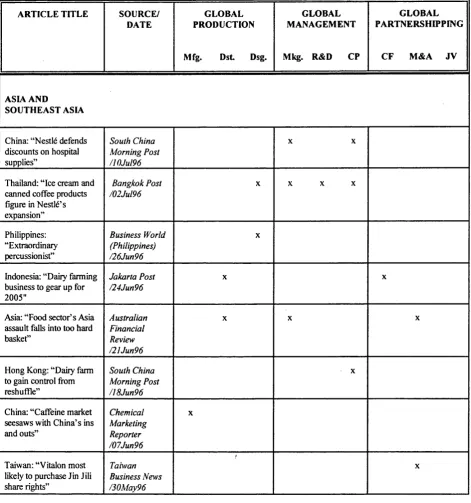
14 The triad of TNC global processes developed in Chapter T wo arose from an intense review of key empirical sources (as outlined in the next section) on my three case studies and on the food industry. In my analysis of sources on Nestte, Unilever and Philip Morris, I sought to analytically distinguish a method to identify and catalogue food TNC global processes. It was found that all data uncovered on the food TNCs could be categorized into what I conceptualize as Global Production, Global Management and Global Partnershipping. I then applied the academic literature to my triad to test and strengthen its theoretical foundation.
Once my global process triad was conceptualized, I was able to catalogue and review all empirical evidence according to that framework. As will be demonstrated in Chapter Three, using evidence from the developing world, this triad was applied to systematically identify and evaluate ‘linkages’ between food processing TNC global processes and local effects in the developing world.
thesis’ theoretically conceived categories o f Global Production, Global Management, and
Global Partner shipping. Significantly, this conceptual triad not only serves as the framework
for assessing TNC global processes in the food processing industry, but it also provides, with industry-specific adjustments, the means by which to analyze TNC global processes in other industries.
Second, using my triad o f food processing TNC global strategies, and with a unique set o f empirical evidence gathered on food TNC operations in the developing world, the linkage between ‘global process’ and ‘local effect’ will be identified and evaluated. It should be noted that ‘linkages’ and ‘effects’ are inextricably connected, in that you must first identify the linkage before evaluating effects. In McMichael’s (1992a:362) words, “the goal is to understand how global processes are interpreted, expressed and realized locally”. It is in this way that the idea of globalization in the economy (via the food TNC) is used to identify local linkages and consequently assess a variety of local effects in the ‘developing world’.15
OUTLINE OF RESEARCH DESIGN: A FRAMEWORK FOR EVALUATING GLOBAL PROCESSES AND LOCAL EFFECTS
In summary, theories of economic globalization frequently point to the transnational corporation as a primary vehicle through which global processes are facilitated. While the general importance of the transnational corporation has been emphasized in globalization literature, this thesis dissects the food processing TNC to develop an explanatory framework from which to identify and evaluate how food TNCs act as global facilitators. Subsequently, TNC global actions are assessed in regard to how they are linked to local conditions.
15According to the United Nations Human Development Program (UNDP 1994), ‘developing countries’ typically include those with middle to low GNP per capita (see Appendix 1.1: List o f Developing Countries According to the UNDP). As discussed above, this thesis’ investigation of the connection between global processes and local effects will not use entire countries as units of analysis, but instead will focus on empirical evidence from local communities in the developing world.
In order to investigate how TNCs act as global facilitators, it is first necessary to survey theories o f the transnational corporation. Hence, a review o f TNC literature and an overview of the global food industry will be presented in Chapter Two. The bulk of Chapter Two’s investigation will lie in establishing the ‘global’ aspects o f TNC operations in the food processing industry. As theoretically conceived within this thesis, the global processes of transnational corporations in the food industry are identified through the intricate development o f three distinct categories of TNC global operations - Global Production, Global
Management, and Global Partner shipping. The placement o f TNC global processes into
these three distinct categories provides the organizing framework o f this thesis. First, these categories enable a systematic assessment of globalization within the food processing industry. Second, through these indicators a framework is established which is used to assess the linkages between TNC global processes and local effects in the developing world.
It is through the global process triad that all empirical evidence will be weighed. The primary data sources may be divided into five blocs: (i) company public and internal documentation (including archival materials over a 30 year period)16; (ii) interviews conducted at Nestle, Unilever and Philip Morris17; (iii) personal and on-site experience in
16There was a great deal o f empirical data uncovered in the company-sponsored documentation, which not only enabled an historical assessment of the evolving global strategies o f the TNCs, but also assisted in the construction o f my conceptual framework to reveal which areas of firm activities the food TNCs themselves perceived to be globalizing. This company-sponsored information could then be confirmed by independent local developing world sources and other sources obtained and reviewed.
17
The interviews were conducted mainly with personnel at the "corporate relationsV’worldwide regulatory affairs’ departments of each TNC. These interviews not only provided contextual discussions o f the research, but also subsequently allowed for access to important archival materials necessary for my historical analysis. In addition, internal company documentation such as company newspapers, magazines, speeches and country/regional reports were obtained through the interview contacts, which in turn enabled a more detailed search of the TNC archives. As elaborated on in Chapter Six, depending on the TNC, arranging interviews and retrieving data met with varying degrees of difficulty. To ensure that the interviewee was kept at ease, the interviews were unstructured and informal. While much o f the information obtained through the TNC interviews was general, specific enquiries were, on occasion, researched by the interviewee, and a response followed at a later date, either via fax, mail or telephone.
• 18 # •
several manufacturing industries in developing world regions ; (iv) developing world newspapers and reports l9; and (v) international agencies (e.g. World Bank, UNCTAD, ILO) and academic reports.
Except where specifically noted in the subsequent analysis, the overall quality o f the data provided by each bloc of sources was high, and generally allowed for the cross- referencing of stated facts and the implementation of other such reliability checks to support observable trends and patterns.
Through my own experience in developing world regions, I was familiar with a number o f the sources which provided empirical data for this research. Specifically, developing world newspapers are noted to report both negative and positive accounts o f local business activities, thereby suggesting an objectivity o f the data they report. Moreover, through my previous experiences in developing regions, I became aware of which aspects of business activity local news sources are particularly interested in, such as working conditions, training practices, technological upgrading, and supplier links.
18While my on-site experiences in the developing world prior to the commencement o f this research provided an important contextual background, to interpret developing world data on TNC operations, the nature o f the research question (i.e. the ‘global’ and the ‘local’) made it necessary for a wide net to be cast using worldwide data sources, rather than relying on field research in one particular location or in a couple o f locations. Instead, the worldwide data sources provided instances of linkages across the globe, which could be compared and measured against the data retrieved.
19 Developing world data sources include, but are not limited to, a wide range o f online and CD-Rom sources. The list o f developing countries provided in Appendix 1.1 served as a guide to my search for sources from the developing world. By and large, searches were conducted for sources covering the activities o f Nestle, Unilever and Philip Morris (and each TNC’s prominent subsidiaries) in Africa, Asia, Caribbean, Central Asia, East Asia, South America and the Middle E ast The following is a sampling o f the databases used in this research:
(i) Reuters- provided worldwide coverage of full text articles and reports from 2,000 publications over a four year period (the Reuters database enabled searches by developing regions, which assisted in obtaining a large database concerning food processing TNC activity in the developing world); (ii) EBSCO World Magazine Bank -
provided full text articles from over 1,000 worldwide magazines and journals from 1984 to the present; (iii)Agricola - provided worldwide coverage of literature relating to agriculture, including food and nutrition, food service management, natural resources and pollution, consumer protection and other food-related concerns; (iv) F&S Predicasts- provided full text reports from 1,000 government publications, trade journals, country reports and newspapers, with particularly good coverage of developing world news sources; (v) Investext- provided specialized full text reports and forecasts for worldwide companies and industries as researched by equities and brokerage firms; (vi) Information Access Company- this data source covers 7,000 specialist publications worldwide (Information Access Company databasessearched include developing world publications, trade and business publications, agricultural publications and food industry publications).