University of East London Institutional Repository:
http://roar.uel.ac.uk
This paper is made available online in accordance with publisher policies. Please
scroll down to view the document itself. Please refer to the repository record for this
item and our policy information available from the repository home page for further
information.
To see the final version of this paper please visit the publisher’s website.
Access to the published version may require a subscription.
Author(s):
Ceccato, Mariano; Di Penta, Massimiliano; Nagra, Jasvir; Falcarin,
Paolo; Ricca, Filippo; Torchiano, Marco; Tonell, Paolo.
Article title:
The Effectiveness of Source Code Obfuscation: an Experimental
Assessment
Year of publication:
2009
Citation:
Ceccato, M. et al. (2009) ‘The Effectiveness of Source Code Obfuscation:
an Experimental Assessment’ In: 17th IEEE International Conference on Program
Comprehension (ICPC-09), Vancouver (Canada) May 17-19, 2009, IEEE pp 178 -
187
Link to published version:
http://dx.doi.org/10.1109/ICPC.2009.5090041
The Effectiveness of Source Code Obfuscation: an Experimental Assessment
Mariano Ceccato
1, Massimiliano Di Penta
4, Jasvir Nagra
5, Paolo Falcarin
3,
Filippo Ricca
2, Marco Torchiano
3, Paolo Tonella
1 1Fondazione Bruno Kessler–IRST, Trento, Italy
2Unit`a CINI at DISI, Genova, Italy
3Politecnico di Torino, Italy
4University of Sannio, Dept. of Engineering, Benevento,Italy
5University of Trento, Italy
ceccato|[email protected], [email protected], [email protected], paolo.falcarin|[email protected], [email protected]
Abstract
Source code obfuscation is a protection mechanism widely used to limit the possibility of malicious reverse engi-neering or attack activities on a software system. Although several code obfuscation techniques and tools are available, little knowledge is available about the capability of obfus-cation to reduce attackers’ efficiency, and the contexts in which such an efficiency may vary.
This paper reports the outcome of two controlled experi-ments meant to measure the ability of subjects to understand and modify decompiled, obfuscated Java code, compared to decompiled, clear code.
Results quantify to what extent code obfuscation is able to make attacks more difficult to be performed, and reveal that obfuscation can mitigate the effect of factors that can alter the likelihood of a successful attack, such as the attack-ers’ skill and experience, or the intrinsic characteristics of the system under attack.
Keywords: Empirical studies, Software Obfuscation,
Program comprehension
1
Introduction
Software protection has become a central issue for dis-tributed applications providing remote services (e.g., video on demand). In fact, such services are often provided under strict use conditions and service agreement. By tampering with the client code of such applications, attackers may gain personal benefits or unfair treatments and they could access the remote services without complying to the service con-ditions (e.g., without paying the service fee). Source code obfuscation is widely used to prevent or limit malicious at-tacks aimed at altering the program’s behavior in an illegal
or non-permitted way. In fact, attackers can take advan-tage of static and dynamic analysis methods, first of all to understand the code and locate the features of interest in the implementation, and ultimately to break any protection and implement the modifications necessary to achieve their goals. Attackers can decompile, trace, debug, analyze stat-ically and dynamstat-ically and of course inspect the (decom-piled) source to perform their task.
Despite the proved theoretical impossibility of building general purpose obfuscators [2], implementations of ob-fuscators do exist and they are actually used in practice. Available obfuscators provide limited though effective pro-tection against malicious reverse engineering, transforming the code into a semantically equivalent program which is harder to understand for an attacker even if automatic code analysis tools are used [7]. Obfuscation transformations can be classified into three groups [6]: layout obfuscations, re-move relevant information from the code without chang-ing its behavior; data obfuscations, transform application data and data structures (e.g., data encoding, data splitting); and, control-flow obfuscations, alter the original flow of the application. The obfuscation technique considered in this work, identifier renaming, is an instance of layout obfus-cation. It removes relevant information from the code by changing the names of classes, fields and operations into meaningless identifiers.
We conducted two controlled experiments aimed at em-pirically assessing the potency of identifier renaming, one of the most widely used obfuscation technique. Specifically, we considered whether the capability to perform compre-hension and change tasks was affected by obfuscation. We also quantified the effects of obfuscation, whenever the at-tack tasks could be successfully completed, by measuring the attacker’s efficiency in task execution. In fact, benefits can be obtained from obfuscation even if the attack is not completely prevented, when mounting an attack involves a substantially increased amount of time, compared to break-ing the original code. In addition to the average scenario, we take into account the worst-case scenario (i.e., the most effective attack), since in practice the best attacker can eas-ily distribute the instructions to break an application once he is successful. For the same reason, in our experiments we compare the behavior of skilled vs. novice attackers. We also investigate whether there are systems intrinsically easier or harder to attack.
The experiments presented in this paper represent a first contribution toward building a comprehensive, quantitative knowledge on the benefits coming from obfuscation against attackers of various skills and for various kinds of systems being protected. Moreover, other than testing the presence of a significant effect of obfuscation on the attack efficiency, which could easily be expected, this paper deals mainly with determining the size of such effect (i.e., the magnitude of the difference between efficiencies experienced with and without obfuscation), and analyzing the interaction of ob-fuscation with other context factors, such as the attacker’s ability and experience, and the characteristics of the system under attack.
The paper is organized as follows: Section 2 gives the de-tails of the experimental design. Experimental results (Sec-tion 3) are followed by a discussion, in Sec(Sec-tion 4, which includes analysis of the threats to validity. After a discus-sion of related work (Section 5), Section 6 concludes the paper and outlines directions for future work.
2
Experiments definition and planning
This section reports the definition, design and settings of the experiments in a structured way, following the template and guidelines by Wohlin et al. [13].
The goal of this study is to analyze the effect of a source code obfuscation technique named Identifier renaming with the purpose of evaluating its ability in making the code re-silient to malicious attacks. The quality focus regards how this obfuscation technique reduces the attacker’s capabil-ity to correctly and efficiently understand and modify the source code. Investigating the effect of obfuscation on the attack efficiency is a crucial point in our experimentation: although we are aware that an attacker could be able to
com-plete an attack on obfuscated code anyway, she/he could be discouraged if such an attack requires a substantial ef-fort/time. Results of this study can be interpreted from mul-tiple perspectives: (i) a researcher interested to empirically assess the Identifier renaming obfuscation technique; and (ii) a practitioner, who wants to ensure high resilience to at-tacks to subsystems of a distributed application delivered to the clients, running in an untrusted environment.
The context of this study consists of subjects involved in the experimentation and playing the role of attackers, and objects, i.e., systems to be attacked. Subjects are mainly graduate students, either Master or PhD students. The study consisted in two experiments: Exp I was performed with 10 Master students from the University of Trento and Exp II with 22 PhD students from Politecnico di Torino. Mas-ter students have a good knowledge on Java programming (they previously developed non-trivial systems as projects for at least 3 exams), and an average knowledge about soft-ware engineering topics (e.g., design, testing, softsoft-ware evo-lution). All subjects attended at least one software engineer-ing course where they learned analysis, design and testengineer-ing principles.
The systems used to conduct the experiment are two client-server applications developed in Java, a Car Race game and a Chat system. CarRace is a network game that allows two players to run a car race. The player that first completes the total number of laps wins the race. During the race, players have to refuel at the box. The number of completed laps and the fuel level is displayed on the upper part of the window. The client consists of 14 classes, for a total of 1215 LOC (both clear code and obfuscated code). ChatClient is a network application that allows people to have text based conversation through the network. Conver-sations can be public or private. The client consists of 13 classes, for a total of 1030 LOC (both clear and obfuscated code). The obfuscation was performed on the bytecode us-ing the SandMark tool1, which replaces identifiers with ran-domly generated ones.
2.1
Hypotheses formulation and variable
selection
Following the study definition reported above, we can formulate the null hypotheses to be tested:
H01the source code obfuscation does not significantly
de-crease the efficiency of an attacker to perform a com-prehension task.
H02the source code obfuscation does not significantly
de-crease the efficiency of an attacker to perform a change task.
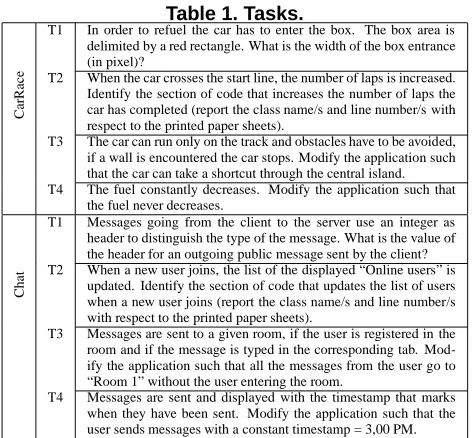
Table 1. Tasks.
T1 In order to refuel the car has to enter the box. The box area is delimited by a red rectangle. What is the width of the box entrance (in pixel)?
C
ar
R
ac
e T2 When the car crosses the start line, the number of laps is increased.
Identify the section of code that increases the number of laps the car has completed (report the class name/s and line number/s with respect to the printed paper sheets).
T3 The car can run only on the track and obstacles have to be avoided, if a wall is encountered the car stops. Modify the application such that the car can take a shortcut through the central island. T4 The fuel constantly decreases. Modify the application such that
the fuel never decreases.
T1 Messages going from the client to the server use an integer as header to distinguish the type of the message. What is the value of the header for an outgoing public message sent by the client?
C
h
at T2 When a new user joins, the list of the displayed “Online users” is
updated. Identify the section of code that updates the list of users when a new user joins (report the class name/s and line number/s with respect to the printed paper sheets).
T3 Messages are sent to a given room, if the user is registered in the room and if the message is typed in the corresponding tab. Mod-ify the application such that all the messages from the user go to “Room 1” without the user entering the room.
T4 Messages are sent and displayed with the timestamp that marks when they have been sent. Modify the application such that the user sends messages with a constant timestamp = 3,00 PM.
The above two hypotheses are one-tailed, since we are interested in analyzing the effect of obfuscation in one di-rection, i.e., to investigate whether the obfuscation reduces the attacker’s efficiency to understand the source code and to perform a change task.
The null hypotheses suggest we have two dependent variables, i.e., the efficiency in performing comprehension tasks, and the efficiency in performing change tasks. To measure the attacker’s capability to perform a comprehen-sion task (achieved comprehencomprehen-sion level), we asked sub-jects to run the application, look at the client source code, and perform two comprehension tasks, (T1 and T2 in Ta-ble 1). The above tasks were conceived so that only one correct answer is possible, thus correct answers were evalu-ated as one, wrong answers as zero. To measure the success subjects had in change tasks (success of change tasks), we asked them to mount two attacks (T3 and T4 in Table 1) against the two different systems. It is important to note that the proposed tasks are representative of realistic attacks that a hacker could perform on a distributed game or on a chat e.g., gaining unlimited fuel, or accessing to restricted messages. Since attacks can be thought of as maintenance tasks, we evaluated the correctness of the attack by running test cases on the code modified by the subjects, and evalu-ated the attack as successful if test cases passed. A test suite was defined for each change task. The test suite reproduces the interaction scenario of the attack to be performed.
The efficiency of a subject in performing comprehension or change task is evaluated as:
P2
i=1Corri
P2
i=1T imei
(1)
whereCorri = 1if thei−thcomprehension or change
task was correctly performed, 0 otherwise, and T imei is
the time in minutes needed to perform the task. In other words, the efficiency is measured as the number of correctly performed task per minute.
The main factor of the experiment—that acts as an in-dependent variable—is the presence of the treatment during the execution of the task. The two alternative treatments are (i) decompiled source code, derived from obfuscated (with identifier renaming) code, and (ii) decompiled clear code. Decompilation was performed using the Jad 1.5 de-compiler2.
Among the co-factors that can potentially affect the re-sults, we identified and measured the following ones:
• The subjects’ Experience:, i.e., comparing Master and PhD students.
• The subjects’ Ability: the subjects’ Ability was evalu-ated by resorting to the average grades obtained in the previous related exams. In Italy grades vary between 18 (lowest grade) and 30 (highest grade), however all our subjects had grades above 21. We identified three Ability levels (low, medium, and high) corresponding to the intervals: [22-24], [25-27], and≥28.
• The System to be attacked: as detailed in Section 2.2, to use a balanced design we need two systems: Chat-Client and CarRace. Although they are comparable in terms of size and complexity, subjects may perform differently on different systems.
• The Lab, i.e., whether there is a learning effect across subsequent experiment laboratories.
• Learning across subsequent tasks: in the same way,
we analyze whether there is a learning effect as the subjects perform the four subsequent tasks.
For each co-factor, we test (see Section 2.4) the effect on the efficiency in performing the attack—as defined in equa-tion (1)—and the interacequa-tion with the main factor’s treat-ments. In other words, the following two hypotheses are tested:
H0cthe co-factor has no significant effect on the efficiency
of subjects in performing an attack.
H0cithe co-factor does not significantly interact with the
presence of obfuscation to influence the efficiency of subjects in performing the attack.
These hypotheses are two-tailed, because we do not know a-priori the direction of a possible influence of co-factors.
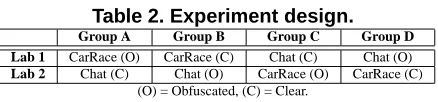
Table 2. Experiment design.
Group A Group B Group C Group D Lab 1 CarRace (O) CarRace (C) Chat (C) Chat (O) Lab 2 Chat (C) Chat (O) CarRace (O) CarRace (C)
(O) = Obfuscated, (C) = Clear.
2.2
Experiment design
We adopt a balanced experiment design intended to fit two Lab sessions (2-hours each). Subjects are split into four groups, each one working in Lab 1 on a system with a treatment and working in Lab 2 on the other system with a different treatment (see Table 2). Ability levels are equally distributed across groups. The design ensures that each sub-ject works on different Systems in the two Labs, receiving each time a different treatment. Also, the design allows for considering different combinations of System and treatment in different order across Labs. More important, the chosen design permits the use of statistical tests (e.g., analysis of variance) for studying the effect of multiple factors.
2.3
Experimental procedure and material
This section details the procedure we followed to per-form the experiments, and the material employed. Before each experiment, subjects were properly trained with lec-tures on obfuscation techniques, and with exercises hav-ing the purpose of performhav-ing comprehension tasks on the (non-obfuscated) source code of an electronic record book. Right before the experiment, we provided subjects with a detailed explanation of the tasks to be performed during the lab; no reference was made to the study hypotheses.
To perform the experiment, subjects used a personal computer with the EclipseTM development environment— which they are familiar with—including syntax highlight-ing and debugger, and the Java API documentation avail-able. We distributed to subjects the following material, available online for replication purposes3:
• a short textual documentation of the system they had to attack;
• a jar archive containing the server of the application. The server was executed locally by the subjects to avoid any network related problem. However, we did not provide the source code and checked that subjects did not decompile it;
• the decompiled client source code, either clear or ob-fuscated depending on the group the subject belonged
3http://selab.fbk.eu/ceccato/replication packages/id renaming package.zip
to (see Table 2). Subjects had decompiled code avail-able rather than source code because, in a realistic at-tack, they cannot access source code; instead, they can decompile the binary or the bytecode; and
• slides explaining the experiment procedure.
The experiment was carried out according to the follow-ing procedure. Subjects had to:
1. read the application description;
2. import the client source code in EclipseTM;
3. run the application (CarRace or ChatClient) to famil-iarize with it;
4. for each of the four tasks to be performed: (i) ask the teacher for a paper sheet describing the task to be per-formed; (ii) mark the start time; (iii) read the task and perform it; and (iv) mark the stop time and return the paper sheet;
5. after completing all tasks, create an archive containing the modified project and send it to the teacher by email;
6. complete a post-experiment survey questionnaire.
During the experiment, teaching assistants and profes-sors were in the laboratory to prevent collaboration among subjects, and to check that subjects properly followed the experimental procedure.
After the experiment, subjects were required to fill a post-experiment survey questionnaire. It aimed at both gaining insights about the subjects’ behavior during the ex-periment and finding justifications for the quantitative re-sults. The questionnaire contains 18 questions (see ex-perimental package or a longer technical report [4] for details)—most of them expressed in a Likert scale [9]— related to:
• the clarity of tasks and objectives (Q1 – Q4);
• the difficulties experienced when performing the dif-ferent tasks (comprehension and change) (Q5 – Q7);
• the confidence in using the development environment and the debugger (Q8, Q10);
• the usefulness of the EclipseTM renaming and debug-ging features (Q11, Q12);
• debugger frequency of use (Q9), number of executions in debugging mode (Q14) and execution mode (Q13);
• to what extent subjects considered the analysis of ob-fuscated code hard (Q17);
• whether subjects considered important executing the system to better understand the behavior of obfuscated code (Q18).
2.4
Analysis method
Different kinds of statistical tests need to be used to ana-lyze the results of this experiment.
Two non-parametric tests are used to test the hypotheses related to differences in the subjects’ efficiency in perform-ing comprehension and change tasks (H01andH02). First,
an unpaired analysis—i.e., an analysis of all data grouped by different treatments of the main factor—is performed us-ing the Mann-Whitney, one-tailed test [10]. Given the cho-sen experiment design, it is also possible to use a paired test, i.e., the Wilcoxon, one-tailed test [10]. Such a test allows to check whether differences exhibited by subjects with dif-ferent treatments (clear and obfuscated code) over the two labs are significant.
While the above tests allow for checking the presence of significant differences, they do not provide any information about the magnitude of such a difference. This is particu-larly relevant in our study, since we are interested to inves-tigate to what extent the use of obfuscation decreases the attacker’s efficiency. To this aim, we used the Cohend ef-fect size, which indicates the magnitude of a main factor treatment effect on the dependent variables. The effect size is considered small for d≥0.2, medium for d≥0.5 and large for d≥0.8 [5]. For independent samples—to be used for un-paired analyses—it is defined as the difference between the means (M1andM2), divided by the pooled standard
devi-ation: d= (M1−M2)/σ. For dependent samples—to be
used for paired analyses—it is defined as the difference be-tween the means (M1andM2), divided by the standard
de-viation of the (paired) differences between samples: (σD):
d= (M1−M2)/σD.
To provide a picture of what a worst case scenario (best attacker) could look like we compute, for each experi-ment and for each system used in the experiexperi-ment, the low-est times (expressed in minutes) achieved in correctly an-swering comprehension questions (T1, T2) and performing change tasks (T3, T4). We compare the difference between the obfuscated and clear cases to the pooled standard devia-tion (as for the Cohend). We deem relevant the differences that are≥σ. Although we cannot claim statistical signifi-cance and therefore no specific hypothesis was formulated, we believe this measure provides useful insights.
The analysis of co-factors, i.e., the test of hypotheses H0c,H0ci, as well as the hypothetical effect of
confound-ing factors such as system and lab, is performed usconfound-ing a two-way Analysis of Variance (ANOVA), and interactions
are visualized using interaction plots. Although ANOVA is a parametric test, it is considered quite robust also for non-normal and non-interval scale variables.
Regarding the analysis of survey questionnaires, we evaluate questions related to objectives clarity, availability of enough time and general difficulties subjects might have encountered (Q1-Q4, Q8, Q10) by verifying that the an-swers are either Strongly agree (1) or Agree (2). We test medians, using a one-tailed Mann-Whitney test for the null hypothesisQxf ≥3, where 3 corresponds to “Undecided”, and Qxf is the median for question Qx. A similar anal-ysis is performed, only for subjects receiving obfuscated code, for questions related to the use made of the debug-ger (Q9), the difficulty in comprehending obfuscated code (Q17) and the usefulness of executing the system to under-stand it when the code is obfuscated (Q18). For the ques-tions related to the ability of subjects in performing compre-hension, feature location, and change tasks (Q5, Q6, Q7), answers of subjects receiving clear code were compared with answers of subjects receiving obfuscated code. In this case a two-tailed Mann-Whitey test is used for the null hy-pothesisQ^Clear =QObf uscated^ . A similar comparison is
also performed for questions concerning the usefulness of debugging (Q11) and automatic renaming (Q12), and for questions concerning the number of executions (Q13), de-buggings (Q14) and time spent looking at the code (Q15) and running the system (Q16).
In all the statistical tests performed, we adopted a 95% significance level, i.e., we accept a 5% probability of com-mitting a type I error.
3
Results
This section reports results for the two experiments, with the aim of testing the hypotheses formulated in Section 2.1. Raw data of results are included in the replication package4, while detailed analyses are reported in a longer technical report [4].
3.1
Efficiency
of
comprehension
and
change tasks
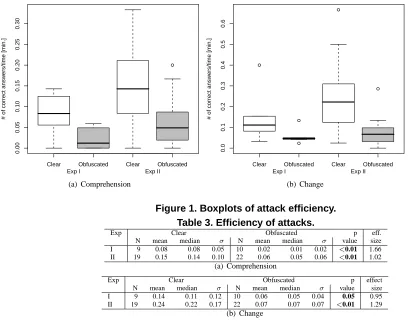
Figure 1 shows, for comprehension and change tasks, boxplots of the number of correct answers per minute. Ta-ble 3 reports descriptive statistics of the unpaired analy-sis, including the number of subjects who participated to the experiments, mean, median, standard deviation, Mann-Whitney test p-value and Cohen d effect size. For com-prehension tasks, subjects working with clear code signif-icantly outperform subjects with obfuscated code in both Exp I and II, with a large effect size (d≥0.8). There are
Clear Obfuscated Clear Obfuscated
0.00
0.05
0.10
0.15
0.20
0.25
0.30
# of correct answers/time [min.]
Exp I Exp II
(a) Comprehension
Clear Obfuscated Clear Obfuscated
0.0
0.1
0.2
0.3
0.4
0.5
0.6
# of correct answers/time [min.]
Exp I Exp II
[image:7.612.59.467.68.394.2](b) Change
Figure 1. Boxplots of attack efficiency. Table 3. Efficiency of attacks.
Exp Clear Obfuscated p eff.
N mean median σ N mean median σ value size I 9 0.08 0.08 0.05 10 0.02 0.01 0.02 <0.01 1.66 II 19 0.15 0.14 0.10 22 0.06 0.05 0.06 <0.01 1.02
(a) Comprehension
Exp Clear Obfuscated p effect
N mean median σ N mean median σ value size I 9 0.14 0.11 0.12 10 0.06 0.05 0.04 0.05 0.95 II 19 0.24 0.22 0.17 22 0.07 0.07 0.07 <0.01 1.29
(b) Change
slightly different number of subjects for different treatments because 1 subject in Exp I and 3 subjects in Exp II did not attend the second laboratory. For change tasks, subjects with clear code significantly outperform subjects with ob-fuscated code in both Exp I value=0.05), and Exp II (p-value<0.01). Also for change tasks, the effect size is high for both Exp I and II.
In addition to unpaired analysis, we also performed a paired analysis, comparing performances of each subject in the two laboratories, with different treatment and object. This was possible for the 9 subjects of Exp I and 19 sub-jects of Exp II who attended both labs. Table 4 reports for each experiment the number of subjects, descriptive statis-tics of differences, Wilcoxon paired test p-value and Co-hendeffect size for dependent samples. As shown, again for comprehension tasks there are significant differences in both Exp I and II, with a large effect size (d≥0.8) in Exp I and a medium effect size (d≥0.5) for Exp II. For change tasks, differences are significant for Exp II only. The effect size is large for both experiments. It has to be noticed that 5 subjects out of 9 in Exp I and 2 out of 19 in Exp II were not able to perform the change tasks.
Overall, while unpaired analysis indicates a rejection for bothH01 andH02, for paired analysis H02 cannot be
re-jected in Exp I.
Table 4. Efficiency: paired analysis.
Exp N diff diff σ p effect
mean median value size I 9 0.06 0.06 0.05 0.01 1.07 II 19 0.08 0.08 0.11 <0.01 0.78
(a) Comprehension
Exp N diff diff σ p effect
mean median value size I 4 0.14 0.12 0.16 0.12 0.91 II 17 0.19 0.16 0.19 <0.01 0.99
(b) Change
3.2
Worst case scenario
[image:7.612.337.528.421.510.2]Table 5. Lowest times for successful attacks.
Exp Treatment ChatClient CarRace
T1 T2 T3 T4 T1 T2 T3 T4
I Clear 1 20 3 15 2 7 3 1
Obfuscated 25 NA 18 9 15 7 12 3
σpooled 4.8 13.7 23.5 6.2 3.8 1.2 5.0 5.7
II Clear 1 3 2 3 2 2 1 1
Obfuscated 5 2 4 1 4 2 10 <1
σpooled 10.8 5.0 8.6 4.9 3.4 5.4 4.7 3.6
[image:8.612.59.301.94.169.2]Times are expressed in minutes.
Table 6. Two-way ANOVA by Treatment & Ex-perience.
Df Sum Sq Mean Sq F value Pr(>F) Treatment 1 0.09 0.09 17.70 0.0001
Experience 1 0.04 0.04 7.21 0.009
Treatment:Experience 1 0.00 0.00 0.35 0.56
Residuals 56 0.28 0.00
(a) Comprehension
Df Sum Sq Mean Sq F value Pr(>F) Treatment 1 0.27 0.27 17.19 <0.001
Experience 1 0.04 0.04 2.27 0.14
Treatment:Experience 1 0.02 0.02 1.02 0.32
Residuals 46 0.72 0.02
(b) Change
all 5 cases where we observed a relevant difference, higher lowest times were observed for the obfuscated code.
3.3
Analysis of co-factors
This section reports the analysis of co-factors. First, we analyze whether the subjects’ Experience (master vs. PhD students) had a significant effect on the efficiency in per-forming comprehension and change tasks. Table 6 reports results of the two-way ANOVA by Treatment & Experience. For comprehension tasks, the subjects’ Experience has a significant effect, although it does not interact with the main factor’s treatments. As it can be noted from Figure 1 and from descriptive statistics in Table 3-a, the comprehension level for PhD students (Exp II) is, for both clear and ob-fuscated code, higher than for Master students (Exp I). For change tasks, the subjects’ Experience has no significant ef-fect nor any interaction with the main factor’s treatments. However, looking at the interaction plot of Treatment & Experience (for maintenance tasks) in Figure 2, it can be noticed that, when the code is obfuscated, the difference between the less experienced master students and the more experienced PhD students is reduced. If comparing the two experience levels, the effect size is Medium (d=0.66) for clear code and Small (d=0.26) for obfuscated code.
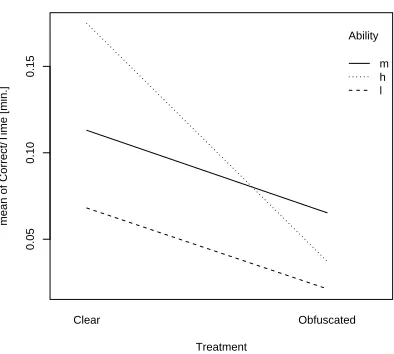
Similarly, we analyze whether the subjects’ Ability (low, medium and high ability levels) had an effect on the effi-ciency in performing comprehension and change tasks. Re-sults of the two-way ANOVA by Treatment & Ability are
0.10
0.15
0.20
0.25
Treatment
mean of Correct/Time [min.]
Clear Obfuscated
Experience
[image:8.612.59.293.225.324.2]PhD Master
Figure 2. Interaction plot of Treatment & Ex-perience for change tasks.
0.05
0.10
0.15
Treatment
mean of Correct/Time [min.]
Clear Obfuscated
Ability
[image:8.612.317.514.263.440.2]m h l
Figure 3. Interaction plot of Treatment & Abil-ity for comprehension tasks.
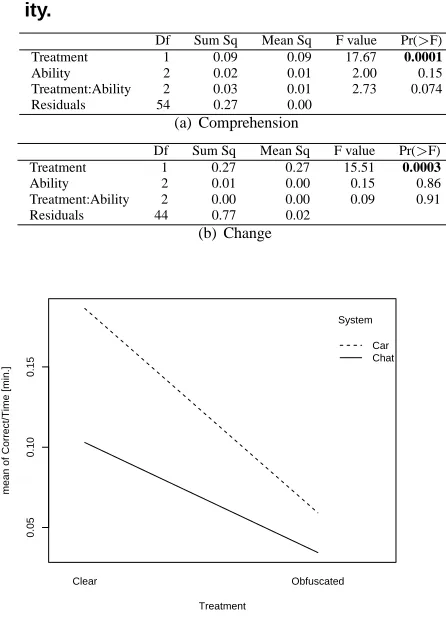
shown in Table 7. The only effect visible, this time, is an interaction of the Ability with the main factor’s treatment for comprehension task, although marginally significant (p-value=0.074). The interaction is clearly visible in the plot of Figure 3: for obfuscated code the gap between low, medium and high Ability subjects is reduced: in other words, the ob-fuscation reduces the capability of highly skilled subjects to understand the obfuscated code, making them as good as low Ability subjects.
Table 7. Two-way ANOVA by Treatment & Abil-ity.
Df Sum Sq Mean Sq F value Pr(>F) Treatment 1 0.09 0.09 17.67 0.0001
Ability 2 0.02 0.01 2.00 0.15
Treatment:Ability 2 0.03 0.01 2.73 0.074 Residuals 54 0.27 0.00
(a) Comprehension
Df Sum Sq Mean Sq F value Pr(>F) Treatment 1 0.27 0.27 15.51 0.0003
Ability 2 0.01 0.00 0.15 0.86
Treatment:Ability 2 0.00 0.00 0.09 0.91 Residuals 44 0.77 0.02
(b) Change
0.05
0.10
0.15
Treatment
mean of Correct/Time [min.]
Clear Obfuscated
System
Car Chat
Figure 4. Interaction plot of Treatment & Sys-tem.
considering together data from both experiments, ANOVA also indicated a mild interaction between System and the main factor’s treatment (p-value=0.05). This result can be interpreted by looking at the interaction plot of Figure 4: al-though the CarRace is always easier to attack than the Chat-Client, the difference is reduced when obfuscating the code. In other words, the obfuscation makes systems easier to be attacked (like the CarRace) as difficult as systems that are intrinsically harder to be attacked (like ChatClient).
Finally, we found no significant effect of the Lab factor (p-value=0.40 for Exp I and 0.27 for Exp II) nor any learn-ing across subsequent tasks T1-T4 (p-value=0.36 for Exp I and 0.13 for Exp II).
3.4
Survey questionnaire analysis
Only a few problems emerged from the analysis of sur-vey questionnaire questions (Q1, Q2, Q3, Q4, Q8, Q10) related to the overall subjects’ ability to perform the tasks in the time needed and to the clarity of the lab objectives.
Subjects of Exp I, regardless of the treatment, experienced problems regarding the time needed to perform the task, and to use the debugger. No particular problem was experienced in Exp II (more experienced subjects).
Then, we compared the answers provided by subjects, when using clear and obfuscated code, on the difficulties encountered in code comprehension (Q5), location of the feature to be understood/changed (Q6), and in perform-ing the change task (Q7). In Exp I, subjects felt that the obfuscation makes feature location more difficult (p-value=0.04), while there is no difference for code compre-hension (p-value=0.52) and change (p-value=0.20). In Exp II, subjects felt that obfuscation makes all three activities— comprehension, feature location and change—more diffi-cult (p-value<0.01 in all cases). Also, we investigated the perceived usefulness of the main tools available to the sub-jects, i.e., the use of the debugger (Q11) and the renam-ing facility provided by Eclipse (Q12). The debugger was found useful only by subjects in Exp II both for clear and obfuscated code. The renaming facility was found useful by all subjects only for the obfuscated code.
When performing comprehension and change tasks, we investigated whether there was a variation—between sub-jects with clear and obfuscated code—in the number of sys-tem executions (Q13) and executions in debugging mode (Q14) indicated as needed to perform the task, the percent-age of time spent looking at the code (Q15) and running the system (Q16). A significant difference was found in Exp I, where subjects felt they needed to execute the sys-tem more time when it was obfuscated (Q13, p-value=0.04), while in Exp II more executions were performed in debug-ging mode (Q14, p-value=0.01), although subjects said they used the debugger for obfuscated code as often as for clear code (Q9, p-value=0.38 in Exp I and 0.20 in Exp II). Re-sults suggest that in Exp I subjects used system executions as a way to better understand obfuscated systems rather than debugging as subjects of Exp II, since they felt debugging difficult to be performed (as reported in the answers to ques-tion Q10). Finally, subjects from both experiments agreed (p-value<0.01) that the obfuscated code was more difficult
to understand (Q17), and that system execution is neces-sary for understanding purposes (Q18), as a complement to static code analysis.
4
Discussion
available, the attacker would require, to successfully com-plete an attack, two to four times the time needed with clear code.
Also, results of worst case scenarios indicate that, in most cases, subjects with clear code needed less time than subjects with obfuscated code to successfully complete an attack. Although, as indicated in survey questionnaires, ob-fuscation makes it more difficult to conduct comprehension, feature location and change tasks, having enough time avail-able, an attacker would be able to achieve his objectives. In most cases the time available to complete an attack is limited, because other protection mechanisms are used in conjunction with obfuscation. For example, (part of) the client code may be periodically replaced/updated with new versions, which makes an attack useless if not performed within the expiration time of a given version.
An important role is played by factors such as the attack-ers’ experience, ability, and the system ease of comprehen-sion and maintenance. Results suggest that:
• The presence of obfuscation reduces the gap be-tween highly skilled or experienced attackers and low skilled/experienced ones. In our experiments, we noticed that the subjects’ experience plays a signif-icant role for change tasks (the capability of mod-ifying an unknown, difficult to be maintained sys-tem is achieved with years of work), while personal skills influence the ability of performing comprehen-sion tasks. When the code is not obfuscated, highly experienced/skilled subjects perform attacks signifi-cantly better than low experienced/skilled ones. The presence of obfuscation makes the system difficult to be attacked for highly skilled/experienced subjects as for low skilled/experienced ones.
• The ability of attackers to understand and change a sys-tem is, as one can expect, significantly influenced by the intrinsic characteristics of the system itself. This depends on factors such as the system architecture and design, the presence of adequate requirement and de-sign documentation (not available in both systems used in our experiments) or the quality of the source code (structure, identifiers, comments). What can be no-ticed when the code is obfuscated is that obfuscation, again, reduces the gap, this time between systems eas-ier to be attacked and systems harder to be attacked.
4.1
Threats to validity
We identified the main threats to the validity that can af-fect our results: construct, internal, conclusion, and external validity threats.
Construct validity threats concern the relationship be-tween theory and observation. They are mainly due to how
we measure the capability of a subject to perform an at-tack. As explained in Section 2, the chosen tasks are rep-resentative of realistic attacks. Also, the measurements we conceived—comprehension questions with one possible an-swer and test cases to assess code correctness—are as objec-tive as possible. Clearly, the ability to understand the ques-tions we asked might not fully reflect the comprehension achieved by the attacker for that particular attack. Also, the test cases we used only cover the scenario we asked to mod-ify in the attack task. Alternative scenarios are not tested, as well as code not directly involved in the scenario that might have been impacted by the change. Finally, the way subjects’ ability was assessed is objective, although we are aware that exam grades may not fully reflect subjects’ skills. Internal validity threats concern external factors that may affect an independent variable. The chosen design al-lowed us to control a series of factors, such as ability, sys-tem, and learning effect. Subjects were not aware of the study hypotheses, and were told not to be evaluated on the performance exhibited during the experiment.
Conclusion validity concerns the relationship between the treatment and the outcome. We used non-parametric tests (Mann-Whitney and Wilcoxon), not requiring data normality. The only parametric test used is the ANOVA which is however robust to deviation from normality. Sur-vey questionnaires, mainly intended to get qualitative in-sights, were designed using standard ways and scales [9].
External validity concerns the generalization of the findings. First, only one type of obfuscation—identifier renaming—was considered. Work-in-progress aims at ex-perimenting further techniques and performing a compari-son among them. Then, although we considered two differ-ent distributed systems belonging to differdiffer-ent domains and having a different complexity, further studies with differ-ent systems are desirable. Last, but not least, the study was performed in an academic environment. Although for this type of experiment (hacker attack) it is not interesting to ex-periment with industrial developers, we are aware that the expertise of students could be far from that of hackers. This threat was at least mitigated (i) by considering graduated students only, (ii) by analyzing the worst case scenario, and (iii) by performing a co-factor analysis by ability. All in all, many hackers are not that different from best students (high Ability subjects/worst case scenarios in our experiments).
5
Related Work
of time required to perform automatic de-obfuscation to evaluate the usefulness of control-flow flattening obfusca-tion, relying on a combination of static and dynamic anal-ysis. Goto et al. [8] proposed the depth of parse tree to measures source code complexity. Anckaert et al. [1] at-tempted at quantifying and comparing the level of protec-tion of different obfuscaprotec-tion techniques. In particular, they proposed a series of metrics based on code, control flow, data and data flow: they computed such metrics on some case study applications (both on clear and obfuscated code), however without performing any validation on the proposed metrics. Rather than proposing new metrics, we aim at ex-perimentally assessing obfuscation techniques, by measur-ing the success of an attack and the efficiency of an attacker in performing it, on both clear and obfuscated source code. The work more similar to ours is an experimental study on the complexity of reverse engineering binary code [11]. The authors of this study asked a group of 10 students (of heterogeneous level of experience) to perform static analy-sis, dynamic analysis and change tasks on several C (com-piled) programs. They found that the subjects’ ability was significantly correlated with the success of reverse engi-neering tasks they had to perform. Our study goes beyond: first, we compare—by using statistical tests and effect size measures—the capability and efficiency of subjects in per-forming attack tasks on clear and obfuscated code. Thus we can quantify the increased effort necessary to reverse engineer an obfuscated program, with respect to the effort necessary for a non-obfuscated one.
In a companion paper [3] we describe the design and planning of this experimentation, and briefly summarize early results (only unpaired analysis) of Exp I. The present work extends it by adding a further experiment (Exp II), reporting paired analysis, and analyzing the effect of co-factors and the answers provided by subjects to survey ques-tionnaires.
6
Conclusions
We have described and discussed the results obtained from two experiments, designed to evaluate the potency of source code obfuscation. In particular, we focused on iden-tifier renaming, one of the most widely used obfuscation methods.
Results show that identifier renaming significantly de-creases the efficiency of attacks, at least doubling the time needed to complete a successful attack (even in the worst-case scenario, i.e., against the best attacker). In addition, obfuscation reduces the gap between novice and skilled at-tackers, making the latter less efficient, and makes systems that are easier to attack in clear more similar to those that are intrinsically harder to break.
Our future work will include replication of the study in
different settings and contexts, so as to corroborate our find-ings and extend their validity. In particular, we plan to as-sess other obfuscation techniques (e.g., opaque predicates), by performing a comparative assessment of their effects.
References
[1] B. Anckaert, M. Madou, B. D. Sutter, B. D. Bus, K. D. Boss-chere, and B. Preneel. Program obfuscation: a quantitative approach. In QoP ’07: Proc. of the 2007 ACM Workshop on Quality of protection, pages 15–20, New York, NY, USA, 2007. ACM.
[2] B. Barak, O. Goldreich, R. Impagliazzo, S. Rudich, A. Sa-hai, S. Vadhan, and K. Yang. On the (im) possibility of obfuscating programs. Lecture Notes in Computer Science, 2139:19–23, 2001.
[3] M. Ceccato, M. Di Penta, J. Nagra, P. Falcarin, F. Ricca, M. Torchiano, and P. Tonella. Towards experimental eval-uation of code obfuscation techniques. In Proc. of the 4th Workshop on Quality of Protection, pages 39–46. ACM, Oct 2008.
[4] M. Ceccato, M. Di Penta, J. Nagra, P. Falcarin, F. Ricca, M. Torchiano, and P. Tonella. The ef-fectiveness of source code obfuscation: an experimen-tal assessment. Technical report, University of Sannio – http://www.rcost.unisannio.it/mdipenta/icpc09-tr.pdf, Jan 2009.
[5] J. Cohen. Statistical power analysis for the behavioral sci-ences (2nd ed.). Lawrence Earlbaum Associates, Hillsdale, NJ, 1988.
[6] C. Collberg, C. Thomborson, and D. Low. A taxonomy of obfuscating transformations. Technical Report 148, Dept. of Computer Science, The Univ. of Auckland, 1997.
[7] C. Collberg, C. Thomborson, and D. Low. Watermarking, tamper-proofing, and obfuscation - tools for software pro-tection. IEEE Transactions on Software Engineering, 28, 2002.
[8] H. Goto, M. Mambo, K. Matsumura, and H. Shizuya. An approach to the objective and quantitative evaluation of tamper-resistant software. In Third Int. Workshop on Infor-mation Security (ISW2000), pages 82–96. Springer, 2000. [9] A. N. Oppenheim. Questionnaire Design, Interviewing and
Attitude Measurement. Pinter, London, 1992.
[10] D. Sheskin. Handbook of Parametric and Nonparametric Statistical Procedures (4th Ed.). Chapman & All, 2007. [11] I. Sutherland, G. E. Kalb, A. Blyth, and G. Mulley. An
em-pirical examination of the reverse engineering process for binary files. Computers & Security, 25(3):221–228, 2006. [12] S. Udupa, S. Debray, and M. Madou. Deobfuscation:
re-verse engineering obfuscated code. Rere-verse Engineering, 12th Working Conference on, Nov. 2005.