Journal of Chemical and Pharmaceutical Research, 2012, 4(4):2087-2095
Research Article
CODEN(USA) : JCPRC5
ISSN : 0975-7384
Central composite design application for optimization of aqueous two-phase
extraction of protein from shrimp waste
D. Ramyadevi, A. Subathira and S. Saravanan
*Department of Chemical Engineering, National Institute of Technology, Tiruchirappalli, India
______________________________________________________________________________
ABSTRACT
An experimental design was used to optimize protein partitioning from shrimp waste using Polyethylene glycol/sodium citrate aqueous two-phase systems (ATPS). Four factors like PEG’s molecular weight (A), pH (B), Addition of sodium chloride (C), and Tie Line Length (D) affecting the protein partitioning were studied. To build the mathematical model and minimize the number of experiments for the design parameters, response surface methodology (RSM) with a central composite design was defined based on the conditions found for the highest partitioning by preliminary tests. The best conditions of partioning were achieved using ATPS composed of PEG 4000, sodium citrate salt, pH8, 1M Addition of sodium chloride, and 40 Tie Line Length. The maximum percentage yield of protein extracted from shrimp waste was about 90.54%. Analysis of response surface plots as a function of, PEG molecular weight, pH, and concentration of sodium chloride, and Tie Line Length was studied.
Keywords: Protein partitioning; PEG- sodium citrate aqueous two-phase systems; Response surface methodology;
Central composition design.
______________________________________________________________________________
INTRODUCTION
Aqueous two-phase system (ATPS) is an effective, environmental friendly and economically viable separation method. ATPS is an ideal technology where clarification, concentration, and partial purification can be integrated in one step, thus it is recognized for offering reduction and shortening of the purification process of protein. When compared to the conventional liquid–liquid extraction, ATPS has the advantage of preserving the targeted bio molecule with high water content of both phases (70 – 85% w/w), high biocompatibility and low interfacial tension, low degradation of biomolecules, good resolution, high separation yield, relatively high capacity, ease of scale-up, low material costs and the possibility of polymer and salt recycling [1-3]. For these reasons, ATPS have been widely studied on a laboratory scale for the partitioning of whey milk protein [4], lysozyme [5], amino acids and peptides [6].
Aqueous two-phase systems are composed of aqueous solutions of either two water-soluble polymers, usually polyethylene glycol (PEG) and dextran (Dx), or a polymer and a salt, usually PEG and phosphate or sulphate. Aqueous polymer-salt systems have several advantages over the polymer-polymer systems due to the larger differences in density, greater selectivity, lower viscosity, less cost, etc. Utilization of citrate as a phase forming component has been suggested to be preferable to phosphate and sulphate systems, because of its biodegradability and non-toxicity [7].The phosphate or sulphate salts led to a strong negative impact on the environment. The value of the partition coefficient relies on the physico–chemical properties of the target bio molecule and other molecules and their interactions with those of the chosen system.
weight depending on the species [8].The major components (on dry weight basis) of shrimp waste are protein (35– 50%), chitin (15–25%), minerals (10–15%) and carotenoids. This biotechnological process results in a liquor fraction rich in proteins, minerals and carotenoids (especially astaxanthin) along with a solid fraction rich in chitin [9]. These globular proteins have potential application in food and biopharmaceutical industries [10-11].
RSM is a collection of mathematical and statistical techniques useful for designing experiments, building models and analyzing the effects of the several independent variables. The main advantage of RSM is the reduced number of experimental trials needed to evaluate multiple factors and their interactions [12-13]. The four-level factorial design was used to study the partition behaviour of the protein in ATPS. To link to individual and interactive effects, a systematically statistical method response surface methodology (RSM) was applied to investigate how factors would affect the partitioning of protein. To expose the relationship between the partitioning of protein and the compositions of the system and also to simplify the further process optimization in examined Aqueous Two Phase system, a statistical analysis was performed by response surface methodology (RSM) which appeared itself to be very useful tool for modelling of processes of isolation and partitioning of biomolecules in ATPSs Hence, there is scope for the recovery of valuable material from the shrimp waste. Present work aims to identify the most suitable operating conditions for partitioning of protein from shrimp waste. A central composite design was used to optimize the operation conditions such as PEG’s molecular weight, pH, and concentration of sodium chloride, and Tie Line Length for this process. The objective of this study is to develop a relationship between the factors and the response through the partitioning of protein in ATPS and to determine the optimum conditions for the next step of protein purification directly from the crude waste.
EXPERIMENTAL SECTION
Materials
Polyethylene glycol with molecular weights of 4000, 6000 and 10000 was obtained from Merck-Schuchardt (Munich,Germany) and bovine serum albumin (BSA) was purchased from Sigma (St. Louis, MO, USA). Tribasic sodium citrate dehydrate was obtained from Merck-Schuchardt (Munich,Germany). The polymer and salts were used without further purification. Milli porewater was used throughout the experiments. Shrimp head waste was collected from local market in India.
Preparation of shrimp waste
Fresh shrimp waste was collected from the local market. Known weight of shrimp waste was ground in cell lysis buffer, centrifuged and the supernatant was collected. The shrimp extract was stored at 4°C and required quantities were taken as and when required for different experiments and directly subjected to Aqueous two phase system (ATPS).
Preparation of Aqueous two-phase system
Partitioning of soluble proteins from shrimp waste was carried out in PEG - sodium citrate - water system. BSA was used as model protein for partitioning. The criterion for selecting this system was based on the reported selectivity of PEG for proteins [14]. All partition experiments were carried out at different pH (6, 7 and 8) values at temperature
30◦C.These pH values were chosen so that the aqueous phase is neither too acidic nor too basic. This is important
since, too acidic or too basic solution cannot be discharged to the environment without further treatment. Phase systems were prepared in 50 ml graduated centrifuge tubes by weighing out appropriate quantities of the PEG of desired molecular weight, sodium citrate stock solutions and added to crude shrimp extract to make the total weight of the system 100 % (w/w). The pH of the system was maintained by using citric acid monohydrate and the contents were mixed thoroughly. Complete phase separation was achieved by centrifugation at 3000 rpm for 20 min to speed up the phase separation, and then placed at room temperature for 24 hour to ensure complete equilibration. After equilibration, estimates of the volumes of top and bottom phases were made in graduated centrifuge tubes. In order to determine the concentration of proteins in each of the co-existing phases, samples from each solution phase was collected using a syringe. The top and bottom phases were withdrawn separately. Due to high viscosity of the polymer solution, it is necessary to dilute the sample prior to estimation of protein [15].
Yield percentage was calculated by using the Eq (1)
( )
1
100
1
+
=
−KR
Y
(1) where K is a partition coefficient, R is a phase volume ratio
Protein quantification
Total protein was quantified by the Bradford method using a Coomassie assay reagent supplied by Pierce Rockford, IL,USA). To avoid interference from phase components, samples were analysed against blanks containing the same phase composition but without proteins. Bovine serum albumin (BSA) was used as a protein standard and absorbance was monitored at 595 nm.
Experimental design
[image:3.595.169.444.373.421.2]To establish the optimum conditions for partitioning of protein in ATPS, response surface methodology (RSM) was used [16]. The CCD system is an effective model and used for sequential experimentation which provides information for testing ‘the goodness of fit’ and does not require unusual large number of design points thereby reducing the overall cost associated with the experiment. A four-factor central composite design (CCD) obtained by using Design-Expert 8.0.5 software, (State-Ease Inc., Minneapolis MN, USA), was applied. The four factors considered to affect the protein partitioning in the ATPS systems were the PEG’s molecular weight (A), pH (B), Addition of sodium chloride(C), and Tie Line Length (D). The level and ranges chosen for the factors are shown in Table 1. The complete design consisted of 30 experimental points which included six replications at the center point. The 30 samples were prepared in random order. In each experiment the yield percentage was calculated and each trial was performed in duplicates.
Table 1 : Factors and value levels used in the central composite design
Variables (factor) Low value (-1) Centre value (0) High value (+1)
Molecular weight (A) 4000 6000(-0.333) 10000
pH(B) 6 7 8
Addition of Nacl(C) 0 0.5 1
Tie Line Length (E) 32 36 40
Statistical analysis
The experimental data obtained from the design were analyzed by the response surface regression procedure using the following second-order polynomial equation:
∑
∑
∑
+
+
+
=
ij
j i ij ii
i ii i
i i o
i
X
X
X
X
Y
β
β
β
2β
(2)where Yi is the predicted response, βo, βi , βii and βij are regression coefficients for the intercept, linear, quadratic
and interaction coefficients, respectively and Xi and Xj are the coded independent variables.
The statistical software package, Design-Expert 8.0.5 was used for regression analysis and graphical analysis of the data obtained during the experiment. Analysis of variance (ANOVA) was used to estimate the statistical parameters. The second-order polynomial equation was employed to fit the experimental data. The significance of the model equation and model terms were evaluated by f-test. The quality of fit of the polynomial model equation was expressed by the coefficient of determination (R2), adjusted R2 and ‘‘adequate precision’’. The fitted polynomial equation was expressed as three-dimensional surface plots to visualize the relationship between the responses and the experimental levels of each factor used in the design. To optimize the level of each factor for maximum response ‘‘numerical optimization’’ process was employed. The combination of different optimized parameters, which gave maximum response, i.e. maximum protein partitioning in PEG phase was tested experimentally to confirm the validity of the model.
RESULTS AND DISCUSSION
Effect of PEG molecular weight on the partitioning
32 34 36 38 40 50
55 60 65 70 75
Y
ie
ld
(
%
)
[image:4.595.173.441.84.307.2]Tie Line Length
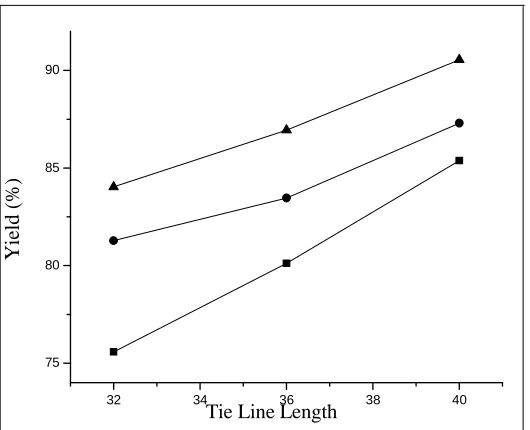
Figure 1 : Effect of Tie Line Length and PEG molecular weight on the partitioning yield at pH 6 ■ 4000,
●6000, ▲, 10000
Effect of added salt on protein partitioning
Salts are often used in aqueous two phase system to direct partitioning of protein between phases. In order to improve the partition of protein to the top phase different concentration of Nacl added to a PEG 4000/sodium citrate at pH 8 are shown in Figure 2. The extraction efficiency was increased with increasing concentration of Nacl. The hydrophobic and electrostatic interactions between the proteins and the phase forming components are probably responsible for the protein partition to the top phase. The addition of Nacl to a PEG/sodium citrate system increases the hydrophocity difference between the phases and thus promotes partition of the more hydrophobic protein to the top phase. Another one the added salt creates an electrical potential between the two phases that can drive proteins to one or another phase depending on charge. While positively charged proteins are partitioned more to the top phase and negatively charged proteins are partitioned more to the bottom phase [1].
32 34 36 38 40
75 80 85 90
Y
ie
ld
(
%
)
Tie Line Length
[image:4.595.169.434.479.694.2]Model building
The partitioning of protein in a PEG / sodium citrate ATPS was optimized using a statistical experimental design involving four variables, namely PEG molecular weight (A), pH(B), addition of Nacl(C), and Tie Line Length (D) at
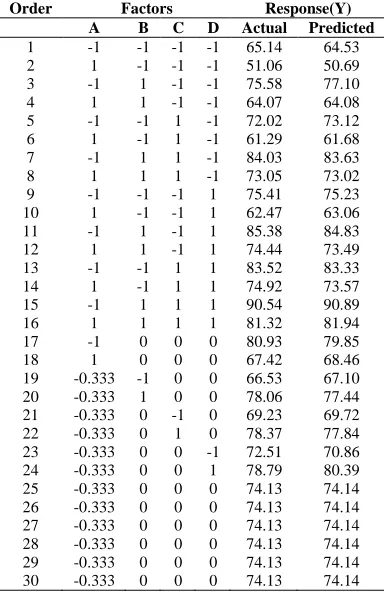
two levels. Table 2,presents the design matrix of the variables and data where the actual and the predicted data for
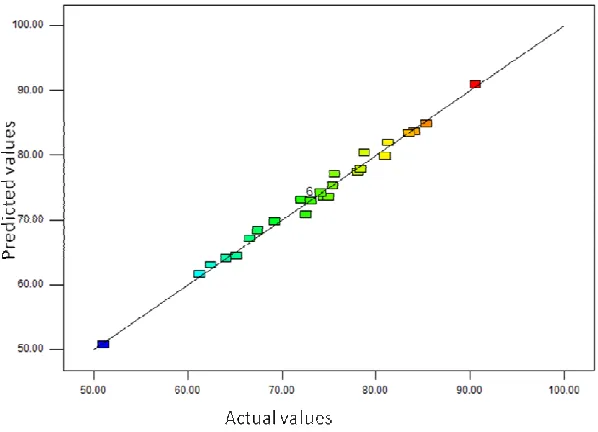
[image:5.595.210.402.188.485.2]protein partitioning were compared. Actual values were the measured response data for a particular run and the predicted values were determined by approximating functions employed for the models.
Table 2 : Central composite design matrix measured and predicted responces of protein partition in PEG / sodium Citrate System
Order Factors Response(Y) A B C D Actual Predicted
1 -1 -1 -1 -1 65.14 64.53
2 1 -1 -1 -1 51.06 50.69
3 -1 1 -1 -1 75.58 77.10
4 1 1 -1 -1 64.07 64.08
5 -1 -1 1 -1 72.02 73.12
6 1 -1 1 -1 61.29 61.68
7 -1 1 1 -1 84.03 83.63
8 1 1 1 -1 73.05 73.02
9 -1 -1 -1 1 75.41 75.23
10 1 -1 -1 1 62.47 63.06
11 -1 1 -1 1 85.38 84.83
12 1 1 -1 1 74.44 73.49
13 -1 -1 1 1 83.52 83.33
14 1 -1 1 1 74.92 73.57
15 -1 1 1 1 90.54 90.89
16 1 1 1 1 81.32 81.94
17 -1 0 0 0 80.93 79.85
18 1 0 0 0 67.42 68.46
19 -0.333 -1 0 0 66.53 67.10
20 -0.333 1 0 0 78.06 77.44
21 -0.333 0 -1 0 69.23 69.72
22 -0.333 0 1 0 78.37 77.84
23 -0.333 0 0 -1 72.51 70.86
24 -0.333 0 0 1 78.79 80.39
25 -0.333 0 0 0 74.13 74.14
26 -0.333 0 0 0 74.13 74.14
27 -0.333 0 0 0 74.13 74.14
28 -0.333 0 0 0 74.13 74.14
29 -0.333 0 0 0 74.13 74.14
30 -0.333 0 0 0 74.13 74.14
The analysis of variance (ANOVA) was performed in order to verify the validity of the models and the results are presented in Table 3. According to the analysis of variance, f-value for the overall regression model (117.25) is significant at 5% level and the lack of fit is insignificant indicating that the first-order model with interaction is very adequate in approximating the response surface of the experimental design. The regression analysis of the
experimental design showed that the linear model terms (A, B, C, and D), quadratic model terms (A2, B2 and D2) and
interactive model term (AC, BD) are significant (P < 0.05). However, quadratic model term (C2) and interactive
model terms (AB, AD, BC, and CD) were found to be insignificant (P > 0.05). The coefficient of determination (R2)
and adjusted R2 values were 0.9909 and 0.9825, respectively. This indicates that the model could explain 99.09% of
the variability in response. Adequate Precision measures the signal to noise ratio and a ratio greater than 4 is desirable. In this case, a ratio of 53.30 was achieved indicating an adequate signal and so this model can be used to navigate the design space.The analysis of variance is employed for the determination of significant variables. The regression equations were submitted to the F-test in order to determine the coefficient R2. Table 3 lists the significant parameters and statistical test results of the models. The F-values and ‘probability > F’ values of all the
regression equations show that these models are significant and the model determination coefficient R2 indicates a
good response between model prediction and experimental data. For further convenience, the relative model equations of uncoded variables fitted by regression analysis are given by Eq (3)
2 2 2 2
48
.
1
37
.
0
87
.
1
14
.
2
12
.
0
74
.
0
51
.
0
42
.
0
60
.
0
21
.
0
91
.
4
26
.
4
24
.
5
70
.
5
01
.
72
D
C
B
A
CD
BD
BC
AD
AC
AB
D
C
B
A
Yield
+
−
−
+
−
−
−
+
+
+
+
+
+
−
=
(3)Model analysis
[image:6.595.201.412.175.436.2]The response surface plots provide a method to visualize the relationship between responses and experimental levels of each variable and the type of interactions between two test variables [17]. Through the response surface plots, the interactions between two variables and their optimum ranges can be well understood. The maximum values of the response appeared near the centres of the graph, indicating that the centre points chosen for this experiment were appropriate.
Table 3 : Analysis of variance for the experimental results of the Central composite design
Source SS DF MS F-V Prob > F
Model 1866.59 14 133.33 117.25 < 0.0001
A* 583.79 1 583.79 513.29 < 0.0001
B* 492.04 1 492.04 433.22 < 0.0001
C* 326.16 1 326.16 286.77 < 0.0001
D* 432.68 1 432.68 380.43 < 0.0001
AB 0.69 1 0.69 0.61 0.4483
AC* 5.83 1 5.83 5.13 0.0388
AD 2.83 1 2.83 2.49 0.1357
BC 4.20 1 4.20 3.69 0.0738
BD* 8.79 1 8.79 7.73 0.0140
CD 0.24 1 0.24 0.21 0.6558
A2* 9.25 1 9.25 8.13 0.0121
B2* 9.10 1 9.10 8.00 0.0127
C2 0.35 1 0.35 0.31 0.5855
D2* 5.68 1 5.68 4.99 0.0411
Residual 17.06 15 1.14
Lack of Fit 17.42 10 1.71
Pure Error 0 5 0
Core Total 1884.01 29
R2 0.9909
Adj R2 0.9825
*
significant at 5% level A Molecular weight
B pH CAddition of Nacl D Tie Line Length
[image:6.595.156.455.485.701.2]The quadratic model for the recovery yield was used to calculate the area contours of constant response and to plot the response surfaces present in Figure 4, in which the effect of PEG molecular weight and pH and (Figure 4a), Tie Line Length and pH (Figure 4b), and PEG Molecular weight and Addition of Nacl (Figure 4c) is shown.
Figure 3: Actual and predicted plot for protein partioning.
Figure 4 : 3D response surface plot for percentage yield of protein partioning in shrimp waste (a) PEG Molecular weight and pH ; (b) Tie Line Length and pH; (c) PEG Molecular weight and Addition of
Nacl;while other variables are set at optimized value.
CONCLUSION
This work has presented the potential application of ATPS processes for the recovery of protein from shrimp waste extracts, as a initial purification step in the development of a biotechnological process with commercial application. A central composite design allowed a thorough analysis of the factors that influence the partition of protein in the aqueous two phase systems, leading to the definition of the conditions that maximize the recovery yield. When PEG 4000 / sodium citrate ATPS was operated at pH 8, and 40 TLL with addition 1M of sodium chloride, approximately 90.54% of protein can be extracted from the shrimp waste.
REFERENCES
[1]PA Alberttson; Partition of Cell Particles and Macromolecules, Wiley, New York, 1986.
[2]DE Brooks; KA Sharp; D Fisher; H Walter; D Fisher; Partitioning in Aqueous Two Phase Systems, Academic
Press, New York, 1985.
[3]R Hatti-Kaul; Aqueous Two-Phase Systems: Methods and Protocols, Humana Press, New Jercy, 2000.
[4]L Capezio; D Romanini; GA Pico; B Nerli; Journal of Chromatography B, 2005,819, 25–31.
[5]CK Su; BH Chiang; Process Biochemistry, 2006, 41, 257–263.
[6]JGLFL Alves; DA Chumpitaz; LHM Silva; TT Franco; AJA Meirelles; Journal of Chromatography B,
2000,743, 235–239
[7]J Vernau; MR Kula; Biotechnology and Applied Biochemistry, 1990, 12, 397– 404.
[8]NM Sachindra; N Bhaskar; NS Mahendrakar; Waste Management, 2006, 26, 1092–1098.
[9]NM Sachindra; N Bhaskara; Bioresource Technolology, 2008, 99, 9013–9016.
[10]HG Muller; An Introduction to Food Rheology. Heinemann, London, 1973.
[11]M Rito- palomares; A Middelberg; Jounal of Chemical Technology and Biotechnology, 2002, 77, 1025- 1029.
[12]M Khan; CKM Tripathi; Journal of Chemical and Pharmaceutical Research, 2011, 3, 281-289.
[13]Tarak J. Mehta; Mukesh R. Patel; Kanu R. Patel; Natvarlal M. Patel; Alpesh D. Patel; Journal of Chemical and
Pharmaceutical Research, 2011, 3, 747-752.
[14]B Deepa; W Carol; VC Kevin; Z Chenming; Journal of Chromatography A, 2003, 989, 119-129.
[15]MM Bradford; Analytical Biochemistry, 1976, 72, 248- 254.
[16]LH Tee; A Luqman Chuah; KY Pin; A Abdull Rashih; YA Yusof; Journal of Chemical and Pharmaceutical
Research, 2012, 4(3), 833-1841.
[17]DL Qiao; B Hu; D Gan; Y Sun; H Ye; XX Zeng; Carbohydrate Polymers, 2009, 76, 422–429.
[18]S Rawdkuen; P Pintathong; P Chaiwut; S Benjakul; Food and bioproducts processing, 2011, 89, 73–80.
[19]S Saravanan; J Raghava Rao; T Murugesan; Balachandran Unni Nair;T Ramasamia; Chemical Engineering
Science, 2007, 62, 969 – 978.
[21]JA Asenjo; AS Schmidt; F Hachem; BA Andrews; Journal of Chromatography A, 1994, 668, 47–54.
[22]Schmidt AS; AM Ventom; JA Asenjo; Enzyme and MicrobialTechnology, 1994, 16, 131–142.
[23]PAJ Rosa; AM Azevedo; MR Aires-Barros; Journal of Chromatography A, 2007, 1141, 50–60.