This content has been downloaded from IOPscience. Please scroll down to see the full text.
Download details:
IP Address: 103.31.34.2
This content was downloaded on 26/03/2014 at 07:08
Please note that terms and conditions apply.
The effects of bolted joints on dynamic response of structures
View the table of contents for this issue, or go to the journal homepage for more 2013 IOP Conf. Ser.: Mater. Sci. Eng. 50 012018
The effects of bolted joints on dynamic response of structures
I Zaman1,a, A Khalid1, B Manshoor1, S Araby2 and M I Ghazali1
1Faculty of Mechanical and Manufacturing Engineering, Universiti Tun Hussein Onn
Malaysia, 86400 Batu Pahat, Johor, Malaysia
2School of Advanced Manufacturing & Mechanical Engineering, University of South
Australia, SA 5095, Australia
E-mail: a[email protected]
Abstract. Joint is an universal fastening technology for structural members; in particular bolted joints are extensively used in mechanical structures due to their simple maintenance and low cost. However, the components of bolted joints are imperative because failure could
be catastrophic and endanger lives. Hence, in this study, the effects of bolted joints on vibrating structures are investigated by determining the structural dynamicproperties, such as mode shapes, damping ratios and natural frequencies, and these are compared with the monolithic structures (welding). Two approaches of experimental rigs are developed: a beam and a frame where both are subjected to dynamic loading. The analysis reveals the importance
of bolted joints in increasing the damping properties and minimizing the vibration magnitude of structures, this indicates the significant influence of bolted joints on the dynamic behaviour of assembled structures. The outcome of this study provides a good model for predicting the experimental variable response in different types of structural joints.
1. Introduction
Joints, in most engineering structures are considered vital part due to its functionality to unite and assemble the structural members. This result in using a choice of fastening techniques such as bolting, welding and riveting [1,2]. Although joint is known to introduce flexibility to the structure, its behaviour when subjected to a dynamic loading is still not fully understood. In most cases, vibration is the most critical problem occurred in the mechanical structures which concerns to joint failure. The structural vibration causes the components to move in rapid linear motion, as a consequent produces a harmful effect mainly to the torque of joints. This awareness makes most people in particular structural engineers to realize the importance of joint especially in a giant construction where a failure instigates catastrophic and people death.
In order to accurately model the properties of joints, researchers calculated the frequency response function (FRF) data using the finite element analysis [7-11]. The assembly structure was divided into three systems: (i) first was substructure system, (ii) second was joint system and (iii) the third was the whole assembly system. Regardless it is difficult to get the accurate calculation because FRF data were contaminated by measurement errors. Kim et al. [12] introduced four finite element models of bolted joints, such as a solid bolt model, a coupled bolt model, a spider bolt model and a non-bolt model in order to investigate the accurateness of these modelling techniques. The models were analysed using ANSYS.
Although there are many research in the past have been devoted in the structural dynamics system, until today there are still lacking of studies in getting the accurate parameters of the bolted joints effects in particular. Aforementioned it is important to know and understand the behaviours of joint ant its effect on dynamic environments. Therefore, this study aims to evaluate and describe the effects of joints using the experimental rig testing. The experimental is carried out using modal testing―where impact hammer is excited through beams and frames structure in order to get the structural dynamic characteristics.
2. Research Methodology
2.1.Sample Preparation
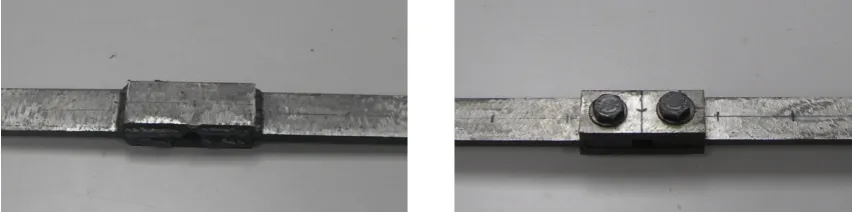
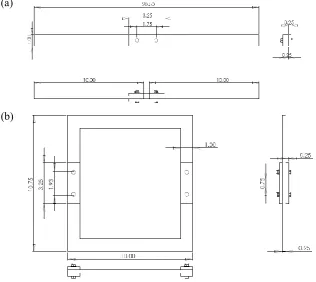
[image:3.595.82.511.445.552.2]There are two assembly structures were analysed in the study, which are a beam and frame structures. Both beam and frame were having two types; monolithic structure, where components are merged using welding method, and jointed structure, where components are merged using bolt and nut (See figure 1). The structures were weighted equivalently to avoid errors. In the bolted structure, 12 mm diameter hexagon bolts were employed. Figure 2a shows the dimension of beam structure which given as 5.2×2.5×0.635 cm while figure 2b shows the dimension of frame structure at 26.7×25.4×0.635 cm.
Figure 1. Monolithic structure and bolted-joint structure.
2.2.Design of Experiment
For the modal testing, the structure was suspended by 1 m length of elastic rope in order to stimulate a free-free boundary condition as shown in figure 3. An impact hammer was used to excite the structure at all points (11 points for beam and 30 points for frame) and an accelerometer was fixed at point 1 to accept acceleration response from the structures. The force and acceleration data were collected through data analyser which later converting to FRF using Dynamic Signal Analyzer software.
(a)
[image:4.595.126.443.117.399.2](b)
[image:4.595.168.430.456.638.2]Figure 2. Dimensions of (a) beam structure (b) frame structure from front, top and side view.
Figure 3. Typical experimental set-up for impact hammer test.
3. Results and discussion
3.1.Analysis of Beam
Table 1 tabulates the results of natural frequencies and damping ratios of each type of beams that obtained from experimental modal testing. It can be seen that the natural frequencies increase from each mode within the range of 0–2000 Hz. The bolt-jointed beam, however, shows reduction of natural frequencies about 1–15% compares to monolithic structure. By contrast, the damping ratios
accelerometer
increased significantly in jointed beam, where the highest increment recorded was ~440% at mode three.
Table 1. Structural dynamic properties of beams.
Mode Nat. freq. (Hz) Monolithic beam Damp. ratios Nat. Freq (Hz) Jointed beam Damp. ratios
1 189 1.77 159 1.75
2 444 0.224 437 0.166
3 1010 0.306 868 1.66
4 1420 0.222 1320 1.15
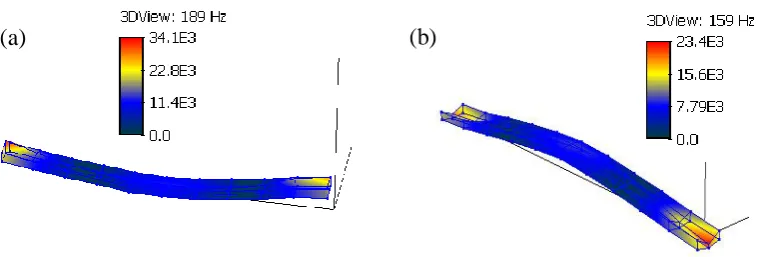
[image:5.595.82.516.418.550.2]These results were further analysed using FRF where the graph log magnitudes were plotted against frequencies (see figure 4a). It can be seen that the maximum peak in the third mode (1010 Hz) is shifted about 14%, and 7% for mode four (1420 Hz). Since the mass of both structures are similar, the only parameter that could affect natural frequency is stiffness. The stiffness of bolt-jointed beam was found smaller than monolithic beam due to the gaps at the lap joints. The magnitude of jointed beam was also found smaller where it decays about 77% and 85% for mode three and four, respectively. This result revealed that the bolted joints can reduce vibration in assembly structure and the hypothesis is supported by higher damping factor as shown in table 1. Similar result was observed by (Ma et al., 2001) when they compared monolithic beam and jointed beam in their experiment. The corresponding mode shape of the beam at mode one is illustrated in figure 5. It was found that the highest residue magnitude occurred at both end sides of the beam, where the lowest is observed in bolt-jointed beam. Monolithic beam Bolt-jointed beam (a) Monolithic frame Bolt-jointed frame (b)
Figure 4. Graph log magnitude vs. frequency for (a) beam and (b) frame.
Figure 5. Mode shape of (a) monolithic beam and (b) bolt-jointed beam.
(a)
(b)
[image:5.595.114.494.601.729.2]3.2.Analysis of Frame
Figure 4b shows the FRF result of frames against frequencies. Similarly, bolt-jointed frame was compared to monolithic frame. There are ten mode were collected in range of 0 to 2000 Hz of frequency. The peaks are shifted for several modes where the joints are located. The first four peaks show almost similar phases, while the rest shows significantly different. Table 2 tabulates the dynamic properties of frames for the first four modes. It can be seen that bolt-jointed frame produces lower natural frequencies and higher damping ratios than monolithic frame. The average percentage increase of damping ratio recorded was ~290%. This can be further verified in figure 4b, where the FRF of jointed frame is more stable and has lower amplitude from peak to peak. Figure 6 illustrates the mode shape of frames at first mode which observed as mode torsion.
Table2. Structural dynamic properties of frames.
Mode Monolithic frame Jointed frame
Nat. freq. (Hz) Damp. ratios Nat. Freq (Hz) Damp. ratios
1 105 0.231 98.4 0.819
2 221 0.255 199 1.000
3 343 0.254 328 0.906
4 486 0.17 476 0.476
Figure 6. Mode shape of (a) monolithic frame and (b) bolt-jointed frame.
4. Conclusion
This study investigated the effects of joints on dynamic response of assembly structures. The importance conclusions of this study are summarized as follows:
The addition of bolted joints decreases the structure' natural frequencies by adding additional mass to the structure.
The assembled structure using bolted joint significantly increases the damping ratio, thus this will immensely affect a complex structure.
The monolithic structures have higher stiffness compare to jointed structures.
Acknowledgements
The authors thank Universiti Tun Hussein Onn Malaysia for the support under Short Term Grant, vote 0441.
References
[1] Blakke A 1985 Design of Mechanical Joints (New York: Marcell Dekker)
[2] Bickford J H and Nassar S 1998 Handbook Of Bolts and Bolted Joints (New York: Marcel Dekker)
[3] Ahmadian H and Jalali H 2007 Identification of Bolted Lap Joints Parameters in Assembled Structures Journal of Mechanical Systems and Signal Processing21 1041-50
(a)
[4] Kamal M, Rahman M M and Rahman A G A 2012 J Mech Eng Sci 3 291
[5] Kamal M, Rahman M M and Rahman A G A 2013 Inter J Automot Mech Eng 7 912
[6] Ma X, Bergman L and Vakakis A 2001 Identification of Bolted Joints Through Laser Vibrometry Journal of Sound and Vibration246 441-60
[7] Guo T, Li L, Cai L and Zhao Y 2012 Alternative Method for Identification of the
Dynamic Properties of Bolted Joints Journal of Mechanical Science and Technology 26
3017-27
[8] Ren Y and Beards C F 1994 Identification of Joint Properties of a Structure Using FRF Data Journal of Sound and Vibration186 567-87
[9] Reid J D and Hiser N R 2004 Detailed Modeling of Bolted Joints With Slippage Journal of Finite Elements in Analysis and Design41 547-62
[10] Saxena M, Tripathi K and Kanchwala H 2012 Investigation of Dynamic Response of Bolted Joint Test Rig Under Free Vibrations using FEA International Journal of Applied
Engineering Research7 1359
[11] Kadirgama K, Rahman M M, Ismail A R and Bakar R A 2011 J Mech Eng Sci1 37 [12] Kim J, Yoon, J C and Kang B S 2006 Finite Element Analysis and Modeling of Structure
with Bolted Joints Journal of Applied Mathematical Modelling31 895-911