NG BAN HUAT
A thesis submitted in
fulfillment of the requirement for the award of the Degree of Master of Civil Engineering
Faculty of Civil and Environmental Engineering Universiti Tun Hussein Onn Malaysia
v
ABSTRACT
ABSTRAK
vii
CONTENTS
TITLE i
DECLARATION ii
DEDICATION iii
AKNOWLEDGEMENT iv
ABSTRACT v
ABSTRAK vi
TABLE OF CONTENTS vii
LIST OF TABLES xiii
LIST OF FIGURES xv
LIST OF SYMBOLS AND ABBREVIATIONS xviii
LIST OF APPENDICES xxii
CHAPTER 1 INTRODUCTION 1
1.1 Background of research 1
1.2 Problem statement 2
1.3 Research question 12
1.4 Research objective 13
1.5 Scope of research 13
1.6 Significance of the research 15
CHAPTER 2 LITERATURE REVIEW 18
2.1 Introduction 18
2.2 Building energy efficiency development 18 2.3 Definition of energy-efficient building 20 2.4 The variable of terminology for building
with energy efficiency features 22
2.4.1 Zero energy building 22
2.4.2 Passive house 22
2.4.3 Low energy building 23
2.4.4 Green building 24
2.4.5 Energy self-sufficient house 24 2.5 The development of energy-efficient
building in Malaysia 25
2.5.1 National Energy Policies 25
2.5.2 Energy-efficiency programs 26
2.5.3 MS: 1525, Energy-efficiency in non
residential buildings as regulatory 29 2.6 Building’s energy-efficient design 31
2.6.1 Passive design 31
2.6.2 Active system 40
2.7 Indoor environmental quality (IEQ) 48 2.7.1 Energy-efficient design problems affecting
occupants’ comfort with respect to IEQ
ix
2.7.2 Thermal comfort, lighting, air quality,
acoustics 53
2.8 Building Performance Analysis 59
2.8.1 Purpose of building performance analysis 60 2.8.2 Advantages of building performance analysis 61 2.9 Building performance analysis method 62 2.9.1 Justification on the implementation of
occupant survey questionnaire 64
2.10 Building performance assessment system 65 2.10.1 Justification on the implementation of
post occupancy evaluation 67
2.10.2 Elaboration of the post occupancy evaluation
(POE) concept applied in the study 68
2.11 Summary 71
CHAPTER 3 RESEARCH METHODOLOGY 72
3.1 Introduction 73
3.2 Preliminary study 75
3.3 Case study building 75
3.4 Literature review 76
3.5 Data collection 77
3.5.1 Primary data 77
3.5.2 Secondary data 78
3.5.3 Mapping previous study 78
3.6 Construct initial questionnaire templates 78
3.6.2 Pilot study 79
3.7 Evaluation framework testing 80
3.7.1 Sampling 80
3.7.2 Sampling data analysis 80
3.7.3 Pearson correlation coefficient 82
3.8 Summary 84
CHAPTER 4 DATA ANALYSIS 86
4.1 Introduction 86
4.2 Respondents’ background 87
4.2.1 Information coding 87
4.3 Energy-efficient and passive design
components 88
4.3.1 Building orientation 89
4.3.2 Daylighting 90
4.3.3 Insulation system 96
4.3.4 Reduced internal load 100
4.3.5 Cooling System 100
4.3.6 Energy-efficient lighting system 105 4.4 Energy-efficient and passive design
components in the case study buildings 106
4.5 Mapping previous study (MPS) 107
4.6 Evaluation framework development 113 4.7 Content validity test analysis 116
4.8 Data analysis 120
xi
4.8.2 Reliability test analysis 125
4.8.3 Test-retest reliability 125
4.8.4 Criterion validity analysis 127
4.8.5 Construct validity analysis 136
4.8.6 Comparison of overall comfort with
sustainable building rating tools score 138
4.9 Summary 142
CHAPTER 5 CONCLUSION AND RECOMMENDATION 143
5.1 Introduction 143
5.2 Objective 1 - To propose an evaluation framework for the identification of problems
which affect the occupants’ comfort. 144
5.3 Objective 2 - To determine the reliability and validity of the proposed evaluation
framework. 145
5.4 Objective 3 - To analyze the occupants’ comfort level of the energy-efficient
(office) building. 147
5.5 Research limitations 148
5.6 Recommendations for future research 149
5.7 Summary 150
REFERENCES 151
APPENDIX 177
APPENDIX A 178
APPENDIX C 185
APPENDIX D 188
APPENDIX E 189
APPENDIX F 191
APPENDIX G 193
APPENDIX H 194
APPENDIX I 195
xiii
LIST OF TABLES
1.0 Types of building performance assessment
method 7
1.1 Types of Indoor Environmental Quality (IEQ)
Survey 9
2.1 Fluorescent light fixture characteristics 47 2.2 Energy-efficient design problems affecting
occupants’ comfort with respect to IEQ criteria 53 3.1 Energy-efficient building in Malaysia 75 3.2 Minimum values of CVR for different number
of panelists 79
3.3 Pearson’s correlation coefficient r 84
4.1 Information coding table 88
4.2 Checklist of energy-efficient and passive design
components in the case study buildings 106 4.3 Energy-efficient design problems affecting
occupants’ comfort 108
4.4 Level of agreement scale 115
4.5 Composition of panel of experts 116
4.6 Means and CVR values of the respective
judgments and acceptation or rejection result 118 4.7 Sample size and questionnaire form return rate 122
4.8 Building A – Respondents’ background 123
4.9 Building B – Respondents’ background 123
4.10 Building C – Respondents’ background 124 4.11 Cronbach’s Alpha for Building A, Building B,
4.12 ICC Reliability of EEBEQ 126 4.13 Correlation of thermal comfort – Building A 128 4.14 Correlation of acoustics – Building A 128 4.15 Correlation of lighting – Building A 128 4.16 Correlation of Indoor Air Quality (IAQ)
– Building A 129
4.17 Descriptive analysis of lighting (EEBEQ)
– Building A 130
4.18 Descriptive analysis of lighting (BUS)
– Building A 131
4.19 Correlation of thermal comfort – Building B 132 4.20 Correlation of acoustics – Building B 132 4.21 Correlation of lighting – Building B 132 4.22 Correlation of Indoor Air Quality (IAQ)
– Building B 132
4.23 Correlation of thermal comfort – Building C 133 4.24 Correlation of acoustics – Building C 133 4.25 Correlation of lighting – Building C 134 4.26 Correlation of Indoor Air Quality (IAQ)
– Building C 134
4.27 Descriptive analysis of lighting (EEBEQ)
– Building C 135
4.28 Descriptive analysis of lighting (BUS)
– Building C 136
4.29 Correlation with overall satisfaction question
from BUS – Building A 137
4.30 Correlation with overall satisfaction question
from BUS – Building B 137
4.31 Correlation with overall satisfaction question
from BUS – Building C 137
4.32 Descriptive analysis of window blinds/shades
xv
LIST OF FIGURES
1.0 Building’s performance evaluation perspectives 4 1.1 Occupants’ point of view is equally important
as its technological performance 5
1.2 Correlation between occupants’ satisfaction level towards indoor environmental quality
(IEQ) and building performance 6
2.1 MIT Solar House I located at Cambridge,
Massachusetts, United States 19
2.2 A ZEH at Danish Technical University,
Lyngby, Denmark 22
2.3 Passive House in Darmstadt Kranichstein 23
2.4 SD Worx, Kortrijk, Belgium 23
2.5 Genzyme Corporation Headquarter,
Cambridge, Massachusetts, USA 24
2.6 Self-Sufficient Solar House (SSSH) in
Freiburg, Germany 25
2.7 Orientation and building shape in warmer
climatic zones 32
2.8 Analogy of daylighting showing the path of
sunlight enter the building 35
2.9 Side view of energy-efficient window 35 2.10 Position of shades of an energy-efficient
building 36
2.11 Venturi effects in energy-efficient building 37
2.13 Elements and levels of building performance
evaluation 61
2.14 Building performance analysis method 62 2.15 Types of building performance assessment system 65
3.1 Flowchart of research methodology 74
4.1 Site plan of Malaysia Green Technology
Corporation building 89
4.2 (a) Building wall facing to east (b) Building wall
facing to west 90
4.3 (a) Building wall facing to north (b) Building wall
facing to south 90
4.4 (a) The process of diffuse light enter the building through skylight (b) Spectrally selective glazing
(c) Natural sunlight from rooftop 91
4.5 (a) & (b) Sunlight enter the building through Building Integrated Photovoltaic (BIPV) panel
functioned as atrium roof of the building 92 4.6 (a) Diffuse light enter the building
(b) Mirror lightshelf (c) High reflective ceiling 92
4.7 (a) Transparent wall (b) Window area 93
4.8 Internal layout of energy-efficient building 93 4.9 Schematic diagram of double glazing window 94
4.10 Shading plate 95
4.11 Louvers 95
4.12 Step-in design (self-shading) 96
4.13 (a) Office building internal wall (b) &
(c) Internal wall installed with insulation system
during construction of the building 97 4.14 (a) Office building external wall (b) &
(c) External wall installed with insulation system
during construction of the building 98 4.15 The photo shows the installation of Styrofoam
xvii
4.17 Polystyrene layer is installed on the uppermost
floor of the office building 100
4.18 Cooling process happens on tricking cool roof 101
4.19 Rainwater collection tank 102
4.20 PCM plate flactice-10 102
4.21 Air Handling Unit (AHU) 103
4.22 VAV and VSD system 103
4.23 PEX pipe installed on the slab during the
construction process 104
4.24 Chilled metal ceiling (CMC) 104
4.25 (a) Compact Fluorescent Light (CFL)
(b) Fluorescent Light (c) LED Light 105
4.26 Daylight sensor 105
4.27 Present sensor 105
4.28 EEBEQ survey framework, energy-efficient design variables and Indoor Environmental
Quality (IEQ) variables 114
4.29 Frequency of IEQ criteria 113
4.30 The interior of the case study buildings 121 4.31 Picture on the left shows the exterior of the
renovated area and picture on the right shows
the interior of the renovated area 129
4.32 Additional blinds install after building
occupancy 136
4.33 Overall comfort mean scores for case studies
building 138
4.34 GBI scores for case study buildings 138 4.35 GBI (IEQ) scores for case study buildings 139 4.36 Window without blinds and exterior of
building without shades plate 139
4.37 No reflective ceiling features reduce the
emitting of natural daylight 140
4.38 Office area is dark when lights are turned
LIST OF SYMBOLS AND ABBREVIATIONS
% - Percents
CO2 - Carbon Dioxide
CVR - Content Validity Ratio
hrs/wk - Hours per week
kW - Kilowatt
kWh - Kilowatt-hour
kWh/m2 - Kilowatt hours per meter square
kWh/m²/yr - Kilowatt hours per square meter per year kWh/year - Kilowatt hours per year
m - Meter
m2 - Square meter
MJ - Mega joule
mm - Millimeter
n/2 - number of panelists divided by two
ne - number of panelists indicating “essential”
r - rho
Tvis - Visible Transmittance
α - Alpha
AHU - Air Handling Unit
AIA - American Institute of Architects APEC - Asia-Pacific Economic Cooperation ASEAN - Association of Southeast Asian Nations
ASHRAE - American Society of Heating, Refrigerating and Air Conditioning Engineers
BASE - Building Assessment Survey and Evaluation
xix
BIPV - Building Integrated Photovoltaic
BIU - Building-In-Use
BQA - Building Quality Assessment
BREEAM - BRE Environmental Assessment Method BS5240 - Industrial Safety Helmets - specification for
construction and Performance
BUS - Building Use Studies
CBE - Center for the Built Environment
CDC - Centers for Disease Control and Prevention
CFL - Compact Fluorescent Lamp
CMC - Chilled Metal Ceiling
COPE - Cost effective Open Plan
CPEC - Car park Energy Consumption
CRT - Cathode Ray Tube
CVI - Content Validity Index
DCA - Data Centre Area
DCEC - Data Centre Energy Consumption
DDC - Direct Digital Control
DTU - Danmarks Tekniske Universitet
EEBEQ - Energy-efficient Building Environmental Evaluation Framework
EDPM - Electronic Data Processing Machine EEMP - Energy Efficiency Master Plan, Malaysia
EMS - Energy Management System
ERV - Energy Recovery Ventilation
ETP - Engineering Thermoplastic
FVR - Weighted Floor Vacancy Rate
GBI - Green Building Index
GEF - Global Environment Facility
GEO - Green Energy Office
GFA - Gross Floor Area
GLA - Gross Lettable Area
HOPE - European Health Optimization Protocol for Energy- efficient buildings
HVAC - Heating, Ventilating, and Air Conditioning
IAQ - Indoor Air Quality
ICC - Intra-class Correlation Coefficient
ICIEE - International Center for Indoor Environment and Energy
IEQ - Indoor Environmental Quality
KeTTHA - Ministry of Energy, Green Technology and Water, Malaysia
KKR2 - Kompleks Kerja Raya 2
KL - Kuala Lumpur
KLCC - Kuala Lumpur City Center
LCD - Liquid Crystal Display
LED - Light-Emitting Diode
LEED - Leadership in Energy and Environmental Design
LEO - Low Energy Building
MIEEIP - Malaysia Industrial Energy Efficiency Improvement Project
MIT - Massachusetts Institute of Technology
MPS - Mapping previous study
MS 1525:2001 - Code of Practice on Energy Efficiency and use of Renewable Energy for Non-residential Buildings
PC - Personal Computer
PCM - Phase Change Material
PEX - Cross-linked polyethylene
POE - Post Occupancy Evaluation
PROBE - Post-occupancy Review of Buildings and their Engineering
PV - Photovoltaic
REF - Ratings of Environmental Features
RIBA - Royal Institute of British Architects
RSF - Research Support Facilities
xxi
SC - Shading Coefficient
SCATS - Smart Controls and Thermal Comfort
SHGC - Solar Heat Gain Coefficient
SPSS - Statistical Package for the Social Sciences
SRI - Solar Reflectance Index
SSSH - Self-Sufficient Solar House
TBEC - Total Building Energy Consumption
TBP - Total Building Performance
UBBL - Uniform Building By-Laws, Malaysia UCB - University of California, Berkeley
UK - United Kingdom
UNDP - United Nations Development Program
UNEP - United Nation Environment Program
USA - United States of America
VAV - Variable Air Volume
VFD - Variable-Frequency Drive
VOCs - Volatile Organic Compounds
VSD - Variable-Speed Drive
VT - Visible Transmittance
WHO - Weighted Weekly Operating Hours
ZEB - Zero Energy Building
LIST OF APPENDICES
APPENDIX TITLE PAGE
A Energy-efficient Building Environmental Quality
Evaluation Framework (EEBEQ) 178
B Content validation form 180
C Building Use Studies (BUS) 185
D Interview questions (energy-efficient buildings’
owners) 188
E Interview questions (architects) 189
F Interview questions (energy consultants) 191
G License agreement (BUS) 193
H Letter of permission (Content validation) 194 I Letter of permission by University –
Questionnaire distribution 195
J Letter of permission by University –
CHAPTER 1
INTRODUCTION
1.1 Background of research
This research is about the development of an energy-efficient building environmental quality evaluation framework for office building in hot and humid climatic regions. According to the National Institute of Building Sciences (2008), human comfort is one of the important aspects needed to be taken into account while developing an energy-efficient building. Therefore, the development of energy-efficient building environmental quality evaluation framework involves identifying the occupants’ comfort level in energy-efficient building through its assessment criteria such as thermal comfort, lighting, acoustics and indoor air quality (IAQ). Such effort could help to prevent repeating past mistakes particularly from the aspect of occupant’s comfort in the future development of energy-efficient building.
These buildings are the initiatives demonstrated by the government to fully engage in the sustainable development (United Nations Environment Programme, 2011).
1.2 Problem statement
The development of a sustainable building rating system such as Leadership in Energy and Environmental Design (LEED), and Malaysian Green Building Index (GBI) reflected the current focus of the building performance objectives mostly on
optimizing energy and resource efficiently. Although the current focus on building energy performance is high yet some of the buildings particularly energy-efficient buildings are still not able to achieve the low energy consumption in terms of the yearly energy use. Newsham et al. (2009) analyzed the data supplied by the New Buildings Institute and the US Green Buildings Council on measured energy use data from 100 LEED-certified commercial and institutional buildings and had found that 28–35% of LEED buildings use more energy than their conventional counterparts. A study by the New Building Institute (2008), also found about 30% of LEED rated buildings perform better than expected, 25% perform worse than expected and a handful of LEED buildings have serious energy consumption problems. These problems are due to repetition of past mistakes by creating unnecessary and wasteful complexity, which can undermine the green buildings’ whole purpose (Leaman & Bordass, 2007).
3
as a strong stimulus for energy conservation measures that simultaneously improve indoor environments (Fisk, 2000). The importance of building’s IEQ especially in energy-efficient buildings has led to the development of Health Optimization Protocol for Energy-efficient Buildings (HOPE) project, a research funded by European Union countries that aims to create healthy and energy-efficient buildings in the region (Bluyssen & Loomans, 2003).
A research done by Baird et al. (2011) shows that the perception of the user towards “sustainable building are better than the “conventional building” in terms of IEQ aspects such as lighting, noise, temperature and air quality. In another study, users have high degree of satisfaction toward overall performance of energy-efficient building (Zainordin, Abdullah & Ahmad, 2012). A research carried out by Ismail & Sibley (2006) show that bioclimatic high rise office building creates a better working environment for the users and provides higher level of satisfaction than conventional ones. The passive design strategies that apply in energy-efficient building in Malaysia on the average, proven effective at improving indoor thermal comfort, which in turn lead to improving occupant satisfaction. Besides high level of users’ satisfaction towards energy-efficient buildings, empirical result also show indoor thermal and ventilation condition in bioclimatic buildings are better than that of conventional ones (Ismail, Sibley & Wahab, 2011).
Qahtan et al. (2010) in two energy-efficient buildings in Malaysia show occupants have less satisfaction on the air movement of the building which could be improved through mechanical ventilation.
Different reasons have been suggested in the literature, which include lack of feedback across the building life cycle (Kalay, 2006); and in terms of more technical issues, Augenbroe (2002) suggests that problems in mapping between different tools and procedures may contribute to the low performance of energy-efficient building. Loftness et al. (2009) revealed that significant gaps between the design intent and the performance of buildings and systems over time and occupancy shift could be caused by failures in the design, construction, management or use of buildings. These inefficient building performances can result in occupants’ discomfort.
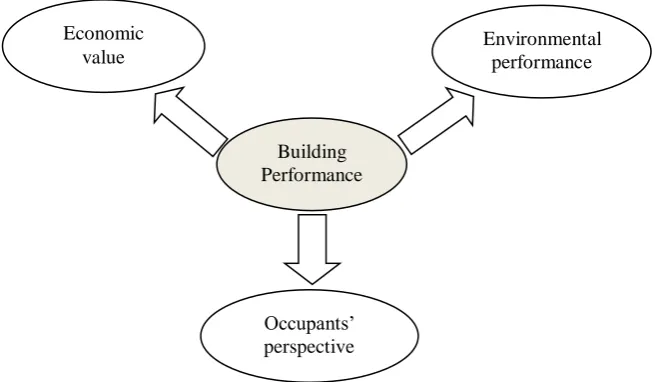
[image:23.595.172.500.507.698.2]Occupants’ comfort and comfort-related behavior can impact a building’s energy and environmental performance and lead to the increasing operating energy, particularly in green buildings which are thought to be more fragile in their performance. Sartori & Hestnes (2007) highlighted that reducing the demand for operating energy appears to be the most important aspect for the design of buildings that are energy efficient throughout their life cycle. This is because operating energy represents by far the largest part of energy demand in a building during its life cycle. Therefore, having a building performance analysis which emphasizes on occupants’ comfort particularly towards building’s IEQ is crucial.
Figure 1.0: Building’s performance evaluation perspectives Building
Performance
Occupants’ perspective
Environmental performance Economic
5
[image:24.595.115.513.499.575.2]Leaman, Stevenson, & Bordass (2010) opine that building performance analysis can be studied from three different perspectives such as occupants, environmental performance and economic value as shown in Figure 1.0. Occupants’ perspective towards building performance is focused on how well their needs are met; for the environmental performance, energy and water efficiency are assessed, and; economic value of building is in regard to whether the building makes economic sense, such as value for money or return on investment. Most of the time, client or building owner and designer are more interested in building’s environmental performance and economic value since these two perspectives have a direct impact in reducing the energy cost. According to Vischer (2008), most design and construction decisions involve trading off building quality with construction cost. Thus, occupants’ perspective is often neglected due to its insignificant economic value. Ibrahim (2003) suggested that it is important to ensure building quality and satisfaction of users’ demands and expectations are attended by the design team during the design stage. Therefore, the co-operation between all members of the building design team should be organized to fulfill suitable environment that achieves the satisfaction of the user. Understanding the experience of the building from the occupants’ point of view is as equally important as its technological performance (Leaman, Thomas & Vandenberg, 2007) as shown in Figure 1.1.
Figure 1.1: Occupants’ point of view is equally important as its technological performance
This is because, not only can a poorly performing building affect occupants’ wellbeing and productivity, subsequent measures needed to alleviate occupants’ discomfort can also result in great expense in the building failing to achieve its efficiency targets. According to Hartkopf & Loftness (1999), fulfilling users’ satisfaction in relation to the performance areas of IEQ criteria such as spatial, thermal, acoustics and air quality will be able to create considerably higher quality in
Equally Important
Occupants’ point of view towards building
performance
living and work environments, while simultaneously reducing energy and environmental consumption. The key to good building usability is related to good relations between the people and the building, thus usability cannot be evaluated by assessing only physical parameters (Blakstad, Hansen, & Knudsen, 2008).
A fine balance should exist between optimizing energy and resource efficiency in green buildings and providing a comfortable, healthy and productive indoor environment. Fundamentally, green buildings often rely on natural conditioning to meet the comfort needs of end-users, passive strategies are employed to provide indoor conditions that are more able to adapt and link to the variation of temperature according to different season and climate. There are some environmental controls systems that can be designed either to accommodate active user’s engagement, or to intelligently respond and adapt to changing external conditions with minimal user’s engagement. Both approaches share a similarity, that they rely on effective feedback to inform users of design intention and the environmental consequences of their actions. Feedback is particularly important when environmental systems and control are new to designers, operators and users, and matching technological and management capability is crucial (Cohen et al., 1999). Furthermore as occupants demand high performance of energy-efficient design with the aim of improving their comfort, relationship between occupants’ satisfaction and building’s IEQ can be positively correlated with better building
[image:25.595.117.506.520.594.2]performance (Wilkinson et al., 2011).
Figure 1.2: Correlation between occupants’ satisfaction level towards indoor environmental quality (IEQ) and building performance
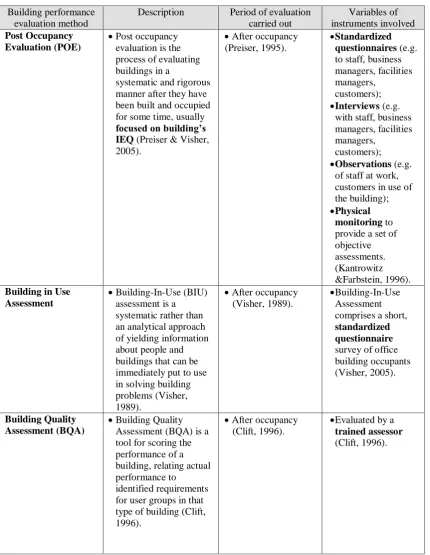
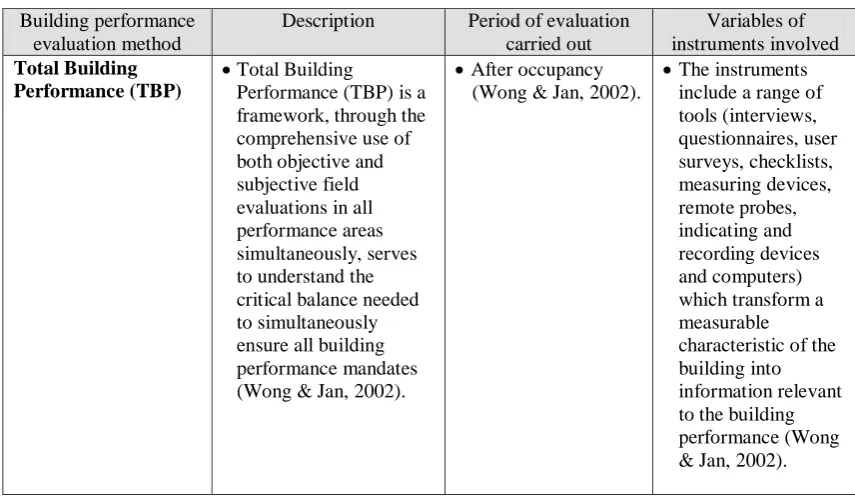
According to Ng (2005), there are four types of building performance evaluation methods focusing on occupants’ perspective as shown in Table 1.0. These include Post Occupancy Evaluation (POE), Building in Use Assessment, Building Quality Assessment (BQA), and Total Building Performance (TBP).
High occupants’ satisfaction level towards Indoor Environmental Quality
(IEQ)
7
Table 1.0: Types of building performance evaluation method
Building performance evaluation method
Description Period of evaluation
carried out
Variables of instruments involved
Post Occupancy Evaluation (POE)
Post occupancy evaluation is the process of evaluating buildings in a
systematic and rigorous manner after they have been built and occupied for some time, usually
focused on building’s IEQ (Preiser & Visher, 2005).
After occupancy (Preiser, 1995).
Standardized questionnaires (e.g. to staff, business managers, facilities managers,
customers); Interviews (e.g.
with staff, business managers, facilities managers,
customers); Observations (e.g.
of staff at work, customers in use of the building); Physical
monitoring to provide a set of objective assessments. (Kantrowitz &Farbstein, 1996).
Building in Use Assessment
Building-In-Use (BIU) assessment is a systematic rather than an analytical approach of yielding information about people and buildings that can be immediately put to use in solving building problems (Visher, 1989).
After occupancy (Visher, 1989).
Building-In-Use Assessment comprises a short,
standardized questionnaire
survey of office building occupants (Visher, 2005).
Building Quality Assessment (BQA)
Building Quality Assessment (BQA) is a tool for scoring the performance of a building, relating actual performance to
identified requirements for user groups in that type of building (Clift, 1996).
After occupancy (Clift, 1996).
Evaluated by a
trained assessor
Table 1.0: Continued Building performance
evaluation method
Description Period of evaluation
carried out
Variables of instruments involved
Total Building Performance (TBP)
Total Building
Performance (TBP) is a framework, through the comprehensive use of both objective and subjective field evaluations in all performance areas simultaneously, serves to understand the critical balance needed to simultaneously ensure all building performance mandates (Wong & Jan, 2002).
After occupancy (Wong & Jan, 2002).
The instruments include a range of tools (interviews, questionnaires, user surveys, checklists, measuring devices, remote probes, indicating and recording devices and computers) which transform a measurable characteristic of the building into information relevant to the building performance (Wong & Jan, 2002).
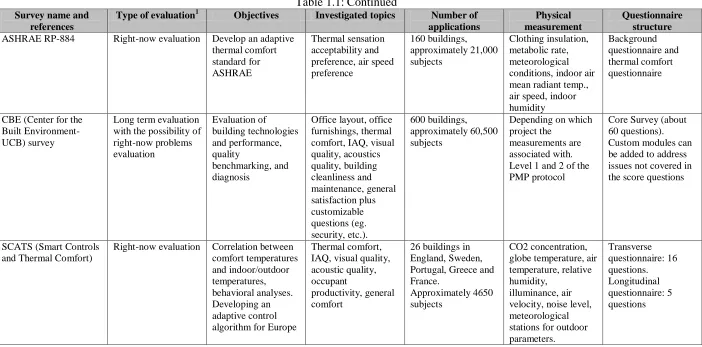
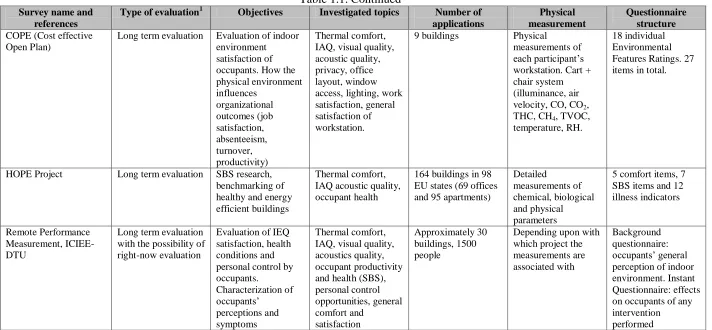
From Table 1.0, it can be concluded that POE encompasses the most comprehensive building performance evaluation from occupants’ perspective compared to other methods. The variables of instruments involved in POE are questionnaire, interview, and observation which are related to occupants’ perspective, and the period of assessment carried out is for after occupancy. Besides that, it also focuses on building’s IEQ. Preiser & Vischer (2005) suggested that POE is different from other evaluation methods as it emphasizes on the needs of building occupants. Measures used in POEs include indices related to organizational and occupants’ performance, workers’ satisfaction and productivity, as well as the measures of building performance such as acoustic and lighting levels, adequacy of space, spatial relationships, etc. Hence, by the reasons stated above, POE is the most suitable building assessment method which studies from occupants’ perspective. The importance of the research on POE has drawn researchers’ attention in recent years and has led the development of various types of IEQ survey instruments. From a research done by Peretti & Schiavon (2011), they had identified ten IEQ surveys as shown in Table 1.1.
9
Table 1.1: Types of Indoor Environmental Quality (IEQ) Survey (Peretti & Schiavon, 2011)
Survey name and references
Type of evaluation1 Objectives Investigated topics Number of
applications
Physical measurement
Questionnaire structure
BUS (Building Use Studies) occupant survey
Long term evaluation Assess how well
buildings work, get feedback on
occupants’ needs and perceptions, improve services to occupants
Thermal comfort, perceived comfort, Indoor Air Quality (IAQ), occupant health, productivity (self estimated), personal control Over 400 organizations and individuals worldwide
Not performed 24 environmental
comfort questions, 10 on personal control, 17 on background info, health, productivity, and design.
HFSQ (Human Factors Satisfaction
Questionnaire)
Long term evaluation Effects of the
physical environment on employees’ behavior and attitudes. Survey on satisfaction with the physical environment and job satisfaction
Thermal comfort, IAQ, acoustic quality, structure organization and quality, health and security of occupants. Satisfaction with environmental factors.
N.A. Not performed Questionnaire is
composed of 42 items
REF (Ratings of Environmental.
Features) questionnaire
Long term evaluation Research strategies
for evaluating facility design, occupants’ productivity, and organizational effectiveness Thermal comfort, IAQ, acoustic quality, visual quality, and structure layout quality
7 administrative units and offices
Not Performed Basic Survey: 24
items.
Complete survey: 48 items
Building Assessment Survey and Evaluation (BASE) Study
Long term evaluation Occupants’
perceptions of IAQ and health symptoms
Workplace physical information, health and well-being, workplace environmental conditions, and job characteristics
100 buildings in 37 cities in 25 US states
Mobile cart: CO2,
temperature, RH, and supply air delivery. Real time monitors: CO, CO2,
temperature, RH, VOCs, PM2.5,PM10
Table 1.1: Continued
Survey name and references
Type of evaluation1 Objectives Investigated topics Number of
applications
Physical measurement
Questionnaire structure
ASHRAE RP-884 Right-now evaluation Develop an adaptive
thermal comfort standard for ASHRAE
Thermal sensation acceptability and preference, air speed preference 160 buildings, approximately 21,000 subjects Clothing insulation, metabolic rate, meteorological conditions, indoor air mean radiant temp., air speed, indoor humidity
Background questionnaire and thermal comfort questionnaire
CBE (Center for the Built Environment-UCB) survey
Long term evaluation with the possibility of right-now problems evaluation Evaluation of building technologies and performance, quality benchmarking, and diagnosis
Office layout, office furnishings, thermal comfort, IAQ, visual quality, acoustics quality, building cleanliness and maintenance, general satisfaction plus customizable questions (eg. security, etc.). 600 buildings, approximately 60,500 subjects
Depending on which project the
measurements are associated with. Level 1 and 2 of the PMP protocol
Core Survey (about 60 questions). Custom modules can be added to address issues not covered in the score questions
SCATS (Smart Controls and Thermal Comfort)
Right-now evaluation Correlation between
comfort temperatures and indoor/outdoor temperatures, behavioral analyses. Developing an adaptive control algorithm for Europe
Thermal comfort, IAQ, visual quality, acoustic quality, occupant
productivity, general comfort
26 buildings in England, Sweden, Portugal, Greece and France.
Approximately 4650 subjects
CO2 concentration, globe temperature, air temperature, relative humidity,
11
Table 1.1: Continued
Survey name and references
Type of evaluation1 Objectives Investigated topics Number of
applications
Physical measurement
Questionnaire structure
COPE (Cost effective Open Plan)
Long term evaluation Evaluation of indoor
environment satisfaction of occupants. How the physical environment influences organizational outcomes (job satisfaction, absenteeism, turnover, productivity) Thermal comfort, IAQ, visual quality, acoustic quality, privacy, office layout, window access, lighting, work satisfaction, general satisfaction of workstation.
9 buildings Physical
measurements of each participant’s workstation. Cart + chair system (illuminance, air velocity, CO, CO2,
THC, CH4, TVOC,
temperature, RH.
18 individual Environmental Features Ratings. 27 items in total.
HOPE Project Long term evaluation SBS research,
benchmarking of healthy and energy efficient buildings
Thermal comfort, IAQ acoustic quality, occupant health
164 buildings in 98 EU states (69 offices and 95 apartments)
Detailed
measurements of chemical, biological and physical parameters
5 comfort items, 7 SBS items and 12 illness indicators
Remote Performance Measurement, ICIEE-DTU
Long term evaluation with the possibility of right-now evaluation
Evaluation of IEQ satisfaction, health conditions and personal control by occupants. Characterization of occupants’ perceptions and symptoms Thermal comfort, IAQ, visual quality, acoustics quality, occupant productivity and health (SBS), personal control opportunities, general comfort and satisfaction Approximately 30 buildings, 1500 people
Depending upon with which project the measurements are associated with
Background questionnaire: occupants’ general perception of indoor environment. Instant Questionnaire: effects on occupants of any intervention performed 1
Although the current IEQ survey instruments for POE are good for grading buildings, they are not inclusive enough when applied on energy-efficient building. The current IEQ survey instruments are unable to directly point out the problems of the building design which causes low performance of IEQ criteria, as the current IEQ survey instruments are not specifically meant for energy-efficient building. Fisk (2001) also argued that studies carried out by PROBE (Building Use Studies (BUS) survey) have failed to tackle all sustainability indicators and occupation styles during reviews.
If a comprehensive building evaluation which encompasses occupants’ perspective is not being conducted to the energy-efficient building, energy-efficient building design team would not be able to easily identify the problems that affect the
building performance. Since occupants are the end users of the building, the occupants’ behavior while using the building can directly affect the building performance. Even though the development of energy-efficient building in Malaysia is still at the beginning stage, the industry players such developers, architects, and consultants should focus not only on the development of new energy-efficient building solely but the study on the existing energy-efficient building must not be neglected as well. Owing to this limitation on the POE, a comprehensive evaluation framework is needed in order to reduce the gap between occupants and building’s
energy-efficient design. For these reasons, the aim of this research is to determine the comfort level of energy-efficient (office) buildings in Malaysia, and to develop an evaluation framework for the identification of problems in respect to energy-efficient design which affects the occupants’ comfort.
1.3 Research question
In accordance to the above problems, the research questions are as follows:
13
(ii) How reliable does the proposed approach in identifying problems affecting the occupants’ comfort in terms of energy-efficient design?
(iii) What is the occupants’ comfort level of the energy-efficient (office) building?
1.4 Research objective
The following objectives are identified in response to the research question:
(i) To propose an evaluation framework for the identification of problems which affect the occupants’ comfort.
(ii) To determines the reliability and validity of the proposed evaluation framework.
(iii) To analyze the occupants’ comfort level of the energy-efficient (office) building.
1.5 Scope of research
The scope of the research is focused on Indoor Environmental Quality (IEQ) criteria
of energy-efficient building. The outcomes from the research carried out by Thomas (2010) highlight the importance of improving IEQ for occupants particularly through increased fresh air, daylight, glare control, access to views, and noise management.
Thus, the evaluation framework criteria for the energy-efficient design of the
buildings are based on the key physical environmental parameters of Indoor
Environmental Quality (IEQ) performance; such as thermal comfort, ventilation,
lighting, and noise etc.
sustainable or energy-efficient building in Malaysia. The Ministry of Energy, Green Technology and Water (KeTTHA) building is the maiden energy-efficient building project in Malaysia; the building has even won the 2006 ASEAN building energy awards (Ministry of Energy, Green Technology and Water [KeTTHA], 2006). In the following years, the development of energy-efficient building in Malaysia continues to flourish, the development of the projects, such as Malaysia Green Technology Corporation and Energy Commission building or colloquially known as ST Diamond building are another two showcase energy-efficient building project initiated by the government following the success of the KeTTHA building. Both of the projects have obtained recognition from Malaysian sustainable building rating tools, Green Building Index (GBI) (Green Building Index [GBI], 2011).
Malaysia Green Technology Corporation building was certified with Green Building Index (GBI) certificate; and the ST Diamond building was awarded GBI Platinum and Green Mark Platinum which is the Singapore sustainable building rating tool (Koay, 2011). Although, the buildings have obtained the award and certified by sustainable building rating tools assessment, the efficiency of the building performance is still not at par as the expected performance. One of the Malaysian showcase energy-efficient building projects, Malaysia Green Technology Corporation office building has yet to achieve its desired performance even after three years in operation (Choong, 2009). Thus the proposed survey framework will be tested on the Malaysians’ showcase energy-efficient buildings; the Ministry of Energy, Green Technology and Water (KeTTHA) building and Energy Commission building which are situated in Putrajaya, and Malaysia Green Technology Corporation building located in Bandar Baru Bangi.
According to Peretti & Schiavon (2011), building occupants are a valuable source of information for IEQ. Thomas & Hall (2004) found that good and robust environmental design begins with an integrated design approach that is cognizant of users’ needs and expectations. Hence, the sampling of research focuses on the occupants of the selected buildings. Random sampling was used to determine the
15
1.6 Significance of the research
The research is important to the following parties/individuals:
(i) Ministry of Energy, Green Technology and Water (KeTTHA); Energy Commission, and Malaysia Green Technology Corporations as the owner of the building in the effort to improve the efficiency of their energy-efficient buildings respectively.
(ii) Contribute some relevant information regarding current energy-efficient building performance to the parties such as developers who are interested in developing construction projects related to the energy-efficient building.
(iii) Design team (architects or consultants) could use the information regarding the energy-efficient design which affects the occupants’ comfort in preventing the repetition of past mistakes in the future development of energy-efficient building.
(iv) Academicians from civil engineering field could use the newly designed evaluation framework in gathering data regarding IEQ performance for energy-efficient building.
1.7 Structure of thesis
Chapter 1
research towards building industry development and engineering field has been justified.
Chapter 2
Chapter 2 is divided into 4 subtopics; energy-efficient building, Indoor Environmental Quality (IEQ), building performance analysis, and post occupancy evaluation. Energy-efficient building subtopic discusses the background and the definition of energy-efficient building, and the energy-efficient designs of the buildings are outlined. Common IEQ criteria problems encountered in energy-efficient building have been identified through previous researches. At the end of the chapter, the importance of implementation of questionnaire survey is justified. The significance of post occupancy evaluation carried out during occupancy stage is also outlined.
Chapter 3
The methodology of the research is divided into three phases; phase 1 involves preliminary study, literature review, and data collection. Phase 2 is regarding the survey framework development. In the second phase, the constructed survey framework EEBEQ validity is determined through content validation and pilot study. After the completion of phase 2, the modified EEBEQ survey questionnaire was tested on the case study building. The results obtained from the survey were then analyzed using sociological validation process, such as criterion validity, construct validity, and intra-class correlation coefficient (ICC).
Chapter 4
17
Detailed discussions are provided in order to examine the credibility of the EEBEQ and to achieve the research objectives.
Chapter 5
LITERATURE REVIEW
2.1 Introduction
In this chapter the literature review is divided into four parts; (1) energy-efficient buildings, (2) Indoor Environmental Quality (IEQ), (3) building performance analysis, and (4) Post Occupancy Evaluation (POE) method. The study is based on the information gathered from this literature review, which are building performance analysis, POE method, IEQ and energy-efficient buildings.
2.2 Building energy efficiency development
19
[image:38.595.216.422.299.443.2]The concept of energy-efficient building has existed since the early 20th century; the construction of solar houses is one of the efforts towards reducing fossil energy consumption which will ultimately contribute to reduced greenhouse gas emission. The construction of the solar houses aims to realize zero fossil energy consumption in buildings heating systems. One of the examples of solar house is MIT Solar House I as shown in Figure 2.1. The solar house was built in 1939 and it is located at Cambridge, Massachusetts, United States. The solar house includes solar thermal collecting area and water storage system (Butti & Perlin, 1980). In 1955, the solar technology had been applied in the Bliss House located at Melbourne, Florida, United States; the solar technology has been used in the ventilation system (Bliss, 1955).
Figure 2.1: MIT Solar House I located at Cambridge, Massachusetts, United States (Artists Domain, 2010)
Another example of energy-efficient building is zero energy building (ZEB). In 1975, Professor Korsgaard from Danish Technical University together with his colleagues had successfully built a Zero Energy House (ZEH) at Thermal Insulation Laboratory. The building is the first solar heated house in northern Europe (Esbensen & Korsgaard, 1977). Following the success of ZEH in Denmark, many countries have started to develop their own energy-efficient buildings.
passive house in Denmark (Passivhus.dk, 2012). This trend is now extending to other parts of the world.
The importance of reducing building energy consumption has elevated the development of energy-efficient building; each country has its own definition and standard to classify energy-efficient buildings. The variables of definitions and standards can be due to the different in climates and economy state of each country. Nevertheless, the approaches and guidelines by each party should contribute towards reducing building energy consumption and greenhouse gas emission by any means.
2.3 Definition of energy-efficient building
There is no specific definition for energy-efficient building whether in academic studies or at national levels. Each country in Europe has different definitions and scopes for energy-efficient building (Thomsen & Wittchen, 2008). However, its term could be traced from the previous research which related to energy-efficient building. In this section a definition of energy-efficient building will be derived from the summary of the previous researches related to the term of energy-efficient building used by researchers from various studies and fields.
energy-21
efficient buildings, one of the studied buildings is a simulated passive solar office room. According to Carassus (2008) energy-efficient buildings could be classified into three types of models: the Low Consumption model (eg. Passivhaus in German), the Energy and Environmental model (eg. LEED certified building) and the Energy Saving and Production model for example Zero Energy Homes.
2.4 The variable of terminology for building with energy efficiency features
2.4.1 Zero energy building
[image:41.595.224.414.364.495.2]According to Torcellini et al. (2006), zero energy building (ZEB) is defined as a residential or commercial building which greatly reduced energy needs through efficiency gains such that the balance of energy needs can be supplied with renewable technologies. In 1975, Professor Korsgaard from Danish Technical University has successfully built a Zero Energy House (ZEH) at Thermal Insulation Laboratory as shown in Figure 2.2. The building is the first solar heated building built in North Europe (Gram-Hansen & Jensen, 2005).
Figure 2.2: A ZEH at Danish Technical University, Lyngby, Denmark (Seifert, 2006)
2.4.2 Passive house
23
[image:42.595.226.420.157.291.2]Kranichstein (Figure 2.3) which has been constructed in 1990/91 on design plans by a team of architects, Prof. Bott/Ridder/Westermeyer, for four private clients (Steinmüller, 2008).
Figure 2.3: Passive House in Darmstadt Kranichstein (Feist, 2006)
2.4.3 Low energy building
Low-energy building or simply low-energy refers to a building built according to special design criteria aimed at minimizing the building’s operating energy (Sartori & Hestnes, 2006). According to European Commission (2009), low-energy buildings typically use high levels of insulation, energy efficient windows, low levels of air infiltration and heat recovery ventilation to lower heating and cooling energy. They may also use passive solar building design techniques or active solar technologies. The office building SD Worx as shown in Figure 2.4, is a low energy building which is located in Kortrijk, Belgium and consists of two office floors on top of a limited ground floor with building services (Breesch et. al., 2004).
[image:42.595.229.416.590.728.2]2.4.4 Green building
[image:43.595.227.414.337.474.2]According to Burnett (2006), green building is a building that provides the specified building performance requirements while minimizing disturbance to and improving the functioning of local, regional, and global ecosystems both during and after its construction and specified service life. Moreover, optimizes efficiencies in resource management and operational performance; and minimizes risks to human health and the environment. Genzyme Corporation as show in Figure 2.5 is a world-class example of green building construction, including advanced daylighting and thermal technologies. The building obtained LEED-Platinum due to its high efficiency and environmentally responsive architecture (Lockwood, 2006).
Figure 2.5: Genzyme Corporation Headquarter, Cambridge, Massachusetts, USA (Kats, 2003).
2.4.5 Energy self-sufficient house
151
REFERENCES
[ASHRAE] American Society of Heating Refrigerating and Air Conditioning Engineers. Standard 55 – 1992: Thermal environmental conditions for human occupancy. Atlanta (GA): American Society of Heating Refrigerating and Air Conditioning Engineers; 1992.
[ASHRAE] American Society of Heating Refrigerating and Air Conditioning Engineers. Standard 62.1 – 2004: Ventilation for acceptable indoor air quality. Atlanta (GA): American Society of Heating Refrigerating and Air Conditioning Engineers.
Abbaszadeh, S. (2006). Post occupancy evaluation of indoor environmental quality in commercial buildings: do green buildings have more satisfied occupants? Master Thesis. University of California, Berkeley.
Abbaszadeh, S. , Zagreus, L. , Lehrer, D. , & Huizenga, C. (2006). Occupant Satisfaction with Indoor Environmental Quality in Green Buildings. In Proceedings of Healthy Buildings, _ (3), 365-370, from http://escholarship.org/
Akman, E. (2002). Post Occupancy Evaluation with Building Values Approach. M.A. Thesis. Bilkent University: Turkey.
Allahyari, T., Rangi, N. H., Khosravi, Y. & Zayeri, F. (2011). Development and evaluation of a new questionnaire for rating of cognitive failures at work.
International Journal of Occupational Hygiene, 3(1), 6- 11.
Altan, H., Ward, I., Mohelnikova, J. & Vajkay, F. (2008). Daylight, Solar Gains and Overheating Studies in a Glazed Office Building. International Journal of Energy and Environment , 2(2), 129 – 138.
Aminuddin, A. M. R., Rao, S. P. & Hong, W. T. (2012). Thermal comfort field studies in two certified energy efficient office buildings in a tropical climate.
International Journal of Sustainable Building Technology and Urban
Development, 3(2), 129-136.
Ampofo, F., Maidment, G. & Missenden, J. (2004). Underground railway environment in the UK Part 1: Review of thermal comfort. Applied Thermal Engineering, 24(2004), 611 – 631.
APEC Energy Working Group (2011). Peer review on energy efficiency in Malaysia.
Asia Pacific Economic Corporation (APEC). Retrieved December 7, 2011 from http://www.ieej.or.jp/
Artists Domain (2010). Energy and buildings in the 20th century. Retrieved March 17,
2010, from Artists Domain:
http://www.artistsdomain.com/dev/eere/web/1940.html
153
Babbie, E. (1992). The Practice of Social Research (6th Ed.) Belmont, California: Wadsworth.
Baird, G., Christie, L., Ferris, J., Goguel, C. & Oosterhoff, H. (2011). User perceptions and feedback from the “best” sustainable buildings in the world [electronic version]. EcoLibrium, June, 2011. Retrieved December 6, 2011, from http://www.airah.org.au/
Baird, G., Gray, J., Isaacs, N., Kernohan, D., McIndoe, G. (Eds.) (1996). Building evaluation techniques. New York: McGraw-Hill.
Bauer & Scartezzini (1997). A simplified correlation method accounting for heating and cooling loads in energy-efficient buildings. Energy and Buildings, 27(1998), 147 – 154.
Betchel, R. (1997), Environment and Behavior: An Introduction, Sage, Thousand Oaks, CA.
Birt, B. & Newsham, G. R. (2009). Post-occupancy evaluation of energy and indoor environment quality in green buildings: a review. 3rd International Conference on Smart and Sustainable Built Environments (pp. 1-7). Delft, Netherlands.
Blakstad, S. H., Hansen, G. K. & Knudsen W. (2008). Methods and tools for evaluation of usability in buildings. Usability of Workplaces : W111 Research Report : Phase 2. Netherland: International Council for Research and Innovation in Building and Construction.
Bluyssen, P. M. & Loomans, M. G. L. C. (2003). A framework for performance criteria of healthy and energy-efficient buildings. Proceedings: Healthy Buildings 2003, _. Retrieved September 3, 2012, from http://sts.bwk.tue.nl
Bond, M. (2005). Self-sufficient solar house [Online image]. Retrieved December 7, 2011 from http://www.sciencephoto.com/
Boyce, P. R., Berman, S. M., Collins, B. L., Lewis, A. L. Rea, M. S. (1989). Lighting and human performance: A review. Washington, D. C.: National Electrical Manufacturers Association (NEMA) and Lighting Research Institute.
Breesch, H., Bossaer, A. & Janssens, A. (2004). Passive cooling in a low-energy office building. Solar Energy, 79(2005), 682 – 696.
Bülow-Hübe, H. (2008). Daylight in glazed office buildings. A comparative study of daylight availability, luminance and luminance distribution for an office room with three different glass areas. Report EBD-R--08/17. Retrieved December 8, 2011 from http://www.ebd.lth.se/
Burnett, J. (2006). City buildings—Eco-labels and shades of green!. Lanscape and Urban Planning, 83(2007), 29 – 38.
Butti, K. & Perlin, J. (1980). A Golden Thread, 2500 Years of Solar Architecture and Technology. Van Nostrand Reinhold Company: New York.
Carassus, J. (2008). Energy efficient buildings: models, innovation and market. CIB W55-W65 Joint International Symposium “Transformation through
Construction”, Dubai.
Chen, T. L. (2009). Green design forum preview of green building index Malaysia
155
Choong, M. Y. (2009, December 15). Major breakthrough. The Star. Retrieved July 2, 2010, from http://thestar.com.my/
Clift, M. (1996). Building quality assessment (BOA) for offices. Structural Survey, 14(2), 22-25.
Cohen, R., P. Ruyssevelt, M. Standeven, W. Bordass, B. & Leaman, A. (1999) Building Intelligence in Use: Lessons from the Probe Project. Usable Buildings Trust, London, UK.
Cool Communities (2002). Reflective roofing. Retrieved September 20, 2010, from Cool Communities: http://www.coolcommunities.org/cool_roofs.htm
Crump, D., Dengel, A. and Swainson, M. (2009). Indoor air quality in highly energy efficient homes – a review. NHBC Foundation report NF18, IHS BRE Press. Retrieved December 9,2012, from http://nhbcfoundation.org/LinkClick.asp.
Dear, R. J. & Brager, G. S. (2002). Thermal comfort in naturally ventilated buildings: revisions to ASHRAE Standard 55. Energy and Buildings, 34 (2002), 549–561.
Department of Energy (2001). Federal energy management program, low-energy building design guidelines, energy-efficient design for new federal facilities,
retrieved July 11, 2011, from pg. 1 on
http://www1.eere.energy.gov/femp/pdfs/25807.pdf
Douglas, J. (1996). Building performance and its relevance to facilities management.
Facilities, 14(3), 23 – 32.
Energy Policies of Malaysia (2005). Ministry of Energy, Water and Communications.
Esbensen, T. V. & Korsgaard, V. (1977). Dimensioning; the solar heating system in the zero energy house in Denmark [electronic version]. Solar Energy, 19( _ ), 195-199. Retrieved November 23, 2012, from http://www.byg.dtu.dk/
European Commission (2009). Low energy buildings in Europe: current state of play, definitions and best practices. Retrieved March 3, 2012, from European Commission: http://ec.europa.eu/energy/efficiency/doc/buildings/info_note.pdf
Evans, G. W. & Johnson, D. (2000). Stress and open-office noise. Journal of Applied Psychology. 85(5), 779 – 783.
Evans, G. W. & Stecker, R. (2004). Motivational consequences of environmental stress.
Journal of Environmental Psychology, 24(2), 143 – 165.
Fanger, P. O. (2000). Indoor air quality in the 21st century: search for excellence [electronic version]. Indoor Air, 10(2), 68 – 73.
Feist, W. (2006). The passive house in Darmstadt – Kranichstein during spring, summer, autumn and winter. Retrieved March 3, 2012, from Passive House Institute: http://www.passivhaustagung.de/Kran/Passive_House_Spring_Winter.htm
Feist, W., Schnieders, J. & Dorer, V. (2005). Re-inventing air heating: Convenient and comfortable within the frame of the Passive House concept. Energy and Buildings, 37(2005), 1186 – 1203.
157
Feng, C., Meng, Q. & Zhang, Y. (2009). Theoretical and experimental analysis of the energy balance of extensive green roofs. Energy and Buildings, 42(6), 954 – 965.
Fisk, D. (2001), Sustainable development and post-occupancy evaluation. Building Research and Information, 29(6), 466 – 468.
Fisk, W. J. & Rosenfeld, A. H. (1998). Potential nationwide improvements in productivity and health from better indoor environments. ACEEE Summer Study (85-97).
Fisk, W. J. (2000). Review of health and productivity gains from better IEQ.
Proceedings of Healthy Buildings 2000, _ (4), 22–34. Helsinki, Finland. Retrieved November 21, 2012, from http://www.senseair.se/
Fisk, W. J. (2001). Estimates of potential nationwide productivity and health benefits from better indoor environments: an update. In Spengler, J. D., Samet, J, M. & McCarthy, J. F. (Eds.). Indoor air quality handbook, McGrawhill: New York.
Foster, M. & Oreszczyn, T. (2001). Occupant control of passive systems: the use of venetian blinds. Building and Environment, 36(2001), 149-155.
Fountain, M., Brager, G. & Dear, R. (1996). Expectations of indoor climate control.
Energy and Buildings, 24(1996), 179 – 182.
Fowles, D. L. (2008). Environmentally responsible lighting design. In Jones, L. (Ed.)
Environmentally responsible design: green and sustainable design for interior
Fox, B., Andary, J. & Hootman, T. (2008). Department of energy national renewable energy lab, research support facilities (RSF). Retrieved September 4, 2020, from pg. 16 – 22 at http://www.slideshare.net/tomhootman/zero-energy-building-for-nrel
Friedman, A., Zimring, C. and Zube, C. (1978). Environmental Design Evaluation, Plenum, New York.
Galasiu, A. D., & Veitch, J. A. (2006). Occupants preferences and satisfaction with the luminous environment and control systems in daylit offices: a literature review.
Energy and Buildings, 38(2006) 728 – 742.
Gillham, B. (2007). Developing a questionnaire. Continuum International Publishing Group: New York.
Goins, J., Alminana, J, Bauman, F., Dickerhoff, D., Mendel, C., Morris, P, Schiavon, S. Webster, T., Allbee, A., Alter, E. & Nahman, E. (2010). Case study of Kresge foundation office complex Troy, Michigan. Retrieved November 18, 2012 from the Centre For The Built Environment website: http://www.cbe.berkeley.edu
Gram-Hansen, K. & Jensen, J. O. (2005). Green building in Denmark from radical ecology to consumer-oriented market approaches. in Guy, S. & Moore, S. A. (Eds.) (2005). Sustainable architectures cultures and natures in Europe and the north America. New York: Spoon Press.
Green Building Index (GBI) (2011). GBI Certified Buildings. Retrieved November 23, 2011, from http://www.greenbuildingindex.org
159
Hartkopf, V. & Loftness, V. (1999). Global relevance of total building performance.
Automation in Construction, 8(1999), 377-393.
Hartkopf, V.H., Loftness, V. E., & Mill, P.A.D. (1986). The concept of total building performance and building diagnostics in building performance: function, preservation and rehabilitation. ASTM STP 901. In. G. Davis, Ed., American Society for Testing and Materials: Philadelphia.
Hauge, A. L., Thomsen, J. & Berker, T. (2010). User evaluation of energy-efficient buildings. Proceedings of Renewable Energy Conference 2010, Trondheim, Norway.
Heerwagen, J. & Zagreus, L. (2005). The human factors of sustainable building design: post occupancy evaluation of the Philip Merrill Environmental Centre,
Annapolis, MD, retrieved July 11, 2011, from pg 2 on http://www.wbdg.org/pdfs/human_factors_cbf.pdf
Heschong, L., Wright, R. L. & Okura, S. (2002). Daylighting impacts on human performance in school [electronic version]. Journal of the Illuminating Engineering Society, 31(2), 101 – 114. Retrieved December 13, 2012, from http://www.lightingcontrols.com/
Hinge, A., Taneja, O. & Bobker, M. (2008). Sustainability in commercial buildings – bridging the gap from design to operations. Proceedings of the 5th International Conference on Improving Energy Efficiency in Commercial
Buildings: IEECB Focus 2008 (pp. 97-104). Frankfurt am Main, Germany.
Hitam, S. (1999). Sustainable energy policy and strategies: a pre-requisite for the concerted development and promotion of the renewable energy in Malaysia.
Hua, Y., Oswald, A. & Yang, X. (2011). Effectiveness of daylighting design and occupant visual satisfaction in a LEED Gold laboratory building Building and Environment, 46(2011), 54 – 64.
Humphreys, M. A. (1976). Field studies of thermal comfort compared and applied.
Journal of the Institute of Heating and Ventilating Engineers, 44(1976), 5 – 27.
Ibrahim, H. (2003). Design process co ordinations for relevant building environment– program to fulfill user need. Fifth International Architectural Conference in Assiut (IACA-V) on Urbanization and Environment (Theory and Application)
(pp. ___ ). Department of Architecture, University of Assiut, Assiut, Egypt. Retrieved December 6, 2011, from http://faculty.ksu.edu.sa/
Ibrahim, N., & Zain-Ahmed, A. (2007). Daylight availability in an office interior due to various fenestration options. In Proceedings of the 2nd PALENC Conference and 28th AIVC Conference on Building Low Energy Cooling and Advanced
Ventilation Technologies in the 21st Century (pp. 436-440).
Ismail, L. H. & Sibley, M. (2006). Bioclimatic performance of high rise office buildings: a case study in Penang island. Conference on Passive and Low Energy Architecture, Geneva, Switzerland.
Ismail, L. H., Sibley, M., & Abdul Wahab, I. (2011). Bioclimatic Technology in High Rise Office Building Design: A Comparison Study for Indoor Environmental Condition. Journal of Science and Technology, 3(2), 89-103.