GRADE OF SMA FRANSISKUS BANDAR LAMPUNG.
(An Action Research)
By
Yosep Papuanus Iyai
ENGLISH EDUCATION STUDY PROGRAM LANGUAGE AND ARTS EDUCATION DEPARTMENT
TEACHER TRAINING AND EDUCATION FACULTY UNIVERSITY OF LAMPUNG
THE IMPLEMENTATION OF EXCLUSIVE LEARNING MODEL IN IMPROVING STUDENTS’ SPEAKING SKILL AT THE SECOND GRADE
OF SMA FRANSISKUS BANDAR LAMPUNG
Yosep Papuanus Iyai, Muhammad Sukirlan, Ramlan GT Suka. Faculty of Teacher-Training and Education
Lampung University
Jl. Prof. Dr. Soemantri Brojonegoro No.1 Gedung Meneng [email protected]/[email protected]
Phone:081273124855
Abstract: The aims of this study were to improve students’ speaking skill, students’s participation and also the quality of teacher’s teaching performance. The subjects of the research were 30 students at the second grade of SMA Fransiskus Bandar Lampung. Action research was applied as the method of the research within exploring, clustering, simulating, valuing, and evaluating (EXCLUSIVE) Learning Model. The results show that there are significant improvements due to the gain of mean score for the students speaking performance, and students’ participation as the learning products. Meanwhile, the improvement of teacher’s teaching performance as the learning process improved in every cycle. Students’ speaking performance, in cycle one was 69.89, in cycle two 75.87, and in cycle three 82.75. Likewise in students’ participation, in every cycle the gain increased. In cycle one 67%, in cycle two became 75%, and in cycle three was 85%. Likewise, there was an increase of the quality of teacher’s teaching performance in every cycle. As the result, this suggests that, this learning model can help and improve students’ speaking skill, students’ participation in the classroom and also the quality of teacher’s teaching performance.
GRADE OF SMA FRANSISKUS BANDAR LAMPUNG.
(An Action Research)
By
Yosep Papuanus Iyai
(An Action Research)
Submitted in a Partial Fulfillment of The Requirement for Bachelor Degree
in
English Study Program
The Language and Arts Education Department Faculty of Teacher Training and Education
ENGLISH EDUCATION STUDY PROGRAM LANGUAGE AND ARTS EDUCATION DEPARTMENT
TEACHER TRAINING AND EDUCATION FACULTY UNIVERSITY OF LAMPUNG
iii Yosep Papuanus Iyai was born in Florence City, on April 21st, 1994. He is the
fifth child of a wonderful couple, Ambrosius Iyai and Chatarina Butu.
He started his study from at St.Michael kindergarten Berlin. Entering the second
year, he moved to St. Fernando Kindergarten in Rome and graduated in 1999. In
the same year, he joined St. Michael Roman Catholic Primary Schoolschool in
Florence. After being at the fourth grade, he moved to West Papua and continued
his Primary school at the fifth grade of SDN Inpress Bomomani and graduated in
2006. He, then entered his secondary school at Bishop Epalle School in Salomon
Island. He then got acceleration program and graduated in 2008. He continued his
study at Senior High School 01 Dogiyai, West Papua and graduated in 2010
through Acceleration Program. Afterward, the writer took two-years-Mandarin
course at Jayapura Language Centre. Furthermore, the author took Latino course
at the same place and finished in 2013.
After taking his Mandarin and Latino courses, the writer was registered as the
student of English Education Study Program at the Teacher Training and
Education Faculty, University of Lampungin 2013 through Papua Affirmation
iv Program as one of the requirements for teachership students at State Secondary
v
Thank You My Lord, Jesus Christ for helping me. Praise Your Holy Name, Glorify Your Kingdom as my Savior and Final Destintion.
This script is fully dedicated to:
My beloved Mom, Chatarine Butu
My beloved Dad, Ambrosius Iyai
My beloved older Sisters, Nella Iyai, Agustine Iyai, Albertina Iyai, Ancelina Iyai,
My beloved little brother, Fransiskus Iyai
My beloved nephew, Alva Jessan, Rhoni, Vanni, Ino Dogomo, Aldo, Beato, Bella
Sale Tebai, Elkoli Tebai, all my beloved big family.
My beloved Brothers and Sisters, Papuans students in Lampung university
especially, Helton Wopari, Videlis M H Saflesa, Sherly Rina Balyo and all
beloved friends.
My beloved colleagues, English Education Study Program 2013
vi I can do all this through Him who gives me strength
(Philippians 4:13)
The future is waiting for our ability to change that
(Papuanus)
Education is the most powerful weapon that can be used in this century
vii Hallelujah, Hosanaa. Praise is merely to The Mightiest Lord, my God. Jesus
Christ, glorify Your holy name. The holy Trinity, the Creator and the Owner of
the universe for the gracious mercy and tremendous blessing. Because of His
grace and mercy so that this script entitled “The Implementation of EXCLUSIVE
Learning Model in Improving Students’ Speaking Skill at the Second Grade of
SMA Fransiskus Bandar Lampung”, is submitted as a partial fulfillment of the
requirements in accomplishing S-1 Degree at the Language and Arts Education
Department of Teacher Training and Education Faculty, University of Lampung,
the year of 2016/2017.
The author would like to express his deepest gratitude to all those who gave him
the possibility to complete this script. The writer would also like to acknowledge
his sincere gratitude and respect to:
1. Dr. Muhammad Sukirlan, M.A., first advisor for his guidance, stimulating
suggestions, knowledge, and encouragement.
2. Drs. Ramlan GT Suka, M.Pd., as his second advisor, for his trust,
guidance, knowledge, and invaluable suggestions to the writer during
viii this script.
4. Dr. Ari Nurweni, M.A., the head of English Study Program, for her
guidance and support.
5. Dr. Mahpul, M.A., the Academic Advisor for his recommendation,
encouragement, and support.
6. Budi Kadaryanto, M.A., the author’s former Academic Advisor for his
guidance, encouragement, and suggestion for the sake of accomplishing
this script.
7. Prof. Dr. Cucu Sutarsyah, M.A., for his support and motivations in
accomplishing this script.
8. All lecturers of greatest English Education study program.
His deepest appreciation is also extended to Nun M. Pauli FSGM, the headmaster
of SMA Fransiskus Bandar Lampung, and Dominikus Setiyadi Prabowo, the
English teacher of SMA Fransiskus Bandar Lampung, who have given him the
chance to conduct his research. His appreciation is also due to the students of
SMA Fransiskus Bandar Lampung, especially class 2 Social 2 for their nice
cooperation during the research.
The writer would like to acknowledge his deepest gratitude to his beloved mother,
Chatarina Butu, who always prays for his success, thank you for your kindness
ix Ancelina Iyai, B.A, for their cooperation and encouragement. A massive thank to
my beloved little brother, Fransiskus Xaverius Iyai for his encouragement and
prays.
In this occasion, the author would also like to put forward his inner-most gratitude
to his big family, West Papuan students in Lampung university for their kindness,
prays, loyalty, affection, suggestion, and support to accomplish this script,
especially to:
Helton Wopari, Rina Sherly Balyo, Videlis Michael Saflesa Howay Jr, Maya
Chatarina Kangrom, Magrita Sada, Melia Pricilia Tika Korano, Nicky Keroman,
Ichal Bisibin, Yance Pieter Dominukus Warikar, Tasya Ayomi, Elvira Kambu,
Michael Manibury, Uce Ajami, Lenni, Musa Pombos, Yulianus Amnan, Emira
Yikhwa, Samuel Amnan, Mario Kingho, Meilani, Peggy, Echa Waryensi, Ikha
Wariso, Bikha, Ipee, Matias, Amelia, Ernes, sergio, Ibe, Ferdi, Doklay, Meddi,
Hanna, Memoria, Terresia, Lenni, Yuliana, Yosintha, Golda. And also to my
Bataknese friends, Binner Silitonga, Samurung Nadeak, Santos Simanjuntak, and
the rest of my big family.
A massive thanks to my comrades, students of English Departement of Lampung
university, generation of 2013. Thank you for their support, prays, love, wishes,
x 2. Agung P Mangungsong and Ricky Octavianus for their support, wishes,
assist, and encouragement to complete this script,
3. Boys of ED 2013, Arsad Algifahri, Rikko Karendra, Agus Budiarte, Azmi
Alharis, Nur Kholik, Deva Suhendra, Irham Julianto, Aldo Pratama, Deni
Saputra, and Dio Feriska.
4. Girls of ED 2013, Maria Tyasti, Ariza Yuliska, Atika D Purwandani, Ade
Eka Safitri, Citra Mustika Zulya, Desta Tririzki, Urmila Armistamtia,
Susan Rizki Utami, Retno Prabandari, Umi Ma’rifah, Niken Wulandari,
Silviani Mareta, Victoria Triguna, Dewi Purnama Sari, Inkolisatun Nafsia,
Hatika Nesia, and all beautiful girls of greatest English Study Education
Program, especially those who have been coming through with the writer,
generation of 2013.
There is no exeption to say the author’s deepest gratitude to his KKN friends for
giving support, pray and encouragement notably to, Anisa Amalia Suci R, Azizah
Arum Puspanigtyas, Ayu Mugi Armista, Intan Komala Sari, Oki Sukmawa, Siti
Lindriati, Uun Febriani, Selvi Rahayu, and, Wisnu Prestian Putra.
The author would also like to say his deepest gratitude to big family of UKM
Katolik of Lampung university for their support, prays, and love specially to
Andreas Deddi A Liang Hansen for his help and support, and also Katarina
Noviana, Vania Christina Silalahi, Wenceslaus Ari, and all the catholic college
xi 2. Mr. Pieter Lakuli, the African Priest in Kenya for his support
3. Catholic Priest, John Fransisco, I.P, (Brishbine University)
4. Dr. Benny Giyai, Synod of GKI Papua for his motivation and support
5. Mother Marry Louis, for her visit and donation of books
6. Daniel Iyai, my beloved well-wisher (Post Graduate students at Oxford
University) for his resources, link, and references for the materials in
composing the script.
7. Romo Imam Mursid, Pr for his great encouragement and pray
8. K. Demi Mote, for his teaching on true meaning of life
9. Bpk, Agus Riagus, S.E., M.M for his financial aid during the script.
It is indeed, there are some mates that the author cannot explain one by one. A
huge thank to my beloved mates of Lampung Translation Service Community,
KOMPASS-Sesumatera, Papuans Students Aliance Across Indonesia (AMPI),
ISIC Indonesia, AIESEC of lampung, Papuans Futsal FC, Junior Club PSBL,
Random Papua FC, Lampung Catholic Students Community (KMKL), UKM
Katolik, Indonesia Polyglot Community, West Papua Lover Community, Body
Contest Community, Indonesia Animal Lover Community, PT. Anugerah Batu
Mulia, and PT. Bumi Wawai.
Hopefully, this script would give a positive contribution to the educational
development or to those who want to carry out further research.
Bandar Lampung, 6 April 2017
Yosep Papuanus Iyai 1313042091
N P
M
xii TABLE OF CONTENTS
Page
STATEMENT LETTER ...ii
CURRICULUM VITAE ...iii
DEDICATION ...v
MOTTO ...vi
FOREWORD ...vii
TABLE OF CONTENTS ...xii
LIST OF TABLES ...xiv
LIST OF GRAPHICS ...xv
LIST OF APPENDICES ...xvi
CHAPTER I INTRODUCTION...1
1.1Background of the Problem ...1
1.2Formulation of the Problems ...8
1.3Objective of the Research ...10
1.4Uses of the Research ...11
1.5Scope of the Research ...12
1.6Definition of Terms ...13
CHAPTER II LITERATURE REVIEW ... .14
2.1Review of Previous Research...14
2.2Concept of Speaking ...17
2.3Aspect of Speaking ...19
2.4Types of Speaking ...20
2.5Concept of Teaching Speaking ...23
2.6Concept of Learning Model ...24
2.7Types of Learning Model ...25
2.8Concept of EXCLUSIVE Learning Model ...27
2.8.1 Rational ...28
2.8.2 EXCLUSIVE as a Learning Model ...29
2.8.3 Syntax of EXCLUSIVE Learning Model ...31
2.8.4 Principles of Interaction ...33
2.8.5 Social System ...34
2.8.6 Supporting System ...34
2.8.7 Instructional and Accompanying Impact ...35
xiii
CHAPTER III RESEARCH METHOD...42
3.1Setting of the Research ...42
3.2Subject of the Research……….45
3.3Major Description of the Research ...46
3.4Research Procedures ...47
3.5Indicators of the Research ...50
3.6Instruments of the Research ...52
3.7Data Analysis ...60
CHAPTER IV RESULTS AND DISCUSSIONS ... 64
4.1Result ...64
4.1.1 Cycle 1 (Pre-experiment) ...65
4.1.1.1 Planning Stage ...65
4.1.1.2 ImplementingStage ...66
4.1.1.3 Observing Stage ...70
4.1.1 4 Reflecting Stage ...85
4.1.1.5 Recommendation for Cycle 2 ...92
4.1.2 Cycle 2 ...93
4.1.2.1 Planning Stage ...94
4.1.2.2 ImplementingStage ...94
4.1.2.3 Observing Stage ...96
4.1.2.4 Reflecting Stage ...113
4.1.2.5 Recommendation for Cycle 3 ...116
4.1.3 Cycle 3 ...117
4.1.3.1 Planning Stage ...117
4.1.3.2 ImplementingStage ...118
4.1.3.3 Observing Stage ...120
4.1.3.4 Reflecting Stage ...137
4.2Discussion ...144
CHAPTER V CONCLUSION AND SUGGESTIONS ...167
5.1Conclusions ...167
5.2Suggestions ...169
xiv
Table Page
1.1 Advantage and Disadvantage of EXCLUSIVE ...40
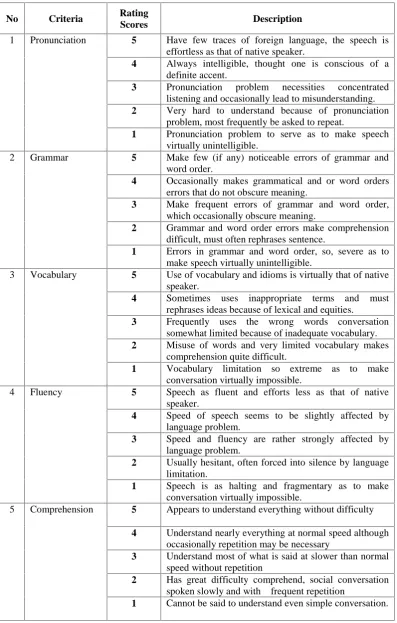
3.1 Harris’Speaking Scoring Scale ...53
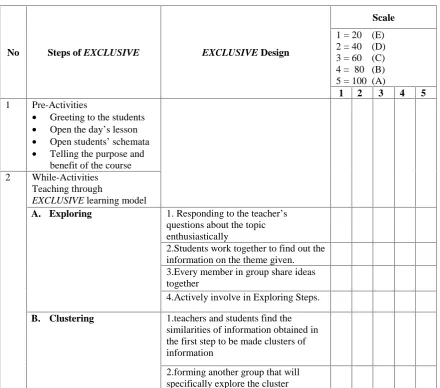
3.2 Observation SheetforStudents’Participation ...55
3.3 The result of students participation...57
3.4 Observation Sheet ofStudents’ Activities ...57
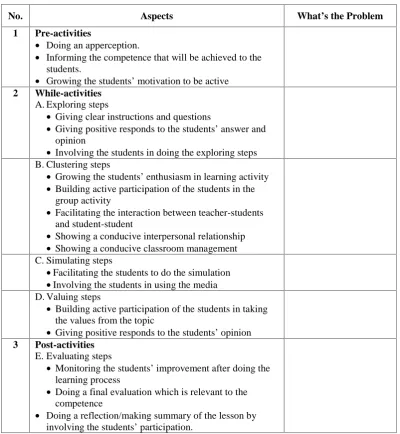
3.5 Table of Teacher’s TeachingPerformance ...58
3.6 Aspects of speaking score ...62
3.7 Steps of EXCLUSIVE...62
4.1 Students’ Speaking Score at Cycle 1 ...70
4.2 Students’Speaking Aspects at Cycle 1 ...70
4.3 Students’ Activities ObservationSheet at Cycle 1 ...73
4.4 Students’ ParticipationObservation Sheet at Cycle 1 ...78
4.5 The result of Students’ Participation...80
4.6 Teacher’s Performance Observation Sheet at Cycle 1...83
4.7 Students’ Speaking Score at Cycle2 ...96
4.8 Students’Speaking Aspects at Cycle 2 ...96
4.9 Students’Observation Sheet at Cycle 2...99
4.10 The Result of Students Participation………..…….103
4.11 The Result of Students Participation at Cycle 2 ...105
4.12 Teacher’s PerformanceObservation Sheet at Cycle 2...108
4.13 Improvement of Speaking Aspects from Cycle 1-Cycle 2 ...112
4.14 Improvement of the Mean Score of Cycle 1-Cycle 2 ...113
4.15 Students’ Speaking Score at Cycle3 ...119
4.16 Students’Speaking Aspects at Cycle 3 ...120
4.17 Students’ Observation Sheet at Cycle 3 ...122
4.18 Students’ Participation Based on Steps ofEXCLUSIVE ...126
4.19 The result of Students’ Participation...127
4.20 Teacher’s PerformanceObservation Sheet at Cycle 3 ...131
4.21 Improvement of Speaking Aspects from Cycle 2-Cycle 3 ...136
4.22 Improvement of the Mean Score of Cycle 2-Cycle 3 ...136
4.23 Matrix of the Revised Model from Cycle 1-Cycle 3 ...138
4.24 Advantages and Disadvantages of EXCLUSIVELearning Model ...140
4.25 Students’ Speaking Score from Cycle 1 to 3...142
4.26 Improvement of Students’ Speaking Aspects from Cycle 1 to 3...143
4.27 The Result of Students Participation Based on The Steps of EXCLUSIVE ...150
xv
Graphic 2.1 PS2 EXCLUSIVE Learning Model ... 33
Graphic3.1 The cycle of Classroom Action Research ... .48
Graphic 3.2 The Model of Classroom Action Research ... .49
Graphic4.1. Mean Score of Students’ performance...144
Graphic 4.2. Speaking Aspects Improvement...145
Graphic 4.3 Students’ Participation Based on the Steps ofEXCLUSIVE...151
xvi Appendix
1. Research Schedule 2. Documentation Paper 3. Lesson Plan 1 (Cycle 1) 4. Lesson Plan 2 (Cycle 2) 5. Lesson Plan 3 (Cycle 3) 6. Speaking Test for Cycle 1 7. Speaking Test for Cycle 2 8. Speaking Test for Cycle 3
9. Students’ Speaking Scores at Cycle 1 10.Students’ Speaking Scores at Cycle2 11.Students’ Speaking Scores at Cycle3
12. Result ofStudents’Speaking Test at Cycle 1 13. Result ofStudents’Speaking Test at Cycle 2 14. Result ofStudents’Speaking Test at Cycle 3
15. Observation Sheet of Students’ Activities at Cycle 1 16. Observation Sheet of Students’ Activities at Cycle 2 17. Observation Sheet of Students’ Activities at Cycle 3 18. Observation Sheet forStudents’ Participationat Cycle 1 19.Observation Sheet for Students’ Participationat Cycle 2 20. Observation Sheet forStudents’ Participationat Cycle 3 21. Students’ Transcription at Cycle 1
22. Students’ Transcription at Cycle 2 23. Students’ Transcription at Cycle 3 24. SuratKeteranganPenelitian
This chapter particularly put across regarding: (1) background of the problem, (2)
formulations of the problem, (3) objectives of the research, (4) uses of the
research, (5) scope of the research, and (6) definition of terms.
1. 1 Background of the Problem
In a simple word, language is a sound. It is, indeed however, in general language
defined as a means of communication. According to English Encyclopedia 2007,
Language was defined as the ability to acquire and use complex systems of
communication, particularly the human’s ability to do so, and it has any specific
example of such a system. Language is the most important aspect in the life of all
beings. The use of language is to express inner thoughts and emotions, make
sense of complex and abstract thought, to learn to communicate with others, to
fulfill humen wants and needs, as well as to establish rules and maintain humen’s
culture (Ormrod,1995:20).
Since English was issued as one of the International target language, it became
more demanding language to be mastered by people around the world. Likewise
Indonesians, in order to be able to communicate in English properly, it is crucial
this reason, there was a statement made based on the 2006 English curriculum of
SMA that stated SMA/MA students are reguired be able to use the language in
international level. There are, therefore four skills included among others:
listening, speaking, reading, and writing (Depdiknas, 2006:307). In short, the
statement made has the instruction for English teacher to teach English to the
studentsat schools, and also schools to make lesson planning and syllabuses
regarding English as a compulsory subject.
As a matter of fact, there is no doubt that there have some constraints have been
facing by some educational institutions. Some schools do not really pay attention
toward the importance of English. The teachers, in this case, arestill having
confusion of finding the magnificent way to get along with the students, notably
in dealing with students’ speaking ability, and also students’ participation in the
class. As a result, their failures make them not successful in guiding students’
paradigm toward English language learning that they are not going to teach ast
schools as a compulsory subject. Ultimately, for years students learn English,
however they still could not produce the language well as expected. Not only the
teacher, the students also have the problems in learning English. They just learn
Englis in order for them to get score rather than reaching insight in the interest of
their future since they do not consider English as important subject. Converserly,
they are incline to face English as the terms only to graduate from the school even
It is, therefore increadibly crucial for the students to learn English. As we know
that speaking has communication function which in daily life uses as a vehicle to
express ideas, opinions, and thought. In terms of mastering English, it means that
students should be taught how to speak, listen, read, and write in English as
International target language language for these four skills are widely recognized
as the fundamental groundworks to step forward. Thus it is hoped, the teacher can
deal with the students’ paradigm toward English, their tendencies, which
influence the way of thinking and how they do see the world beyond English.
One of these four English skills is speaking. Speaking is two-way process
between speaker and listener and involves productive and receptive skills of
understanding, Bryne (1984:81). According to Richards & Willy (2002), speaking
is one of the elements of communication, where communication is the output
modality and learning is the input modality of language acquisition (Brown,
1980:210). It is in line with Tarigan (1987:5) which defines that speaking is the
instrument of language and the primary aim of speaking is for communication.
From the definitions given above, it is clear that students should learn English to
speak so that they can communicate in English well. In mastering speaking skill
ofcourse, the students need a lot of practice besides knowing the grammar or the
structure of the language, etc. But, in fact, the teacher still cannot make the
students learn how to speak well. Perhaps, the teachers do not use appropriate
Seeing some problems that tend to be happenning at schools, the researcher was
therefore interested to hold further investigation concerning students’ constraints
in mastering English, especially speaking skill and also the way of teaching that is
generally held by teacher as well. Furthermore, the researcher decided to hold a
pre-observation which aimed at assuring the problems that have been facing by
the students and English teacher as well. Based on the pre-observation that had
done at SMA Fransiskus Bandar Lampung, the researcher found that many
students had difficulties in mastering speaking skill. It was, however, some
students who had self-confidence in expressing their ideas dominated the teaching
learning activity in the class. Some students gave the respond positively toward
teacher’squestions, however a big part of them kept quite and did not participate
properly in the class. For the teacher’s way of teaching in the class, the teacher
was not able to deal with the class management as well as the meadia. In addition,
the teaching method was not compatible with the students.
Here, the researcher had found some problems based on the pre-observation ever
conducted at SMA Fansiskus Bandar Lampung. The first problem was students’
outage in speaking ability. The lack of students’ speaking ability can be viewed
when the teacher gives the questions or even asking their opinions on any given
topics. Almost all student did not give any response toward teacher’s questions.
The second problem found was the lack of students in participating while teaching
learning process was going on in the classroom. While the teacher was explaining
the lesson in front of the class, some students were still having chat with each
outage in choosing the appropriate model for teaching. Eventually, these obstacles
hamper teaching learning process.
In order to make teaching learning process go well, the classroom management is
urgently needed. Classroom management covers, media, methods, timeable, and
vehicles used in a teaching learning process McDougal, Littell & Company
(1981). One of the most important aspects of classroom management is the
teaching method in teaching. Therefore, there should be specific method,
technigue, or learning model which furthermore in teaching learning process can
support teachers in teaching and notably for the students to comprehend well
through the method or learning model that is about to apply. If the teacher does
not use any appropriate method, technigue, or learning model then it can further
be influential toward students’ comprehension. If only the method used in
learning is suitable with the students, but if the teacher has no any ability in
applying the method being used, it then can bring nothing and ultimately no
result.bv
Based on the three constraints found above, those matters should therefore be
considered as a must for English teachers to cope with. The first problem was the
students’ outage in mastering English speaking skill. English speaking as the
ability to express oneself in life situation, or the ability to report acts or situation
in precise words, or the ability to converse, or to express a sequence of ideas
fluently, Lado (1961:240). The second problem found was the lack of seriousness
third problem was the teaching method used does not support learning process.
Thus, the researcher proposes to deal with this constraint there should be a
specific learning model. Learning model is a conceptual framework that describes
a systematic procedure in organizing learning experiences to achieve specific
learning objectives and serves as a guide for learners and teachers in
implementing the learning activities, Winataputra in Sugiyanto (2008).
As the result, applying a specific learning model considered as a critical step in
order to deal with those problems that already found. When a teacher teaches the
students, the teacher should know the problems that have been confronted by his
or her students so that the teacher can tackle the problems using the learning
model applied. Learning models provide the teachers with an organized system
for creating an appropriate learning environment and planning instructional
activities. It also affects what the teacher does, what the students do, the
organization of the classroom, the nature of the procedures, materials, and the
instructional tasks. Seeing this, implementing appropriate learning model in the
learning process should be considered by every teacher when they are going to
teach.
The learning model applied in this research was EXCLUSIVE learning model.
This learning model was designed based on the model framework of Sudiarta
(2005). Thematic learning model which had been developed is based on
constructivism oriented by the three pillars of awareness and literacy character of
learning model that includes the main syntax of exploring, clustering, simulating,
valuing, and evaluating named EXCLUSIVE learning models. EXCLUSIVE
learning model isalso developed based on the theory of metacognition and
learning strategy. Flavell (1979) is the expert who had first introduced the term
and concept of metacognition in learning. It is defined as the science of
consciousness and control over the processes of cognition. Simon (2001 in
Desoete) has revealed that metacognition is divided into two components:
knowledge and skills of metacognition. Metacognitive knowledge is defined as
knowledge and understanding of the thought process. Meanwhile metacognitve
skill is defined as controlling the thinking process. There are three components of
metacognitive knowledge: declarations, procedural, and conditional and the four
components of metacognitive skill are predict, plan, monitor, and evaluate.
EXCLUSIVE learning model is also developed by determining certain topic, a
theme or main topic, then the theme that has been chosen is used as a groundwork
to determine the sub-themes. It can be done by the teacher or students which is
taken from the students’ environment and is closer to them so the theme can be
developed based on their need and interest. This kind of learning model is useful
to learn and gain the information from the facts around related to the students’ real
experince in their daily life. In addition to that, this learning model is also
developed by using Student Centered Learning (SCL) approach which can make
the students active in the learning process, and metacognitive learning strategy
which enables the students to develop their understanding. From this explanation,
active in every phase of learning because the topic is related to students’ real
experience and the learning process is centered among the students. If the students
are actively involved in the learning process, hopefully they can improve their
speaking skill because they will more practice to use the language during the
class.
In this case, learning model which had applied in this research was based on the
result of previous research by Shanti (2013). She conducted the action research
using EXCLUSIVE learning model at SMAN 9 Bandar Lampung and found the
learning model was able to improve students’ speaking skills. In addition, this
learning model also had been development by Abdurrahman, Tarmini, and
Kadaryanto (2012). They developed a thematic learning model on the basis of
constructivism which was oriented in three pillars of literacy and awareness
characters: Understanding, Consciousness, and Alertness. From that research,
there comes a learning model which its main syntax consisting of Exploring,
Clustering, Simulating, Valuing, and Evaluating named EXCLUSIVE learning
model. Because this model was still in the form of concept and it had never been
applied in preceding studies, hence the researcher also tried to develop the
procedure in using this model in teaching learning process.
It is essential to keep in mind that language teacher is not only to inform what
language is, but also to facilitate the students and enable them to use the language.
So far, our education is still dominated by the view that knowledge is a set of fact
the only learning sources and speech as the main learning strategies. There, should
Therefore be a new learning strategy that can expose students’ language
competence. EXCLUSIVE learning model is considered as an alternative.
EXCLUSIVE learning model is not at the level of implementation yet, so that it is
needed to conduct an action research in order to find the technique that can be
used to make the model applicable in teaching learning process, especially in
teaching speaking.
Observingthe problems discussed above, the researcher was interested in
investigating the problems to be figured out. Hence, the researcher had conducted
an action researchentitled “The Implementation of EXCLUSIVE Learning Model
in Improving Students’ Speaking Skill at the second grade of SMA Fransiskus
Bandar Lampung”. The learning model of EXCLUSIVE had applied deliberately
to overcome the problems formulated. It hoped to produce an effective model that
can be used by teachers in order to help students improve their speaking skill,
student participation and the quality of teacher’s teaching performance in the
classroom based on the principles of EXCLUSIVE learning model.
1.2 Formulation of the Problems
Based on the above explanation, there were several constraints that have been
faced by students and English teacher as well. As the result, the problems of this
research were formulated as follows:
1. Can the implementation of EXCLUSIVE Learning Model improve students’
2. How can the steps of EXCLUSIVE Learning Model improve students’
participation during the teaching learning process?
3. How can the implementation of EXCLUSIVE Learning Model improve the
quality of teacher’s teaching performance?
1.3 Objectives of the Research
In the research questions above, there were three main considerations. They were
students speaking ability, their participation and also teacer’s teaching
performance. Hence, based on problems formulated, the objectives of this
research are to find out whether or not:
1. The implementation of EXCLUSIVE Learning Model can improve students’
speaking skill.
2. How the steps of EXCLUSIVE Learning Model can improve students’
participation during the teaching learning.
3. How the implementation of EXCLUSIVE Learning Model can improve the
quality of teacher’s teaching performance.
1.4 Uses of the research
The main purposes of this research are having such uses as follows:
Theoretical uses:
To verify the previous theory dealing with the theories of EXCLUSIVE
To be used as a reference for the next researcher who will concentrate on
students’ speaking skill, and students’ participation in teaching learning using
EXCLUSIVE learning model.
Practical uses:
As an information concerning theimprovement of students’speaking skill, and
students’ participation in teaching learning process in the implementation of
EXCLUSIVE Learning Model.
As an assist to English Teachers in finding an appropriate way to increase
students’ speaking skill, and students’ participation in teaching learning
process.
1.5 Scope of the Research
This research concerns with the implementation of EXCLUSIVE learning model
that aims at improving students’ speaking skill, students’ participation, and also
the quality of teacher’s teaching performancebased on the syntax of EXCLUSIVE.
Those syntaxes of EXCLUSIVE furthermore called as steps of EXCLUSIVE
learning model: exploring, clustering, simulating, valuing, and evaluating in
improving the students’ speakingskill based on five aspects of speaking that are:
pronunciation, fluency, vocabulary, grammar, and comprehension in doing
transactional dialogue. Besides, the researcher also focusses on students’
participation during teaching learning process in according with the steps of
1.6 Definition of Terms
1. Speaking as the ability to express oneself in life situation, or the ability to
report acts or situation in precise words, or the ability to converse, or to
express a sequence of ideas fluently, Lado (1961:240).
2. Teaching speaking means teaching how to use the language for
communication, for transferring ideas, thought or even feeling to other
people. The goal of teaching speaking skills is to communicate efficiency.
Learners should be able to make themselves understood, using their current
proficiency to the fullest. They should try to clear away confusion in the
message due to faulty pronunciation, grammar, or vocabulary and to observe
the social and cultural rules that apply in each communication, Burkart
(1998:240).
3. Learning model is a conceptual framework that describes a systematic
procedure in organizing learning experiences to achieve specific learning
objectives and serves as a guide for learning and the crier proclaimed and
teachers in implementing the learning activities, Winataputra in Sugiyanto
(2008).
4. EXCLUSIVE learning model is developed based on the theory of
metacognition and learning strategy. Flavell (1979) is the expert who has first
introduced the term and concept of metacognition in learning. It is defined as
the science of consciousness and control over the processes of cognition.
Simon (2001 in Desoete) has revealed that metacognition is divided into two
components: knowledge and skills of metacognition. Metacognitive
Meanwhile metacognitve skill is defined as controlling the thinking process.
There are three components of metacognitive knowledge: declarations,
procedural, and conditional and the four components of metacognitive
skillare predict, plan, monitor, and evaluate.
The results of discussion above are the parts of chapter one that concerns with the
introduction which involves background of the problem, formulations of the
problem, objectives of the research, uses of the research, scope of the research,
and definition of terms. In the background it had explained that there are some
constraints in speaking for the students as well as the teachers. Furthermore, those
constraints had formulated and there are three main problems involving: students’
speaking skill, students’ participation, and the quality of teacher’s teaching
performance. Those three problems are the objectives of the research. Next, the
uses of the reserach, there are two crucial uses among others: practical uses, and
theoretical uses. A part from that, this research has its scope. The scope of this
research covers: the implementation of EXCLUSIVE learning model in which
there are steps of EXCLUSIVE, exploring, clustering, simulating, valuing, and
evaluating. Those steps of EXCLUSIVE had applied in improving students’
speaking ability according to aspects of speaking which involves: pronunciation,
vocabulary, grammar, fluency, and comprehension. Accordingly, this research had
applied action research as the research method which has planing, implementing,
In this chapter, there are nine topics that are going to be discussed, among
others:(1) review of previous researches, (2) concept of speaking, (3) aspect of
speaking, (4) types of speaking, (5) concept of teaching speaking, (6) concept of
learning model, (7) types of learning model, (8) concept of EXCLUSIVE learning
model, (9) EXCLUSIVE learning model in teaching speaking, (10) procedure of
teaching speaking through EXCLUSIVE learning model, (11) advantage and
disadvantage of EXCLUSIVE learning model, (12) and theoretical assumption.
2.1 Review of Previous Researches
There have been several studies conducted regarding the implementation of
EXCLUSIVE learning model in teaching English at all education levels from
elementary school, secondary school until senior high school. It was indeed, those
who had involved in research using EXCLUSIVE learning model found that
EXCLUSIVE learning model had a great play in improving students’ speaking
skills. The only deference is that each research uses different variable, method,
Shanti (2013) conducted an action research using EXCLUSIVE learning model in
improving students’ speaking skill at the first grade of SMA Negeri 9 Bandar
lampung. The author used qualitative approach in measuring the success of
implementing EXCLUSIVE learning in teaching speaking. As stated in her script,
the result was successful, she eventually made it out of nothing and found
EXCLUSIVE learning was able to improve students’s speaking performance,
students’ participation in the class, and also the quality of teacher’s teaching
performance. Based on the resullt, the gain of students’ speaking performance as
the learning products sifnificantly increased. It was proved by the data from
students’ speaking mean score in cycle 1 that was 65.87, in cycle 2 improved to
71, and in cycle 3 improved to 77.2. The improvement also occurs in each aspect
of speaking, whether in pronunciation with the total gain was 1.07, grammar with
the total gain was 0.93, vocabulary with the total gain was 1.2, fluency with the
total gain was 1.14, and in comprehension with the total gain was 1.34. By
implementing EXCLUSIVE learning model, the students’ participation was also
improved from cycle one to cycle three. Not only that, this learning model had
improved the quality of teacher’s teaching performance that significantly
improved from cycle one to cycle three.
Another researcher was Wulandari (2014). She implemented the EXCLUSIVE
learning model in teaching reading at Senior High School Negeri 2 Metro. The
research used quantitative approach within experimental research in which she
applied control group pre-test post-test design. The result of the research was
was successful. It means that in the pre test, the students were not able to answers
on test provided by the researcher, it was however, after being treated using
EXCLUSIVE learning model, the students showed significant success. The
significant success can be seen from the students’ success in percentage. It was
stated that in the pre test, students did not understand about reading at all, which
was cumulated at about 20%, but after teaching students’reading skill improved
since the result showed at about 90%. To conclude, the EXCLUSIVE learning
model which was applied by Wulandari (2014) found able to improve students’
reading comprehension.
Besides, EXCLUSIVE learning model is developed based on the theory of
metacognition and learning strategy. Flavell (1979) was the expert who had first
introduced the term and concept of metacognition in learning. It was defined as
the science of consciousness and control over the processes of cognition. Simon
(2001 in Desoete) had revealed that metacognition is divided into two
components: knowledge and skills of metacognition. Metacognitive knowledge is
defined as knowledge and understanding of the thought process. Meanwhile,
metacognitve skill is defined as controlling the thinking process. There are three
components of metacognitive knowledge: declarations, procedural, and
conditional and the four components of metacognitive skillare predict, plan,
2.2 Concept of Speaking
Speaking is one of the four language skills that should be mastered by the
students. Bryne (1984:81) states that speaking is two-way process between
speaker and listener and involves productive and receptive skills of understanding.
According to Brown and Yule (1983), there are two basic functions of speaking.
They are the transactional function, which is concerned with the transfer of
information, and the interactional function, which has the primary purpose of
maintaining social relationships.
Speaking is one of the productive skills in which the speaker produces the
language for communication. According to Richards & Willy (2002), speaking is
one of the elements of communication, where communication is the output
modality and learning is the input modality of language acquisition (Brown,
1980:210). It is in line with Tarigan (1987:5) which defines that speaking is the
instrument of language and the primary aim of speaking is for communication.
From the definition, it is clear that students should learn to speak in order to be
able to communicate. As a human being, we always need communication to
express our idea to do everything. The need is more for students or learners since
they have to speak with their teacher during the learning process to express their
idea.
Meanwhile, Lado (1961:240) describes speaking as the ability to express oneself
in life situation, or the ability to report acts or situation in precise words, or the
besides for communication, speaking emphasizes learners to express or report
something by their utterance or language accurately and fluently. These two
aspects are important to be successful in speaking, because when we speak, we
have to know what we talk about and how to pronounce it whether in transactional
or interactional conversation.
In other words, speaking is fundamental and instrumental act (Herbert & Eve,
1997:223). Speakers talk in order to have some effects on their listeners. They
assert things to change their state of knowledge. They ask them questions to get
them to provide information. They request things to get them to do things for
themand they promise, warn, and exclaim to affect them in still other ways. The
nature of the speech act should therefore play a control role in the process of
speech production. Speakers begin with the intention of affecting their listeners in
a particular way. They select and utter a sentence just to bring this effect.
From those explanations, it can be said that speaking is essential for language
development, for learning, for relating to others, for living successfully in society,
especially for English language teaching. Students should learn to express their
own ideas, feelings and thoughts clearly, and to respond to others appropriately, in
a range of formal and informal situations. Speaking requires learners to not only
know how to produce specific points of language such as grammar, pronunciation,
or vocabulary, but also they should understand the processes by which they
acquire these skills. They should understand when, where, why and in what ways
2.3 Aspects of Speaking
In speaking, there are some aspects that must be fulfilled by the learners. It can be
used as a measurement whether our speech is good or not. According to Harris
(1974: 75), there are five aspects of speaking:
2.3.1 Fluency
Fluency can be defined as the ability to speak fluently and accurately. According
to Harris (1974:81) fluency refers to the ease and speed of the flow of the speech.
Fluency is the smoothness of flow with which sounds, syllables, word, and
phrases are joined to other when speaking. It means that when a person make a
dialogue with other person, the other person can give respond well without
difficulty.
2.3.2 Grammar
Heaton (1987:5) defines grammar as students’ ability to manipulate structure and
to distinguish appropriate ones. Syakur (1987) defines grammar as a correct
arrangement sentence in conversation.
2.3.3 Vocabulary
One cannot communicate effectively or express ideas in oral form if they do not
have sufficient vocabulary. Therefore, vocabulary means the appropriate diction
which is used in communication as what is stated by Syakur (1987:56).
2.3.4 Pronunciation
According to Syakur (1987:89), pronunciation refers to the ability to produce
easily comprehensible articulation. Meanwhile Harris (1974:81) defines
2.3.5 Comprehension
Syakur (1987:90) defines comprehension for oral communication that requires a
subject to respond to speech as well as to initiate it. Comprehensibility denotes
the ability of understanding the speaker’s intention and general meaning (Heaton,
1991:35). This idea means that if a person can answer or express well and
correctly, it shows that he comprehends or understands well.
2.4 Types of Speaking
Brown (2001: 250) said that much of our language teaching is devoted to
instruction in mastering English conversation. He classified the types of oral
language into:
2.4.1 Monologue
In monologue, when one speaker used spoken language, as in speech, lecture,
reading, and news broadcast, the listeners must process long stretch of speech
without any interruption and the stream of the speech will go on whether or not
the listener understands. There are two kinds of monologue: planned and
unplanned.
2.4.2 Dialogue
Dialogue involved two or more speakers. As stated before, dialogue can be
divided into transactional which is concerned with the transfer of information, and
the interactional which has the primary purpose of maintaining social
Brown (2001) also provides six types of classroom speaking performance that
students are expected to carry out in the classroom, they are involving:
a) Imitative Dialogue
A very limited portion of classroom speaking time may be legitimately speech
generating human tape recorder speech, where, for example, learner practice an
intonation contour or try to pinpoint a certain vowel sound. Imitationof this kind is
carried out not the purpose of meaningful interaction, but for focusing on some
particular element of language form.It also can be defined as drills in which the
learner simply repeats a phrase or structure (e.g., “Excuse me.” or“Can you help
me?”) for clarity and accuracy.
b) Intensive Dialogue
Intensive speaking goes one-step beyond imitative to include any speaking
performance that is designed to practice some phonological or grammatical aspect
of language such as minimal pairs or repetition of a series of imperative sentences.
Intensive speaking can be self initiated or it can even form part of some pair work
activity, where learners “going over” certain forms of language.
c) Responsive Dialogue
A good deal of student speech in the classroom is responsive: short replies a
teacher or student initiated questions or comments. These replies are usually
sufficient and do not extend into dialogue such as a series of answers to yes/no
d) Transactional Dialogue
Transactional language, which is carried out for the purpose of conveying or
exchanging specific information is an extended form of responsive language. It
can be the form of dialogues conducted for the purpose of information exchange,
such as information gathering interviews, role plays, or debates. Conversation, for
example, may have more of a negotiate nature to them than responsive speech.
e) Interpersonal Dialogue
The other form of conversation mentioned in the previous was interpersonal
dialogue, which is carried out more for the purpose of maintaining social
relationship than for the transmission of fact and information, such as personal
interviews or causal conversation role plays. Learners would need to learn how
such features as the relationship between interlocutor, casual style, and sarcasm
are coded linguistically in this conversation.
f) Extensive (monologue)
Students at intermediate to advanced levels are called on to give extended
monologes in the form of oral reports summaries of perhaps short speeches.
In this research, the researcher focussed on how the students do the conversation
through transactional dialogue because it had conducted for the purpose of
information exchange, such as information gathering, interviews, role plays, or
speaking. So, the researcher considered to apply EXCLUSIVE learning model by
using transactional dialogue in order to improve the students’ speaking skills.
2.5 Concept of Teaching Speaking
Teaching speaking is the way for the students to express their emotions,
communicative needs, interact to other person in any situation, and influence the
others. For the reason, in teaching speaking skill it is necessary to have clear
understanding involved in speech.
Teaching speaking means teaching how to use the language for communication,
for transferring ideas, thought or even feeling to other people. The goal of
teaching speaking skills is to communicate efficiency. Learners should be able to
make themselves understood, using their current proficiency to the fullest. They
should try to avoid confusion in the message due to faulty pronunciation,
grammar, or vocabulary and to observe the social and cultural rules that apply in
each communication, Burkart (1998:240).
It is clear that communication through language is very important. We cannot only
teach what will be spoken but also the situation what we deal with. The teacher
teaches speaking by carriying out the students to certain situation when the topic
is being talked about. The topic then must be familiar to the students, so that the
ideas and its organization are clear and the students have an oral command of the
In teaching speaking, it also needs to determine the focus in order to make the
learning speaking in transactional form easier to be planned. In speaking, there are
some components to be considered. According to Harris (1974:84), as stated
before, the components are prounciation, fluency, grammar, vocabulary, and
comprehension. Meanwhile, in transactional speaking the components that can be
reached and arised is accuracy. It is based on Richards (1990) which is said that
an issue that arises in practicing talk as transaction using different kinds of
communicative tasks are the level of linguistic accuracy that the students achieve
when carrying out the tasks. This is also supported by Higgs and Clifford in
Richards (1990) states that transactional speaking develops accuracy and fluency.
We can see that if the students are able to deliver their mind accurately and
fluently, the comprehension will increase. Teacher, in this case, should help
students in developing their ability to produce grammaticaly correct, logically
connected sentences that are appropriate to specific contexts, and do so using
acceptable pronunciation.
2.6 Concept of Learning Model
Learning model is a conceptual framework that describes a systematic procedure
in organizing learning experiences to achieve specific learning objectives and
serves as a guide for learning and the crier proclaimed and teachers in
2.7. Types of Learning Model
Sugiyanto (2008) suggests that there are many learning model developed by
experts in an effort to optimize student learning outcomes. The learning model is
comprised of:
2.7.1 Contextual Learning Model
Contextual learning model is the concept of learning that encourages teachers to
link between the material being taught to the students real-world situations. This
study also encourages students make connections between knowledge and its
application in their daily lives. Knowledge and skills gained from the efforts of
students to construct their own knowledge and skills as students learn.
2.7.2 Cooperative Learning Model
Model of cooperative learning is a learning approach that focuses on the use of
small groups of students to work together in maximizing the learning conditions
for achieving learning objectives.
2.7.3 Quantum Learning Model
Quantum Learning model is an assembly of various theories or views of cognitive
2.7.4 Integrated Learning Model
An integrated learning model of learning that allows students both individually
and in groups of actively searching, digging, and found the concepts and
principles of holistic. Learning is a model that tried to integrate several subjects.
2.7.5 Model Problem Based Learning (PBL)
Model of problem-based learning (PBL) is a cognitive psychology of learning that
takes as its theoretical support. The focus is not much on what is being worked on
students but on what students think as long as they do. Enabling teachers
themselves as mentors and facilitators so that students can learn to think and solve
their own problems.
The term learning model has broader meaning than the other four terms. Joyce &
Weil (2001) defines learning model as a conceptual framework that is used as a
guide in learning. In other words, it is a conceptual framework that describes the
systematic procedure in organizing learning experiences to achieve certain goals
and serve as a guide in planning and implementing lessons.
According to Arends (1998), learning model has 4 (four) characteristics, namely:
1. Theoretical rationale; the point of view and the frame of thought how the
students can learn,
2. Learning objectives; what purpose that the learners learn
3. Syntax, how the sequence patterns of the teacher and student’s behavior
While Sudiarta (2005) elaborates in more detail the learning model as a
conceptual framework that describes the systematic procedure organize the
learning experience of learners include the following:
1. Theoretical rationale; the frame of thought how the students can
learn well,
2. Syntax, how the sequence patterns of the teacher and student’s behaviour
3. Principles of interaction; how the teachers positioning themselves to students,
as well aslearning resources
4. Social systems: how the point of view between components within the learning
community
5. Support system: how the learning environment supports
6. Learning impact: how the outcomes and impact of learning expected in the
short and long term
The learning model that is used in this research is developed based on Sudiarta
(2005) model framework by Abdurrahman, Tarmini, and Kadaryanto (2012)
named EXCLUSIVE Learning Model. The researcher tries to apply this learning
model by developing learning procedures in improving students’ speaking skills.
2.8 Concept of EXCLUSIVE Learning Model
This learning model is designed based on the model framework of Sudiarta
(2005). Thematic learning model which is developed is based on constructivism
Understanding, Conscious, and Awareness (PS2). It produces a learning model
that includes the main syntax of exploring, clustering, simulating, valuing, and
evaluating named EXCLUSIVE learning model with the complete designs are:
2.8.1 Rational
Developing the theme that is very close to the students can be interesting and
appropriate in the development of the learning model with the Student Centred
Learning (SCL) approach. The learning process is developed by the condition of
Understanding, Conscious, and Awareness (PS2), can deliver a model of learning
which the main syntax are exploring, clustering, simulating, valuing and
evaluating (EXCLUSIVE).
This learning model is developed from a thematic study in which the development
begun by specifying a particular topic as a central theme or topic, after the theme
is determined then it is defined as the basis for determining the basis of subthemes
from other related fields of study. In detemining the theme, it can be carried out
by teachers or students or based on the agreement that can be drawn from the
concept or subject around the students, therefore the theme can be developed
based on the interests and needs of students, which moves from the students’
nearby environment and move on to the farthest one.
EXCLUSIVE learning model is useful in assessing the information of facts or
phenomena that exist in the environment and linked it to the real experiences of
similar concept that is started from experiences and conditions before they will
confirm it with the concept they earned and then simulated based on the
information obtained in the previous stage.
2.8.2 EXCLUSIVE as a Learning Model
EXCLUSIVE learning model is developed based on the theory of metacognition
and learning strategy. Flavell (1979) is the expert who has first introduced the
term and concept of metacognition in learning. It is defined as the science of
consciousness and control over the processes of cognition. Simon (2001 in
Desoete) has revealed that metacognition is divided into two components:
knowledge and skills of metacognition. Metacognitive knowledge is defined as
knowledge and understanding of the thought process. Meanwhile, metacognitve
skill is defined as controlling the thinking process. There are three components of
metacognitive knowledge: declarations, procedural, and conditional and the four
components of metacognitive skillare predict, plan, monitor, and evaluate.
Knowledge and skills of metacognition can be developed in learning if students
are invited to solve the problem related to daily life in the neighbourhood. When
implementing problem solving, students’ cognitive awareness can be grown by
providing guidance to enable students to ask themselves whether or not they
understand what they are learning, thinking, and doing. Through the phases of
learning, a) students are guided to be aware of what is known and what is
unknown, b) what is needed and what is not needed, c) what to do and what not
phases of the solution, giving reasons why the solution of the problem is, f)
monitor what is being done and, g) plan, evaluate what has been done. Flavell
states that learning through awareness and control of student thinking process
through problem solving is a kind of learning with metacognition development.
Metacognitive skills enables students to develop an understanding of the concept
because of the metacognitive skills, students can construct knowledge, apply the
concepts, and broaden it so that they can give answers and scientific arguments
which presents understanding. Developing an understanding can occur because
nature provides complex problems that can challenge students to apply and
develop their understanding, as in exploring the facts, interpreting and
exemplifying the relationship of various concepts, classifying, comparing,
explaining the concepts, and making conclusions that lead to the awareness of the
importance of all activities through awareness and monitoring the way they think.
To understand more clearly about metacognitive, it needs to differentiate between
metacognitive and cognitive. Cognitive skills tend to focus on a particular issue or
subject matter and directly related with the application, manipulate, or
transformation of the delivery of learning materials. Metacognitive skills, on the
other hand includes many things, often covers a variety of issues, and involves a
greater level of thinking about the learning process. Metacognitive is not merely
cognitive because it requires individuals to plan before the learning takes place, to
check for understanding and learning outcomes, and evaluate the student for
more intentional and requires someone to actively interact in a given study
(Sudiarta, 2010).
2.8.3 Syntax of EXCLUSIVELearning Model
The learning model has some steps (exploring, clustering, simulating, valuing, and
evaluating) which is called as syntaxes of EXCLUSIVE. This learning model was
also developed based on rational learning needs of students and the theory of
metacognition, thus the syntax of the learning model is described as follows:
Step 1: Exploring
First of all, the teacher greets the students and opens students’ schemata prior to
the main activity in te class. Next, teacher makes apperception and motivation
regarding the topic that already given. Students are divided into groups where
each group has a duty to seek as much information related to the detailed
information on the theme already given. In this case, if it is possible the teacher
divides the group based on the information they had got. Each group works
together to ensure that every member has comprehended the information
thoroughly and properly.
Step 2: Clustering
As soon as each group get enough information within a specified time, teachers
and students find the similarities of information obtained in the first step to be
made clusters of information. Then, from the cluster information that is formed,
concerned. Once clustered information is formed, teachers and students discuss to
confirm the clustered data before simulation. For example, clustered data/
information is formulated into concrete steps which are simulated.
Step 3: Simulating
In simulating step, students are invited to perform simulations. All students that
worked in group with their mates, they are reguired to perform the simulation in
front of the class. The teacher, in this case has no any due in determining which
group should be first, on the one hand all group is chosen randomly. The next step
is the choosen group is welcomed to perform in front of the class, as soon as they
finish their performance, they can point out other group to perform in front of te
class, and so on till all group finish performing each of their group discussion.
Step 4: Valuing
At this stage, students are encouraged by the teacher to internalize the values
obtained through the discussion and simulation, so there is a strong willingness
and ability to internalize and get used to in daily life. It means that, the teacher has
tough duty to make students aware of what they are learning are applicable in real
life so that they can realize in their daily life.
Step 5: Evaluating
The last stage is to evaluate the course of the entire learning process so as to
obtain a formulation of the recommendations of improvements to subsequent
some things that need to be explored in more depth, step back and explore to do
so on such a cycle.
Graphic 2.1 PS2 EXCLUSIVE learning model
EXCLUSIVE learning model could be developedto encourage students’role to be
more active in every phase of learning. Students are expected to give their
opinions. This learning model requires students to be actively engage with each
other and exchange ideas, collaborate, communicate, and simulate together to
achieve the desired learning objectives that students are expected to be able to
develop their ability.
2.8.4 Principles of Interaction
In the EXCLUSIVE learning model based on metacognitive, teachers positioning
themselves as facilitators providing learning resources, encourage students to
learn to solve metacognitive problems, give motivation, reward, and provide some
helps to students in order to learn and construct knowledge optimally. Interaction
that will be occured is mutual interaction between teachers, students, and teaching
material (learning resources). In other words, EXCLUSIVE learning model based Exploring
PS2
Evaluating Clustering