Copyright © 2017, Scholarly Research Journal for Interdisciplinary Studies
IMPROVED REPLICATION AND LOAD BALANCING STRATEGIES IN CLOUD COMPUTING
Ms. Musmade Anjali J.
In day today’s life, Cloud computing is becoming very famous as a service provider among the
several developers. It provides many services21` like storage resources, computing and
communication as a service over a network. It is very suitable platform for developing new
applications. The main aim of cloud computing is minimizing delays and provide high data
availability. Since more and more applications are developing in cloud computing a major problem
arises here is of big data management. While dealing with this big data many problems arises; here in
this paper we study QADR problem in detail with considering number of aspects like Quality of
Service, energy efficiency, load balancing in cloud computing data centers. We are proposing an
optimal solution to this QADR problem with respect to QoS requirements as well as load balancing
among different Data Nodes. For that purpose we are proposing a system to solve the QADR
problem. In this system we are developing some algorithms for each aspect separately. So the
appropriate Data Node is get selected through all these algorithms and data block replica is stored at
this Data node.
Keywords: data replication, energy efficiency, Load balancing, cloud computing.
1. Introduction
Cloud computing is becoming an emerging trend in IT industry for developing data
intensive applications. Cloud computing is nothing but a service provider. It provides services
like IaaS (Infrastructure as a Service), PaaS (Platform as a Service), SaaS (Software as a
Service). Cloud computing have many features such as:- high flexibility, high security, easy
to maintain, location independent, reduction in capital expenditure on hardware and software.
Due to these features more and more data intensive applications are developing in cloud
computing system. This results in a problem of maintaining huge volume of data in cloud
computing system. As there are huge volume of data stored in cloud computing system there
may be possibilities of software or hardware failure at data centers and due to that there may
be possibilities of data corruption; that indirectly violate the QoS (Quality of Service)
Z Scholarly Research Journal's is licensed Based on a work at www.srjis.com
Copyright © 2017, Scholarly Research Journal for Interdisciplinary Studies
requirements of the applications. This problem is known as QADR (QoS Aware Data
Replication) problem.[1]
In this paper we want to investigate this QADR problem and want to find out an efficient
solution to this QADR problem. To avoid this kind of data corruption problem, the data
replication strategy is used at several data centers. Many more research is going on in data
replication strategy now days. Data replication means maintaining duplicate copies of
original data so that if original data is get lost by any problem then the duplicate that means
replica can be used of that, and in this way the data corruption is get tolerate. If such a
corrupted data is requested by any application for the access and that data is not available for
the application will result in violation of Quality of Service of that application. This is
nothing but the problem of QADR. To solve this problem we are proposing a new system.
This system deals with the QoS requirements of the application, minimization of total
replication cost and also minimizes the QoS violated data replicas. In addition to this system
is also going to consider energy consumption requirements and load balancing problem
within the Data Nodes of Cloud computing data centers. Remaining paper is distributed in
following sections: the related work in second section, the system model and design in third
section, system development and its performance in fourth section, conclusion of the paper in
the fifth section.
2. Related Work
Here we will discuss some existing technologies developed in the same scenario by
different authors. To tolerate the data corruption problem, data replication technology is used
in cloud computing system to provide data availability. But here Qos requirements of the
application are not considered. In this paper, the QADR problem is investigated firstly. The
QADR problem concerns how to efficiently consider the QoS requirements of applications in
the data replication. To solve the QADR problem, author proposes a greedy algorithm, High
QoS first replication (HQFR) algorithm. In second algorithm the QADR problem is transform
to MCMF (Minimum cost Maximum flow) algorithm. However these two algorithms run in
polynomial time. [1]
Here author proposes a data replication technique for cloud computing data centers
which optimizes energy consumption, network bandwidth and communication delay both
Copyright © 2017, Scholarly Research Journal for Interdisciplinary Studies
focuses on the performance of cloud applications, utilization of communication resources and
energy efficiency.[2]
In this paper author uses fog server system for balancing load in the network and the
cloud servers. Author proposes three tier architecture; including cloud server tier, fog server
tier and ground tier. The fog server functions as a middleware. The roles for administration of
server process, IP packets, load and communication are optimized by Fog Server
Manager(FSM). Each fog server carries one FSM.[3]
In this paper, author investigated the QoS aware replica placement problem for
responsiveness QoS requirements. They consider two classes of service models:
replica-aware services and replica-blind services. In the replica-replica-aware services, the servers are replica-aware
of the locations of replicas and can therefore optimize request routing to improve
responsiveness. In replica-blind services, the servers are not aware of the location of the
replicas or even their existence. Efficient algorithms are proposed to compute the optimal
locations of replicas under different cost models.[4]
In this paper, author proposes Differentiated Replication (DiR); which allows users to
choose different replication strategies by considering both the user requirements and system
capability. They implemented a system that offers four differentiated storage services with
DiR.[7]
Here author studied server failures and hardware repairs for large data centers. They
present a detailed analysis of failure characteristics as well as a preliminary analysis on
failure predictors. Author characterizes server failures for large data centers.[8]
Here author researches on data replication in cloud computing data centers. They
consider both aspects energy efficiency and bandwidth consumption of the system, along
with the improved Quality of Service (QoS) as a result of the reduced communication
delays.The main goal of the proposed replication strategy is to improve system performance
while minimizing the energy consumption and bandwidth usage.[10]
A dynamic replacement strategy is proposed by author for a region based network
where a weight of each replica is calculatedto make the decision for replacement.The factors
to be considered for replica replacement are size, cost, bandwidth and prediction of future
access of the particular replica.Author proposed a region based framework.The design of the
Copyright © 2017, Scholarly Research Journal for Interdisciplinary Studies
In this paper, a datareplica selection optimization algorithm based on an ant colony
system is proposed. The background application of the work is theAlpha Magnetic
Spectrometer experiment, which involves large amounts of data being transferred,
organizedand stored. It is critical and challenging to be cost and time aware to manage the
data and services in thisintensive research environment.[13]
In this paper, authors propose a data replication strategy which adaptivelyselects the
data files for replication in order to improve the overall reliability of the system and to meet
the required qualityof services. Further, the proposed strategy decides dynamically the
number of replicas as well as the effective data nodesfor replication. The popular data files
are selected for replication based on employing a lightweight time-series technique,which
analyzes the recent pattern of data files requests, and provides predictions for the future data
requests.[16]
All the above given algorithms unable to solve QADR problem efficiently. In this
QADR problem the main aim is to minimize total replication cost, provide high data
availability, minimize the QoS-violated data replicas, minimum use of energy consumption
by data nodes and equal load balancing of data amongst thousands of data nodes connected in
cloud computing system. As far as our knowledge is considered; in previous work all these
aspects are not considered in a single system that means for each aspect there is a separate
strategy or system was proposed by many authors. So for providing an optimal solution to
QADR problem we are proposing the new strategy of data replication in cloud computing for
data intensive application.
3. System Model
Here we are describing the model of cloud computing system which we are using in
our system. In this system, we are considering Hadoop Distributed file system (HDFS)
architecture for the data storage system.
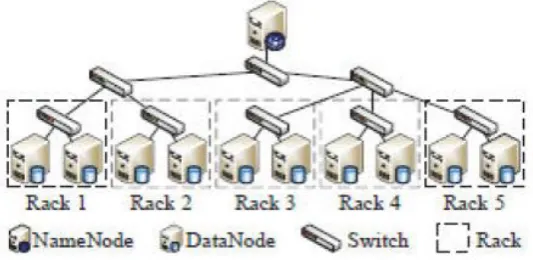
This architecture includes NameNodes, DataNodes, Switches and Racks. Here is a single NameNode that manages the file system’s metadata and namespace and multiple
DataNodes. The file content is divided into different blocks. And then these blocks are stored
at DataNodes. This distribution is done according to the aspect of security.While performing
data replication; each block of fileis replicated at different DataNodes. Here NameNode is a
Master node and DataNodes are slave nodes; this is shown in fig. 1. There are number of
Copyright © 2017, Scholarly Research Journal for Interdisciplinary Studies
DataNode has its own Node number as well as a rack number;in which rack that DataNode is
placed. All these numbering is maintained by the NameNode. NameNode have to keep track
[image:5.595.166.433.165.295.2]of each data block, where its original copy is stored or where its replicas are stored.
Fig. 1: Architecture of Hadoop Distributed File System
Now we will assume that at a time a single node can run one application. The file is
divided into number of blocks each having size 64MB. We are maintaining two default data
replicas against data corruption. One replica will be stored in the same rack and second will
be stored in different rack. That will overcome on the data corruption problem due to rack
failure. While storing this data block or data replica the particular DataNode should be
elected throughout the all DataNodes available in Data Center of cloud computing. The
DataNode should have high Quality of Service requirements. For this election we are
designing a new algorithm by taking idea from already existing HQFR (High QoS First
Replication) algorithm. But this algorithm just satisfies only one objective of the QADR
problem; to minimize data replication cost but what about minimizing QoS- violated data
replicas. The solution is convert QADR problem into MCMF (Minimum cost Maximum
Flow) Problem. After this we are designing an optimal solution for QADR problem known as
Optimal Replica Placement algorithm.[1]
Here we are designing two separate strategies for both the remaining objectives. For
energy consumption issue a new Energy Manager is introduced in this system. This manager
will manage all the energy consumption requirements of the applications to fulfill their QoS
requirements. This strategy optimizes energy consumption, network bandwidth and
communication delay both between geographically distributed datacenters as well as inside
each datacenter.[2]
There is no sufficient work is done regarding the issue of load balancing in data
Copyright © 2017, Scholarly Research Journal for Interdisciplinary Studies
strategy for balancing the load amongst number of nodes, so that it will maintain equal
memory load as well as work load amongst number of DataNodes present at DataCenters. It
will minimize work overload as well as memory overload among all the datanodes. And this
will result in minimizing delay of the data requests executing by data intensive applications.
Hence the QoS requirements of the applications are fulfilled. And the data will be made
available to the user very easily without failure.[3]
As far as our knowledge is concerned there is no such a system which deals with all
the aspects like QoS requirements, energy consumption and load balancing at the same time.
In previous work there is a separate strategy for each aspect. So our aim is to design such a
system which deals with all the aspects at the same time. We are going to elect an appropriate
DataNode through all the algorithms and then replicas are stored at appropriate DataNode.
This will minimize the replication cost and minimize the number of QoS-violated data
replicas, also minimizes the energy consumption and the load overhead.
4. System Implementation
Here, we are proposing some algorithms to solve QADR problem in data replication
of the cloud computing system. The main goal of our system is to minimize replication cost
and to minimize QoS unsatisfied data replicas. We also want to find an efficient algorithm for
data replication with minimum energy consumption and for maintaining load balance equally
over the number of nodes.
Weare going to design a Replica Placement Manager (RPM), a system which deals
with all the problems of QADR problem. This RPM should be installed at the NameNode i.e.
the Master node; which is responsible for managing and updating of data blocks at different
DataNodes in the cloud computing system. The request is send by any application for data
access is come to the NameNode first, and then NameNode will decide to which DataNode
the request should be forwarded for further execution. So our RPM will work here only. It
will check all the aspects like QoS requirements, energy consumption, and load balancing
and then elect the qualified node for storing the data replica.
Weare developing some algorithms in the same system RPM but separately for each
aspect. The first algorithm we are going to design is inspired from HQFR algorithm (High
QoS First Replication). The second algorithm is inspired from MCMF (Minimum Cost
Maximum Flow) algorithm. Then third one is designed for Energy Efficient Replication. And
Copyright © 2017, Scholarly Research Journal for Interdisciplinary Studies
4.1 HQFR algorithm: According to the name High QoS First Replication algorithm serves the request first which is having highest QoS requirements. Here the QoS requirementsare
considered from the aspect of request information and its access time only. The file which is
going to store in cloud computing data centers; should be divided into blocks first and then
these data blocks are stored at appropriate location in DataNodes. InHDFS (Hadoop
Distributed File System) the data file is divided into 64MB data blocks and the replication
factor is two by default. Weare making twocopies or replicas of data block different from the
original copy of data block. These two copies are stored on differentDataNodes or different
data racks. The NameNode keeps track of all the replicas other than original copyand they
mounted on different data racks to avoid rack failure.
According to our knowledge the high QoS application have stricter requirements in the
response time of adata access time than the normal applications. High QoS requirement
application should take precedence overthe low QoS requirement application to perform data
replication. We have to sort all the applications according to their QoS requirement in a way,
the application with high QoS should come first and then thelower one. If the data replication
space is limited then first stores the data replicas of high QoS applications. When the high
QoS application reads a corrupted data replica, its QoS requirements can be supported
continuously by retrieving the data replica from high performance node. In the cloud
computing system when any application performs a write operation then the node at which
that application is executing will forward are placation request of a data block to the
NameNode. The access time means the QoS requirement of that application is also attached
with that request which going to generate a QoS aware replication request. Like this multiple
QoS aware replication requests are issued in the cloud computing system from different
nodes.But these requests are processed and sorted them in ascending order according to their
associated access time. If the replication request ri has higher QoS requirement than the
replication request rj that means the ri has smaller access time than rj. In such a case ri will be
processed first to store its data replicas in this algorithm. While processing this replication request we have to find the qualified node’s list; which helps us to satisfy the QoS
requirements of the appropriate application while running. The QoS requirement is given in
Copyright © 2017, Scholarly Research Journal for Interdisciplinary Studies The algorithm is described as below:-
Input: The list of all the connected nodes in the cloud to the master node. Output: The list of qualified nodes.
Step 1: create a list of all the nodes connected to the master node R. Step 2: Get access time of each node from the node list R.
Step 3: Sort the node list R in ascending order in a way that node having minimum
access time (high Qos) will appear first.
Step 4: Store the sorted list of nodes in qualified node list Q.
Note that while finding qualified node itshould satisfy two conditions:
The requested node Ri and its qualified node Qj should not be mounted in the same
rack. They should belong to two different racks.
Rack(Ri) ≠ Rack(Qj) ---(1)
Where Rack() is the function to determine in which rack a node is located.
The total data replica access time from qualified node Qj to request node Ri
(Taccess(Ri,Qj))should be smaller than the QoS requirement of running application in Ri
which is Tqos.
Taccess(Ri,Qj) ≤ Tqos---(2)
After finding the qualified nodes by using these two conditions the data block can
store its one data replica ineach qualified nodes and the qualified nodes update their
replication space respectively. Now we willcalculate the total replication cost. In HQFR
algorithm the total replication cost is represented by the totalstorage cost taken by all the
requested nodes to store their appropriate replicas. The replication cost is nothingbut the total
summation of storage costs of all data block replicas. But we are mainly interested in
minimizingreplication cost and also the number of QoS violated data replicas. For achieving
second objective we aregoing to propose another algorithm for data replication.
4.2 An efficient replica placement algorithm: This algorithm gives an efficientsolution to the QoS aware replication problem. In this algorithm we are transforming
QoS aware problem tothe MCMF [Minimum Cost Maximum Flow] problem. As same to the
previous algorithm in this algorithm also we are going to find out SqRi the set of qualified
nodes for each requested node Ri. Then after we will make union of the set of qualified nodes
Sq with the newly derived set SqRi which is set of qualified nodes corresponding to each
Copyright © 2017, Scholarly Research Journal for Interdisciplinary Studies
graph are from both the sets Sr and Sq and each edge represents the pair of appropriate
capacity and cost of the data replication. Then by applying a suitable MCMF algorithm find
out an efficient solution for that network flow graph. Then after we will perform the same
operation for the unqualified nodes corresponding to each requested node Ri. Form the new
graph from both the sets described above. Solve the graph by using same MCMF algorithm.
Consider both the solutions obtained previously and perform an efficient optimal placement
of all QoS violated data replicas. Because of optimal placement of Qos-violateddata replicas
the number of these replicas are minimized, which is our main goal. As we have used MCM
Falgorithm in this scheme, we get our solution in polynomial time. In this scheme the second
part is having one flow graph. The amount of this flow graph is the amount of flow leaving
from requested node Ri. The algorithm is described as follows:-
Input: The list of all the connected nodes in the cloud to the master node.
Output: Data replicas are placed to the qualified nodes and removal of unused QoS
violated data replicas.
Step 1: Create a Graph G =(V,E) by using the list of nodes connected to the master
node R in a way such that master node is a source and qualified nodes are sink.
Step 2: Create a two dimensional matrix and stores the cost of replication and capacity
of data flow from one datanode to other.
Step 3: Apply MCMF algorithm to this network graph and get efficient solution
having minimum cost and maximum flow.
Step 4: Now apply Replication Policy to the elected nodes derived from MCMF
algorithm.
Step 5: Replicas are get stored to their appropriate location and removal of excess
QoS violated data replicas.
Here we areconsidering the amount of flow leaving, which is not added to the total
replication cost, which automaticallyhelps in minimizing the total replication cost. Hence we
achieved our both objectives. But we are interested inminimizing energy consumption in data
replication. We are going to investigate another algorithm for energyoptimization.
4.3 Energy Efficient Replication Algorithm: In this algorithm similar to above algorithm we are finding aset of qualified nodes corresponding to each requested node Ri.
Copyright © 2017, Scholarly Research Journal for Interdisciplinary Studies
each node and make another set for this nodes Er. Then according to the energy status of
nodes, sort them with higher energy node should come first. The replication request of that
node should be considered first from the set of requested node. So the replication request is
performed in minimum time with efficient energy. The algorithm is described as follows:- Input: The list of all the connected nodes in the cloud to the master node.
Output: The list of qualified nodes.
Step 1: create a list of all the nodes connected to the master node R.
Step 2: Get energy status of each node from the node list R and set energy flag. Step 3: Sort the node list R in descending order in a way that node having higher
energy status will appear first.
Step 4: Store the sorted list of nodes in qualified node list QE.
4.4 Load Balancing Algorithm: In this algorithm we are checking the load status of the qualified nodes. And will elect the node with minimum load so that the access time will get
minimized of the application. In this way the QoS requirement will get satisfied of the
application. The algorithm is given as follow:
Input: The list of all the connected nodes in the cloud to the master node. Output: The list of qualified nodes.
Step 1: create a list of all the nodes connected to the master node R.
Step 2: Get memory storage information of each node from the node list R.
Step 3: Sort the node list R in ascending order in a way that node having higher
memory storage area will appear first.
Step 4: Store the sorted list of nodes in qualified node list QL.
So all these algorithms will run in Replica Placement Manager and after applying all
these algorithms system will elect the appropriate qualified node for storing the data replica.
This will help in achieving all the objectives mentioned above and give optimal solution to
the QADR problem.
5. Result Analysis
We have created our own cloud computing environment as per the possible levels. We are
successful in passing messages between different nodes in the cloud computing system. Now
we are applying our applications to the data nodes through the name nodes. We are
Copyright © 2017, Scholarly Research Journal for Interdisciplinary Studies
problem. According to the time complexities of the first three algorithms we have got some
observations as per the number of node considered. It is represented as below in chart:-
Fig.5.1 graph for number of nodes Vs access time
We also have done comparison with existing system in case of QoS violated replicas and the
result is shown below in the form of graph:-
Fig.5.2 graph for Number of QoS violated data replicas Vs number of nodes
6. Conclusion
After investigation we find out the problem of QADR (QoS Aware Data Replication)
in case of data replication in cloud computing systemfor data intensive applications and then
develop an optimal solution for the QADR problem. This new system helps to minimize the
total data replication cost and also to minimize the number of QoS-violated data replicas.
This system also works for minimizing energy consumption overhead and data overload
amongst different numbers of DataNodes. The main aim of the system is to satisfy Quality of
Service requirements of the data intensive applications which are running in cloud computing
system. We want to provide high data availability in minimum access time. As far as our 0
0.5 1 1.5 2 2.5 3 3.5 4 4.5 5
50 100 150 200 250
HQFR
EO
ERP Number of nodes Vs Access time
0 1 2 3 4
50 100 150 200 250
Existing system
Copyright © 2017, Scholarly Research Journal for Interdisciplinary Studies
knowledge is considered very few systems are working in this scenario. So we developed a
single system; which works for all the aspects like QoS requirements, energy consumption,
and memory overload. By applying all these algorithms we find the appropriate DataNode for
data replication.
In future, we want to implement this system in real time cloud computing system and
also want to find out the rate of execution time for each application running in cloud
computing system.
References
J. W. Lin, C. H. Chen and J. M. Chang " QoS-Aware Data Replication for Data Intensive Applications in Cloud Computing Systems " in Digital Object Identifier 10, 1109/TCC 2013.
D. Boru, D. Kliazovich, F. Granelli, P. Bouvry, A. Y. Zomaya “Energy-Efficient data replication in cloud computing datacenters” in Spinger Science + Business Media New York 2015.
S. Varma, A. K. Yadav, D. Motwani, R. S. Raw, K. Sing “An Efficient Data Replication and Load Balancing Techniques for Fog Computing Environment” Preceedings of the 10th
INDIAcom, IEEE conference ID:37465, 3rd International Conference on “Computing for Sustainable Global Development”, March 2016 , ISSN 0973-7529, ISBN: 978-93-80544-20-5.
X. Tang, J. Xu “QoS-Aware Replica Placement for Content Distribution” IEEE Transaction on Parallel and Distributed Systems, Vol-16, No.10, Oct 2005.
H. Wang, P. Liu , J. Wu “ A QoS-Aware Heuristic Algorithm for Replica Placement” Grid Computing Conference 2006.
K. Shvachko, H. Kuang, S. Radia, R. Chansler “The Hadoop Distributed File System” Storage Conference 2010.
Tung Nguyen, Anthony Cutway, and Weisong Shi “Differentiated Replication Strategy in Data Centers” IFIP International Federation for Information Processing 2010, NPC 2010, LNCS 6289, pp. 277–288. Kashi Venkatesh Vishwanath and Nachiappan Nagappan “Characterizing Cloud Computing Hardware
Reliability” SoCC’10, June 10–11, 2010, Indianapolis, Indiana, USA.
Rajkumar Buyya1,2, Saurabh Kumar Garg1, and Rodrigo N. Calheiros “SLA-Oriented Resource Provisioning for Cloud Computing: Challenges, Architecture, and Solutions” , 2011 International Conference on Cloud and Service Computing.
Dejene Boru, Dzmitry Kliazovich, Fabrizio Granelli, Pascal Bouvry, and Albert Y. Zomaya “ Energy-Efficient Data Replication in Cloud Computing Datacenters” , Cloud Computing Systems, Networks, and Applications 2010.
G. Malathy, Rm. Somasundaram “ Performance Enhancement in Cloud Computing using Reservation Cluster” European Journal of Scientific Research ISSN 1450-216X Vol. 86 No 3 September, 2012, pp.394-401. K. Sashi and T. Santhanam “ Replica Replacement Algorithm For Data Grid Environment” ARPN Journal of
Engineering and Applied Sciences ISSN 1819-6608 , VOL. 8, NO. 2, FEBRUARY 2013
Wang, L., Luo, J., Shen, J. & Dong, F. “Cost and time aware ant colony algorithm for data replica in alpha magnetic spectrometer experiment” IEEE 2nd International Congress on Big Data (pp. 254-261). United States: IEEE 2013.
Dejene Boru, Dzmitry Kliazovich, Fabrizio Granelli, Pascal Bouvry, and Albert Y. Zomaya “ Energy-Efficient Data Replication in Cloud Computing Datacenters” , Conference Paper in Cluster Computing , December 2013.ISSN: 978-1-4799-2851-4
Copyright © 2017, Scholarly Research Journal for Interdisciplinary Studies
Mohamed-K HUSSEIN, Mohamed-H MOUSA “ A Light-weight Data Replication for Cloud Data Centers Environment” International Journal of Innovative Research in Computer and Communication Engineering, ISSN(Online): 2320-9801, Vol. 2, Issue 1, January 2014.
S. Soundharya “QADR with Energy Consumption for DIA in Cloud “ International Journal of Computer Science and Mobile Computing, Vol.3 Issue.4, April- 2014, pg. 131-138.
Vijaya -Kumar-C “Optimization of Large Data in Cloud computing using Replication Methods” (IJCSIT) International Journal of Computer Science and Information Technologies, Vol. 5 (3) , 2014, 3034-3038.
Shipra Gupta, Indu Kashyap “Cost and Time Evaluation of Load Balancing and Service Broker Strategies in Multiple Data Centers” International Journal of Computer Applications (0975 – 8887) Volume 103 – No 17, October 2014.
M.Amutha, R.Sugumar “Comparative Analysis on Data Replication System in Clouds Based On Data Mining
Techniques”, International Journal of Innovative Research in Computer and Communication Engineering, ISSN(Online): 2320-9801, Vol. 3, Issue 8, August 2015.
Rashmi Ranjana T P, Jayalakshmi D S, Dr.Shrinivasan R “On Replication Strategies for Data Intensive Cloud Applications“(IJCSIT) International Journal of Computer Science and Information Technologies, Vol. 6 (3) , 2015, 2479-2484
Dr. Sunita Varma, Ms. Gopi Khatri “QoS-Aware Data Replication in Hadoop Distributed File System” Int. J. Advanced Networking and Applications Volume: 07 Issue: 03 Pages: 2741-2751 (2015) ISSN: 0975-0290
Manisha Kalkal*, Sona Malhotra “Replication for Improving Availability & Balancing Load in Cloud Data Centres” International Journal of Advanced Research in Computer Science and Software Engineering 5(4), April- 2015, pp. 108-110.
Pradeep Singh Rawat, Priti Dimri, G.P. Saroha, Varun Barthwal “A Load Balancing Analysis of Cloud Base Application with different Service Broker Policies” International Journal of Computer Applications (0975 – 8887) Volume 135 – No.10, February 2016