RELATIONSHIP BETWEEN TECHNICAL TRAINING
AND THE PERFORMANCE OF MICRO AND SMALL
ENTERPRISES IN KISII COUNTY
Samuel Ongoncho
1Patrick Ngugi
2Romanus Odhiambo
3Mary Kamaara
4PhD candidate, Jomo Kenyatta University of Agriculture and Technology, Kenya1
Senior Lecturer, College of Human Resource Development, Jomo Kenyatta University of Agriculture and Technology, Kenya2
Deputy Vice Chancellor, Academic Affairs, Jomo Kenyatta University of Agriculture and Technology, Kenya 3
Lecturer, College of Human Resource Development, Jomo Kenyatta University of Agriculture and Technology, Kenya 4
ABSTRACT: The objective of the study was to establish the relationship between technical training and the performance of MSEs in
Kisii County. A descriptive survey design was used to carry out the study. The target population was 12,772 owner managers. The sample size was 384 which obtained through simple stratified random sampling where 9 strata were studied. Data was collected using questionnaires, interview schedules and observation checklist. Data was analyzed using Statistical Package for Social Sciences (SPSS) version 20.0 computer software. The hypothesis was also tested using the t- test. Results of the Technical training were found to be satisfactory in explaining performance of micro and small enterprises in Kisii County. This was supported by coefficient of determination also known as the R square of 75.7%. This means that independent variable explain 75.7%of the variations in the dependent variable which is performance of micro and small enterprises in Kisii County. The ANOVA results indicated that the overall model was statistically significant. This was supported by an F statistic of 214.536 and the reported p value (0.000) which was less than the conventional probability of 0.05significance level. Regression of coefficients showed that managerial training and performance of micro and small enterprises in Kisii County had a positive and significant relationship (r=2211681.748 p=0.000 . The R2 before moderation was 75.7% but after moderation the R2 reduced to 49.6%. This implies that legal requirements reduce the performance of micro and small and enterprises in Kisii County. The study concluded that Technical training influences the performance of micro and small enterprises in Kisii County. It was recommended that that more technical training should be organized for Micro and Small Enterprises in Kisii County.
Keywords: technical training, performance, results oriented
1. Introduction
According to the Ministry of Trade and Industry Interim Draft report on National Trade Policy of August (2007), the following were identified as some of the characteristics of small scale enterprises in Kenya: Small scale units providing and distributing goods and services some of whom employ family labour or hired workers or apprentices, they operate with inadequate capital, use low level of technology and skills, hence operating at low level of productivity, provide low and irregular incomes and highly unstable employment, unregistered and unrecorded in official statistics, they tend to have little or no access to organized markets and credit, public services and amenities, they are not recognized and protected, and supported or regulated by the government, and often compelled by circumstances to operate outside the framework of the law, they live and work in appalling, dangerous and unhealthy conditions, they rely on self-supporting and “informal” institutional arrangements, they obtain credit from sources outside the formal sector and often on much more unfavorable terms, they acquire skills through their own informal apprenticeship shares, they have to rely on family or group solidarity or unofficial organization to access social security, they operate beyond the law and receive little or no legal protection, they are vulnerable to the ambivalent authorities and the formal enterprises. Information gathered from 2008-2012 Strategic Plan of the Ministry of Trade printed in April, 2009 stated that in the recent past, all sectors of the economy recorded improved performance, which was attributed to favorable business environment, availability of credit from financial instruments and increase in investment opportunities in the country.
2016 by the Kenya National Bureau of Statistics (KNBS) indicated that 400,000 MSEs are dying annually. The report also indicated that some MSEs do not celebrate their second anniversary in the last five years raising concern over their sustainability.
The National Trade Policy of August (2007) report further indicated that a total of 2.2 million micro enterprises have been closed in the last five years, 2016 inclusive. Most of these enterprises closed because of increased operating costs, declining income and losses incurred from the business, an indication that the country’s state of economy has not been as impressive as it should be. This also raises questions whether or not the many training to MSEs in management, finances, technology, networking, governance and ethics have been helpful. In Kisii County, according to the Directorate of Revenue report of 2016, MSEs have not fully realized their potential due to a number of factors such as poor infrastructure, restrictive legislation, unfriendly regulations, poor management, unaffordable finance, poor access to land, poor market linkages between small and large enterprises, inadequate market information, limited technical skills, poor governance and unethical practices. This has necessitated that this study be undertaken.
The above studies reveal that managerial training in deed plays a significant role in contributing to Micro and Small Enterprises (MSEs) success that eventually results in economic growth and sustainable development. A survey carried out in 2016 by the Kenya National Bureau of Statistics (KNBS) indicated that 400,000 MSEs are dying annually. In the last five years 2.2 Million micro enterprises have been closed, 2016 inclusive. Most of these enterprises are normally closed because of increased operating costs, declining income and losses incurred from the business, an indication that the country’s state of economy is not as impressive as it should be. This also raises questions whether or not the much training to MSEs in management, finances, technology, networking and governance have been helpful to this group of investors.
The national government has invested heavily in protecting MSEs. In particular the national government has consistently allocated sufficient funds in the budget to train and provide conducive environment for MSEs growth. In the recent past the national government has formed MSEs authority to deal with strategic issues of this group of investors. The Strategic Plan of the Micro and Small Enterprises Authority (MSEA) has been developed in cognizance of Kenya’s Vision 2030, Millennium Development Goals, the Constitution of Kenya, the MSE Act No. 55 of 2012 and the Sessional Paper No. 2 of 2005 among other legal and policy documents. The implementation of this Strategic Plan is based on stakeholder participation, good governance and a professional approach to institutional management. According to the controller of budget of Kisii county in the financial years 2014/2015,2015/2016 and 2016/2017, MSEs were allocated Ksh.30 million, Ksh. 25 million and Ksh. 25 million respectively to enable them access soft loans at lower interest rates to boost their businesses. Since the county’s inception, Ksh. 20 million has been used to train MSEs in Kisii County. This is massive investment compared with the county’s revenue stream which has consistently remained low in the last three years.
Rezaee (2009) observes that MSEs are the engine of growth in prosperous and growing economy and play an important role in creating an economic growth. MSEs contribute to economic development by creating employment for rural and urban population, providing flexibility and innovation through entrepreneurship and increase international trade by diversifying economic activity. Their role in income generation and economic growth for developing countries is critical. In the developing countries MSEs are major contributors to gross domestic product and private sector employment contributing as much as 60% to workforce. In developing countries they employ more than 70% of labour force.
Wanjohi (2011) stated that despite the role played by the MSEs sector it has been faced by a number of challenges such as lack of adequate business skills. This is mainly attributed to low levels of education. MSEs in Kenya suffer from constraints that lower their resilience to risk and prevent them from growing and attaining economies of scale. Challenges associated with access to financial resources are constrained by both internal and external factors.
Magableh et al. (2011) observed that in spite of their diversity and relative abundance of studies conducted so far little efforts have been devoted to fully analyze the determinants of training process before assessing its impact. These studies have not taken governance into consideration and yet this is a major characteristic that MSEs need to be trained on; given that most of them are either form four dropouts or college dropouts whose managerial skills are wanting. It was therefore necessary to conduct a study to determine the relationship between managerial training and the performance of MSEs in Kisii County, Kenya. This study sought to establish the relationship between technical training and the performance of Micro and Small Enterprises in Kisii County.
2. Literature Review’
Millennium Development Goals for the country by 2020. This shows that technical training in MSEs is a major area of concern in developing countries.
Ndegwa (2012) in his study found that managers of MSEs who do not apply the latest technology in their businesses will grossly affect not only their productivity but also their growth and profitability. In this regard technical skills play pivotal role in MSEs survival. Kiveu (2008) found that MSEs seem to be ill equipped with technical skills to embrace opportunities presented while confronting challenges of globalization. Globalization of MSEs opportunities to participate in the regional and international markets while internationalization presents opportunity for growth and development beyond the local market. However, globalized production by multinationals presents new threats in the form of increased competition. The ability of MSEs to survive in an increasingly competitive growth environment is largely dependent upon their capacity to embrace technical training.
Njoroge and Gathugu (2013), established that majority of entrepreneurs did not have skills and experience in areas such as business planning, financial reporting, strategic planning and financial management. They noted that the MSEs expressed desire for training that would enable them improve their businesses. The study further established that entrepreneurs were able to market their products and do a market research. They were also able to meet the needs of their customers. This however is not attributed to training because they never received entrepreneurial training. The results of the study further revealed that they were able to do daily book keeping of their transactions. However, most of these entrepreneurs were not able to prepare serious accounting practices such as preparation of profit and loss account and a balance sheet. Suffering from such issues may lead to business failure an obvious issue in MSEs. Technical training will therefore handle such issues in depth to help MSEs in daily business activities.
Abdulahi et al. (2015) in their study found that there is significant influence of training on business success in Nigeria. The study signified the benefit of training on business success, and at the same time it helps the MSEs to cope with the latest management concepts, accounting systems, production techniques and information technology. In addition to training, other factors such as relevant education and experience are recognized as a requirement to cope with work and environmental change. Technical aspects in this study seemed to be ignored and success was 0.197 percent which means that for each unit increase in training, business access increases by 0.197 percent. This indicates that there is a huge gap when it comes to technical training which is one of the areas that bridge MSEs competition and environmental challenges.
Kisaka (2014),in his study concluded that there is a strong relationship between level of education, training , business experience, access to credit and entrepreneurial behavior (risk taking, innovativeness, knowledge of results and responsibility). The study however concentrated on behavior only ignoring serious technical training aspects in MSEs like hands-on experiences that make entrepreneurs more responsive and proactive in their business endeavors.
3. Methodology
ss
The study used a descriptive survey design, which deals with the collection of data from the members of a sample for the purpose of estimating one or more population parameters. Descriptive survey design like the scientific model, will be based on precise definition of the problem to be studied, standardized research methods, representative samples and other smaller groups with a view of making generalizations of the population under study. By using the descriptive survey method, questions in questionnaires were posed to respondents thus facilitating investigations that will answer the stated research questions.
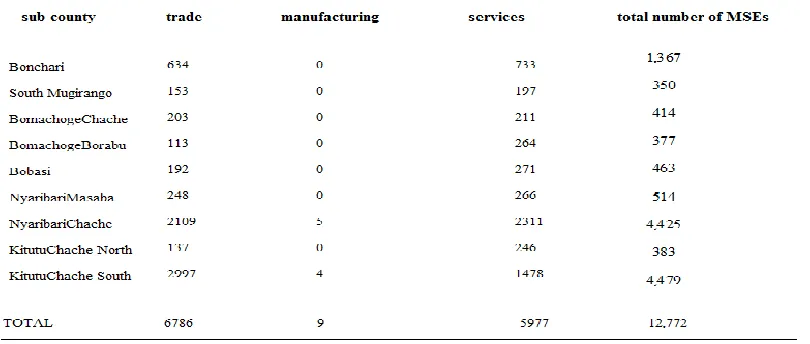
Table 1: Distribution of micro and small enterprises in Kisii County by sub-counties
This study has nine strata, with a total population of 12,772 MSEs. This therefore means that simple stratified random sampling was employed when conducting the study. The table 1 indicates the population distribution per stratum. The study adopted stratified random sampling technique which is aimed at selecting a group of subjects for the study in such a way that their attributes represented the larger group from which they are to be drawn. According to Mugenda and Mugenda, (2013) the size of a sample influences the detection of significant differences, relationships and interactions. Critical factors in determining sample size include the population size, the desired level of precision, the level of confidence and the degree of variability of attributes being measured Since the population of the required characteristics was estimated at 50% (p=0.5), the sample size was determined as follows according to Saunders et al. (2009):
n = Z2pq
d2
where: n = estimated sample size if the target population is greater than 10,000.
Z = standard normal deviate at the required confidence level (value for selected alpha level (1.96)
p= the proportion of the target population estimated to have characteristics being measured.
q=1-P
d = the level of statistical significance set (0.05).
Executing the formula, the distribution of the target population and the corresponding sample size will be 384. In order to get proportionate allocation of the sample in the different sub-counties, the following formula was used;
Sample size in the Sub-County=Number of enterprises in the Sub-county
Number of enterprises in the County × sample size
This formula was repeated for each sub-county and the corresponding sample size given as follows.
Table 2: Sample sizes per Sub-county
Sub-county Number of MSEs Sample sizes
Primary data was collected using a questionnaire whereas secondary data was got from published reports. The researcher obtained permission to commence his study from the National Commission for Science Technology and Innovation (NACOSTI) upon production of introductory letter from the Director School of Graduate Studies and an approved proposal. The research permit was produced to the CEC trade and all the sub county commissioners for permission to collect data in the sub counties. Similarly, chiefs, Assistant chiefs and clan elders were informed about the intended visit to collect data and research work in their respective arrears. The study targeted respondents in their business premises and working places. Out of 384 MSEs selected from Kisii County 38 were used in piloting. They were selected randomly to include all the 9 strata that were studied.
This study used the Cronbach's alpha as a measure of internal consistency. Cronbachs Alpha Coefficient value of 1.0 indicates a perfect reliability while that of below 0.70 will indicate low reliability. Content validity was ensured through piloting. Construct validity was achieved through the review of the theories that formed the major themes of the study and will establish the existence of the constructs and finally external validity was achieved through generalization of the findings of the studies.
This study yielded both qualitative and quantitative data which was analyzed using descriptive and inferential statistics. In this study, measures of central tendency and spread were analyzed descriptively using the mean, mode, median and the standard deviation. Relationships between the variables were analyzed inferentially using Regression Analysis. The data collected was first edited to correct the errors if any, coded and then analyzed using the Statistical Package of Social Sciences (SPSS) version 20.0 computer software which enabled in the manipulation and transformation of variables into desired forms for the purpose of analysis. The analyzed data was then presented using tables, pie charts and graphs such as bar graphs, histograms and ogives.
Regression analysis was conducted to determine the relationship between training and the performance of micro and small enterprises. Regression analysis was also conducted to examine the weight of each variable against the dependent variable. Performance of micro and small enterprises was regressed against managerial training. The equation was expressed as follows;
Where:
Yp = performance of micro and small enterprises.
βo =constant (co efficient of intercept)
X1 = technical training
= error term
Bonchari 1367 41
South Mugirango 350 10
BomachogeChache 414 12
BomachogeBorabu 377 12
Bobasi 463 14
NyaribariMasaba 514 15
NyaribariChache 4425 133
KitutuChache North 383 12
KitutuChache South
TOTAL
4479
12,772
135
4. Findings, Conclusions and Recommendations
4.1 Findings
The objective of this study was to determine the relationship between technical training and the performance of MSEs in Kisii
County. To establish the relationship between technical training and the performance of MSEs in Kisii County, a Likert scale of 1 to 5
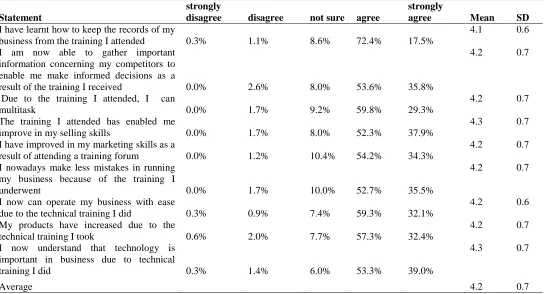
[image:6.612.38.586.300.594.2](1 = strongly disagree, 2 = Disagree 3 = Neutral, 4 = Agree, 5 = strongly agree) was used and the mean response rate from the micro and small enterprise owners calculated. For the purposes of interpretation 4 & 5 (agree and strongly agree) were grouped together as agree, 1 & 2 (strongly disagree and disagree) were grouped as disagree while 3 was neutral. The results of this study are as depicted in Table 4.1.
Regarding the statement that I have learnt how to keep the records of my business from the training I attended, majority of the respondents 89.9% (72.4%+17.5%) agreed to the statement. The results had a mean response of 4.1 with a standard deviation of 0.6. This means that there was low variation in the responses from the respondents implying that most of the respondents could keep records.
Majority of the respondents89.4% (53.6% + 35.8%) agreed that they are now able to gather important information concerning my competitors to enable me make informed decisions as a result of the training they received. The results had a mean response of 4.2 with a standard deviation of 0.7.This means that there was a low variation in the responses from the respondents with regard to the statement.
Table 4.1: Technical training and performance of MSEs in Kisii County
Statement
strongly
disagree disagree not sure agree
strongly
agree Mean SD
I have learnt how to keep the records of my
business from the training I attended 0.3% 1.1% 8.6% 72.4% 17.5%
4.1 0.6
I am now able to gather important information concerning my competitors to enable me make informed decisions as a
result of the training I received 0.0% 2.6% 8.0% 53.6% 35.8%
4.2 0.7
Due to the training I attended, I can
multitask 0.0% 1.7% 9.2% 59.8% 29.3%
4.2 0.7
The training I attended has enabled me
improve in my selling skills 0.0% 1.7% 8.0% 52.3% 37.9%
4.3 0.7
I have improved in my marketing skills as a
result of attending a training forum 0.0% 1.2% 10.4% 54.2% 34.3%
4.2 0.7
I nowadays make less mistakes in running my business because of the training I
underwent 0.0% 1.7% 10.0% 52.7% 35.5%
4.2 0.7
I now can operate my business with ease
due to the technical training I did 0.3% 0.9% 7.4% 59.3% 32.1%
4.2 0.6
My products have increased due to the
technical training I took 0.6% 2.0% 7.7% 57.3% 32.4%
4.2 0.7
I now understand that technology is important in business due to technical
training I did 0.3% 1.4% 6.0% 53.3% 39.0%
4.3 0.7
Average 4.2 0.7
Another 89.1% (59.8% + 29.3%) of the respondents indicated that due to the training they attended, they can multitask. The results had a mean response of 4.2 with a standard deviation of 0.7.This means that there was a low variation in the responses from the respondents with regard to multitasking. The study also sought to find out whether the training attended had enabled them to improve in their selling skills. Results of the study showed that 90.2 % (52.3%+37.9%) of the respondents agreed to the statement. The results had a mean response of 4.3 with a standard deviation of 0.7. This means that there was low variation in the responses from the respondents.
business because of the training I underwent. Majority of the respondents 88.2% (52.7%+35.5%) agreed to the statement. The results had a mean response of 4.2 with a standard deviation of 0.7. This means that there was low variation in the responses from the respondents.
Further the respondents were asked to respondent on the statement that I now can operate my business with ease due to the technical training I did. Majority of the respondents 91.4% (59.3%+32.1%) agreed to the statement. The results had a mean response of 4.2 with a standard deviation of 0.6. This means that there was low variation in the responses from the respondents. Regarding the statement that my products have increased due to the technical training I took, majority of the respondents 89.7% (57.3%+32.4%) agreed to the statement. The results had a mean response of 4.2 with a standard deviation of 0.7. This means that there was low variation in the responses from the respondents. Finally, the respondents were asked to respond on the statement that I now understand that technology is important in business due to technical training I did, 92.3% (53.3% +39.0%) agreed to the statement. The results had a mean response of 4.3 with a standard deviation of 0.7. This means that there was low variation in the responses from the respondents.
This means that there was low variation in the responses from the respondents. The results agree with that of Ndegwa (2012) that technical skill play pivotal role in MSEs survival. Tijani, Okhale, Oga and Tags (2012) and Baileti (2012) in their studies revealed that commercial entrepreneurial skills can only provide a short-run economic solution without economic development but technical entrepreneurial development for the country, visa-vi attainment of Millennium Development Goals for the country by 2020.
Abdulahi et al. (2015), in their study found that there is significant influence of training on business success in Nigeria. The study signified the benefit of training on business success, and at the same time it helps the MSEs to cope with the latest management technical requirements in order to run a success business. This shows that technical training in MSEs is a major area of concern for economic development. Technical training is important in the growth of SMEs.
Overall, the average mean of the responses was 4.2 which means that majority of the respondents were agreeing to the statements in the questionnaire. The standard deviation was 0.7 meaning that the responses were clustered around the mean response
The results presented in Table 4.2 present the fitness of model used of the regression model in explaining the study phenomena.
Table 4.2: Model Fitness
Model R R Square Adjusted R Square Std. Error of the Estimate
.821a .674 .673 3855142.88058
Technical training was found to be satisfactory in explaining performance of micro and small enterprises in Kisii County. This is supported by coefficient of determination also known as the R square of 67.4%. This means that technical training explain 67.4%of the variations in the dependent variable which is performance of micro and small enterprises in Kisii County. The results of the model fitness agree with that of Ndegwa (2012) that technical skill play pivotal role in MSEs survival. This implies that we have a close relationship between technical training and performance of micro and small enterprises. Technical training is important in the growth of MSEs.
Table 4.3: Analysis of Variance
Model Sum of Squares df Mean Square F Sig.
Regression 10689505886555570.000 1 10689505886555570.000 719.245 .000b
Residual 5172020067118714.000 348 14862126629651.477
Total 15861525953674284.000 349
Table 4.3 provides the results on the analysis of the variance (ANOVA). The results indicate that the overall model was statistically significant. Further, the results imply that the independent variable is a good predictor of MSEs performance in Kisii county. This was supported by an F statistic of 719.245and the reported p value (0.000) which was less than the conventional probability 0.05 significance level.
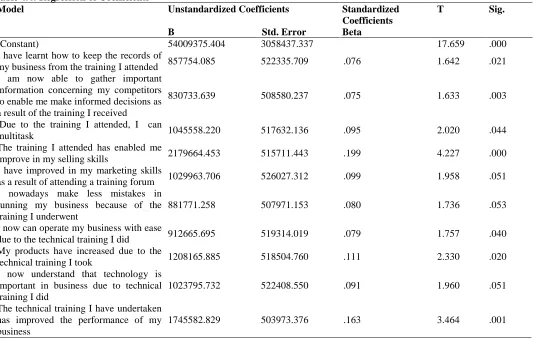
Regression of coefficient results is presented in Table 4.4. Regression of coefficients showed that keeping records as a result of training and MSE performance had a positive and significant relationship (r=857754.085, p=0.021).The results also revealed that gathering important information as a result of training and MSE performance had a positive and significant relationship (r=830733.639, p=0.003). The results also revealed that multitasking is possible as result of the training received and MSE performance had a positive and significant relationship (r=1045558.220, p=0.044).
a positive and significant relationship (r=1029963.706, p=0.051).The results agree with that of Ndegwa (2012) that technical skill play pivotal role in MSEs survival. Abdulahi et al. (2015), in their study found that there is significant influence of training on business success in Nigeria.
[image:8.612.43.577.152.495.2]The study signified the benefit of training on business success, and at the same time it helps the MSEs to cope with the latest management technical requirements in order to run a success business. This shows that technical training in MSEs is a major area of concern for economic development. Technical training is important in the growth of MSEs.
Table 4.4: Regression of Coefficients
Model Unstandardized Coefficients Standardized
Coefficients
T Sig.
B Std. Error Beta
(Constant) 54009375.404 3058437.337 17.659 .000
I have learnt how to keep the records of
my business from the training I attended 857754.085 522335.709 .076 1.642 .021
I am now able to gather important information concerning my competitors to enable me make informed decisions as a result of the training I received
830733.639 508580.237 .075 1.633 .003
Due to the training I attended, I can
multitask 1045558.220 517632.136 .095 2.020 .044
The training I attended has enabled me
improve in my selling skills 2179664.453 515711.443 .199 4.227 .000
I have improved in my marketing skills
as a result of attending a training forum 1029963.706 526027.312 .099 1.958 .051
I nowadays make less mistakes in running my business because of the training I underwent
881771.258 507971.153 .080 1.736 .053
I now can operate my business with ease
due to the technical training I did 912665.695 519314.019 .079 1.757 .040
My products have increased due to the
technical training I took 1208165.885 518504.760 .111 2.330 .020
I now understand that technology is important in business due to technical training I did
1023795.732 522408.550 .091 1.960 .051
The technical training I have undertaken has improved the performance of my business
1745582.829 503973.376 .163 3.464 .001
The results further showed that reduced mistakes in the business and MSE performance had a positive and significant relationship (r=881771.258, p=0.053). The results also revealed that easing of operating business as a result of the training received and MSE performance had a positive and significant relationship (r=912665.695, p=0.040). The results also showed that product variety and MSE performance had a positive and significant relationship (r=1208165.885, p=0.020). The results further showed that importance of technology in business operation and MSE performance had a positive and significant relationship (r=1023795.732, p=0.051).
Finally, that technical training undertaken and MSEs performance had a positive and significant relationship (r=1745582.829, p=0.001). The results agree with that of Ndegwa (2012) that technical skill play pivotal role in MSEs survival. Tijani et al. (2012) and Baileti (2012) in their studies revealed that commercial entrepreneurial skills can only provide a short-run economic solution without economic development but technical entrepreneurial development for thecountry, visa-vi attainment of Millennium Development Goals for the country by 2020.
Abdulahi et al. (2015), in their study found that there is significant influence of training on business success in Nigeria. The study signified the benefit of training on business success, andat the same time it helps the MSEs to cope with the latest management technical requirements in order to run a success business. This shows that technical training in MSEs is a major area of concern for economic development. Technical training is important in the growth of SMEs.
Table 4.5: Optimal Model for technical training
Model Unstandardized Coefficients Standardized
Coefficients
B Std. Error Beta
(Constant) -25707773.791 1090591.449 -23.572 .000
Technical training 6274578.432 233962.480 .821 26.819 .000
Regression of coefficients showed that technical training and MSE performance had a positive and significant relationship (r=6274578.432, p=0.000). This was supported by a calculated t-statistic of 26.819which is larger than the critical t-statistic of 1.96. Results agree with Abdulahi et al. (2015) who found that there is significant influence of training on business success. The study signified the benefit of training on business success, and at the same time it helps the MSEs to cope with the latest management concepts, accounting systems, production techniques and information technology.
Y = -25707773.791+ 6,274,578.432X1
Where Y = MSE performance
X1 is technical training
The first Hypothesis to be tested was that there is a significant relationship between technical training and the performance of MSEs in Kisii County. The hypothesis was tested by using simple linear regression and determined using t-value. The acceptance/rejection criteria was that, if the p value is greater than 0.05, the Ho1 is not rejected but if it’s less than 0.05, the Ho1 fails to be accepted.
Therefore the null hypothesis is that there is no significant relationship between technical training and the performance of MSEs in Kisii County.
The null hypothesis was that there is that there is no significant relationship between technical training and the performance of MSEs in Kisii County. Results show that the p-value was 0.000. This was supported by a calculated t-statistic of 26.819 which is larger than the critical t-statistic of 1.96. The null hypothesis was therefore rejected. The study therefore adopted the alternative hypothesis that there is a significant relationship between technical training and the performance of MSEs in Kisii County. The findings agree with those of Rogerson (2000) in South Africa that successful clothing entrepreneurs were those who had undertaken a number of business and technical training programmes.
4.2 Conclusions
The study further concluded that technical training and MSE are positively and significantly related. There is need for all stakeholders including governance and other participants in the crusade for entrepreneurship programme to redirect and rethink with emphasis on technical entrepreneurship development. In conclusion, the aspects of managerial training that are important to performance include training on record keeping, information gathering, multitasking, selling skills, marketing skills, ease of doing business, more products and importance of technology.
4.3 Recommendations
It was found that technical training influences the performance of micro and small enterprises in Kisii County. It is recommended that there is need for all stakeholders including government and other participants to crusade for entrepreneurship programme to redirect and rethink with emphasis on technical entrepreneurship development among small and medium enterprises.
REFERENCES
Ababa, A. (2014). Networking and business performance of medium sized enterprises in Addis Ababa (Doctoral dissertation, ADDIS
ABABA UNIVERSITY).
Abdullahi, M. S., Awang, Z., Abubakar, A., Umar, K., Bala, M., Khalid, S. S., & Shamsu, S. (2015); The influence of training on
business success in Nigeria: Case of registered small and medium scale enterprises (SSEs) in Kano State, Nigeria, Scholars
Journal of Economics, Business and Management,4(3),28-42.
Abor, J, & Biekpa, N, (2007) - Corporate debt policy of Small and Medium Enterprises in Ghana: University of Stellenbosch, South
Agbim, K. C. (2013). The Relative Contribution of Management Skills to Entrepreneurial Success: A Survey of Small and Medium
Enterprises (SSEs) in the Trade Sector. OSR Journal of Business and Management5(2), 111-126.
Fadahunsi, A. (2012) The Growth of Small Businesses: Towards A Research Agenda, American Journal of Economics and
Business Administration.4(1):105-115. ISSN 1945-5488
Aldrich, H. E., & Martinez, M. (2010).Entrepreneurship as social construction: a multilevel evolutionary approach. In Z. J. Acs& D.
B. Audretsch (Eds.), Handbook of entrepreneurship research. New York: Springer.
Ariyo, D. (2009). Small firm are the backbone of Nigeria economy. Africa Economic Analysis, Africa Enterprises Information
Service, Bridgnorth United Kingdom
Arregle, J.; Hitt, M. A., Sirmon, D. G. & Very, P. (2007). The development of organizational social capital: Attributes of family
firms, in Journal of Management Studies,44(3), 36-44.
Barney, J. B. (1986). Strategic factor markets: Expectations, luck and business strategy”, in Management Science, Vol. 32, No. 1, pp.
1231−1241.—. 1991. “Firm resources and sustained competitive advantage”, in Journal of Management, 17,(2) 99−120.
Barrick, M.R., & Mount, M.K. (2003).The Big Five personality dimensions and job performance: A Meta-Analysis. Personnel Psychology.
Bruhn, M., Miriam, W. &Bilal, Z. (2012). Stimulating Managerial Capital in Emerging Markets: The Impact of Business and
Financial Literacy for Young Entrepreneurs,Mimeo. World Bank
Chiliya, N., & Roberts-Lombard, M. (2012). Impact of level of education and experience on profitability of small grocery shops in South Africa. International Journal of Business Management & Economic Research, 3(1), p462.
Cole, M., Schaninger, W., & Harris, S. (2007). The workplace social network exchange: a multilevel, conceptual examination. Group
& Organization Management, 27(1)240-262.
Donaldson, L. & Davis, J. (1994). Boards and company performance: research challenges the
Døving, E. & Gooderham, P. (2008). Dynamic capabilities as antecedents of the scope of related diversification: the case of small
firm accountancy practices, in Strategic Management Journal, 29(1)120-136.
Eunseong Cho, Mushin Lee (2005). An exploratory study on contingency factors affecting R&D performance measurement,
International Journal of Manpower.; 26(6):502-512.
Fatoki, O. (2012). The Impact of Ethics on Availability of Trade credit to new small and Medium Sized Enterprises. South Africa
Frankfort-Nachmias, C., & Nachmias, D. (1996), Research Methods in the Social Sciences (5th Ed). New York St. Martin’s Press.
Fred, A. F., Gordana, P., &, A. (2008).Relationship between quality management practices and the performance of small and medium size enterprises (SSEs) in Ghana. International Journal of Quality & Reliability Management, 25(7)250-269.
Gefen, D., & Ridings, C. (2002). Implementation team responsiveness and user evaluation of customer relationship management: a
quasi-experimental design study of social exchange theory. Journal of Management Information Systems, 19(1), 47-69.
Gin Chong H (2008). Measuring performance of small-and medium sized enterprises: the grounded theory Approach, Journals of
Business and Public affairs, 2(1)180-195. ISSN 1934-7219
Hair, J., Black, W., Babin, B., Anderson, R., &Tatham, R. (2006). Multivariate data analysis (6th Ed.).Uppersaddle River, N.J.: Pearson Prentice Hall.
Hellriege, I. D., & Jackson, S. E. (2008).Management. 2nd South Africa Edition. Oxford: Oxford
Jayawarna, D., Macpherson A., & Wilson, A. (2007): Training Commitment and Performance in Manufacturing SSEs Incidence,
Intensity and Approaches. Journal of Small Business and Enterprise Development, 14,(3) 26-39.
Kisaka, E. S. & Mwewa, N. M. (2014), “Effects of Micro-credit, Micro-saving and Training on the Growth of Small and Medium
Entreprises in Machakos County in Kenya”, Research Journal of Finance and Accounting, 7 (2), 43 – 49.
Klijn, E.H., J. Edelenbos and B. Steijn (2010b). Trust in governance networks; its impact and outcomes, Administration and Society, 42 (2): 193-221
Latha, K.L. & Murthy, B. (2009). The motives of small scale entrepreneurs: an exploratory study. South Asian Journal of
Management, 16: 91-108
MacInnes, J.; Cressey, P.; Eldridge, J. (1985). Just managing: Authority and democracy in industry (Milton Keynes, Open University
Press).
Magableh, I., & Kharabsheh, R. (2011). The Determinants and Impact of Training: the Case of SSEs in Jordan. International Journal
of Economics and Finance, 5(2), 52-72.
Miladi, A. I. (2014). Governance for SMEs: Influence of leader on organizational culture. International Strategic Management Review, 2(1), 21-30.
Miller, M., Godfrey, N., Levesque, B., & Stark, E. (2009).The Case for Financial Literacy in Developing Countries: Promoting
Access to Finance by Empowering Consumers. World Bank, DFID, OECD, and CGAP joint note, Washington, DC: World
Bank (Retrieved February 18, 2012)
Mugenda, O.M. and Mugenda, A, G. (2003). Research methods.Quantitative and Qualitative Approaches, Acts Press, Nairobi-Kenya.
Mungai, B. (2012). The Relationship between Business Management Training and Small and Medium-sized Enterprises' Growth in
Kenya. Unpublished PhD Thesis, Kenyatta University.
Mungai, B. (2012). The Relationship between Business Management Training and Small and Medium-sized Enterprises' Growth in
Kenya. Unpublished PhD Thesis, Kenyatta University.
Njoroge, C. W., & Gathungu, J. M. (2013). The effect of entrepreneurial education and training on development of small and medium size enterprises in Githunguri District-Kenya. International Journal of Education and Research, 1(8), 1-22.
Purateera, T., (2009), Influence factors affecting management of small enterprises in Northeast Thailand.International Business & Economics Research Journal, 8(2), 41-46.
R Baldwin and J Black, Really Responsive Regulation (2007), LSE Law Society and Economy Working Paper 15 (2007), 11.
Radipere, S., & Dhliwayo, S. (2014). The role of gender and education on small business performance in
Shaw, K. L. (2007). “Personnel economics: The economist’s view of human resources”, in Journal of Economic Perspectives,
21(3),244-256.
Sheehan, M. (2013).“Human resource management and performance: Evidence from small and medium-sized firms,”in International
Small Business Journal, online publication, DOI: 10.1177/0266242612465454.
Sriniva D., (2013), Quality management practices in rural and urban SSEs Strategic plan of ministry of Trade printed April (2009)
Teece. D. J.; Pisano, G.; Shuen, A. (1997). “Dynamic capabilities and strategic management”, in Strategic Management Journal, 18(1), 76-87.
Umar, F. (2015) What is Interview Schedule: Definitionand Types, International Journal of Science and Research (IJSR)
Wanigasekara .W.M.S.K & Surangi H.K.N.S (2011). Impact of level of education and business experience on business success among small retail owner managers in Sri Lanka , University of kelaniya. Paper to be presented at 2nd International Conference on Business and Information (ICBI) 20 October 2011. [On-line].Available: http://www.kln.ac.lk/fcms /ICBI 2011/ images /ICBM/dccs/Microsoft%20Word%20-%20ENP001.pdf [Accessed: 18 Aug. 2011].
Weston, J. F. & Brigham, E.F. (1981). Managerial finance, 7th ed., Dryden Press, Hinsdale
White, M.; Hill, S.; McGovern, P.; Mills, C. & Ssesaton, D. (2003).“‘High-performance’ management practices, working hours and work–life balance”, in British Journal of Industrial Relations, 41(2), 175−195.
Yahya, A. Z., Othman, M. S., & Shamsuri, A. L. S. (2012). The impact of training on small and medium enterprises (SMEs)
Yahya, A. Z., Othman, M. S., & Shamsuri, A. L. S. (2012). The impact of training on small and medium enterprises (SMEs)