SECURE BIO-METRIC BASED
GLUCOSE CONTROL FOR DIABETIC PATIENTS
USING ZIGBEE
ANKUR NAGAR
Selvakumar.A
Abstract- Embedded systems are commonly found in consumer, cooking, industrial, automotive, medical, commercial and military applications. Telecommunications systems employ numerous embedded systems from telephone switches for the network to cell phones at the end-user. Computer networking uses dedicated routers and network bridges to route data.
Consumer electronics include personal digital assistants (PDAs), mp3 players, mobile phones, videogame consoles, digital cameras, DVD players, GPS receivers, and printers. Household appliances, such as microwave ovens, washing machines and dishwashers, include embedded systems to provide flexibility, efficiency and features. Advanced HVAC systems use networked thermostats to more accurately and efficiently control temperature that can change by time of day and season. Home automation uses wired- and wireless-networking that can be used to control lights, climate, security, audio/visual, surveillance, etc., all of which use embedded devices for sensing and controlling.
In this project, a novel non-invasive sensor for the measurement of the glucose concentrations in blood is presented. By using a microstrip band pass filter, a wireless sensor is achieved. In the introduced design, the thumb is placed on the structure of the filter as a superstrate. The response of the filter is dependent on the permittivity of the superstrate. A compact size, linearity and cost effectiveness are the most important advantages of the proposed sensor. The linear behaviour of the filter in terms of the frequency is investigated and for a linear behaviour, a certain frequency for operation is selected. The introduced sensor can be used by diabetics for continuous self-monitoring of the glucose level. The structure of the proposed sensor is designed on the
low-cost substrate, FR4, by compact dimensions of 50 mm × 40 mm ×1.6mm
Keywords- Feature Vector; Kekre transform; Walsh transform; Haar transform; GAR
I. INTRODUCTION
1. Diabetic Patients require continuous blood glucose level assessment in order for proper health maintenance.
2. So a monitoring schedule must be maintained at required period of time without fail.
3. Hence it necessitates to discuss the glucose level with the doctors regularly.
4. Here we automate the monitoring process by wireless sending of glucose level of patients to doctors
5. Use of biometric help for secure database II. EXISTINGSYSTEM 1. Here glucose level is not monitored regularly
2. No automated facility is available for updating the glucose level to the doctors
3. No Security is provided for patient details maintenance
4. Very late process results in improper diagnosis of patients
III. PROPOSEDSYSTEM
1. Here glucose level is monitored using glucose sensor 2. The glucose sensor value is sent wirelessly using
zigbee to the doctor
3. At the receiver side , only authorized doctor can receive the patient information
5. Based on the authentication the patients details are received and stored in PC
IV. SYSTEMARCHITECTURE GLUCOSELEVELMONITORING
BLOCKDIAGRAM:
RECEIVER SIDE
Methodology for fingerprint
Dataset Preparation:
Here preparation of dataset is done by collecting Biometric scammed Images of a person
of different biometrics such as finger, iris & face. All these datasets are stored in a local directory
Feature Extraction :
Here the Images are processed based on different algorithms as per the biometric used. In This papers we extract features of finger , iris & face & generate score values which are used for authentication & further control of devices based on these results
Finger print feature Extraction:
Fingerprints are the most used biometrics in applications where a high level of security is required. This project implements the identification procedure: it matches one fingerprint among N fingerprints. It uses minutiae points based algorithms: in the enrollment step, the points are extracted from the print. Later on, during the authentication step, the points are matched. This step is implemented using fingerprint enhancement and minutia filtering.
In a fingerprint, they correspond to either a ridge ending or a bifurcation. There is a duality between the two types of minutiae: if the pixel brightness is inverted, ridge endings become bifurcations and vice versa. The position of the minutia point is at the tip of the ridge or the valley. The orientation is given by the orientation of the arrow formed by the ridge or the valley . First, the local orientation field needs to be computed.
ALGORITHMS / PROTOCOLS
UART PROTOCOL
The Universal Asynchronous Receiver/Transmitter (UART) controller is the key component of the serial communications subsystem of a computer. UART is also a common integrated feature in most microcontrollers. The UART takes bytes of data and transmits the individual bits in a sequential fashion. At the destination, a second UART re-assembles the bits into complete bytes. Serial transmission of digital information (bits) through a single wire or other medium is much more cost effective than parallel transmission through multiple wires. Communication can be “full duplex” (both send and receive at the same time) or “half duplex” (devices take turns transmitting and receiving).
HARDWARE REQUIREMENT:
Microcontroller 8051
ADC
Glucose sensor
MI
CR
O
CO
NT
RO
LL
ER
U
A
R
T
G
L
U
C
OS
E
SE
NS
O
R
A
D
C
Z
I
G
B
E
E
UA
RT
ZI
GB
EE
MA
TL
AB
UART
Pc
Zigbee
Power Supply Unit
SOFTWARE REQUIREMENT:
Keil compiler
Embedded C
MATLAB
Microcontroller
All the functions required on a single chip. A microcontroller differs from a microprocessor, which is a general-purpose chip that is used to create a multi-function computer or device and requires multiple chips to handle various tasks. A microcontroller is meant to be more self-contained and independent, and functions as a tiny, dedicated computer.
They are typically designed using CMOS (complementary metal oxide semiconductor) technology, an efficient fabrication technique that uses less power and is more immune to power spikes than other techniques. There are also multiple architectures A microcontroller is an integrated chip that is often part of an embedded system. The microcontroller includes a CPU, RAM, ROM, I/O ports, and timers like a standard computer, but because they are designed to execute only a single specific task to control a single system, they are much smaller and simplified so that they can include used, but the predominant architecture is CISC (Complex Instruction Set Computer), which allows the microcontroller to contain multiple control instructions that can be executed with a single macro instruction. Some use a RISC (Reduced Instruction Set Computer) architecture, which implements fewer instructions, but delivers greater simplicity and lower power consumption.
Early controllers were typically built from logic components and were usually quite large. Later, microprocessors were used, and controllers were able to fit onto a circuit board. Microcontrollers now place all of the
needed components onto a single chip. Because they control a single function, some complex devices contain multiple microprocessors.
Microcontrollers have become common in many areas, and can be found in home appliances, computer equipment, and instrumentation. They are often used in automobiles, and have many industrial uses as well, and have become a central part of industrial robotics. Because they are usually used to control a single process and execute simple instructions, microcontrollers do not require significant processing power.
Introduction:
`The AT89c51 is a low-power, high-performance CMOS 8-bit microcontroller with 8K bytes of in-system programmable Flash memory. The device is manufactured using Atmel’s high-density nonvolatile memory technology and is compatible with the industry-standard 80C51 instruction set and pin out. The on-chip Flash allows the program memory to be reprogrammed in-system or by a conventional nonvolatile memory pro-grammer. By combining a versatile 8-bit CPU with in-system programmable Flash on a monolithic chip, the Atmel AT89c51is a powerful microcontroller which provides a highly-flexible and cost-effective solution to many embedded control applications. The AT89c51provides the following standard features: 8K bytes of Flash, 256 bytes of RAM, 32 I/O lines, Watchdog timer, two data pointers, three 16-bit timer/counters, a six-vector two-level interrupt architecture, a full duplex serial port, on-chip oscillator, and clock circuitry. In addition, the AT89c51 is designed with static logic for operation down to zero frequency and supports two software selectable power saving modes. The Idle Mode stops the CPU while allowing the RAM, timer/counters, serial port, and interrupt system to continue functioning.
Features:
Compatible with MCS-51 Products
– Endurance: 10,000 Write/Erase Cycles
4.0V to 5.5V Operating Range
Fully Static Operation: 0 Hz to 33 MHz
Three-level Program Memory Lock
256 x 8-bit Internal RAM
32 Programmable I/O Lines
Three 16-bit Timer/Counters
Eight Interrupt Sources
Full Duplex UART Serial Channel
Low-power Idle and Power-down Modes
Interrupt Recovery from Power-down Mode
Watchdog Timer
3.2.2.1INTRODUCTION TO MICROCONTROLLER (AT89c51):
The AT89c51 is a low-power, high-performance CMOS 8-bit microcontroller with 8K bytes of in -system programmable Flash memory. The device is manufactured using Atmel’s high-density non-volatile memory technology and is compatible with the I n d u s t r y s t a n d a r d 8 0 C 5 1 i n s t r u c t i o n s e t a n d p i n o u t . T h e o n - c h i p F l a s h a l l o w s t h e p r o g r a m m e m o r y t o b e r e p r o g r a m m e d i n - s y s t e m o r b y a c o n v e n t i o n a l n o n - v o l a t i l e memory programmer. By combining a versatile 8-bit CPU with in-system programmable Flash on a monolithic chip, the Atmel’s AT89c51 is a powerful microcontroller which p r o v i d e s a h i g h l y -f l e x i b l e a n d c o s t - e -f -f e c t i v e s o l u t i o n t o m a n y e m b e d d e d c o n t r o l application.
-Network, Security & Application layers -Brand management
IEEE 802.15.4 -“the hardware”
-Physical & Media Access Control layers
IEEE 802.15.4 Architecture
• PHY functionalities:
– Activation and deactivation of the radio transceiver
– Energy detection within the current channel – Link quality indication for received packets – Clear channel assessment for CSMA-CA – Channel frequency selection
– Data transmission and reception – PHY packet fields
– Preamble (32 bits) – synchronization – Start of packet delimiter (8 bits) – shall be
formatted as “11100101”
– PHY header (8 bits) –PSDU length – PSDU (0 to 127 bytes) – data field • The standard specifies two PHYs :
– 868 MHz/915 MHz direct sequence spread spectrum (DSSS) PHY (11 channels)
• 1 channel (20Kb/s) in European 868MHz band
• 10 channels (40Kb/s) in 915 (902-928)MHz ISM band
IEEE 802.15.4
868/915 MHz
PHY
IEEE
802.15.4
2400 MHz
PHY
IEEE 802.15.4 MAC
IEEE 802.2 LLC
Other LLC
Data Link Controller (DLC)
Networking App Layer
ZigBee Application
Framework
IEEE 802.15.4
868/915 MHz
PHY
IEEE
802.15.4
2400 MHz
PHY
IEEE 802.15.4 MAC
Data Link Controller (DLC)
Other
LLC
ZigBee Application
Framework
IEEE 802.15.4 MAC
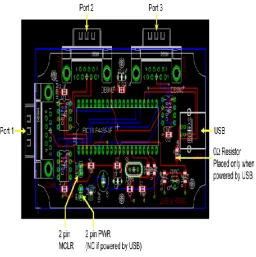
USB to RS232 Converter Circuit Description
1.0 CIRCUIT OVERVIEW
[image:5.595.36.293.219.477.2]The USB to RS232 Converter board is a PIC microcontroller based device that receives a USB signal from a PC and converts the signal to an RS232 output. The output signal can be sent to any one of three serial ports. Devices which may be connected to the RS232 ports include the ASI Inc. X-Y Stage, the Olympus Z-Focus, and the Mai Tai LASER.
Figure 1: Current PCB Layout
LITERATURE SURVEY:
Title 1: Development of the Portable Blood Glucose Meter for Self-monitoring of Blood Glucose
Author : Qi Li 1, Jingqi Yuan Abstract :
The work outlined in this paper is towards developing a portable, economy blood glucose meter for self-monitoring of blood glucose, which has high performance-price ratio with multifunction and is attractive to the average people. Its functions include blood glucose concentration measurement, LCD display, historical records
restore, calendar/timer. It enables the patients with diabetes to detect blood glucose with a glucose oxidase electrode independently at home. This paper will outline hardware configuration in the implementation and software management. Especially, graphic trend curve on LCD allows individuals to easily see how actual blood glucose
readings compare with historical records stored in the meter and show how individuals stay within their specific target range so that they can determine how well they are
controlling their diabetes. Experimental results indicate that this device is easy-to-use and suitable for home blood glucose monitoring for patients.
Disadvantage:
Patient data is insecure and is not maintained
Title2 : A 3micro W CMOS Glucose Sensor for Wireless Contact-Lens Tear Glucose Monitoring
Author : Yu-Te Liao, Huanfen Yao, Andrew Lingley, Babak
Parviz, and Brian P. Otis
Abstract :
This paper presents a noninvasive wireless sensor platform for continuous health monitoring. The sensor system integrates a loop antenna, wireless sensor interface chip, and glucose sensor on a polymer substrate. The IC consists of power management, readout circuitry, wireless communication interface, LED driver, and energy storage capacitors in a 0.36-mm CMOS chip with no external components. The sensitivity of our glucose sensor is 0.18 A mm mM . The system is wirelessly powered and achieves a measured glucose range of 0.05–1 mM
with a sensitivity of 400 Hz/mM while consuming 3 W from a regulated 1.2-V supply.
Disadvantage:
Data of glucose is not recorded wirelessly REFERENCES
[1] A. Anandkumar, N. Michael, and A. Tang. Opportunistic spectrum access with multiple players: Learning under competition. In Proc. of IEEE INFOCOM, 2010.
[2] P. Auer, N. Cesa-Bianchi, and P. Fischer. Finite-time analysis of the multiarmed bandit problem. Machine learning, 47:235–256, 2002.
[3] W. Bao, H. Li, N. Li, and W Jiang. A liveness detection method for face recognition based on optical flow field. In Proc. IEEE Int. Conf. on Image Anal. and Signal Process., 2009, IASP 2009, pages 233–236. IEEE, 2009.
[5] B. C. Becker and E. G Ortiz. Evaluation of face recognition techniques for application to facebook. In 8th IEEE Internat. Conf. on Automatic Face & Gesture Recognition, 2008. FG’08., pages 1–6. IEEE, 2008.