Survey of Adaptive On Demand Distance Vector
Learning Protocol (AODV)
Sandeep Nandanwar, Vikram Jain, Sandeep Sahu
Abstract: Mobile Ad-hoc Network (MANET) is an infrastructure less and decentralized network which need a robust dynamic routing protocol. In such an environment, it may be necessary for one mobile host to enlist the aid of others in forwarding a packet to its destination, due to the limited propagation range of each mobile host’s wireless transmissions. Some previous attempts have been made to use conventional routing protocols for routing in ad hoc networks, treating each mobile host as a router. There have been several routing protocol proposed. In Manet protocols are classified in two categories Reactive and proactive protocol.The most efficient reactive protocol is Ad-hoc on demand distance vector (AODV) routing protocol. We examine AODV in term of advantage and limitation.
Index Terms-:MANET, Proactive and Reactive routing protocols, AODV, DSDV
I. INTRODUCTION
MOBILE ad hoc network (MANET) [3] consists of a many of wireless mobile nodes communicating with each other without any centralized control or fixed network infrastructure.MANET have been evolving to serve a increasing number of applications that rely on multihop wireless infrastructures that can be easily installed. The potential applications include emergency disaster relief, battlefield command and control, mine site operations, and wireless classrooms in which participants wish to share information. Today, wireless technologies such as IEEE 802.11 [4], Bluetooth [1], and third-generation cellular have led to a proliferation of mobile devices. The number of mobile Internet devices is expected to reach a billion in the near future [2] and exceed the number of stationary nodes. Therefore, we need MANETs to be interconnected to the Internet in many applications.
II. ROUTING IN MANET
MANET routing protocols may be broadly classified into two major categories: Proactive and Reactive.
Proactive Routing Protocols: Proactive protocols
continuously learn the topology of the network by sharing topological information among the network nodes. Thus, when route is requiredfor a destination, such route information is given immediately. If the network topology changes too frequently, the cost of maintaining the network could be very high. If the network activity is low, the information about actual topology could not be used.
Reactive Routing Protocols: The reactive routing protocols are based on query-reply dialog. Reactive protocols establish route(s) to the destination only when the need arises. They need not periodic transmission of topological information of the network.
Based on the method of delivery of data packets from the source to destination, classification of MANET routing protocols may be done as follows:
Unicast Routing Protocols: This protocols consider sending information packets to a single destination from a single source.
Multicast Routing Protocols: In this protocols, the delivery of information to a group of destinations simultaneously, using the most efficient strategy to deliver the messages over each link of the network only once, creating copies only when the links to the destinations split. Multicast routing use both multicast and unicast for data transmission.
PROACTIVE ROUTING PROTOCOLS:
Dynamic Destination-Sequenced Distance-Vector Routing Protocol (DSDV)
Wireless Routing Protocol (WRP)
Cluster Gateway Switch Routing Protocol (CGSR)
Global State Routing (GSR)
Fisheye State Routing (FSR)
Hierarchical State Routing (HSR)
Zone-Based Hierarchical Link State Routing Protocol(ZHLS)
Landmark Ad Hoc Routing (LANMAR)
Optimized Link State Routing (OLSR)
REACTIVE ROUTING PROTOCOLS:
Associativity-Based Routing (ABR)
Signal Stability–Based Adaptive Routing Protocol (SSA)
Temporarily Ordered Routing Algorithm (TORA)
Cluster-Based Routing Protocol (CBRP)
Dynamic Source Routing (DSR)
Ad Hoc On-Demand Distance Vector Routing (AODV)
III. AODV AODV Feature
AODV does not need any central administrative system to handle the routing process. AODV
reduce the control traffic messages overhead at the cost of increased latency in finding new routes.
Tries to keep the overhead of the messages small. If host has the route information in the Routing Table about active routes in the network, then the overhead of the routing process would be minimal. The AODV has advantage in overhead over simple protocols which require to keep all the route from the source host to the destination host in their messages. The RREQ and RREP messages, whose responsibility for the route discovery, do not increase significantly the overhead from these control messages. AODV reacts relatively quickly to the topological changes in the network and keep update only the hosts that may be affected by the change, using the RRER message. The Hello messages, whose responsibility for the route maintenance, are also limited so that they do not create unnecessary overhead in the network.
Loop free and avoids the counting to infinity problem, which were not easy to the classical distance vector routing protocols, by the usage of the sequence numbers.
IV. INTRODUCTION
A devices like laptop, mobile phone, Personal Digital Assistant (PDA), or similar devices, which can communicate directly with one another without a central administrator through MANET.A MANET, is an autonomous system of mobile routers and associated hosts connected by wireless links. MANET does not require a central administration infrastructure due to its wireless nature and can be deployed as a multi-hop packet network with low expense and rapidely[5].MANET has its own routing protocols which can be compromised with dynamic topology ,frequent route exchange, multi-hop routing, bandwidth constraint and A mobile ad hoc network routing protocol controls how nodes decide which way to route packets between computing devices [6]. The routing protocols in MANET are proactive (table driven), reactive (on demand) and hybrid routing protocols. Popular proactive routing protocols are highly dynamic DSDV (Destination-Sequenced Distance Vector) and Optimized Link State Routing protocol while reactive routing protocols include AODV( Ad hoc On demand Distance Vector) and Dynamic Source Routing (DSR).hybrid routing protocol is Zone Routing Protocol (ZRP).
The MANET requirements for multi-hop routing dynamic,self-starting between mobile nodes [7]. AODV protocol makes routes among nodes when required by source nodes thats why called on demand routing protocol. Maintenance of routes depend on the sources need [8].The mobile Nodes maintain a route cache and use a destination sequence number for each route entry. The node in AODV looking for information about the network only when needed reduces overhead since nodes do not have to maintain unnecessary route information while the use of a sequence
V. The Ad-hoc On-Demand Distance Vector Algorithm
The AODV algorithm is on-demand route request system; nodes that do not depend on active paths neither store any routing information nor take part in any periodic routing table exchanges. The AODV routing algorithm designed for mobile networks which is ad hoc[9] [10]. Unicast and multicast routing is supported by AODV [11]. AODV builds routes among nodes when only source nodes requires. Sequence numbers in AODV is to ensure the freshness of routes. AODV apply in large numbers of mobile nodes and based on loop free. [8].
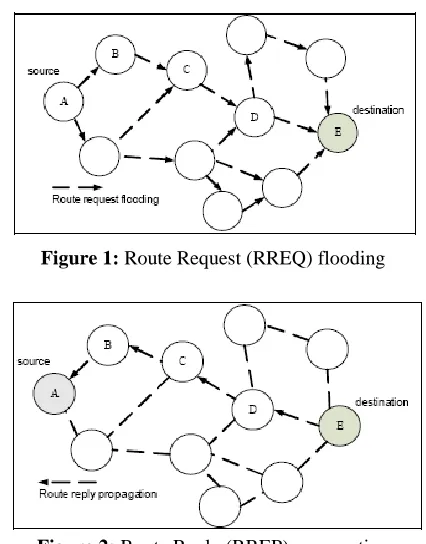
AODV builds routes using a route request route reply query cycle. Source node broadcasts a route request (RREQ) packet across the network when it want a route to destination. The route tables has backward pointers for nodes which receive packet and source nodes and update their information for the source node. In addition to the broadcast ID ,source IP address, current sequence
number the RREQ has updated sequence number for the destination.A route reply (RREP) is sent by node which receiving
the RREQ ,node which is the destination or has a route to the destination with greater sequence number. the RREQ's source IP
address and broadcast ID [11] is maintained by nodes. Already processed RREQ,is not forwarded.The RREP sends back to the
[image:2.612.338.551.345.617.2]source by Nodes.it set forward pointers. The source node forward data packets to the destination.if it receive RREP
Figure 1: Route Request (RREQ) flooding
Figure 2: Route Reply (RREP) propagation
Route continue to be maintained if it is active. In case of link break when the route is active, the node along the route send a route error (RERR) message to the source node.If the source node apply route discovery procedure if it require after receiving the RERR.
The Path Discovery process is generated whenever a source node has no routing information in its routing table.if it communicate with nodes.
Every node maintains two separate counters: a node sequence number and a broadcast id. The source node looks for route by broadcasting a route request (RREQ) packet to its neighbors. The RREQ contains the following fields:
< source_addr; source_ sequence #; broadcast_ id; dest_ addr; dest _sequence #; hop cnt >
The pair < source addr; broadcast id > uniquely identifies a RREQ. broadcast id is incremented whenever the source send a new RREQ. Each neighbor either accept the RREQ by sending a route reply (RREP) back to the source or rebroadcasts the RREQ to its own neighbors after increasing the hop count. Notice that a node may receive many copies of the same route broadcast packet from various neighbors. When RREQ is received by intermediate node, which has same source address and broadcast id, RREQ is deleted. If a node cannot accept the RREQ, it keeps track of the following information in order to implement the reverse path setup, as well as the forward path setup that will accompany the transmission of the eventual RREP:
Destination IP address
Source IP address
Broadcast id
Expiration time for reverse path route entry
Source node's sequence number
The optimization of AODV is based on the recent draft of the AODV specification [4]. The essential functionality of AODV includes:
• RREQ and RREP messages (for route discovery)
• RERR messages, HELLO messages, & precursor lists (for route maintenance)
• Sequence numbers • Hop counts
• Expanding ring search
The following fields exist in each route table entry of AODV:
• Destination IP Address:
• Destination Sequence Number: It is associated to the route.
• Next Hop: Either the destination itself or an intermediate node designated to
forward packets to the destination
• Hop Count: Between the source IP Address to the Destination IP Address the number of hops
• Lifetime: Consider the route is valid in Time for node that have RREQ
• Routing Flags: The state of the route; up (valid), down (not valid) or in repair.
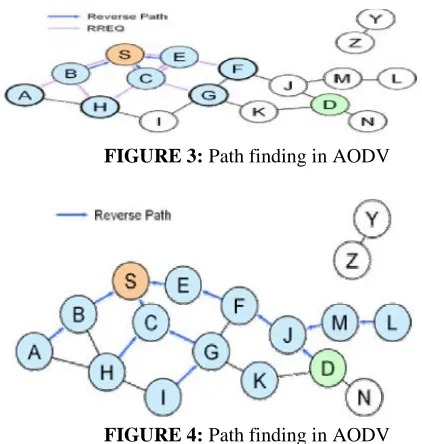
[image:3.612.321.532.53.275.2]Suppose S would like to communicate with D Figure 3, the node send out a RREQ to explore a route to the destination. S generates a Route Request with destination address, Sequence number and Broadcast ID and sent it to his neighbour nodes. Each node receiving the route request sends a route back (Forward Path) to the node.
FIGURE 3: Path finding in AODV
FIGURE 4: Path finding in AODV
[image:3.612.321.529.348.465.2]The route is made available by unicasting a RREP back to D and is written in the routing table from S Figure 4. After receiving the route reply every node has to update its routing table if the sequence number is more recent.
FIGURE 5: Path finding in AODV
[image:3.612.324.530.503.598.2]Now node S can communicate with node D, Figure 5, 6.
FIGURE 6: Path finding in AODV
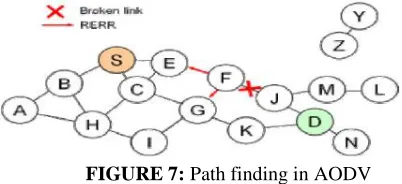
A RERR message is sent to other nodes when active route has broken link Figure 7. If the nodes have a route in their routing table with this link, the route will be erased. Node S sends once
again a route request to his neighbour nodes. Or a node on the way to the destination can try to find a route to D. That
FIGURE 7: Path finding in AODV
Route Table Management
The source and destination sequence numbers, other useful information is also recorded in the route table entries. Reverse path routing entries is a timer, called the route request expiration timer. The work of this timer is to maitain reverse path routing entries from those nodes that do not have the path from the source to the destination.The expiration time depends upon the size of the adhoc network. Another important parameter with routing entries is the route caching timeout.A neighbor which sends minimum one packet to destination in active timeout period is considered active.. This information is maintained so that all active source nodes can be informed when a link along a path to the destination breaks. Active neighbors use route entry is considered as active.Active route entries has a path from a source to a destination, which is followed by packets is called an active path.In DSDV, all routes with destination sequence numbers in the route table are marked, which guarantee that no routing loops can form, even if of out-of-order packet delivery and high node mobility conditions. A mobile node maintains a route table entry for each destination of interest. Each route table entry contains the following information:
Destination
Next Hop
Number of hops (metric)
Sequence number for the destination
Active neighbors for this route
Expiration time for the route table entry
When source to destination data transmission, the route entry timeout is reset to current time. The mobile node compares the destination sequence number of the new route to the destination sequence number for the current route if a new route is given to a mobile node. The route is selected that have the greater sequence number. If the node have same sequence numbers, then the new route is selected only if it has a smaller metric (fewer number of hops) to the destination.
Path Maintenance
Movement of nodes not lying along an active path does not deflect the routing to that path's destination.If the source node moves during an active session, it may reinitiate the route discovery procedure to form a new route to the destination. A RREP is sent to the affected source nodes when either intermediate node or the destination moves. Periodic hello
failures would be detected by using link layer acknowledgments. A link failure is also showed if attempts to forward a packet to the next hop fail.Once the next hop becomes unreachable, the RREP with a fresh sequence number is forwarded by node and hop count of 1 to all active upstream neighbors. Those nodes subsequently propogate that message to their active neighbors and so on. When all active source nodes are informed then process stops.it ends because AODV maintains only loop-free routes and there are only a finite number of nodes in the ad-hoc network.Upon receiving notification of a broken link, source nodes can restart the searching if nodes require route to the destination.A node determine if route is still needed it inspect upper level protocol control blocks to see whether connections remain open using the indicated destination as well as the route has been used recently.
Local Connectivity Management
Nodes know their neighbors in one of two ways.Whenever a node receives a request from a neighbor, it updates its local connectivity information to ensure that it add this neighbor. In the event that a node has not sent any packets to all of its active neighbors within hello interval, it send to its neighbors a hello message (a special RREP), containing its identity and sequence number. The node's sequence number is not changed for hello message transmissions. The hello messages that have less TTL value of 1 is not rebroadcasted outside the neighborhood of the node .Neighbors update their local connectivity information to the node if receive packet.Failing to receive hello messages from not active neighbors does not activate any protocol action. If hello messages are not received from the next hop along an active path, the active neighbors using that next hop are sent notification of link failure We have determined the optimal value for allowed hello loss is two.
The hello messages can also be used to maintain that neighbors of nodes that have bidirectional connectivity are considered. For this purpose, a node lists the nodes from which it has heard hello messages. Each node uses only routes to neighbors that have heard the node's hello message
Limitations of AODV
Need on broadcast medium: The algorithm requires that the nodes in the broadcast medium can detect each others broadcasts.
Overhead on the bandwidth : Overhead on bandwidth will be occurred compared to DSR. When an RREQ travels from node to node in the process of discovering the route info on demand,it setsup the reverse path in itself with the addresses of all the nodes through which it is passing & it carries all this info all its way.
No reuse of routing info: AODV lacks on efficient route maintenance technique. The routing info is always obtained on demand including for common case traffic.
High route discovery latency:AODV is reactive routing protocol.This means that AODV does not discover a route until a flow is initiated.This route discovery latency result can be high inlarge-scale mesh networks.VI. CONCLUSION
We have studied in AODV that the route maintenance technique is not efficient in AODV. The routing info is always obtained on demand including for common case traffic.The nodes can detect each others broadcasts in the broadcast medium This is the requirement of broadcast medium.Overhead on bandwidth will be occurred compared to DSR. When node to node travels of an RREQ for the route information on demand, the reverse path is setup in itself with the addresses of all the nodes through which it is passing & it carries all this info all its way. The frequent route repair causes higher route cost and delay this is due to breaking of link.The simple algorithm neighbor change ratio resolve the faults. But the problem of the method is that the nodes are not forwarding control packets or data packets which have the neighbor messages of their neighbors but still need to send Hello packets periodically. We have concluded that the neighbor stability algorithm can incorporate piggyback mechanism to resolve the issue of longer delay and periodically Hello packet sending.
REFERENCES [1] Bluetooth Core Specification, v1.2, Nov. 2003.
[2] C. E. Perkins, J. T. Malinen, R. Wakikawa, A. Nilsson, and A. J. Tuominen, “Internet connectivity for mobile ad hoc networks,” J.
Wireless Commun. Mobile Comput., vol. 2, no. 5, pp. 465–482, Aug. 2002.
[3] S. Corson and J. Macker, “Mobile ad hoc networking (MANET):
Routing protocol performance issues and evaluation considerations,” IETF RFC 2501, Jan. 1999
.
[4] Wireless LAN medium access control (MAC) and physical layer (PHY) specifications,ISO/IEC8802-11; ANSI/IEEE Standard 802.11, Aug. 1999.
[5] Z. Ismail, R. Hassan, A. Patel, R. Razali, A Study of Routing Protocol for Topology Configuration Management in Mobile Ad Hoc Network, International Conference on Engineering,Electrical and Informatics (ICEEI 09), 5-7August 2009, Bangi, Malaysia, pp. 412-417.
[6] S. Mittal, P. Kaur, Performance Comparison of AODV, DSR and ZRP Routing Protocols in MANET’s, 2009 International Conference on Advances in Computing, Control and Telecommunication Technologies (ACT 2009),28-29 December 2009, Trivandrum, Kerala,India, pp. 165-168.
[7] E. M. Royer, C. E. Perkins, An Implementation Study of AODV Routing Protocol, IEEE Wireless Communications and Networking Conference (WCNC 2000), 23-28 September 2000, Chicago, pp. 1003-1008
[8] Zahian Ismail, Rosilah Hassan. A Performance Study of Various Mobility Speed on AODV Routing Protocol in Homogeneous and Heterogeneous MANET,2011 17th Asia-Pacific Conference on Communications (APCC)
[9] Azizol Abdullah, Norlida Ramly, Abdullah Muhammed, Mohd Noor Derahman: Performance Comparison Study of Routing Protocols for Mobile Grid Environment, pp 82-88, IJCSNS VOL.8 No.2, February 2008
[10] Altman E, and Jimenez T., (2003). NS Simulator for Beginners. Lecture notes. Univ.de Los Andes, Merida, Venezuela and ESSI.Sophia-Antipolis, France.
[11] C.E. Perkins & E.M. Royer, Ad-hoc On-Demand Distance Vector Routing, [12] Dr. Aditya Goel ,Ajaii Sharma Performance Analysis of Mobile Ad-hoc
AUTHORS
First Author – Sandeep Nandanwar, MTech(CTA) pursuing,
SRIT JBP MP INDIA,[email protected]
Second Author – Vikram Jain,M.E.(Comp.Sc.), SRIT JBP MP
INDIA ,[email protected]
Third Author – Sandeep Sahu, M.E(Comp. Sc.), SRIT JBP MP