OPTIMIZED MEMORY POLYNOMIAL WITH BINOMIAL
REDUCTION IN DIGITAL PRE-DISTORTION FOR
WIRELESS COMMUNICATION SYSTEMS
Hong Ning Choo
1, Nurul Adilah Abdul Latiff
1, Pooria Varahram
2and Borhanuddin Mohd Ali
11
Department of Computer and Communication Systems Engineering, Faculty of Engineering, Universiti Putra Malaysia Serdang, Selangor, Malaysia
2
Department of Electronic Engineering, National University of Ireland Maynooth Maynooth, Co. Kildare, Ireland E-Mail: [email protected]
ABSTRACT
The non-linearity of the Power Amplifier (PA) causes signal amplitude and phase distortion which contributes to Adjacent Channel Interference (ACI). Moreover, today’s inevitable increasing bandwidth and transmission speed causes Memory Effects, an undesired scattering of the PA output signal. Among various PA linearization methods, Digital Pre-distortion (DPD) stands out due to its balanced advantages and trade-offs in implementation simplicity, bandwidth, efficiency, flexibility and cost. An accurate modeling of the PA is required by the DPD, where the highly popular Memory Polynomial Method (MP) is used to model the PA with Memory Effects but with reduced complexity. This project presents the Memory Polynomial with Binomial Reduction method (MPB) which is a performance optimized MP with reduced addition and multiplication operations. When compared to MP, MPB is capable of achieving improvements in Normalized Mean Square Error (NMSE) of up to 35dB. The MPB and MP methods are simulated/compared using a modeled ZVE-8G Power Amplifier and sampled 4G (LTE) signals.
Keywords: power amplifier, PA linearization, digital pre-distortion, 4G, memory polynomial.
1. INTRODUCTION
The Power Amplifier (PA) is a vital component in the transmitter design of a communication system. The ideal PA is supposed to be linear when graphed in terms of output power versus input power. However, the PA exhibits non-linearity when implemented in real world. As the PA input power increases, the output power slants away from the linear region, resulting in smaller output power than expected. The non-linearity of the PA generates spectral regrowth, which further leads to the Adjacent Channel Interference (ACI) problem [14]-[22]. The obvious solution is to back-off the PA’s operating region to ensure it only runs in its linear region. However, the solution is not efficient as limiting the PA to operate only in the linear region results in low efficiency and high cost. On the other hand, high Peak to Average Power Ratios (PAPR) in Wideband Code Division Multiple Access (WCDMA) and Orthogonal Frequency Division Multiplexing (OFDM) requires the PA to be backed off far from its saturation point. This contributes to the low efficiency of the PA.
The waste of power is a cost for telecommunication companies. In the business perspective, there is definitely a demand for a solution to improve the communication system’s efficiency. Therefore, linearizing the PA is needed to meet up the expectations of efficiency requirement from the industry.
The Digital Pre-Distortion (DPD) technique linearizes the cheaper non-linear power amplifiers,
resulting in a lower overall cost of the communication system [11], [15]-[22]. DPD offers many advantages in terms of cost, power management, reliability and handling if compared to the other linearization methods [1]-[9], [11], [13]. The Memory Polynomial (MP) is used widely for PA modelling in DPD. This paper focuses on developing a better performing MP in terms of resource optimization without compromising key performance indexes.
2. Model Description
2.1 Digital Pre-distortion
Figure-1. Pre-distortion Linearization Block Diagram [14].
2.2 Volterra Series
Conventionally, the Volterra series is used to model the PA with considerations of the Memory Effects [8]-[9]. Volterra Series is defined as:
y(t) = ∑ ∫ ⋯ ∫ hk 2k+1(τ2k+1) ∏i=1k+1z(t − τi)∏2k+1i=k+2z∗(t −
τi)dτ2k+1 (1)
Where h2k+1(τ2k+1) = 1 22k(2k + 1k ) h̃2k+1(τ2k+1)e−j2π(∑k+1i=1τi−∑2k+1i=k+2τi) 𝒇𝒐: Carrier Frequency (∙)∗: Complex conjugation Equation (1) could be rewrite in discrete-time domain: y(n) = ∑ ∑ ⋯ ∑k l1 l2k+1h2k+1(l1, l2, ⋯ , l2k+1) ∏k+1i=1 z(n − li) ∏2k+1i=k+2z∗(n − li) (2)
The number of coefficients increases exponentially when non-linearity order and memory length increases. Despite being one of the most accurate PA modeling system, the Volterra Series do not perform as an optimum system, due to its heavy trade off in calculation complexity, which will be requiring more processing power and memory space, resulting in higher operational cost and total Bill of Materials (BOM). This leads to the development of a more optimized PA modeling method, lesser coefficients, but with comparable linearization performance, the Memory Polynomial (MP) method by [8]-[9]. 2.3 Memory Polynomial (MP) The MP method utilizes the diagonal kernels of the Volterra Series, resulting in a reduced number of coefficients. The MP method is shown below [8]-[9]: z(n) = ∑Kk=1 ∑Qq=0akqx(n − q)|x(n − q)|k−1 k odd (3)
and 𝑎𝑘𝑞 is the inversed of the Power Amplifier coefficients, which is also the MP coefficients. The Least Squares (LS) method is used to obtain the MP coefficients [8]-[9]. The input signal 𝑥(𝑛) is replaced with the output signal𝑦(𝑛), yields the following 𝑧(𝑛) = ∑𝐾𝑘=1 ∑𝑄𝑞=0𝑎𝑘𝑞𝑦(𝑛 − 𝑞)|𝑦(𝑛 − 𝑞)|𝑘−1 𝑘 𝑜𝑑𝑑 (4)
(4) in matrix form: 𝑧 = 𝑌 ∙ 𝑎 (5)
Where 𝑧 = [𝑧(0), 𝑧(1), … , 𝑧(𝑁 − 1)]𝑇 (6)
𝑌 = [𝑦10, … , 𝑦𝐾0, … , 𝑦1𝑄, … 𝑦𝐾𝑄] (7)
𝑎 = [𝑎10, … , 𝑎𝐾0, … , 𝑎1𝑄, … 𝑎𝐾𝑄]𝑇 (8)
𝑎 = [𝑎10, … , 𝑎𝐾0, … , 𝑎1𝑄, … 𝑎𝐾𝑄]𝑇 (9)
The least square solutions in (5) could be rewrite as: 𝑎 = (𝑌𝑐𝑜𝑛𝑗∙ 𝑌)−1𝑌𝑐𝑜𝑛𝑗𝑧 (10)
2.4 Memory Polynomial with Binomial Reduction (MPB) As in [4], the two real and imaginary forms of MPB are shown below: 𝑧(𝑛) = ∑𝐾𝑘=0∑𝑄𝑞=0𝑎𝑘𝑞𝑥(𝑛 − 𝑞)𝑥(𝑛 − 𝑞)𝑟𝑒𝑎𝑙2𝑘 (11)
z(n) = ∑Kk=0∑Qq=0akqx(n − q)x(n − q)imag2k (12)
The linearization performance of (11) and (12) are compared among each other in terms of NMSE. The graphs is shown in the NMSE graph results section, where (12) has a better NMSE value than (11). The coefficient
𝑥
𝐹(∙)
𝐺(∙)
Pre-distorter PA
𝐹(𝑥) 𝑦 = 𝐺(𝐹(𝑥))
𝑃𝑜𝑢𝑡
𝑃𝑖𝑛 𝑃𝑜𝑢𝑡
𝑃𝑖𝑛 𝑃𝑜𝑢𝑡
2.5 Digital Pre-distortion Learning Architecture
High transmission bandwidth coupled with fast changes in electrical components temperatures results in Memory Effects observed in the PA, where the PA output is rapidly changing especially in high Peak to Average Power Ratio (PAPR) scenarios [8]-[9], [17]-[19]. An adaptation block is therefore justified to be required to accurately ensure the DPD block to adapt to the rapid behaviour changes in PA. The learning methodologies in the DPD blockare Direct Learning, and indirect Learning Architecture. The Direct Learning Architecture requires both the PA input and output signal, while Indirect Learning Architecture utilizes the pre-distorted signal and the PA output signal, as shown in Figure-2.
Figure-2. Direct and Indirect Learning Architectures in Digital pre-distortion [25].
3. Performance Metrics
3.1 Normalized Mean Square Error (NMSE)
Normalized Mean Square Error (NMSE) is capable of properly quantify the accuracy of the improved Memory Polynomial Model with respect to the original Memory Polynomial Model.
NMSE is shown in the formula below:
𝑁𝑀𝑆𝐸(𝑑𝐵) = 10 𝑙𝑜𝑔∑𝑁𝑛=1|𝑦𝑖𝑑𝑒𝑎𝑙(𝑛)−𝑦𝑝𝑑(𝑛)|2 ∑𝑁𝑛=1|𝑦𝑖𝑑𝑒𝑎𝑙(𝑛)|2
(13)
where𝑦𝑖𝑑𝑒𝑎𝑙(𝑛) is the Ideal Power Amplifier Output, and
𝑦𝑝𝑑(𝑛) is the Pre-distorted Power Amplifier Output. A lower/smaller NMSE value is preferable because it indicates smaller error deviation from the ideal output values, therefore resulting in higher accuracy.
4. RESULTS AND DISCUSSIONS
4.1 Normalized Mean Square Error (NMSE)
The comparison in NMSE performance between (11) & (12) is shown in Tables 1-3 and Figure-3, where the non-linearity order ranges from 1 to 4 and the memory depth for the results is set to 3.(11) is represented by MPB-real-2k, and (12) is represented by MPB-imag-2k.MPB-imag-2k has relatively slightly better accuracy compared to MPB-real-2k. This is because MPB-imag-2k has lower NMSE value, indicating smaller errors against the ideal output signal.
Table-1. NMSE for MPB-imag-2k and MPB-real-2k when PAG is 2.
K MPB-imag-2k MPB-real-2k
NMSE difference between MPB-imag-2k and MPB-real-MPB-imag-2k
1 -86.197 -84.582 -1.614
2 -83.943 -85.368 1.425
3 -79.937 -83.459 3.522
4 -73.44 -66.651 -6.788
Table-2. NMSE for MPB-imag-2k and MPB-real-2k when PAG is 3.
K MPB-imag-2k MPB-real-2k
NMSE difference between MPB-imag-2k and MPB-real-MPB-imag-2k
1 -71.33 -71.861 0.531
2 -71.366 -72.739 1.373
3 -69.212 -72.343 3.131
4 -67.56 -66.603 -0.956
Indirect Learning Direct Learning
𝑥
Pre-distorter
𝑃𝐴
𝑥𝑝𝑟𝑒−𝑑𝑖𝑠𝑡𝑜𝑟𝑡𝑒𝑑 𝑦
Table-3. NMSE for MPB-imag-2k and MPB-real-2k when PAG is 4.
K MPB-imag-2k MPB-real-2k
NMSE difference between MPB-imag-2k and MPB-real-MPB-imag-2k
1 -53.47 -53.365 -0.104
2 -53.265 -53.501 0.236
3 -42.926 -46.995 4.069
4 -38.321 -24.765 -13.555
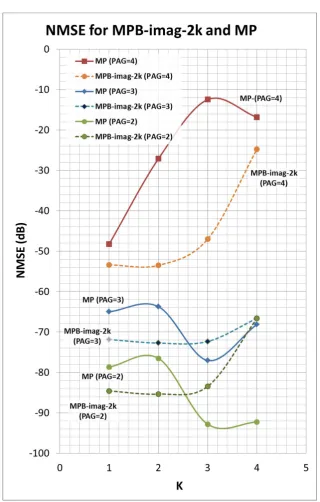
Table-4. NMSE for MPB-imag-2k and MP when PAG is 2.
K MPB-imag-2k MP NMSE difference between
MPB-imag-2k and MP
1 -84.58229 -78.66833 5.91396
2 -85.36833 -76.51994 8.84839
3 -83.45954 -92.81956 -9.36002
4 -66.65129 -92.26313 -25.61184
Table-5. NMSE for MPB-imag-2k and MP when PAG is 3.
K MPB-imag-2k MP NMSE difference between
MPB-imag-2k and MP
1 -71.86156 -64.97981 6.88175
2 -72.7396 -63.71627 9.02333
3 -72.34312 -77.03894 -4.69582
4 -66.60309 -68.11177 -1.50868
Table-6. NMSE for MPB-imag-2k and MPwhen PAG is 4.
K MPB-imag-2k MP NMSE difference between
MPB-imag-2k and MP
1 -53.36592 -48.2505 5.11542
2 -53.50133 -27.1319 26.36943
3 -46.99565 -12.4829 34.51275
Figure-4. NMSE for MP and MPB.
CONCLUSIONS
The Memory Polynomial with Binomial Reduction (MPB-imag-2k) Model is an improved Memory Polynomial (MP) Model, by using the Binomial Reduction Method at the MP Basis Function, with improvements in Normalized Means Square Error (NMSE) performance. Table VII shows the respective values of NMSE for non-linearity orders, k ranging from 1 to 4, with memory depth set to 3, and Pre-amplifier Gain (PAG) of 2 to 4. MPB-imag-2k shows positive improvement in NMSE performance with values up to 34.51dB when operating in
Table-7. NMSE Performance of MPB-imag-2k against MP.
K NMSE Improvement (dB)
(PAG = 2) (PAG = 3) (PAG = 4)
1 5.91396 6.88175 5.11542
2 8.84839 9.02333 26.36943
3 -9.36002 -4.69582 34.51275
REFERENCES
[1] Chen W. H., Zhang S. L., Liu Y. J., Ghannouchi F.M., Feng Z. H. and Liu Y. A. 2014. Efficient Pruning Technique of Memory Polynomial Models Suitable for PA Behavioral Modeling and Digital Predistortion. Microwave Theory and Techniques, IEEE Transactions on, on 62(10): 2290-2299.
[2] Choo H. N. 2012. DSP implementation of digital pre-distortion in wireless systems. Degree thesis, Dept. of Comp. and Comm. Systems Eng., Univ. Putra M’sia, Selangor, Malaysia.
[3] Choo H. N., Varahram P. and Ali B. M. 2017. DSP implementation of Digital Pre-distortion in wireless communication systems. Communications (MICC), 2013 IEEE Malaysia International Conference on. pp. 207-212.
[4] Choo H.N., Latiff N. A. A., Varahram P., Ali B. 2017. Memory polynomial with binomial reduction in digital pre-distortion for wireless communication systems. Pertanika J. Sci. & Technol. 25(S): 49-58.
[5] Choo H.N., Latiff N. A. A., Varahram P., Ali B. 2016. Error reduction of memory polynomial with binomial reduction in digital pre-distortion for wireless communication systems. ICT Convergence (ICTC’16), 2016 the 7thInternational Conference on, Jeju Island, Korea.
[6] Choo H.N. 2017. Enhanced memory polynomial with reduced complexity in digital pre-distortion for wireless power amplifier. M.S. thesis. Dept. of Comp. & Comm. Sys. Eng., Faculty of Eng., Univ. Putra Malaysia., Serdang, Selangor.
[7] Choo H.N., Latiff N. A. A., Varahram P., Ali B. 2018. Operations optimization of memory polynomial with binomial reduction in digital pre-distortion for wireless communication systems. IEEE Symposium on Computer Applications & Industrial Electronics (ISCAIE 2018).
[8] Ding L., Zhou G. T., Morgan D. R., M, Z. X., Kenney J. S., Kim J. and Giardina C. R. 2004. A robust digital baseband predistorter constructed using memory polynomials. IEEE Transactions on Communications. 52: 159-165.
[9] Ding L. 2004. Digital predistortion of power amplifiers for wireless applications. PhDdiss., Georgia Institute of Technology.
[10]Dasilva M. and Stanton S. 2007. Boost Power Amplifier Efficiency with Digital Predistortion. Micro Waves & RF website, Penton Media, Inc., http://mwrf.com/Articles/Index.cfm?Ad=1&ArticleID =16344.
[11]Dawson, J. L. 2001. Power Amplifier Linearization Techniques: An Overview. Workshop on RF Circuits for 2.5G and 3G Wireless Systems, http://smirc.stanford.edu/papers/isscc01s-joel.pdf.
[12]Hou J., Ge J., Li J. 2011. Peak-to-Average Power Ratio Reduction of OFDM Signals Using PTS Scheme with Low Computational Complexity. IEEE Transactions on Broadcasting. 57(1): 143, ISSN: 00189316.
[13]Kenington P.B. 2000. High Linearity RF Amplifier Design Artech House Inc.
[14]Pinal P. L. G. 2007. Multi Look-Up Table Digital Predistortion for RF Power Amplifier Linearization. Department of Signal Theory and Communications, Universitat Politecnica de Catalunya, Barcelona.
[15]Stapleton S. P. 2001. Digital Predistortion of Power Amplifiers. Presentation on Digital Predistortion of Power Amplifiers, Agilent EEs of EDA, http://cp.literature.agilent.com/litweb/pdf/5989-9105EN.pdf.
[16]Techsource-asia. 2012. Digital predistortion: Seeing clearly in the house of mirrors. Press Room, News, http://techsource-asia.com/news/press-room/detail/25- digital-predistortion--seeing-clearly-in-the-house-of-mirrors.html.
[17]Varahram P., Mohammady S., Hamidon M.N., Sidek R.M., Khatun S. 2009. Complex Gain Predistortion in WCDMA Power Amplifiers with Memory Effects. Accepted for publication in the International Arab Journal of Information Technology (IAJIT), Jordan.
[18]Varahram P., Mohammady S., Hamidon M. N., Sidek R. M., Khatun S. 2009. Digital Predistortion Technique for Compensating Memory Effects of Power Amplifiers in Wideband Applications. Journal of Electrical Engineering. 60(3).
[20]Vella-Coleiro G. 2012. Improving the Efficiency of RF Power Amplifiers with Digital Predistortion. Technical Articles, Newsletters, Mathworks, http://www.mathworks.com/tagteam/71045_91990v0
0_improving-the-efficiency-of-rf-power-amplifiers.pdf.
[21]Voelker K. 1992. Apply error vector measurements in communications design. Microwave & RF. pp. 143-152.
[22]Wood J. (PhD). 2012. What’s New in Digital Pre-Distortion? IEEE Comsoc SCV, http://ewh.ieee.org/r6/scv/comsoc/Wood_Feb2012.pd f.
[23]Xilinx, Xilinx Digital Pre-Distortion (DPD) Reference Design, Digital Pre-Distortion, 2009.
[24]Xie D., Zeng Z. 2012. An Improved Adaptive Algorithm for Digital Predistortion. ICCSEE. 3: 340-343, 2012 International Conference on Computer Science and Electronics Engineering.