0095-1137/08/$08.00⫹0 doi:10.1128/JCM.00861-08
Copyright © 2008, American Society for Microbiology. All Rights Reserved.
Novel Multiple-Locus Variable-Number Tandem-Repeat Analysis
Method for Rapid Molecular Typing of Human
Staphylococcus aureus
䌤
Risma Ikawaty, Rob J. L. Willems, Adrienne T. A. Box, Jan Verhoef, and Ad C. Fluit*
Department of Medical Microbiology, University Medical Centre Utrecht, Utrecht, The Netherlands
Received 5 May 2008/Returned for modification 18 June 2008/Accepted 14 July 2008
We evaluated the use of a novel multiple-locus variable-number tandem-repeat analysis (MLVA) method for typing of humanStaphylococcus aureus. For a total of 150 clinical isolates, MLVA demonstrated the highest discriminatory power. MLVA correctly assigned isolates to outbreaks or identified isolates as unlinked. MLVA is a rapid and simple method for the epidemiological typing ofS. aureus.
Pulsed-field gel electrophoresis (PFGE) is considered the
gold standard method for the typing ofStaphylococcus aureus
isolates (1). Other commonly used typing schemes include
multilocus sequence typing (MLST) andspatyping (www.mlst
.net and www.spaserver.ridom.de) (2, 7). Recently, a method based on the unique lengths of the intergenic regions contain-ing repetitive DNA loci (5, 8, 9, 12, 13), known as multiple-locus variable-number tandem-repeat analysis (MLVA), was introduced and described. Using this method, Hardy et al. described an MLVA scheme based on seven variable-number
tandem repeats in S. aureus, termed staphylococcal
inter-spersed repeat units (SIRUs) (5, 6). All of these methods have a number of drawbacks; most importantly, they are either fingerprinting methods, which are difficult to compare, or li-brary typing methods lacking discriminatory power (3, 9, 10, 12, 13). We therefore developed a character-based MLVA
scheme for humanS. aureusthat is based on the number of
repeats of each locus, i.e., the allelic profile, which can then be
used in combination withspatyping. A similar approach has
already been reported for bovineS. aureus(4).
Our scheme was first tested using 100 European clinical
human S. aureus isolates: 25 methicillin-susceptible and 75
methicillin-resistant isolates obtained between 1997 and 2004 were selected from the ENARE collection at the University Medical Centre Utrecht (UMCU), The Netherlands. These 100 specimens represented 35 MLST types and were well
dis-tributed throughout theS. aureuspopulation (data not shown).
MLVA typing was performed by using SIRU01, -05, -07, -13,
-15, -16, and -21 (representing thespagene) andsspA(5, 10).
Each amplification was performed separately. The PCR
prod-ucts of SIRU01, -05, -07, -13, -15, -16, andsspAwere analyzed
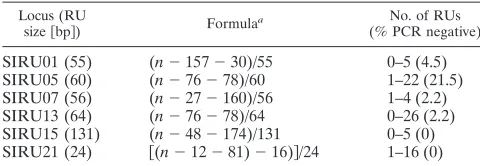
on 2% agarose gel, while the SIRU21 PCR product was run on a 3% agarose gel. The number of repeat units (RUs) in each locus was determined by subtracting the sizes of the flanking regions from the size of the amplicon and then dividing the
difference by the size of the repeat (Table 1). The result was then rounded to the nearest integer value.
The MLVA showed the numbers of RUs to range from 0 to
26 (Table 1). SIRU16 and sspA were excluded from further
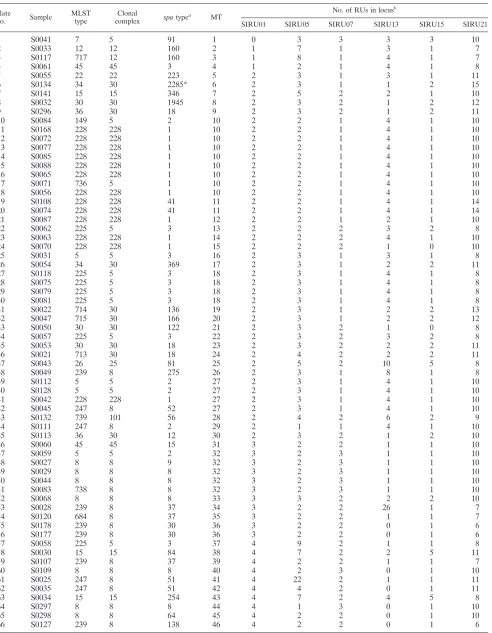
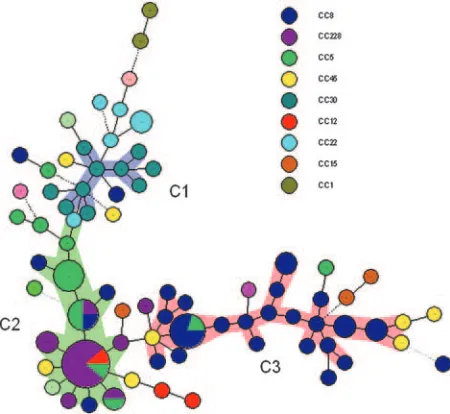
study due to a lack of variation in RUs. Seventy-three isolates yielded complete MLVA profiles, and 27 isolates yielded par-tial profiles. The unamplified loci of the latter isolates were assigned the number 999. Combinations of RUs from SIRU01, -05, -07, -13, -15, and -21 yielded number strings that were considered to be the allelic profiles. An MLVA type (MT) was assigned to each of these profiles. The 76 MTs observed (Table 2) were clustered into three dominant MT genogroups, C1, C2, and C3 (Fig. 1). Most of the isolates belonged to clonal com-plexes 1, 5, 8, 12, 15, 22, 30, and 228 and were generally linked to genogroups. Isolates in clonal complex 45 were an excep-tion. This difference may be explained either by unexpected evolutionary pressure or by the horizontal transfer of genetic material containing one or more SIRUs among the clonal complex 45 isolates.
spatyping was performed as described by Harmsen et al. (7)
and yielded 50 sequence variations, orspatypes, including 2
newspatypes, 2285 and 2176. The numbers of repeats found in
SIRU21 byspatyping and MLVA agreed completely.
The discriminatory power of MLVA, MLST, andspatyping
showed that MLVA had a higher discriminatory power than
both MLST andspatyping (for MLVA, 0.987 [95% confidence
interval {CI}, 0.977 to 0.997]; for MLST, 0.941 [95% CI, 0.922
to 0.960]; and forspatyping, 0.963 [95% CI, 0.946 to 0.979]),
* Corresponding author. Mailing address: Department of Medical Microbiology, University Medical Centre Utrecht, Room G04.614, P.O. Box 85500, Utrecht 3584 CX, The Netherlands. Phone: 31887557630. Fax: 31302541770. E-mail: [email protected].
[image:1.585.300.540.615.698.2]䌤Published ahead of print on 23 July 2008.
TABLE 1. Characteristics of the MLVA scheme
Locus (RU
size关bp兴) Formula
a No. of RUs
(% PCR negative)
SIRU01 (55) (n⫺157⫺30)/55 0–5 (4.5) SIRU05 (60) (n⫺76⫺78)/60 1–22 (21.5) SIRU07 (56) (n⫺27⫺160)/56 1–4 (2.2) SIRU13 (64) (n⫺76⫺78)/64 0–26 (2.2) SIRU15 (131) (n⫺48⫺174)/131 0–5 (0) SIRU21 (24) 关(n⫺12⫺81)⫺16)兴/24 1–16 (0)
a
The formula for calculating the number of RUs per locus is as follows: (amplicon size关n兴 ⫺size of left flanking region⫺size of right flanking region)/ size of RU.
3147
on May 16, 2020 by guest
http://jcm.asm.org/
TABLE 2. MLVA allelic profiles, MTs, andspatypes obtained from 100S. aureusisolates with known MLST types
Isolate
no. Sample
MLST type
Clonal
complex spatype
a
MT
No. of RUs in locusb
SIRU01 SIRU05 SIRU07 SIRU13 SIRU15 SIRU21
1 S0041 7 5 91 1 0 3 3 3 3 10
2 S0033 12 12 160 2 1 7 1 3 1 7
3 S0117 717 12 160 3 1 8 1 4 1 7
4 S0061 45 45 3 4 1 2 1 4 1 8
5 S0055 22 22 223 5 2 3 1 3 1 11
6 S0134 34 30 2285* 6 2 3 1 1 2 15
7 S0141 15 15 346 7 2 5 2 2 1 10
8 S0032 30 30 1945 8 2 3 2 1 2 12
9 S0296 36 30 18 9 2 3 2 1 2 11
10 S0084 149 5 2 10 2 2 1 4 1 10
11 S0168 228 228 1 10 2 2 1 4 1 10
12 S0072 228 228 1 10 2 2 1 4 1 10
13 S0077 228 228 1 10 2 2 1 4 1 10
14 S0085 228 228 1 10 2 2 1 4 1 10
15 S0088 228 228 1 10 2 2 1 4 1 10
16 S0065 228 228 1 10 2 2 1 4 1 10
17 S0071 736 5 1 10 2 2 1 4 1 10
18 S0056 228 228 1 10 2 2 1 4 1 10
19 S0108 228 228 41 11 2 2 1 4 1 14
20 S0074 228 228 41 11 2 2 1 4 1 14
21 S0087 228 228 1 12 2 2 1 2 1 10
22 S0062 225 5 3 13 2 2 2 3 2 8
23 S0063 228 228 1 14 2 2 2 4 1 10
24 S0070 228 228 1 15 2 2 2 1 0 10
25 S0031 5 5 3 16 2 3 1 3 1 8
26 S0054 34 30 369 17 2 3 1 2 2 11
27 S0118 225 5 3 18 2 3 1 4 1 8
28 S0075 225 5 3 18 2 3 1 4 1 8
29 S0079 225 5 3 18 2 3 1 4 1 8
30 S0081 225 5 3 18 2 3 1 4 1 8
31 S0022 714 30 136 19 2 3 1 2 2 13
32 S0047 715 30 166 20 2 3 1 2 2 12
33 S0050 30 30 122 21 2 3 2 1 0 8
34 S0057 225 5 3 22 2 3 2 3 2 8
35 S0053 30 30 18 23 2 3 2 2 2 11
36 S0021 713 30 18 24 2 4 2 2 2 11
37 S0043 26 25 81 25 2 5 2 10 5 8
38 S0049 239 8 275 26 2 3 1 8 1 8
39 S0112 5 5 2 27 2 3 1 4 1 10
40 S0128 5 5 2 27 2 3 1 4 1 10
41 S0042 228 228 1 27 2 3 1 4 1 10
42 S0045 247 8 52 27 2 3 1 4 1 10
43 S0132 739 101 56 28 2 4 2 6 2 9
44 S0111 247 8 2 29 2 1 1 4 1 10
45 S0113 36 30 12 30 2 3 2 1 2 10
46 S0060 45 45 15 31 3 2 2 1 1 10
47 S0059 5 5 2 32 3 2 3 1 1 10
48 S0027 8 8 9 32 3 2 3 1 1 10
49 S0029 8 8 8 32 3 2 3 1 1 10
50 S0044 8 8 8 32 3 2 3 1 1 10
51 S0083 738 8 8 32 3 2 3 1 1 10
52 S0068 8 8 8 33 3 3 2 2 2 10
53 S0028 239 8 37 34 3 2 2 26 1 7
54 S0120 684 8 37 35 3 2 2 1 1 7
55 S0178 239 8 30 36 3 2 2 0 1 6
56 S0177 239 8 30 36 3 2 2 0 1 6
57 S0058 225 5 3 37 4 9 2 1 1 8
58 S0030 15 15 84 38 4 7 2 2 5 11
59 S0107 239 8 37 39 4 2 2 1 1 7
60 S0109 8 8 8 40 4 2 3 0 1 10
61 S0025 247 8 51 41 4 22 2 1 1 11
62 S0035 247 8 51 42 4 4 2 0 1 11
63 S0034 15 15 254 43 4 7 2 4 5 8
64 S0297 8 8 8 44 4 1 3 0 1 10
65 S0298 8 8 64 45 4 2 2 0 1 10
66 S0127 239 8 138 46 4 2 2 0 1 6
Continued on following page
on May 16, 2020 by guest
http://jcm.asm.org/
even though the 95% CI for MLVA overlapped somewhat with
that forspatyping. The adjusted Rand index for MLVA and
spa typing and that for MLVA and MLST were 0.341 and
0.184, respectively. The Wallace coefficients (Table 3) indi-cated that MLVA was reasonably predictive of both MLST and
spatype, whereas the reverse was not true.
A confirmation study was performed to validate our MLVA
scheme. This study compared the MTs with the PFGE andspa
types of 50S. aureusisolates from the Department of Infection
[image:3.585.45.539.79.424.2]Control and Infection Prevention of UMCU. PFGE was per-formed using SmaI as previously described by Tenover et al. (11). The isolates were considered to be either epidemiologi-cally related or devoid of any known epidemiological link,
[image:3.585.50.275.461.668.2]FIG. 1. Population structure ofS. aureusisolates based on MLVA. Each circle represents a different MLVA profile. Three clusters (C1, C2, and C3) were identified as shown by the three colors (blue, green, and pink). Heavy lines connecting two MTs denote a single-locus variant, thin lines denote MTs with a double-locus variant, and dotted lines connect MTs that differ by more than two loci.
TABLE 2—Continued
Isolate
no. Sample
MLST type
Clonal
complex spatype
a
MT
No. of RUs in locusb
SIRU01 SIRU05 SIRU07 SIRU13 SIRU15 SIRU21
67 S0121 685 8 64 47 4 2 3 1 1 10
68 S0129 247 8 75 48 4 4 2 1 1 12
69 S0069 239 8 30 49 5 2 2 1 1 6
70 S0066 735 45 305 50 5 3 2 4 2 11
71 S0051 239 8 421 51 2 3 1 4 1 6
72 S0052 45 45 693 52 2 2 1 4 1 1
73 S0039 101 101 56 53 2 2 1 4 1 9
74 S0067 254 8 9 74 999 2 2 1 1 10
75 S0037 9 Singletonc 2176* 77 4 2 999 0 1 4
76 S0300 5 5 88 80 3 10 1 999 2 11
77 S0299 72 8 126 83 3 10 999 999 2 8
78 S0295 5 5 2 85 2 999 1 4 1 10
79 S0046 228 228 1 85 2 999 1 4 1 10
80 S0076 22 22 32 87 2 999 2 4 0 16
81 S0078 22 22 32 87 2 999 2 4 0 16
82 S0089 22 22 476 89 2 999 2 2 0 11
83 S0116 97 97 527 91 2 999 3 3 1 12
84 S0024 22 22 192 93 2 999 2 7 3 13
85 S0036 45 45 1081 95 999 999 1 2 2 7
86 S0086 45 45 4 97 999 999 2 0 1 9
87 S0130 45 45 26 99 999 999 2 1 0 3
88 S0023 45 45 1933 101 999 999 2 1 1 7
89 S0166 239 8 37 103 999 999 2 0 1 7
90 S0176 239 8 37 103 999 999 2 0 1 7
91 S0167 239 8 37 105 4 999 2 0 1 7
92 S0175 239 8 37 105 4 999 2 0 1 7
93 S0026 247 8 844 107 4 999 2 0 1 8
94 S0169 247 8 51 109 4 999 2 0 1 11
95 S0110 247 8 52 111 4 999 2 0 1 10
96 S0126 572 8 51 113 4 999 2 1 1 11
97 S0119 1 1 922 115 1 999 3 1 2 6
98 S0040 188 1 189 117 1 999 3 3 5 6
99 S0115 239 8 359 119 5 999 4 3 2 9
100 S0082 737 22 5 122 2 999 2 3 0 12
a
Asterisks indicate two novelspatypes observed in this study.
b
999, no SIRU PCR amplification.
c
This MLST type did not group into any of the clonal complexes.
TABLE 3. Wallace coefficients for the methods used to characterize the 100 humanS. aureusisolates
Typing method
Wallace coefficient for:
MLST spatyping MLVA
MLST 0.433 0.123
spatyping 0.690 0.239
MLVA 0.554 0.677
on May 16, 2020 by guest
http://jcm.asm.org/
[image:3.585.301.542.662.726.2]based on either their phage or their PFGE types (depending on the method used by the National Institute of Public Health and the Environment, The Netherlands, at the time of the initial isolation) and on their times of isolation. Two PCR fragments detected for SIRU13 in two isolates were assigned the value 888.
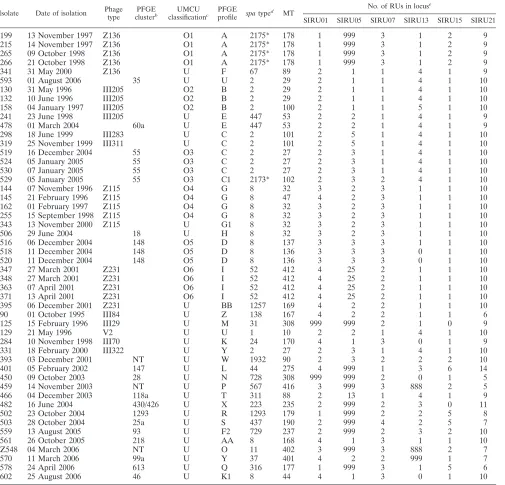
Totals of 31 MTs, 24spatypes, and 30 PFGE profiles were
obtained (Table 4). The Simpson indices for MLVA,spa
typ-ing, and PFGE were 0.971, 0.908, and 0.970, respectively. The
concordance between MLVA andspatyping was 93.5%, and
that between MLVA and PFGE was 97.7%. The adjusted
Rand indices for MLVA compared with PFGE andspatyping
were 0.599 and 0.435, respectively. The Wallace coefficients
showed that MLVA andspatyping were mutually predictive
(data not shown).
MLVA typing distinguished 10 MTs from 22 isolates
belong-TABLE 4. MTs,spatypes, and PFGE profiles ofS. aureusisolatesa
Isolate Date of isolation Phage type
PFGE
clusterb UMCU
classificationc PFGE
profile spatype
d
MT
No. of RUs in locuse
SIRU01 SIRU05 SIRU07 SIRU13 SIRU15 SIRU21
199 13 November 1997 Z136 O1 A 2175* 178 1 999 3 1 2 9
215 14 November 1997 Z136 O1 A 2175* 178 1 999 3 1 2 9
265 09 October 1998 Z136 O1 A 2175* 178 1 999 3 1 2 9
266 21 October 1998 Z136 O1 A 2175* 178 1 999 3 1 2 9
341 31 May 2000 Z136 U F 67 89 2 1 1 4 1 9
593 01 August 2006 35 U U 2 29 2 1 1 4 1 10
130 31 May 1996 III205 O2 B 2 29 2 1 1 4 1 10
132 10 June 1996 III205 O2 B 2 29 2 1 1 4 1 10
158 04 January 1997 III205 O2 B 2 100 2 1 1 5 1 10
241 23 June 1998 III205 U E 447 53 2 2 1 4 1 9
478 01 March 2004 60a U E 447 53 2 2 1 4 1 9
298 18 June 1999 III283 U C 2 101 2 5 1 4 1 10
319 25 November 1999 III311 U C 2 101 2 5 1 4 1 10
519 16 December 2004 55 O3 C 2 27 2 3 1 4 1 10
524 05 January 2005 55 O3 C 2 27 2 3 1 4 1 10
530 07 January 2005 55 O3 C 2 27 2 3 1 4 1 10
529 05 January 2005 55 O3 C1 2173* 102 2 3 2 4 1 10
144 07 November 1996 Z115 O4 G 8 32 3 2 3 1 1 10
145 21 February 1996 Z115 O4 G 8 47 4 2 3 1 1 10
162 01 February 1997 Z115 O4 G 8 32 3 2 3 1 1 10
255 15 September 1998 Z115 O4 G 8 32 3 2 3 1 1 10
343 13 November 2000 Z115 U G1 8 32 3 2 3 1 1 10
506 29 June 2004 18 U H 8 32 3 2 3 1 1 10
516 06 December 2004 148 O5 D 8 137 3 3 3 1 1 10
518 11 December 2004 148 O5 D 8 136 3 3 3 0 1 10
520 11 December 2004 148 O5 D 8 136 3 3 3 0 1 10
347 27 March 2001 Z231 O6 I 52 412 4 25 2 1 1 10
348 27 March 2001 Z231 O6 I 52 412 4 25 2 1 1 10
363 07 April 2001 Z231 O6 I 52 412 4 25 2 1 1 10
371 13 April 2001 Z231 O6 I 52 412 4 25 2 1 1 10
395 06 December 2001 Z231 U BB 1257 169 4 2 2 1 1 10
90 01 October 1995 III84 U Z 138 167 4 2 2 1 1 6
125 15 February 1996 III29 U M 31 308 999 999 2 1 0 9
129 21 May 1996 V2 U U 1 10 2 2 1 4 1 10
284 10 November 1998 III70 U K 24 170 4 1 3 0 1 9
331 18 February 2000 III322 U Y 2 27 2 3 1 4 1 10
393 03 December 2001 NT U W 1932 90 2 3 2 2 2 10
401 05 February 2002 147 U L 44 275 4 999 1 3 6 14
450 09 October 2003 28 U N 728 308 999 999 2 0 1 5
459 14 November 2003 NT U P 567 416 3 999 3 888 2 5
466 04 December 2003 118a U T 311 88 2 13 1 4 1 9
482 16 June 2004 430/426 U X 223 235 2 999 2 3 0 11
502 23 October 2004 1293 U R 1293 179 1 999 2 2 5 8
503 28 October 2004 25a U S 437 190 2 999 4 2 5 7
559 13 August 2005 93 U F2 729 237 2 999 2 3 2 10
561 26 October 2005 218 U AA 8 168 4 1 3 1 1 10
Z548 04 March 2006 NT U O 11 402 3 999 3 888 2 7
570 11 March 2006 99a U Y 37 401 4 2 2 999 1 7
578 24 April 2006 613 U Q 316 177 1 999 3 1 5 6
602 25 August 2006 46 U K1 8 44 4 1 3 0 1 10
a
These classifications are compared to those previously given by the Department of Infection Control and Infection Prevention, UMCU, The Netherlands, on the basis of phage type or PFGE clustering.
b
NT, not typeable.
c
O1 to O6, outbreaks 1 to 6, respectively; U, unlinked epidemiological isolate.
d
Asterisks indicate two newspatypes observed in this study.
e
999, no SIRU amplification found; 888, double fragments on SIRU PCR detected.
on May 16, 2020 by guest
http://jcm.asm.org/
[image:4.585.45.550.82.567.2]ing to six outbreaks and 24 MTs from 28 unlinked isolates
(Table 4). MLVA, spa type, and PFGE profile completely
agreed for two of the outbreaks (O1 and O6). Four other outbreaks (O2, O3, O4, and O5) were correctly assigned when single-locus differences in MLVA, long periods between iso-late collection (isoiso-lates 506, 593, 298, and 319 and isoiso-lates from O4 and O5), and a foreign origin (isolate 395) were taken into account. The 28 unrelated isolates all exhibited unique MTs.
MLVA was able to distinguish between the different out-breaks when single-locus variants were considered to belong to the same outbreak and when date of isolation was taken into consideration.
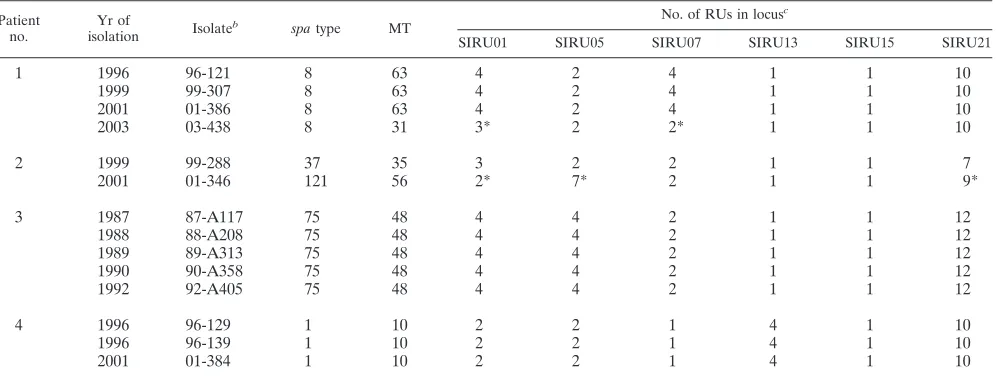
Data in Table 5 indicate that MLVA profiles are relatively
stable over time. Identical MTs andspatypes were detected in
the isolates from patients 3 and 4 during a 5-year period, while
variations in only two loci (SIRU01 and -07) (spa types
re-mained identical) were seen in isolates from patient 1 recov-ered 7 years after the first isolate was taken. Distinct
geno-types, MTs, and spa types were detected in isolates from
patient 2, which may be explained by a later infection with a
differentS. aureusstrain. Thus, the long-term stability of the
MLVA profiles is not a major concern for outbreak detection. In summary, our MLVA scheme showed good typeability and excellent discriminatory power for the major clonal
complexes and singletons ofS. aureus. Moreover, the
reli-ability of the method is very good: the number of RUs
determined by MLVA for SIRU21, representing the spa
gene, completely agreed with the number of repeats
ob-tained whenspatyping was performed on all isolates.
REFERENCES
1.Bannerman, T. L., G. A. Hancock, F. C. Tenover, and J. M. Miller.1995. Pulsed-field gel electrophoresis as a replacement for bacteriophage typing of
Staphylococcus aureus. J. Clin. Microbiol.33:551–555.
2.Enright, M. C., N. P. Day, C. E. Davies, S. J. Peacock, and B. G. Spratt.2000. Multilocus sequence typing for characterization of methicillin-resistant and
methicillin-susceptible clones ofStaphylococcus aureus. J. Clin. Microbiol. 38:1008–1015.
3.Francois, P., A. Huyghe, Y. Charbonnier, M. Bento, S. Herzig, I. Topolski, B. Fleury, D. Lew, P. Vaudaux, S. Harbarth, W. van Leeuwen, A. van Belkum, D. S. Blanc, D. Pittet, and J. Schrenzel.2005. Use of an automated multiple-locus, variable-number tandem repeat-based method for rapid and high-throughput genotyping ofStaphylococcus aureusisolates. J. Clin. Microbiol. 43:3346–3355.
4.Gilbert, F. B., A. Fromageau, L. Ge´lineau, and B. Poutrel.2006. Differen-tiation of bovine Staphylococcus aureus isolates by use of polymorphic tan-dem repeat typing. Vet. Microbiol.117:297–303.
5.Hardy, K. J., B. A. Oppenheim, S. Gossain, F. Gao, and P. M. Hawkey.2006. Use of variations in staphylococcal interspersed repeat units for molecular typing of methicillin-resistantStaphylococcus aureusstrains. J. Clin. Micro-biol.44:271–273.
6.Hardy, K. J., D. W. Ussery, B. A. Oppenheim, and P. M. Hawkey.2004. Distribution and characterization of staphylococcal interspersed repeat units (SIRUs) and potential use for strain differentiation. Microbiology150:4045– 4052.
7.Harmsen, D., H. Claus, W. Witte, J. Rothganger, H. Claus, D. Turnwald, and U. Vogel.2003. Typing of methicillin-resistantStaphylococcus aureusin a university hospital setting by using novel software for spa repeat determina-tion and database management. J. Clin. Microbiol.41:5442–5448. 8.Lindstedt, B. A.2005. Multiple-locus variable number tandem repeats
anal-ysis for genetic fingerprinting of pathogenic bacteria. Electrophoresis26: 2567–2582.
9.Malachowa, N., A. Sabat, M. Gniadkowski, J. Krzyston-Russjan, J. Empel, J. Miedzobrodzki, K. Kosowska-Shick, P. C. Appelbaum, and W. Hryniewicz.2005. Comparison of multiple-locus variable-number tandem-repeat assay analysis with pulsed-field gel electrophoresis,spatyping, and multilocus sequence typing for clonal characterization ofStaphylococcus aureusisolates. J. Clin. Microbiol.43:3095–3100.
10.Sabat, A., J. Krzyszton-Russjan, W. Strzalka, R. Filipek, K. Kosowska, W. Hryniewicz, J. Travis, and J. Potempa.2003. New method for typing Staph-ylococcus aureusstrains: multiple-locus variable-number tandem repeat anal-ysis of polymorphism and genetic relationships of clinical isolates. J. Clin. Microbiol.41:1801–1804.
11.Tenover, F. C., R. D. Arbeit, R. V. Goering, P. A. Mickelsen, B. E. Murray, D. H. Persing, and B. Swaminathan.1995. Interpreting chromosomal DNA restriction patterns produced by pulsed-field gel electrophoresis: criteria for bacterial strain typing. J. Clin. Microbiol.33:2233–2239.
12.Tenover, F. C., R. R. Vaughn, L. K. McDougal, G. E. Fosheim, and J. E. McGowan, Jr.2007. Multiple-locus variable-number tandem-repeat assay analysis of methicillin-resistantStaphylococcus aureusstrains. J. Clin. Micro-biol.45:2215–2219.
[image:5.585.45.544.81.269.2]13.van Belkum, A.2007. Tracing isolates of bacterial species by multilocus variable number of tandem repeat analysis (MLVA). FEMS Immunol. Med. Microbiol.49:22–27.
TABLE 5. Evolution ofS. aureuscarriership based on MTs for four patients over timea
Patient no.
Yr of
isolation Isolate
b
spatype MT
No. of RUs in locusc
SIRU01 SIRU05 SIRU07 SIRU13 SIRU15 SIRU21
1 1996 96-121 8 63 4 2 4 1 1 10
1999 99-307 8 63 4 2 4 1 1 10
2001 01-386 8 63 4 2 4 1 1 10
2003 03-438 8 31 3* 2 2* 1 1 10
2 1999 99-288 37 35 3 2 2 1 1 7
2001 01-346 121 56 2* 7* 2 1 1 9*
3 1987 87-A117 75 48 4 4 2 1 1 12
1988 88-A208 75 48 4 4 2 1 1 12
1989 89-A313 75 48 4 4 2 1 1 12
1990 90-A358 75 48 4 4 2 1 1 12
1992 92-A405 75 48 4 4 2 1 1 12
4 1996 96-129 1 10 2 2 1 4 1 10
1996 96-139 1 10 2 2 1 4 1 10
2001 01-384 1 10 2 2 1 4 1 10
aAn isolate collected in 2003 from patient 2 showed two locus variations (SIRU01 and -07) compared to the isolates collected during the previous year, even though
identicalspatypes were observed. Two isolates taken from patient 3 revealed three locus variations (SIRU01, -05, and -21) indicating that these two isolates were unrelated. The differentspatypes strengthen this finding.
bThe isolates are numbered according to year of isolation and strain number, e.g., 96-121 means the isolate collected in 1996 with strain number 121.
cAsterisks indicate locus variation.