A Review on Clustering Protocol in Wireless Sensor
Network
Altaf Hussain Mir1, Rajesh Kumar2
Department of ECE, IGCE Abhipur Mohali Punjab, INDIA
Abstract: The research conducted in Wireless Sensor Networks (WSN) in last few years witnessed the popularity of this domain among the researchers. There are various issues in WSN such as energy consumption, route optimization, lifetime enhancements, etc. that are required to resolve. The clustering approach is developed to resolve the issue of energy consumption in network. But the cluster selection is most tedious task to perform. Thus, various cluster head selection strategies have been developed by different authors. This study provides an analysis over the sensor networks and various strategies that can be used for creating an energy efficient network by modifying the cluster head selection criteria.
Keywords: Wireless Sensor Network, Cluster Head Selection, LEACH, TEEN.
I. INTRODUCTION
In past ten years, Wireless Sensor Networks (WSN) have gained huge popularity due to its numerous applications which can be found in diverse fields that ranges from civilian to defense sectors. The most crucial stage in developing WSNs is the designing process on the basis of it appropriate clustering routing algorithms are applied in order to meet the requirements. Researchers have made great efforts in developing and employing some of the most efficient techniques that operates over suitable clustering routing protocols for WSNs so that a higher levels of performance can be obtain [1].
Clustering routing protocols are relatively more preferable than conventional flat routing protocols due to the fact that these routing protocols offer more scalability with lower levels of load. Besides being highly robust, these protocols help in achieving reduced energy consumption levels. Clustering routing protocols are relatively more preferable than conventional flat routing protocols due to the fact that these routing protocols offer more scalability with lower levels of load [2]. Besides being highly robust, these protocols help in achieving reduced energy consumption levels. Some of the advantages which also serve as objective of WSN are elaborated in the section given below:
1) Higher Scalability: WSN contains number of clusters with associated assignment levels that are formed by the grouping up of sensor nodes. The data is collected from cluster nodes and transmitted to base station by elected nodes called as cluster heads which is capable of managing the entire network. Size of routing table that is stored at each sensor node is minimized by applying appropriate clustering topology [3,4].
2) Data Aggregation/Fusion: Cluster heads accomplishes the process of collecting data from all the sensor nodes that belong to their cluster followed by transmitting the fused data to base station [5]. This helps in checking the redundant transmissions so as to reduce energy consumption which can be achieved by the application of appropriate aggregation or fusion methods. 3) Reduced Load: Elimination of redundant data before transmission is done by gathering data from all the sensors at cluster
heads. Therefore, multiple storing of duplicate data by nodes are removed which lessens the load of entire network with multi-dimensional view of targets under monitoring.
4) Minimized Energy Consumption: Minimized Energy consumption levels can be achieved through clustering routing algorithms which involves least number of sensor nodes for data communication. This leads to lower energy consumption.
5) Greater Robustness: Clustering routing algorithms are capable of providing a network with better control, higher extensibility and easier fault detection within a cluster which improves the performance of the entire network.
6) Collision Avoidance: Sensor nodes in multi-hop flat model shares the bandwidth which is poor utilization of network resources whereas data is gathered using sensor nodes by inter-communication and transmission involves intra-communication. Therefore, allocation of resources is done orthogonally to avoid cluster collision [6].
8) Load Balancing: The life span of a network is influenced by its ability to balance its load. Therefore the entire network is partitioned into numerous clusters in which each cluster head controls its cluster and its processing. In order to increase lifetime of network equal-sized clusters are preferred to balance load.
9) Fault-Tolerance: When used in dynamic applications, sensor nodes are exposed to hardware malfunctioning, malicious attacking, energy depletion. Fault tolerance is a major concern as application like hurricane modeling needs number of sensors leading to high network costs. Therefore, sensor nodes must be capable of working in all environments [7].
10) Maximizing of the Network Lifetime: The availability of battery and bandwidth for transmission influences the processing ability of cluster nodes. In case of nodes located at least distances from other nodes must be elected as cluster heads to reduce communication cost and energy consumption. Besides this, only the optimized route for data transmissions must be employed that ultimately extends the life span of network.
II. CLUSTERING PROTOCOLS
This section provides a brief explanation to the cluster head selection techniques or protocols with respect to the used cluster head selection criteria.
A. LEACH
Low Energy Adaptive Clustering Hierarchy (LEACH) involves the distribution of sensor nodes across the network in such a manner that balances the load of entire network [8]. This clustering protocol constructs clusters that comprises of sensor nodes. Each cluster has an elected sensor node that is considered as cluster head. In case of inefficient selection of cluster head, the selected node would soon die off in no time due to its incapability to handle such load. This will ultimately cause wastage of those potential sensor nodes which belongs to that cluster. This problem is occurs in conventional protocols which is solved by an adaptive and self-organized LEACH protocol. It causes the depletion of battery of a single sensor by making a highly energized cluster to rotate among other clusters. Data is compressed through data fusion process before being transmitted from a cluster to base station which leads to reduced energy consumption levels which extended network life span. The selection of cluster heads among all cluster nodes is performed by nodes themselves and the one with higher possibility is chosen at any time [9]. On being selected, the cluster head nodes notify all other nodes via their status. Each sensor node tends to choose its own cluster which costs least energy consumption for communication to them. Each sensor node is assigned with an associated schedule according to which the radio-components of sensor nodes are enabled during transmission time only leading to minimum energy consumption. Cluster heads are responsible for gathering data from all the nodes that falls under its native cluster followed by compressing it for further sending to base station. The grouping of sensors nodes into clusters is determined by the strength of signals being received and distance of native cluster head from the base station. LEACH has following characteristics that are mentioned below:
1) Cluster formation is achieved through localized coordination and operation among cluster nodes. 2) Cluster heads or base stations and their associated clusters are rotated randomly.
3) Data compression is done before transmitting further in order to reduce communication processes.
Each operation in LEACH is of predefined fixed duration rounds which initiates in set up phase and leads to steady state phase. Some of the limitations of LEACH are mentioned below:
1) Due to the latency offered by LEACH it cannot be used for Real time applications.
2) The Hot spot problem may lead to excess drainage of battery by the nodes present on route that acts as hot spot to the sink. 3) With each round number of clusters formed may vary.
4) Sensor networks for large coverage areas cannot use LEACH.
Fixed homogeneous nodes that are stable in Automatic wireless sensor networks can provide increased efficiency when used with LEACH [10]. Autonomic Sensor Networks with mobile battery that operate using LEACH are highly efficient as it provides minimized control messages and allows optimized allocation of resources with proper power controlling capacity. In LEACH, every sensor node is exposed to equal opportunities to select themselves as CHs which is based on the probabilistic model. Being hierarchical in nature, this protocol works in two consecutive phases. The first phase involves the division of sensor nodes for the purpose of cluster formation which is later followed by the steady state phase that includes transmission of actual compressed data.
B. TL-LEACH
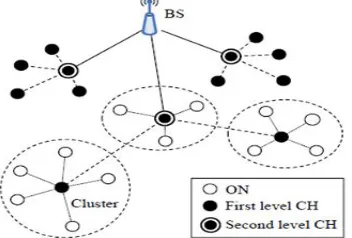
level and other are considered as ONs. Advertisement phase in this protocol is similar to LEACH that involves the classification of cluster head nodes as primary, secondary CH or ON which is entirely based on decision of each CH. Primary CH notifies other nodes with their status. The advertisement phase uses Carrier Sense Multiple Access (CSMA) is followed by three other phases in sequence that are cluster setup phase, schedule creation and data transmission.
Figure 5 showing the two-level hierarchy in TL-LEACH and ONs are notified through advertisements by secondary CH. Later in the phase secondary CH chooses the primary CH to which it belongs and advertises that particular CH. Similarly, secondary CH are chosen by ON which are notified via opposite message.
In each group, every sensor node is assigned a TDMA schedule by their respective primary CH in the third phase to transmit. Every node which is present at secondary level is notified to use the chosen CDMA code in its group. In similar manner, ONs present at lower level are intimated by secondary CH which uses the code along with assigned schedule for transferring the same information. Data transmission phase accomplishes the process of cluster formation which is followed by sending the required data according to the TDMA schedule created by assigned primary CH that are present at top level. Some of the advantages of TL-LEACH are mentioned below:
1) In order to achieve efficient load distribution throughout the entire network primary and secondary CHs are rotated randomly. 2) Coordination among local nodes i.e. nodes belonging to same cluster provides higher scalability levels and more robust
network.
[image:4.612.219.387.320.440.2]3) The mean transmission distance is reduced considerably by the two-levels clustering in TL-LEACH as compared to LEACH. 4) Reduced levels of energy are consumed as minimum number of nodes is involved in sending the data to base station.
Figure 1: The Two-level Hierarchy in TL-LEACH [9]
C. PEGASIS
Power-Efficient Gathering in Sensor Information Systems (PEGASIS) is based on two most important parameters that are as follows:
1) Chaining, 2) Data fusion
This chain-based algorithm is similar to LEACH which is relatively more power efficient [11]. Greedy algorithm is employed by sensor nodes to carry out the process of chain formation in which each node behaves as the chain leader. Assumptions that are considered in PEGASIS are given below:
1) Entire network’s information is accessible by the sensor nodes. 2) Every node in the network is fixed.
3) All the nodes have information regarding the location of their neighboring nodes.
The process of data fusion is accomplished by the nodes before the chain gets terminated. PEGASIS has the following advantages over LEACH that are given below:
1) All the dynamic clusters are removed.
2) Difference between the leader nodes and non-leader nodes is reduced to minimum level, 3) Numbers of transmissions allowed are restricted up to certain limit,
Due to the unavailability of the entire information pertaining to every single node in network, PEGASIS algorithm is inapplicable in case of wireless sensor networks that involves huge number of sensor nodes which is the major limitation of this algorithm [12].
D. DEEC
Heterogeneous wireless sensor networks employ Distributed Energy Efficient Clustering (DEEC) protocol which is entirely based upon the probability ratio. This probability ratio is obtained by evaluating the ratio of residual energy on each node and the mean energy of the entire network. Cluster head nodes are elected according to their probability ratio. Initial and residual energy levels of sensor nodes decide the number of the rotation on each node. These rotations are converted into energy by this protocol [13]. The nodes that are eligible for becoming cluster heads are the ones that bear higher initial and remaining energies. DEEC is highly efficient protocol for multi-level heterogeneous networks as it involves the effective messages as compared to other clustering algorithms. Therefore it provides increased life span of the entire network.
E. TEEN
TEEN clustering protocol brings two types of thresholds in considerations by defining the soft threshold as certain threshold value for attribute that stores sensing value and hard threshold as absolute value. This absolute value which is considered as hard threshold is the limit of the value beyond which the sensor node on sensing notifies its respective cluster head and turns on it transmitter for sending data. Sensor nodes belonging to a particular cluster are provided with the soft and hard threshold values which helps them in communicating in restricted manner. This means that nodes are able to communicate only when the sensing value is in the desired range [14]. The figure representing the 2-tier topology in TEEN clustering protocol is given below:
Figure2 Illumination of the 2-tier Clustering Topology in TEEN [3]
Soft threshold eliminates the data communication processes that involves slight or no change at all in the sensed values. By varying certain parameters of efficient energy consumption with higher accuracy rate can be achieved as smaller soft threshold values are more likely to produce better results. Parameters can be varied with the changing soft threshold values that are required at every cluster change time. TEEN has the following advantages that are as follows:
1) Controlled transmissions are performed which are determined by the two threshold leading to efficient energy consumption with more accurate results.
[image:5.612.223.399.348.467.2]2) Applications involving critical analysis of the changes occurring in the sensed values use TEEN protocol like in reacting and time crucial scenes.
Table 1 Comparison of clustering routing protocol
Protocol Energy Efficiency
Cluster
Stability Scalability Complexity LEACH Very low Moderate Very low Low TL-LEACH Low Moderate Moderate Low
PEGASIS Low Low Very low High
DEEC Moderate High Moderate Moderate
TEEN Very
III. LITERATURE REVIEW
Xu-XunLiu (2012), [1]presented a fine grained and comprehensive proposed clustering routing protocols in WSN. In this different objectives and advantages of clustering were elaborated by the authors. Clustering attributes of WSN are described effectively that provided critical analysis of different clustering routing protocols along with their comparison based metrics by which they made the following conclusions:
JiaXu ( 2012), [2] Proposed a revised clustering scheme that was named as E-LEACH (Enhanced-LEACH). Whereas in original LEACH protocol the CH selection is done randomly and refreshment of the network is done after a fixed interval, in E-LEACH, the remaining battery power of the nodes was considered to balance the workload of the network and the re-clustering relies upon the size of the optimal clusters. The result section of the proposed work depicted that the proposed work enhanced the network lifetime by 40% in contrast to the LEACH protocols.
Prerna (2015), [2]Proposed a novel approach of routing based on static clustering and dynamic CH election technique. It divided the whole network into a fix number of sub sections. CH election was done on the basis of the three major parameters i.e. distance from node to BS, degree of the nodes and residual energy of the nodes. Simulations has been done in MATLAB and proved the proficiency of proposed work over LEACH, LEACH-C and DR technique with respect to the energy consumption and network connectivity.
A. Ihsan, (2015), [3]discussed that a lot of protocols have been available and LEACH is considered as a subject of matter under this work. It was depicted that LEACH is a sort of self organized energy efficient cluster head selection technique. It is also known as an adaptive clustering protocol which works on the basis of random distribution of the workload on the nodes. It eliminates the excessive energy consumption of the nodes by performing data aggregation. LEACH, LEACH-C and LEACH-F was analyzed in this work.
Sneha Kamble, (2016), [4] proposed a system to overcome the cons of the traditional techniques i.e. to find out the malicious node as well as cluster head. The results established the network life as well as accuracy of the network was amplified as well as keeping the nodes away from harasser through making the use of proposed system.
Sanjoy Mondal, (2016), [5] proposed an energy well-organized load balanced data collecting protocol coined as RF-LEACH where partitioning was done by using rough fuzzy C-means (RFCM) and cluster head selection was based upon fuzzy logic. Simulation results indicated that RF-LEACH achieved better than LEACH, FCM LEACH and Fuzzy LEACH in terms of expanding the network lifetime and throughput in a load balanced way.
K. V.,(2016), [6] defined that excess in the access of data compilation in dense regions can leads to the extra energy consumption by the nodes. This issue was resolved by developing the DRINA (Data Routing In-Network Aggregation) which reduces the energy consumption by the nodes and decreasing the communication rounds between nodes and BS. Then the data transmission was done by using data aggregation and follows a shortest path for delivering the data to the destination node. But this was also observed to lack at the point of cluster head selection strategy. Then to resolve the clustering issue, the study proposed an energy efficient routing strategy which works on the basis of dynamic clustering approach. After simulation, it was observed that the proposed work had the capability to reduce the communication overhead, battery consumption, and increase the lifespan of the network.
IV. CONCLUSION
The clustering routing protocols are the basic need for an energy efficient cluster head selection in a wireless sensor networks. This study provides a broad review to the clustering routing protocols in sensor network. This concludes a systematical review to few of the classic routing protocols and also generates a comparison study among them. In future, more enhancements in the performance of the network can be bring by modifying these existing protocols.
REFERENCES
[1] Xu-Xun Liu, “A Survey on Clustering Routing Protocols in Wireless Sensor Networks”, Sensors, vol 12, 2012 [2] Jia Xu ( 2012) “Improvement of LEACH protocol for WSN” IEEE, Pp 2174-2177
[3] Prerna (2015), “Energy Efficient Clustering Algorithm for WSN”, IEEE, Pp 990-993
[4] A. Ihsan, (2015), “Analysis of LEACH Protocol(s) using Formal Verification”, IEEE, Pp 254-262
[5] Sneha Kamble, “Reliable Routing Data Aggregation using Efficient Clustering in WSN” IEEE, Pp: 246-250, 2016
[6] Sanjoy Mondal, “Energy Efficient Rough Fuzzy Set based Clustering and Cluster Head Selection for WSN”, IEEE, Pp: 439-444, 2016 [7] K. V., Praveen Kumar, “EBDRA: Energy balanced dynamic cluster routing approach for WSN”, IEEE, Pp: 141-145, 2016
[10] Sharma Nishi et al , “Heterogeneous LEACH Protocol for Wireless Sensor Networks”, Int. .J. Advanced Networking and Applications, pp 1825-1829, Vol: 5, Issue : 01, 2013
[11] Liu Jenn-Long et al, “ LEACH-GA: Genetic Algorithm-Based Energy-Efficient Adaptive Clustering Protocol for Wireless Sensor Networks” IEEE, pp 79-85 Vol – 1, No- 1, 2011
[12] BakaraniyaParul et al, “ K-LEACH: An improved LEACH Protocol for Lifetime Improvement in WSN”, IJETT, pp 1521-1526 Vol-4, Issue-5, 2013
[13] OtgonchimegBuyanjargal, “Adaptive and Energy Efficient Clustering Algorithm for Event-Driven Application in Wireless Sensor Networks (AEEC)”, Journal of Networks, August,2010, VOL. 5, NO. 8, pp 904-911
[14] AmandeepKaur et al, “Event Driven Clustering Scheme and Energy Efficient Routing for Wireless Sensor Network - A Review” (IJCSIT) International Journal of Computer Science and Information Technologies, Vol. 5 (4), 2014, 4949-4951
[15] Zahra Rezaei, “Energy Saving in Wireless Sensor Networks”, IJCSES, February 2012, Vol.3, No.1, pp 23-37
[16] Ping Yang, “An Energy Effective Routing Algorithm for Event-driven Wireless Sensor Networks”, IEEE, DOI 10.1109, pp 96-99, 2015
[17] Chu-Fu Wang, “A Network Lifetime Enhancement Method for Sink Relocation and Its Analysis in Wireless Sensor Networks”, IEEE SENSORS JOURNAL, VOL. 14, NO. 6, JUNE 2014, pp 1932-1943
[18] Arun K. Kumar, “Energy-Efficient Mobile Data Collection in Wireless Sensor Networks with Delay Reduction using Wireless Communication”, IEEE, 2010 [19] AsisNasipuri, Robert Cox, “Design Considerations for a Large-Scale Wireless Sensor Network for Substation Monitoring”, 5th IEEE International Workshop
on Practical Issues in Building Sensor Network Application, Pp 866-873,2010
[20] B. Manzoor, N. Javaid, “Q-LEACH: A New Routing Protocol for WSNs”, ELSEVIER, Pp 1-6,2013
[21] Buyanjargal, “An Energy Efficient Clustering Algorithm for Event-Driven Wireless Sensor Networks (EECED)”, IEEE, pp1758 – 1763, August, 2009 [22] Chu-Fu Wang, “A Network Lifetime Enhancement Method for Sink Relocation and Its Analysis in Wireless Sensor Networks”, IEEE Sensors Journal, Vol. 14,
![Figure 1: The Two-level Hierarchy in TL-LEACH [9]](https://thumb-us.123doks.com/thumbv2/123dok_us/8293629.852091/4.612.219.387.320.440/figure-level-hierarchy-tl-leach.webp)