R E S E A R C H
Open Access
Effects of hazardous and harmful alcohol use on
HIV incidence and sexual behaviour: a cohort
study of Kenyan female sex workers
Matthew F Chersich
1,2,3*, Wilkister Bosire
4, Nzioki King
’
ola
4, Marleen Temmerman
2and Stanley Luchters
2,5,6,7Abstract
Aims:To investigate putative links between alcohol use, and unsafe sex and incident HIV infection in sub-Saharan Africa.
Methods:A cohort of 400 HIV-negative female sex workers was established in Mombasa, Kenya. Associations between categories of the Alcohol Use Disorders Identification Test (AUDIT) and the incidence at one year of unsafe sex, HIV and pregnancy were assessed using Cox proportional hazards models. Violence or STIs other than HIV measured at one year was compared across AUDIT categories using multivariate logistic regression.
Results:Participants had high levels of hazardous (17.3%, 69/399) and harmful drinking (9.5%, 38/399), while 36.1% abstained from alcohol. Hazardous and harmful drinkers had more unprotected sex and higher partner numbers than abstainers. Sex while feeling drunk was frequent and associated with lower condom use. Occurrence of condom accidents rose step-wise with each increase in AUDIT category. Compared with non-drinkers, women with harmful drinking had 4.1-fold higher sexual violence (95% CI adjusted odds ratio [AOR] = 1.9-8.9) and 8.4 higher odds of physical violence (95% CI AOR = 3.9-18.0), while hazardous drinkers had 3.1-fold higher physical violence (95% CI AOR = 1.7-5.6). No association was detected between AUDIT category and pregnancy, or infection with Syphilis orTrichomonas vaginalis. The adjusted hazard ratio of HIV incidence was 9.6 comparing women with hazardous drinking to non-drinkers (95% CI = 1.1-87.9).
Conclusions:Unsafe sex, partner violence and HIV incidence were higher in women with alcohol use disorders. This prospective study, using validated alcohol measures, indicates that harmful or hazardous alcohol can influence sexual behaviour. Possible mechanisms include increased unprotected sex, condom accidents and exposure to sexual violence. Experimental evidence is required demonstrating that interventions to reduce alcohol use can avert unsafe sex.
Keywords:Alcohol, Sub-Saharan Africa, HIV prevention, Cohort study, Kenya, AUDIT test
Introduction
When considered separately, harmful alcohol use and unsafe sex account for a considerable portion of disease in eastern and southern Africa [1-3]. There are, however, plausible intersections between these risk factors. In countries with the most severe HIV epidemics in sub-Saharan Africa, such as in Kenya, drinking patterns are
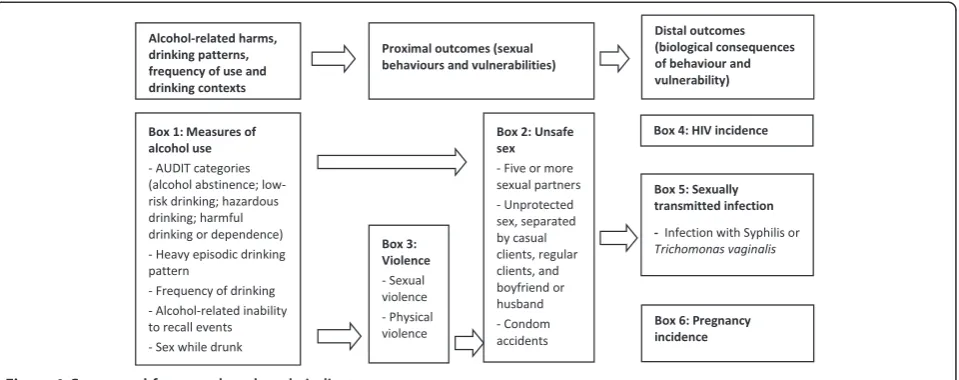
characterised by infrequent, but heavy, drinking episodes [4]. Such drinking patterns are most pronounced in the population sub-groups within these countries that have the highest HIV levels [5,6]. Evidence accrued to date, links heavy episodic alcohol use as well as other alcohol use disorders with unsafe sex and HIV transmission (see Conceptual framework for study: Figure 1) [7-9]. Yet, these links have received relatively little research atten-tion and substantial gaps in evidence remain. Alcohol in-terventions are presently largely ignored within HIV prevention services, with alcohol receiving considerably less attention than interventions for altering sexual * Correspondence:[email protected]
1
Centre for Health Policy, School of Public Health, Faculty of Health Sciences, University of the Witwatersrand, Johannesburg, South Africa
2
International Centre for Reproductive Health, Department of Obstetrics and Gynaecology, Ghent University, Ghent, Belgium
Full list of author information is available at the end of the article
behavioural, HIV testing and biomedical factors such as medical male circumcision [10,11]. Similarly, within HIV treatment strategies, harmful drinking reduces adher-ence to antiretroviral therapy and hastens the disease course of HIV [12-14], but there is little programmatic response or interventional research to date.
Opportunities for alcohol use and sex often co-exist within physical locations, [15-17] and social contexts. In paid sex, both sex workers and clients commonly use al-cohol around the time of sexual exchange [7,18-21]. Links between alcohol and unsafe sex may be mediated by alcohol’s pharmacological effects [22]; the nature of drinking venues in Africa [23,24]; intersections between alcohol and other drugs [25]; and also likely by a set of psychological and social influences [26-28]. Consistent and strong associations, including limited evidence of a dose–response effect, [29] have been detected between heavy drinking and incident HIV infection, [11,29] and the proximate determinants of HIV infection, such as multiple partners, unsafe sex and violence [6,29,30]. Meta-analyses in two systematic reviews showed that those who drink alcohol have approximately 70% higher risk for HIV [29,31]. These studies used an array of alco-hol exposure measures, and few had longitudinal study designs [31,32].
Sex work is common in sub-Saharan Africa where an estimated 0.7 to 4.3% of women exchange sex for money, goods or favours [33]. A 2012 national house-hold survey in Kenya found that 4% of women had ever received money gifts or favours in exchange for sex, with 1% having done so in the past year [34]. Worldwide sex workers carry a markedly high burden of HIV (almost 13-fold greater than women in the general population) and other sexually transmitted infections (STIs) [35]. Much of HIV risk for these women is a manifestation of their extraordinary social and economic vulnerability
[36]. About a third of sex workers in Mombasa Kenya are HIV infected [37]. Also, violence pervades the lives of sex workers in sub-Saharan Africa, with long-term consequences including stress, depression and low self-esteem [38]. Among sex workers in urban and rural Kenya, for examples, about a third reported being raped and 17% had been physically assaulted by a client [39]. Prospective data has demonstrated that effects of gender-based violence on future sexual behaviour are, at least in part, mediated through alcohol use in high-risk contexts in Africa [40]. These linkages are, however, amenable to intervention. A trial in South Africa evalu-ated a combined counselling and educational interven-tion, including alcohol reducinterven-tion, among sex workers and found the intervention group decreased use of sub-stances during sex work, had lower levels of victimisa-tion and fewer STI symptoms than controls [41].
Though there is a growing body of knowledge around the alcohol-HIV nexus, substantial evidence gaps re-main. Controversy continues about some components of the alcohol-HIV causal pathway, specifically, it is un-known whether reducing alcohol use would lower risk for HIV transmission. Some contend that associations between alcohol and sexual behaviour are merely due to personality traits (such as sensation seeking), which ac-count for both alcohol use and unsafe sex [11]. Import-antly, most studies have not used validated measures of alcohol use to assess these associations [42]. This study, applying validated measures of alcohol use, [6,9] aimed to determine whether alcohol use is associated with un-safe sex, violence and incident HIV infection among sex workers in Kenya. Using validated alcohol indicators wherever possible, associations between study outcomes and several dimensions of alcohol use were examined, such as alcohol harms, patterns of use and alcohol-sex temporality. The study population has considerable
variation in alcohol use, facilitating this enquiry. The study intends to contribute additional data to further substantiate the critical need for interventional research on this topic, and to identify which specific characteris-tics of alcohol use are associated with unsafe sex and violence.
Methods
Study setting and design
Sex workers were recruited from their homes, guest houses and the street in two divisions of Mombasa, (Kisauni and Chaani), within the Coast province. This setting was selected as the research team had strong links with the community leaders and sex workers in these divisions, as well as the high incidence of alcohol use, unsafe sex and HIV in the area [37]. A household survey among the general population reported that HIV prevalence in Coast Province was 8.1% in 2007 and 4.3% in 2012 [34]. HIV prevalence among postpartum women attending a large public sector facility in Mombasa was 10.9% in 2006 [43].
The study area was divided into eleven zones, each al-located a field worker. Field workers were familiar with their respective areas and responsible for inviting women to enrol in the study and then maintaining con-tact with them over the study period. Snowball sampling was used, whereby initial sex workers known to the field worker were invited to participate and those recruited then provided contact details of other sex workers. To be eligible for participation, women had to report receipt of money in exchange for sex as part of their livelihood in the last 6 months, and be at least 16-years old, sexu-ally active in the past 3 months, and not pregnant at the time of enrolment. Women were only eligible if they tested HIV negative with rapid HIV testing at enrolment. Those planning to travel or relocate elsewhere, or who were participating in another HIV intervention study were excluded from participation.
Study procedures
In this cohort study, women were followed over 12 months with quarterly study visits. Study visits were held at drop-in centres within the community in Kisauni and a local health centre in Chaani. Where indicated, participants received treatment for STIs according to local guidelines or were referred to health services. Con-traceptives, including male and female condoms, were offered free of charge. Participants received HIV testing and counselling, and family planning and risk reduction counselling. Women testing HIV positive received post-test counselling and were linked with nearby facilities providing follow-up care and antiretroviral treatment. The Kenyatta National Hospital Ethics and Research Committee approved the study protocol. Participants
signed informed consent and provided contact details. Reimbursements of 400 Kenya Shillings were given for travel costs and time taken in interview at baseline and endline (USD6), and 300 Kenya Shillings for other shorter visits (USD4.5).
A structured questionnaire was administered in English or Swahili by a trained research assistant at each of the three-monthly follow-up visits. We collected data on sexual behaviour, pregnancy and HIV status of partici-pants. In addition, at the 12 month visit, data were col-lected on physical and sexual violence, STIs other than HIV, and alcohol use. A conceptual framework was used to guide selection of study variables and analysis. In this framework, the exposure alcohol use is linked to the proximal outcomes of sexual behaviours and vulnerability. These, in turn, have biological conse-quences, which were our distal outcomes (HIV, STIs other than HIV and pregnancy).
Study eligibility and HIV status at three monthly follow-up visits were determined using two HIV rapid tests performed in parallel (Uni-Gold™HIV, Trinity Bio-tech plc, Bray, Ireland; and Determine™HIV-1/2, Abbott Laboratories, Abbott Japan Co Ltd, Minato-Ku, Tokyo, Japan). If these results were discordant, an HIV ELISA was done for confirmation. To ascertain that partici-pants were HIV uninfected at enrolment and at study end, pooled RNA real-time polymerase chain reaction (PCR) assays (Generic HIV-1 Charge Virale, Biocentric, Bandol, France) were done [44]. For participants sero-converting during the study, a PCR was done on the last antibody negative blood sample to improve estimation of the timing of infection.
Gynaecological examination and vaginal swabs were done at baseline, after 12 months and at other visits when clinically required. Urine pregnancy tests were performed three monthly. Syphilis infection was de-tected with a rapid plasma reagin test (Human GmbH, Wiesbaden, Germany). Infection with Trichomonas vaginalis was determined by wet mount. Tests were not done for Neisseria gonorrhoeae as previous stud-ies in this population had found a low prevalence of this infection [37,45]. Detection of other STIs, such as herpes simplex virus-2, was not done due to cost and technical constraints.
Study instruments
slippage in the past three months was used as an indica-tor for condom accidents. Experience of violence from any partner was assessed through a 19-item question-naire, used by Dunkle et al. [14,16], which drew on the WHO violence against women instrument [17]. To as-sess sexual violence, women were asked whether any partner had physically forced them to have sex when they did not want to in the past 12 months. Women reporting having been pushed, slapped, hit or kicked by a partner in the past 12 months were classified as having experienced physical violence. Information was collected on six different types of sexual, physical and other forms of violence, whether this had occurred in the past 12 months and, if so, how often (once, few, many times). Alcohol use, the main study exposure was measured in several ways. The Alcohol Use Disorders Identification Test (AUDIT) [46] was used, and measures of alcohol volume, drinking patterns and temporally-paired alcohol-sex events. A review found that AUDIT has high sensitiv-ity (median 0.83 in 21 studies) and specificsensitiv-ity (median 0.87 in 21 studies), across a range of settings and popula-tions, though test validity does vary depending on the AUDIT scores used to define each drinking category [47]. The Cronbach’s Alpha (internal consistency) for the in-strument in this population was 0.88. Alcohol exposure was classified as alcohol abstinence (lifetime abstinence or no alcohol use in past 12 months), low-risk drinking (AUDIT score 1–7); hazardous drinking (AUDIT score 8–15), and harmful drinking (AUDIT score ≥16, which includes alcohol dependence) [46]. For analysis, these categories were coded 0, 1, 2 and 3 respectively. Heavy-episodic drinking was defined as five or more drinks on one occasion [48]. Two event-level measures were used to evaluate whether alcohol use and unsafe sex were tem-porally paired: sex while feeling drunk in the past seven days and condom use while drunk. Frequency of alcohol intake (irrespective of volume per occasion) was catego-rized as: drinking two to four times a month or less; two to three times a week; or four or more times a week. Total annual alcohol consumption is calculated as the product of number of alcohol units (assuming an alco-holic drink contains 10 g of pure alcohol) and frequency of use [48].
Data management and analysis
Data were double entered by separate clerks and ana-lyzed using Intercooled Stata 12.1 (Stata Corporation, College Station, TX, USA). Associations were assessed between baseline AUDIT categories, and demographic, sex work and reproductive health characteristics at co-hort entry. Chi-square tests were used for analysis of cat-egorical variables, while for continuous variables we used unpaired analysis of variance (variables with a Nor-mal distribution) or Kruskal-Wallis tests (non-NorNor-mal
variables). The strength of linear associations between continuous variables, for example age at alcohol and sex-ual debut, was assessed using correlation coefficients (r), derived by simple linear regression.
HIV infection, the primary outcome, was considered a study endpoint for analysis purposes. The time that each woman remained in the cohort and at risk for HIV was summed to give the total person years at risk. Using uni-variate analysis, we examined associations between AUDIT group and the proximal study outcomes: unsafe sex (partner number and condom use), physical and sex-ual violence, as well as the distal outcomes (biological measures of pregnancy, HIV and other STIs). Alcohol abstinence constitutes the baseline group in these ana-lyses as no lower level of alcohol consumption that is ‘safe’for sexual behaviour has been defined, and previous studies suggest a dose–response relationship may exist between alcohol use and unsafe sex [30]. Women’s re-ported alcohol use at the 12-month interview was used in analysis of associations between AUDIT groups and study outcomes, as these alcohol measures reflect the time period at risk for HIV acquisition and other study outcomes.
Using multivariate models, we investigated whether AUDIT categories were independently associated with the proximal and distal study outcomes, controlling for potential confounding factors. Six Cox proportional hazards models were constructed for outcomes mea-sured at repeated intervals (≥5 sexual partners; unpro-tected sex with casual client, regular client, or boyfriend or husband; HIV and pregnancy, all assessed at 3, 6, 9 and 12 months). For pregnancy and HIV infection, par-ticipants were censored at failure, with the event as-sumed to occur midway between the corresponding study visits.
Women with laboratory-diagnosed syphilis and/or trichomonas infection at 12 months (STIs other than HIV) were grouped together and compared with women with none of these infections. As STIs other than HIV, and physical and sexual violence were only measured at month 12, we constructed multiple logistic regression models for these binary outcomes. Each model was ad-justed for age, religion and level of education, as these variables, considered potential confounders, were associ-ated with the AUDIT categories in univariate analysis.
Results
(n = 20) and declining a gynaecological examination (n = 10). Two women were excluded as they were unable to sign informed consent due to being clearly drunk.
The 400 enrolled participants contributed a total of 381.3 woman-years at risk. Overall, 369 women (92.3%) reached the study endpoint (incident HIV infection) or were retained over the 12-month study period. The mean age of participants was 25.1 years (standard deviation
(sd) = 5.2 years) at enrolment, with 22.7% aged 16 to 20 years. About a third of women were Muslim (159/399), a quarter catholic (102/399) and the remaining 40% were mostly protestant religion (154/399). Women had begun sex work on average at 20.4 years with almost a third be-ginning under 18 years (119/399).
At enrolment, 36.1% of women were classified as alco-hol abstainers (144/399; Table 1). Predominately these
Table 1 Association between alcohol use, and demographic and reproductive health characteristics of female sex workers in Mombasa, Kenya at cohort entry
Variable Alcohol abstinence
n = 144, n (%)
Low-risk drinking n = 148, n (%)
Hazardous drinking n = 69, n (%)
Harmful drinking or
dependence n = 38, n (%) P
Agemean years (sd) 24.7 (5.2) 26.1 (5.4) 24.6 (4.9) 24.1 (4.3) 0.04*
Religion
Catholic 23 (16.0) 42 (28.4) 21 (30.4) 16 (42.1)
Protestant or other 54 (37.5) 55 (37.2) 30 (43.5) 20 (52.6)
Muslim 67 (46.5) 51 (34.5) 18 (26.1) 2 (5.3) <0.001
Highest education level
None or primary incomplete 65 (45.1) 67 (45.3) 26 (37.7) 10 (26.3)
Primary school 45 (31.3) 37 (25.0) 18 (26.1) 11 (29.0)
Secondary or tertiary level 34 (23.6) 44 (29.7) 25 (36.2) 17 (44.7) 0.13
Marital status
Single 101 (70.1) 101 (68.2) 55 (79.7) 30 (79.0)
Married or cohabiting 4 (2.8) 6 (4.0) 1 (1.5) 0 (0)
Separated, divorced or widowed 39 (27.1) 41 (27.7) 13 (18.8) 8 (21.1) 0.48
Sex work durationmedian years (IQR) 3 (2–6) 4 (2–7) 4 (2–8) 3 (2–5) 0.19^
Part-time sex work 112 (77.8) 110 (74.3) 50 (72.5) 27 (71.1) 0.76
Weekly income from sex work
≤500 KShs 50 (34.7) 32 (21.9) 10 (14.5) 2 (5.4)
501-1000 43 (30.0) 48 (32.9) 20 (29.0) 9 (24.3)
1001-2000 33 (22.9) 41 (28.0) 18 (26.1) 12 (32.4)
>2000 18 (12.5) 25 (17.1) 21 (30.4) 14 (37.8) <0.001
Number of live children
0 33 (23.0) 18 (12.2) 16 (23.2) 12 (31.6)
1 40 (27.8) 59 (39.9) 31 (44.9) 21 (55.3)
2-3 56 (38.9) 55 (37.2) 20 (29.0) 5 (13.2)
≥4 15 (10.4) 16 (10.8) 2 (2.9) 0 (0) <0.001
Current contraception
None 61 (42.4) 42 (28.4) 23 (33.3) 20 (52.6)
Injectable or implant 44 (30.6) 51 (34.5) 26 (37.7) 8 (21.1)
Oral contraception 16 (11.1) 18 (12.2) 5 (7.3) 5 (13.2)
Consistent condoms or other 23 (16.0) 37 (25.0) 15 (21.7) 5 (13.2) 0.25
Substances other than alcohol
Cannabis in past week 1 (0.7) 12 (8.1) 10 (14.5) 7 (18.4) <0.001
Khat+in past week 12 (8.3) 27 (18.2) 23 (33.3) 12 (31.6) <0.001
Chi-square test unless indicated; *Anova test; ^Kruskal-Wallis; IQR inter-quartile range; sd standard deviation. KShs Kenya Shillings 1USD = +/−80 KShs; 5 participants had other religion. 15 used contraceptive methods other than those listed. n (%) unless indicated.+
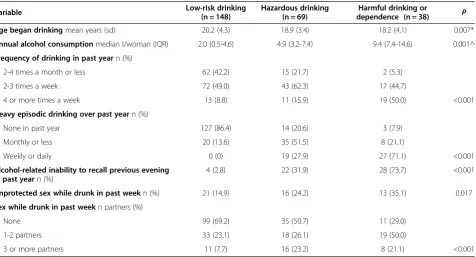
women reported lifetime abstinence (109/144; 75.7%), and around half were Muslim (46.5%, 67/144). Muslim women constituted about a third of low-risk drinkers (51/148), a quarter of hazardous drinkers (18/69), but only 5.3% of those with harmful alcohol use (2/38). About a quarter were classified as hazardous (69/399; 17.3%) or harmful drinkers (9.5%; 38/399; Box 1 of Figure 1). More than 80% of women with hazardous or harmful alcohol use drank more than once a week (84.1%, 90/107; Table 2). Heavy episodic drinking was also frequent, reported by 71% of harmful drinkers at least once a week. Inability to recall events due to alco-hol use was reported by three quarters of harmful drinkers. Women with hazardous or harmful drinking had also commonly used cannabis (15.9%, 17/107), khat1 (32.7%, 35/107) or both substances (8.4%, 9/107) in the past week (Table 1). Only four women reported ever using heroin, three of whom used it during the study period.
Some women never attended school (7%, 28/399), and a further 35.1% did not complete primary education. Only 8 women had received any tertiary-level training. Education level and religion were associated, with school attendance less common among Muslim women (55.1%, 76/138), than Catholic (39.2%, 40/102) or Protestant women (32.7%, 52/159;P< 0.001). About 40% of women with hazardous or harmful drinking had completed sec-ondary or tertiary education (42/107), which was higher
than among low-risk drinkers (29.7%, 44/148) and alco-hol abstainers (23.6%, 34/144; P = 0.07; Table 1). No as-sociation, however, was detected between education level and drinking pattern, when this analysis was strati-fied by religion.
Approximately 80% of participants had children (320/ 399), though fewer women with harmful drinking had a child (68%, 26/38; P< 0.001) than other groups. Of all women, 36.6% (146/399) were not using contraception at cohort entry, and this was highest among women with harmful drinking, at 52.6% (20/38; P= 0.01). Pregnancy occurred in a quarter of women over the study period (25.8%, 103/399), and was 5.3-fold higher among women reporting no condom use than those using injectable contraception or implants (95%CI hazard ratio = 2.9-9.5).
Association between alcohol use and unsafe sex or violence
Mean age at first sex was 17.2 years (sd = 2.6) and at sex work onset 20.4 years (sd = 4.7), while women began drinking at a mean 19.7 years (sd = 4.1). Age of drinking onset was correlated with age at first sex (r = 0.22, P< 0.001). More than half the women had sex before they began alcohol use (59.2%, 170/287), while 29.6% began sex and alcohol use at the same age. Also, age at onset of alcohol use and sex work debut were correlated (r = 0.65,P< 0.001). In this instance, alcohol use preceded sex
Table 2 Alcohol volume, drinking patterns and event-level measures among female sex workers in Mombasa, Kenya at cohort entry
Variable Low-risk drinking
(n = 148)
Hazardous drinking (n = 69)
Harmful drinking or
dependence (n = 38) P
Age began drinkingmean years (sd) 20.2 (4.3) 18.9 (3.4) 18.2 (4.1) 0.007*
Annual alcohol consumptionmedian l/woman (IQR) 2.0 (0.5-4.6) 4.9 (3.2-7.4) 9.4 (7.4-14.6) 0.001^
Frequency of drinking in past yearn (%)
2-4 times a month or less 62 (42.2) 15 (21.7) 2 (5.3)
2-3 times a week 72 (49.0) 43 (62.3) 17 (44.7)
4 or more times a week 13 (8.8) 11 (15.9) 19 (50.0) <0.001
Heavy episodic drinking over past yearn (%)
None in past year 127 (86.4) 14 (20.6) 3 (7.9)
Monthly or less 20 (13.6) 35 (51.5) 8 (21.1)
Weekly or daily 0 (0) 19 (27.9) 27 (71.1) <0.001
Alcohol-related inability to recall previous evening in past yearn (%)
4 (2.8) 22 (31.9) 28 (73.7) <0.001
Unprotected sex while drunk in past weekn (%) 21 (14.9) 16 (24.2) 13 (35.1) 0.017
Sex while drunk in past weekn partners (%)
None 99 (69.2) 35 (50.7) 11 (29.0)
1-2 partners 33 (23.1) 18 (26.1) 19 (50.0)
3 or more partners 11 (7.7) 16 (23.2) 8 (21.1) <0.001
work for 39.1% of women (113/289) and 30.5% started drinking and sex work at the same age.
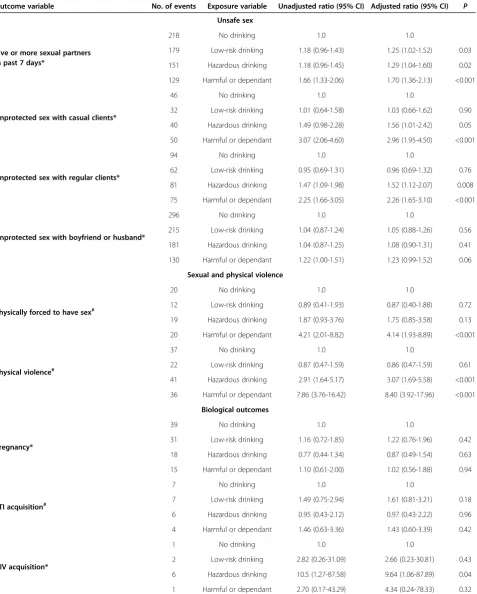
With each increase in AUDIT category, the median number of partners rose, from 3 (IQR = 2-5) in the past week among alcohol abstainers and low-risk drinkers to 6 partners (IQR = 2-7) in the past week among harmful drinkers (P= 0.004; Box 2 of Figure 1). Similarly, multi-variate analysis showed that there was a stepwise in-crease in the likelihood of having five or more partners with each increase in AUDIT category (Table 3). Levels of income from sex work also rose with each increase in AUDIT category, not surprising as number of partners and income levels were associated. Sex workers earning ≤500 Kenya shillings had a median of 3 partners in the past week (IQR = 2-4), compared to a median 5 partners (IQR = 3-7) in those earning >2000 Kenya Shillings.
Sex while feeling drunk in the past week was frequent, reported by nearly three quarters of women with harm-ful drinking (71.1%, 27/38), half of hazardous drinkers (49.3%, 34/69) and even in 30.8% of women with low-risk drinking (44/143; Table 2). A considerable propor-tion had sex while drunk with three or more partners in the past week (22.4% of women with hazardous or harmful drinking). A third of harmful drinkers had un-protected sex while drunk in the past week, 3.1 fold higher than those with low-risk drinking (95%CI = 1.34-7.17; P= 0.005). Also, the proportion reporting condom accidents rose with each increase in AUDIT category, from 11.3% in alcohol abstainers (16/142), 14.9% in low-risk drinkers (14/94), 27.2% in hazardous drinkers (22/81) to 32.7% of women with harmful drinking (16/49;P< 0.001).
Multivariate analysis showed that the likelihood of having unprotected sex with clients was higher in women with hazardous or harmful drinking than in al-cohol abstainers and low risk drinkers (Table 3). Com-pared to non-drinkers, the adjusted hazard ratio (AHR) of unprotected sex with a casual client was 1.56 among hazardous drinkers and 2.96 in harmful drinkers. Effect sizes of associations between alcohol use and unpro-tected sex with a boyfriend or husband were lower than these associations with clients. A trend was noted in this association among harmful drinkers (AHR = 1.23; 95% CI = 0.99-1.52;P= 0.06).
Almost a third of women with hazardous or harmful drinking had been physically forced to have sex in the past year (39/130) and 59.2% had experienced physical violence (77/130; Box 3 of Figure 1 and Table 3). Compared with women who abstain, those with harmful drinking were 4-fold more likely to experience sexual violence (adjusted odds ratio (AOR) 95%CI = 1.9-8.9) and 8-fold more likely to experience physical violence (AOR 95%CI = 3.9-18.0). Hazardous drinking was also associated with physical vio-lence (AOR = 3.1; 95%CI = 1.7-5.6).
Association between alcohol use and biological outcomes At month 12, 24 women had an STI other than HIV (6.3/100 person years at risk; Table 3). No association was detected between alcohol use and incident preg-nancy or STIs other than HIV (Box 5 and 6 of Figure 1). There were 10 incident HIV cases in the cohort (2.6/100 person years at risk). One case occurred in the 142 women with alcohol abstinence over the 12-month period of the study, and seven among the 130 women with hazardous or harmful alcohol use (Box 4 of Figure 1). After adjusting for age, religion and education, the hazard ratio of HIV acquisition was 9.6 fold higher in women with hazardous drinking than those who abstained from alcohol (95%CI = 1.1-87.9; P= 0.04); harmful drinking was not associated with HIV acquisi-tion (AHR = 4.3, 95%CI = 0.24-78.3).
Discussion
Though about a third of the study population did not drink, alcohol-use disorders were common (as assessed with the AUDIT screening tool), as were violence, preg-nancy and HIV. Incidence of HIV was higher in women with hazardous drinking than those who abstained from alcohol, and alcohol-use disorders were associated with unsafe sex and violence. The study also demonstrated temporal linkages between alcohol exposure and unsafe sex (unprotected sex while drunk). Links between alco-hol and these outcomes might be due to the effects of al-cohol on sexual decision-making, condom negotiation and their correct use [26].
Hazardous drinking may form part of social-behavioural interactions that are linked with sex, while alcohol use among people with alcohol harm (such as dependence) is often less social in nature. In people with alcohol dependence, a greater separation of alcohol use and socially-mediated outcomes such as sex, could mean they incur more individual-level harms than social-type outcomes such as unsafe sex [48]. These differ-ences may account for the study demonstrating an as-sociation between HIV acquisition and hazardous drinking, but not with harmful drinking. Interestingly, associations between alcohol use and unsafe sex were more apparent among clients than emotional partners. This might reflect the role that alcohol plays in sex work, where it may assist sex workers to approach cli-ents and to cope with sex work [49].
Table 3 Multivariate analysis of associations between hazardous and harmful drinking, and unsafe sex, violence and incident HIV among female sex workers in Mombasa, Kenya
Outcome variable No. of events Exposure variable Unadjusted ratio (95% CI) Adjusted ratio (95% CI) P
Unsafe sex
Five or more sexual partners in past 7 days*
218 No drinking 1.0 1.0
179 Low-risk drinking 1.18 (0.96-1.43) 1.25 (1.02-1.52) 0.03
151 Hazardous drinking 1.18 (0.96-1.45) 1.29 (1.04-1.60) 0.02
129 Harmful or dependant 1.66 (1.33-2.06) 1.70 (1.36-2.13) <0.001
Unprotected sex with casual clients*
46 No drinking 1.0 1.0
32 Low-risk drinking 1.01 (0.64-1.58) 1.03 (0.66-1.62) 0.90
40 Hazardous drinking 1.49 (0.98-2.28) 1.56 (1.01-2.42) 0.05
50 Harmful or dependant 3.07 (2.06-4.60) 2.96 (1.95-4.50) <0.001
Unprotected sex with regular clients*
94 No drinking 1.0 1.0
62 Low-risk drinking 0.95 (0.69-1.31) 0.96 (0.69-1.32) 0.76
81 Hazardous drinking 1.47 (1.09-1.98) 1.52 (1.12-2.07) 0.008
75 Harmful or dependant 2.25 (1.66-3.05) 2.26 (1.65-3.10) <0.001
Unprotected sex with boyfriend or husband*
296 No drinking 1.0 1.0
215 Low-risk drinking 1.04 (0.87-1.24) 1.05 (0.88-1.26) 0.56
181 Hazardous drinking 1.04 (0.87-1.25) 1.08 (0.90-1.31) 0.41
130 Harmful or dependant 1.22 (1.00-1.51) 1.23 (0.99-1.52) 0.06
Sexual and physical violence
Physically forced to have sex#
20 No drinking 1.0 1.0
12 Low-risk drinking 0.89 (0.41-1.93) 0.87 (0.40-1.88) 0.72
19 Hazardous drinking 1.87 (0.93-3.76) 1.75 (0.85-3.58) 0.13
20 Harmful or dependant 4.21 (2.01-8.82) 4.14 (1.93-8.89) <0.001
Physical violence#
37 No drinking 1.0 1.0
22 Low-risk drinking 0.87 (0.47-1.59) 0.86 (0.47-1.59) 0.61
41 Hazardous drinking 2.91 (1.64-5.17) 3.07 (1.69-5.58) <0.001
36 Harmful or dependant 7.86 (3.76-16.42) 8.40 (3.92-17.96) <0.001
Biological outcomes
Pregnancy*
39 No drinking 1.0 1.0
31 Low-risk drinking 1.16 (0.72-1.85) 1.22 (0.76-1.96) 0.42
18 Hazardous drinking 0.77 (0.44-1.34) 0.87 (0.49-1.54) 0.63
15 Harmful or dependant 1.10 (0.61-2.00) 1.02 (0.56-1.88) 0.94
STI acquisition#
7 No drinking 1.0 1.0
7 Low-risk drinking 1.49 (0.75-2.94) 1.61 (0.81-3.21) 0.18
6 Hazardous drinking 0.95 (0.43-2.12) 0.97 (0.43-2.22) 0.96
4 Harmful or dependant 1.46 (0.63-3.36) 1.43 (0.60-3.39) 0.42
HIV acquisition*
1 No drinking 1.0 1.0
2 Low-risk drinking 2.82 (0.26-31.09) 2.66 (0.23-30.81) 0.43
6 Hazardous drinking 10.5 (1.27-87.58) 9.64 (1.06-87.89) 0.04
1 Harmful or dependant 2.70 (0.17-43.29) 4.34 (0.24-78.33) 0.32
that study, those who drank, especially those having three or more drinks a day, used condoms less fre-quently with clients and had other related HIV risks [52]. In addition, alcohol use among sex workers is sub-stantially higher than among the general population. While about two thirds of sex workers reported current drinking, only 16.6% of urban Kenyans and 11.4% of rural dwellers reported drinking in a national survey [53]. Similarly, sex while drunk was common among sex workers, but only about 5% of youth 15–24 years had sex in the past year when they or their partner was drunk [54].
Complexities inherent in measurements of alcohol, sex and HIV do, however, limit the ability to definitively in-vestigate causality in the absence of trial data. Event-level measures of the alcohol-sex-HIV nexus are difficult to implement as the precise timing of HIV infection is hard to discern. Moreover, gathering alcohol exposure data that is co-terminous with the window periods com-monly used for HIV infection is constrained by the need to minimise recall bias with measures of unsafe sex and alcohol. Alcohol itself can hamper recall, with three quarters of harmful drinkers acknowledging that in this study. Employing methods, such as using time-line fol-low back or providing participants with calendars, may have reduced effects of recall bias in this study.
The relatively small sample size of this study limited the ability to detect associations between some study ex-posures and outcomes. The study is, however, strength-ened by having a relatively large proportion of sex workers who abstained from alcohol and constituted a sizable comparison group. Using the abstinent group as the baseline comparator can be substantiated given the lack of a known lower safe limit of alcohol use for sex. However, use of low-risk drinkers as a baseline group could be considered a more realistic measure of the dis-ease burden which is modifiable (or the standard against which to compare risks of illness), given that low-risk drinking is the major public health goal for most alcohol reduction interventions, rather than complete abstinence [48]. Finally, clearly the ability to generalise these find-ings to other study populations is limited. Findfind-ings may even differ in other sex worker settings, as the study population received a set of interventions as part of the study procedures and benefit from long-standing ser-vices in the area [37].
More interventional research on alcohol harm reduc-tion among sex workers is required, examining, for ex-ample, the effects of ‘brief interventions’ on unsafe sex in sex work settings [26,49,55]. In addition, applying more complex multilevel interventions would simultan-eously aim to shift individual behaviours and the social norms around drinking. One example of a multilevel venue-based intervention was tested in the Philippines,
among sex workers in bars, discos, and night clubs [56]. Peer counselling, focused on condom use and sexual ne-gotiation skills, formed the basis for change in individual and social norms. Changes to the bar environment were achieved by working with bar managers to implement HIV prevention practices. The combination of individ-ual, social and environmental interventions appeared to impact on condom use and subsequent STIs. While in-terventions targeting inter-personal factors and the physical settings within drinking contexts seem promis-ing, the social factors that underlie alcohol-associated HIV-infection risks also warrant attention, such as gen-der power-imbalances that manifest as alcohol-related gender-based violence [15,16]. While not diminishing the importance of these social factors, given the associations detected between alcohol use and violence, it is important to determine whether interventions to make alcohol use safer can lower women’s experiences of violence.
a risk level and then providing Brief Interventions could markedly improve the health of this population. Vali-dated tools, such as WHO-ASSIST linked to Brief Inter-ventions, take 3–15 minutes to apply and should form part of the services packages being designed for this population [62,63].
Endnote
1
Khat, an amphetamine-like stimulant, contains a monoamine alkaloid called cathinone and is a controlled substance in some countries.
Competing interest
No conflict of interest to declare.
Authors’contributions
WB, NK, MT & SL led the design of the study, trained interviewers and coordinated data collection. WB & NK supervised data collection in the field sites. MFC gave input into data collection tools and analysis, helped draft the manuscript, and coordinated overall editing. All authors read, gave substantial input and approved the final manuscript.
Acknowledgements
We thank the Ministry of Health, Government of Kenya for their support. We would like to sincerely thank the entire ICRH research team in Mombasa for their commendable contributions to the study. Many thanks to Dr Annalene Nel of the International Partnership for Microbicides for support to the study. We also acknowledge the staff at the Chaani clinic and the Kisauni drop-in centre. Lastly, we thank all study participants for their invaluable contribution. Financial support for this study was provided by the International Partnership for Microbicides (IPM). The authors also gratefully acknowledge the contribution to this work of the Victorian Operational Infrastructure Support Program. We acknowledge the contribution of the EU DIFFER project to Matthew Chersichs input on this paper.
Author details
1Centre for Health Policy, School of Public Health, Faculty of Health Sciences,
University of the Witwatersrand, Johannesburg, South Africa.2International Centre for Reproductive Health, Department of Obstetrics and Gynaecology, Ghent University, Ghent, Belgium.3Wits Reproductive Health and HIV Research Institute, Faculty of Health Sciences, University of the Witwatersrand, Johannesburg, South Africa.4International Centre for Reproductive Health, Mombasa, Kenya.5School of Public Health, Faculty of Health Sciences, University of the Witwatersrand, Johannesburg, South Africa. 6Centre for International Health, Burnet Institute, Melbourne, Australia. 7
School of Public Health and Preventive Medicine, Monash University, Melbourne, Australia.
Received: 27 October 2013 Accepted: 24 March 2014 Published: 3 April 2014
References
1. Rehm J, Kehoe T, Rehm M, Patra J:Alcohol consumption and related harm in WHO Africa region in 2004. Toronto, Canada: Centre for Addiction and Mental Health.InBook Alcohol consumption and related harm in WHO Africa region in 2004.Toronto, Canada: Centre for Addiction and Mental Health; 2009.
2. Rehm J, Mathers C, Popova S, Thavorncharoensap M, Teerawattananon Y, Patra J:Global burden of disease and injury and economic cost attributable to alcohol use and alcohol-use disorders.Lancet2009,
373:2223–2233.
3. The Global Burden of Disease: 2004 update.Geneva; 2008. ISBN ISBN 978 92 4 156371 0.
4. Rehm J, Rehn N, Room R, Monteiro M, Gmel G, Jernigan D, Frick U:The global distribution of average volume of alcohol consumption and patterns of drinking.Eur Addict Res2003,9:147–156.
5. Chersich MF, Rees HV:Causal links between binge drinking patterns, unsafe sex and HIV in South Africa: its time to intervene.Int J STD AIDS 2010,21:2–7.
6. Li Q, Li X, Stanton B:Alcohol use among female sex workers and male clients: an integrative review of global literature.Alcohol Alcohol2010,
45:188–199.
7. Chersich MF, Luchters SMF, Malonza IM, Mwarogo P, Kingola N, Temmerman M:Heavy episodic drinking among Kenyan female sex workers is associated with unsafe sex, sexual violence and sexually transmitted infections.Int J STD AIDS2007. in press.
8. Hahn JA, Woolf-King SE, Muyindike W:Adding fuel to the fire: alcohol’s effect on the HIV epidemic in Sub-Saharan Africa.Curr HIV/AIDS Rep2011,
8:172–180.
9. Luchters S, Geibel S, Syengo M, Lango D, King’ola N, Temmerman M, Chersich MF:Use of AUDIT, and measures of drinking frequency and patterns to detect associations between alcohol and sexual behaviour in male sex workers in Kenya.BMC Public Health2011,11:384.
10. Chersich M, Rees HV:Vulnerability of women in southern Africa to infection with HIV: biological determinants and priority health sector interventions.AIDS2008,22(suppl 4):S1–S14.
11. Shuper PA, Neuman M, Kanteres F, Baliunas D, Joharchi N, Rehm J:Causal considerations on alcohol and HIV/AIDS–a systematic review.Alcohol Alcohol2010,45:159–166.
12. Azar MM, Springer SA, Meyer JP, Altice FL:A systematic review of the impact of alcohol use disorders on HIV treatment outcomes, adherence to antiretroviral therapy and health care utilization.Drug Alcohol Depend 2010,112(3):178–193.
13. Hendershot CS, Stoner SA, Pantalone DW, Simoni JM:Alcohol use and antiretroviral adherence: review and meta-analysis.J Acquir Immune Defic Syndr2009,52:180–202.
14. Hahn JA, Samet JH:Alcohol and HIV disease progression: weighing the evidence.Curr HIV/AIDS Rep2010,7:226–233.
15. Watt MH, Aunon FM, Skinner D, Sikkema KJ, Kalichman SC, Pieterse D: “Because he has bought for her, he wants to sleep with her”: alcohol as a currency for sexual exchange in South African drinking venues.Soc Sci Med2012,74:1005–1012.
16. Pitpitan EV, Kalichman SC, Eaton LA, Cain D, Sikkema KJ, Skinner D, Watt MH, Pieterse D:Gender-based violence, alcohol use, and sexual risk among female patrons of drinking venues in Cape Town, South Africa.
J Behav Med2013.
17. Wechsberg WM, Myers B, Reed E, Carney T, Emanuel AN, Browne FA:
Substance use, gender inequity, violence and sexual risk among couples in Cape Town.Cult Health Sex,15:1221–1236.
18. Heravian A, Solomon R, Krishnan G, Vasudevan CK, Krishnan AK, Osmand T, Ekstrand ML:Alcohol consumption patterns and sexual risk behavior among female sex workers in two South Indian communities.Int J Drug Policy2012,23(6):498–504.
19. Maher L, Mooney-Somers J, Phlong P, Couture MC, Stein E, Evans J, Cockroft M, Sansothy N, Nemoto T, Page K:Selling sex in unsafe spaces: sex work risk environments in Phnom Penh, Cambodia.Harm Reduct J 2011,8:30.
20. Medhi GK, Mahanta J, Kermode M, Paranjape RS, Adhikary R, Phukan SK, Ngully P:Factors associated with history of drug use among female sex workers (FSW) in a high HIV prevalence state of India.BMC Public Health 2012,12:273.
21. Urada LA, Morisky DE, Pimentel-Simbulan N, Silverman JG, Strathdee SA:
Condom negotiations among female sex workers in the Philippines: environmental influences.PLoS One2012,7:e33282.
22. George WH, Stoner SA:Understanding acute alcohol effects on sexual behavior.Annu Rev Sex Res2000,11:92–124.
23. Fritz K, Woelk G, Bassett M, McFarland W, Routh J, Tobaiwa O, Stall R:The association between alcohol Use, sexual risk behavior, and HIV infection among Men attending beerhalls in Harare, Zimbabwe.AIDS Behav2002,
6:221–228.
24. Lewis JJ, Garnett GP, Mhlanga S, Nyamukapa CA, Donnelly CA, Gregson S:
Beer halls as a focus for HIV prevention activities in rural Zimbabwe.
Sex Transm Dis2005,32:364–369.
26. Chersich MF, Rees HV, Scorgie F, Martin G:Enhancing global control of alcohol to reduce unsafe sex and HIV in sub-Saharan Africa.Global Health 2009,5:16.
27. Morojele NK, Kachieng’a MA, Mokoko E, Nkoko MA, Parry CD, Nkowane AM, Moshia KM, Saxena S:Alcohol use and sexual behaviour among risky drinkers and bar and shebeen patrons in Gauteng province, South Africa.Soc Sci Med2006,62:217–227.
28. Kalichman SC, Simbayi L, Jooste S, Vermaak R, Cain D:Sensation seeking and alcohol use predict HIV transmission risks: prospective study of sexually transmitted infection clinic patients, Cape Town, South Africa.
Addict Behav2008,33:1630–1633.
29. Fisher JC, Bang H, Kapiga SH:The association between HIV infection and alcohol use: a systematic review and meta-analysis of African studies.
Sex Transm Dis2007,34:856–863.
30. Kalichman SC, Simbayi LC, Kaufman M, Cain D, Jooste S:Alcohol use and sexual risks for HIV/AIDS in sub-Saharan Africa: systematic review of empirical findings.Prev Sci2007,8:141–151.
31. Baliunas D, Rehm J, Irving H, Shuper P:Alcohol consumption and risk of incident human immunodeficiency virus infection: a meta-analysis.
Int J Public Health2010,55:159–166.
32. Leigh BC, Vanslyke JG, Hoppe MJ, Rainey DT, Morrison DM, Gillmore MR:
Drinking and condom use: results from an event-based daily diary.
AIDS Behav2008,12:104–112.
33. Vandepitte J, Lyerla R, Dallabetta G, Crabbe F, Alary M, Buve A:Estimates of the number of female sex workers in different regions of the world.
Sex Transm Infect2006,82(Suppl 3):iii18–iii25.
34. National AIDS and STI Control Programme Ministry of Health Kenya:Kenya AIDS Indicator Survey 2012: Preliminary Report.Nairobi, Kenya; 2013. 35. Baral S, Beyrer C, Muessig K, Poteat T, Wirtz AL, Decker MR, Sherman SG,
Kerrigan D:Burden of HIV among female sex workers in low-income and middle-income countries: a systematic review and meta-analysis.Lancet Infect Dis2012,12(7):538–549.
36. Scorgie F, Chersich MF, Ntaganira I, Gerbase A, Lule F, Lo YR: Socio-demographic characteristics and behavioral risk factors of female sex workers in Sub-Saharan Africa: a systematic review.AIDS Behav2012,
16(4):920–933.
37. Luchters S, Chersich MF, Rinyiru A, Barasa MS, King’ola N, Mandaliya K, Bosire W, Wambugu S, Mwarogo P, Temmerman M:Impact of five years of peer-mediated interventions on sexual behavior and sexually transmitted infections among female sex workers in Mombasa, Kenya.
BMC Public Health2008,8:143.
38. WHO:Violence against women and HIV/AIDS: critical intersections. Violence against sex workers and HIV prevention. 2005. www.who.int/ gender/documents/sexworkers.pdf.
39. Pitpitan EV, Kalichman SC, Eaton LA, Cain D, Sikkema KJ, Skinner D, Watt MH, Pieterse D:Gender-based violence, alcohol use, and sexual risk among female patrons of drinking venues in Cape Town, South Africa.J Behav Med2013,36:295–304.
40. Pitpitan EV, Kalichman SC, Eaton LA, Sikkema KJ, Watt MH, Skinner D:
Gender-based violence and HIV sexual risk behavior: alcohol use and mental health problems as mediators among women in drinking venues, Cape Town.Soc Sci Med2012,75:1417–1425.
41. Wechsberg WM, Luseno WK, Lam WK, Parry CD, Morojele NK:Substance use, sexual risk, and violence: HIV prevention intervention with sex workers in Pretoria.AIDS Behav2006,10:131–137.
42. Fisher JC, Cook PA, Kapiga SH:Alcohol use before sex and HIV risk: situational characteristics of protected and unprotected encounters among high-risk African women.Sex Transm Dis2010,37:571–578. 43. Chersich MF, Luchters SM, Yard E, Othigo JM, Kley N, Temmerman M:
Morbidity in the first year postpartum among HIV-infected women in Kenya.Int J Gynaecol Obstet2008,100:45–51.
44. Novack L, Galai N, Yaari A, Orgel M, Shinar E, Sarov B:Use of seroconversion panels to estimate delay in detection of anti-human immunodeficiency virus antibodies by enzyme-linked immunosorbent assay of pooled compared to singleton serum samples.J Clin Microbiol 2006,44:2909–2913.
45. Chersich MF, Luchters SM, Malonza IM, Mwarogo P, King’ola N, Temmerman M:
Heavy episodic drinking among Kenyan female sex workers is associated with unsafe sex, sexual violence and sexually transmitted infections.Int J STD AIDS2007,18:764–769.
46. A U D I T. The alcohol Use disorders identification test guidelines for Use in primary care.http://whqlibdoc.who.int/hq/2001/WHO_MSD_MSB_01.6a.pdf. 47. Reinert DF, Allen JP:The alcohol use disorders identification test: an
update of research findings.Alcohol Clin Exp Res2007,31:185–199. 48. International guide for monitoring alcohol consumption and related
harm.http://whqlibdoc.who.int/hq/2000/WHO_MSD_MSB_00.4.pdf. 49. Wechsberg WM, Wu LT, Zule WA, Parry CD, Browne FA, Luseno WK, Kline T,
Gentry A:Substance abuse, treatment needs and access among female sex workers and non-sex workers in Pretoria, South Africa.Subst Abuse Treat Prev Policy2009,4:11.
50. Bradley J, Rajaram S, Alary M, Isac S, Washington R, Moses S, Ramesh B:
Determinants of condom breakage among female sex workers in Karnataka, India.BMC Public Health2011,11(Suppl 6):S14. 51. Baeten JM, Hassan WM, Chohan V, Richardson BA, Mandaliya K,
Ndinya-Achola JO, Jaoko W, McClelland RS:Prospective study of correlates of vaginal Lactobacillus colonisation among high-risk HIV-1 seronegative women.Sex Transm Infect2009,85:348–353.
52. Yadav G, Saskin R, Ngugi E, Kimani J, Keli F, Fonck K, Macdonald KS, Bwayo JJ, Temmerman M, Moses S, Kaul R:Associations of sexual risk taking among Kenyan female sex workers after enrollment in an HIV-1 prevention trial.J Acquir Immune Defic Syndr2005,38:329–334. 53. NACADA:National Survey on Alcohol and Drug Abuse. National
Authority for the Campaign Against Alcohol and Drug Abuse.2012. http://www.nacada.go.ke/documents-and-resources.
54. Kenya National Bureau of Statistics (KNBS), ICF Macro:Kenya Demographic and Health Survey 2008–09. Calverton, Maryland: KNBS and ICF Macro.
InBook Kenya Demographic and Health Survey 2008–09.Calverton, Maryland: KNBS and ICF Macro; 2010.
55. Chisholm D, Rehm J, Van Ommeren M, Monteiro M:Reducing the global burden of hazardous alcohol use: a comparative cost-effectiveness analysis.J Stud Alcohol2004,65:782–793.
56. Morisky DE, Stein JA, Chiao C, Ksobiech K, Malow R:Impact of a social influence intervention on condom use and sexually transmitted infections among establishment-based female sex workers in the Philippines: a multilevel analysis.Health Psychol2006,25:595–603. 57. Schneider M, Chersich M, Neuman M, Parry C:Alcohol consumption and
HIV/AIDS: the neglected interface.Addiction2012,107:1369–1371. 58. Hill AB:The environment and disease: association or causation?Proc R
Soc Med1965,58:295–300.
59. Kalichman SC, Simbayi LC, Jooste S, Cain D, Cherry C:Sensation seeking, alcohol use, and sexual behaviors among sexually transmitted infection clinic patients in Cape Town, South Africa.Psychol Addict Behav2006,
20:298–304.
60. Dunne EM, Freedlander J, Coleman K, Katz EC:Impulsivity, expectancies, and evaluations of expected outcomes as predictors of alcohol use and related problems.Am J Drug Alcohol Abuse2013,39:204–210.
61. Fritz K, McFarland W, Wyrod R, Chasakara C, Makumbe K, Chirowodza A, Mashoko C, Kellogg T, Woelk G:Evaluation of a peer network-based sexual risk reduction intervention for men in beer halls in Zimbabwe: results from a randomized controlled trial.AIDS Behav2011,
15:1732–1744.
62. Humeniuk R, Ali R, Babor TF, Farrell M, Formigoni ML, Jittiwutikarn J, de Lacerda RB, Ling W, Marsden J, Monteiro M, Nhiwatiwa S, Pal H, Poznyak V, Simon S:Validation of the alcohol, smoking and substance involvement screening test (ASSIST).Addiction2008,103:1039–1047.
63. WHO:The ASSIST-linked brief intervention for hazardous and harmful substance use: manual for use in primary care.2010. whqlibdoc.who.int/ publications/2010/9789241599399_eng.pdf.
doi:10.1186/1744-8603-10-22