Reviewable v1 Grant Proposal
NFDI4Culture - Consortium for research data on
material and immaterial cultural heritage
Reinhard Altenhöner, Ina Blümel, Franziska Boehm, Jens Bove, Katrin Bicher, Christian Bracht ,
Ortrun Brand, Lisa Dieckmann, Maria Effinger, Malte Hagener, Andrea Hammes, Lambert Heller,
Angela Kailus, Hubertus Kohle, Jens Ludwig, Andreas Münzmay, Sarah Pittroff, Matthias Razum,
Daniel Röwenstrunk, Harald Sack, Holger Simon, Dörte Schmidt, Torsten Schrade,
Annika-Valeska Walzel, Barbara Wiermann
‡ Stiftung Preußischer Kulturbesitz, Berlin, Germany
§ TIB Leibniz Information Centre for Science and Technology, Hannover, Germany | FIZ Karlsruhe - Leibniz Institute for Information Infrastructure, Karlsruhe, Germany ¶ Sächsische Landesbibliothek - Staats- und Universitätsbibliothek, Dresden, Germany # Philipps-Universität Marburg, Marburg, Germany
¤ University of Cologne, Cologne, Germany « Heidelberg University Library, Heidelberg, Germany » Ludwig-Maximilians-Universität, Munich, Germany
˄Paderborn University, Paderborn, Germany
˅Academy of Sciences and Literature, Mainz, Germany ¦ Verband deutscher Kunsthistoriker e.V., Bonn, Germany
ˀGerman Musicological Society, Kassel, Germany
Corresponding author: Torsten Schrade ([email protected]) Received: 29 Jul 2020 | Published: 31 Jul 2020
Citation: Altenhöner R, Blümel I, Boehm F, Bove J, Bicher K, Bracht C, Brand O, Dieckmann L, Effinger M, Hagener M, Hammes A, Heller L, Kailus A, Kohle H, Ludwig J, Münzmay A, Pittroff S, Razum M, Röwenstrunk D, Sack H, Simon H, Schmidt D, Schrade T, Walzel A-V, Wiermann B (2020) NFDI4Culture - Consortium for research data on material and immaterial cultural heritage. Research Ideas and Outcomes 6: e57036. https://doi.org/10.3897/rio.6.e57036
Abstract
Digital data on tangible and intangible cultural assets is an essential part of daily life, communication and experience. It has a lasting influence on the perception of cultural identity as well as on the interactions between research, the cultural economy and society. Throughout the last three decades, many cultural heritage institutions have contributed a wealth of digital representations of cultural assets (2D digital reproductions of paintings, sheet music, 3D digital models of sculptures, monuments, rooms, buildings), audio-visual data (music, film, stage performances), and procedural research data such as encoding
‡ § | ¶ ¶ #
# ¤ « # ¶ §
# » ‡ ˄ ˅ |
˄ | ¦ ˀ ˅
¶ ¶
and annotation formats. The long-term preservation and FAIR availability of research data from the cultural heritage domain is fundamentally important, not only for future academic success in the humanities but also for the cultural identity of individuals and society as a whole. Up to now, no coordinated effort for professional research data management on a national level exists in Germany. NFDI4Culture aims to fill this gap and create a user-centered, research-driven infrastructure that will cover a broad range of research domains from musicology, art history and architecture to performance, theatre, film, and media studies.
The research landscape addressed by the consortium is characterized by strong institutional differentiation. Research units in the consortium's community of interest comprise university institutes, art colleges, academies, galleries, libraries, archives and museums. This diverse landscape is also characterized by an abundance of research objects, methodologies and a great potential for data-driven research. In a unique effort carried out by the applicant and co-applicants of this proposal and ten academic societies, this community is interconnected for the first time through a federated approach that is ideally suited to the needs of the participating researchers. To promote collaboration within the NFDI, to share knowledge and technology and to provide extensive support for its users have been the guiding principles of the consortium from the beginning and will be at the heart of all workflows and decision-making processes. Thanks to these principles, NFDI4Culture has gathered strong support ranging from individual researchers to high-level cultural heritage organizations such as the UNESCO, the International Council of Museums, the Open Knowledge Foundation and Wikimedia. On this basis, NFDI4Culture will take innovative measures that promote a cultural change towards a more reflective and sustainable handling of research data and at the same time boost qualification and professionalization in data-driven research in the domain of cultural heritage. This will create a long-lasting impact on science, cultural economy and society as a whole.
Keywords
Research Data Management, NFDI, NFDI4Culture, Cultural Heritage, Art History, Musicology, Architecture, Theater Studies, Dance Studies, Media Studies, Digital Humanities
Consortium
Research domains or research methods addressed by the consortium, objectives
differentiation. Research units in the consortiums’ community of interest are often very small (right down to individual researchers) and comprise university institutes, art colleges, academies and cultural heritage institutions such as galleries, libraries, archives and museums (GLAM). At the same time, this community is very rich regarding its research objects, methodologies and its future potential for data-driven research: Digital cultural assets, practices and performances have become an essential part of our daily life, communication and experience and have a lasting influence on our individual and societal perceptions (Münzmay 2018, Hadjakos et al. 2017, Kailus and Stein 2018, Kailus 2017).
The long-term preservation and FAIR availability of research data from the cultural heritage domain is therefore fundamentally important, not only for future academic success but also for cultural identity, cultural economy and society (Wilkinson et al. 2018). Although many relevant institutions working in the field already have appropriate technological means, experience and solutions at their hands, until now, the community lacks a coordinated effort for professional research data management and curation on a national level.
To fill this gap, several academic societies ranging from musicology and art history to architecture, theatre, film and media studies have joined with the applicant and co-applicant institutions of this proposal in a unique effort to tie together the heterogeneous existing solutions and shape a research data management strategy and work program that is ideally suited to the strong needs of the involved community of interest. NFDI4Culture will create a new and sustainable infrastructure that is based on a thorough analysis of the existing research landscape. The consortium will integrate, merge and enhance a broad range of existing solutions and take innovative approaches to research data management in a field relevant to science and society as a whole (Fig. 1).
Figure 1.
NFDI4Culture’s community of interest produces a great variety of research data throughout the entire research process through close interaction with GLAM institutions and infrastructure facilities. Up to now, data has been collected with a strong analog orientation in mind (very often using digital sources with analog methods while aiming at print publications). In contrast, NFDI4Culture wants to establish a professional network in close cooperation with all participating partners from research, GLAM and infrastructure institutions, that will promote a cultural change and conscious approach to research data management and data-driven research in line with the FAIR principles for all phases of the research data life cycle in the cultural heritage domain: from data capture and enrichment of digital cultural assets to data analysis with software tools and enhanced (data-)publications, standardized and sustainable solutions for long-term archiving and ethically as well as legally safeguarded options for reuse of digital cultural assets, related metadata and procedural data. To this end, the following most important objectives shall be reached:
1. Provide broadly-usable, sustainable, long-term accessibility to cultural heritage data: Preserving the already existing digitized collections and procedural research data on material and immaterial cultural assets (2D as well as 3D representations of material cultural objects, audio-visual representations of immaterial cultural objects) and the data collections that are generated anew on a daily basis and making them permanently accessible across academic disciplines for today’s as well as tomorrow’s researchers and the interested public is of utmost importance. This requires the development of subject-adequate archiving and publication solutions as well as operating models for the long-term accessibility and reuse of digital material and immaterial cultural assets. Whereas practicable solutions in the area of 2D representations exist but need to be connected, the sustainable archiving of complex data types like 3D digital representations or annotated audio-video representations is still experimental due to the lack of common standards. The consortium will evaluate, merge and certify existing solutions and develop reference implementations for hitherto untreated data types within a federated infrastructure that exposes an easy-to-use interface to the outside for the users.
connect it to the data offerings of other NFDI consortia as well as beyond the NFDI to important information infrastructures such as the data hub of the European Open Science Cloud and Wikidata (Div. Authors (n. d.) 2020). The reusability of research data covered by NFDI4Culture is thus guaranteed.
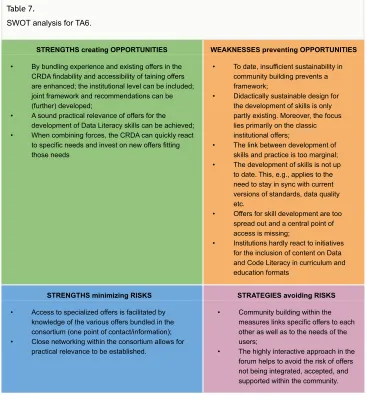
3. Boost professionalization and training in Data Literacy and Code Literacy: Since research processes are increasingly data-driven, it is of crucial importance to be able to critically assess and reflect on the algorithms and software instruments with which the analyses are carried out and the results achieved in scientific and social contexts. Just as the ability to critically assess sources has been part of the repertoire of researchers in the humanities and cultural sciences for a long time, Data and Code Literacy must also be included in the canon as new competences today. Eight professorships with research focuses in Digital Humanities, Digital Musicology, Digital Art History, Media Science, Data Literacy and Digital Methods in combination with four DH study programs and DH centers (Köln, Mainz, Paderborn, Marburg) as well as professional trainers from the cultural economy take part in dedicated task areas and will build a highly efficient network of training offers (Culture Research Data Academy, CRDA) for students and researchers in higher education as well as for employees in the GLAM sector.
4. Foster knowledge exchange and enable innovations through inward-outward cooperation: Openness for collaboration, mutual assistance, sharing of knowledge and technology have been guiding principles of the NFDI4Culture initiative from the beginning and will be at the heart of all workflows and decision-making processes of the planned consortium. In May 2019, a comprehensive Working Paper (NFDI4Culture Working Paper 2019) was published that laid open core topics for mutual discussion and exchange between NFDI4Culture and the larger NFDI community. NFDI4Culture is also one of the initiators of the Memorandum of Understanding (NFDI 2019) of NFDI initiatives in the humanities. It is also a signatory of the Berlin Declaration (Glöckner 2019) of 21 consortia regarding close collaboration on cross-cutting topics in the NFDI. The development of a trans-disciplinary national research data infrastructure through complementary consortia will enable the application of new research methods. In the area of material and immaterial cultural heritage such methods may be automated mechanisms for the enrichment of digital representations, crowd-sourcing approaches to increase metadata coverage and quality, semantic reasoning and knowledge discovery on federated cultural collections or new approaches in computer vision and artificial intelligence that result in multimodally enhanced (data) publications. Besides the provision of a sustainable research data management infrastructure for its community of interest, NFDI4Culture also sees its mission in the development of a cross-disciplinary methodological framework for innovative digital research.
Composition of the consortium and its embedding in the community of interest
participants. The composition aims to ideally represent the broad spectrum of different actors in the cultural heritage domain as described above. The co-applicants comprise
four universities (UHD, UMR, UZK and UPB), three infrastructure institutions (FIZ, TIB and SLUB), Germany’s largest institution in the GLAM sector (SPK) and an Academy of Science (AWLM) covering the long-term foundational research aspects with particular focus on musicology and the fine arts (Fig. 2).
This group is joined by 11 participating academic societies each representing one of the research domains that together make up NFDI4Culture’s community of interest: The Gesellschaft für Musikforschung (German Musicological Society), the International Association of Music Libraries, German section (IAML-DE), the Verband Deutscher Kunsthistoriker (Association of German Art Historians), the Gesellschaft für Medienwissenschaft (Society for Media Studies), the Gesellschaft für Theaterwissenschaft (Society for Theatre Studies), the Gesellschaft für Tanzforschung (Dance Research Society), the Bund deutscher Architekten (Association of German Architects), the Vereinigung der Landesdenkmalpfleger (Union of Regional Conservationists), the Rektorenkonferenz der deutschen Musikhochschulen and the Rektorenkonferenz der deutschen Kunsthochschulen (rector’s conferences of the German universities of music and art) each of which represents 24 higher education institutions and the DHd Verband (Association for Digital Humanities in the German Speaking Area). NFDI4Culture was initiated out of its research community by these very academic societies and
Figure 2.
conceptualized in close cooperation with the participating provider institutions. Therefore, NFDI4Culture is highly embedded in its community of interest. The academic societies will actively participate in the governance of the consortium and co-determine the operationalization of the planned work program together with the co-applicant institutions (Fig. 3).
Participating institutions
Akademie der Wissenschaften und der Literatur | Mainz (AWLM): With 35 long-term research projects (timeframe 12 to 24 years, currently reaching to the year 2040) and a special research focus in musicology and art history the Academy is one of the leading institutions in foundational research in the humanities, cultural studies and fine arts on a national as well as international level. A great number of highly skilled researchers work on musicological oeuvres including those of Beethoven, Brahms, Händel, Haydn, Schubert, Weber, Zimmermann, and others. AWLM also hosts long term art history projects dealing with rare and endangered cultural heritage objects from genres such as medieval stained glass. In view of the necessary administrative infrastructure for smoothly operating the consortium, the Academy provides long-standing expertise in the administration of funds and in scientific project management (currently the AWLM disburses funds for research undertakings in 11 federal states and also manages project funds from the DFG, BMBF and others). AWLM will provide NFDI4Culture with a highly efficient and goal-oriented
Figure 3.
administration. In addition, AWLM has been a very active institution in the field of Digital Humanities and research data management for almost twenty years. The Digital Academy (DA), the Academy’s research department for Digital Humanities, has a high impact on a national and international scale. The research activities of the DA focus on sustainable research software engineering and research data management in the humanities, current web technologies in cultural research contexts, and the application of Linked Open Data to open up new analysis and reuse scenarios. AWLM is one of the co-founding institutions of the DH master’s program Digital methods in the humanities and cultural studies (JGU and HSM) and actively contributes with a DH professorship, regular lectures and international summer schools to the education and training of young academic professionals in a highly relevant area of research. With the dedicated support of the Ministry of Science, Qualification and Culture of the federal state of Rhineland-Palatinate, AWLM will found a center for digital musicological documentation within NFDI4Culture and commit to the consortium's administrative framework beyond the current NFDI funding period.
FIZ Karlsruhe – Leibniz Institut für Informationsinfrastruktur (FIZ): FIZ Karlsruhe makes significant contributions to the information infrastructure by supporting researchers in science, humanities and industry worldwide. FIZ curates and indexes very large amounts of patent information and research data from various sources. Nearly 300 employees develop and operate innovative information services and e-research solutions for precise research and intelligent analysis of these data. FIZ conducts applied research in close collaboration with academic and research organizations and acts as an experienced partner in national as well as European research projects. FIZ is engaged in several high-level working groups and committees dealing with information infrastructure and digital preservation aspects on a national and international level. The department e-Research (IEE) focusses on research data management, digital long-term archiving and virtual research environments. With a strong background in software engineering, it has participated in or led projects like National Hosting of Electronic Resources, RADAR (research data repository), German Newspaper Portal, TOPORAZ (digital space-time model for networked research) and Time Machine Europe. It oversees the operation and software development of the German Digital Library (DBB) and German Archives Portal. IEE brings extensive experience with software development in the Humanities and services such as RADAR to the consortium. Information Service Engineering (ISE) is a research department led by Prof. Harald Sack, covering Semantic Technologies, Knowledge Discovery, Ontological Engineering and Exploratory Search. ISE brings profound experience with the design, implementation and exploitation of ontologies, knowledge graphs, and Linked Data to the consortium. Intellectual property rights in distributed information infrastructures (IGR), led by Prof. Franziska Boehm, deals with copyright, IT (security) and data protection law on a German and EU level. Compliance with data protection and copyright laws are of high importance to the NFDI4Culture Community when it comes to the collection, storage and re-use of research data.
and coordination centers in the German library system, as well as providing a location for lively and intensive social and scientific exchange. With the help of forward-looking technologies, knowledge is produced, transparently networked, and made easily accessible. In its development of digital services (catalog, the digitization software Kitodo, etc.), the library consistently relies on open source products. SLUB coordinates the State Digitization Program for Science and Culture of the Free State of Saxony and the measures to safeguard Saxony's audiovisual heritage. In doing so, SLUB can draw upon the wide technical expertise of the Dresden Digitization Centre, and has, thus, been able to yield an average digitization volume of three million images in recent years. SLUB operates a productive long-term archive and possesses competence in LTA requirements for various media types. It is actively involved in the development of metadata standards (e.g. METS/ MODS, LIDO) and of standard data models. SLUB provides the research data support service for the Technical University Dresden (Excellence University) and is a founding member of the SaxFDM research data management network. With the Deutsche Fotothek (DF), SLUB operates one of the most important public image archives in Europe. With its Archive of Photographers, DF is committed to the preservation and publication of German photographic heritage. In its image database, DF publishes image media from around 100 partner institutions (research institutes, museums, libraries, archives). It also acts as an aggregator and content partner for DDB and Europeana. DF supports the expansion and design of research data infrastructure by offering innovative tools and services for image indexing, research, and analysis. Furthermore, it is home to DDB's Image/Photography Department, and also provides the spokesperson of AKBF (Consortium for Art-Historical
Picture and Photographic Libraries). Founded in 1816, the Music Department of SLUB
houses one of the most important collections of musical sources in Germany. Its holdings (textual sources and AV materials) are consistently directed towards the digital space. It holds a national RISM office and DDB’s Sound Department. SLUB coordinates an average of 17 third-party funded projects per year with an average annual volume of €2 million. SLUB is tasked by the DFG with providing such services as the FIDs Kunst Fotografie Design (in cooperation with UHD/UB), and Musikwissenschaft (in cooperation with BSB). In doing so, SLUB offers the international research community key infrastructure components, such as the portal arthistoricum.net, musiconn.publish (subject repository), and musiconn.performance, a research data hub on cultural events.
provide access for the specific requirements of researchers and the general public. Increasingly, data enrichment methods, which are also developed or applied within the Foundation, as well as data analysis methods are becoming more important. The organizational reorientation of SPK was manifested by appointing Chief Digital Officers by the establishment of a dedicated team in 2017. In NFDI4Culture, SPK and its institutions will contribute as an infrastructure provider between culture, research and science. Through a large number of national and international projects, it has rich experience in the organization and design of collaborative undertakings, especially in the object-oriented research field of text, image and moving image, physical and audio artifact. SPK is motivated by the opportunity to work closer with the NFDI4Culture research communities and to translate their requirements into better and transferable services. At the same time, there is an opportunity to better communicate and interlink the (basic) research carried out within the foundation and to contribute this potential to the consortium as a whole.
Technische Informationsbibliothek Hannover (TIB): The German National Library for Science and Technology (TIB) represents and operates a national research infrastructure facility for the provision of scientific information. TIB preserves and organizes information, data and knowledge in its target domains, such as architecture, and provides direct access to these large-scale information spaces through digital services, irrespective of time and place. With its vast collections and innovative services, TIB aims to support the complete lifecycle of research and the digitization of science and technology in general. As the world's largest specialized information center in its fields, TIB has outstanding expertise in developing, managing and preserving knowledge, particularly in key areas such as grey literature, big research data, vocabularies and ontologies, films and 3D objects, as well as patents and standards. Some examples of key services include the TIB portal giving access to more that 100 Million documents and research artifacts, the audio-visual portal AV-Portal comprising more than 15.000 scientific videos, license negotiation, Open Access and Digital Preservation offers, the research data management software Leibniz Data Manager or the collaborative OpenCourseWare authoring platform SlideWiki. In 2009 TIB founded the DataCite association with currently more than 130 international member organizations and provides the DataCite headquarters. In close cooperation with L3S research center from Leibniz University Hannover, TIB performs world-class research aiming to advance information, data and knowledge sharing in the digital age, for example with its Open Research Knowledge Graph. Research and development at TIB include Visual Analytics, Data Science, Scientific Data Management, Open Science, and Non-textual materials. TIB is increasingly active in the field of open culture, both in third-party funded projects and in community building. Partners are Europeana, Time Machine, Wikimedia, and other communities dedicated to free knowledge.
Library (UHD/UB) has developed electronic information infrastructures in pilot projects over the past two decades that have set standards for open science. These projects range from state-of-the-art digitization technologies and workflows, to innovative electronic publishing platforms such as Heidelberg University Publishing (heiUP), which publishes high-quality research work in several digital formats in Open Access, and also offers comprehensive research data management services. Within the framework of its FIDs Kunst, Fotografie, Design and Altertumswissenschaften, which are supported by the DFG, UHD/UB has for many years been taking on central tasks in the field of value-added infrastructure services for the art and classical studies community, in addition to the nationwide provision of literature and information throughout Germany. The focus here is on electronic publishing in Open Access, with innovative design of traditional formats playing a major role. In addition to aspects of informal communication and collaborative work, this also includes linking to other sources and integrating multimedia content or related research data. For this purpose, dynamic and collaborative publication services have been developed. Future cooperation within the NFDI will serve to strengthen these existing and well-used services within the specialist community, to further develop them in line with demand and to make them usable beyond the boundaries of the subject areas supported in Heidelberg. UHD focuses on electronic publishing (including the archiving of research data) and the development of workflows, business models and best-practice offers based on international standards and has great networking potential due to the high likelihood of subsequent use by other specialist communities. The predominant use of standard software under open source licenses, combined with the strong demand for Heidelberg's infrastructure offers by scientists, results in a broad range of opportunities for the use of developed services and technologies, both by subject-related disciplines within NFDI4Culture, and in other sciences and their NFDI consortia.
using prometheus and there are currently also 8,000 active personalized accounts. In addition, the faculty provides a research-oriented data center (DCH) that addresses the needs of researchers in the dedicated humanities research data management. The Cologne Center for eHumanities (CCeH) is a member-supported teaching and research center at the Faculty of Arts and Humanities. In this capacity, UZK represents the interests in research data management of a large number of researchers who deal with objects of material and immaterial cultural heritage.
Philipps-Universität Marburg (UMR): UMR covers a wide range of disciplines and has a long tradition in cultural science, e.g. in art history and media studies. Its comprehensive research data infrastructure is well recognized for its cooperation with other research institutes and GLAMs, forming an ecosystem for digital research data preservation and accessibility with a notable focus on cultural assets. UMR has founded a local service center for e-research to support its scientists in all aspects of digitally assisted research. It has the lead within the joint project Hessische Forschungsdateninfrastrukturen (Hessian Research Data Infrastructure) which fosters a coordinated Hessian-wide research data support. With the projects FOKUS and TRUST, UMR has built up major competencies in promoting Data and Code Literacy. TRUST gained one out of five prizes in a nation-wide contest for digital skill development. UMR is one of 15 universities within the Data Literacy Education network driven by the Stifterverband. The German Documentation Center for Art History (DDK) is an internationally acclaimed research and service institute for art history and related disciplines. Its mission is to collect, index and make available image materials related to European art and architecture as well as to conduct research on the history, practice and theory of how visual cultural assets are passed on. It is further actively involved in designing workflow standards for the international museum community. For more than 30 years, DDK has been enabling and supporting the digitization of the inventory data of about 100 partner institutions (museums, offices for the protection of historic monuments, libraries, archives and research institutes) along with its own scholarly photographic collection. For scientific reuse, it publishes the data in its image databases and on other (research) web platforms. DDK has explored the application of standards and data quality management in dozens of projects and has provided expertise and recommendations for a sustainable data management. In current projects, DDK develops a systematic, FAIR-based quality assurance management of structured research data on objects of material culture. It also engages in the adaption of the GND (DNB) to meet the requirements of non-librarian cultural heritage and humanities communities. In the NFDI it focuses on standards and interoperability of data from various sources, as well as on facilitated use and reuse. In addition, UMR is establishing the Marburg Center for Digital Culture and Infrastructure (MCDCI) that combines scientific expertise, e-research infrastructure, local cooperation in digital humanities and competencies in cultural data studies. Cooperative professorships with the AWLM and strategically aligned professorships from UMR form the center of the digital humanities cluster.
contribute to the scientific and technological development of the information society and to critically reflect these developments by taking into account the history, norms, and values of society, it complements the spectrum of "hard" sciences with the arts and humanities and to successfully learn from each other. Its mission includes a strong international and cultural presence, since the information society is decidedly global and should not remain a purely intellectual undertaking. In 2014, Digital Humanities were defined as one of the five key research areas of the University (with several interdisciplinary research institutes and many corresponding project activities). In 2019, UPB established the master study program Digital Humanities. For 15 years, the Musicological Department of UPB has been developing software tools for musical editing. Since then, the so-called “Edirom tools" have been used in many editorial projects. 10 years ago, the Edirom-Summer-School was established in order to promote the use of international standards like TEI and MEI and to provide students and participants from the academic or cultural community with all necessary skills around X-technologies and digital editions software. In 2014, the BMBF-Center for Music, Edition, Media (ZenMEM) was founded which is active in the field of tool-development and critical assessment of new tendencies in software tool-development for the humanities. At the same time, ZenMEM is an important consultant for musicological projects and acts as an agency service for training and education. ZenMEM is the central contact point for digital musicology in Germany. Members are involved in the international TEI and MEI community and in developing solutions relevant to scholars beyond national and disciplinary borders. Besides its musicological research and services, UPB places a strong focus on cultural heritage in general. The competence center Cultural Heritage: Material, Immaterial, Digital serves as a central agency for the coordination of research in this area and provides education and services around methods in Digital Humanities. Since 2006, the center serves the Paderborner Bildarchiv with images of e.g. art, architecture, urban development, and sculptures which is searchable through prometheus.
To ensure optimal acceptance by its community of interest, NFDI4Culture integrates a broad spectrum of participants from all areas of the cultural heritage sector. With regard to the highly diversified research landscape already described above this is the only approach that will lead to successful, demand-oriented service offers and real user participation. For this reason, the scope of participants that contribute to NFDI4Culture’s work program ranges from subject-specific international organizations such as RISM (musicology, working groups in 35 countries) or CVMA (art history, 17 member countries), international research institutions like the Hertziana (Rome) and DFK Paris to national GLAM institutions like DNB or GNM, smaller research institutions with high impact such as the Beethoven Haus Bonn (BHB) to universities (such as FAU, LMU and UdK) and archives from the public media sector such as the Deutsches Rundfunkarchiv (DRA). Besides this, NFDI4Culture has the support of numerous governmental and non-governmental organizations such as the German Music Council (Deutscher Musikrat), the German Commission for UNESCO, the Union of the German Academies of Sciences and Humanities as well as international organizations such as, ORCID, DataCite, the
Analysis of the existing research and infrastructure environment and development of the planned consortium according to the users’ needs
The envisaged research data infrastructure is based on a thorough analysis of the existing research landscape. At the time of writing, 76 relevant data collections with millions of records have been identified (with widely differing levels of standardization and quality assurance), that are already curated at one of the co-applicant or participant institutions. Five long-term repository and publication solutions for 2D, 3D and audio-visual cultural assets exist that are operated through the consortium partners. Regarding storage and publication infrastructures, many good solutions already exist in the area of 2D digital representations, documents and metadata, whereas the area of 3D digital representations and multimodal publications will need reference implementations that pave the way for standardization and interoperability. There are 51 research software tools by consortium members and 35 subject-specific information infrastructures (24 written or operated by members of NFDI4Culture) that need to be considered when dealing with research data of tangible and intangible cultural assets. This clearly demonstrates the broad technological potential on the one hand but also the great challenge on the other because the software quality and sustainability of those technical components is not yet subject to a defined process of quality assurance and monitoring. Solutions for this will be developed in a dedicated task area of the work program and in close cooperation with similar approaches in other NFDI consortia. With regard to teaching materials, the planned consortium can already fall back on a solid basis of existing training offers (33 by consortium members, incl. professorships). Nevertheless, coordinated teaching approaches to Data and Code Literacy (especially in the field of train-the-trainer offers) are still missing and will be developed through dedicated measures in the work program.
Means of communication and collaborative development of the consortium
The development of NFDI4Culture took place in a two-year collaboration between users and providers in the research domain of material and immaterial cultural heritage. The overarching needs and challenges of "Research-driven infrastructures in the humanities" were discussed early on in the NFDI process between representatives of academic associations, universities, memory institutions and infrastructure providers during three workshops conducted by CLARIN, DARIAH, the Union of the German Academies of Sciences and Humanities and the DHd Association in 2018. The workshops clearly showed that research data in the humanities varies greatly in terms of quantity, quality, dynamism, level of standardization, degree of abstraction, legal and ethical circumstances, and subject specific data types. Therefore, the demands of the humanities in the NFDI can be best met with a coordinated effort that takes a disciplinary as well as methodological approach. To reach this goal, a network of cooperating NFDI initiatives with subject-specific, distinct areas of responsibility and complementary fields of action was formed.
providers. The needs and demands of the users were gathered during dedicated workshops on research data management in art history, musicology and related disciplines in 2018. These workshops paved the way for the foundation of the consortium initiative in December 2018. Integration, collaboration, networking, knowledge exchange and openness have been the guiding principles from the beginning. With regard to networking and collaboration, NFDI4Culture has been a regular participant and active contributor to the NFDI Forum (March, June 2019) of the DHd Association (which will also dispatch a delegate to NFDI4Cultures’ steering board and ensure tight relations to academic associations engaged in other NFDI consortia via the NFDI Forum of the DHd). NFDI4Culture also initiated several networking workshops of NFDI initiatives in the humanities (April, June 2019) and is one of the signatories of the Memorandum of Understanding of NFDI initiatives that has been the result of these workshops.
For the first time a coordinated initiative of this scale takes place in the field of material and immaterial cultural assets. Since 2018 it has already created a very positive impact on
and gathered strong acceptance in the participating disciplines. Because NFDI4Culture follows a new and innovative approach for its area of concern, care has been taken to test the effectiveness and adequacy of the plans at a very early stage. From February to October 2019 the consortium initiative tested its planned workflows in a proto-operational phase. One example for this is the jointly founded NFDI4Culture Coordination Office (NCCO; 3 FTE provided by the (co-)applicants). The staff of the NCCO has been working closely with the designated spokesperson, co-spokespersons and representatives from the scientific communities and associations. A transparent and iterative process for participation was put into practice based on a large-scale survey (May to August 2019) that continuously collected, evaluated and structured information and feedback about existing infrastructure components, tools and services from the community of interest (Fig. 4).
The NCCO oversaw the publication of the NFDI4Culture Working Paper for the NFDI conference of the DFG in May 2019. Many of the topics introduced by NFDI4Culture’s perspective (such as Data and Code Literacy, sustainable research software engineering, standardization and quality assurance and development of authority data) have become essential cross-cutting concerns for the NFDI at large (also cf. the Berlin Declaration from September 2019).
Interaction between users and providers
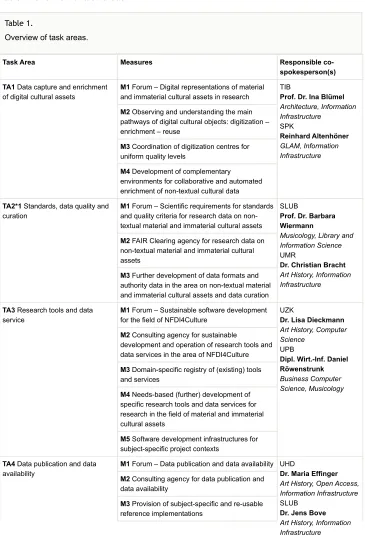
Much care has been taken to create structures within the consortium that are evenly balanced between users and providers. This starts with the composition of the group of co-applicants comprising four universities with particular research focuses (art history, musicology, theatre studies etc.), four infrastructure facilities (one from the GLAM sector) and one academy of science providing research as well as infrastructure. This also holds true for the designated (co-)spokespersons, each of which has long-standing expertise with regard to scientific infrastructures and is also an expert researcher in one of the subject domains covered by NFDI4Culture. The consortium's work program also provides for a wide range of participation opportunities for users. Each of the six task areas will establish a specialized forum in which users from the community of interest will closely and continuously work on the central topics together with experts from the provider institutions. Forums are organized and managed by the respective co-spokespersons of each task area. They do not only foster knowledge exchange – they are long-term participatory structures that will also produce guidelines and recommendations to the steering board and effectively mirror the changing needs of the user community. Forums will also provide important monitoring functions to the operationalization of the work program. Further interaction between users and NFDI4Culture also takes place on the level of consultation. Each of the task areas will implement measures for setting up specialized helpdesks (i.e. regarding digitization, data standards, sustainable software, archiving and publication, legal and ethical issues and training). The NFDI4Culture
information portal will provide a single point of contact for the users from where inquiries and feedback are directed to the responsible helpdesk. NFDI4Culture plans two coordination offices, one administrative and one technical, that will oversee that the
Figure 4.
inquiries are processed, documented and replied to in an appropriate time frame. The
Culture Community Plenary will be a focal point of interaction between users and providers (cf. chap. Organizational Structure and Viability). During this two day event (planned each autumn) the NFDI4Culture Community and all organs of the governance body (the steering board, the advisory council, the task teams and the forum working groups) come together to discuss the current state of the consortium’s work and decide on ideas and plans for the next year. This will also be the point where proposals for candidates and elections for seats in the governance bodies will take place and where new members may join the consortium and meet the community.
The consortium within the NFDI
Cooperation with other NFDI consortia
NFDI4Culture has established a continuous and productive dialogue with other consortia to foster inward–outward cooperation in the NFDI. NFDI4Culture’s work program has been discussed openly with representatives from other consortia
during the Culture Community Workshop and advice from this feedback process has been integrated during the finalization phase of the proposal. In the humanities, the consortium is one of the initiators and signatories of the joint Memorandum of Understanding. The other three signatories are the initiatives NFDI4Objects, NFDI4Memory and Text+. The Memorandum defines the responsibilities and modes of cooperation between the four partners with the aim to create a meshed structure with a complementary division of tasks that best addresses the diverse needs of the highly differentiated research landscape in the humanities. Additionally, NFDI4Culture is one of the 21 signatories of the Berlin Declaration on cross-cutting topics in the NFDI (Glöckner 2019). The consortium closely embraces the spirit of cooperation and the goals of the Declaration and will actively contribute to the cooperative treatment of topics such as metadata harmonization, provenance concepts, interoperability across research domains, legal and ethical aspects, terminologies and linked data services, and the development of training concepts for Data and Code Literacy.
approaches. On the basis of this cooperation, MARDI and NFDI4Culture hope for good coverage of these research data categories and aim to evolve their work into a generic standard that is also useful to other consortia and the NFDI in general. In the area of training and qualification, NFDI4Ing and NFDI4Culture have identified Data Literacy, Code Literacy, and the provision of open educational resources as cross-cutting topics for close collaboration. Both consortia also intend to cooperate in the area of standardization and curation of 3D data types (e.g., CAAD models and other forms of 3D representations). Since image data plays an important part in NFDI4Neuroscience and NFDI4Culture, both consortia plan to cooperate in the standardization of image metadata and image formats and in the joint development of image analysis tools in the field of computer vision. Text+ and NFDI4Culture intend to explore data standardization potentials at the interface between musicology and philology (taking MEI and TEI as a starting point).
Members participating in other NFDI consortia
Members of NFDI4Culture participate in the following NFDI consortia and commit to strengthening the institutional network within the NFDI across subject areas and research domains:
• Astro-NFDI: UMR (participant), TIB (participant), UZK (participant) • BERD@NFDI: UZK (co-applicant)
• DAPHNE: TIB (participant)
• FAIRMat: UPB (participant), TIB (participant) • ForumX: UZK (co-applicant),
• MaRDI: FIZ (co-applicant) • NFDI4Agri: FIZ (co-applicant)
• NFDI4Biodiversity: UMR (co-applicant), SUBG (participant)
• NFDI4Chem: FIZ (co-applicant), TIB (co-applicant), UZK (participant) • NFDI4Earth: TIB (participant), UZK (participant)
• NFDI4Health: UZK (co-applicant/participant) • NFDI4Ing: TIB (co-applicant), SLUB (participant) • NFDI4Memory: FIZ (co-applicant), HI (co-applicant) • NFDI4MSE: FIZ (co-applicant)
• NFDI4MobilTech: FIZ (co-applicant), SLUB (participant), TIB (participant) • NFDI4Neuroscience: UMR (participant)
• NFDI4Objects: SPK (co-applicant), UZK (participant) • PAHN-PaN: TIB (participant), UZK (co-applicant)
• Text+: AWLM (participant), DNB (co-applicant), SUBG (co-applicant), UPB (participant), UZK (participant)
Contributions to the NFDI as a whole
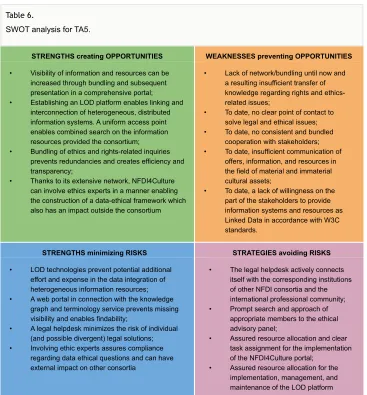
metadata, the development and sustainable curation of authority data and data harmonization workflows. NFDI4Culture deals with complex data types (that consist of a combination of basic data types like semantically annotated 3D reconstructions of historic buildings, multimodal works of art like music, theatre or dance performances consisting of annotated video and/or audio streams, etc.). The consortium will develop standardization recommendations and reference implementations for long-term archiving and publication solutions for complex data types and will be glad to exchange knowledge and technologies with other consortia. The partners of NFDI4Culture are very much aware that the field of rights management and ethical advice for research data can only be solved in close cooperation on the NFDI level. Since legal expertise and data ethics are of primary importance for research in the field of cultural heritage as well as the NFDI in general, NFDI4Culture has planned dedicated measures in its work program, e.g. the establishment of a legal helpdesk and an advisory panel on data ethics (cf. TA5|M4, TA5|M5). It will also initiate a stakeholder process for the development of a legal framework for research data (cf. TA5|M5). These measures could also provide expertise to the NFDI as a whole.
Together with the participating universities and in exchange with other NFDI consortia, NFDI4Culture plans to implement training and education programs in Data and Code Literacy, two skills that will become indispensable for future research in any subject. NFDI4Culture also has a strong grounding in the field of linked data and the semantic web. Concepts for the collaborative curation of terminologies and the active onboarding and engagement of users from research as well as from citizen science and the joint creation and community-driven curation of an overarching knowledge graph on tangible and intangible cultural assets have been developed together with
Wikimedia and could be an interesting methodological approach for other NFDI consortia as well. On a more general level, due to the close connection of its research domain with cultural politics and the cultural economy, NFDI4Culture intends to contribute the results and experiences with regard to the development of adequate models for public/private partnerships in the NFDI. The consortium can also share knowledge and best practices from its experience in integrating a diversified landscape of disparate research units into a consortium’s network.
Expectations from the NFDI
NFDI4Culture defines three levels of action in regard to cross-cutting topics:
1. at the level of the consortium itself, pooling user needs from different research communities covered by the consortium,
2. at the level of cooperation between several consortia, sharing common methodological or technological expertise for the benefit of a larger user base and 3. generic solutions at the level of the NFDI as a whole.
expert committee and the results of the DFG’s NFDI governance workshop in August 2019 that need to be decided within the NFDI’s collaborative framework:
• A common legal framework as well as a single legal entity for the NFDI to which consortia can join as members while allowing to keep their internal structures
that have been carefully considered with respect to their community of interest. • Joint development of a Research Data Commons as outlined in the Berlin
Declaration. This cross-consortia infrastructure should include NFDI-wide solutions for a common authentication and authorization infrastructure (AAI) which must include a flexible access management for data sets that are subject to particular legal and ethical obligations. It should include solutions for persistent identifier management (PIDs).
• Joint data federation solutions and federated discovery systems across NFDI consortia and close collaboration in the area of terminology services and linked data.
• Joint development and exchange of experiences regarding adequate operating models (especially for long-term operation, archiving and data publication). This also includes a common NFDI certification scheme for the services offered by the NFDI.
• Joint development of new reputation schemes and academic credit systems
that will support a cultural change towards new forms of academic contributions and achievements (like data publications or research software).
• Joint development of subject specific as well as general criteria for the sustainability and long-term provision of research software.
International networking
association also has a strong international network. On the one hand through the language-bound definition of its area of responsibility, which per se includes not only Germany, but also Austria and (German-speaking) Switzerland. DHd is an associate organization in the European Association for Digital Humanities (EADH), which in turn is a constituent organization in the Alliance of Digital Humanities Organizations (ADHO).
International interaction also takes place on the participant level of the consortium. Several institutions have joined NFDI4Culture, each with an outstanding international impact, for example the KHI Florenz (Italy), the Hertziana (Italy), the DFK Paris (France) or RISM-CH (Switzerland). NFDI4Culture also has participants that provide subject-specific, large-scale international research infrastructures. For the field of musicology
RISM, initiated and accompanied to this day by IAML and IMS, can be named as an example with its working groups in 35 countries across the globe. In the field of art history, there are scientific connections to 17 countries through the CVMA, while the network
PHAROS (members from NFDI4Culture are UMR/DDK and the Hertziana), the International Consortium of Photo Archives, creates a digital research platform allowing for comprehensive consolidated access to photo archive images and their associated metadata worldwide. The prometheus image archive (UZK/prom) consists of an international consortium with 162 institutions, 35 of which are located in Europe and the US and already integrates up to 10% of research data from other European Countries. NFDI4Culture also interacts with international academic networks such as the
International Association of Music Libraries (IAML, the German chapter is a participant of the consortium), the International Musicological Society (IMS) and the European Federation of Academies of Sciences and Humanities (ALLEA), representing more than 50 academies from over 40 countries in Europe. With AGATE (A European Science Academies Gateway for the Humanities and Social Sciences) the AWLM develops and operates a digital research information system with a European perspective that can connect information from foundational SSH research to the consortium.
Members of NFDI4Culture engage in numerous international standardization bodies
for research data on material and immaterial cultural assets and will ensure mutual transfer of knowledge and work results between the consortium and those initiatives. Examples are the MEI standard (via the GfM, UPB, and AWLM), the LIDO standard, the CIDOC CRM, the Iconclass classification system and IIIF (via UMR/DDK, SUBG and TIB). Members of NFDI4Culture further engage in outstanding European GLAM initiatives such as Europeana, contributing to an open, knowledgeable and creative society. Key providers in the field of international research have expressed their strong interest for collaboration and their support for NFDI4Culture. Institutionally, this ranges from the Getty Research Institute, to subject-specific research data initiatives such as the MEI community and
Organizational structure and viability
At the time of writing, the consortium consists of the nine co-applicants, 11 participating academic societies and 51 participants from universities, research institutions, GLAM institutions, and cultural heritage initiatives and associations. Together they represent the full spectrum of the diversified research landscape with regard to material and immaterial cultural heritage which is crucial for ensuring the acceptance of the consortium’s services in its community of interest. All participants have expressed their explicit commitment and contributions to the consortium in letters of commitment.
NFDI4Culture implements four guiding principles:
1. lean decision-making,
2. transparent communication and easy participation,
3. promotion of innovative solutions for the needs of users and providers, and 4. rapid adaptation of operationalization strategies in response to (changing)
needs in the community of interest.
These principles also serve as the four success criteria for the periodic evaluation of the governance that will take place every second year (for the first funding period: autumn 2022 and autumn 2024).
The planned internal structure of the consortium consists of three levels: academic societies, participants and co-applicants together form the community level with its
central representative organ, the yearly Culture Community Plenary. On the operative level of the consortium, measures from the work program are realized by members of the community (co-applicants and participants). The operative level provides participatory structures for the community that are anchored in each task area (forums and task teams), consultation structures for the users of the consortiums’ services (specialized helpdesks, consultation agencies, clearing agencies), and overarching coordination structures (the administrative and technical coordination offices) for the smooth running of the consortium. The governance level consists of three organs: the Culture Steering Board acts as the central body in all decision making processes of the consortium, the
Culture Spokesperson Committee serves as the executive organ that oversees and takes responsibility for the proper and timely realization of the measures of the work program and the Culture Advisory Council that serves as an independent body that gives advice, assists with proposals for the resolution of controversial issues and connects NFDI4Culture’s governance level to the governance level of other NFDI consortia and the NFDI as a whole (Fig. 5).
Communication, cooperation, responsibilities and decision-making
spokesperson committee) and invited guests from national and international research and infrastructure come together to discuss the current state of the consortium, present results of finished tasks, validate the progress of the work program and shape the consortium’s strategy for the next year. During the CCP, members of the community can present and submit proposals to the steering board for the realization of topics covered by one of the dedicated budgets that are planned for the enhancement of NFDI4Culture’s service offerings (e.g. for data curation and rescue, tool and data service improvements, development of training offers and the support of research projects that apply for third party funding). Proposals always have to be substantiated with a reasonable need analysis and have to be prepared collaboratively between users and providers in the forums of NFDI4Culture.
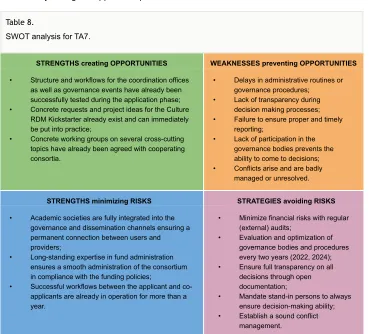
Culture Forums (CF): Forums are the key participatory structure of NFDI4Culture. Each of the six task areas provides a forum that is managed by the responsible co-spokesperson and the staff from the administrative and technical coordination offices. Forums are open structures in which providers (co-applicants, participants) and users from research work together on specific topics in each task area (data capture, development of standards, software sustainability, long-term archiving, rights and ethics, training offers etc.). Forums do not only provide a continuous knowledge exchange, they also fulfill a monitoring function and produce substantial and measurable output (e.g. in the form of guidelines, proposals for fund usage etc.).
Helpdesks, consultation agencies, clearing agencies: To guarantee optimal service brokerage and provide easy orientation to the users of NFDI4Culture, each task area will set up a subject-specific consultation structure which will be the starting point for inquiries. The analysis of the users' demands has shown that this content-driven, federated
Figure 5.
approach will suit the needs of NFDI4Cultures’s community of interest much better than a one-fits-all solution. Central consultation services of the consortium therefore consist in two clearing positions (for data capture and enrichment and implementation of FAIR data), two consultation agencies (for research tools and long-term data archiving and publication) and two dedicated helpdesks (for legal aspects and training offers).
Administrative and Technical Coordination Offices (ACO / TCO): To ensure the smooth operation of the consortium with regard to all administrative issues (reporting, contract management, financial management, documentation, etc.) and to provide an overarching and long-term technical perspective that reaches beyond single measures in the work program the consortium will set up two offices: the administrative and the technical coordination office. The staff of the two offices closely works together with the task area co spokespersons and the Spokesperson Committee. Both offices operate as distributed coordination structures and each of the co-applicant institutions has dedicated staff in both offices. The ACO lead rests with AWLM and the TCO lead rests with FIZ. ACO and TCO set up a tight coordination network for the consortium using weekly stand-ups moderated by the ACO and the TCO leads and report progress to the Spokesperson Committee at least once a month. This has proven to be very successful during the application phase with the NFDI4Culture coordination office (NCCO) being a prototype of this structure.
Culture Spokesperson Committee (CSC): The CSC is the central executive body in NFDI4Culture’s governance. It consists of all co-spokesperson and has the responsibility to coordinate, monitor and realize the implementation of the work program. The CSC bears the financial responsibility towards the DFG and ensures that funds are always used in compliance with the NFDI’s funding policy. The CSC has to check and give approval to all financial decisions made by the other organs of the consortium’s governance. The applicant institution will perform a final compliance check for the use of funds. In case a financial decision does not pass the check by the CSC and the applicant institution, it is returned to the CSB for reworking. The CSC sends six representatives (one for each task area) and the consortium’s spokesperson to the steering board. The CSC conducts a monthly conference in which upcoming tasks are discussed and decisions on the efficient realization of measures are taken.
Culture Advisory Council (CAC): The CAC is a body of up to twelve independent counselors from national and international research and infrastructure and cooperating NFDI consortia (its exact composition may vary over time). The members are nominated and invited to the CAC by the CSB. The CAC advises the consortium on (long-term) strategic issues and can be requested to give recommendations on proposals from the community for the use of grants for the enhancement of the consortium’s services. The CAC has full access to all reports and work results and takes part in the yearly Culture Community Plenary. It can also be requested to give counsel in controversial issues, always taking into account general developments and goals in the NFDI and beyond.
Reporting, guidelines for decision-making, conflict resolution
Disbursement of funds
As applicant institution of NFDI4Culture the AWLM will set up a cooperation agreement between the members of the consortium and ensure the implementation of the DFG’s compliance rules on all levels of the consortium. Since the AWLM acts as a funding institution in the Academies’ program of the Union of the German Academies of Sciences (federal and state funding), she has proven financial control mechanisms and established administrative workflows to ensure the appropriate use of funds during disbursement to co-applicants and participants. Regular financial controlling and yearly (external) audits will be implemented by the AWLM’s ACO lead (sciences administration staff of the consortium) in close information exchange with the consortium’s spokesperson. The AWLM will set up individual agreements for the transfer of funds using the sample cooperation agreement provided by the DFG (if applicable). This will also be applied to future cooperation between co-applicants and (possibly new) participants. Grants to participants will only be released after a proposal and evaluation process by the governance bodies (Community Plenary, Steering Board, Advisory Council) as described above has taken place and an official disbursement decision by CSB/CSC has been filed to the ACO.
Viability of structures
NFDI4Culture has included several measures in its work program to develop adequate business and operational models in the field of research data management on tangible and intangible cultural assets (cf. TA4|M5, TA6|M3 and TA7|M3). Since collaboration in the consortium will extend over a period of at least 10 years, it is to be expected that consortium partners may withdraw, or new partners may join the consortium. To this end, NFDI4Culture provides consolidated admission and withdrawal processes via the CSB. In addition, a mechanism will be implemented to review the overall structure of the consortium every two years (internal evaluation 2022 and 2024) in order to implement necessary structural adjustments in response to the changing needs of the users. Long-term viability and permanent acceptance in the community of interest will largely depend on the flexibility in the use of funds and the implementation of an innovation performance radar in response to the user feedback gathered through the many participation channels of the consortium (forums, teams, helpdesks, information portal etc.).
Operating model
(contracted members of the consortium) with the sole purpose of promoting science and research and only by way of a genuine grant. As a strong advocate of the Berlin Declaration, NFDI4Culture looks forward to close collaboration with other NFDI consortia and the NFDI directorate on this topic.
Research Data Management Strategy
Since the tangible and intangible dimensions of non-textual cultural assets have an intrinsic value that is never fully realized in a digital representation, the research data targeted by NFDI4Culture is subject to specific requirements: First, it is necessary to
differentiate between digital representations (reproductions) of cultural assets, including their metadata, and procedural research data resulting from research processes on material and immaterial assets. Second, it must always be taken into account that digital representations of cultural assets can become immaterial cultural assets in themselves. This opens up new perspectives and innovative aspects for future research. Third, material and immaterial cultural assets are often subject to complex legal and sometimes ethical conditions. This also holds true for research data generated from such assets, which then requires thoroughly considering copyrights and personal rights (Klimpel 2015, Klimpel and König 2015) as well as questions of provenance during the whole research data life cycle. Fourth, research data as an outcome of research processes on material and immaterial cultural assets can be closely linked to the cultural economy that uses the results for economic purposes. In turn, the cultural products created by the economic use of this data can themselves become the objects of research among the communities addressed by the consortium. The users participating in NFDI4Culture do not only generate data about their research objects (through metadata or annotations), the research objects themselves (usually in the form of digitized representations) become an inseparable part of the research data life cycle as well.
Overview of data types to be managed
The consortium’s RDM strategy deals with complex multimodal data types on two levels:
1. digital representations of cultural assets, such as all forms of 2D digital reproductions, (e.g. of paintings, sculptures, sheet music, scores, but also of performed works, etc.), 3D models of cultural assets (from artifacts to large man-made structures such as monuments, buildings or rooms) created by photogrammetric processes, laser-based 3D scanners or structured light systems or by (re-)construction using 3D modeling software, all types of audiovisual data
on material and immaterial cultural assets (music, film, stage performances etc.), and
CAAD or rendering programs, computer-based simulations of cultural spaces or artistic performances, encoding and annotation formats (e.g. XML-based formats for encoding music or annotating images, time tags or shape annotations for videos, etc.), metadata and serializations of semantic models (e.g. CIDOC CRM, IFLA LRM and other derivatives) for the description of material and immaterial cultural assets, exchange formats (e.g. IIIF, LIDO), authority data (e.g. GND, Getty: AAT, TGN, ULAN) (Fig. 6).
Development of the work program, user involvement and acceptance
The work program is the result of close collaboration between users and providers
during several extensive community workshops (August to December 2018; February, July, September 2019) and a large-scale survey of existing RDM infrastructures (April to August 2019). 51 institutions have expressed their interest in NFDI4Culture and submitted contributions to the consortium’s infrastructure and services. The survey showed that there is great demand for a consortium dealing with research data on material and immaterial cultural heritage within the NFDI and that the consortium can draw on many mature (long-term) publication infrastructures, repositories and software solutions as well as on well-developed materials and expertise in the area of legal services and teaching/training. On the basis of the survey data, the consortium partners have identified and formalized 28
Figure 6.