The University of San Francisco
USF Scholarship: a digital repository @ Gleeson Library |
Geschke Center
Master's Theses Theses, Dissertations, Capstones and Projects
5-7-1999
The Effect of Community Service on High School
Students' Perceptions of Nonprofit and Public
Organizations
Lara Pepp RajningerUniversity of San Francisco
Follow this and additional works at:https://repository.usfca.edu/thes
This Thesis is brought to you for free and open access by the Theses, Dissertations, Capstones and Projects at USF Scholarship: a digital repository @ Gleeson Library | Geschke Center. It has been accepted for inclusion in Master's Theses by an authorized administrator of USF Scholarship: a digital
Recommended Citation
Rajninger, Lara Pepp, "The Effect of Community Service on High School Students' Perceptions of Nonprofit and Public Organizations" (1999).Master's Theses. 1142.
The author of this thesis has agreed to make available
to the University community and the public a copy of this dissertation project.
Unauthorized reproduction of any portion of this dissertation is prohibited.
The quality of this reproduction is
contingent upon the quality of the original copy submitted.
University of San Francisco Gleeson Library/Geschke Center
2130 Fulton Street
The Effect of Community Service on High School Students' Perceptions of Nonprofit and Public Organizations
A THESIS SUBMITTED
by
Lara Pepp Rajninger
In Partial Fulfillment of the Requirements
For the Degree of
Master of
Nonprofit Administration
The University of San Francisco
L...V
'1~&1
<;\L?Sf3
"'315
The Effect of Community Service on High School Students' Perceptions of Nonprofit and Public OrganizationsThis Thesis written by
Lara Pepp Rajninger
This Thesis written under the guidelines of the Faculty Advisory Committee, and approved by all its members, has been accepted in partial fulfillment of the requirements for the degree of:
Master of Nonprofit Administration
at the
University of San Francisco
Research Committee:
~-~ fid~/
__
--~~{~~~~~~--~~~~
Chairperson
-~:-_c__f~~----~.:
nd Reader.>"-~~~ _~L,~
---~-~-~~
Program Director Date
J.J-~---~
1
§..;;_~----~lL'Ll-'l_f
___ _
TABLE OF CONTENTS
Abstract
Vita Auctoris
Acknowledgements
List of Tables
List of Appendices
Chapter One: Introduction
Chapter Two: Review of Related Literature
Chapter Three: Methodology
Chapter Four: Results
Chapter Five: Summary and Conclusions
References
Appendices
iv
v
vi
vii
viii
1
9
23
35
49
61
ABSTRACT
This study is designed to determine whether early exposure to nonprofit
organizations through a hands-on volunteer experience increases students'
knowledge of and affects students' attitudes toward pursuing a nonprofit
career, a lifestyle of service, or both. The results from the survey instrument
were analyzed by a comparison of scores, means, standard deviations, paired
t-tests, independent t-tests, analysis of variance (ANOVA) and Tukey's
honestly significant difference (Tukey's HSD).
The results of this research indicate that students perceive that
volunteering in the nonprofit sector has a positive influence on their
attitudes toward nonprofit organizations, prompting a desire for a
philanthropic lifestyle. For more that 50 percent of students, the influence
was positive in terms of affecting attitude toward nonprofit organizations and
stimulating a desire to pursue a lifestyle of service. For the remainder,
volunteering positively affected attitude toward nonprofit and public
organizations but did not stimulate a desire to pursue a career in the
nonprofit sector. In fact, for some students, performing community service
may have a negative impact on their desire to pursue a nonprofit or public
career. The primary conclusion drawn is that volunteering may have a
profound impact, be it positive or negative, on whether young people pursue
VITA AUCTORIS
Name:
Date of Birth:
High School:
Graduated:
Baccalaureate Degree:
College:
Graduated:
Lara Pepp Rajninger
May 7,1969
Beverly Hills High School
Beverly Hills, California
1987
Bachelor of Arts Degree
University of California
Berkeley, California
ACKNOWLEDGEMENTS
Conducting this research project has been my greatest academic challenge.
This finished project would still be a thesis-in-progress without the help of
the following: my advisors Kathleen Fletcher and Steve Friedman, my
instructor Carol Silverman, and the staff and students at Oceana High School.
Thank you to my parents, family, and friends for their moral support.
Finally, I could not have completed this paper without my husband Steve's
Table 4.1
Table 4.2
Table 4.3
Table 4.4
Table 4.5
Table 4.6
Table 4.7
Table 4.8
Table 4.9
Table 4.10
LIST OF TABLES
Frequency of demographic characteristics of respondents
Comparison of pre- and post- community service attitudes
Attitudinal change regarding nonprofit and public careers relative to demographic profiles (ANOV A)
Attitudinal change regarding nonprofit and public careers relative to demographic profiles (t test)
Post-service attitudes toward nonprofit and public careers relative to demographic profiles (ANOV A)
Post-service attitudes toward nonprofit and public careers relative to demographic profiles (t test)
Change in pre- and post-service attitudes toward the nonprofit and public sectors in relation to demographic profiles
(ANOVA)
Change in pre- and post-service attitudes toward the nonprofit and public sectors in relation to demographic profiles (t test)
Post-service attitudes toward the nonprofit and public sectors relative to demographic profiles (ANOV A)
LIST OF APPENDICES
Appendix A Table 4.3
Appendix B Table 4.4
Appendix C Table 4.5
Appendix D Table 4.6
Appendix E Table 4.7
Appendix F Table 4.8
Appendix G Table 4.9
Appendix H Table 4.10
Appendix I Survey Questionnaire
CHAPTER 1: INTRODUCTION
In his 1961 inaugural address, President John Kennedy reflected the social philosophy of the nation by declaring " ... ask not what your country can do for
you; ask what you can do for your country." Twenty years later, President
Ronald Reagan asked citizens: "Are you better off today than you were four
years ago?" Kennedy's appeal mirrored the idealism and sense of community
in the 1960s while Reagan's question epitomized the individualism and
materialism of the 1980s (Kahne & Westheimer, 1996). In recent decades, the notion of service to the community and to the nation has reemerged in the
form of the introduction of community service programs in schools. A
recent national symposium on service found that, "In all its manifestations,
in every image, the word 'service' conveys a persistent theme of giving
-giving of oneself out of a commitment or obligation" (Grantmaker Forum on
Community and National Service, 1997, p. 1).
Background of the Issue
Encouraging community service participation has long been a goal in the
United States but its saliency over time was contingent on society's evolving
collective conscience. Some examples of national community service
agendas are President Kennedy's creation of the Peace Corps in the 1960s,
Clinton's creation of AmeriCorps in the 1990s. Recently, Congress adopted
the National Education Goals, which include the objective that all students
will be involved in activities that promote and demonstrate good citizenship
and community service. Moreover, one of the original missions of public
schooling was to create active and informed citizens. Community service is
one of the programs that can help fulfill that mission (Raskoff & Sundeen,
1998b).
According to these goals, the act of volunteering is presumed to be
beneficial to those who participate. Youth are often made a special focus
when community service programs are created because they are at a time in
their lives when their attitudes and values are still being formed. Therefore,
the act of volunteering might contribute to their perceptions about
community service. Exposing youth to community service may help shape
or shift their values from financial and material comfort toward altruism. As
a result, students may be more inclined to enter the nonprofit or public
sectors professionally, begin to lead a life partially focused on helping others,
or both.
The State of California has a relatively young yet rich tradition of
community service that includes outstanding programs led by grass-roots and
nonprofit organizations, higher education institutions, local and state
conservation corps, private and public K-12 schools, volunteer centers, civic
state has experienced a tremendous growth in the number of such programs
and has devoted much attention to the importance of service, especially
among youth.
On the local level, in 1981, the Constitutional Rights Foundation
collaborated with the San Francisco Unified School District and San Francisco
School Volunteers to build large youth service models in schools. By linking
schools and nonprofit organizations, community service programs often
improve student motivation and academic performance. Shumer (1994)
found that "participation in volunteer activities had a positive effect on
school grades, but other factors that are related to grades (such as household
income and the education level of adults in the household ... ) are also related
to student participation" (p. 362).
Another benefit of volunteer work is that students may learn that what
they do can make a difference and that shared work creates a common
purpose among individuals. Community service gives students a much
broader understanding of the world outside the classroom. Programs are
based on the premise that the sensitivity gained through volunteer work is
necessary for students' growth and personal development.
Reflecting society's belief in the potential benefit of community service
programs, President Bush introduced The National and Community Service
Act of 1990 and President Clinton promoted the National Service Trust Act of
National Service, August 5, 1998). Both acts, through the grants that they
disperse, bring attention to multiple values of youth service, beyond the
contributions it makes to communities.
Many schools in California and across the nation espouse this vision and
are very active in promoting formal community service programs. The
California Department of Education reports that 133 school districts out of 994
districts in the state, or 13 percent of California school districts, offer
community service programs. In addition, 40 districts encourage community
service in an informal manner. It is predicted that by the year 2000, 25 percent
of school districts in California will provide formal community service
programs to their students at the elementary, middle school, and high school
levels (Brugh, 1998).
At the secondary education level, states and school districts are gradually
adopting ways to increase opportunities for community service through
elective courses and extra-curricular activities as well as by instituting
community service graduation requirements.
One such program aimed toward public high school students is that of
Oceana High School in Pacifica, California. The program requires students to
perform 25 hours of community service per year, or 100 hours over a
four-year high school career. Oceana's program is unique in that, of only five
similar programs in the San Francisco Bay Area public high schools, it
This program promotes volunteering as a way for young people to explore
nonprofit and public organizations. It is possible that a community service
experience may positively affect their attitudes toward nonprofit and public
organizations, toward entering the nonprofit and public sectors as a career, or
toward pursuing a lifestyle of service.
It is the purpose of this study to explore whether participation of high
school students in a community service program will positively influence
their attitudes toward nonprofit and public organizations, toward pursuing a
career in one of those sectors, or toward pursuing a lifestyle of service.
Statement of Study Issue
This research project will explore the impact of the community service
experience on students' attitudes toward nonprofit and public organizations.
All attitudes cited in this paper are self-reported by the participants and reflect
their current perceptions of their thoughts and feelings both before and after
performing community service. It will show whether involving high school
students in community service positively influences their attitudes toward
nonprofit or public organizations, pursuing a career in those sectors, or both.
It will also indicate whether students' experiences result in personal
satisfaction from helping a nonprofit or public organization and its
constituency, and whether the experience may lead to a permanent lifestyle of
service. Study results may also indicate which types of students will be more
Definitions of Key Concepts
• Community service - an activity in which one volunteers to help solve a
community problem or act on a community issue and offers to give hours of
service of his or her own free will, without expecting financial remuneration.
Student community service programs encourage school-age youth to take
part in volunteer activities in the community and are powerful tools for
connecting students with their community. The majority of these volunteer
activities take place in nonprofit organizations, though there are also
opportunities to volunteer in government, or public, agencies.
• Lifestyle of service - a way of life wherein one shows an altruistic concern
for human beings, especially as manifested by donations of money, property,
or work to organizations advancing human welfare. Such a lifestyle involves
one's being socially active and striving to make a difference in improving
one's community or the world.
Research Questions
The purpose of this study is two-fold: 1) to explore students' attitudes
toward the nonprofit and public sectors as a result of performing community
service, and to determine to what degree, if any, high school students are
motivated to pursue a career in either of these two sectors or to pursue a
lifestyle of service; and 2) to find out what type of student is most likely to be
most affected by the community service experience. This study will consider
experience. The study will look at student characteristics such as race, gender,
family characteristics, and the impact of adults as examples.
It is hypothesized that as a result of performing community service, certain
students will be more likely to adopt positive attitudes toward nonprofit and
public organizations, toward pursuing a career in those areas, or pursuing a
lifestyle of service. This hypothesis is based on published research that
indicates that students who choose to volunteer tend to be English-speaking
Caucasian and Asian females with a higher socioeconomic status and reading
proficiency who live in a two-parent/ guardian household with parents or
guardians with high educational backgrounds who volunteer. Relevant
research will be detailed in the second chapter.
Significance of the Study
This study is designed to determine whether early exposure to nonprofit
and public organizations through a hands-on community service experience
increases students' knowledge of, and affects students' attitudes toward, those
types of organizations. The results of this research may indicate that
performing community service has a positive influence on students' attitudes
toward nonprofit organizations, influencing them to choose a lifestyle of
service. However, this study may suggest that volunteering positively affects
attitude but does not stimulate a desire to pursue a career in the nonprofit or
Research studies have been done on the subject of volunteering to perform
community service and which types of students are most likely to do so.
However, no studies could be found on the effects of community service on
students' attitudes toward nonprofit and public organizations nor on the
types of students who may adopt a lifestyle of service as a result of performing
community service. In fact, two researchers who have studied this issue
extensively stated that "despite the national interest in community service for
high school students, little empirical research has been devoted to student
perspectives on their community service experiences" (Raskoff & Sundeen,
1998a, p. 2).
The purpose of this paper is to fill a gap in the literature on community
service. In addition, high schools across the nation can utilize the results to
evaluate the efficacy of their community service programs and examine
which types of students are effected most profoundly and least profoundly by
community service. Schools can use this information to make any changes
in their approach to requiring community service. The information gleaned
from this research study will also be helpful to elementary and middle
schools in terms of evaluating the efficacy of their programs so that, by the
time students reach high school, they will be more likely to embrace
CHAPTER 2: LITERATURE REVIEW
In his inaugural address, President John Kennedy attempted to foster a
sense of community and altruism. Likewise, his brother Senator Edward
Kennedy suggested in 1991 that it was time to harness the energy and
idealism of 60 million students across the country by offering them
opportunities to serve. In doing so Kennedy said," We will be helping to
guarantee the continued vitality of our democracy in the years ahead"
(Kennedy, 1991, p. 773).
Related Studies
In addition to benefiting society, there is a widespread belief that young
people themselves benefit from serving others (Raskoff & Sundeen, 1998b;
U.S. Department of Education, 1995; Melchior 1998). The community service
experience is a means for students to explore careers and reap the satisfaction
of helping an organization and, ultimately, the organization's constituency.
Nonprofit organizations that participate in service programs benefit from
having reliable volunteers aid often over-worked employees and supplement
the staff. For example, student volunteers can provide services to clients,
assist in educational outreach, enhance visibility for the organization, or
promote volunteerism. For nonprofit organizations, a ready source of
As a result of their performing community service, students are expected to
benefit in four areas: personal growth, social growth, intellectual growth, and
citizenship (National Dropout Prevention Center, 1997). Personal growth
concerns the development of characteristics relating to self-improvement and
self-actualization. These characteristics may include self-respect, a sense of
usefulness, a sense of identity, and personal values and beliefs. Similarly,
social growth includes development of a sense of caring for others and
acceptance of others from diverse and multicultural backgrounds. As a result
of meaningful service, students also heighten their intellectual growth by
enhancing academic learning and acquiring higher-level thinking skills.
Kahne and Westheimer (1996) believe that community service imparts to
students a sense of responsibility to contribute to society. By participating in a
community service program that inculcates a sense of civic duty, students can
understand how they can impact their community by caring for others.
Those promoting community service programs believe that "to be properly
educated in a democracy, students must undergo experiences that
demonstrate the value of altruism and the dangers of exclusive self-interest.
Volunteerism and compassion for the less fortunate are the undergirding
conceptions of political socialization associated with this vision" (p. 595).
According to Conrad and Hedin (cited in Alt & Medrich, 1994) there are two
schools of thought about how students benefit from community service.
community service as a strategy for enhancing young people's values and
behavior. The "education reformers" see community service as affecting
educational outcomes, by motivating students to learn more and retain what
they learn. The question arises as to how much improvement in academic
skills can reasonably be expected to result from community service. Conrad
and Hedin found that students who participated in community service had
better problem-solving abilities. Wilson (cited in Alt & Medrich, 1994)
observed that students involved in political or social action became more
open-minded, which is one component of critical thinking. However,
Wilson concluded that the general knowledge of students performing
community service does not differ significantly from that of students not
performing community service. Thus, service may not improve general
knowledge, but it also does not appear to reduce knowledge, even though
these students spend less time in the classroom. In fact, there is little
empirical evidence that those who volunteer actually learn more or develop
in different ways than those who do not engage in service (Alt & Medrich,
1994). In studying high school students, most researchers do not take into
account the fact all youth are likely to grow and mature in their teenage years,
whether or not they participate in community service. The research
compiled by Alt and Medrich (1994) states that there is often an absence of
statistical significance in results and there are many irreconcilable findings in
this field. Few studies have employed quantitative methods to measure the
representative of the United States high school population (Alt & Medrich,
1994).
At this point, community service in public high schools has not been
institutionalized. Perhaps this is due to a perception, as expressed by Dr.
Andrew Furco (cited in Raskoff & Sundeen, 1998b), that "the various
constituents of the educational community are not convinced that service
programs are an effective and appropriate way to educate young people."
This lack of institutionalization may also be due to a lack of empirical
evidence concerning the benefits of community service.
Some students do report benefits, however. On behalf of Brandeis
University, Melchior (1998) evaluated the Learn and Serve America K-12
program and found that more than 90 percent of all participants reported that
they were satisfied with their service and that the service they performed was
helpful to the community. Eighty-seven percent reported that they had
learned a skill that would be useful in the future. Seventy-five percent
reported developing a good personal relationship through service, generally
with other students, a mentor, or a service beneficiary.
However, Melchior's study included the results of a follow-up study one
year later. Melchior's findings indicate that many of the positive impacts
mentioned by participants do weaken over time. Long-term effects on service
leadership, school engagement, and math grades were determined to be
involvement in organized service over time are significantly more likely to
continue to experience the benefits of participation.
While published research shows how students are expected to benefit from
community service and why it is important to perform such service, students
have their own ideas about why they volunteer. According to a recent study,
the most important reasons students volunteer are: It makes them feel good
about themselves (89%); they want to list some community service activities
on their college applications (87%); they want to learn skills they cannot learn
elsewhere (81%); they have roots in the community (78%); they feel they have
to give something back to the community (75%); and they find it fun or have
friends who do it (75%). Teens believe the key reasons students do not
volunteer are: they are too busy with part-time jobs, homework or other
school activities (91 %); they would rather keep their leisure time for TV,
music, vacations and the like (71 %); and they do not believe volunteering can
make a difference (57%). Teens also say students do not volunteer because
they do not know how to get involved (74%) or simply are never asked (60%)
(Prudential, 1995).
Raskoff and Sundeen (1998a), querying students why they volunteer, quote
one student who explained, "Instead of us just being out on the street just
doing nothing, como pachucos, like my mom tells me, you know, do
something positive ... helping the community, making the community look
some cases now, our kids, they come up, they have something better to be in,
a better environment" (p. 20).
While most high school students recognize the value of volunteerism
and community service, they often need help and encouragement to become
involved. Sixty-two percent of the teenagers surveyed in the Prudential study
believe that the solutions to community problems lie in individual and group action rather than government programs (Prudential, 1995). Further,
95 percent believe it is important for people to be involved in the community
by volunteering their time to charitable, civic, cultural, environmental or
political activities, and nearly two-thirds (62 percent) feel it is very important.
The majority of students surveyed feel that neither adults nor students are
devoting enough time to community activities. Eighty-eight percent believe
an important factor in getting students involved in community activity is the
encouragement of teachers, parents, and other adults (Prudential, 1995).
Of the 44 percent of students surveyed in the Prudential study who were
performing community service, approximately 15 percent performed required
service, while 29 percent reported service that was entirely voluntary. The
likelihood of performing community service was associated with a number of
student characteristics such as gender, race, ethnicity, and socioeconomic
status. Females were more likely than males to volunteer, and whites and
Asians volunteered more than Blacks, Hispanics, and American Indians.
Students with higher socioeconomic status and reading proficiency were
seniors who did perform community service reported volunteering at
church-related groups. Other types of organizations in which high school
seniors were involved included youth groups, neighborhood organizations,
schools, community centers, and hospitals. This study did not include data on
the students' frequency and duration of service. In other words, the service
reported by students could represent either a regular commitment or a
one-time activity.
The U.S. Department of Education (1995) found that about two thirds of
seniors in Catholic.high schools performed community service, while 57
percent of those in other private high schools did. The study found that only
42 percent of seniors in public high schools reported performing community
service.
Similar findings were reported by U.S. Department of Education (1997)
which studied students in grades 6 through 12 and published the results of a
National Education Household Survey in a statistical analysis report entitled
"Student Participation in Community Service Activity." The report is based
on a subset of the total population of students enrolled in schools in the sixth
through twelfth grades. Eighty-six percent of these students reported that
their schools encouraged community service, either through requiring
participation or by arranging or offering community service. This figure
included 16 percent who indicated that their schools required it. Almost 14
service. Regardless of school policies, the study found that the percentage of
students who performed community service was 20 points higher in private
schools than in public high schools. It is likely that the 14 percent of students
in schools that did not encourage community service are enrolled in public
high schools. A study of community service among seniors in public high
schools may indicate that schools can have substantial influence by simply
offering, arranging, or requiring community service of their students.
According to these survey results, "At least two hypotheses are available to
explain how school policies affect students' participation in community
service: school policies might compensate for lower motivation to participate
among some students. . . or schools might help students to overcome other
barriers to participation" (U.S. Department of Education, 1997, p. 18). In other
words, requiring students to perform community service will force students
to participate, regardless of their motivation. It will also make participation
easier so that less work or initiative is required for students to participate. On
the other hand, simply arranging community service makes it easier for
motivated students to get involved and know who to contact. Individual
schools must decide what their objectives are in relation to community
service. Requiring students to participate might compensate for low
motivation, while simply arranging community service may serve to remove
barriers to participation. The report's authors concluded, "Based on this logic,
requiring it provides some evidence that students are willing to participate
but that many students need help in order to participate" (p. 18).
It appears that some students are more likely to volunteer than others.
The U.S. Department of Education (1997) found that students who were more
likely to participate in voluntary community service tended to be females
(53%), whites (53%), students with higher family incomes, and students who
received high grades. Approximately 60% of those participating reported
receiving mostly As, compared with 48% of those receiving mostly Bs, 38%
receiving mostly Cs, and 30% receiving mostly Ds and Fs. Shumer (1994)
found that participation had a positive effect on school grades, but that other
factors, such as alternative student activities and family characteristics that are
related to grades are also related to student participation. It may be the case
that performing community service positively affects grades, or it may be that
the types of students who serve are most likely to receive high grades.
Just as there are differences among the types of students who perform
community service, there are differences in how much they participate.
Overall, though, students who participated in community service were
divided fairly evenly between those who participated one or two times and
those who participated more regularly. The 1997 Department of Education
study did not consider the relationship between type of involvement
(meaningful, somewhat meaningful, or not very meaningful) and amount of
Further, this survey found that students were more likely to participate if
the highest degree held by a parent in the household was a college degree or
higher (58-64%) than if no adult had a college degree (34-48%) (U.S.
Department of Education, 1997). Students were more likely to perform
community service if the household income was more than $40,000 (53-60%) than if it were lower (37-47%). Students in two-parent households were more likely to participate than those in one-parent households. This may be
attributed to the fact that parents in two-parent households may have more
time and resources to support their children. The study also found that
students who had an adult in the household with any level of educational
background who did perform community service were more likely to
participate more regularly than those who had a parent with .the highest level
of education who did not volunteer. In the Prudential survey (1995), 43
percent of the student volunteers said their parents placed a lot of emphasis
on community involvement. Among non-volunteers, this percentage
dropped to 12 percent.
Student choices to participate in community service are affected by the
demographics of the student's community as well as by their family situation.
Students living in zip codes in which 20 percent or fewer lived in poverty
were more likely to participate than those in zip codes in which 20 percent or
more lived in poverty. The same is true for students living in zip codes
where more than 60 percent of the homes are owner-occupied, as opposed to
access to power and resources, which are the minimum requirements for
having the luxury to get involved in community service (U.S. Department of
Education, 1997).
Whatever their socioeconomic status, youth are often viewed by society as
apathetic and disinterested in community. As a result, they often feel
powerless and are given little opportunity to participate in solving
community problems. Popular belief holds that youth are self-absorbed and
socially inert, seeking to distance themselves from the community. These
young people have grown up in an era of heightened cynicism toward the
role of government and other social institutions. They have also grown up
with an increasingly diverse American population.
However, according to a study entitled "New Leadership for a New
Century" authored by Peter A. Hart Associates (1998), today's youth are part of
a generation actively looking for new and distinctive ways to connect to the
people and issues surrounding them (Hart Associates, 1998). Today's youth
emphasize supporting individuals and providing direct service. Similarly,
they believe in the efficacy of small groups of people working together to
effect change in tangible ways. They are concerned with reaching out to
connect with people from different backgrounds to address problems and
formulate solutions. Equal proportions (64 percent) of the sample group said
that "feeling as though you give back to the community" and "being
In fact, "nearly seven in ten (68 percent) young adults reported that in the
past three years they have been involved in activities to help their
community" (Hart Associates, 1998, p. 2). Further, approximately 50 percent
of the 728 young people interviewed cite the value of contributing to a
healthy community over the value of individual responsibility. Only 38
percent placed a higher value on individual responsibility.
The Hart Associates study found that "young people embrace a style of
leadership that emphasizes the power of collective responsibility, cooperation
among diverse individuals, sensitivity toward others, and equal participation
by all citizens regardless of their authority or position in the community"
(New leadership, 1998, p. 4). Approximately 80 percent of those interviewed
felt that communities and individuals are responsible for solving their
problems collectively and that average people have the resources to solve
most of the problems in their communities. In addition, 65 percent of the
young people thought that everyone in the community has the potential to
contribute, regardless of their age, authority or experience.
Approximately three quarters of the 18-to-30-year-olds interviewed by Hart
Associates (1998) who participate in community service activities do so
through an organized group or association (New leadership, 1998). Forty-six
percent of young people interviewed stated that it is the responsibility of
opportunities so that they can become a positive force in the community and
contribute to solving particular issues.
A recent survey by Independent Sector (1996) indicates that 93 percent of
teenagers who were asked to volunteer did serve within their local
community, compared with 24 percent of those who served but who were not
asked. In a previous Independent Sector survey (1988) of 608 middle and high
school students, 91 percent of students polled said they should be encouraged
to participate in community service and 75 percent said they learned more
during community service than in a typical class. However, only 36 percent
of the students said that they think students should be required to participate
in community service. Most students like the idea of community service, but
not if it's required.
Further, the U. S. Department of Education (1995) published a study of
community service performed by high school seniors. The survey,
administered in the spring of 1992, asked high school seniors about any
community service they had performed in the prior two years. The study
found that fewer than half (44 percent) of high school seniors in 1992 had
performed any unpaid community service in the past two years.
Conclusion
The notion of community service is not new. In fact, the idea began to
take shape in the 1930s as philanthropic nonprofit organizations were
1936). Educators at that time believed that if American youth were to assist in this effort, public schools were the institution best suited to coordinate it.
Schools represent the one universal institution in every community and
have access to the trained leadership and energy of young people.
Educators of today have specialized and individualized their teaching
techniques compared to educators of the earlier part of this century. They
have shifted their emphasis from a traditional, classical, and academic
approach to teaching to an emphasis on the solution of problems facing
society (Harrison, 1987). Specifically, in the 1970s, society and its institutions
began to understand that service programs and volunteer experiences in the
community helped develop a student's personal growth and understanding
of nonprofit and public organizations.
There are many research studies which look at the type of student who is
most likely to volunteer to perform community service and the personal
benefits of so doing. However, no studies could be found which addressed
the research questions mentioned in this paper, specifically the effects of
community service on career aspirations and future volunteering. This
paper intends to fill a gap in the literature available on the effects of
CHMnER3:METHODOLOGY
This study investigates the questions, "Does performing community
service in high school positively influenFe students' perceptions of nonprofit
and public organizations and their attitudes toward pursuing professional
careers in those sectors? Does this community service experience propel high
school students to begin to adopt a lifestyle of service? Which type of student
is likely to be most profoundly affected by her experiences?" In order to
explore these issues, this researcher studied high school seniors who are
required to complete 100 hours of community service in the four years prior
to graduation. As the study considered students who have four months
remaining in their senior year, most have completed the majority of the 100
hours. Thus, this group of students had adequate experience to answer the
questions posed. All attitudes cited in this paper are self-reported by the
participants and reflect their current perceptions of their thoughts and
feelings both before and after performing community service. A research
instrument in the form of a survey questionnaire was employed to test
whether performing community service actually alters students' attitudes
toward nonprofit and public organizations.
Subj9ct/Respondents in the Research Project
Students enrolled at Oceana High School must perform 100 hours of
minimum of 25 volunteer service hours for each of the four years of high
school. Currently, there are 141 seniors at Oceana High School.
Throughout their high school careers, students have had the opportunity
to perform community service at nonprofit organizations or public agencies.
Each student coordinates her own volunteer experience by contacting the
organization and creating a schedule of weekly and monthly service. If a
student is unable or unwilling to arrange her own volunteer opportunity, the
community service coordinator assists in the matter. Oceana High School's
community service. coordinator, Rachel Kalish, works to match an individual
student's interests, ability, and maturity level to various nonprofit or public
organizations so that all parties benefit. The matches are partially based on
students' time availability, transportation needs, and the needs of the
organization. If a student expresses a particular assignment preference, this is
considered. Oceana's students have volunteered in a variety of capacities and
organizations since the inception of this requirement in 1992. These include
tutoring in an elementary or middle school, mentoring at a teen center,
helping at cultural events, and coaching soccer at a community center.
The emphasis of the community service program is on allowing students
to gain nands-on experience by performing a variety of day-to-day tasks at
their sites. In addition to hands-on experiences, students also have the option
of interfacing with executive directors and staff on an individual basis to
Students share these experiences in an "advisory class" that comprises the
first 20 minutes of each school day. By reaching them through their advisory
classes, the researcher attempted to capture the entire senior class in her
sample.
Research Design
The research study presented here is exploratory and strives to investigate
the impact of community service on students' attitudes and whether students
with particular characteristics are more influenced by their involvement in
community service. Namely, the hypothesis posed by this researcher is that
students who possess certain characteristics will change their attitudes toward
nonprofit or public organizations in the positive direction. All of the studies
cited in Chapter 2, which concerned the likelihood of youth performing
community service, found that the likelihood is associated with a number of
characteristics such as gender, race or ethnicity, and socioeconomic status.
Previous research has shown that certain demographic characteristics are
associated with students who volunteer to perform community service and
enjoy it. It is a certain type of student who commits herself to volunteering
and is profoundly affected by performing service.
Because the students at Oceana High School are required to perform
community service, the independent variable in this study is "performing
community service." The intervening variables are those demographic
race. The dependent variables are the ways in which students are affected by
performing community service, i.e. students' attitudes toward the nonprofit
and public sectors, students' attitudes toward pursuing a career in either of the
nonprofit or public sector, and students' attitudes toward pursuing a lifestyle
of service.
The researcher has considered the effect of the independent variable on the
dependent variables and has utilized the intervening variables to explore her
hypothesis.
Instrumentation
Chapters 4 and 5 are based on results from a survey questionnaire, which
uses the Likert Scale and a semantic differential scale, followed by general
demographic questions. Several questions, including questions six and 10,
and the cover letter to respondents were adapted from the National
Evaluation of Learn and Serve America School and Community-Based
Programs (Abt Associates Inc., & Brandeis University, 1994). The 24-question
survey for this study by the author was developed to assess students' attitudes
about nonprofit organizations, both before and after performing community
service.: The statements in the first part of the questionnaire require responses
that can be ordered. This ordinal level of measurement was deemed
appropriate because of the nature of the outcome variables. Pre-testing was
Then, the survey was altered, incorporating the students' suggestions. It was
pre-tested on a second group of 28 students at the same high school.
However, no reliability or validity testing was done on this instrument.
For the positive statements in the first section of the questionnaire, each of
the five choices in the Likert scale (strongly agree, agree, neither agree nor
disagree, disagree, strongly disagree) will be given values one through five,
respectively.
In the first section, the positive statements listed below are associated with
a lower score. The-lower the score, the more likely the respondent perceives
that nonprofit and public organizations are beneficial to the community and
perceives that she may pursue a professional or volunteer career.
• Nonprofit organizations are effective in accomplishing what they set out to
do.
• Nonprofit organizations improve the community.
•People in charge of nonprofit organizations make important decisions.
• Nonprofit organizations provide interesting and enjoyable work.
• I will choose to pursue a career in the nonprofit sector.
• I plan to continue community service throughout my life.
The negative statements below indicate negative attitudes about nonprofit
one, respectively. The higher the score, the more negatively the student
views nonprofit organizations.
• Nonprofit organizations do not really provide important community
services.
•Working for a nonprofit organization is considered a low-status occupation.
• I would prefer to work for an organization other than a nonprofit
organization when it is time for me to enter the workforce.
The second section of the survey instrument is designed to reveal
demographic information about the respondents that is necessary for
purposes of this study. Listed below are select questions that may require a
brief explanation why they are posed to the respondents. Straightforward
questions to derive simple demographic data are not explained here.
• "If you marked more than one (race/ethnicity), which do you identify with most?" This question is posed in order to help classify one's race/ethnicity in
the event that the respondent marks more than one box.
• "Why did you enroll in Oceana High School?" Responses will indicate why
the student is attending a high school with a community service
requirement, as opposed to one of two public high schools in the immediate
area. This will indicate the student's initial interest in community service, if
any.
• "Have you participated in any community service activity ... beyond what
serve to highlight the students who seem most dedicated to community
service.
• "Do you plan to perform community service next year?" This will indicate
those students who may be more likely to adopt a lifestyle of service and
possibly pursue a career in the nonprofit sector.
Procedures
The researcher sent to the Community Service Coordinator of Oceana High
School a letter which explained the purpose of the survey and requested her
cooperation. The community service coordinator was contacted by telephone
by the researcher to discuss the study and the school's participation in it. The
researcher delivered questionnaires and a cover letter, explaining the purpose
of the study and how Oceana's students would participate. This face-to-face
contact provided an additional opportunity to discuss what was required for
participation in the study.
On January 4, Oceana's eight senior advisory teachers distributed the
attached parental consent form to all seniors under 18 years of age. Students
were instructed to return the consent forms by a particular date. After that
date, tht; advisory teachers distributed questionnaires to those students who
had parental consent forms on file.
The researcher was able to obtain parental consent forms from only 48, or
predicted a study of this type would be able to attract 30 to 40 percent of eligible
students. This is primarily due to the fact that high school seniors, especially
in their second semester, typically do not take home consent forms, do not
bother to get their parents' or guardians' signatures, or both. A sample size of
48 high school seniors out of a possible 141 is considered relatively small, and
therefore is subject to a larger sampling error. The researcher was unable to
obtain data as to the how representative the profile of the sample was of
Oceana High School's senior class. It is possible that more significant results
could be obtained with a larger sample size.
Attached to each questionnaire was a cover letter addressed to the
students explaining the purpose of the study and thanking them for their
cooperation. The letter emphasized that the survey was confidential and
voluntary (i.e. students were free to choose to not answer any question that
made them feel uncomfortable, or to not answer the entire survey). The
teachers were instructed to reiterate the fact that participation is voluntary.
To avoid any implicit coercion, the teacher was not responsible for
individually collecting each survey. When students finished filling out their
surveys, a large manila envelope was passed around the classroom, from
student to student. Students were instructed to place their survey (whether
completed or not) inside the envelope. The last student was instructed to seal
surveys to the office and the researcher retrieved them from the office later
that week.
Each student participating in this study received a self-administered survey
questionnaire. The questionnaire was developed by means of an exploratory
study and through general research.
Treatment of Data
While analyzing the data generated as a result of the survey questionnaire,
an attempt was made to identify connections which might exist between the
effects of community service and specific demographic information about
students. The information elicited in the second section was used as
background information about individual volunteers. This served to explore
the relationship between types of student volunteers and their intentions to
pursue careers in nonprofit or public organizations, and between types of
student volunteers and their intentions to pursue a lifestyle of service.
In certain cases, the researcher combined information from single
questions to create indices of respondents' attitudes about nonprofit and
public organizations and the desirability of pursuing a professional or
volunteer career in one of those sectors. The researcher created a single
Tabulated data were analyzed on a Macintosh personal computer using
SPSS. The analysis of data was derived from means, standard deviations,
correlations, t tests, ANOV A and post-hoc Tukey' s hsd.
The mean for each statement is a measure of central tendency specifying
the arithmetic average. Standard deviation is a measure of variability that
indicates how far all scores in a distribution vary from the mean.
Correlations and t tests measure a difference in two scores. Correlation is a
quantitative formulation of the relationship that exists among two or more
variables. At test is used to establish whether significant differences can be
detected between two means.
ANOV A is used on interval data when more than two sample means are
to be compared for differences. The resulting statistic, the F ratio, determines
the ratio between the variability occurring between the sample groups and the
variability occurring within each of the sample groups. Although a
significant F ratio shows that there are significant differences among the
several group means, it does not specify precisely where those differences are
occurring. However, Tukey's HSD can show us any significant difference
between particular groups.
Limitations of the Study
This study is cross-sectional because it looks at students at one particular
time in the program. It does not follow students over time and it does not
students. A longitudinal study would be necessary to determine the number
of students, if any, affected by their community service experience(s) in terms
of their choices of where to work or whether or not to volunteer. All that can
be ascertained from this study is the degree to which students perceive that
performing community service has had an impact on modifying their
interest level in and attitude toward nonprofit and public organizations.
However, there are certain factors such as parental involvement,
socioeconomic status, gender and ethnicity that may affect students'
experience and outlook.
There are three other major limitations of this study. First, because of
time constraints, it was not possible to repeat the experiment to test for
reliability. This study should be duplicated with students from public and
private high schools in various parts of the country. Second, the student
responses on the survey suffer from the possibility that any variable might
have contributed to the responses. For example, a student's responses could
be skewed either way because she had a positive or negative volunteer
experience at a specific nonprofit or public organization. Lastly, this study
measures students' opinions of nonprofit organizations and public agencies
after having performed community service and their attitudes before
performing community service. Since it is before-after with no separate
control, the study is open to several possible confounding variables. Any age
on a particular subject four years ago. Likewise, it is difficult for a senior high
school student to attempt to remember how she might have responded to
certain questions as a freshman student. In the formative period of these four years, students were likely exposed to other experiences, outside of
performing community service, which may have contributed to their
opinions about the nonprofit or public sector. In addition, subjects may change as a result of a host of other variables systematically related to both the
independent variable and dependent variable, some of which are perhaps
CHAPTER 4: RESULTS
This study is designed to determine whether early exposure to nonprofit
and public organizations through a hands-on community service experience
increases students' knowledge of and affects students' attitudes toward those
types of organizations.
Research studies have been done on voluntary community service, and
on which types of students are most likely to volunteer. The results from this
study suggest similarities between students who volunteer and students who
are most likely to be positively affected after performing community service.
The sample used in this research project consisted of 48 Oceana High
School students who had performed or were in the process of performing
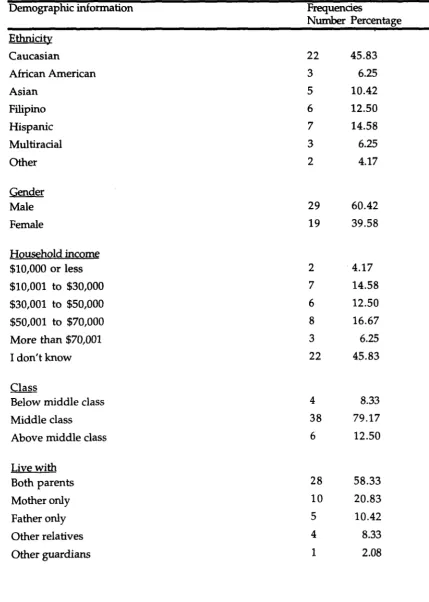
community service. Table 4.1 shows demographic information on these
Demographic information Ethnicity Caucasian African American Asian Filipino Hispanic Multiracial Other Gender Male Female Household income $10,000 or less $10,001 to $30,000 $30,001 to $50,000 $50,001 to $70,000 More than $70,001 I don't know Class
Below middle class Middle class
Above middle class Live with Both parents Mother only Father only Other relatives Other guardians Table 4.1
Frequency Distribution of Sample
Frequencies
Highest education
Less than high school 4 8.33 High school diploma 11 22.92 College degree or higher 27 56.25 I don't know 6 12.50 Adult communi~ servi~e
Yes 13 27.08
No 30 62.50
I don't know 5 10.41 Amount Qf adult ~ervice
Up to 3 hours per week 4 19.05 4-8 hours per week 5 23.81 9 or more hours per week 1 4.76 I don't know 11 52.38
Wh~ attend O~eana Hi~h School?
Friends 8 16.67 Wanted to volunteer 1 2.08 Parents wanted me to volunteer 5 10.41 No choice 17 35.42 Closest school 14 29.17
Other 3 6.25
Grades
Mostly As 16 33.33 Mostly Bs 8 16.67 Mostly Cs 18 37.50 Mostly Ds or Fs 6 12.50 Extra service
Yes 22 45.83
No 26 54.17
Volunteer how often?
Only once or twice
Community service next year? Yes
No
I don't know
27
11
18 19
56.25
22.92 37.50 39.58
Note. Certain categories do not equallOO"'o. This is due to rounding to the second decimal place.
It is most interesting to note the following frequencies. A discussion will
follow in the next chapter.
• A total of 12.49 percent of the seniors at Oceana High School attend because
either their parents want them to perform community service or they want to
do it for themselves.
• After performing community service, 39.58 percent of the respondents did
not know whether they were inclined to volunteer the following year.
The survey instrument distributed determined students' knowledge of
nonprofit and public organizations and attitudes toward pursuing a career in
those sectors and/ or pursuing a lifestyle of service. The student volunteers
revealed their attitudes about nonprofit organizations and public agencies
and how their attitudes may have been changed as a result of their
experiences performing community service.
Analysis of the Data
The means for compilation scores and individual statements on the
mean was considered the most appropriate measure of central tendency for
this study and was used to describe the scores that were most representative of
the group as a whole. The values associated with each of the ordinal
variables for positive statements are as follows: strongly agree, 1; agree, 2;
neither agree nor disagree, 3; disagree, 4; and strongly disagree, 5. Positive
statements were scored on a scale of one to five. Negative statements were
scored on a scale of five to one. Although students were given the option of
choosing "I don't know," no question elicited a substantial number of such
responses. (Across all statements, the "I don't know" category was chosen in a
high of 11 (23 percent) cases and a low of 2 (4 percent) cases). In all
computations, the values for "I don't know" statements were replaced with
the mean value of the other responses for that particular statement.
With all statements, a low score indicated a favorable attitude toward
pursuing a nonprofit career and a lifestyle of service; a higher score indicated
a less favorable attitude. Students were asked to indicate how they felt about
each statement before their community service and after their community
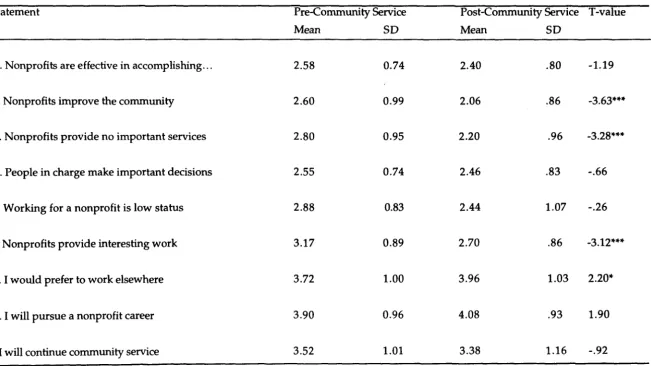
service. Table 4.2 shows the means for the entire group of students, allowing
Table 4.2
Individual Means and Standard Deviations of the Difference in Scores Between Student's Current Attitudes and Attitudes
Before Performing Community Service
Statement Pre-Community Service Post-Community 5ervice- T -value Mean SD Mean SD
A Nonprofits are effective in accomplishing ... 2.58 0.74 2.40 .80 -1.19 B. Nonprofits improve the community 2.60 0.99 2.06 .86 -3.63*** C. Nonprofits provide no important services 2.80 0.95 2.20 .96 -3.28"'** D. People in charge make important decisions 2.55 0.74 2.46 .83 -.66 E. Working for a nonprofit is low status 2.88 0.83 2.44 1.07 -.26 F. Nonprofits provide interesting work 3.17 0.89 2.70 .86 -3.12***
G. I would prefer to work elsewhere 3.72 1.00 3.96 1.03 2.20*
H. I will pursue a nonprofit career 3.90 0.96 4.08 .93 1.90
Combined measures
Perceptions about the nonprofit sector
Perceptions about pursuing a nonprofit career
*= paired t tests showed a significance at the .05 level
***= paired t tests showed a significance at the .00 level
11.51 1.99
16.21 2.68
10.05 2.52 -3.91***
As shown under the heading "Combined measures" in Table 4.2,
information from single questions was combined to create indices of
respondents' perceptions about nonprofit and public organizations and the
desirability of pursuing a professional or volunteer career in one of those
sectors. The researcher created a single measure by adding together the
responses from several questions. Scores from statements a, b, c, and i were
added together to create an index of how the respondents perceive nonprofit
and public organizations and whether or not they are likely to pursue a
lifestyle which includes service. Statements d, e, f, g, and h were combined to
form an index that would show what respondents felt about pursuing a career
in nonprofit or public organizations.
The researcher completed t tests on the statements in the first section of the
survey instrument and found four statistically significant differences out of a
possible nine. These represent differences between pre-community service
responses and post-community service responses.
Adding the numeric responses for each statement using the
aforementioned Likert scale yielded point differences for the nine statements
ranging from a high of 40.00 points to a low of 18.70 points. There were 29
cases out of 48 (60 percent) in which post-community service scores decreased
compared with pre-community service scores, indicating a positive attitude.
Of these, 21 cases (72 percent) decreased by 2 points or more. The largest
were 15 cases out of 48 (31 percent) in which post-community service scores
increased over pre-community service scores, indicating a negative attitude.
Of these, nine cases (60 percent) increased by 2 points or more. The largest
increase was 7 points, and the average was 3.78 points. In four cases, scores
remained the same.
The mean of the pre-community service scores was 27.72. The mean of
the post-community service scores was 26.09. This difference (t=-2.74) is
statistically significant at the .01 level and suggests that the volunteer
experience may have had a positive effect on student perceptions of the
nonprofit sector. (Note that for the purposes of this report of findings,
fractional numbers were rounded off to the second decimal number.)
In statements which combined to measure perceptions of nonprofit
organizations, there was a statistically significant difference in the
pre-community service and post-pre-community service means (t= -3.91). Significant
at the .00 level, this may indicate that volunteering may have altered in the
positive direction their impressions of the type of work accomplished by
nonprofit organizations. The slight decline in post-community service
standard deviation reflects a slightly greater adherence to the mean. Of the
four statements combined in this measure, statements band c were both
significant at the .00 level (t=-3.63 and t=-3.28, respectively).
Most interesting are responses to statements g and h. Responses to
nonprofit organization or public agency when it is time for me to enter the
workforce") indicate that, after performing community service, students do
not have a desire to work in a nonprofit organization or public agency. An
increase in the post-community service mean shows that, after volunteering,
they were slightly less likely to choose a nonprofit career. The t-value (2.20) is
significant at the .05 level.
Although not statistically significant, responses to statement h ("I will
choose to pursue a career in the nonprofit or public sector") indicate that most
students do not have a desire to pursue a nonprofit career. An increase in the
post-community service mean shows that they were slightly less inclined in
this direction after volunteering. There was a slight decrease in the standard
deviation of the post-community service scores, signifying smaller differences
in student scores.
In both their pre-community service and post-community service scores,
students chose the middle values on the statement regarding their desire to
adopt a lifestyle of service (answers in the range of 2.5 to 3.5 were considered
for this interpretation). A decline in the mean of the post-community service
score suggests that volunteering may have enhanced their desire to pursue
community service throughout their lives. A slight increase in the
post-community service standard deviation reflects that the sample held slightly