Patron: Her Majesty The Queen Rothamsted Research Harpenden, Herts, AL5 2JQ
Telephone: +44 (0)1582 763133 Web: http://www.rothamsted.ac.uk/
Rothamsted Repository Download
G - Articles in popular magazines and other technical publications
Halford, N. G., Curtis, T. Y. and Muttucumaru, N. 2010. The Maillard
reaction in food processing and cooking. Portland Press Ltd.
doi:10.1042/BIO03206010
The publisher's version can be accessed at:
•
https://dx.doi.org/10.1042/BIO03206010
The output can be accessed at:
https://repository.rothamsted.ac.uk/item/8q78y/the-maillard-reaction-in-food-processing-and-cooking.
© 1 December 2010, Please contact [email protected] for copyright queries.
Features
FoodKey words: acrylamide, cooking, flavour, Maillard reaction, melanoidin, Strecker-type reaction
A classic case of risk and benefit
The Maillard reaction in food
processing and cooking
The Maillard reaction is one of the most important in the food industry and home cooking, being largely
responsible for the colour, flavour, aroma and texture of some of our favourite foods. However, it also results
in the formation of undesirable products, including the neurotoxin and probable carcinogen, acrylamide.
The food industry is grappling with the task of reducing acrylamide levels in its products while retaining
the characteristics that consumers want and expect.
base cyclizes to give an N-substituted aldosylamine, such as glucosylamine from glucose. Acid-catalysed rearrangement of the aldosylamine gives a 1,2-enaminol, which is in equi-librium with its ketotautomer, an N-substituted 1-amino-2-deoxyketose: these are known as Amadori rearrangement products. Ketoses, such as fructose, give related Heyns rear-rangement products by similar pathways.
In the second stage of the reaction, the Amadori and Heyns rearrangement products undergo enolization, deamination, dehydration and fragmentation, giving rise to sugar dehydration and fragmentation products contain-ing one or more carbonyl groups, includcontain-ing heterocyclic furfurals, furanones and pyranones (Figure 3). These car-bonyl compounds may contribute to flavour characteristics in their own right4, but they also undergo condensation
reactions with amino groups and other components, result-ing in the formation of many different flavour compounds. An important reaction of carbonyl compounds is Strecker degradation, whereby an amino acid is deaminated and decarboxylated to give an aldehyde. Strecker degradation The Maillard reaction is named after the French chemist
Louis Camille Maillard, who first described it in 19121,
although the steps in the reaction as they are understood today were first proposed by an American chemist, John Hodge, in 19532 (Figure 1). It comprises a series of
non-en-zymatic reactions between sugars and amino groups, prin-cipally those of amino acids, which occurs during cooking and food processing. Temperatures in excess of 120ºC are required, such as occur during frying, baking and roasting; the Maillard reaction does not occur when food is boiled.
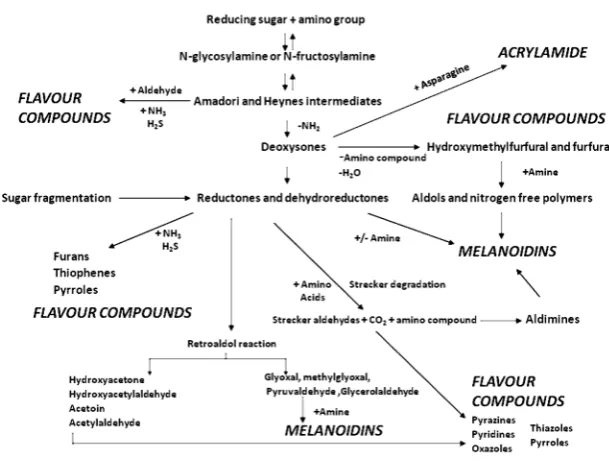
The products of the Maillard reaction were listed by Friedman in a comprehensive review in 20053 and the
pathways to the major products are shown in Figure 2. They include heterocyclic compounds such as pyrazines, pyr-roles, furans, oxazoles, thiazoles and thiophenes4,5 (Figures
2 and 3). The particular compounds formed give different cooked foods their characteristic flavours, aromas and, to some extent, textures, and depend on the amino acid and sugar composition of the food and the processing condi-tions. The most important flavour and aroma volatiles in French fries and baked potatoes, for example, include pyra-zines, pyrroles, pyridines, oxazoles, alkyloxazoles, thiazoles, furfural and hydroxymethylfurfural (HMF), whereas the most important bread flavour compound is 6-acetyl-1,2,3,4 tetrahydroxypyridine, and 2-acetyl-1-proline provides the main flavour in wheat and rice crackers.
Not one reaction, but many
For detailed descriptions of the Maillard reaction, readers are directed to articles by Nursten6 and Mottram4. The
re-action requires a reducing sugar such as glucose, fructose or maltose; sucrose does not participate unless it is first hy-drolysed through an enzymatic, thermal or acid-catalysed reaction7. The first step is the condensation of the carbonyl
(C=O) group of the reducing sugar with an amino group to produce a Schiff base. If the sugar is an aldose, the Schiff Nigel G. Halford,
Tanya Y. Curtis and Nira Muttucumaru (Rothamsted Research, Harpenden)
Figure 1. Louis Camille Maillard (1878–1936) (left) and John Hodge (1914–1996). Right picture from Advances in Carbohydrate Chemistry and Biochemistry Volume 53, Feather, Milton S., ‘John E. Hodge 1914-1996’, pp 1a, 1-4, ©1998
with permission from Elsevier.
Features
Food
product that has been shown to be carcinogenic in rodent models15. However, it is
acry-lamide that has received most attention to date. Dietary intake of acryacry-lamide is estimated to be approximately 0.3–0.6 µg per kg of body weight per day, with the intake for teenagers and children being higher on a per body weight basis16. Baked, roasted and fried potato
and cereal foods, in addition to coffee, are responsible for most of this intake. It is diffi-cult to assess how much of a risk this represents to health. Toxicology experiments con-ducted on animals leave the question of whether or not humans respond in the same way. Furthermore, the levels of acrylamide that rodents are exposed to in toxicology studies are three to four orders of magnitude higher than our intake from food. On the other hand, the experiments are conducted over weeks, whereas we eat acrylamide-containing foods of cysteine is particularly important because it provides a
route for the introduction of nitrogen and sulfur into het-erocyclic flavour compounds, such as pyrazines, oxazoles and thiazoles4.
Amine-catalysed polymerizations of reactive inter-mediates from the breakdown of Amadori and Heynes intermediates, such as deoxysones, glyoxal, methylglyoxal, hydroxypropan-2-one, 3-hydroxybutan-2-one, glycola-ldehyde and enaminols, also result in the production of melanoidins, which are brown nitrogenous polymers8. The
browning process is often used to assess the extent of the Maillard reaction.
It will be evident from this brief description that the Maillard reaction is very complex. A key point to note is that it is multi-step, with amino groups participating in the first stage and the last, and is not one reaction but many. This means that the relationship between precursor con-centration and different products is not a simple one; for instance, the concentrations of free amino acids as a whole may affect the rate and scale of the first part of the reaction, but the ratios of different free amino acids to each other in the pool may also be important, determining the relative amounts of different products that are made in the final step if sugars are limiting.
The good, the bad and the ugly of the
Maillard reaction
It is the Maillard reaction that makes a roast potato different from a boiled potato and gives French fries, po-tato crisps, bread crust, biscuits, rye crispbreads and a wide variety of other popular foods their characteristic flavour, aroma and texture (Figure 4). As well as the obvious ben-efits of palatability, colour and aroma, the Maillard reaction produces antioxidants, antibiotics and antimutagens. On the bad and ugly side, there are also products with muta-genic, clastogenic and cytotoxic effects, while cross-linked polymers prevent access by proteolytic enzymes, to some extent obstructing digestion. One of the toxic products is acrylamide (Figure 3); this chemical, which is very familiar to biochemists because of its use in gel electrophoresis, was discovered in mainly plant-derived foods as recently as 20029. Acrylamide is neurotoxic, carcinogenic and
genoto-xic in rodents10 and has been classified as a probable human
carcinogen by the World Health Organization. Its discovery in foods was perhaps all the more shocking for biochemists because they were familiar with it as a laboratory chemical that they handled with caution. The major route for acryla-mide formation is a Strecker-type reaction involving sugar-derived carbonyl compounds and asparagine11–13.
In addition to acrylamide, potentially harmful com-pounds derived from the Maillard reaction include het-erocyclic aromatic amines in grilled meat14. Furan has
also come under scrutiny as another Maillard reaction
Figure 2. Routes of formation of the major products of the Maillard reaction
Figure 3. Structures of some of the classes of aroma and flavour compounds formed in the Maillard reaction, and of acrylamide
Features
Foodfor a lifetime that spans decades. The only other evidence that we have to date comes from epidemiological studies that have investigated possible links between dietary intake of acrylamide and human cancers or other health effects. A plethora of publications have resulted from such studies: most have had inconclusive results17, but two have shown
an apparent link with endometrial cancer18,19.
The response of regulators to this difficult situation has been varied. The State of California took a number of food companies to court for failing to put warning labels on their products, and the companies eventually conceded defeat in 2008, but other US states have not followed suit. German regulators set a de facto limit of 1000 parts per billion, pres-suring companies whose products exceeded this level to take action. The European Commission adopted a position that, while reductions in dietary intake of acrylamide would be desirable if they could be achieved, guidelines or limits were not necessary; it was left to the food industry to take action. The food industry did just that, and there are anecdotal and published reports of significant reductions being made in some sectors20,21, the goal being to reduce acrylamide to
lev-els ‘as low as reasonably achievable’ (ALARA). However, the European Commission is expected to change its approach and to adopt a position closer to that taken by Germany in issuing guideline levels. The food industry is understand-ably nervous about how the new policy will operate and the potential reaction of the media and consumers if their products sometimes fail to comply.
Acrylamide reduction strategies
The formation of flavour compounds and colour com-pounds (melanoidins) from the Maillard reaction results
from multiple routes (Figure 2) and is a complex process. A number of factors have been found to be influential, including pH, amino acid concentrations, sugar concen-trations, temperature and time of cooking, presence of oxygen and water content. Many of these have also been shown to affect acrylamide formation and processors have used them where possible to reduce acrylamide levels in their products. The addition of asparaginase to convert asparagine into aspartic acid has also been shown to reduce acrylamide levels in some processed foods, but is effective only in certain food matrices (it is ineffective, for example, in sliced and chipped potatoes and breakfast cereals). Ef-fective methods for reducing acrylamide formation have been compiled by the Confederation of Food and Drink Industries of the European Union (CIAA) in its acrylamide ‘Toolbox’22. The upshot of the fact that the same changes in
processing methods that affect acrylamide formation also affect flavour, aroma, colour and texture is that it is often not possible to reduce acrylamide formation without af-fecting the characteristics that define a product and that consumers like. As modifications to processing reach the limit of what can be achieved, attention has turned to the raw material; i.e. the potato tubers and cereal grains from which the foods are made.
Free asparagine concentration has been shown to be the key parameter determining the potential for acryla-mide formation in wheat and rye flour23–25. Asparagine
usually accounts for 10% or less of the total free amino acids in cereal grains, but the amount and concentration is influenced by both genetic and environmental factors and its accumulation can be induced by both biotic and abiotic stresses26. In general, asparagine accumulates when the rates
of protein synthesis are low and there is a plentiful supply of reduced nitrogen. A lack of sulfur during wheat cultiva-tion, for example, causes a massive accumulation of free asparagine in the grain, with levels rising up to 30-fold23,24.
This has a concomitant effect on acrylamide formation dur-ing processdur-ing and it is important that sulfur deprivation is avoided in wheat. Rye is less sensitive to sulfur deprivation, possibly because it is better able to scavenge what sulfur is available25.
In both wheat and rye, currently available varieties show significant differences in free asparagine concentra-tion, so varietal selection has the potential to make an im-mediate impact on acrylamide formation in wheat and rye products once more varieties have been analysed (this may not be as simple as it sounds for wheat, because processors generally buy grain from the world market and have little control over variety selection). There is also clear evidence that genotypes could be produced with significantly lower acrylamide-forming potential, and this must become a tar-get for plant breeders.
In potato tubers, asparagine is the dominant free amino compound, typically accounting for approximately Figure 4. The colour, flavour, aroma and texture of some of
our favourite foods are dependent on products of the Mail-lard reaction. However, the reaction also produces undesir-able compounds such as acrylamide.
Features
Food
one-third of the total free amino acid pool. This relatively high free asparagine concentration and a relatively low sugar concentration has led some to conclude that sugar concen-tration must be the key parameter controlling acrylamide formation in potato products. However, the relationship between acrylamide formation and the concentrations of sugars, asparagine and other free amino acids in potato is complex. Sugar concentration appears to be a good indica-tor of the relative acrylamide-forming potential of different batches of tubers of the same potato variety and a valuable tool for storage management. However, on its own, the reducing sugar concentration of the potato is not always directly proportional to the acrylamide concentration observed in a fried potato product and there is evidence that asparagine as a proportion of the total free amino acid pool could be important27. This may arise as a result of
competi-tion between different amino acids for participacompeti-tion in the last stage of the Maillard reaction when sugars are limiting. Fortuitously, crisp and chip manufacturers have fa-voured low sugar varieties for many years (much longer than they have been aware of the acrylamide issue) in order to make a product with a consistent light brown colour. Nevertheless, fried potato products still have a significant acrylamide problem and reducing the ratio of asparagine to other free amino acids may be more effective. Indeed, there are already anecdotal reports that some manufacturers have made significant reductions in the acrylamide levels in their products through selecting varieties on the basis of this parameter.
Research into developing genetic approaches to reduc-ing the levels of acrylamide precursors in wheat, rye and potato is ongoing at Rothamsted Research, Scottish Crop Research Institute and the University of Reading, funded by the UK’s Biotechnology and Biological Sciences Research Council, the Sustainable Arable LINK programme and industry partners.
Don’t throw the baby out with the
bathwater
The Maillard reaction gives us a classic example of risk and benefit, producing the flavours, aromas and colours of fried, baked and roasted foods that we enjoy so much, as well as compounds believed to be beneficial to health, but also compounds that are potentially harmful. Foods are complex mixtures of compounds, and, as the techniques for identifying the different components that are present improve, it seems likely that other undesirable compounds will be discovered. This should be looked on as a good news story: as undesirable compounds are identified in foods, strategies can be developed to reduce or eradicate them, making food safer. However, regulators may not see it that way, and the food industry may face challenging targets for contaminant reduction while retaining the
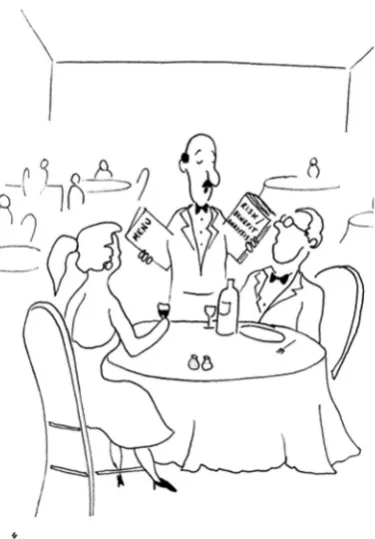
character-istics of their products that their customers demand. The industry also faces the problem of communicating risk and benefit to the news media and consumers; something that ‘food scares’ of the last 30 years, from Salmonella in eggs, to BSE (bovine spongiform encephalopathy) and genetically modified crops have shown to be extremely difficult (Figure 5).
When considering the unknown risk of eating foods that contain acrylamide, the health benefits should also be taken into account, and the contribution that cereal and potato products make to meeting our nutritional needs. Cereal and potato products are a valuable source of energy in the form of complex carbohydrate. The flavours, colours and aromas of roast potatoes, chips (French fries) and crisps has meant that fried potato products have become an intrinsic part of our everyday diet. Wheat is a unique and irreplaceable food source, used to make bread, noodles, cakes, biscuits/cookies, steamed bread, dough-nuts, croissants, bagels, pizza, flat breads and chapatis. It is a valuable source of fibre, protein, B vitamins, iron, calcium, phosphoric acid, zinc, potassium and magnesium28. Rye
products have a distinctive flavour, texture and colour, are rich in fibre, notably arabinoxylan and β-glucan, and ben-eficial phytochemicals such as folate, phenolic acids, alkyl- resorcinols (phenolic lipids) and sterols29. It is important
that the benefits of these foods are retained while acrylamide
Figure 5. Consumers want their food to be ‘zero risk’; explaining relative risk and benefit is notoriously difficult (Steve Harvey, Rothamsted)
Features
Foodlevels are reduced, and that consumers are not put off eating wholegrain cereals.
■
Rothamsted Research receives grant-aided support from the Biotechnology and Biological Sciences Research Council (BBSRC) of the UK. Tanya Curtis is financially supported by the Home Grown Cereals Authority of the UK and the BBSRC. Nira Muttucumaru is supported by the BBSRC through the Sustain-able ArSustain-able-LINK programme.
References
Nira Muttucumaru is a senior research scientist at Rothamsted Research. She graduated with a BSc (Hons) in Microbiology from the University of London, obtained her MSc in Molecular Biology from the University of Hertfordshire and was awarded her PhD by the University of Hertfordshire in 2003 for her work on the regulation of nitrogen assimilatory genes, undertaken at Rothamsted. She worked on the identification of novel therapeutic targets in the human pathogen Mycobacterium tuberculosis at the Centre for Infectious Disease, Queen Mary’s School of Medicine and Dentistry before returning to Rothamsted in 2005 to work on the agronomic and genetic factors that affect acrylamide precursor formation and hence acrylamide potential in potato and wheat. email: [email protected]
1. Maillard, L.C. (1912) C. R. Acad. Sci. Paris 154, 66–68 2. Hodge. J.E. (1953) J. Agric. Food Chem. 1, 928–943
3. Friedman, M. (2005) In Chemistry and Safety of Acrylamide in Food (Mottram, D.S. and Friedman, M., eds), pp. 135–156, Springer, New York 4 Mottram, D.S. (2007) In Flavours and Fragrances: Chemistry,
Bioprocessing and Sustainability (Berger, R.G., ed), pp 269–284, Springer Verlag, Berlin
5. Halford, N.G., Curtis, T.Y., Muttucumaru, N., Postles, J. and Mottram, D.S. (2010) Ann. Appl. Biol., in the press
6. Nursten, H.E. (2005) The Maillard Reaction, Royal Society of Chemistry, Cambridge
7. De Vleeschouwer, K., Van der Plancken, I., Van Loey, A. and Henndrickx, M.E. (2009) Food Chem. 114, 116–126
8. Martins, S.I.F.S, Van Boekel, M.A.J.S. and Jongen, W.M.F. (2000) Czech J. Food Sci. 18, 281–282
9. Tareke, E., Rydberg, P., Karlsson, P., Eriksson, S. and Törnqvist, M. (2002) J. Agric. Food Chem. 50, 4998–5006
10. Friedman, M. (2003) J. Agric. Food Chem. 51, 4504–4526 11. Mottram, D.S., Wedzicha, B.L. and Dodson, A.T. (2002) Nature 419,
448–449
12. Stadler, R.H., Blank, I., Varga, N. et al. (2002) Nature 419, 449–450 13. Zyzak, D.V., Sanders, R.A., Stojanovic, M. et al. (2003) J. Agric. Food Chem.
51, 4782–4787
14. Skog, K.I., Johansson, M.A.E. and Jagerstad, M.I. (1998) Food Chem. Toxicol. 36, 879–896
15. Leopardi, P., Cordelli, E., Villani, P. et al. (2010) Mutagenesis 25, 57–62
16. Mucci, L.M. and Wilson, K.M. (2008) J. Agric. Food Chem. 56, 6013–6019 17. Mucci, L.A. and Adami, H.O. (2009) J. Natl. Cancer Inst. 101, 618–621 18. Hogervorst, J.G., Schouten, L.J., Konings, E.J., Goldbohm, R.A. and
van den Brandt, P.A. (2007) Cancer Epidemiol. Biomarkers Prev. 16, 2304–2313
19. Wilson, K.M., Mucci, L.A., Rosner, B.A. and Willett, W.C. (2010) Cancer Epidemiol. Biomarkers. Prev. 19, 2503–2515
20. Claus, A., Schreiter, P., Weber, A. et al. (2006) J. Agric. Food Chem. 54, 8968–8976
21. Mustafa, A., Aman, P., Andersson, R. and Kamal-Eldin, A. (2007) Food Chem. 105, 317–324
22. Confederation of the Food and Drinks Industries of the European Union (CIAA): www.ciaa.eu/asp/documents/brochures_form.asp?doc_id=65 23. Muttucumaru, N., Halford, N.G., Elmore, J.S. et al. (2006) J. Agric. Food
Chem. 54, 8951–8955
24. Curtis T.Y., Muttucumaru, N., Shewry, P.R. et al. (2009) J. Agric. Food Chem. 57, 1013–1021
25. Curtis, T.Y., Powers, S.J., Balagiannis, D., et al. (2010) J. Agric. Food Chem. 58, 1959–1969
26. Lea, P.J., Sodek, L., Parry, M.A., Shewry, P.R. and Halford, N.G. (2007) Ann. Appl. Biol. 150, 1–26
27. Elmore, J.S., Mottram, D.S., Muttucumaru, N., Dodson, A.T., Parry, M.A.J. and Halford, N.G. (2007) J. Agric. Food Chem. 55, 5363–5366
28. Shewry, P.R. (2009) J. Exp. Bot. 60, 1537–1553
29. Nyström, L., Lampi, A.M., Andersson, A.A.M. et al. (2008) J. Agric. Food. Chem. 56, 9758–9766
Tanya Curtis is a graduate of the University of Plovdiv, Bulgaria, and obtained Masters degrees from that university and the Agriculture University of Plovdiv. She has been at Rothamsted studying the genetic and agronomic factors that determine free asparagine concentration and therefore acrylamide forming potential in wheat and rye since 2006, working in collaboration with Professor Don Mottram and Dr Steve Elmore at the University of Reading. email: [email protected]
Nigel Halford graduated from the University of Liverpool in 1983, obtained a Masters degree from University College London in 1984 and was awarded a PhD by the Council for National Academic Awards in 1989 for his work on wheat storage protein genes, undertaken at Rothamsted. His work concerns metabolic regulation and signalling in crop plants. Reducing the concentrations of acrylamide precursors in wheat, rye and potato is one of his current strategic targets, along with the integration of metabolic and stress signalling pathways and the manipulation of the C:N balance in crops for food and fuel applications. He is a Visiting Professor at Shanghai Academy of Agricultural Sciences and a Special Professor at the University of Nottingham. email: [email protected]