ARD Prasad & Devika P. Madalli (Eds.): ICSD-2007, pp. 133-143, 2007
Achieve Dynamic Integration And Runtime Process
Optimization Using Semantic SOA
Bhavin Raichura and Shaurabh Bharti
Infosys Technologies Ltd., India
{Bhavin_Raichura, Shaurabh_Bharti}@infosys.com
Abstract. In today’s competitive world, business is forced to continuously innovate and adopt new business models to survive, compete and get an extra edge over others. From IT perspective, it is a big challenge to enable the organization to achieve and sustain the business model innovations economically. Many large enterprises believe and visualize Service-Oriented Architecture (SOA) as a key IT enabler to address the business challenge. As more and more enterprises adopt SOA, with wider spread of SOA implementation across businesses, there will be again a strong need for business innovation. It will demand Dynamic Integration of Services and Runtime Optimization of Business Processes to realize additional business value of IT systems. Semantic SOA is about applying ontology to the SOA implementation, which empowers enterprises with Automatic Service Discovery, Dynamic Integration, and Runtime Process Optimization and Correction capabilities.
Keywords: Semantic, Soa, Runtime Optimization, Dynamic Integration.
1 Introduction
In the recent Forrester's Business Technographics® survey, it has been reported that a large number of enterprises have started adopting Service-Oriented Architecture (SOA) strategically and tactically to gradually solve business integration issues. Many large enterprises are adopting SOA in a strategic way to achieve business transformation goals, which includes the business process automation and dynamic integration. As SOA implementation becomes mature in enterprises, there is a strong demand for dynamic integration of services to realize the process automation and runtime optimization and correction to sustain business models innovations.
Today, the IT systems for business integration and process automation forces minor or major human intervention to complete the business operation. The human intervention is required mainly for selection, negotiation, constraints validation and decision making steps in a business process. As systems go mature, and these “human interventions” become more “structured, defined and commoditized”; it is possible to automate it. Such automation will avoid human interference in many of the business process systems, and thus helps in realizing additional business value of IT implementations. This, to some level today is achieved through business rules engine (BRE), workflow engine (WE) and Business Process Management (BPM) technology innovations over SOA. For commoditized business processes, enabling dynamic integration, process automation and runtime process optimization through IT systems can result in optimized operations cost to the business.
The key issue with these traditional approaches for automation is they depend too much on syntactical representations, which restricts collaboration without standardization agreements. Supporting dynamic integration and process automation in an enterprise and between enterprises require the addressing of heterogeneity in integration, dynamic constraints validation and runtime agreement negotiations. Semantic SOA is seen as the key enabler to address these challenges. Semantic SOA enablesnext generation process automation to facilitate the interaction of organizations with markets, competitors, suppliers, customers in a much more dynamic way.
In this paper, we will discuss the Business Case for Dynamic Integration, Process Automation and Runtime Process Optimization and Correction and how Semantic SOA approach enables enterprises to achieve the same, through data semantics, functional semantics, execution semantics and QoS (Quality of Service) semantics.
2 Business Case for dynamic integration and runtime process optimization
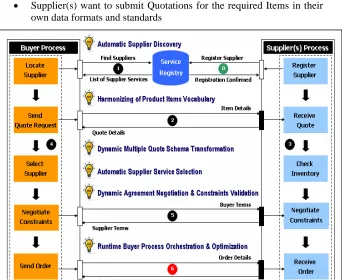
better understanding of the principles, however, the actual process cam be much more complex than shown here. The following are the key use-cases in our scenario:
• Buyer wants to locate the Suppliers who can fulfill the Item / Product Procurement Request
• Buyer wants to receive Quotations from multiple suppliers
• Supplier(s) want to submit Quotations for the required Items in their own data formats and standards
Figure 1. Semantic SOA Business Case: Business Process Automation and Runtime Optimization
• Buyer wants to process the Quotations as per the required organizational standards
• Buyer wants to select the best deal / price supplier based on the quotation data
• Buyer wants to validate the constraints before operating with the suppliers
• Buyer wants to negotiate the agreements for the final deal
To facilitate complete process automation, the traditional solutions face the following challenges:
a) How can the Supplier(s) recognize the Product / Item Procurement
Details? The traditional solutions use predefined (syntactical)
agreed-upon data fields as a protocol for communication. The other approach is to use standards like Rosetta-Net and agree upon how to use these standards. It is sometimes difficult to implement standards globally for all the enterprises; it requires much effort and the costs are great. In the enterprise scenario, the complexity of the dynamic integration and process automation solutions increases while traversing from single information domain to multiple information domains and heterogeneity of the applications on the landscape. Semantic SOA brings ontology-enabled vocabularies, which facilitates meaning and reasoning over the data and syntax to address the multiple information domain problems and the heterogeneity involved. Semantic SOA uses Data Semantics which defines ontology for harmonizing the vocabulary facilitating wider communications.
b) How can the appropriate Supplier be located? The traditional solutions
use UDDI discovery which is more-or-less keyword (syntactical) search on UDDI registry. But with the capabilities of harmonizing the vocabularies in Semantic SOA through data semantics, a Semantic Service Discovery can enable enterprises to reach-out to a wide array of suppliers and offer more options then conventional discovery. The Semantic SOA offers automation of the discovery process and provides automatic supplier discovery and selection through functional semantics.
c) Do Suppliers support Buyer’s constraints; does Supplier adhere to the
Buyer’s Policies? The traditional solutions require manual interventions
for such decision making steps in business process. The Semantic SOA offers automation of constraints validation and agreement negotiation through QoS semantics. We will discuss about data semantics, functional semantics, execution semantics and QoS semantics in detail a little later.
d) How do Buyer and Supplier Process communicate to each other? The
traditional solutions will force a hard-coded or somewhat configurable solution to facilitate the process / services orchestrations and execution. It does not offer too much of process automation or runtime optimization and correction. The Semantic SOA approach, with the use of functional semantics, execution semantics and QoS semantics can automate the process and also facilitate runtime decision making for process optimization and correction.
• Automatic Supplier Discovery
• Harmonizing of Product / Item Vocabulary
• Dynamic Multiple Quote Schema Processing
• Automatic Supplier Selection based on the beast deal algorithm
• Dynamic Constraints Validation and Agreement Negotiation between Buyer and Supplier(s)
• Runtime Buyer and Supplier Process Optimization based on Quote, Constraints and Agreements
These capabilities offer multi-fold business value to an enterprise by improving key performance indicators such as Cost per Order, Order Cycle Time and Operational Expenses. The improvement in the operational metrics, revenue metrics and overall business metrics is achieved by eliminating manual intervention; replaced by dynamic integration, process automation and runtime process optimization.
3 Realizing the business value through Semantic SOA
The Semantic SOA is a standards-based, ontology-enabled, constraint-driven approach that enables automatic service discovery and selection, dynamic integration and runtime process orchestration, optimization and correction. Semantic SOA is about applying ontology to the SOA implementation to provide the process automation and dynamic integration capabilities in SOA. The power of semantics simplifies and automates complex process mediation scenarios through ontology-based dynamic integration and runtime process optimization. The Semantic SOA architecture goal is to enable enterprise with following additional capabilities:
• Automatic Service Discovery and Selection
• Dynamic Integration through Dynamic Data Transformation
• Dynamic Service Constraints Validation
• Dynamic Agreement Negotiation
• Facilitate Process Automation
• Runtime Process Orchestration, Optimization and Correction
• Semantic SOA implementation has the characteristics of Data Semantics, Functional Semantics, Execution Semantics and Quality of Service (QoS) Semantics to achieve the desired capabilities.
3.1 Data Semantics for Dynamic Integration
The Semantic SOA uses registered ontology; the ontology mappings and message metadata dynamically determine how to convert one data format from one information domain to another data format in another information domain. It performs dynamic data transformation using ontology and metadata introspection. It enables enterprises to achieve dynamic integration. Thus, it provides the Dynamic Integration capability to the SOA solution.
Ontology is a graph of abstract concepts, relations and logical assertions that comprise an information model for the given set of request and responses. The conversion from one information domain to another information domain is achieved through a single ontology mappings file.
Since Ontology Information Domain can be defined over XML standards, it gives a complete freedom to enterprises to consume the XML standards of their interest. This helps enterprise to leverage the legacy systems. Also, it saves a lot of time to come to an agreement of how to use the standards for B2B Collaboration.
The Ontology Information Domain also harmonizes the vocabularies for request and response structures and there-by enables dynamic integration irrespective of syntax of the data. Enabling SOA approach with semantics (ontology) provides “explicit meaning” to the data exchange and business operations to infer “knowledge” and achieve required dynamic integration with automation.
The ontology definitions can be auto-linked, the mapping of two information domain ontologies automatically links any other ontologies to which they are connected. Thus, ontology mappings and automatic linking eliminates the need of many-to-many data transformation XSL files in SOA.
To understand it in enterprise context, the collection of data schemas (XSDs) for a given enterprise is equivalent to just a single information domain – an ontology definition file. Hence, the single ontology mapping entity between two information domains, replaces a number of XSL mappings between them. This helps in reducing the maintenance and management of integration issues.
3.2 Functional Semantics for Automatic Service Discovery
Functional Semantics describes ontology for the definition of service capabilities and operations offered. The ontology annotations for the service definition and capabilities help to perform Automatic Service Discovery. The functional semantics provides a template based semantic service discovery with matchmaking algorithm, which provides ranked available service results. The Functional Semantics enable the Semantic SOA implementation to facilitate Automatic Service Discovery. Leveraging the capabilities offered by Data Semantics, it also facilitates Automatic Server Selection.
Functional Semantics can be used for Service Publication and Discovery, which is facilitated through existing and emerging standards and frameworks such as UDDI, WSIL, OWL-S, and METEOR-S.
3.3 Execution Semantics and QoS Semantics for Runtime Process Optimization
Execution Semantics describes ontology for the execution flow of services in a business process or operations in a service. The ontology annotations help to determine the flow for dynamic service execution and invocation. It facilitates Runtime Process Orchestration capability to the SOA solution.
Quality-of-Service (QoS) Semantics describes ontology for the qualitative and quantitative constraints for service execution and invocation. The ontology annotations help to dynamically negotiate the constraints and agreements before actually executing the services. It facilitates Runtime Process Orchestration capability to the SOA solution.
The Execution Semantics help to optimize the business process flow at runtime. The QoS Semantics enable Semantic SOA implementation to dynamically validate the service constraints and negotiate agreements. Both together, provide Runtime Process Orchestration, Optimization and Correction capabilities to the Semantic SOA implementation. The Semantic Enabled Process Mediation Engine facilitates Runtime Process Orchestration, Optimization and Correction by consuming execution semantics and QoS semantics ontology definitions. Execution Semantics can be used for Service Orchestration, which is facilitated through existing and emerging standards and frameworks such as Commercial BPEL, BPWS4J.
QoS Semantics can be used for Service Composition and Choreography, which is facilitated through existing and emerging standards and frameworks such as BPEL, BPML, WSCI, WSCL, OWL-S, and METEOR-S
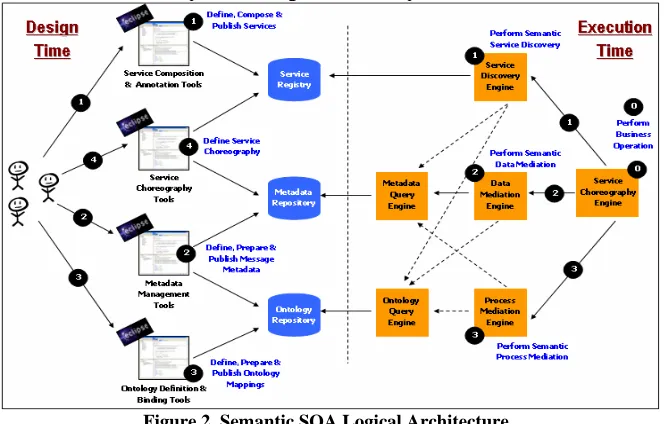
The following are the key conceptual components of Semantic SOA architecture, which help in realizing the above capabilities:
Figure 2. Semantic SOA Logical Architecture
3.4 Storage Registry
Service Registry is used to store the Service Definitions which will be used to facilitate service discovery. It can be implemented as UDDI registry for web services. Metadata Registry is used to store the metadata for data formats used in service requests and responses. The service metadata also facilitates the automatic service discovery. Ontology Registry is used to store ontology for the request and response message structures, which enables dynamic data transformation using ontology mappings.
3.5 Semantic Enabled Service Discovery Engine
The Service Discovery Engine is enabled with a Reasoning Interface to provide the dynamism required to automatic service discovery using the introspection of the service metadata. The Semantic Enabled Service Discovery Engine facilitates Automatic Service Discovery and Selection by consuming functional semantics ontology definitions stored in the Service Registry and Ontology Registry. The Semantic Enabled Service Discovery Engine provides the Automatic Service Discovery and Selection capabilities to the Semantic SOA implementation.
3.6 Semantic Enabled Data Mediation Engine
Engine will consume the data semantics of the message structure, metadata for the request content, ontology definition and ontology mappings to dynamically convert one data format to another. Data Mediation Engine provides dynamic integration capabilities to the Semantic SOA implementation.
3.7 Semantic Enabled Process Mediation Engine
The Process Mediation Engine uses the Ontology Registry, Service Registry and Metadata Registry to determine the functional semantics to invoke and execute the services to complete the desired business process. It subsumes functional semantics, execution semantics and QoS semantics to facilitate automatic service discovery, dynamic constraints validation and runtime agreement negotiations. It provides the process automation and runtime process optimization and correction capabilities to the Semantic SOA implementation.
3.8 Service Choreography Engine
The Service Choreography Engine wraps the complete business operation and performs the various steps that are required to complete the business operation using Semantic Service Discovery, Data Mediation and Process Mediation. The Choreography Engine also wraps the communication mechanisms that should be used to communicate with services.
4 Related Work
The following standards and frameworks are evolving to realize Semantic SOA architecture goals:
4.1 Standards
OWL-S, derived from DAML-S, is a standard which helps software robots to discover, invoke, compose and monitor web services offered from multiple resources using their service descriptions. It uses Web Ontology Language
(OWL) to describe its semantics. It consists of three major parts. It exposes
ServiceProfile for advertising and discovering services, process model that gives detailed information about its operations and grounding to facilitate communications between services using messages.
approach to semantically annotate WSDL documents also offers easy updates and maintenance in future.
WSMO Web Services Modeling Ontology (WSMO) provides a conceptual framework and a formal language to describe semantic aspects of web services to improve their discovery, composition and invocation on web. WSMO is richer than WSDL-S and has the capability to describe preconditions, post conditions, assumptions and effects on operations as well as orchestration and choreography of interfaces. WSMO contains four basic elements namely ontology, web service description (describes functional and behavioral aspects of service), goals (describes user’s interests in services)
and mediators (handles interoperability between other three elements). The
formal logic language used in WSMO is described using Web Service Modeling Language or WSML
SWSO Semantic Web Services Ontology (SWSO) describes conceptual model of ontology as well as a first-order-logic axiomatization (called FLOWS) to define semantics of ontology. FLOWS enable reasoning between web services using semantics for interaction between each other and other applications.
4.2 Frameworks
WSMX (Web Service Modeling eXecution environment) is a reference implementation of WSMO which internally uses WSML as a language. It is a semantic execution environment for business process automation and dynamic integration. WSMX provides a semantic execution environment which is able to consume semantic messages, discover semantically described web services, invoke and compose them to achieve dynamic integration, process automation and runtime process optimization and correction. WSMO and WSML specifications together with WSMX environment are developed by DERI International under SDK cluster.
METEOR-S is a Web Service Composition Framework. It is about applying semantics in annotations, Quality of Service (QoS), Discovery, Composition and Execution to implement Semantic Web Services and Processes. The METEOR-S project at the LSDIS Lab, University of Georgia aims to extend the standards such as WSDL and BPEL4WS to achieve greater dynamism and scalability by adding semantics to the above standards.
5 Conclusion
models. It can act as a business transformation catalyst and open new prospects for business, services and revenue.
At the same time, Semantic SOA is a comparatively new, innovative and ambitious approach that offers dynamic integration and process automation. Many of the industry standards are still evolving; also the visual tools that provide reasonable development productivity are under development. Apart from that, the ontology definitions and mappings require additional skills in the bucket of enterprise.
To conclude, enterprises can not ignore the power and agility that Semantic SOA brings even-though it looks ambitious at this stage. It is recommended that enterprises adopting SOA should approach Semantics step-by-step, keeping balance between innovation and realization. The SOA implementation should be planned and designed for semantics to make it future-proof.
References
[1] Survey Data Says: The Time For SOA Is Now - April 14, 2006, Forrester
[2] http://www.forrester.com/Research/Document/0,7211,39289,00.html,
accessed 11th Jul
[3] Web Service Semantics - WSDL-S
http://www.w3.org/Submission/WSDL-S/ , accessed 17th Jul
[4] Aligning WSMO and WSDL-S http://www.wsmo.org/TR/d30/v0.1/ , accessed 19th Jul
[5] OWL-S: Semantic Markup for Web Services
http://www.w3.org/Submission/OWL-S/ , accessed 16th Jul
[6] OWL Web Ontology Language http://www.w3.org/TR/owl-guide/ , accessed 15th Jul
[7] RDF - http://www.w3.org/RDF/ , accessed 12th Jul
[8] METEOR-S: Semantic Web Services and Processes
http://lsdis.cs.uga.edu/projects/meteor-s/ , accessed 19th Jul
[9] Web Service Modeling Ontology (WSMO)
http://www.w3.org/Submission/WSMO/ , accessed 18th Jul
[10] The Web Service Modeling Language WSML