The University of San Francisco
USF Scholarship: a digital repository @ Gleeson Library |
Geschke Center
Master's Theses
Theses, Dissertations, Capstones and Projects
10-18-1999
Community Foundations Serving Rural Regions:
A Study of Rural-Serving Community Foundations
Located in Northern California
Michele B. Finstad
University of San Francisco
Follow this and additional works at:
https://repository.usfca.edu/thes
This Thesis is brought to you for free and open access by the Theses, Dissertations, Capstones and Projects at USF Scholarship: a digital repository @ Gleeson Library | Geschke Center. It has been accepted for inclusion in Master's Theses by an authorized administrator of USF Scholarship: a digital repository @ Gleeson Library | Geschke Center. For more information, please [email protected].
Recommended Citation
Finstad, Michele B., "Community Foundations Serving Rural Regions: A Study of Rural-Serving Community Foundations Located in Northern California" (1999).Master's Theses. 1144.
The author of this thesis has agreed to make available
to the University community and the public a copy of this dissertation project.
Unauthorized reproduction of any portion of this dissertation is prohibited.
The quality of this reproduction is
contingent upon the quality of the original copy submitted
.
University of San Francisco Gleeson Library/Geschke Center
2130 Fulton Street
Community Foundations Serving Rural Regions: A Study of Rural-Serving Community Foundations Located
in Northern California
A THESIS SUBMITTED
by
Michele B. Finstad
In Partial Fulfillment of the Requirements
for the Degree of
Master of
Nonprofit Administration
The University of San Francisco
LD
lt<"t:il
c
J
I 1 i r'(/7... U)-;i' p _,,Community Foundations Serving Rural Regions: A Study of Rural-Serving Community Foundations Located
In Northern California
This Thesis written by
Michele
B.
FinstadThis Thesis written under the guidelines of the Faculty Advisory Committee, and Approved by all its members, has been accepted in partial fulfillment of the Requirements for the degree of:
Master of Nonprofit Administration
at the
University of San Francisco
Research Committee:
'J
(
~~
"'I
'}}L~ (,~.A'"
1 '-£ l r-U(_)Chai son
econd Reader
"'it~ ~_;('
o(b(?t
Program Duector Date
TABLE OF CONTENTS
ABSTRACT ... v
VITA AUCTORIS ... vii
ACKNOWLEDGEMENTS ... viii
LIST OF TABLES ... ix
CHAPTER ONE: INTRODUCTION ... 1
Background of the Problem ... l Statement of the Issue ... 7
Specification of Research Questions ... 8
Definition of Major Concepts ... 9
Importance of the Study ... 11
CHAPTER TWO: REVIEW OF RELATED LITERATURE ... 13
CHAPTER THREE: METHODOLOGY ... 29
Subjects and Respondents ... .. 29
Research Design ... . 29
Instrumentation ... 30
Procedures ... 31
Operational Definitions of Relevant Variables ... .. 32
Treatment of Data/Data Analysis ... 34
Limitations of the Study ... 35
CHAPTER FOUR: RESUL TS/FINDfNGS ... 36
Introduction ... 3 6 Research Findings ... 37
Interview Findings ... 73
CHAPTER FIVE: SUMMARY AND CONCLUSION ... 74
Review of the Problem ... 84
Discussion of the Findings ... 85
Conclusions ... 90
Recommendations for Action and Further Research ... 92
Recommended Action ... 92
Recommendations for Future Research ... 93
REFERENCES ... 95
ABSTRACT
This research project-a qualitative study with data collected primarily through
interviews-was conducted to determine whether there are notable characteristics
common to community foundations serving rural regions, and whether these
characteristics differ from those of other community foundations in general. The
framework developed for this research project \vas adapted from three empirical studies,
each emphasizing specific characteristics related to organizational development and
community foundations. The first study (Agard, 1992) examined the administrative,
social, strategic, and technical systems of community foundations with regard to growth
and change over time at different ages and asset sizes. The second study (Mayer, 1994)
addressed the characteristics necessary for a community foundation to facilitate and build
community capacity within its service area. The third study (Struckhoff, 1991) focused
on the threshold endowment size (or "take-off point'') needed for a community
foundation to attain sustainable growth capacity. Data gathered for the present study
demonstrates that, as is generally true of most community foundations, the characteristics
of community foundations serving rural regions changed as they grew older and larger.
The study also found that among rural-serving community foundations, the asset level
was more significant than organizational age as a factor associated with ~:,rrowth.
Furthermore, it was evident from this research that there are distinguishing characteristics
particular to community foundations serving rural regions. A significant finding was that
the majority of executive directors regarded their community foundations as service
organizations first and foundations second. These directors varied widely in their
estimates of the endow1nent "take-off' point enabling a community foundation to achieve
sustained growth. These varied estimates seemed to be related to the current age and asset
size of the directors' respective organization. Where local economies are agriculturally
based, the community foundations' fund-raising mindset seems to differ from that of
other community foundations in general. Not all community foundations serving rural
regions studied have grown in similar patterns. Many rural-serving community
foundations are assisting large service territories incorporating enonnous geographical
areas. The effects of technology are beginning to play a very large role in these
community foundations. Still in question is a definitive answer to whether a community
foundation serving a rural region can proyide more services per endowment dollar than
VITA AUCTORJS
Name Michele B. Finstad
Date of Birth: August 1, 194 7
High School: Castilleja School Palo Alto, California
Graduated: 1965
Baccalaureate Degree: Bachelor of Science Degree
College: University of the Pacific Stockton, California
Graduated: 1970
Elementary Teaching Credential: University of the Pacific Stockton, California
Graduated: 1971
ACKNOWLEDGEMENTS
My deepest appreciation goes to Mary Anna Colwell, my committee chair, who
was an outstanding mentor to me during the thesis process.
Thank you to Janet Bankovich of the Northern California Grantmakers, who was
kind enough to lend time from her busy schedule to be my second reader.
Thank you to Carol Silvennan and my wonderful cohort group, especially Kathy
Guidi, who continued to support me while I worked toward my ultimate goal.
Finally, I offer my love and gratefulness to my three children, Derek, Farrell, and
Courtney for being so very understanding and patient.
This thesis is dedicated to Ill}' hushand, James L. Finstad, whose never-ending
love and support gave me the strength and persistence I needed to make this project
LIST OF TABLES
Table 4.1 Number of Volunteer or Paid Staff
Table 4.2 Number of Special Project Staff
Table 4.3 Number ofPro!,>ram Officer Specialists
Table 4.4 Number of Program Officer Generalists
Table 4.5 Number of Financial Support Staff
Table 4.6 Number of General Officer Support
Table 4.7 Number of Marketing/Donor Relations Specialists
Table 4.8 Number of Communication Staff Specialists
Table 4.9 Number of People in the Office of the Executive Director
Table 4.10 Number of People Supervised by the Executive Director
Table 4.11 Levels of Hierarchy
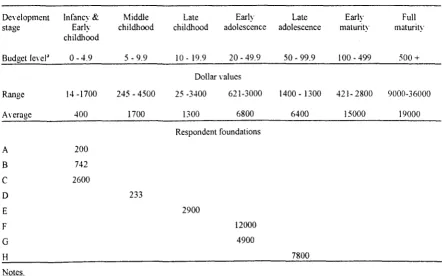
Table 4.12 Administrative Budget
Table 4.13 Number of Board Members
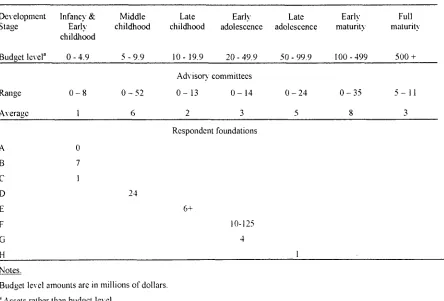
Table 4.14 Number of Advisory Committees
Table 4.15 Number of Advisory Committee Members
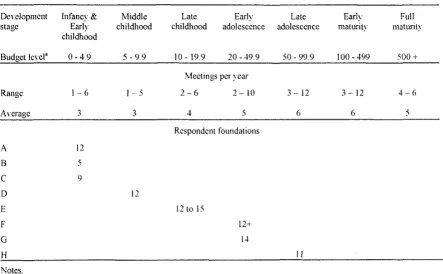
Table 4.16 Number of Board Meetings per Year
Table 4.17 Number of Grantmaking Meetings per Year
Table 4.18 Number of Pages in the Annual Report
Table 4.19 Population of the Service Area
Table 4.20 Total Assets
Table 4.21 Number of Grants Made
Table 4.22
Table 4.23
Table 4.24
Table 4.25
Table 4.26
Table 4.27
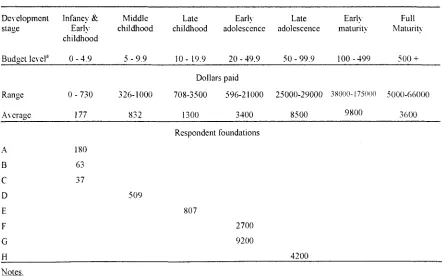
Dollars Paid Each Year
Number of Grantmaking Categories
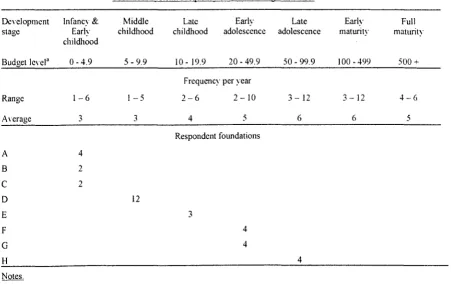
Frequency of Grantmaking Each Year
Dollar Value of Gifts Received Annually
Age in Years
CHAPTER ONE: INTRODUCTION
Background of the Problem
This study explores the characteristics of community foundations serving rural
regions, drawing on analyses of community foundations in general by other researchers
and data collected from foundations serving rural communities in northern California.
In the past 100 years, rural regions in the United States have changed dramatically.
The farming communities of rural regions have dwindled and declined with the
introduction of mechanization and farmland sales to large corporations. Today, just 25
percent of all Americans live in rural areas (Graham, 1998) and, according to Hammack,
"Only about one percent of the United States population earns its living from agriculture"
(Hammack, personal communication, April 22, 1999). The term rural is confusing to
many. This confusion is addressed by the following quotation from David Hammack, a
member of the history department at Case Western University, who has done extensive
research in public and social policy.
Many of those who live in rural areas are functionally part of the urban economy, as
in the case of those who work for resorts that serve visitors from metro areas. For a
very long time, rural has been a concept that Americans manipulate for ideological
and political purposes, rather than a clearly defined and useful tenn for analysis.
Rural has always been a term that embraces a wide variety of circumstances. It is
very difficult to specify any real difference between rural and urban except that
urban communities involve a relatively greater density of settlement. Nearly all
compared with the San Francisco Foundation, for example, and nearly all have
small endowments. (Hammack, 1999)
Community foundations in the U. S. initially appeared with the creation of the
Cleveland Foundation in 1914 by founder Frederick H. Goff, president ofthe Cleveland
Trust Company (Magat, 1989). According to Eugene Struckhoff, who has done
comprehensive research on smaller community foundations, "Their contributions to the
growth and vitality of communities like Cleveland, Boston and New York are almost
legend. But much less is known about the impact of their resources and leadership on
smaller communities" (Struckhoff, 1991, p. v.). In 1997, 83 years after the founding of
the Cleveland Foundation, a survey of United States community foundations by the
Columbus Foundation of Ohio illustrated the explosive growth in this area of
philanthropy by citing results from the unprecedented number of 54 7 community
foundations. The survey revealed that in 1997 "gifts to community foundations exceeded
$2.4 billion, grants surpassed $1.2 billion and assets vaulted to $21.27 billion. Compared
to 1996, gifts grew by more than $217 million, grants from community foundations grew
by more than $255 million, and community foundations assets grew by more than $4.1
billion"' (Columbus Foundation, 1 997). Today, according to Darlene Siska, "Community foundations are one of the fastest growing segments of organized philanthropy" in the
United States (Siska, 1998b, paragraph 1 ). In 1989, community foundations made up less
than 1% of all United States foundations, but were awarded 5.4 %of all grant dollars,
received 10 %of all new gifts and held 4.4 %of all foundation assets (Mayer, 1994, p.
Community foundations serve many different sizes and types of communities and
vary in structural characteristics including but not limited to age, philosophy, ability,
efficiency, endowment, and grantmaking (Agard, 1992). Many community foundations
are created to serve a small geographic area, according to Somerville (1995). Community
foundations with over $5 million in assets are typically in areas with a population of more
than 11 0,000; those with assets under $5 million are typically in areas with fewer than
60,000 people (Agard, 1989). Some practitioners identify a common benchmark for the
creation of a community foundation as a population of 150,000. In general, community
foundations are broad-based, f,>Tant-giving nonprofit organizations providing financial
support to other nonprofits, community programs, individuals, and, rarely, to private
businesses with the intention ofbuilding a stronger communal base for the future of their
regton.
Community foundations have several distinguishing characteristics. They serve a
particular location; they create perpetual endowments through the individual bequests of
community members; and they serve a tripartite role within their service area, providing
development, grantmaking, and convening. In addition, individuals or organizations
making donations to community foundation endowments have the authority to request
how their money will be used within the community. This ability of a donor to earmark
money for a favorite charity or local program illustrates an important characteristic that
distinguishes community foundations from organizations such as United Way (although
this distinction may be changing as United Way agencies update their current
fund-raising strategy and adopt new policy to create pennanent endowment). As Mayer notes,
'to' it. The distinction is more than semantic. A donor can recommend a specific
beneficiary, indicate particular areas of interest, or leave the choice entirely to the
discretion of the foundation" (p. 70). Not long ago, community foundations very seldom
developed offspring organizations, but this may be changing as large community
foundations choose to create satellites in outlying regions. According to the Council on
Foundations (1998), "Community foundations ... often forge partnerships with
semiautonomous 'affiliates.' These entities can be incorporated or unincorporated
charities that work in a specific geographic area, using the community foundation's
financial management and legal expertise, and other centralized services" (Online,
Council on Foundations).
The critical role of community foundations as a source of nonprofit income in
localities lacking strong family or corporate philanthropy cannot be exaggerated. Small
community foundations, or community foundations serving rural regions, have a great
importance in their local roles as neutral convenors. Every day, community foundations
bring together disparate parties to look at community issues. The convening function
leverages donor (and community foundation) dollars by encouraging groups to work
together, and by providing them a neutral meeting ground. Lewis Feldstein (cited in
Somerville, 1995) affinns this notion when he talks about the cooperative spirit that is
facilitated by the community foundation.
In most cases, donors approach community foundations at least in part because of
their neutrality. Community foundations can provide donors with expert advice on how
objective evaluation, able to provide donors with candid insights into the management
and operation of local nonprofit organizations.
Leonard ( 1989) writes that in order for community capital to grow, there is a need
for synergy between donor, recipient, and community and that a mission balancing the
needs of these constituencies will lead to steady grov,rth and maximum flexibilty of
community foundations. Leonard also reports that most community foundations initially
favor one or two of these constituencies and that this results in multiple interpretations of
community foundation roles and disparate fund-raising strategies and rates of gro\v1h (p.
89). Community foundations have varied strategies for endowment building, and a range
of services are provided to donors including pass-through funds, permanent advised
funds, donor-advised funds (both permanent and pass-through), and charitable remainder
trusts. Some community foundations accept difficult-to-manage gifts on behalf of other
entities.
For most community foundations, and certainly the smaller ones, a major goal is the
development of permanent endowment funds. Foundations usually ask current donors to
provide these funds. Leonard (1989) reports that gifts of living donors appear to have
overtaken bequests as the largest single source of community foundation income,
according to a 1988 Council on Foundations survey she cites (p. 94 ). Donors making ~ . gifts to these funds may tailor their restrictions to meet their own charitable interests.
Some of the funds are undesignated and the donor relies on the community foundation
board (through the distribution committee, if it has one) to identify pressing community
issues to fund. Other funds are restricted to scholarships, a particular geographic area (in
the case of a large community foundation that also serves a rural population), a specific
program interest, or even a single nonprofit agency.
The first community foundation in California was the California Community
Foundation. Established in 1915, the California Community Foundation was also the
first community foundation to serve a rural region. Today, this community foundation
serves the needs of a fast-moving urban Los Angeles County. The California Community
Foundation, The San Francisco Foundation, The San Diego Community Foundation, The
Peninsula Foundation and other large urban community foundations have made an
important name for themselves through the creation of substantial endowments and the
provision of grantmaking. But what about those community foundations that serve the
rural population? It is important to ask the question: Does a community foundation serving a rural region differ from other community foundations, in general?
There is little research published about small community foundations, and empirical
and statistical data are virtually nonexistent regarding community foundations serving
rural regions. Available research studies generally center on those community
foundations that are established in age, manage a powerful endmvment, and serve a large
area. However, the importance of the community foundation serving a rural region must
not be evaluated by asset size alone. The concept of community capacity is also an
important factor in light of the interdependent quality of the American economy. Mayer
(1994) defines community capacity as "the combined influence of a community's
commitment, resources, and skills which can be deployed to build on community
study community foundations serving rural regions to ascertain if they differ from other
community foundations, and if they do differ, how and why?
Statement ofthe Issue
The issue central to this thesis is to determine whether there are notable
characteristics common to community foundations serving rural regions and if these
characteristics differ from those of other community foundations in general. Community
foundations serving rural regions will be studied. The organizational framework for this
thesis will be taken from three empirical studies focusing on specific characteristics of
community foundations (Agard, 1992; Mayer, 1994; Struckhoff, 1991 ). This framework
\viii facilitate the evaluation and comparison of my research findings \Vith the results of
the other researchers.
The first part of the framework is a self-assessment checklist created by Dr. Kathryn
Agard ( 1992). The checklist classifies community foundations according to the life cycle
metaphor. The community foundation's age and asset size are used as the basis for
categorization.
The second component, which concentrates on capacity building, draws from
Mayer's 1994 report on a study of community foundations (conducted between the years
of 1987 and 1992) that was financed by the Ford Foundation and entitled the Leadership
Program for Community Foundations. To learn more about community foundations and
their potential for community capacity building, the Leadership Program for Community
Foundations had evaluated four categories. These evaluative categories included
organizational development, with the subcategories of administration, board and staff;
asset development, with the subcategories of endowment growth, communications, and
administrative support; community role, with the subcategories of leadership skills,
contributions in progress, and institutional linkage; and programming and grantmaking,
with the subcategories of grantmaking procedures, strategic grantmaking, and
programming effectiveness.
The final component of the research framework addresses Eugene Struckhoff s
( 1991) theory that a $5 million endowment represents the "take-off" point that enables
any community foundation to sustain growth. This thesis examines his hypothesis with
regard to community foundations serving rural regions.
Specification ofResearch Questions
Do community foundations serving rural regions differ from other community
foundations in general? And if so, how and \vhy? In this research, findings will be
evaluated to discover common characteristics of rural community foundations related to
their role, organizational development, asset development, programming and
grantmaking effectiveness, and rate and path of grovvth and change over time. In
addition, the data will be examined to determine whether asset size relates to quality of
services, whether community wealth relates to size of the endowment, and whether an
endovvment of$5 million appears to be the take-off point for substantial growth. Finally,
with regard to a common pattern of community foundation growth, there will be an
analysis of the analogies of these rural-serving community foundations with other
community foundations in general to see if there are patterns of growth related to age and
Definitions of Major Concepts
For the purposes of this research project, the following definitions will be used.
Community Foundation: The approved definition provided by the Council on
Foundations, a national industry membership association (cited in Mayer, 1994), is as
follows:
A community foundation is a tax-exempt, not-for-profit, autonomous, publicly
supported, philanthropic institution organized and operated primarily as a pennanent
collection of endowed funds for the long-term benefit of a defined geographic area.
Each community foundation:
• Is officially recognized by the Internal Revenue Service as tax-exempt under
Section 50l(c)(3)
• Meets the public support test under Section 170(b )I(A)(vi) as codified by the
Treasury Regulations 1.170A- 9( e )(1 0)
• Has a governing body broadly representative of the general public
• Operates primarily as a grantmaking institution and may also provide direct
charitable services
• Focuses its primary grantmaking and charitable services within a defined
geographic area no larger than three states
In layman's terms, a community foundation is a donor-serving institution, acting
locally to generate some of the area's philanthropic capital, governed by local leadership
to resolve current problems. According to Hammack, "By intent and definition, a
community foundation has no single fixed, active purpose" (cited in Magat, 1989, p. 23 ).
Rural Region: According to the United States Census, a rural region is any region that is
not considered a metropolitan area. Technically, the United States Census Bureau ( 1995)
defines rural as:
Territory, population, and housing units not classified as urban constitute "rural."
The "urban" and "rural" classifications cut across other hierarchies; for example,
there is generally both "urban" and "rural" territory within both metropolitan and
nonmetropolitan areas . . . . Since the 1960 census, there has been a trend in some
states toward the extension of city boundaries to include territory that is essentially
"rural" in character ... the rural portion is included in "other rural."
Community Foundation Serving a Rural Region: A community foundation located in a
rural region; or a community foundation located in another geographical region that
serves a rural population.
Take-off Point: The definition of take-off point is the level of endowment at which a
foundation will experience continued healthy grO\vth (Struckhoff, 1991 ).
Age and/or Maturity Level of a Community Foundation: Maturity level relates to the size
of a foundation's endoVvment and the foundation's stage of grO\vth in the life-cycle
paradigm. A large endowment would suppose a more mature community foundation,
although this may not be the case when a foundation in the early development stage is
given a larger endowment. A chronologically and organizationally young community
foundation may have an enormous endowment, and if so, will exhibit disjunctive
Community Capacity: "Community capacity is the combined influence of a
community's commitment, resources, and skills which can be deployed to build on
community strengths and address community problems (Mayer, 1994, pp. 3, 4).
Organizational Capacity: Organizational capacity is the potential of the organization to
create and sustain quality in all its work.
Adaptive Capacity: Adaptive capacity is the potential of the organization to adapt to its
internal and external environment.
Organizational Life-Cycle Paradigm: This paradigm, as used by Agard (1992), comes
from the life sciences, and utilizes stages of birth, growth, maturity, revival, and decline.
Mechanistic Metaphor: This metaphor describes organizations as machines. "Principles
emerging from this metaphor are used ... to observe the structural components of
community foundations, in particular, the administrative system" (Agard, 1992, p. 83).
Agard lists the variables ofthis metaphor as (a) specialization of labor, (b) division of
labor, (c) span of control, (d) hierarchical development and (e) job roles (p.l85).
Importance ofthe Study
Community foundations are recognized as the fastest growing organizational
segment of the nonprofit world today, and as the Council of Foundations notes, "Their
level of grantmaking activity is disproportionate to their size" (cited in Mayer, 1994, p.
22). Yet, given their significance, research about community foundations serving rural
regions is virtually nonexistent. This study ~vill partially fill that void by evaluating
community foundations serving rural regions in northern California to gain some insights
into their structural and capacity-growing characteristics. This study will ask the
questions: Do community foundations serving rural regions differ from other community
foundations in general? And, if so, how do they differ and why? As Agard (1992) has
written, "A recent call for standardization and certification by larger metropolitan
community foundation leaders, the phenomenal growth in the field demanding increased
technical assistance, and the unique nature of community foundations require more
knowledge about their growth patterns and characteristics" (p. 184). The results of this
research may suggest that all future investigations of community foundations should
stipulate whether a community foundation is rural-serving, urban-serving, or a
combination of each. Finally, this research may establish that these rural-serving
community foundations are important philanthropic institutions deserving of funding
CHAPTER TWO: REVIEW OF RELATED LITERATURE
The literature review investigates four areas related to the topic of community
foundations serving rural regions. First, a brief history summarizing the development of
community foundations and associated research will be reviewed. Second, using
published data by Agard ( 1992 ), the organizational behavior of community foundations at
different ages and asset sizes will be addressed. Third, the concept of building
community capacity will be explored utilizing Mayer's 1994 report on the Leadership
Program for Community Foundations research studies. And finally, a substantial study of
community foundations by Struck hoff (1991) \viii be analyzed, probing Struckhoff s
theory that an endowment of $5 million constitutes a '·take-off' point for a community
foundation.
The national framework for charitable giving changed in the late 1800s and early
1900s. Whereas community welfare had been largely dependent on services provided by
the religious community during the nineteenth century, religious and secular (or
nonreligious) charitable entities diverged around the turn ofthe century. Philanthropic
history saw a changeover from control by a few wealthy donors to the appearance of
professional managers, the creation of federated charities, and the arrival of the first
community foundations.
Community foundations began to emerge with the creation ofthe Cleveland
Foundation in 1914, founded by Frederick H. Goff, president ofthe Cleveland Trust
Company. Goff was the first to see the need for endowments based strictly on geob'Taphy
and exercising flexible philanthropy. Leonard (1989) describes Goffs vision as an
"inventive plan to remove the 'dead hand' from doomed bequests" (p. 90). Goff had the
idea of a permanent endowment that could respond to the changing needs of the
community. Hammack (1989), analyzing the purpose of community foundations, agrees
with this last notion when he writes that "Frederick H. Goff s often-quoted rationale for
the community foundation-that it is 'an agency for making philanthropy more effective
and for cutting off as much as is harmful of the dead past from the living present and
unborn future'-has an eminently sensible ring" (p. 23 ). Noland ( 1989) states, "The 9::
pres doctrine [taken from cy pres comme possible-Norman French for "as near as
possible"] supposedly solves this 'dead hand' problem by allowing community
foundations to vary the purposes of funds where the original intent cannot be carried out
because it is impossible" (p. 132).
Initially, the concept of community foundations involved collaboration between one
or more local bank trust departments and a citizen committee, selected by and
representing the most influential community leaders. While other endowments were
created for specific organizations such as schools, hospitals, museums and orchestras, the
uniqueness of a community foundation was that it had no defined purpose. According to
Hammack ( 1989), ''By intent and definition, a community foundation has no single, fixed, active purpose" (p. 23 ).
Over the years there have been times \vhen the community foundation movement
was more successful and accepted. A small body of literature illustrates that the 1920s,
1950s and 1960s were distinct periods of vitality for community foundations in the
Midwest and the Northeast. Conversely, during the Great Depression and the period from
(Council on Foundations, 1998; Hammack, 1989; Leonard, 1989; StruckhotT, 1991 ).
These particular periods "offered the first evidence that community foundations needed a
healthy economy to flourish" (Leonard, 1989, p. 90). The Tax Refonn Act of 1969 and
"the failure of the stock market to keep pace with inflation during these same years-and
the deflating effect of inflation on the value of bonds ... accounted for some ofthe asset
sta!,rnation" (Hammack, 1989, p. 39). From the late 1980s to the present, the nwnber of
community foundations has risen to 54 7 (Council on Foundations, 1998). Siska ( 1998a)
writes, "According to estate planners, the primary reasons for the revitalization in
foundation births since the 1980s are that there have been more incentives for creating
them as regulations were relaxed and tax incentives have improved .... Lawyers, estate
•
planners and other financial planners have over the years become more comfortable with
foundations" (p. 44). Furthermore, the period since 1980 has also witnessed the creation
of an infrastructure that supported and promoted the foundation world. Organizations
such as regional associations of grantmakers (RAGS) and the Council on Foundations
have worked to improve the regulatory environment for philanthropists, to educate and
attract new philanthropists, and to develop ways to organize the philanthropic field
(Siska, 1998a, p.44 ).
A review of literature and empirical findings illustrates the great need for additional
information about the field of community foundations serving rural regions. Mayer
( 1994) suggests this notion when he writes:
If research on philanthropy and voluntarism in general is thin, it is threadbare with
respect to community foundations. Of 130 Working Papers that have emerged from
PONPO at Yale, only one deals with community foundations. In Daphne N.
Layton's Philanthropy and Volunteerism: An Annotated Bibliography ( 1987), only
three of the 2,212 entries treat the subject. In a recent survey of scholars on future
research needs in the sector conducted for the Independent Sector Research
Committee, community foundations were listed as one of a half-dozen sparsely
investigated areas (p. 5, 6).
Even today, one ofthe most experienced scholars in the world of philanthropy, Stanley
Katz ( 1999) says:
We have come a long way in the development ofthe study of philanthropy, but we
have a very long way to go. It seems to me that we have not even begun to solve some of the major problems in the field. Some of these are self-evident. I have in
mind the institutional definition of the sector and the systematic collection of data
describing these institutions and behaviors. You can only count what you can
describe, and it is not easy to determine the boundaries of the sector and to unpack
the complex of motivations and behaviors that constitute its essence .... We have
dramatically improved our data resources in the United States, but I can assure you that much more will need to be done to map and understand the sector fully and
accurately. (p. 79, 80)
In 1991 Struckhoffwrote, "Few foundations in the West serve populations of fewer
than 50,000 people" (p. 69). Only seven years later Siska (1998a) stated in an article that
" ... foundations are also expanding rapidly into rural areas and small towns, areas once
thought lacking the demographics to sustain high levels of philanthropic giving" (p. 3 ).
In 1992, Agard published a study of community foundations entitled Characteristics
indicators within the categories of age, size, environment, administrative system, social
system, strategic system, and technical system to answer questions about the changing of
organizational subsystems across time and asset range. Several organizational theories
provided the constructs used in her approach, including: (a) a metaphor and theory
describing organizations as machines \vith the following variables: specialization of
labor, division of labor, span of control, hierarchical development, and job roles; (b) a
theory that views organizations as social systems with variables including the roles and
numbers of individuals involved, the relationships between these individuals, and the
degree of organizational complexity; (c) systems theory as it relates to the choice of
foundation strategy and service environment relative to the population size of a service
area; (d) subsystem analysis, which concerns the technical aspects of community
foundations such as assets, grantmaking, leadership, and fund management; and (e)
life-cycle theory, which explores a model of gro\\th focusing on change within organizations
over time, addressing such variables as age, size, periods of evolution and revolution, and
environment.
In her 1992 study of 89 randomly-sampled community foundations, Agard found
that "of 48 indicators used to answer the questions about the changing of the
organizational subsystems over time and asset size ... a particularly illuminating finding
is that asset size has a substantially stronger relationship to all other variables than does
age" (p. 40). Agard's data showed that although age and asset size are related,
organizational change primarily derives from asset growth. A foundation that grows
rapidly will experience change without respect to age. On the other hand, aging
foundations that are not experiencing growth will not change as much. Agard cited a
1972 study by Griener, who noted that ''Organizations that do not grow in size can retain
many of the same management issues and practices over lengthy periods" (p. 40).
Certain characteristics of organizational behavior appear in community foundations at
different stages of their organizational life cycle. Agard writes: "Community foundation
characteristics change over time as they grow older and larger .... Community
foundations experience growth cycles of stability and instability similar to but less abrupt
than other organizations. Community foundation systems change over time and these
changes appear to follow a pattern" (p. 186). Mintzberg's thrust of work, illustrated by
the follo\ving citation in Agard's study, underscores the importance of the four
subsystems of evaluation (administrative, social, strategic, and technical) that Agard later
explored. Mintzberg wrote, '' ... effective organization depends on developing a
cohesive set of relations between structural design, the age, size and technology of the
firm, and the conditions of the industry in which it is operating" (cited in Agard, 1993, p.
83).
Acknowledging a possible flaw in her theoretical model, Agard has written, ''One
noted weakness of the life-cycle analogy is the possible omission of the fact that
organizations can affect their own futures by acting on the external environment" (Agard,
1993, p. 85 ). This observation relates to the theory of community capacity and the role of
community foundations. Mayer ( 1994) explains the meaning of community capacity as
"that combined influence of a community's commitment, resources, and skills which can
be deployed to build community strenbrths and address community problems'' (p. 3).
In Building Community Capacity: The Potential of Community Foundations, Steven
for Community Foundations written to address the challenges of community foundation
growth. The report focused on a five-year program funded by the Ford/McArthur
Foundation Leadership Challenge, through which the Ford Foundation provided 27 small
community foundations with $100,000 per year in matching funds. The foundations
could use up to $50,000 of the matching funds to staff and support their initiatives and
institutional growth, especially financial resource development. The remainder was
allocated to grants or loans that would further the foundation's initiatives.
Findings from the Leadership Program for Community Foundations research were
summarized in Mayer's ( 1994) book in order to: (a) introduce and advance the concept of
community capacity: (b) show the role of community foundations as producers of
community capacity; and (c) reveal the features of a program that successfully helped
small community foundations develop their organizational capacity. The report was
\\Titten to address the challenges of community foundation growth. Mayer states that the
results of earlier research had influenced the authors of the Leadership Program for
Community Foundations study to pay close attention to a number of qualities exhibited
by community foundations including their missions, the variety ofleadership roles they
can play, their interactive relationships with different types of agents for healthy
communities, and their suitability as vehicles for the charitable impulse (Mayer, p. xiv).
The Leadership Program for Community Foundations stipulated that each
participating community foundation had the responsibility for devising a community
initiative or program that would create maximum impact for their organization. The
major working parts of the study included: (a) staffing; (b) fact-finding or background
research: (c) a community advisory mechanism; (d) focused grant-making; (e)
community education and awareness efforts; and (f) emphasis on system change, problem
prevention, and raised levels of practice (Mayer, p. 121 ).
Seven guidelines for success of community foundations were developed from the
research findings, including: (a) focus on building capacity; (b) focus on developing
commitment, resources, and skills; (c) provision of services to others; (d) learning the
best methods; (e) seeking the collegial support of others; (f) seeking assistance; and (g)
evaluating progress (Mayer, p. 207, 208). Additionally, recommendations were implied
for institutions other than community foundations such as funders, program and policy
designers, organizational executives, business and community leaders, and government
agencies wishing to help community groups build their capacity.
Mayer states the major lessons gleaned from the experience of the Leadership
Program for Community Foundations are: (a) an organization's capacity can be
increased; (b) community groups can play constructive roles in the development of
others' capacities; and (c) community foundations are especially well-suited to be
efficient builders of community capacity (Mayer, p. 21 0). Mayer writes, "Through the
Leadership Program for Community Foundations, participants have shown community
foundations have the potential to play a pivotal role, leveraging commitment, resources,
and skills many times over in the service of community building'' (Mayer, p. 211 ).
Results of this five-year study on the challenges of community foundation gro\>v1h
reveal that, among the 27 small community foundaJuns selected, four major areas for
increased capacity proved significant. These were (a) organizational development: (b)
(d) grantmaking and pro~,'Tam practice. Furthennore, data indicated that these areas could
be reorganized into three ingredients of community capacity: (a) commitment; (b)
resources; and (c) skills. The study concludes that it is important to realize that the ways
in which these critical components develop may vary, but the need to develop these
necessary ingredients of capacity is always present. Finally, Mayer ( 1994) summarizes
that the community foundations studied in this project grew in their capacities because (a)
they already had some capacity and intended to develop it more; and (b) they benefited
from the growth-engendering features of the Leadership Program for Community
Foundations such as matching grant funding and nonprofit organizational management
supervision. These characteristics paint a picture that organizational growth of
community foundations appears to be the result of asset grovvth followed by attention to
infrastructure development, in a reiterative pattern of growth and stabilization. Agard
( 1992) states that this pattern parallels the Greiner model and Katz and Khan's insights
regarding the tension in organizations between diversification and integration \Vhich
accomplishes growth.
The research literature illustrates a number of barriers that inhibit the capacity
building of community foundations. These barriers include (a) few financial resources;
(b) even fewer discretionary financial resources; and (c) little experience with community
leadership (Mayer, 1998). Hammack ( 1999) adds that small community foundations face
several challenges to their legitimacy. First, they must devote disproportionate shares of
their income to fundraising. Second, their small areas can support few nonprofit
activities. Therefore, the community foundation staffs find themselves allocating grants
among small numbers of nonprofits and are not forced to be very selective. Third,
community foundations in small communities compete with nonprofits for endowment
funds, with the effect that the community foundations siphon off overhead and
administrative costs from monies that might otherwise go directly to nonprofit agencies,
thus delaying the movement of funds to the nonprofits as well. Finally, Hammack says
that small community foundations are almost inevitably parochial and reinforce the social
and geographical fra!:,rmentation that threatens to tear apart society (personal
communication, April 22, 1999).
Analyzing new outside challenges that community foundations face, Magat ( 1989)
states that history seems to have come full circle as he alludes to the wisdom of Peter
Dobkin Hall. Hall (cited in Magat, 1989) seconds Hammack's thinking when he reminds
us that civic leaders 75 years ago were ambivalent about larger forces impinging on their
localities. While they shared in the progress of the national economy, these local leaders
could not help resenting the extent to which !:,lTO\vth was transforming their communities.
Magat quotes Hall stating that, "Towns that \vere once relatively isolated and
self-detennined were becoming cities aft1icted by the same problems of poverty, dependency,
disease, and disorder characteristics of the great metropolises'' (p. 8).
Leonard ( 1989) reflects her point of view, when writing that "A state or large
territory can be difficult to organize. Small tovvns offer the advantages of a coherent
leadership structure, easily identifiable donor prospects, and cheap, effective promotional
avenues .... Where a community foundation actively cultivates its territory, competition
is unlikely to flower'' (p. 94 ).
Mayer ( 1994) sums it up nicely saying that the lessons learned from the Leadership
can, ifthey act intentionally, find and benefit from gr0\\<1h opportunities around them (p.
206). In other words, the findings of the Leadership Program for Community
Foundations study were that there is no one best way to run a community foundation.
Agard reaches the same conclusion when she states, "The premise of these evaluation
efforts is that each community foundation develops in response to local conditions.
There could be as many paths to effectiveness as there are participating foundations"
(Agard, 1992, p. 90).
Letts, Grossman, and Ryan (1998) theorize that "there's a set ofbroader, deeper,
vital organizational capacities that drive perfonnance .... In other words, to understand
how organizational performance can drive program outcomes, and how the nonprofit
sector can support better performance, we must look at the new issue of organizational
capacity'' (Letts et al., 1998, p. 2). The authors state that depending on their varying
goals and degree of sophistication, effective nonprofit organizations rely on three types of
organizational capacity to build their capacity for performance: (a) program delivery
capacity; (b) prot,rram expansion capacity; and (c) adaptive capacity. A cover story
sidebar published in the Foundation News and Commentary(" 'Capacity' and the Small
Guys,'· 1998) supports this view in the following statement:
Smaller nonprofits it has often been assumed, cannot-and need not-build
organizational capacity to perform well. Therefore, goes this logic, the commitment
and determination of their staffs and boards will have to suffice. Considering the
vital role small nonprofits play in meeting social needs, this cavalier attitude is risky
.... And since many of these organizations have no desire to grow beyond their
local community, they face the choice of either building capacity at a small scale or
missing entirely an opportunity to create value.
Even with limited resources, small organizations can build organizational
capacity .... Small organizations also need to develop some ofthe fundamental
assets of high perfonnance. That is, the adaptive capacity to support learning,
responsiveness, innovativeness, and motivation .... Many small nonprofits study
the perfonnance of other organizations and assess the implications for themselves ..
. . Small nonprofits typically remain closer to their clients and donors, and can
respond accordingly.
Eugene C. Struckhoff has played an instrumental role in the creation of more than
one hundred U. S. community foundations and has done extensive research within this
realm. In 1991, Struckhoff wrote a report that summarized the findings of several studies
on community foundations serving populations under 250,000. His report focused on
asset grm\th, the rate of asset f,JT0\\1h, and the percentage of assets held as pern1anent
endowment. In a synopsis of his report, Struckhoff ( 1991) wrote that "it was
commissioned to determine whether community foundations serving communities with
populations smaller than 250,000 aspire to similar or different goals; how these
foundations are operated; and what actions they might take to better realize their potential
for asset gro\\1h and community service" (p. vii).
Struckoff's research included: the Tri-State Survey including the states of Indiana,
Michigan and Ohio; the Southeastern Survey including the states of Alabama, Florida,
Georgia, Kentucky, North Carolina, South Carolina and Virginia; and the Western
Washington. According to Struckhoffs study, multiple factors affect asset growth for
community foundations. These are: (a) community characteristics, including community
demographics; (b) characteristics of founders and board members, specifically focusing
on persons of affluence and position and their capability of investing and managing
proffered assets; (c) getting off to a healthy start, or how well the work was done \vhen
community foundations were started; (d) devising a comprehensive plan including a
fund-raising strategy designed to make the organization self-sufficient within its first few
years; and (e) realizing the importance of stafTing the foundation ( Struckhoff, 1991, pp. 6,
7, 8).
The findings of the Western Survey included in the overall study (cited in
Struckhof( 1991, p.131-132 ), \Vhich comprised 18 foundations in California, Colorado,
New Mexico, Oregon, Texas, and Washington state, are substantial and reconfinn other
research cited in this review of the literature. Among these findings \vere that: (a)
foundations in smaller communities were relatively new organizations; (b) there was a
significant relationship between a foundation's asset size and its staffing pattern; (c)
solicitation of major donors was the most important factor in the gr0\\1h of a foundation's
assets; (d) community foundations that serve a population of fewer than 15,000 had no
paid statT; (e) the majority of the foundations had no formal plans for asset development;
(f) governing bodies of community foundations were predominantly self-selected; and (g) one-half of the community foundations served a population of fewer than 140,000.
Struck hoff ( 1991, p. 70) also states that data about community foundations in the
smallest communities, with populations of fewer than 15,000, validated some conclusions
reached in the Tri-State and Southwestern surveys concerning community foundations
that serve similar small populations. It usually takes decades for these foundations to
attract permanent endO\vment of as much as $1 million. (One small foundation had
almost reached this level after more than 60 years.) In general, no significant effort is
made to attract permanent endowment. Operating with little or modest endowment, these
community foundations do more limited programming than community foundations
serving larger populations. They function without paid staff, which limits their ability to
seek funds and manage them; and that being the case, they are less likely to manage
endowments for other agencies or to conduct active donor-advised fund prof,rramming.
The primary use of the community foundation is as a tax-deductible channel for citizens
to contribute to community projects and programs.
Furthermore, Struckhoff summarized five conclusions from his research about the
asset growth of western community foundations serving populations larger than 100,000.
A strong start-up increases the chances for growth to take-oft: at which time the pace of
growth accelerates. A strong start-up is achieved when one donor contributes in the
mid-six or mid-seven figures or more. Most places that have achieved take-off have been
helped, primarily at start-up, by one donor. Executive staffing from start-up further
increases the odds for rapid growth. Finally, the move from administrative to part-time
executive staff occurs at asset levels of more that $1 million and most commonly
increases to full-time executive staff when assets reach more than $3 million (Struckhoft:
1991, p. 71 ). Struckhoff emphasizes that "the western states have benefited by starting
their community foundations in an era when the experience of other regions could be
carefully examined and analyzed to see how it might be improved upon" (p. 72).
suggest that $5 million is a kind oftake-offpoint-the level at which growth acceleration
and perpetual life are ensured, and full-time executive staffing becomes feasible" (p. 22).
Leonard ( 1989) adheres to a different point of view when she discusses the Mott
On-Site Consulting Program \Vith reference to Struckhoffs take-off theory of $5 million
in assets. Leonard states that "take-off has been misrepresented in two fundamental
ways: that assets will grow automatically (and rapidly) after it is reached, and that there is
a magic number common to all communities'' (p. I 01 ). Leonard ( 1989) summarizes her
critique by saying that the take-off might instead be regarded as the point at which a
community foundation reaches economies of scale that give it greater utility than a
private foundation. Donors \vith less than $5 million or up to $10 million can be
persuaded to establish a fund within a community foundation, rather than a private
foundation, because a community foundation can point to economies in administration,
investment and grantmaking (p. 10 I). This is an important point to keep in mind \Yhile
investigating community foundations serving rural regions.
Finally, \vith respect to Struckhoffs take-off point, it is important to discuss the
association between asset size and quality. While it has been documented (e.g. Agard,
1992; Council on Foundations, 1998; Mayer, 1994; Struckhoff, 1991) that there is a
strong correlation between asset size and the growth of community foundations, Magat
( 1989) notes, ''There is no necessary correlation between size (of assets or community)
and quality" (p. 6). Magat also states that although money has accumulated massively in
the accounts of America's community foundations, it is not going to be the measure of
community foundations' influence on the quality of American life. "[T]he values \\hich
[community foundations] recognize, nurture, and promulgate can have impact which far
surpasses the effect of their material resources," Magat says. "Community foundations
stand at the threshold of a new vision-institutions which sustain and disseminate those
CHAPTER THREE: METHODOLOGY
This study evaluated eight community foundations serving rural regions in northern
California. Using existing data on community foundations and research gathered from
the participating community foundations, this study endeavored to determine ifthere are
notable characteristics common to community foundations serving rural regions and if
these characteristics differ from those of other community foundations in general.
Subjects and Respondents
Northern California was the region of choice for the selection of subjects for this
research. In this study, northern California means all territory north of Monterey,
California. The primary respondents of this study were the executive directors of
community foundations. The community foundations were selected according to the
operational definition of a rural region, and only those community foundations that serve
a rural population were potential candidates for inclusion of this study. The League of
California Community Foundations was contacted to provide a list of the community
foundations that fit the pertinent description.
Research Design
My research design was idiographic, including a general analysis and in-depth
descriptive case studies on all community foundations that met the standard of serving
rural populations in northern California. This study compared multiple characteristics of
community foundations serving rural regions in northern California with characteristics
(Agard, 1992; Leonard, 1989; Magat, 1989; Mayer, 1994; Struckhoff, 1991 ). The data
collected served as the basis for developing an understanding of the important attributes
of these rural-serving foundations.
Instrumentation
Data about each community foundation were collected and entered into the Agard
self-assessment instrument (Agard, 1992) according to appropriate categories. The
model, which categorizes the characteristics of community foundations of different ages
and sizes, is based on the life-cycle system. Using her investigative data, Agard created
this self-assessment model for use by all community foundations. The model was used in
this project to compare the researcher's findings with Agard's and to categorize each of
the selected community toundations according to Agard's model. The most currently
published annual report of each foundation was used to obtain the necessary data for this
comparison. The reports provided the bulk of the data for completing the self-assessment
forms. If any of the annual report data were incomplete or unclear, foundation directors
were asked for clarifying infonnation during interviews. A copy of the self-assessment
instrument with \Witten explanation is shown in Appendix D.
An interview guide containing open-ended questions was used for face-to-face
interviews with executive directors. Each interview took approximately one to one and
one-half hours. To the extent that open-ended questions in the interview guide were not
fully answered by the executive directors, the researcher posed further questions related
to the characteristics of community foundations serving rural regions. A copy of the
Finally, the researcher developed a profile of the selected community foundations
over the past 25 years. This profile was compared to published research on community
foundations (Agard, 1992; Magat, 1989; Mayer, 1994; Struckhoff, 1991) to answer the
question: Do community foundations serving rural regions differ from other community
foundations in general? And, if so, how and why?
Procedures
The League of California Community Foundations was asked to provide a list ofthe
community foundations that serve rural regions. It \vas anticipated that about 10
community foundations would be in this category.
The researcher sent a letter of introduction to each community foundation executive
director with an explanation of the research project. One week later, the researcher
follov,:ed up on the correspondence by placing a call to the executive director. That
telephone contact re-introduced the research project to the director, solicited his/her
cooperation, and detennined that the community foundation would participate in the
research project. Each executive director was invited to give a personal interview and, at
the same time, a request was made for the foundation's annual report and IRS Tax Form
990. This contact clarified the purpose of the study, which is to understand ifthere are
characteristics that distinguish community foundations serving rural regions when
compared to other community foundations in general.
Subsequent to the initial phone contact, a letter was mailed to each executive
director, again describing the nature of the study and confinning the interview date. The
letter also stated that the infonnation collected during the project would be kept
confidential and that a copy of the research would be made available to those
participating in the study. A consent form indicating the community foundation's
voluntary participation in the study was enclosed with an interview guide. If the current
executive director had held the position for one year or less, it was understood that an
attempt would be made to contact the previous executive director. The researcher
conducted all interviews within four weeks from the date of the initial contact letter.
Operational Definition ofRelevant Variables
Rural region: Rural areas were operationalized by using census classifications.
Administrative system: The researcher used Agard's self-assessment model to appraise
the administrative system of each community foundation. Thirteen dependent variables
were measured. These were: ( 1) total number of staff; (2) number of staff working on
special projects; (3) number of program specialists who are specialists; (4) nwnber of
program stafhvho are generalists; (5) number of financial support specialists; (6) number
of general support personnel; (7) number of marketing/donor relations specialists; ( 8)
number of communications specialists; (9) nwnber of individuals in the office of the
chief executive officer (CEO); ( 1 0) number of people supervised directly by the CEO
(span of control); ( 11) number of hierarchical levels; (12) the administrative budget; and
(13) the sophistication of personnel policies (Agard, 1992).
Social system: The researcher used Agard's self-assessment model to investigate the
concept of organizational complexity. Eleven dependent variables were measured. These
were: (I) number of board members; (2) number of board meetings per year; (3) number
(6) number of supporting organizations; (7) number of advisory committees; (8) number
of people on advisory committees; (9) number of trustee banks; (10) the legal fonn ofthe
foundations (corporate, trust, or mixed); and ( 11) number of pages in the annual report
(Agard, 1992).
Strategic System: In Agard's self-assessment model, the strategic system is defined as the
•
relationship of the community foundation to its environment and its choice of strategy for
community capacity building. Two variables were measured: ( 1) the environment,
determined by population size; and (2) strategic decisions, detennined by the choice of
mission as described by Leonard ( 1989). Leonard lists seven indicators under the
heading of strategic decisions: ( 1) leadership; (2) grantmaking; (3) donor service; ( 4)
leadership and donor service; (5) leadership and brrantmaking; (6) donor service and
grantmaking; and (7) leadership, donor service, and grantmaking ( 1989).
Technical svstem: The major tasks of a community foundation, called the technical
system, comprise four categories: ( 1) asset management, including service to donors,
with the indicators to be measured being (a) total assets, and (b) the number of new gifts;
(2) grantmaking, with the indicators to be measured being (a) the number of grants per
year, and (b) the dollar value of grants paid: (3) leadership, with the indicators to be
measured being (a) the existence of special project funds, and (b) the number of special
project staff; and (4) fund management, with the indicators to be measured being (a) the
Treatment of Data/Data Analysis
Both qualitative and quantitative techniques \vere used to report and interpret the
data. Facts on the four community foundation systems (administrative, social, strategic,
and technical) came from annual reports. The theory of community capacity building
was investigated through interviews with the community foundation executive directors,
using Mayer's categories of organizational development which are asset development,
community role, and programming and grantmaking.
Data from the annual reports were put into the Agard instrument and organized by
Agard's categories. (A sample instrument is included as Appendix D.) Data from this
checklist were presented in written form and, where applicable, a table was created for
ease of statistical comparison. These data described the characteristics of community
foundations serving rural regions using Agard's model.
The interview instrument was composed of open-ended questions, keeping in mind
that the interview should be flexible, iterative, and continuous (Lofland & Lofland, 1995). The face-to-face interviews were recorded and transcribed verbatim. Each
interview was intended to increase the understanding ofthe data derived from Agard's
checklist. Data from the interviews were presented in a qualitative fonnat. The responses
of the executive directors were compared to the published data for the structural
categories of organizational development, financial resource development, community
role, and programming and grantmaking (Mayer, 1994 ). The researcher categorized the
interview responses to the following: (1) reason(s) for the creation of the community