R E S E A R C H
Open Access
Production of copolyesters of 3-hydroxybutyrate
and medium-chain-length 3-hydroxyalkanoates
by
E. coli
containing an optimized PHA
synthase gene
Xue Gao
1†, Xiao-Xi Yuan
1†, Zhen-Yu Shi
2, Ying-Ying Guo
1, Xiao-Wen Shen
1, Jin-Chun Chen
1, Qiong Wu
1*and Guo-Qiang Chen
1,3*Abstract
Background:Microbial polyhydroxyalkanoates (PHA) are biopolyesters consisting of diverse monomers. PHA synthase PhaC2Pscloned fromPseudomonas stutzeri1317 is able to polymerize short-chain-length (scl)
3-hydroxybutyrate (3HB) monomers and medium-chain-length (mcl) 3-hydroxyalkanoates (3HA) with carbon chain lengths ranging from C6 to C12. However, the scl and mcl PHA production inEscherichia coliexpressing PhaC2Psis limited with very low PHA yield.
Results:To improve the production of PHA with a wide range of monomer compositions inE. coli, a series of optimization strategies were applied on the PHA synthase PhaC2Ps. Codon optimization of the gene and mRNA stabilization with a hairpin structure were conducted and the function of the optimized PHA synthase was tested inE. coli. The transcript was more stable after the hairpin structure was introduced, and western blot analysis showed that both codon optimization and hairpin introduction increased the protein expression level. Compared with the wild type PhaC2Ps, the optimized PhaC2Psincreased poly-3-hydroxybutyrate (PHB) production by approximately 16-fold to 30% of the cell dry weight. When grown on dodecanoate, the recombinantE. coliharboring the optimized genephaC2PsO
with a hairpin structure in the 5’untranslated region was able to synthesize 4-fold more PHA consisting of 3HB and medium-chain-length 3HA compared to the recombinant harboring the wild typephaC2Ps.
Conclusions:The levels of both PHB and scl-mcl PHA inE. coliwere significantly increased by series of optimization strategies applied on PHA synthase PhaC2Ps. These results indicate that strategies including codon optimization and mRNA stabilization are useful for heterologous PHA synthase expression and therefore enhance PHA production.
Keywords:PHB, Polyhydroxyalkanoates, PHA synthase, Codon optimization, Hairpin, Escherichia coli
Background
Polyhydroxyalkanoates (PHA) are a family of biopolyesters accumulated by many bacteria, and have been studied to meet the various demands in chemical, material and special industries [1-6]. The structures and properties of PHA can be adjusted by controlling their monomer compositions
[7,8]. On the basis of the carbon chain lengths of mono-mers, PHA are classified as short-chain-length PHA (scl PHA) and medium-chain-length PHA (mcl PHA) consist-ing of three to five and six or more carbon atoms in their monomers, respectively [7,9]. The differences in PHA monomers and compositions can strongly affect the prop-erties and qualities of the polyesters [10-12]. Generally, PHA copolymers consisting of scl and mcl monomers are considered to have more potentials for applications due to their suitable properties including tensile strength, Young’s modulus, elongation at break and so on [13]. Particularly, the scl and mcl PHA copolymers consisting of high molar percentage of scl monomers (such as 3HB) and low molar * Correspondence:[email protected];[email protected].
edu.cn
†Equal contributors
1
MOE Key Lab of Bioinformatics, Department of Biological Science and Biotechnology, School of Life Science, Tsinghua-Peking Center for Life Sciences, Tsinghua University, Beijing 100084, China
3Center for Nano and Micro Mechanics, Tsinghua University, Beijing 100084, China
Full list of author information is available at the end of the article
percentage of mcl monomers have better application prop-erties including high melting temperature and toughness as well as rapid crystallization process [14]. Many bacteria such as Aeromonas hydrophila and Ralstonia eutropha were reported to be able to produce scl and mcl PHA with different compositions and yields [15,16]. However, there are still difficulties to control the PHA monomer composi-tions when industrial fermentation processes are conducted for production of PHA [8].
One of the key factors that determine PHA monomers composition is the substrate specificity of the PHA syn-thase (PhaC). The production of scl and mcl PHA requires synthases with relatively wide substrate specifi-cities, such as PhaC from Aeromonas caviae[17,18] and PhaC2Ps from Pseudomonas stutzeri 1317 (named
PhaC2Ps) [19]. These PHA synthases have been well
characterized and expressed for production of scl and mcl copolymers [17,19]. For example, when expressed in a PHA synthase genephbCRe negative mutant R.
eutro-phaPHB-4, PhaC2Pscould confer on the host strain the
ability to synthesize PHA with monomer compositions adjustable by altering carbon sources [19]. Furthermore, to achieve a high mole faction of 3-hydroxybutyrate (3HB) monomer in scl-mcl PHA copolymers for better thermal and mechanical properties, specific point muta-genesis was successfully applied [20], leading to mutated PHA synthase PhaC2PsQKST that increased PHA
accu-mulation up to 42 wt% consisting of 93 mol% 3HB inR. eutropha PHB-4. However, all of the PhaC2Ps mutants
have not yet been characterized in E. coli which is a well-developed cell factory for many fine products [21].
E. coliwas successfully exploited for scl PHA [22] and scl-mcl PHA production [23,24]. Particularly, pathways were constructed to achieve scl-mcl PHA accumulation in E. coli using related or unrelated carbon sources [25-27]. However, the overall PHA yields were generally low prob-ably due to inadequate supply of PHA precursors, and/or lower synthase activity during the polymerization process.
The stability of mRNA is one of the most significant factors that affect levels of protein synthesis, in this case, PHA synthase synthesis. It was reported that the sec-ondary structures within 5’untranslated regions (UTRs) of prokaryotic mRNA could act as mRNA stabilizers, prevent them from fast degradation by RNases and therefore promote translation [28]. Various rationally designed synthetic 5’hairpin structures have been inves-tigated and their half lives and effects in mRNA stability were measured [28,29], and it is significant to add differ-ent mRNA secondary structures in the 5’ UTR region for controlling the expression of recombinant genes. On the other hand, species-specific variations in codon usage are generally considered one of the major factors that affect heterologous protein expressions. If the con-centrations of the E. colitRNAs for the rare codons are
insufficient to optimally translate mRNA [30], codon optimization could be effective to enhance protein ex-pression [31,32].
To achieve high scl-mcl PHA production, the func-tions of the wild type phaC2Ps and its recombinants in E. coli were evaluated in this study, and codon optimization and mRNA stabilization strategy were employed to enhance PHA synthase expression. The re-combinantE. coliexpressing the optimized PhaC2Pswas
proven to be able to produce scl-mcl PHA much more effectively than the wild type did.
Results
Analysis and optimization of the mutated PHA synthase
PhaC2PsQKST
In previous studies, the scl-mcl PHA production abilities of several mutants of PhaC2Pswere studied [20]. A double
mutant of PhaC2Ps named PhaC2PsQKST was shown to
have higher scl-mcl PHA productivity and altered sub-strate specificity. When this mutated PHA synthase was expressed in R. eutropha PHB-4, the recombinant was reported to produce 42 wt% scl-mcl PHA [20]. However, the expression of this enzyme in E. coli was not high enough for producing large amount of PHA (Figure 1). Codon analysis of the original phaC2PsQKST gene revealed that almost 60% codons were not preferred inE. coli. For example, in a total of 23 codons for lysine, 21 codons are AAG with a frequency of 27% in the E. coli genome, while only 2 codons are AAA with a frequency of 73%. Very rare codons such as AGG (Arg) and CUA (Leu) also exist. Thus, codon optimization of thephaC2PsQKST gene may improve productivity by increasing protein ex-pression. Therefore, PhaC2PsQKST was optimized by“one
amino acid-one codon” strategy, resulting in new PHA synthase genephaC2PsO(Figure 2). Also, the GC content of the coding sequence was adjusted from 66.7% to 58.3%.
To further enhance the expression level of the target protein, the hairpin structure pHP17 (Figure 2), which was reported to have the longest half life among a hair-pin mRNA pool [29], was chosen to evaluate its effect on the expression of PhaC2PsQKST. To do this, pHP17
was inserted to the upstream of the gene phaC2PsO, resulting inphaC2PsOH[GenBank: JX082171].
Effect of the optimization strategies on mRNA
degradation and protein expression ofphaC2Ps
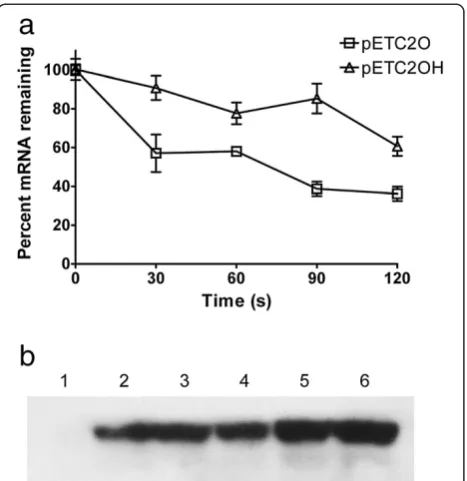
the remaining mRNA at different time intervals. The mRNA with the hairpin structure (expressed in pETC2OH) appeared to be more stable than the one without it (expressed in pETC2O), indicating the hairpin structure had contributed to an enhanced level of gene expression.
The PHA synthase expression levels were further examined by western blot analysis (Figure 1b). While the original PhaC2Ps, the mutants PhaC2PsQK and
PhaC2PsQKST were expressed with similar abundance,
codon optimization of the gene significantly increased the protein expression level (lane 5). With hairpin struc-ture inserted in front of the gene, the protein expression was further enhanced (lane 6).
PHB accumulation in recombinantE. coliexpressing
optimized PhaC2Ps
To test the functions of different PhaC2Pss for PHB
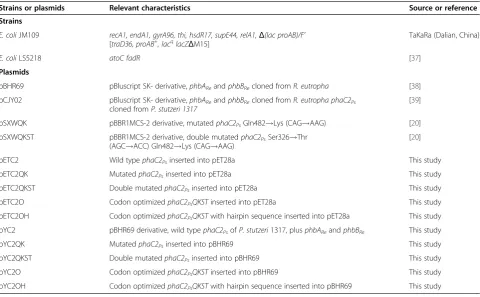
pro-duction in E. coli, a series of plasmids were constructed harboring phbA, phbB, and different phaC2Ps genes (Table 1). The five plasmids were named pYC2, pYC2QK, pYC2QKST, pYC2O, and pYC2OH, harboring PHA
synthase genes including the original phaC2Ps, the two recombinants phaC2PsQK and phaC2PsQKST, the codon optimizedphaC2PsO, andphaC2PsOwith a hairpin coding region, respectively. The details are described in Methods. Other transcription and translation-related elements such as promoters and ribosome binding sites were maintained the same among those constructed plasmids to avoid dif-ferences resulting from those elements.
The five constructed plasmids were transformed into E. coli JM109 to evaluate their functions of PHB accu-mulation, respectively. The shake flask study was per-formed using these recombinants grown on MS medium supplemented with thiamine. When 20 g/l gluconate was supplied as the sole carbon source, homopolymer PHB was synthesized under the catalysis of PhaC2Pss after 48 h
of cultivation (Figure 3). Shake flask experiment showed significant differences in PHB production and CDW among the recombinants (Figure 3). While native PhaC2Ps
only accumulated less than 2% PHB in cell dry weight (CDW) of 2.5 g/l, specific point mutagenesis of PhaC2Ps
increased PHB content to 2.4 wt% for PhaC2PsQK and
12 wt% for double mutated PhaC2PsQKST (Figure 3).
Sub-sequently, the codon optimization of PhaC2PsQKST
showed a significant improvement in enzyme activity indi-cated by the enhanced PHB accumulation to 20.4 wt% CDW (Figure 3). The PhaC2PsQKST with a hairpin
struc-ture that stabilized the mRNA further increased the PHB content to 30 wt%. The series of PhaC2Ps optimization
achieved approximately 15-fold improvement in PHB con-tent in total, and the codon optimization and hairpin structure contributed approximately 2.6-fold. Along with the enhancement of PHA production, CDW was also increased from 2.5 g/l to 3.4 g/l in this process.
Scl-mcl PHA production by recombinantE. coli
In order to study their abilities of scl-mcl PHA
produc-tion, the recombinant plasmids pYC2, pYC2QK,
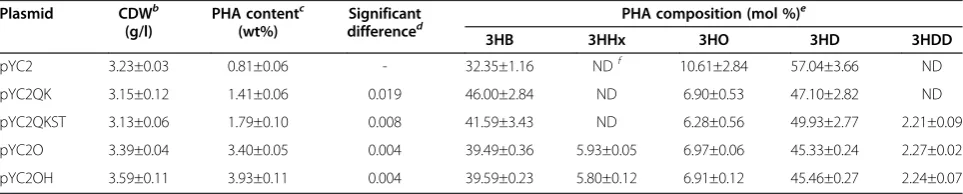
pYC2QKST, pYC2O, and pYC2OH were transformed into E. coliLS5218, a FadR and AtoC (two regulators in fatty acid degradation) deficient strain [33]. The shake flask study was performed with these recombinant strains using MS medium supplied with 1 g/l yeast ex-tract. When cultured with 8 g/l dodecanoate as a carbon source, the recombinant strains accumulated scl-mcl PHA with various concentrations and monomer compo-sitions (Table 2). An obvious increase of PHA content from 0.81 wt% to 3.93 wt% (significance p < 0.01), along with a slight increase of CDW from 3.23 g/l to 3.59 g/l was observed. The recombinant harboring pYC2 could only accumulate 0.81 wt% PHA composed of 3HB, 3-hydroxyoctanoate (3HO) and 3-hydroxydecanoate (3HD), while the recombinant harboring the double mutated
PhaC2PsQKST accumulated PHA up to 1.79 wt%
with an enhanced 3HB molar ratio at 84 mol%, and Figure 1Gene expression profiles and western blot analysis of
PhaC2Pss in recombinantE. coliharboring pET-based plasmids.
(a) The decay profiles of the transcripts ofphaC2PsOandphaC2PsOH
determined by quantitative RT-PCR. After adding rifampicin and incubating for 1 min, samples were iced at different timed intervals. The relevant abundances of mRNA compared to theompAmRNA abundance were determined by qPCR, and theyaxis showed the percentages of the remaining mRNA at timed intervals. Experiments were carried out in triplicate. (b) Western blot analysis of the PHA synthase PhaC2Psexpressed in recombinantE. coliharboring pET-based plasmids. Lane 1 to 6: crude extracts from recombinantE. coli
Figure 2Strategy for constructing DNA cassettes expressing different PhaC2Pss for PHA production.Five vectors containing different
DNA cassettes of mutatedphaC2Psunder the control of a lac promoter were constructed. GenesphaC2PsQK and phaC2PsQKSTare site-specific
mutants ofphaC2Psusing the original codon strategy, andphaC2PsOis the gene coding for PhaC2PsQKST yet with its codon optimized (the selected codon for each amino acid and the percentage of this codon in the original coding sequence are listed on the right). In the fifth DNA cassette, DNA sequence coding for a hairpin structure [29] was inserted into the 5’untranslated region of the gene. Double underlinines indicate the ribosome binding sites (RBS), and the single underlinine indicates translation start codon. Abbreviations:bla:beta-lactam resistance gene,
phbA:β-ketothiolase gene,phbB: acetoacetyl-CoA reductase gene,phaC2Ps: a PHA synthase gene fromP. stutzeri1317.
Table 1 Bacterial strains and plasmids
Strains or plasmids Relevant characteristics Source or reference
Strains
E. coliJM109 recA1, endA1, gyrA96, thi, hsdR17, supE44, relA1,Δ(lac proAB)/F’
[traD36, proAB+, lacqlacZΔM15]
TaKaRa (Dalian, China)
E. coliLS5218 atoC fadR [37]
Plasmids
pBHR69 pBluscript SK- derivative,phbAReandphbBRecloned fromR. eutropha [38]
pCJY02 pBluscript SK- derivative,phbAReandphbBRecloned fromR. eutropha phaC2Ps cloned fromP. stutzeri 1317
[39]
pSXWQK pBBR1MCS-2 derivative, mutatedphaC2PsGln482!Lys (CAG!AAG) [20]
pSXWQKST pBBR1MCS-2 derivative, double mutatedphaC2PsSer326!Thr (AGC!ACC) Gln482!Lys (CAG!AAG)
[20]
pETC2 Wild typephaC2Psinserted into pET28a This study
pETC2QK MutatedphaC2Psinserted into pET28a This study
pETC2QKST Double mutatedphaC2Psinserted into pET28a This study
pETC2O Codon optimizedphaC2PsQKSTinserted into pET28a This study
pETC2OH Codon optimizedphaC2PsQKSTwith hairpin sequence inserted into pET28a This study pYC2 pBHR69 derivative, wild typephaC2PsofP. stutzeri1317, plusphbAReandphbBRe This study
pYC2QK MutatedphaC2Psinserted into pBHR69 This study
pYC2QKST Double mutatedphaC2Psinserted into pBHR69 This study
pYC2O Codon optimizedphaC2PsQKSTinserted into pBHR69 This study
3-hydroxydodecanoate (3HDD) was also detected. Fur-thermore, in the case of the codon optimized PhaC2PsO,
the recombinant strain accumulated 3.40 wt% PHA with monomers including 3HB, 3-hydroxyhexanoate (3HHx), 3HO, 3HD and 3HDD. Among those recombinants, the one harboring pYC2OH accumulated the highest PHA content of 3.93 wt%, in which the molar ratios of 3HB, 3HHx, 3HO, 3HD and 3HDD were 39.59, 5.80, 6.91, 45.46 and 2.24, respectively.
To further investigate the effect of precursor supply in scl-mcl PHA production, different concentrations of glu-conate were added as an additional carbon source to the recombinantE. coliLS5218 harboring plasmid pYC2OH. A better growth and higher PHA accumulation were
observed when 5 g/l or 10 g/l gluconate was added com-pared to 20 g/l (Table 3), indicating a suitable balance between cell growth and PHA accumulation in this con-dition. 3HB fraction ranging from 52% to 96% in the polymers increased as more gluconate was provided (Table 3).
Discussion
With the development of synthetic biology, many func-tional modules are designed to be heterologously expressed in a host strain, and thus efficient and some-times precise expression of a specific enzyme is generally required to meet the demand of coordination among multiple modules [34]. There are many possibilities to adjust expression levels of proteins in different situa-tions, and codon optimization is generally considered a universal means to control or enhance heterologous pro-tein expression [31,32]. Recent development in DNA synthesis and sequencing allows the rapid and accurate synthesis of large amount of DNA constructs at a lower cost, providing more accessibility to optimizing codon usage of heterologously expressed genes and to screening for suitable expression levels [35]. The “one amino acid-one codon” optimization strategy was employed in this study. PHB accumulation studies indi-cated that the mutagenesis and optimization of PHA synthase PhaC2Ps cloned from P. stutzeri 1317
signifi-cantly enhanced the synthase polymerization activity, and thus promoted PHB synthesis (Figure 3). It was pre-viously reported that PhaC2Pscould achieve up to 40 wt
% PHB accumulation when expressed in R. eutropha PHB-4 [19,20]. However, when expressed in E. coli, this PHA synthase could only accumulate trace amount of PHB (Figure 3). The series of site-specific mutagenesis of this synthase PhaC2Pswas reported to achieve higher
PHA accumulation and 3HB fraction in R. eutropha PHB-4 [20], and the same phenomenon could be observed when the mutated enzymes were expressed in E. coli (Figure 3). The double mutant PhaC2PsQKST Figure 3PHB accumulation ofE. coliJM109 expressing
different PhaC2Pss using gluconate as carbon source.Data
represent results for three independent experiments ± standard deviations. The cultivation was conducted in 500 ml shake flasks each having 50 ml MS medium containing 20 g/l gluconate and 100 mg/l thiamine. IPTG (0.1 mol/l) was used as an inducing agent forlacpromoter and was added at 6 h after inoculation. After 48 h cultivation, strains harboring pYC2OH showed the highest CDW and PHB content (30 wt%, approximately 16-fold of the strains harboring pYC2), and the effect of codon optimization and hairpin stabilization was about 2.6-fold compared to the strain harboring pYC2QKST (p < 0.01).
Table 2 Scl and mcl PHA production byE. coliLS5218 harboring different PhaC2Pssa
Plasmid CDWb
(g/l)
PHA contentc (wt%)
Significant
differenced PHA composition (mol %)
e
3HB 3HHx 3HO 3HD 3HDD
pYC2 3.23±0.03 0.81±0.06 - 32.35±1.16 NDf 10.61±2.84 57.04±3.66 ND
pYC2QK 3.15±0.12 1.41±0.06 0.019 46.00±2.84 ND 6.90±0.53 47.10±2.82 ND
pYC2QKST 3.13±0.06 1.79±0.10 0.008 41.59±3.43 ND 6.28±0.56 49.93±2.77 2.21±0.09
pYC2O 3.39±0.04 3.40±0.05 0.004 39.49±0.36 5.93±0.05 6.97±0.06 45.33±0.24 2.27±0.02
pYC2OH 3.59±0.11 3.93±0.11 0.004 39.59±0.23 5.80±0.12 6.91±0.12 45.46±0.27 2.24±0.07
aCells were cultivated at 37°C and 200 rpm for 48 h as described in“Methods”. 8 g/l dodecanoate were added to the MS medium. Three parallel experiments were conducted for each datum.
b
CDW: cell dry weight.
cPHA content: PHA contents are given as mass percentage of CDW.
dSignificant difference: p value calculated by student’s t-test, indicating the significant difference between the respective and the previous PHA contents. e3HB, 3-hydroxybutyrate; 3HHx, 3-hydroxyhexanoate; 3HO, 3-hydroxyoctanoate; 3HD, 3-hydroxydecanoate; 3HDD, 3-hydroxydodecanoate.
f
could enhance PHB accumulation approximately 6-fold compared to the wild type did, and this was partially due to the altered substrate-specificity [20]. Another 1.7-fold of PHB accumulation was observed in the case of codon-optimized synthase PhaC2PsO (Figure 3). Since
the specificity was not altered compared to
PhaC2PsQKST (the amino acids sequence was exactly
the same), this result indicated that the increased PHB content was completely due to the enhancement of syn-thase expression.
The FadR-deficient strain E. coli LS5218 was used as the host to evaluate the scl-mcl PHA production driven by different PhaC2Pss. When grown on MS medium
sup-plemented with 8 g/l dodecanoate, all five recombinants harboring different plasmids could accumulate scl-mcl PHA (Table 2). Yet for strains harboring pYC2 or pYC2QK, only 3HB, 3HO and 3HD monomers were detected. Compared to the wild type PhaC2Ps, the two
site-specific mutants PhaC2PsQK and PhaC2PsQKST
increased PHA content and thus also the cell dry weight. Simultaneously, the substrate specificity was altered as a higher fraction of 3HB was observed, which was consist-ent with the previous report [20]. However, the overall PHA content was relatively low (1.79 wt%). After codon optimization of phaC2PsQKST, the PHA content was significantly increased to 3.40 wt% and various PHA monomers were found including 3HB, 3HHx, 3HO, 3HD and 3HDD. Particularly, the 3HB monomer frac-tion was reduced slightly compared to the situafrac-tion of PHA synthesis by PhaC2PsQKST (Table 2),
indicat-ing that the monomer composition relies on multiple factors including the substrate specificity, the poly-merization efficiency and the precursor supply. Both the PHB and scl-mcl PHA productions by the opti-mized PhaC2PsQKST verified that the codon
opti-mization strategy worked well in this condition (Figure 3 and Table 2). The replacement of rare codons such as AGG (Arg) and CUA (Leu) led to an significant increase in PHA production, indicating that the expression level of the key enzyme PHA synthase was strongly enhanced. It should be mentioned that there are other algorithms for codon optimization, and their functions on this spe-cific case remain to be explored. It is expected that
further optimization on PHA synthases can lead to wider substrate specificity and higher expression level, allowing the precise control of PHA polymerization.
Altering expression related factors such as promoters, ribosome binding sites, and mRNA stabilizers are possi-bilities to change the transcription and translation level of key PHA synthesis enzymes. In this study, a hairpin structure pHP17 which was reported to increase the half life of mRNA up to 19.8 min [29] was inserted in the 5’ UTR ofphaC2PsO, and it contributed another 1.5-fold in PHB accumulation (Figure 3), demonstrating that the degradation of the mRNA ofphaC2Psis a significant fac-tor that affects PHA accumulation. In the case of scl-mcl PHA production, the contribution of the hairpin struc-ture was also significant (p < 0.01). However, since the main function of this structure is to increase mRNA sta-bility, it is possible that the effect of a hairpin structure is largely dependent on the expression profiles in different conditions.
For the last version of the optimized PhaC2Ps (codon
optimized and hairpin inserted) the effect of different precursor supply situations to the monomer composi-tions of scl-mcl PHA was investigated. Compared to the presence of 20 g/l gluconate along with 8 g/l dodecano-ate (Table 3), E. coli LS5218 harboring pYC2OH could accumulate slightly more PHA when 5 g/l gluconate or 10 g/l were added, and the CDW was also higher. This was probably due to a better balance that could be reached between cell growth and PHA accumulation under low gluconate concentration, which allowed proper coordination with the specificity and expression level of the PHA synthase. On the other hand, monomer compositions can be adjusted by providing different ratios of precursors coming from multiple metabolism pathways. Since E. colihas been well investigated and is relatively easy for genetic integration, we can expect effi-cient scl-mcl PHA production from unrelated carbon sources if precursor supplying pathways are introduced, and precise control of the carbon flux through these pathways would lead to PHA production with desired compositions. Furthermore, expression cassettes with high efficiency is often required for chromosomal ex-pression since it is generally more difficult compared to
Table 3 Scl and mcl PHA accumulation by recombinantE. coliLS5218 harboring pYC2OH grown in mixtures of
gluconate and dodecanoatea
Concentration of gluconate (g/l)
CDW (g/l) PHA content (wt%) PHA composition (mol %)
3HB 3HHx 3HO 3HD 3HDD
5 3.73±0.02 4.18±0.16 52.39±3.40 5.16±0.54 20.24±1.11 14.89±1.75 7.32±0.70
10 3.47±0.33 3.99±0.35 70.11±3.12 4.50±0.31 14.16±0.72 7.01±0.62 4.22±0.08
20 2.10±0.10 3.36±0.18 96.33±0.78 ND 3.67±0.78 ND ND
plasmid system, therefore this investigation provides an optimized PHA synthase which may contribute to plasmid-free PHA production inE. coliin the future.
Conclusions
In summary, a series of optimization strategies were ap-plied on the PHA synthase PhaC2Ps from P. stutzeri
1317, which is a PHA synthase with wide substrate spe-cificities, to optimize its heterologous expression and PHA production inE. coli. The codon optimization and hairpin structure in the 5’-UTR of the mRNA were ef-fective for optimizing PhaC2Ps expression, and both the
PHB and scl-mcl PHA production levels were signifi-cantly increased. The results indicated that these strat-egies provide a good opportunity for future PHA production with optimized yield and composition.
Methods
Optimization of the coding sequence and transcription region of target PhaC gene
For codon bias optimization, “one amino acid-one codon” strategy [36] was employed in this study to ob-tain an optimized translational region of the target gene. Codon preference in E. coli K-12 was selected and the codons of predicted highly expressed genes were chosen to replace rare ones. A hairpin structure which was reported to be able to increase mRNA sta-bility [29] was introduced in the 5’ UTR of the mRNA for the target gene. The entire coding sequence of the optimized gene along with the hairpin region [Gen-Bank: JX082171] was synthesized by Shanghai Qinglan Biotech Co., Ltd.
Bacterial strains, plasmids, and general procedures for DNA manipulation
The main bacterial strains and plasmids used in this study are listed in Table 1. E. coli Trans1-T1 (Trans-gen) strain was used for plasmids construction men-tioned in this study. E. coli JM109 and E. coli LS5218 [37] were used for evaluating the expression of the PHA synthase PhaC2Ps and accumulating PHA with
different compositions.
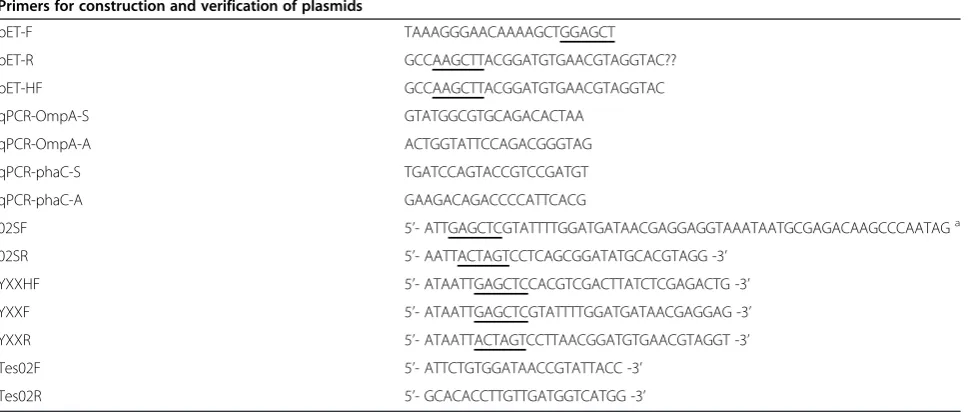
Plasmids related to PHA accumulation were a high-copy plasmid pBHR69 derivatives harboring phbA and phbB(originally cloned fromR. eutropha H16) encoding β-ketothiolase and acetoacetyl-CoA reductase, respectively [38], together with different mutatedphaC2Ps genes. For plasmid constructions, genes were subcloned using stand-ard PCR procedures, digested by respective restriction enzymes, and then ligated into the backbone of pBHR69. Specifically, DNA fragments coding for the optimized PhaC2PsQKST with (termed phaC2PsOH) or without (phaC2PsO) a hairpin sequence were amplified using pri-mer pairs YXXHF/YXXR or YXXF/YXXR (Table 4). Sub-sequently, the two fragments were digested by SacI and SpeI, purified via gel electrophoresis, and finally inserted into pBHR69. The resulting plasmids were named pYC2OH and pYC2O, respectively. Similarly, genes en-coding the wild type PhaC2Ps and two site-specific
mutants PhaC2PsQK and PhaC2PsQKST were subcloned
from plasmids pCJY02 [39], pSXWQK and pSXWQKST [20] using primer pair 02SF and 02SR. These DNA frag-ments were digested by the same endonucleases and then ligated to pBHR69 backbone, leading to plasmids pYC2, pYC2QK and pYC2QKST, respectively. The constructs were verified by PCR using primer Tes02F and Tes02R followed by sequencing verification. To assess the effect of
Table 4 Oligonucleotide sequences
Primers for construction and verification of plasmids
pET-F TAAAGGGAACAAAAGCTGGAGCT
pET-R GCCAAGCTTACGGATGTGAACGTAGGTAC??
pET-HF GCCAAGCTTACGGATGTGAACGTAGGTAC
qPCR-OmpA-S GTATGGCGTGCAGACACTAA
qPCR-OmpA-A ACTGGTATTCCAGACGGGTAG
qPCR-phaC-S TGATCCAGTACCGTCCGATGT
qPCR-phaC-A GAAGACAGACCCCATTCACG
02SF 5’- ATTGAGCTCGTATTTTGGATGATAACGAGGAGGTAAATAATGCGAGACAAGCCCAATAGa
02SR 5’- AATTACTAGTCCTCAGCGGATATGCACGTAGG -3’
YXXHF 5’- ATAATTGAGCTCCACGTCGACTTATCTCGAGACTG -3’
YXXF 5’- ATAATTGAGCTCGTATTTTGGATGATAACGAGGAG -3’
YXXR 5’- ATAATTACTAGTCCTTAACGGATGTGAACGTAGGT -3’
Tes02F 5’- ATTCTGTGGATAACCGTATTACC -3’
Tes02R 5’- GCACACCTTGTTGATGGTCATGG -3’
a
the optimization strategies on mRNA decay and gene ex-pression, pET-based series plasmids were constructed: the five phaC2Ps genes were cloned using primer pairs pET-F/R or pET-HF/R, digested by SacI and HindIII, purified via gel electrophoresis, and finally inserted into pET28a. Restriction enzymes were purchased from Fermentas (China). Plasmids were sequenced by Biosune (Beijing, China).
Analysis of the mRNA decay profiles by quantitative real-time PCR
The recombinant cells (E. coliJM109 harboring pETC2O or pETC2OH) were cultured in LB medium. When OD600 reached 0.2, isopropyl β -D-1-thiogalactopyrano-side (IPTG, 0.1 mol/l) were added and cells were cultured for another 2 h. Rifampicin was added to a final concen-tration of 50μg/ml to inhibit RNA synthesis. After 1 min of incubation, culture samples were iced at timed inter-vals. Total RNA was isolated from each sample using the E.Z.N.A.WBacterial RNA Kit (Omega Bio-tek). The purity and concentration of RNA were checked using a Nano-drop 2000 spectrophotometer (Thermo Fisher Scientific). Following cDNA synthesis was performed using the Quantscript RT Kit (Tiangen).
The mRNA decay profiles were determined by real-time PCR using the cDNA samples as the templates. The ompA gene was selected as the housekeeping gene. The real-time PCRs were performed using the SuperReal PreMix (SYBR Green) kit (Tiangen) with MxPro 3000P (Agilent Technology). The primers for real-time PCR are listed in Table 1, and the reaction condition was as follows: 95°C for 5 min; 95°C for 20 s, 55°C for 30 s, and 72°C for 30 s for 40 cycles.
Western blot analysis
The recombinant strains were cultivated in LB medium with IPTG (0.1 mol/l) and then harvested by centrifugation. After resuspending the cells in PBS buffer, crude extracts were obtained by disrupting the cells with sonication. The concentrations of total proteins were determined with a BCA protein assay kit (Vigorous). Proteins (10μg) in crude extracts were separated by sodium dodecyl sulfate-polyacrylamide gel electrophoresis (SDS-PAGE). Western blot analysis of PhaC2Pswas carried out using anti His-tag
mouse monoclonal antibodies (CW Biotech). Horseradish peroxidase (HRP)-conjugated anti-mouse antibodies (Santa Cruz Biotechnology) were used as a secondary antibody.
Medium and culture conditions
Different strains of E. coli were grown in LB medium or on LB agar plates at 37°C. Antibiotics including ampicilin (100 mg/ml) and kanamycin (50 mg/ml) were added when necessary. Antibiotics were purchased from Sigma (Beijing, China). For PHA accumulation,
shake flask experiments were carried out in a rotary shaker (NBS, Series 25D, New Brunswick, NJ, USA) at 200 rpm and 37°C using 500-ml conical flasks each con-taining 50 ml of medium. 20 g/l gluconate was used for the evaluation of optimized PhaC2Psfor enhanced
poly-3-hydroxybutyrate (PHB) synthesis, and 8 g/l dodecanoate plus 0 g/l, 5 g/l, 10 g/l, or 20 g/l gluconate was added as carbon sources in the case of scl-mcl PHA production. To achieve better utilization of dodecanoate, the flasks were shaken at 60 rpm, 45 °C immediately after sterilization in a rotary shaker until dodecanoate was scattered. Cells of E. coliJM109 or LS5218 were first cultured in LB medium for 12 h and then transferred to mineral salt (MS) medium containing different carbon sources at an inoculation vol-ume of 4% for 48 h. The MS medium contained (per liter) 9.0 g Na2HPO412H2O, 1.5 g KH2PO4, 1.0 g (NH4)2SO4,
0.4 g MgSO47H2O and 2% (v/v) trace element solution as
described in previous studies [40]. 100 mg/l thiamine was added into the MS medium whenE. coliJM109 was used since this strain is thiamine-deficient. For scl-mcl PHA production, 1 g/l yeast extract was added for the culture ofE. coli LS5218. IPTG (0.1 mol/l) was used as an indu-cing agent for lac promoter and was added at 6 h after inoculation.
Gas chromatography (GC) analysis of PHA in dry cells
Cell dry weight (CDW) was evaluated by harvesting 30 ml cell cultures, centrifuged at 10,000 rpm for 10 min and then washed with distilled water when glu-conate was added as sole carbon source. In the case of scl-mcl PHA production using dodecanoate as a carbon source, cells were washed twice with ethanol before washed with distilled water. CDW was measured after vacuum lyophilization (free of the remaining C12 carbon sources). The lyophilized cells and standard PHA sam-ples were subjected to methanolysis in chloroform at 100°C for 4 h in the presence of 3% (v/v) H2SO4to
pre-pare samples for gas chromatography (GC) (SHIMADZU GC-2014C, Kyoto, Japan) equipped with 30-m HP-5 capillary column [41]. PHA contents were determined by analyzing the GC data.
Statistical analysis
For statistical analysis, three parallel experiments were conducted and data collected were evaluated by mean ± SD. Student’s two-tailed t-test was performed to deter-mine the significance of differences (**: p < 0.01, *: p < 0.05).
Competing interests
The authors declare that they have no competing interests.
Authors’contributions
participated in plasmids construction. XWS carried out site-specific mutagenesis. JCC, QW and GQC supervised the study. All authors read and approved the final manuscript.
Acknowledgements
This research was financially supported by the 973 Basic Research Fund (Grant No. 2012CB725201 to GQC and Grant No. 2012CB725204 to QW), the National High Tech Suporting Grants (Project No. 2012BAD32B02 to JCC) and the National Natural Science Foundation of China (Grant No. 31170099 and Grant No. 31170940). We are grateful to Dr. A. Steinbüchel of the University of Münster, Germany, for the generous donation of the plasmid pBHR69.
Author details
1MOE Key Lab of Bioinformatics, Department of Biological Science and
Biotechnology, School of Life Science, Tsinghua-Peking Center for Life Sciences, Tsinghua University, Beijing 100084, China.2Synthenome.com, Dingley Village, Melbourne, VIC 3172, Australia.3Center for Nano and Micro Mechanics, Tsinghua University, Beijing 100084, China.
Received: 30 June 2012 Accepted: 12 September 2012 Published: 14 September 2012
References
1. Gao X, Chen JC, Wu Q, Chen GQ:Polyhydroxyalkanoates as a source of chemicals, polymers, and biofuels.Curr Opin Biotechnol2011,
22:768–774.
2. Chen GQ, Patel MK:Plastics derived from biological sources: present and future: a technical and environmental review.Chem Rev2012,
112:2082–2099.
3. Tripathi L, Wu LP, Chen J, Chen GQ:Synthesis of Diblock copolymer poly-3-hydroxybutyrate-block-poly-3-hydroxyhexanoate [PHB-b-PHHx] by a beta-oxidation weakenedPseudomonas putidaKT2442.Microb Cell Fact
2012,11:44.
4. Zhou XY, Yuan XX, Shi ZY, Meng DC, Jiang WJ, Wu LP, Chen JC, Chen GQ:
Hyperproduction of poly(4-hydroxybutyrate) from glucose by recombinantEscherichia coli.Microb Cell Fact2012,11:54.
5. Zhang S, Wang ZH, Chen GQ:Microbial polyhydroxyalkanote synthesis repression protein PhaR as an affinity tag for recombinant protein purification.Microb Cell Fact2010,9:28.
6. Wang ZH, Ma P, Chen J, Zhang J, Chen CB, Chen GQ:A transferable heterogeneous two-hybrid system inEscherichia colibased on polyhydroxyalkanoates synthesis regulatory protein PhaR.Microb Cell Fact2011,10:21.
7. Hazer B, Steinbüchel A:Increased diversification of polyhydroxyalkanoates by modification reactions for industrial and medical applications.Appl Microbiol Biotechnol2007,74:1–12.
8. Chen GQ:A microbial polyhydroxyalkanoates (PHA) based bio- and materials industry.Chem Soc Rev2009,38:2434–2446.
9. Steinbüchel A, Lutke-Eversloh T:Metabolic engineering and pathway construction for biotechnological production of relevant
polyhydroxyalkanoates in microorganisms.Biochem Eng J2003,
16:81–96.
10. Doi Y, Kitamura S, Abe H:Microbial synthesis and characterization of poly (3-hydroxybutyrate-co-hydroxyhexanoate).Macromolecules1995,
28:4822–4828.
11. Eggink G, de Waard P, Huijberts GN:Formation of novel poly (hydroxyalkanoates) from long-chain fatty acids.Can J Microbiol1995,
41(Suppl 1):14–21.
12. Chen:Plastics from Bacteria: Natural Functions and Applications. Germany: Heidelberg; 2010.
13. Matsusaki H, Abe H, Doi Y:Biosynthesis and properties of poly(3-hydroxybutyrate-co-3-hydroxyalkanoates) by recombinant strains of Pseudomonassp. 61–3.Biomacromolecules2000,1:17–22.
14. Sudesh K, Abe H, Doi Y:Synthesis, structure and properties of polyhydroxyalkanoates: biological polyesters.Prog Polym Sci2000,
25:1503–1555.
15. Jian J, Li ZJ, Ye HM, Yuan MQ, Chen GQ:Metabolic engineering for microbial production of polyhydroxyalkanoates consisting of high 3-hydroxyhexanoate content by recombinantAeromonas hydrophila.
Bioresour Technol2010,101:6096–6102.
16. Normi YM, Hiraishi T, Taguchi S, Sudesh K, Najimudin N, Doi Y:Site-directed saturation mutagenesis at residue F420 and recombination with another beneficial mutation ofRalstonia eutrophapolyhydroxyalkanoate synthase.Biotechnol Lett2005,27:705–712.
17. Loo CY, Lee WH, Tsuge T, Doi Y, Sudesh K:Biosynthesis and
characterization of poly(3-hydroxybutyrate-co-3-hydroxyhexanoate) from palm oil products in aWautersia eutrophamutant.Biotechnol Lett2005,
27:1405–1410.
18. Tsuge T, Watanabe S, Sato S, Hiraishi T, Abe H, Doi Y, Taguchi S:Variation in copolymer composition and molecular weight of polyhydroxyalkanoate generated by saturation mutagenesis ofAeromonas caviaePHA synthase.Macromol Biosci2007,7:846–854.
19. Chen JY, Song G, Chen GQ:A lower specificity PhaC2 synthase from Pseudomonas stutzericatalyses the production of copolyesters consisting of short-chain-length and medium-chain-length 3-hydroxyalkanoates.
Antonie Van Leeuwenhoek2006,89:57–167.
20. Shen XW, Shi ZY, Song G, Li ZJ, Chen GQ:Engineering of
polyhydroxyalkanoate (PHA) synthase PhaC2PsofPseudomonas stutzeri
via site-specific mutation for efficient production of PHA copolymers.
Appl Microbiol Biotechnol2011,91:655–665.
21. Dellomonaco C, Fava F, Gonzalez R:The path to next generation biofuels: successes and challenges in the era of synthetic biology.Microb Cell Fact
2010,9:3.
22. Steinbüchel A, Fuchtenbusch B, Gorenflo V, Hein S, Jossek R, Langenbach S, Rehm BHA:Biosynthesis of polyesters in bacteria and recombinant organisms.Polym Degrad Stabil1998,59:177–182.
23. Park SJ, Lee SY:Biosynthesis of poly(3-hydroxybutyrate-co
-3-hydroxyalkanoates) by metabolically engineeredEscherichia colistrains.
Appl Biochem Biotechnol2004,113:335–346.
24. Matsumoto K, Takase K, Yamamoto Y, Doi Y, Taguchi S:Chimeric enzyme composed of polyhydroxyalkanoate (PHA) synthases from Ralstonia eutrophaandAeromonas caviaeenhances production of PHAs in recombinantEscherichia coli.Biomacromolecules2009,
10:682–685.
25. Nomura CT, Taguchi K, Taguchi S, Doi Y:Coexpression of genetically engineered 3-ketoacyl-ACP synthase III (fabH) and
polyhydroxyalkanoate synthase (phaC) genes leads to short-chain-length-medium-chain-length polyhydroxyalkanoate copolymer production from glucose inEscherichia coliJM109.Appl Environ Microbiol2004,70:999–1007.
26. Nomura CT, Tanaka T, Gan Z, Kuwabara K, Abe H, Takase K, Taguchi K, Doi Y:
Effective enhancement of short-chain-length-medium-chain-length polyhydroxyalkanoate copolymer production by coexpression of genetically engineered 3-ketoacyl-acyl-carrier-protein synthase III (fabH) and polyhydroxyalkanoate synthesis genes.Biomacromolecules2004,
5:1457–1464.
27. Nomura CT, Tanaka T, Eguen TE, Appah AS, Matsumoto K, Taguchi S, Ortiz CL, Doi Y:FabG mediates polyhydroxyalkanoate production from both related and nonrelated carbon sources in recombinantEscherichia coli LS5218.Biotechnol Prog2008,24:342–351.
28. Carrier TA, Keasling JD:Controlling messenger RNA stability in bacteria: strategies for engineering gene expression.Biotechnol Prog1997,
13:699–708.
29. Carrier TA, Keasling JD:Library of synthetic 5’secondary structures to manipulate mRNA stability inEscherichia coli.Biotechnol Prog1999,
15:58–64.
30. Burgess-Brown NA, Sharma S, Sobott F, Loenarz C, Oppermann U, Gileadi O:
Codon optimization can improve expression of human genes in Escherichia coli: a multi-gene study.Protein Expr Purif2008,59:94–102. 31. Gao Z, Li Z, Zhang Y, Huang H, Li M, Zhou L, Tang Y, Yao B, Zhang W:
High-level expression of thePenicillium notatumglucose oxidase gene inPichia pastorisusing codon optimization.Biotechnol Lett2012,
34:507–514.
32. Menzella HG:Comparison of two codon optimization strategies to enhance recombinant protein production inEscherichia coli.Microb Cell Fact2011,10:15.
33. Li QA, Chen QA, Li MJ, Wang FS, Qi QS:Pathway engineering results the altered polyhydroxyalkanoates composition in recombinantEscherichia coli.New Biotech2011,28:92–95.
35. Ellis T, Adie T, Baldwin GS:DNA assembly for synthetic biology: from parts to pathways and beyond.Integr Biol (Camb)2011,3:109–118.
36. Puigbo P, Guzman E, Romeu A, Garcia-Vallve S:OPTIMIZER: a web server for optimizing the codon usage of DNA sequences.Nucleic Acids Res
2007,35:W126–131.
37. Spratt SK, Ginsburgh CL, Nunn WD:Isolation and genetic characterization ofEscherichia colimutants defective in propionate metabolism.
J Bacteriol1981,146:1166–1169.
38. Spiekermann P, Rehm BH, Kalscheuer R, Baumeister D, Steinbüchel A:A sensitive, viable-colony staining method using Nile red for direct screening of bacteria that accumulate polyhydroxyalkanoic acids and other lipid storage compounds.Arch Microbiol1999,171:73–80. 39. Chen JY, Liu T, Zheng Z, Chen JC, Chen GQ:Polyhydroxyalkanoate
synthases PhaC1 and PhaC2 fromPseudomonas stutzeri1317 had different substrate specificities.FEMS Microbiol Lett2004,234:231–237. 40. Qiu YZ, Han J, Guo JJ, Chen GQ:Production of poly(3-hydroxybutyrate-co
-3-hydroxyhexanoate) from gluconate and glucose by recombinant Aeromonas hydrophilaandPseudomonas putida.Biotechnol Lett2005,
27:1381–1386.
41. Kato M, Bao HJ, Kang CK, Fukui T, Doi Y:Production of a novel copolyester of 3-hydroxybutyric acid and medium chain length 3-hydroxyalkanaic acids byPseudomonassp 61–3 from sugars.Appl Microbiol Biotechnol
1996,45:363–370.
doi:10.1186/1475-2859-11-130
Cite this article as:Gaoet al.:Production of copolyesters of
3-hydroxybutyrate and medium-chain-length 3-hydroxyalkanoates byE.
colicontaining an optimized PHA synthase gene.Microbial Cell Factories
201211:130.
Submit your next manuscript to BioMed Central and take full advantage of:
• Convenient online submission
• Thorough peer review
• No space constraints or color figure charges
• Immediate publication on acceptance
• Inclusion in PubMed, CAS, Scopus and Google Scholar
• Research which is freely available for redistribution