R E S E A R C H A R T I C L E
Open Access
Pathological severity determines the renal
recovery for anti-myeloperoxidase
antibody-associated vasculitis requiring
dialysis at disease onset: a retrospective
study
Peng-cheng Xu
1*, Tong Chen
2, Si-jing Wu
1, Xia Yang
1, Shan Gao
1, Shui-yi Hu
1, Li Wei
1and Tie-kun Yan
1Abstract
Background:Many patients with anti-neutrophil cytoplasmic antibody (ANCA)-associated vasculitis (AAV) need dialysis at disease onset due to severe kidney injury. Determining whether they can become dialysis independent is an important clinical assessment.
Methods:Forty kidney biopsy-proved myeloperoxidase (MPO)-ANCA associated AAV patients who required dialysis at disease onset were enrolled. Relationships between laboratory and pathological characteristics and prognoses were analyzed.
Results:Twenty-five patients obtained dialysis independence within 3 months, while the other 15 patients remained dialysis dependent. No sclerotic class was identified among the 40 patients. Only two biopsies exhibited focal class diagnoses and both these patients recovered their renal function. The renal recovery rate of the 20 patients with mixed class was significantly lower than that of the 18 patients with crescentic class (40.0% vs. 83.3%, p= 0.006). Receiver operating characteristics (ROC) curves showed fibrous crescent+global glomerulosclerosis greater than 32.6% was a strong predictor of dialysis dependence with a sensitivity of 93.3% and specificity of 88.0%. When the percentage of fibrous crescent+global glomerulosclerosis exceeded 47.9%, dialysis independence was not possible. Correlation analysis indicated that platelet counts were negatively correlated with the percentage of fibrous crescent+global glomerulosclerosis (R = -0.448,p= 0.004). Most patients with increased platelets (84.62%) obtained renal recovery. Compared with methylprednisolone pulse therapy, plasma exchange accelerated renal recovery (29.4 ± 15.6 vs. 41.4 ± 11.7 days,p= 0.039).
Conclusions:For MPO-ANCA AAV who required dialysis at disease onset, crescentic and mixed classes accounted for the majority of patients in our cohort. The renal outcome of mixed class patients was worse than that of crescentic class. A high proportion of fibrous crescent+global glomerulosclerosis is a predictor of dialysis dependence. Increased platelet count is associated with active and reversible renal lesions.
Keywords:Antineutrophil cytoplasmic antibody, Myeloperoxidase, Renal biopsy, Histopathologic classification, Dialysis
© The Author(s). 2019Open AccessThis article is distributed under the terms of the Creative Commons Attribution 4.0 International License (http://creativecommons.org/licenses/by/4.0/), which permits unrestricted use, distribution, and reproduction in any medium, provided you give appropriate credit to the original author(s) and the source, provide a link to the Creative Commons license, and indicate if changes were made. The Creative Commons Public Domain Dedication waiver (http://creativecommons.org/publicdomain/zero/1.0/) applies to the data made available in this article, unless otherwise stated.
* Correspondence:[email protected]
1Department of Nephrology, Tianjin Medical University General Hospital,
Tianjin 300052, China
Background
Anti-neutrophil cytoplasmic antibody (ANCA)-associ-ated vasculitis (AAV) is a systemic vasculitis. The kidney injury manifests as a rapidly progressive glomeruloneph-ritis (RPGN), and this is very common in AAV and af-fects disease prognosis [1, 2]. Kidney biopsy typically reveals pauci-immune necrotizing glomerulonephritis (GN) [3, 4]. In AAV, a percentage of patients require renal replacement therapy at disease onset. Some of these patients enter end stage renal disease (ESRD) rap-idly in spite of intensive immunosuppressive therapy [5].
Without treatment, the prognosis of AAV is very poor. Immunosuppressive therapy effectively increases sur-vival. However, since intensive immunosuppressive ther-apy can lead to fatal infection [6], reducing the intensity of immunosuppressive therapy is necessary for patients who will not recover renal function. Based on the results of previous studies, plasma exchange (PE) could increase the rate of renal function recovery in AAV [7], but not all patients recover renal function with PE. Determining whether patients with severe kidney injury have the po-tential to become dialysis independent is of great im-portance in clinical practice.
According to the pathological classification proposed by Berden AE et al. [8], the pathological manifestations of ANCA-GN can be classified as focal, crescentic, mixed and sclerotic categories. This classification has been demonstrated to be effective in predicting the risk of ESRD, but there are no studies on whether the patho-logical characteristics can be used to assess the possibil-ity of renal function recovery for patients who require dialysis at disease onset. To investigate this, 40 kidney biopsy-diagnosed ANCA-GN patients who required dia-lysis at disease onset were enrolled in our study.
Materials and methods
Participants
Between January 2005 and May 2017, 244 patients with AAV were diagnosed at the Tianjin Medical University General Hospital. All patients fulfilled the Chapel Hill Consensus Conference classification [9]. Only 7 patients were proteinase 3 (PR3)-ANCA positive, all other patients were myeloperoxidase (MPO)-ANCA positive. Patients with PR3-ANCA were excluded because of insufficient numbers. Among the 237 patients with MPO-ANCA, 217 patients had kidney injury (including haematuria, proteinuria and abnormality of kidney func-tion), but 102 patients did not undergo kidney biopsy. Among these 102 patients, 74 patients did not agree to kidney biopsy (Sixteen patients needed dialysis at pres-entation and 10 patients recovered kidney function within 3 months after treatment) and 28 patients did not receive kidney biopsy because of the insufficient thick-ness of kidney cortex (Twelve patients needed dialysis at
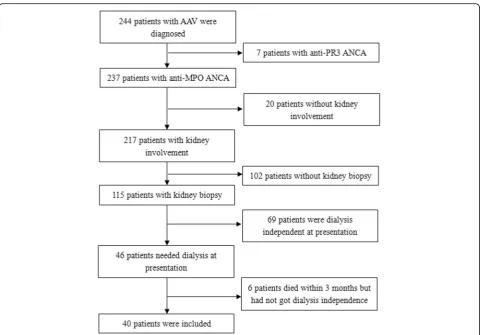
presentation and none recovered kidney function within 3 months following treatment). Among the 115 patients who received kidney biopsy, 46 patients required dialysis at disease onset. In the current study, dialysis depend-ence was defined as when the patients could not acquire dialysis independence for at least 3 months after treat-ment, so 6 patients were excluded because they died be-fore getting dialysis independence within 3 months. In summary, 40 patients were included in this study (Fig.1). The research was in compliance of the declaration of Helsinki and the protocol was approved by the institu-tional review board of Tianjin Medical University Gen-eral Hospital. Informed consent was not required because the study was retrospective.
Clinical and laboratory findings
Clinical data included the following: gender, age (years), time from first symptom (days) and the level of Birming-ham Vasculitis Activity Score (BVAS). Blood samples were taken for laboratory test. Estimated glomerular fil-tration rate (eGFR) was calculated with an equation de-scribed previously [10].
Renal histopathology
Renal biopsies were performed and evaluated using dir-ect immunofluorescence and light microscopy by two pathologists. According to the pathological classification described previously, the biopsy was classified as focal, crescentic, mixed and sclerotic class [8]. The presence of fibrinoid necrosis, cellular crescents and global glomeru-losclerosis of each glomerulus was scored. The presence of glomerular lesions was calculated as the percentage of the total number of glomeruli. Interstitial fibrosis (−/+/++), tubular atrophy (−/+/++) and arterial wall thickening (−/+) were scored semiquantitatively [11].
Treatment
consecutive days (200–500 mg/d) and the MP regimen was repeated after a week if necessary. The majority of patients (31 of 40) received intravenous or oral cyclophosphamide (CTX). 400 mg CTX was administered intravenously every two weeks (Pulse CTX) or by daily oral dose of 50–100 mg according to body weight (Oral CTX). Oral corticoster-oid+CTX or corticosteroid+mycophenolate (0.5-2 g/d) was administered for more than 1 year for maintenance ther-apy. Oral prednisone was prescribed at an initial dosage of 1 mg/kg/day for 1 month, with reducing doses over time. No patient received daily oral azathioprine (AZA) treat-ment because AZA was not available in our hospital.
Statistical analyses
Differences of quantitative parameters were assessed using one-way ANOVA tests (for data that were nor-mally distributed) or nonparametric test (for data that were not normally distributed). Categorical variables are presented as frequencies. Survival was calculated with the Kaplan-Meier, and the curves were compared by
Log-Rank test. To calculate the area under the curve (AUC) value, receiver operating characteristics (ROC) curves were generated. The cut-off value was confirmed by calculating Youden index. For correlation analysis the spearman test was used. P values lower than 0.05 were considered significant. The software SPSS, version 19.0 for Windows (IBM, Chicago, IL, USA), was used for statistical analyses.
Results
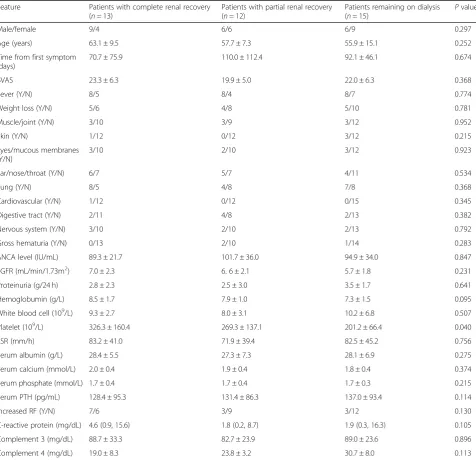
No differences in baseline clinical test characteristics, with the exception of platelet counts, were observed among patients who acquired complete renal recovery, partial renal recovery, or who remained dialysis dependent
(PR, 15 mL/min/1.73m2 < eGFR< 60 mL/min/1.73m2). As shown in Table1, there were no differences of the clinical laboratory characteristics, with the exception of the platelet counts, among the 3 groups. Patients with renal recovery had higher platelet counts (CR: 326.3 ± 160.4 109/L, PR: 269.3 ± 137.1 109/L) than patients who remained dialysis dependent (201.2 ± 66.4 109/L, P= 0.040). There was a trend of higher hemoglobin in patients with renal recovery (CR: 8.5 ± 1.7 g/L, PR: 7.9 ± 1.0 g/L) compared to those who remained dialysis dependent (7.3 ± 1.5 g/L), but the differ-ence was not statistically significant (P= 0.095).
Renal histopathological characteristics were strongly associated with the kidney prognosis
All patients received kidney biopsy, and all biopsy speci-mens contained more than 10 glomeruli. As shown in Table 2, the percentages of normal glomeruli and cellu-lar crescent of patients with CR or PR were significantly higher than the patients who remained dialysis dependent (P= 0.007 and P= 0.015), while the percent-ages of fibrous crescent and global glomerulosclerosis of patients with CR or PR were significantly lower than those of patients who remained dialysis dependent (both
Table 1Comparison of baseline clinical laboratory characteristics of patients with renal recovery and patients remaining on dialysis within 3 months
Feature Patients with complete renal recovery (n= 13)
Patients with partial renal recovery (n= 12)
Patients remaining on dialysis
(n= 15) P
value
Male/female 9/4 6/6 6/9 0.297
Age (years) 63.1 ± 9.5 57.7 ± 7.3 55.9 ± 15.1 0.252
Time from first symptom (days)
70.7 ± 75.9 110.0 ± 112.4 92.1 ± 46.1 0.674
BVAS 23.3 ± 6.3 19.9 ± 5.0 22.0 ± 6.3 0.368
Fever (Y/N) 8/5 8/4 8/7 0.774
Weight loss (Y/N) 5/6 4/8 5/10 0.781
Muscle/joint (Y/N) 3/10 3/9 3/12 0.952
Skin (Y/N) 1/12 0/12 3/12 0.215
Eyes/mucous membranes (Y/N)
3/10 2/10 3/12 0.923
Ear/nose/throat (Y/N) 6/7 5/7 4/11 0.534
Lung (Y/N) 8/5 4/8 7/8 0.368
Cardiovascular (Y/N) 1/12 0/12 0/15 0.345
Digestive tract (Y/N) 2/11 4/8 2/13 0.382
Nervous system (Y/N) 3/10 2/10 2/13 0.792
Gross hematuria (Y/N) 0/13 2/10 1/14 0.283
ANCA level (IU/mL) 89.3 ± 21.7 101.7 ± 36.0 94.9 ± 34.0 0.847
eGFR (mL/min/1.73m2) 7.0 ± 2.3 6. 6 ± 2.1 5.7 ± 1.8 0.231
Proteinuria (g/24 h) 2.8 ± 2.3 2.5 ± 3.0 3.5 ± 1.7 0.641
Hemoglobumin (g/L) 8.5 ± 1.7 7.9 ± 1.0 7.3 ± 1.5 0.095
White blood cell (109/L) 9.3 ± 2.7 8.0 ± 3.1 10.2 ± 6.8 0.507
Platelet (109/L) 326.3 ± 160.4 269.3 ± 137.1 201.2 ± 66.4 0.040
ESR (mm/h) 83.2 ± 41.0 71.9 ± 39.4 82.5 ± 45.2 0.756
Serum albumin (g/L) 28.4 ± 5.5 27.3 ± 7.3 28.1 ± 6.9 0.275
Serum calcium (mmol/L) 2.0 ± 0.4 1.9 ± 0.4 1.8 ± 0.4 0.374
Serum phosphate (mmol/L) 1.7 ± 0.4 1.7 ± 0.4 1.7 ± 0.3 0.215
Serum PTH (pg/mL) 128.4 ± 95.3 131.4 ± 86.3 137.0 ± 93.4 0.114
Increased RF (Y/N) 7/6 3/9 3/12 0.130
C-reactive protein (mg/dL) 4.6 (0.9, 15.6) 1.8 (0.2, 8.7) 1.9 (0.3, 16.3) 0.105
Complement 3 (mg/dL) 88.7 ± 33.3 82.7 ± 23.9 89.0 ± 23.6 0.896
Complement 4 (mg/dL) 19.0 ± 8.3 23.8 ± 3.2 30.7 ± 8.0 0.113
P< 0.001). All patients with PR or patients who remained dialysis dependent had arterial wall thickening, while 38.5% of patients with CR did not have arterial wall thickening (P= 0.003).
Mixed class of pathological classification is associated with poor kidney outcome
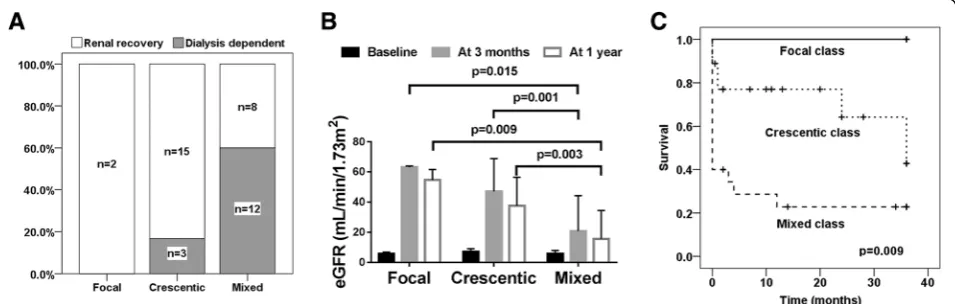
The distributions of 4 pathological categories were in-vestigated. No sclerotic class was found among the 40 patients. Only 2 patients were diagnosed as focal class, and both obtained renal recovery within 3 months. Among 18 patients in the crescentic class, 15 acquired renal recovery within 3 months and the other 3 stayed dialysis dependent. Among the 20 patients in the mixed class, 8 got renal recovery and the other 12 kept dialysis dependent. The renal recovery rate of the mixed class was significantly lower than that of crescentic class (p= 0.006) (Fig.2a).
We compared the eGFR at admission, at 3 months, and at 1 year among patients in the different patho-logical categories. There was no difference in baseline eGFR among patients with focal, crescentic or mixed class. After 3 months of treatment, the eGFR of all 3 groups increased, but the eGFR of patients in the mixed class was lower than that of patients in the crescentic or focal classes. After following up for 1 year, 4 out of 18 patients in the crescentic class died, while 3 out of 20 patients in the mixed class died. Among the living pa-tients, the eGFR of mixed class patients was still lower than that of the crescentic and focal classes (Fig.2b).
Since 12 patients who recovered renal function ob-tained PR but not CR, the renal survival of these patients at 1 year was analyzed. We observed that 3 patients with mixed class entered ESRD, and these 3 patients had higher a proportion of global glomerulosclerosis than patients who did not enter ESRD (Table3).
Table 2Comparison of renal histopathological characteristics of patients with renal recovery and patients remaining on dialysis within 3 months
Feature Patients with complete renal recovery (n = 13)
Patients with partial renal recovery (n= 12)
Patients remaining on dialysis (n= 15)
P value
Normal glomeruli (%) 24.2 (0.0, 57.2) 11.3 (0.0, 40.0) 0.0 (0.0, 15.2) 0.007
Fibrinoid necrosis (%) 3.8 (0.0, 16.7) 0.0 (0.0, 10.0) 0.0 (0.0, 3.1) 0.065
Cellular crescent (%) 58.1 (19.0, 100.0) 50.8 (20.0, 80.0) 31.7 (3.9, 65.6) 0.015
Fibrous crescent (%) 6.3 (0.0, 40.7) 18.8 (9.7, 31.4) 40.3 (0.0, 82.9) <
0.001
Global glomerulosclerosis (%)
0.0 (0.0, 33.3) 2.5 (0.0, 14.8) 20.0 (0.0, 40.0) <
0.001
Interstitial infiltrates (−/+/++/+++)
1/2/6/4 1/0/5/6 0/2/8/5 0.694
Interstitial fibrosis (−/+/++) 5/7/1 2/5/5 1/8/6 0.133
Tubular atrophy (−/+/++) 1/7/5 0/3/9 0/4/11 0.213
Arterial wall thickening (−/+) 5/8 0/12 0/15 0.003
Fig. 2Kidney prognosis of patients with different histopathologic classification.aThe renal recovery rate of patients with focal, crescentic or mixed class.bThe estimated glomerular filtration rate (eGFR) at admission, 3 months after therapy and 1 year after therapy of patients with focal, crescentic or mixed class.cComparison of the combined end point (Death and ESRD) among patients with different histopathologic
We then compared the combined end point (Death and ESRD) among patients with different pathological categories. As shown in Fig.2c, the order of the survival was focal, crescentic and mixed classes (p= 0.009).
Percentage of fibrous crescent+global glomerulosclerosis was a marker to predict the kidney outcome
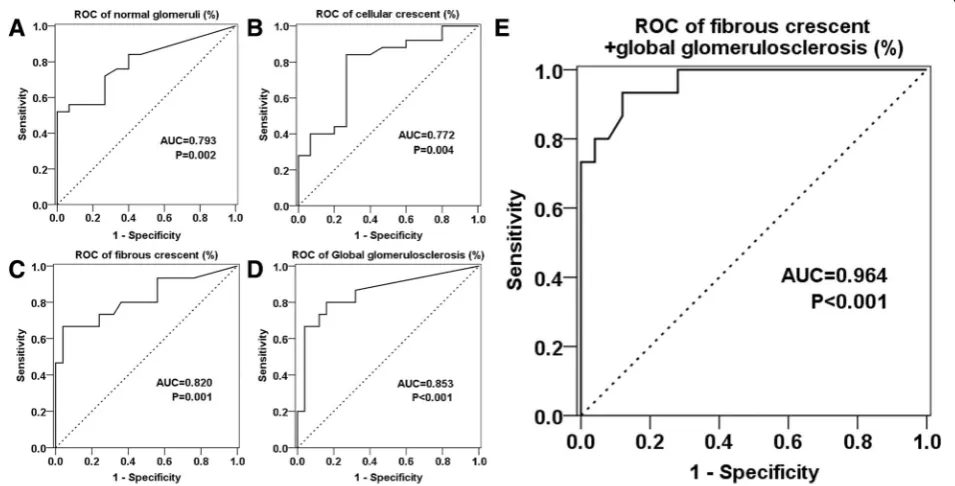
ROC curves were calculated to explore whether there were pathological parameters which could predict the renal prognosis. The ROC curves are shown in Fig. 3a. The AUC of global glomerulosclerosis was the greatest (0.853) among all 4 glomerular parameters. Since fibrous crescent usually indicates a kind of irreversible lesion, we attempted to determine whether the combination of fibrous crescent and global glomerulosclerosis could in-crease the accuracy of the diagnosis. As shown in Fig.3b, the AUC of fibrous crescent+global glomerulosclerosis was
greater than any other parameter. When the percentage of fibrous crescent+global glomerulosclerosis was 32.6%, the Youden index was at the peak value (sensitivity was 93.3% and specificity was 88.0%). When the percentage of fibrous crescent+global glomerulosclerosis exceeded 47.9%, renal recovery was unlikely.
Increased peripheral platelet counts were associated with reversible pathological lesions and high renal recov-ery rate.
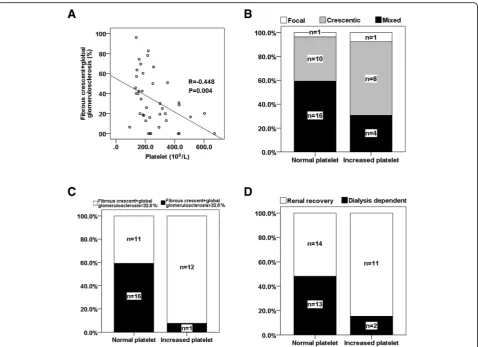
Since patients who obtained renal recovery had higher platelet counts than patients who were dialysis dependent, we explored whether platelet counts could be used as a substitute for pathological lesions to determine kidney outcome. Correlation analysis indicated that platelet counts negatively correlated with the percentage of fibrous crescent+global glomerulosclerosis (Fig. 4a). There were no differences in the distributions of focal, crescentic and
Table 3Comparison of the baseline renal histopathological characteristics between patients who entered ESRD and who did not enter ESRD after follow-up for 1 year among 12 patients with partial renal recovery
Feature Patients who entered ESRD (n= 3) Patients who did not enter ESRD (n= 9) Pvalue
Normal glomeruli (%) 0.0 (0.0, 4.0) 14.3 (5.0, 36.7) 0.405
Fibrinoid necrosis (%) 0.0 (0.0, 0.0) 0.0 (0.0, 10.0) 0.275
Cellular crescent (%) 48.6 (20.0, 80.0) 51.5 (33.3, 74.2) 0.782
Fibrous crescent (%) 30.0 (13.3, 31.4) 18.2 (9.7, 30.0) 0.195
Global glomerulosclerosis (%) 0.0 (0.0, 14.8) 10.0 (6.7, 14.3) 0.038
Pathological classification (F/C/M/S) 0/0/3/0 0/6/3/0 0.046
F/C/M/SFocal/crescentic/mixed/sclerotic
mixed categories between patients with normal platelets and patients with increased platelets (Increased platelets meant the platelet count was larger than the upper limit of normal range 300 × 109/L) (Fig. 4b, p= 0.238), but for the majority patients with increased platelets, the percent-ages of fibrous crescent+global glomerulosclerosis were less than 32.6% (Fig.4c,p= 0.002, compared with patients with normal platelets). Correspondingly, most patients with increased platelets obtained renal recovery (CR + PR) within 3 months (Fig. 4d, p= 0.045, compared with pa-tients with normal platelets). However, the AUC of plate-let counts for distinguishing renal recovery from dialysis dependence was only 0.709.
PE treatment accelerated the renal recovery
Effects of different therapy regimens on renal recovery were analyzed. All 40 patients received daily oral cortico-steroid as a primary treatment. Among these patients, 7
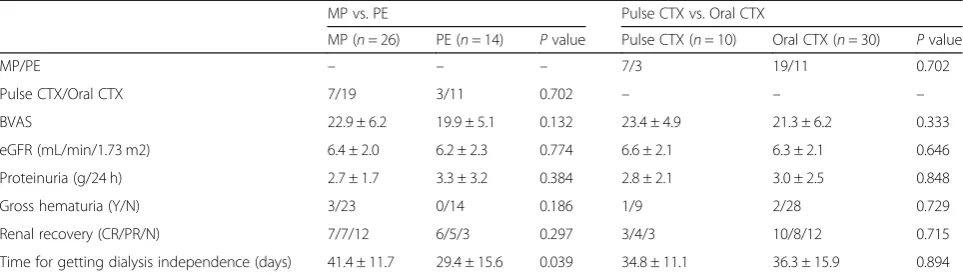
received MP + pulse CTX treatment, 19 patients received MP + oral CTX treatment, 3 patients received PE + pulse CTX treatment and 11 patients received PE + oral CTX treatment. As shown in Table4, there were no significant differences in the baseline BVAS, eGFR, proteinuria, or in-cidence of gross hematuria between the MP and PE groups or between pulse CTX and oral CTX groups. There were also no significant differences in kidney histo-pathology parameters among groups (data not shown). Compared with MP, PE accelerated the rate of renal re-covery (29.4 ± 15.6 vs. 41.4 ± 11.7 days, p= 0.039), and there was a tendency for a greater renal recovery rate in PE group (79%) compared with MP group (53%).
Discussion
RPGN), and RPGN with glomerular deposition of im-mune complexes (type 3 RPGN) [13]. Patients requiring dialysis at disease onset caused by type 1 RPGN usually rapidly enter ESRD [14, 15]. In contrast with type 1 RPGN, most patients with type 3 RPGN usually develop ESRD gradually. As for type 2 RPGN (ANCA-GN), the kidney outcome varies for different individuals.
In the current study, we found that pathological severity was the most important factor affecting renal outcome. Currently, the only practical tool for estimating the renal prognosis of ANCA-GN is the histopathologic classification proposed in 2010 [8]. Its clinical value has been evaluated by several studies in recent years [16–29]. Interestingly, the distribution of the four renal histological categories in our study is different from all previous studies. In the previous studies, the 4 pathological categories were approximately evenly spread, while in our cohort the crescent and mixed classes accounted for a near majority of patients. Although the initial study of Berden AE et al. suggested the prognosis of the mixed class was worse than that of the crescentic class [8], there is no consistent conclusion in subsequent validation studies concerning the comparison of the prog-nosis between the mixed and crescentic classes. In our study, the renal outcome of the mixed class was signifi-cantly worse than that of the crescentic class.
According to previous studies, the sclerotic class (glo-merulosclerosis over 50%) had the worst prognosis in ANCA-GN, but most patients took several years to de-velop ESRD. However, the patients in our study dede-veloped ESRD directly when fibrous crescent+glomerulosclerosis was greater than 32.6%. These results were very interest-ing and required interpretation. Theoretically, not all glomeruli with cellular crescents could return to normal even following intensive immunosuppressive treatments. There were only two patients in the focal class in this study, and we speculate that the proportions of normal glomeruli in both the mixed and crescentic classes in our study were much lower than the patients of the mixed and crescentic classes in previous studies. In contrast,
since the proportion of chronic lesions was greater in the mixed class than in the crescentic class, it was not difficult to see why the renal prognosis of the mixed class was in-ferior to that of the crescentic class in our study. There-fore, for patients needing dialysis at disease onset, the renal outcomes of the crescentic and mixed classes are significantly different.
In clinical work, not all patients are able to undergo kidney biopsy, so an alternative biomarker is of great im-portance [30, 31]. Platelet count has not been a signifi-cant factor in previous studies, but these studies included both patients needing dialysis and patients who did not need dialysis. In our study, platelet count was the only laboratory parameter which exhibited a signifi-cant difference between patients who obtained renal re-covery and those who remained dialysis dependent. It is noteworthy that platelet counts have been associated with disease activity in AAV and can distinguish acute infection from active disease [32, 33]. Platelet-leukocyte aggregates were significantly higher thrombocytosis. Most importantly, platelets could activate the alternative complement pathway, which is crucial in the pathogen-esis of AAV [34]. The peripheral levels of platelet-de-rived microparticles (PMPs) were significantly associated with disease activity and the proportion of crescents in the renal specimen [35]. We found platelet counts corre-lated with the percentages of fibrous crescent+global glomerulosclerosis. However, there was not a suitable cut-off value for platelet counts to predict kidney out-come. In addition, the diagnosis of thrombocytosis was influenced by the definition of upper normal limit of platelets. In our hospital, thrombocytosis was diagnosed when platelet counts were greater than 300 × 109
/L. Thus, platelet counts cannot replace pathological param-eters to predict renal prognosis in AAV.
CRP is a classical acute-phase protein. Interestingly, al-though there was a correlation between platelets and CRP (data not shown), there was no significant difference in CRP among patients with different renal outcomes. One
Table 4Influences of different therapy regimens on the renal recovery within 3 months
MP vs. PE Pulse CTX vs. Oral CTX
MP (n= 26) PE (n= 14) Pvalue Pulse CTX (n= 10) Oral CTX (n= 30) Pvalue
MP/PE – – – 7/3 19/11 0.702
Pulse CTX/Oral CTX 7/19 3/11 0.702 – – –
BVAS 22.9 ± 6.2 19.9 ± 5.1 0.132 23.4 ± 4.9 21.3 ± 6.2 0.333
eGFR (mL/min/1.73 m2) 6.4 ± 2.0 6.2 ± 2.3 0.774 6.6 ± 2.1 6.3 ± 2.1 0.646
Proteinuria (g/24 h) 2.7 ± 1.7 3.3 ± 3.2 0.384 2.8 ± 2.1 3.0 ± 2.5 0.848
Gross hematuria (Y/N) 3/23 0/14 0.186 1/9 2/28 0.729
Renal recovery (CR/PR/N) 7/7/12 6/5/3 0.297 3/4/3 10/8/12 0.715
Time for getting dialysis independence (days) 41.4 ± 11.7 29.4 ± 15.6 0.039 34.8 ± 11.1 36.3 ± 15.9 0.894
possible explanation is that CRP is more easily affected by other factors (such as potential infection) than platelets [32]. In the treatment of ANCA-GN, PE has been recom-mended due to its superiority to MP [7]. In our study, we also demonstrated that patients receiving PE had a faster renal recovery than patients receiving MP, but a higher remission rate was not observed. This may be due to the small cohort size of our study. However, the largest trial of AAV to date (PEXIVAS study), which cluded 704 participants from 98 sites in 15 countries, in-dicated no improvement in outcomes (death or ESRD) of patients who received PE. This issue requires further investigation.
Several limitations of our study should be mentioned. Firstly, due to the restrictions of the enrollment stand-ard, the sample size of the study was small. In our study, no sclerotic class patients were identified, but as many as twenty-eight patients who were dialysis dependent at disease onset were excluded because they did not receive kidney biopsy. Among these 28 patients, 12 patients had kidney atrophy and did not recover kidney function within 3 months. We could not exclude the possibility that most, or even all of these patients were of the scler-otic class. Secondly, only MPO-ANCA positive patients were included because PR3-ANCA positive AAV is rela-tively rare in our center. So whether the present results pertain to patients with PR3-ANCA positive AAV is un-clear. Thirdly, being limited by the inclusion standard, all patients without kidney biopsy or patients that died within 3 months were excluded. This affected the esti-mation of the effects of different therapies on renal re-covery. Finally, whether patients received either MP or PE treatment was not randomly determined due to the shortage of plasma.
Conclusions
In conclusion, for ANCA-GN requiring dialysis at dis-ease onset, the crescentic and mixed classes account for the majority of patients in our cohort. Mixed class is as-sociated with worse prognosis than crescentic class. A high level of fibrous crescent+global glomerulosclerosis pathology is a predictor of dialysis dependence. Patients with increased platelet counts have a greater number of acute pathological lesions and higher renal recovery rate compared to patients with normal platelet counts.
Abbreviations
AAV:neutrophil cytoplasmic antibody-associated vasculitis; ANCA: Anti-neutrophil cytoplasmic antibody; AUC: Area under the curve;
BVAS: Birmingham Vasculitis Activity Score; CR: Complete renal recovery; CTX: Cyclophosphamide; eGFR: Estimated glomerular filtration rate; ESRD: End stage renal disease; GN: Glomerulonephritis;
MP: Methylprednisolone pulse therapy; MPO: Myeloperoxidase; PE: Plasma exchange; PMPs: platelet-derived microparticles; PR: Partial renal recovery; PR3: Proteinase 3; ROC: Receiver operating characteristics; RPGN: Rapidly progressive glomerulonephritis
Acknowledgements
The authors thank Wen-ya Shang (Department of Nephrology; Tianjin Med-ical University General Hospital) for providing the data of the kidney biopsy.
Authors’contributions
PCX conceived and designed the experiments, analyzed data, and wrote the paper. TC collected data, analyzed data, and wrote the paper. SJW, XY and SG made substantial contributions to the acquisition of data, and the analysis and interpretation of data. SYH performed the statistical analyses. LW performed the diagnosis of kidney biopsy. TKY assisted the diagnosis of pathology, raised lots of important and helpful suggestions in manuscript writing. All authors read and approved the final manuscript.
Funding
This study is supported by three grants of National Natural Science Fund (No. 81200534, No. 81570630 and No. 81600554), two grants of Tianjin Research Program of Application Foundation and Advanced Technology (No. 15JCQNJC10700 and 17JCQNJC10200) and a grant of China Postdoctoral Science Foundation funded project (No. 2014 M560191). The funders have no role in study design, data collection and analysis, decision to publish, or preparation of the manuscript.
Availability of data and materials
The datasets used and/or analyzed during the current study are available from the corresponding author on reasonable request.
Ethics approval and consent to participate
The research was in compliance of the declaration of Helsinki and the protocol was approved by the institutional review board of Tianjin Medical University General Hospital [ZYY-IRB-SOP-016(F)-002–03]. Informed consent from each patient to participate in this study was not required by the Institutional Review Board, because the study was a retrospective review of clinical records only.
Consent for publication
Not applicable because this report does not contain data for individual patients.
Competing interests
The authors declare that they have no competing interests.
Author details
1Department of Nephrology, Tianjin Medical University General Hospital,
Tianjin 300052, China.2Department of Hematology, Tianjin Medical University General Hospital, Tianjin 300052, China.
Received: 17 September 2018 Accepted: 24 July 2019
References
1. Tang W, Bose B, McDonald SP, et al. The outcomes of patients with ESRD and ANCA-associated vasculitis in Australia and New Zealand. Clin J Am Soc Nephrol. 2013;8:773–80.
2. Romeu M, Couchoud C, Delaroziere JC, et al. Survival of patients with ANCA-associated vasculitis on chronic dialysis: data from the French REIN registry from 2002 to 2011. QJM. 2014;107:545–55.
3. Kallenberg CG. Key advances in the clinical approach to ANCA-associated vasculitis. Nat Rev Rheumatol. 2014;10:484–93.
4. Sinico RA, Di Toma L, Radice A. Renal involvement in anti-neutrophil cytoplasmic autoantibody associated vasculitis. Autoimmun Rev. 2013;12: 477–82.
5. Booth AD, Almond MK, Burns A, et al. Outcome of ANCA-associated renal vasculitis: a 5-year retrospective study. Am J Kidney Dis. 2003;41:776–84. 6. Shi YY, Li ZY, Zhao MH, et al. The CD4 lymphocyte count is a better
predictor of overall infection than the Total lymphocyte count in ANCA-associated Vasculitis under a corticosteroid and cyclophosphamide regimen: a retrospective cohort. Medicine (Baltimore). 2015;94:e843.
8. Berden AE, Ferrario F, Hagen EC, et al. Histopathologic classification of ANCA-associated glomerulonephritis. J Am Soc Nephrol. 2010;21:1628–36. 9. Jennette JC, Falk RJ, Bacon PA, et al. 2012 revised international Chapel Hill consensus conference nomenclature of Vasculitides. Arthritis Rheum. 2013; 65:1–11.
10. Xu PC, Chen T, Gao S, et al. Clinical and pathologic characteristics of pauci-immune anti-myeloperoxidase antibody associated glomerulonephritis with nephrotic range proteinuria. Ren Fail. 2018;40:554–60.
11. Li ZY, Gou SJ, Chen M, et al. Predictors for outcomes in patients with severe ANCA-associated glomerulonephritis who were dialysis-dependent at presentation: a study of 89 cases in a single Chinese center. Semin Arthritis Rheum. 2013;42:515–21.
12. Ma TT, Liu YR, Chen M, et al. Late restoration of renal function in patients with severe ANCA-associated glomerulonephritis who were dialysis-dependent at presentation. Clin Rheumatol. 2018;37:2143–50.
13. Gharbi C, Bourry E, Rouvier P, et al. Rapidly progressive lupus nephritis and concomitant thrombotic microangiopathy. Clin Exp Nephrol. 2010; 14:487–91.
14. Zhao J, Yang R, Cui Z, et al. Characteristics and outcome of Chinese patients with both antineutrophil cytoplasmic antibody and antiglomerular basement membrane antibodies. Nephron Clin Pract. 2007;107:c56–62. 15. Cui Z, Zhao MH, Xin G, et al. Characteristics and prognosis of Chinese
patients with anti-glomerular basement membrane disease. Nephron Clin Pract. 2005;99:c49–55.
16. Chang DY, Wu LH, Liu G, et al. Re-evaluation of the histopathologic classification of ANCA-associated glomerulonephritis: a study of 121 patients in a single center. Nephrol Dial Transplant. 2012;27:2343–9.
17. Córdova-Sánchez BM, Mejía-Vilet JM, Morales-Buenrostro LE, et al. Clinical presentation and outcome prediction of clinical, serological, and histopathological classification schemes in ANCA-associated vasculitis with renal involvement. Clin Rheumatol. 2016;35:1805–16.
18. Ellis CL, Manno RL, Havill JP, et al. Validation of the new classification of pauci-immune glomerulonephritis in a United States cohort and its correlation with renal outcome. BMC Nephrol. 2013;14:210.
19. Hilhorst M, Wilde B, van Breda Vriesman P, et al. Estimating renal survival using the ANCA-associated GN classification. J Am Soc Nephrol. 2013;24: 1371–5.
20. Iwakiri T, Fujimoto S, Kitagawa K, et al. Validation of a newly proposed histopathological classification in Japanese patients with anti-neutrophil cytoplasmic antibody-associated glomerulonephritis. BMC Nephrol. 2013;14:125. 21. Kristensen T, Gregersen JW, Krag SR, et al. The relation between
histopathological classification and renal outcome, ANCA subtype and treatment regimens in ANCA-associated vasculitis. Clin Exp Rheumatol. 2016;34:S105–10.
22. Moroni G, Binda V, Leoni A, et al. Predictors of renal survival in ANCA-associated vasculitis. Validation of a histopatological classification schema and review of the literature. Clin Exp Rheumatol. 2015;33:S–56-63. 23. Muso E, Endo T, Itabashi M, et al. Evaluation of the newly proposed
simplified histological classification in Japanese cohorts of myeloperoxidase-anti-neutrophil cytoplasmic antibody-associated glomerulonephritis in comparison with other Asian and European cohorts. Clin Exp Nephrol. 2013; 17:659–62.
24. Naidu GS, Sharma A, Nada R, et al. Histopathological classification of pauci-immune glomerulonephritis and its impact on outcome. Rheumatol Int. 2014;34:1721–7.
25. Nohr E, Girard L, James M, et al. Validation of a histopathologic classification scheme for antineutrophil cytoplasmic antibody-associated
glomerulonephritis. Hum Pathol. 2014;45:1423–9.
26. Quintana LF, Peréz NS, De Sousa E, et al. ANCA serotype and histopathological classification for the prediction of renal outcome in ANCA-associated glomerulonephritis. Nephrol Dial Transplant. 2014;29:1764–9.
27. Tanna A, Guarino L, Tam FW, et al. Long-term outcome of anti-neutrophil cytoplasm antibody-associated glomerulonephritis: evaluation of the international histological classification and other prognostic factors. Nephrol Dial Transplant. 2015;30:1185–92.
28. Togashi M, Komatsuda A, Nara M, et al. Validation of the 2010
histopathological classification of ANCA-associated glomerulonephritis in a Japanese single-center cohort. Mod Rheumatol. 2014;24:300–3.
29. Bjørneklett R, Sriskandarajah S, Bostad L. Prognostic value of histologic classification of ANCA-associated glomerulonephritis. Clin J Am Soc Nephrol. 2016;11:2159–67.
30. Westman KW, Bygren PG, Olsson H, et al. Relapse rate, renal survival, and cancer morbidity in patients with Wegener's granulomatosis or microscopic polyangiitis with renal involvement. J Am Soc Nephrol. 1998;9:842–52. 31. Chen Y, Bao H, Liu Z, et al. Risk factors for renal survival in Chinese patients
with myeloperoxidase-ANCA-associated GN. Clin J Am Soc Nephrol. 2017;12: 417–25.
32. Willeke P, Kumpers P, Schluter B, et al. Platelet counts as a biomarker in ANCA-associated vasculitis. Scand J Rheumatol. 2015;44:302–8. 33. Miao D, Li DY, Chen M, et al. Platelets are activated in ANCA-associated
vasculitis via thrombin-PARs pathway and can activate the alternative complement pathway. Arthritis Res Ther. 2017;19:252.
34. Chen SF, Wang FM, Li ZY, et al. Complement factor H inhibits anti-neutrophil cytoplasmic autoantibody-induced anti-neutrophil activation by interacting with neutrophils. Front Immunol. 2018;9:559.
35. Miao D, Ma TT, Chen M, et al. Platelets release proinflammatory microparticles in anti-neutrophil cytoplasmic antibody-associated vasculitis. Rheumatology (Oxford). 2019; Epub ahead of print.
Publisher’s Note