Turkish Journal of Fisheries and Aquatic Sciences 18: 49-55 (2018)
www.trjfas.org ISSN 1303-2712 DOI: 10.4194/1303-2712-v18_1_06
RESEARCH PAPER
© Published by Central Fisheries Research Institute (CFRI) Trabzon, Turkey in cooperation with Japan International Cooperation Agency (JICA), Japan
The Optimization of Wide-Type Zebrafish,
Danio rerio
(Hamilton, 1822)
Reproduction in Low Temperatures under Controlled Conditions
Introduction
Aquaculture of ornamental fish species, including aquarium fish species, is an important part of fisheries trade (Tlusty, 2002; Balon, 2004). Breeding aquarium fish is developing particularly dynamically in Asia although recently an extensive development has also been observed in some European countries. Also, few of aquarium fish, e.g. zebrafish (Danio rerio) or Japanese medaka (Oryzias latipes) are a model fish used in many laboratories (Segner, 2009). The zebrafish is one of the most valuable species in the ornamental fish trade including scientific research. Most fish of this species available in the market are imported from South-East Asia, where they are raised in the aquarium fish farms and in special laboratories or collected from the wild. The zebrafish has many advantages as a model organism, such as small size, reaching maturity in about three months, short reproductive cycle, easy breeding, transparent embryos and many others as possibility to spawn through the year under controlled conditions (Gioacchini et al., 2010; Dai et al., 2014). The zebrafish genome shows a high level of homology with human genome, so the importance of this species
as a model species is highly increasing (Dai et al., 2014).
Properly designed fish breeding procedure under controlled conditions which will ensure reproducible preparation of high quality gametes and thus larvae should cover a lot of aspects. The most important factors must include environmental conditions, including thermal and photoperiod and chemical composition of water, as well as origin, age and size of spawners, level of fish domestication, type of reproductive cycle (single or multi-batch spawners), feeding fish or health condition (Brooks, Tyler & Sumptem, 1997; Carnevelli, Gioacchini, Maradonna, Olivotto, & Migliarini, 2011; Nasiadka & Clark, 2012). Differences can be observed not only between related species but also between populations or breeding stocks (e.g. laboratory stocks) of the same species (Leskela & Kucharczyk, 1995; Brooks et al., 1997; Cieśla et al., 2014).
In recent time, the huge advancement was done in husbandry of zebrafish under controlled conditions. Many aspects, especially including spawning behavior, was mostly studied (Nasiadka & Clark, 2012; Tye et al., 2015). But some other aspects, including feeding regimes, spawning protocols
Dariusz Kucharczyk
1,*, Paweł Stępień
2, Joanna Nowosad
1, Krzysztof Kupren
1,3, Katarzyna
Targońska
1, Roman Kujawa
11
Warmia and Mazury University in Olsztyn, Department of Lake and River Fisheries, Poland. 2
Warmia and Mazury University in Olsztyn, Institute of Geodesy, Poland. 3
University of Warmia and Mazury, Department of Tourism, Recreation and Ecology, Poland.
* Corresponding Author: Tel.: + 48.89 5234215; Fax: + 48.89 5233969; E-mail: [email protected]
Received 23 January 2017 Accepted 8 May 2017
Abstract
Zebrafish is popular aquarium fish and laboratory model species but some aspects of advanced spawning technologies, especially of reproduction and rearing in low temperatures (>25°C), which involve the production of high quality and viable gametes, should be studied. In the present study fish before spawning were reared at cold thermal regime: 19-20°C. From three tested temperatures for fish spawning, the highest spawning effectiveness was noted at 23°C. The highest rate of embryo survival was noted when the temperature in which the spawners were kept before spawning was the lowest (19°C). In the spawning of small breeders groups, the number of males should be higher than the number of females. If the sex rate was 1:1, the lowest embryo survival was noted. From the breeding perspective fish of this species should be reproduced again shortly after the completed spawning a time between spawns should be 20 to 60 days if the spawners were kept at 19°C. Keeping the fish between spawning periods more than 40 days results in a significant deterioration of quality of gametes, expressed as embryo survival. It was observed that spawners of this species produce viable gametes and spawn successfully every 20 days, during a few following spawning periods without changes of embryo survival.
depending to the prior conditions, zootechnical procedures of involved spawning which caused high number of produced and spawned eggs and high gametes quality could not be study enough (Gioacchini et al., 2010; Chen & Ge, 2013; Tye et al., 2015). Zebrafish have asynchronous ovaries, containing follicles at all stages of development (Selman et al., 1993) as well as mature eggs. The growth and maturation of the oocyte occur over a period of about 10 days (Csenki et al., 2010; Nowosad, Kucharczyk, & Targońska, 2017), and in laboratory conditions, eggs are spawned throughout the year. For this reason, short time of changing zootechnical protocols, e.g. feeding regime, temperature, photoperiod, ect … might influence changes in reproductive parameters such as fecundity, embryo survival rate or larvae quality (Nowosad et al., 2017). On the other hand, different strains of zebrafish might show different response on factors stimulated final gametes maturation and ovulation.
Usually, zebrafish were reproduced and rearing in laboratories in constant thermal regime: 25–29°C (e.g. Seki et al., 2007; 2011). But for some research, it is necessary to study much wider range of temperatures, e.g. 12–35°C (Vergauwen, Hagenaarsa, Blusta & Knapena, 2013). This model fish are poikilothermic (“cold-blooded”) and the body temperate vary as ambient temperatures. This gave the possibility to study influence of low (cold) temperatures on oxidative stress (Vergauwen et al., 2013), use of cryoprotectans and applications of cryobiological properties (Seki et al., 2007, 2011), hormones regulation, toxicity, some mutations (e.g. mitfavc7), muscle and skeletal development, heart
function, body pigmentation, oxygen consumption, stress response and many others (e.g. Kulkeaw et al., 2011; Majhi & Das, 2013; Johnson, Turko, Klaiman, Johnston, & Gillis, 2014; Little & Seebacher, 2014; 2015; Zeng, Johnson, Lister, & Patton, 2014; Ackerly & Ward, 2016). Also, cold acclimated strains of zebrafish might be very useful for embryos cryopreservation as less sensitive to thermal stress (Desai, Spikings, & Zhang, 2015). The well described protocol of keeping and reproducing zebrafish under cold thermal regime might be useful in many further studies, in which cold-tolerance strains of this species should be used.
The aim of this study was to reproduce of wild-type zebrafish under controlled conditions with especially target on influence of temperature on
spawning success of zebrafish kept in low (19°C) temperatures before spawning.
Materials and Methods
Spawners
Fish for broodstock was obtained from domesticated stock from one of the Polish tropical fish farm and transported to the Laboratory of Aquaculture at Department of Lake and River Fisheries, Warmia and Mazury University in Olsztyn. The collected fish (over 1500 specimens wild-type) were about 1 cm of total length and 2 months old. In the fish farm, in which they were origin, zebrafish are usually cultured at water temperatures between 19 – 21°C. Initially they were reared at 1 m tank (Kujawa, Kucharczyk, & Mamcarz, 1999) for one month. Later, the fish were reared during three months at constant temperature (19–20°C) in recirculated water system. The water parameters are presented in Table 1. Fish were fed two times daily with frozen natural food: zooplankton, blood and mosquito larvae (Spence et al., 2006).
Initial Spawning
Prior to spawning the fish (6–7 months-old) were segregated according to sex for a period of three weeks and fed three times a day intensively. Then they were moved to the spawning tanks in order to prepare them to the first spawning. The spawn was stimulated by manipulation of environmental conditions, especially by increasing temperature (to 23°C) (Nowosad et al., 2017). A spawning substrate (nylon brush) was used for egg deposition (Nasiadka & Clark, 2012). The females which spawned and showed “empty belly” were used to further experiments. The first spawn (called as "mass") was made in 90 small aquariums (7 dm3 each). At least 3 females and 6 males were moved to each tank. Between the experimental spawnings all of the spawners were kept separately in tanks (both males and females) but in one closed system.
Physicochemical parameters of water used for zebrafish spawning were constant. For that purpose water prepared was obtained from the process of reversed osmosis, and the water with carbon hardness 0°dH and total hardness at 0°n was obtained. Then was mixed with tap water to obtain water with carbon
Table 1. The physic-chemical water parameters during rearing and spawning of zebrafish under controlled conditions
Parameters Rearing parameters Spawning parameters
Temperature (°C) 19 19–27
pH 7.2–7.8 7.2–7.8
Dissolved oxygen (ppm) >6 >6
Ammonia concentration (ppm) <0.1 <0.1
Carbon hardness (°dH) 6–15 6
hardness 6°dH and total hardness at 10°n (Table 1). The temperature of water in spawning tanks was usually 23°C (except experiment No. 1 and 2). All fish, except in experiment 2, were kept at 19°C between the spawning acts. On the bottom of the tank spawn grilles with mesh size of 5 mm were placed. The tanks were aerated. The spawning tanks were placed in photoperiod 12L: 12D. Three times a day the tanks were checked whether spawning took place (one, six and eleven hours after lights witch on). After completed spawning the fish were caught.
Experiment1
The first experiment investigated the influence of the temperature (19, 23 and 27°C) of water in which fish were kept before spawning on the results of spawning. For that purpose two sets of fish (10 reproductive coupe each: 1 female and 2 males) were used. Spawners were placed in the late afternoon into the small tanks (7 dm3 each). A spawning substrate (nylon brush) was used for egg deposition (Nasiadka & Clark, 2012). On the bottom three glass Petri dishes were placed for eggs collection. Spawning usually began on the next (or second) day around dawn and lasted from one to four hours at early morning. The pairs were removed immediately after completed spawning. When the embryos were at eyed-egg-stage (black pigment in embryos eyes are visible) the survival of embryos were counted (live embryos x 100%/ total number of embryos). The water parameters are present in Table 1.
Experiment 2
The second experiment investigated the influence of the temperature (19, 23 and 27°C) of water in which fish were kept by 10-days before spawning on the results of spawning. For that purpose two sets of fish (10 reproductive coupe each: 1 female and 2 males) were used in each temperature. Spawners were placed in the late afternoon into the small tanks (7 dm3 each). After completed spawning the procedure was the same as in experiment 1.
Experiment 3
The third experiment the investigation of the influence of males number per female on spawning results. For this reason 1, 2, 3, or 4, males together with one female were moved to the spawning tanks (7dm3 each). Spawning temperature was 23°C. After completed spawning the procedure was the same as in experiment 1. Experiment was made in triplicate.
Experiment 4
In the fourth experiment the investigation concerned the duration of the most appropriate period between spawning from the breeding perspective. For
that purpose 10 reproductive completes (2 male and 1 female) that successfully completed the first spawning were moved 20, 30, 40 and 60 days to spawning tanks (7 dm3). Spawning temperature was 23°C. After completed spawning the procedure was the same as in experiment 1.
Experiment 5.
The aim of the fifth experiment was the investigation the effect of consecutive spawning acts on the number of obtained larvae. For that purpose 10 reproductive completes (2 male and 1 female) were used. Spawners were placed in the late afternoon into the small tanks (7 dm3 each). Spawning usually began on the next (or second) day around dawn and lasted from one to four hours at early morning. The spawning completes were removed immediately after completed spawning. Every 20 days they were moved to spawning tanks again. After completed spawning the procedure was the same as in experiment 1.
Statistics
The obtained results were analyzed statistically. The differences in the number of embryo survival rates and 7–day–old larvae between groups in individual experiments were processed by variance analysis and Tuckey's post-hoc test at significance level of 5%. The correlation between the number of larvae and the consecutive spawning as well as intervals between individual spawning acts and number of pairs were subjected to regression analysis.
Results
Whatever type of experiment was conducted the percentage of ovulating females was high, ranging from 90% (at least) to 100%, usually 100%.
The different temperatures during spawning of zebrafish showed evidence influence of embryo survival. When the spawnings were occurred at 23°C, the highest survival rate (over 80%) was noted (Figure 1). The lowest survival was observed at highest tested temperature (27 °C), where the difference between keeping and spawning temperatures was 8°C. The embryos mortality dynamics showed, that many of them died (stay white and not-transparent) during first 24 hours of incubation. Any other reason of dyeing embryos was observed.
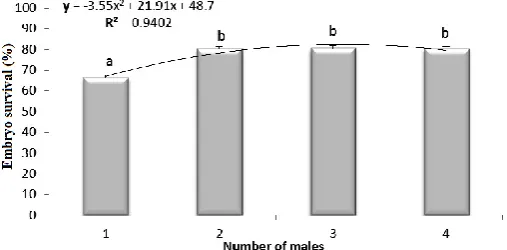
The results of the influence of number of males in spawning complete on embryo survival are presented in Figure 3. The highest embryo survival rates were observed when the minimum numbers of males were 2. The higher number of males per female did not influenced on obtained results.
Figure 4 presents the embryo survival obtained from spawning acts, performed at fixed time intervals (after 20, 30, 40 and 60 days) from the first (mass) spawning. It was demonstrated that the interval between individual reproductive acts in case of zebrafish kept at 19°C should be from 20 to 40 days. Keeping the fish longer than 40 days before consecutive spawning resulted in a significant
decrease of the embryos survival.
Zebrafish spawners produced viable gametes during seven following spawns (Figure 5), including the first-mass spawning. There was any decreasing in embryo survival during the following spawns.
During all the experiments no spawners mortality was recorded.
Discussion
The industrial catching of ornamental fishes from the wild influenced their significant decline (Raghavan et al., 2007). The main problem is that in many cases the collection of fish from the wild is
Figure 1. The relationship between water temperature during zebrafish spawning and embryos survival rates. Before
experiment fish were kept at 19°C.
Figure 2. The relationship between water temperature of keeping zebrafish spawners before spawning and embryos
survival rates.
Figure 3. The relationship between zebrafish number of males per females in spawning completes and embryos survival
cheaper than their breeding in captivity. On the other hand spawn of wild fish is more difficult in captivity than cultured ones. This situation should be changed by fish domestication (Balon, 2004). Many aquarium fishes were spawned in captivity after manipulation of environmental conditions only (Kucharczyk et al., 2008). The same situation was noted in the case of zebrafish, where stimulation by environmental factors (water temperature and photoperiod) was enough for stimulation of final maturation of gametes.
In modern aquaculture obtaining high quality gametes, which allows both obtaining the required number of larvae for initial rearing and planning of production, is one of the most important problems which should be solved. It is also highly important from the economic perspective. This applies not only to fishes reared for consumption but also other fish including the decorative, aquarium and model laboratory species. Numerous factors influence the effects of reproduction, which are in this study understood as spawning and obtaining a specific number of larvae from the spawn. They include, among others, the fish diet and environmental conditions. According to Brooks et al. (1997) the differences between species in the observed influence of environmental conditions on effectiveness of fish reproduction and quality of gametes produced by them were described. In some cases the environmental conditions which the spawners are kept in can also affect offspring rates of survival and growth as well as the resistance to stress (Brooks et
al., 1997; Targońska, 2007; Nowosad et al., 2017). The results of studies indicate that keeping spawners of wild-type zebrafish in excessively high temperature and for excessively long intervals between consecutive spawning actions can significantly influenced on effects of reproduction. It was demonstrated that during selection of reproducers to the spawning stock the number of completed spawning actions and the time between them should also be considered. The results presented in this study fill the information gap concerning biotechnology of model, laboratory and aquarium fish reproduction, which is quite significant also for species highly popular in aquaculture and for economic point of view (Hakuć-Błażowska et al., 2009) during this species culture.
In Bangladesh wild zebrafish live at temperature between 16.5 and 33°C. The reproduction is correlated with food availibity and may be occurred in different temperatures (Spence et al., 2006). Data from controlled laboratory experiments (Cortemeglia & Beitinger, 2005; Schaefer & Ryan, 2006) indicate that zebrafish have a maximal thermal tolerance range of 6.7–41.7°C, which puts them in a similar class with one of the most eurythermal fish species known. It is important to note that the ranges of tolerance in both studies variants in present work (experiment 1 and 2) were strongly influenced by acclimation temperature. In other studies it was showed that fish which are acclimated for a period of time at lower temperatures can extend their lower temperature tolerance further
Figure 4. The relationship between period of following spawning acts of zebrafish and embryos survival rates.
than fish acclimated to higher temperatures (Cortemeglia & Beitinger, 2005; Schaefer & Ryan, 2006). The accumulation of negative influence of high water temperature in which spawners were kept was also found in case of the studied species of tetras: neon and Buenos Aires tetra (Hyphessobrycon anisitsi
Eigenmann, 1907), when extended keeping of fish in water at 25°C caused a decrease in the number of offspring (Kucharczyk et al., 2008). The influence of water temperature on reproductive capability has been described for many fish species (Kraak & Pankhurst 1996). A similar relation between the temperature at which the spawners were kept before reproduction and survival of the embryos and larvae was observed in case of Menidia beryllina (Cope, 1867) (Hubbs & Bryan, 1974).
In present study the period between following spawning acts which occur 20 – 40 days influenced on high embryo survival. Longer time between spawn resulted with lower embryo survival. In zebrafish, the growth and maturation of the oocyte occur over a period of about few days to 10 days at temperature about 27°C (Wang & Ge, 2003a, b; Csenki et al., 2010; Gioacchini et al., 2010). It might suggests that in lower temperature (19°C) in present study elongated a period of oocyte maturation.
In aquarium fishes the period in which females might produce viable eggs are different. The viable offspring of zebrafish can be obtained during all tested sequenced spawning acts. A different situation was noted in some Characidae, i.e. Buenos Aires tetra (Kucharczyk et al., 2008), where during further reproduction (5 – 7 spawn), the eggs were laid but hatched larvae were not obtained.
In conclusion, the present study shows, that it is possible to obtain high quality oocytes from zebrafish kept at low (19°C) temperature. Keeping breeders at such temperature conditions gives the possibility to obtain viable and high quality of eggs for several spawnings following 20 – 40 days each.
Acknowledgements
This study was partially supported by the projects: "Innovations in finfish aquaculture with special references to reproduction" (InnovaFish), Operational Programme Sustainable Development of the Fisheries Sector and Coastal Fishing Areas 2007-2013 (OR14-61724-OR1400003/09/10/11 ).
References
Ackerly, K.L. & Ward, A.B. (2016). How temperature-induced variation in musculoskeletal anatomy affects escape performance and survival of zebrafish (Danio rerio). Journal of Experimental Zoology, 325A, 25– 40. http://dx.doi.org/10.1002/jez.1993
Balon, E.K. (2004). About the oldest domesticates among fishes. Journal of Fish Biology, 65 (Suppl. A), 1–27. http://dx.doi.org/10.1111/j.0022-1112.2004.00563.x Brooks, S., Tyler, C.R., & Sumptem, J.P. (1997). Egg
quality in fish: what makes a good egg? Reviews in Fish Biology and Fisheries, 7, 387–416.
Chen, W., & Ge, W. (2013). Gonad differentiation and puberty onset in the zebrafish: evidence for the dependence of puberty onset on body growth but not age in females. Molecular Reproduction and Development, 80, 384–392.
http://dx.doi.org/10.1002/mrd.22172
Cieśla, M., Jonczyk, R., Gozdowski, D., Śliwinśki, J., Rechulicz, J., & Andrzejewski, W. (2014). Changes in ide Leuciscus idus (L.) females’ reproductive parameters after stimulation with carp pituitary homogenate (CPH) and Ovopel: the effect of domestication? Aquaculture International, 22, 77–88. http://dx.doi.org/10.1007/s10499-013-9668-z
Cortemeglia, C. & Beitinger, T.L. (2005). Temperature Tolerances of Wild-Type and Red Transgenic Zebra Danios. Transactions of the American Fisheries Society, 134(6), 1431 – 1437.
http://dx.doi.org/10.1577/T04-197.1
Csenki, Z., Zaucker, A., Kovács, B., Hadzhiev, Y., Hegyi, A., Lefler, K.-K., … Müller, F. (2010). Intraovarian transplantation of stage I-II follicles results in viable zebrafish embryos. The Internationa Journal of Developmental Biology 54: 585 – 589.
http://dx.doi.org/10.1387/ijdb.082786zc
Dai, Y.-J., Jia, Y.-F., Chen, N., Bian, W.-P., Li, Q.-K., Ma, Y.-B., Chen, Y.-L., & Pei, D.-S. (2014). Zebrafish as a model system to study toxicology. Environmental Toxicology and Chemistry, 33, 11–17.
http://dx.doi.org/10.1002/etc.2406
Desai, K., Spikings, E., & Zhang, T. (2015). Short-Term chilled storage of zebrafish (Danio rerio) embryos in cryoprotectant as an alternative to cryopreservation. Zebrafish 12(1), 111–120.
http://dx.doi.org/10.1089/zeb.2013.0961
Gioacchini, G., Maradonna, F., Lombardo, F., Bizzaro, D., Olivotto, I., & Carnevali, O. (2010). Increase of fecundity by probiotic administration in zebrafish (Danio rerio). Reproduction, 140, 953–959.
http://dx.doi.org/10.1530/REP-10-0145
Hakuć-Błażowska, A., Kupren, K., Turkowski, K., Targońska, K., Jamróz, M., Krejszeff, S., … Kucharczyk, D. (2009). Comparison of economic effectiveness of applying different hormonal preparations for reophile cyprinid fish reproduction stimulation based on the example of asp Aspius aspius (L.) and ide Leuciscus idus (L.). Polish Journal of Natural Sciences, 24(4), 224–234.
http://dx.doi.org/10.2478/v10020-009-0021-y Hubbs, C. & Bryan, C. (1974). Effect of parental
temperature experience on thermal tolerance of eggs of Menidia audens. In: The Early Life History of Fish. Blaxter JHS, (eds), pp. 431–435. Springer-Verlag, Berlin.
Johnson, A.C., Turko, A.J., Klaiman, J.M., Johnston, E.F., & Gillis, T.E. (2014). Cold acclimation alters the connective tissue content of the zebrafish (Danio rerio) heart. Journal of Experimental Biology, 217, 1868–1875.
http://dx.doi.org/10.1242/jeb.101196
Kraak, G.V.D. & Pankhurst, N.M. (1996). Temperature effects on the reproductive performance offish. In: Global Warning: Implications for freshwater and marine fish. Woods CM and McDonalds DG (eds), Cambridge University Press, pp. 159–176.
S., Kupren, K., Kujawa, R., & Mamcarz, A. (2008). Reproduction of Buenos Aires tetra (Hemigrammus caudovittatus) under controlled conditions. Polish Journal of Natural Sciences, 23(4), 858–865. http://dx.doi.org/10.2478/v10020-008-0069-0 Kujawa, R., Kucharczyk, D., & Mamcarz, A. (1999). A
model system for keeping spawners of wild and domestic fish before artificial spawning. Aquacultural Engineering, 20, 85–89.
http://dx.doi.org/10.1016/S0144-8609(99)00004-7 Kulkeaw, K., Ishitani, T., Kanemaru, T., Ivanovski, O.,
Nakagawa, M., Mizuochi, C., … Sugiyama, D. (2011). Cold exposure down-regulates zebrafish pigmentation. Genes to Cells, 16, 358–367.
http://dx.doi.org/10.1111/j.1365-2443.2011.01498.x Leskela, A., & Kucharczyk, D. (1995). The effect of
temperature on the growth of three forms of European white-fish (Coregonus lavaretus L.) larvae. Archives of Hydrobiology Special Issues in Advanced Limnology, 46, 147–152.
Little, A.G., & Seebacher, F.(2015). Temperature determines toxicity: Bisphenol A reduces thermal tolerance in fish. Environmental Pollution 197, 84–89. http://dx.doi.org/10.1016/j.envpol.2014.12.003 Little, A.G., & Seebacher, F. (2014). Thyroid hormone
regulates cardiac performance during cold acclimation in zebrafish (Danio rerio). Journal of Experimental Biology. 217, 718–725.
http://dx.doi.org/10.1242/jeb.096602
Majhi, S.K., & Das, S.K. (2013). Thermal Tolerance, Oxygen Consumption and Stress Response in Danio dangila and Brachydanio rerio (Hamilton, 1822) Acclimated to Four Temperatures. Turkish Journal of Fisheries and Aquatic Sicences, 13, 359–365. http://dx.doi.org/10.4194/1303-2712-v13_2_19 Nasiadka, A., & Clark, M.D. (2012).Zebrafish Breeding in
the Laboratory Environment. ILAR Journal 53, 161– 168.
http://dx.doi.org/10.1093/ilar.53.2.161
Nowosad, J., Kucharczyk, D., & Targońska, K. (2017). Enrichment of Zebrafish Danio rerio (Hamilton, 1822). Diet with Polyunsaturated Fatty Acids Improves Fecundity and Larvae Quality. Zebrafish (in Press).
http://dx.doi.org/10.1089/zeb.2017.1416.
Raghavan, R., Tlusty, M., Prasad, P., Pereira, B., Ali, A., & Sujarittanonta, L. (2007). Should endemic and threatened freshwater ornamental fishes of Kerala part of the Western Ghats biodiversity hotspot be captive bread for international trade? Current Science, 93, 1211–1213.
Schaefer, J., & Ryan, A. (2006). Developmental plasticity in the thermal tolerance of zebrafish Danio rerio. Journal of Fish Biology, 69, 722–734.
http://dx.doi.org/10.1111/j.1095-8649.2006.01145.x Segner, H. (2009). Zebrafish (Danio rerio) as a model
organism for investigating endocrine disruption.
Comparative Biochemistry and Physiology Part C: Toxicology & Pharmacology 149, 187–195.
http://dx.doi.org/10.1016/j.cbpc.2008.10.099
Seki, S., Kouya, T., Tsuchiya, R., Valdez, Jr, D.M., Jin, B., Koshimoto, C., Kasai, M., & Edashige, K. (2011). Cryobiological properties of immature zebrafish oocytes assessed by their ability to be fertilized and develop into hatching embryos. Cryobiology 62, 8–14. http://dx.doi.org/10.1016/j.cryobiol.2010.11.003 Seki, S., Kouya, T., Valdez, Jr, D.M., Jin, B., Hara, T.,
Saida, N., … Edashige, K. (2007). The permeability to water and cryoprotectants of immature and mature oocytes in the zebrafish (Danio rerio). Cryobiology, 54, 121–124.
http://dx.doi.org/10.1016/j.cryobiol.2006.11.005 Spence, R., Runa, K.F., Reichard, M., Huq, K.A.,Waha,
M.A, Ahmed, Z.F., & Smith, C. (2006). The distribution and habitat preferences of the zebrafish in Bangladesh. Journal of Fish Biology, 69, 1435–1448. http://dx.doi.org/10.1111/j.1095-8649.2006.01206.x Targońska, K. (2007). Application of Chironomus larvae in
culture of chosen fish species. 2007 PhD thesis. Warmia and Mazury University in Olsztyn, 140pp (in Polish with English summary).
Tlusty, M. (2002). The benefits and risks of aquacultural production for the aquarium trade. Aquaculture 205, 203–219.
http://dx.doi.org/10.1016/S0044-8486(01)00683-4 Tye, M., Rider, D., Duffy, E.A., Seubert, A., Lothert, B., &
Schimmenti, L.A. (2015). Nonhatching Decapsulated Artemia Cysts As a Replacement to Artemia Nauplii in Juvenile and Adult Zebrafish Culture. Zebrafish 12(6), 457 – 461.
http://dx.doi.org/10.1089/zeb.2014.1031
Vergauwen, L., Hagenaarsa, A., Blusta, R., Knapena, D. (2013). Temperature dependence of long-term cadmium toxicity in the zebrafish is not explained by liver oxidative stress: Evidence from transcript expression to physiology. Aquatic Toxicology, 126, 52– 62.
http://dx.doi.org/10.1016/j.aquatox.2012.10.004 Wang, Y. & Ge, W. (2003a). Gonadotropin regulation of
follisation expression in the cultured ovarian follicle cells of zebrafish, Danio rerio. General and Comparative Endocrinology, 134, 308–315.
Wang, Y. & Ge, W. (2003b). Involvement of cyclic adenosine 3’,5’-monophosphatate in the differential regulation of activin beta A and beta B expression by gonadotropin in the zebrafish ovarian follicle cells. Endocrinology 144, 491–499.
http://dx.doi.org/10.1210/en.2002-220734
Zeng, Z., Johnson, S.L., Lister, J.A., & Patton, E.E. (2014). Temperature-sensitive splicing of mitfa by an intron mutation in zebrafish. Pigment Cell & Melanoma Research, 28(2), 229–232.