An Advanced Elliptic Curve Cryptography based Mutual Authentication
Scheme for Session Initiation Protocol
Yanrong Lu
1,2, Lixiang Li
1,2, Haipeng Peng
1,2, Yixian Yang
1,21 Information Security Center, State Key Laboratory of Networking and Switching Technology, Beijing University of Posts and Telecommunications, China
2 National Engineering Laboratory for Disaster Backup and Recovery, Beijing University of Posts and Telecommunications,China
e-mail: [email protected]
http://dx.doi.org/10.5755/j01.itc.45.4.13401
Abstract. Session Initiation Protocol (SIP) as the controlling protocol has attracted much attention. SIP is one of the most widely used for securing and controlling communication over the Internet. Recently, Arshad and Ikram proposed an enhanced mutual authentication scheme for SIP based on Tasi’s scheme. In this paper, we focus on the security weaknesses in the Arshad and Ikram’s SIP authenticated scheme with Elliptic Curve Cryptography(ECC). We found that the enhanced scheme proposed by Arshad and Ikram was insecure against internal and masquerade attacks while not providing anonymity and update password phase. We then propose an advanced scheme to remedy the flaws and maintain benefits of the original scheme at the cost of increasing the computation consumptions slightly. Through a carefully security analysis and Burrows-Abadi-Needham (BAN) logic analysis of our scheme, we show that our scheme is more secure than other related schemes.
Keywords: authentication; elliptic curve cryptosystem; security; key agreement; session initiation protocol.
1. Introduction
Multimedia service is one of the most important application classes of wired or wireless networks. The session initiation protocol (SIP) is a great importance protocol and has been widely used for multimedia services. SIP [1-3] is a text based and one of the most popular client/sever protocols for multimedia services. Authentication is a necessary process when a remote user wants to get services from the corresponding sever [4-8]. Most communication environments of SIP are unsafe which naturally raises the issue of provi-ding security protection for communication partici-pants. Therefore, try to design a robust and efficient mutual authentication is meaningful and interesting.
Recently, numerous authentication schemes have been proposed for SIP [7-12]. In 2005, Yang et al.[15] proposed a Diffie-Hellman key exchange authentica-tion scheme. However, both Kong [16] and Ring [17] found that Yang et al.’s scheme was vulnerable to replay attack. Later, Durlanik and Sogukpinar [18] also pointed out that the computational cost of Yang et al.’s scheme was very high and an enhanced authenti-cation scheme was proposed by adopting Elliptic
Curve Cryptography (ECC) which offered equivalent security with smaller key size as any other crypto-system [19,20]. Unfortunately, Yoon et al.[21] found that Durlanik and Sogukpinar’s scheme could not withstand the stolen verifier and off-line password guessing attacks. They then presented a secure ECC based authentication scheme for SIP to eliminate the flaws of Durlanik and Sogukpinar’s scheme. Tsai [22] proposed an efficient authentication scheme only using hash functions and random numbers, which lar-gely reduced the computation cost. However, Arshad and Ikram [23] showed that Tsai's scheme failed to achieve known-key secrecy and perfect forward secrecy while it was susceptible to off-line password guessing and stolen-verifier attacks. Subsequently, they presented an ECC based authenticated key agreement scheme and declared that the proposed scheme was immune to possible attacks.
scheme at the cost of increasing the computation consumptions slightly. By a careful security analysis and BAN logic [24] analysis of our scheme, we show that it is more secure than other related schemes.
The remainder of this paper is organized as follows. Section 2 introduces some notations and associated difficult problems based on the Elliptic Curve Diffie-Hellman (ECDH). The review and security analysis of Arshad et al.'s scheme are shown in Section 3 and Section 4, respectively. Section 5 shows our proposed scheme. Section 6 presents a security analysis of our scheme. The performance and functionality comparison among the proposed scheme and other related schemes are shown in Section 7. Section 8 is a brief conclusion.
2. Preliminaries
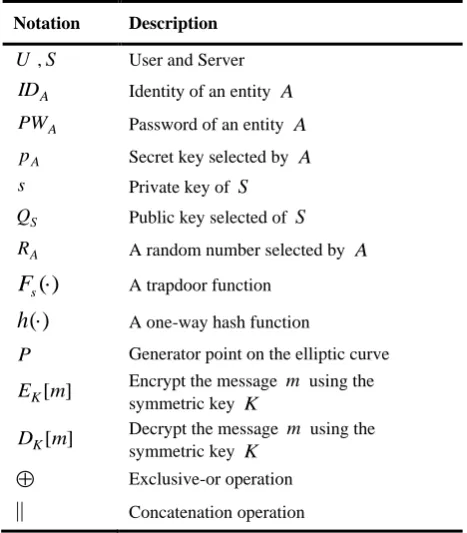
In this section, we show some notations and hard problems related with the ECC . Some notations used in this paper are shown in Table 1.
Table 1. Notations
2.1. Hard problems
1. Given pointsA,Bover Ep(a,b), the
compu-tational discrete logarithm (CDL) problem is to decide *
p F
m from BmA.
2. Given points mP,nP over Ep(a,b) , the
computational Diffie-Hellman (CDH) problem is to computemnP. Note that ECC
is defined as the form of )
(mod :
) ,
(ab y2 x3 ax b p
Ep over a
prime finite field Fp, where a,bFP and
) (mod 0 27
4a3 b2 p .
3. Given points P,mP over Ep(a,b) , the inverse computational Diffie-Hellman (ICDH) problem is to find m1P .
3. A review of Arshad and Ikram’s scheme In this section, we briefly review the Arshad and Ikram's scheme. There are two phases in Arshad and Ikram's scheme: registration and authentication.
3.1. Registration
1) Udelivers his IDU and password PWU to S; 2) Scomputes HPW h(IDU ||PWU),
( || )
S U S
HK h ID p and VPW HPWHKS
,where pS is the secret key of S. Then, S stores
{HPW HK, S}into his database.
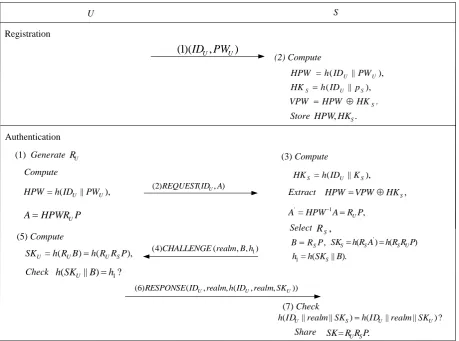
3.2. Authentication and the session key establish-ment
1) U calculates HPW h(IDU||PWU) and selects a random number RU . Then, U computes
P HPWR
A U and sends the request message }
,
{IDU A to S;
2) When receiving the login message, S first extracts HPW from VPWand computes HPW1by Extended Euclidean Algorithm. Next, Sgenerates a random number RS and computes BRSP , the session key SKSh(RSRUP) and h1h(SKS||B) . Finally, S sends the challenge message {realm,B,h1} to U.
3) After receiving the message, U computes )
(R B h
SKU U and checks whether
1 ? '
1 h(SK ||B) h
h U . If they are correct, U computes )
|| ||
(IDU realm SKU
h and sends the response
message {IDU,realm,h(IDU||realm||SKU)} to S. 4) On receiving the message, S computes
) || ||
(IDU realm SKS
h and checks whether it is equal
to the received value. If they are equal, U and S share the session key SK . The process of authentication phase is shown in Figure 1.
4. Weaknesses of Arshad and Ikram’s scheme In this section, we show that Arshad and Ikram's scheme is vulnerable to internal and masquerade attacks while not providing anonymity and password changing phase. The following attacks are based on the assumptions that a malicious attacker C has Notation Description
U ,S User and Server
A
ID Identity of an entity A
A
PW Password of an entity A
A
p Secret key selected by A
s Private key of S
S
Q Public key selected of S
A
R A random number selected by A
)
(
sF
A trapdoor function)
(
h
A one-way hash functionP Generator point on the elliptic curve
] [m
EK Encrypt the message m using the symmetric key K
] [m DK
Decrypt the message m using the symmetric key K
Exclusive-or operation(7) Check
U S
(5) Compute
? ) || (SK B h1
h U
), ( ) (
=h R B h R R P
SKU U U S
Check Compute
(1) Generate
), || (
=h IDU PWU HPW
P HPWR
A U
(3) Compute
), || (
= U S
S hID K
HK
, S HK VPW
HPW
,
= 1
'
P R A HPW
A U
. ) || ( =
1 hSK B
h S
Extract
Select RS,
? ) || || ( ) || ||
(IDU realm SKS hIDU realm SKU
h
Share SK=RURSP. U
R
,
P R
B S SKSh(RSA')h(RSRUP) )
, ( )
2
( REQUESTIDU A
) , , ( )
4
( CHALLENGE realm Bh1
)) , , ( , , ( )
6
( RESPONSEIDU realmhIDU realmSKU
Registration
)
,
)(
1
(
ID
UPW
U(2) Compute
. ), || (
), || ( =
S S U S
U U
HK HPW VPW
p ID h HK
PW ID h HPW
Store HPW,HKS.
Authentication
Figure 1. Authentication and the session key establishment phase of Arshad and Ikram's scheme
completely monitor over the communication channel connecting U andS in authentication and the session key establishment phase. So C can eavesdrop,
modify, insert, or delete any message transmitted via public channel [25].
4.1. Anonymity
In Arshad and Ikram’s scheme, U ’s IDU is exposed in public channel. Thus, any malicious attacker can intercept the message among the communication channel and easily trace who communicates with S.
4.2. Internal attack
In the registration phase of Arshad and Ikram’s scheme, U ’s plain-text password PWU is directly revealed to S. Assume there is an inside malicious sever Cwho has known IDU and PWU. Next, he can firstly compute h(IDU ||PWU) and then further launch intercepting attack to get the session key shared among any other users, the related service is provided by servers. Thus, Arshad and Ikram’s scheme cannot withstand internal attack.
4.3. Masquerade attack
In Arshad and Ikram's scheme, after S receives the request message {IDU,A} from U , S does not verify whether the request message comes from the legal user U. Therefore, as described in the previous subsection, we assume U ’s PWU has been leaked. Moreover, the request message {IDU,A} has been eavesdropped by the attacker C. And then, C selects a random number PWU and sends the forged request message {IDU,A'} to S, the session still continue in their scheme, where A'h(IDU||PWU)RU' P . Finally,C who is masquerading as U and S will authenticate each other and agree on the common session key.
4.4. Lack of password update option
5. Advanced scheme
In this section, we propose an improved mutual authentication scheme for SIP. Our proposed scheme not only overcomes weaknesses of Arshad and Ikram’s scheme but also achieves mutual authentication and resists internal attack.
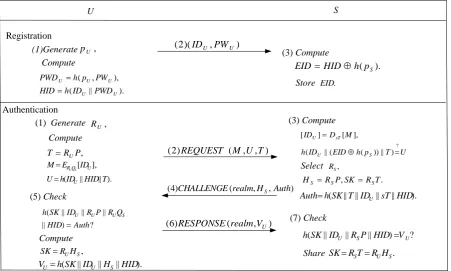
5.1. Registration
1) U chooses his password PWU, his own secret key pU. Then, U computes PWDU h PW( U||pU),
( U|| U)
HIDh ID PWD and submits {ID HIDU, } to S via a secure channel.
2) When receiving the message, S computes )
(pS h HID
EID and stores EID in its database.
5.2. Mutual authentication and key agreement 1) U generates a random number RU and calculates TRUP M ERQ [IDU]
S S , ) || ||
(ID HID T
h
U U . Then, U delivers the request message {M,T,U}to S.
2) After receiving the message, S first decrypts
M by using the symmetric key sT to derive IDU and checks whether h(IDU||(EIDh(pS))||T) is equal to the received U . If it holds, S generates a random number RS and calculates HSRSP ,
T R
SK S , Authh(SK||HID||T||sT||IDU).
Finally, S sends the challenge message }
, ,
{realmHS Auth toS.
3) On receiving the message, U computes SK
U S
R H and checks whether (h SK h ID|| ( U||PWDU) ||
?
|| )
U U S
R P R Q Auth . If they are not correct, the session is terminated. Otherwise, U computes
) || || ||
(SK ID H HID
h
VU U S , and then sends the
response message {realm,VU}to S.
4) Upon receiving the message, S verifies
U U SP ID V R HID SK h ? ) || || ||
( . If they are not equal, S
stops the session. Otherwise, S agrees on a common session key SKRSTRUHSwith U.
5.3. Update the password
When U wants to change the password from
U
PW to PWUnew , he can finish this process with assistance from S.
1)U selects a random number RUand new U
p , then he submits {Ph SK h ID( || ( U|| (h PWU||pU))) ,
( || ) ( || ( new|| new)))
U U U
Qh SK R h ID h PW p , RU}to S.
2) S calculates h(SK||(EIDh(pS))) and validates whether it is equal to the received P. If it is
equal, S computes new ( ) ( || )
S U
EID h p h R SK Q and
then replaces EIDwith
EID
new.U S
(3) Compute
.
,SK R T
P R
HS S S
). || || || ||
(SK T ID sT HID h
Auth U
Select RS,
Compute
(1) Generate RU,
,
P R
T U (2)REQUEST (M,U,T)
) , , ( ) 4
( CHALLENGE realm HS Auth ). || || ( ], [ T HID ID h U ID E M U U Q RUS
U T p h EID ID h M D ID S U sT U ? ) || )) ( ( || ( ], [ ] [
(5) Check
? ) || || || || ( Auth HID Q R P R ID SK
h U U U S
, S UH R SK Compute ). || || ||
(SK ID H HID h
VU U S
(7) Check
? ) || || ||
(SK IDU RSP HID VU
h
ShareSKRSTRUHS. )
, ( )
6
( RESPONSE realmVU
Registration
(3) Compute
) , )( 2
( IDU PWU
). (pS h HID
EID
(1)GeneratepU ,
Compute ). || ( ), , ( U U U U U PWD ID h HID PW p h PWD Authentication
Store EID.
6. Security analysis
In this section, we first conduct discussion and a security analysis of the proposed scheme. Then, we apply Burrows-Abadi-Needham (BAN) logic [24] to demonstrate that the authentication process can correctly generate a session key between communi-cating entities. The following attacks are based on the assumptions that a malicious attacker C has completely monitor over the communication channel connecting U and S in mutual authentication and key agreement phase. So C can eavesdrop, modify, insert, or delete any message transmitted via public channel [25].
6.1. Anonymity
In our scheme, user's real identity IDU is not directly revealed in an open channel. IDU is protected by symmetric cryptography, where the symmetric key
S UQ
R is related with user's random number and the server's public key. The legal server can gain the correct data by using his private key. Any third parties are not able to know which service is request by U .
6.2. Internal attack
In the registration phase, U submits {IDU,HID} instead of {IDU,PWU} , where HIDh ID( U||h
(PWU) ||pU). The sever S cannot retrieve the user's password because of the property of the hash function and secret information. Thus, C will be unable to plot internal attack successfully.
6.3. Mutual authentication
In our scheme, S authenticates U by verifying
U T p h EID ID
h U S
?
) || )) ( (
||
( , h SK ID( || U||R PS
?
||HID)VU . U authenticates S by checking
?
( || U|| U || U S|| )
h SK ID R P R Q HID Auth.
Thus, our scheme provides mutual authentication between U and S.
6.4 Masquerade attack
In our mutual authentication phase, when C tries to masquerade as a legal user, he cannot generate a proper message M since he lacks pU and PWU to compute the verifier HID. Moreover, it would
not be feasible for C to attempt to modify the intercepted message VU, because he cannot compute the correct session key lacking of two one time random numbers RU and RS which are based on the CDL problem. Besides, when Ctries to masquerade as a legal server, he will be detected by the user because he cannot generate the correct message
) || || || ||
(SK ID T sT HID
h
Auth U for validation.
U
R andRS are generated by U and S, respectively. Thus, our proposed scheme can withstand the masquerade attack.
6.5. Verifier attack
Even though C acquires EIDstored in S , he does not have sufficient information to calculate user's identity and password since they are hidden in a hash function with S ’s secret key pS . Therefore, our scheme is secure against verifier attack.
6.6. Replay attack
In our scheme, even if C initiates a parallel session to imitate legitimate user to login onto the server by resending the captured messages transmitted from U to S, he cannot be authenticated successfully by S. Since U generates a new random number RU for each authentication request, the previous T is not equal to the new one. Therefore, the proposed scheme is secure against replay attack.
6.7. Perfect forward secrecy
Even though C can compromise all the passwords of communication entities, he cannot compromise the session key at all. In our scheme, SKRSRUP is generated by U and S , respectively. C cannot obtain RS and RU at the same time from HS RSP,
P R
T U based on the security of CDL problem. Thus, our scheme can achieve perfect forward secrecy.
7. Verifying authentication scheme with BAN logic
We introduce some notations and logical postulates of BAN logic that we will use in our scheme.
1. BAN logical postulates
a. Message-meaning rule:
M B A
M A B A A
K K |~
| , |
:
if A trusts that A and B share K, and sees M encrypted withK, A then trusts B once said M.
b. Fresh conjuncatenation rule:
) , ( # |
) ( # |
N M A
M A
: if A
trusts freshness of M , A then trusts freshness of
) , (M N .
c. Belief rule:
) , ( |
| , |
N M A
N A M A
: if A trusts M and
A trusts N, then A trusts M and N. d. Nonce-verification rule:
M B A
M B A M A
| |
|~ | , #
| : if
A
Table 2. BAN logic notations
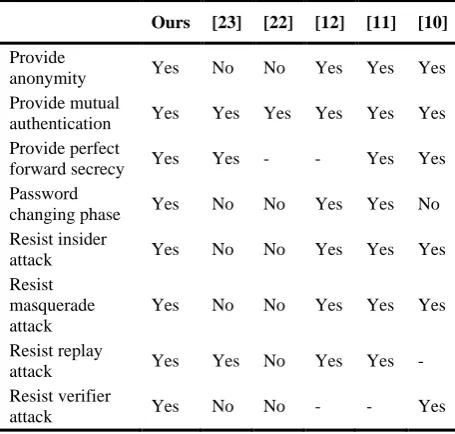
Table 3. Functionality comparison
Ours [23] [22] [12] [11] [10]
Provide
anonymity Yes No No Yes Yes Yes Provide mutual
authentication Yes Yes Yes Yes Yes Yes Provide perfect
forward secrecy Yes Yes - - Yes Yes Password
changing phase Yes No No Yes Yes No Resist insider
attack Yes No No Yes Yes Yes
Resist masquerade attack
Yes No No Yes Yes Yes
Resist replay
attack Yes Yes No Yes Yes -
Resist verifier
attack Yes No No - - Yes
e. Jurisdiction rule:
M A M B A M B A | | | , | :
f. if A trusts thatB has jurisdiction over M and A trusts Bon the fact of M,A then trusts M.
2. Idealized scheme
US :
S U U RUQS ID
, { U, } HID
U S
ID T
,
{ , , } HID
SK
S U
U S
U S H ID
,T
SU:
S U U U SK HID sT ID P R S U , , , }
{ ,HS
3. Establishment of security goals
1
goal : | |
SK
U S U S
2
goal : |
SK
U U S
3
goal : | |
SK
S U U S
4
goal : |
SK
S U S
4. Initiative premises
1
p : U #R
2
p : S|#RS
3
p : U U S
HID
|
4
p : S U S
HID
|
5
p : S| U (U S)
S UQ R 6
p : U| S (U S)
S UQ R 7
p : U| S (U S)
SK
8
p : S| U (U S)
SK
5. Scheme analysis 1
a:Since p3 and
{ , , , } HID
SK
U U
U S
U U S R P ID sT
,
through the message-meaning rule, we obtain:
| |~ ( , , , )
SK SK
U U
U S US R P ID sT .
2
a : Since p1 and a1 , through the fresh conjuncatenation rule and nonce-verification rule, we
obtain: | |~( , , )
SK U SK sT ID S U S
U
3
a
: Since a2, through the belief rule, we obtain:1
| | ( )
SK
U S U S goal , | |
sT
U S U S.
2
goal : Since goal1 and p7 , through the jurisdiction rule, we obtain: |
SK
U U S.
4 a :Since S U S U SK HID H ID S U S , , } {
and p4 ,
through the message-meaning rule, we obtain:
| |~ ( , , )
SK
S U
S U US H ID .
5
a : Since a4 and p2 , through the fresh conjuncatenation rule and nonce-verification rule, we obtain:
| | ( , )
SK
U
S U US ID .
6
a : Since a5, through the belief rule, we obtain:
3
| | ( )
SK
S U U S goal , |S U|IDU.
4
goal : Since p8 and goal3 , through the jurisdiction rule, we obtain: |
SK
S U S.
Notation Description
X
A|
A
trusts XS U
K
Share a key K between user and sever
X
# X is fresh
X
A A sees X
X
A|~ A said X
) ,
(X Y Xor Y is one part of (X,Y)
K X
X is encrypted with K
K X}
Table 4. Comparison of computational costs
Ours Arshad and
Ikram [23]
Tsai
[22]
Kumari et al.’s
scheme [12]
Chaudhry et
al’s scheme [11]
Chaudhry et al’s scheme
[10]
U 3H3PM1S 3H3PM 2H 5H1PA3PM 5H3PM 5H1PA3PM
S 4H3PM1S 4H3PM 3H 5H2PM 3H1PM 5H3PM2S
Total 7H6PM2S 7H5PM 5H 10H1PA5PM 8H4PM 10H1PA6PM2S
8. Performance and security properties comparison
In this section, we compare the functionality and performance of our scheme with Chaudhry et al’s scheme [10,11], Kumari et al.’s scheme [12], Tsai’s scheme [22] , Arshad and Ikram’s scheme [23]. All comparisons are described as Tables 3 and 4. From Table 3, we can see that the proposed scheme can provide proper user anonymity and password changing phase while preventing insider, masquerade, and verifier attacks, where Tsai’s [22] and Arshad and Ikram’s schemes[23] fail to cope with, Chaudhry et al’s. scheme [10] cannot provide password change phase, both of Chaudhry et al.’s scheme [11] and Kumari et al.’s scheme [12] fail to consider verifier attack. The computation cost of these schemes is shown in Table 4, where H,PM,PA, andSdenote a hash function operation, an elliptic curve scalar point multiplication operation, an elliptic curve point addition operation, a symmetrical cryptography operation and exclusive-OR operations separately. From Table 4, we can see that Tsai’s scheme [22] has better performance than Chaudhry et al.’s scheme [11], Kumari et al.’s scheme [12], Arshad and Ikram's scheme [23], and the proposed scheme, but Chaudhry et al.’s scheme [10] consumes a slightly higher than our scheme. In a word, the proposed scheme is more secure and has many excellent features compared with these related schemes.
9. Conclusion
In this paper, we have presented a security analysis of the Arshad and Ikram’s scheme and shown that the scheme is vulnerable to internal, masquerade attacks and can not provide anonymity and password changing phase. An advanced scheme is proposed that inherits the merits of the Arshad and Ikram’s scheme and resists the aforementioned attacks with a slight higher computation cost than others. Finally, in comparison with the previously proposed schemes on security and performance, our scheme is efficient and more secure than other related schemes.
Acknowledgments
The authors would like to thank all the anonymous reviewers for their helpful advice. This paper is supported by the National Natural Science Foundation of China (Grant Nos. 61472045, 61573067), the Beijing Natural Science Foundation (Grant No. 4142016), BUPT Excellent Ph.D. Students Foundation (Grant No. CX2015310), and the Asia Foresight Program under NSFC Grant (Grant No. 61411146001).
References
[1] S. Salsano, L. Veltri, D. Papalilo. SIP security issues: the SIP authentication procedure and its processing load. IEEE Network, 2002, Vol. 16, No. 6, 38-44. [2] J. Arkko, G. Camarillo, T. Haukka, S. Sen,
V. Torvinen. Security mechanism agreement for SIP sessions. IETF Internet Draft, 2002, Jun 3.
[3] M. Thomas. SIP Security Requirements. IETF Inter-net Draft, 2001, November.
[4] J. L. Tsai, N. W. Lo, T. C Wu. Novel anonymous authentication scheme using smart cards. IEEE Transactions on Industrial Informatics, 2013, Vol. 9, No. 4, 2004-2013.
[5] M. Heydari, S. M. S. Sadough, M. S. Farash, S. A. Chaudhry, K. Mahmood. An efficient pass-word-based authenticated key exchange protocol with provable security for mobile client-client networks.
Wireless Personal Communications, 2016, Vol. 88, No. 2, 337-356.
[6] S. A. Chaudhry, M. S. Farash, H. Naqvi, SK. H. IsIam, T. Shon. A robust and efficient privacy aware handover authentication scheme for wireless networks. Wireless Personal Communications, 2015, 1-25. DOI: 10.1007/s11277-015-3139-y
[7] S. A. Chaudhry, M. S. Farash, H. Naqvi, S. Kumari, M. K. Khan. An enhanced privacy preserving remote user authentication scheme with provable security.
Security and Communication Networks, 2015, Vol. 8, No. 18, 3782-3795.
[8] H. H. Kilinc, T. Yanik. A survey of SIP authenti-cation and key agreement schemes. IEEE Communi-cations Surveys & Tutorials, 2014, Vol. 16, No. 2, 1005-1023.
[10] S. A. Chaudhry, H. Naqvi, M. Sher, M. S. Farash, M. U. Hassan. An improved and provably secure privacy preserving authentication protocol for SIP.
Peer-to-Peer Networking and Applications, 2015, 1-15. DOI: 10.1007/s12083-015-0400-9
[11] S. A. Chaudhry, H. Naqvi, T. Shon, M. Sher, M. S. Farash. Cryptanalysis and improvement of an Impro-ved two factor authentication protocol for telecare medical information systems. Journal of Medical Systems, 2015, Vol. 39, No. 6, 1-11.
[12] S. Kumari, S. A. Chaudhry, F. Wu, X. Li, M. S.
Farash, M. K. Khan. An improved smart card based authentication scheme for session initiation protocol.
Peer-to-Peer Networking and Applications, 2015, 1-14. DOI: 10.1007/s12083-015-0409-0
[13] H. Tu, N. Kumar, N. Chilamkurti, S. Rho. An improved authentication protocol for session initiation protocol using smart card. Peer-to-Peer Networking and Applications, 2015, Vol. 8, No. 5, 903-910. [14] L. P. Zhang, S. Y. Tang, Z. H. Cai. Robust and
efficient password authenticated key agreement with user anonymity for session initiation protocol-based communications. IET Communications, 2014, Vol. 8, No.1, 83-91.
[15] C. C. Yang, R. C. Wang, W. T. Liu. Secure authentication scheme for session initiation protocol.
Computers & Security, 2005, Vol. 24, No. 5, 381-386. [16] L. Kong, V. A. Balasubramaniyan, M. Ahamad. A
lightweight scheme for securely and reliably locating SIP users. In: 2006 IEEE Workshop on VoIP Manage-ment and Security, 2006, pp. 9-17.
[17] J. W. Ring, K. K. R Cho, E. Foo, M. H. Looi. A new
authentication mechanism and key agreement protocol for SIP using identity based cryptography. Asia Pacific Inforamtion Technology Security Conference, 2006, pp. 61-72.
[18] A. Durlanik, I. Sogukpinar. SIP authentication scheme using ECDH. In: Proceedings of World Aca-demy of Science Engineering and Technology, 2005, Vol. 8, pp. 350-353.
[19] A. J. Menezes, P. C. Van Oorschot, S. Vanstone. Handbook of applied cryptography. CRC Press New York, 1997.
[20] S. A. Vanstone. Elliptic curve cryptosystem-the ans-wer to strong, fast public-key cryptography for secu-ring constrained environments. Information Security Technical Report, 1997, Vol. 2, No. 2, 78-87.
[21] E. J. Yoon, K. Y. Yoo. Cryptanalysis of DS-SIP authentication scheme using ECDH. In: 3rd Interna-tional Conference on New Trends in Information and Service Science, 2009, pp. 642-647.
[22] J. L. Tsai. Efficient nonce-based authentication sche-me for session initiation protocol. International Jour-nal of Network Security, 2009, Vol. 9, No.1, 12-16. [23] R. Arshad, N. Ikram. Elliptic curve cryptography
based mutual authentication scheme for session initiation protocol. Multimedia Tools and Applications,
2013, Vol. 66, No. 2, 165-178.
[24] M. Burrow, M. Abadi, R. M. Needham. A logic of authentication. ACM Transactions on Computer Systems, 1990, Vol. 8, No. 1, 18-36.
[25] L. Lamport. Password authentication with insecure communication. Communications of the ACM, 1981, Vol. 24, No. 11, 770-772.