Copyright © 2015 IJECCE, All right reserved
66
Studying an Effective Contribution of Techniques of
Video Compression
Pradeep Kumar N.S.
Asst. Prof: Dept of Electronics & Communication Engg. South East Asian College of Engineering & Technology
Bangalore, India.
email: [email protected]
Dr. H.N. Suresh
Prof.: Dept. of Electronics & Instrumentation Engg. Bangalore Institute of Technology,
Bangalore, India. email: [email protected]
Abstract: With the use of 3G and 4G network, the channel capacity of a network is highly increased to fit various dynamic need of existing customers, where majority of the applications they preferred are video based e.g. video calls, sharing and downloading video, video streams etc. Hence, in such situation video compression plays a very important role that not only targets to minimize size of the video but also targets to retain maximum quality of the video and channel capacity optimization. This paper presents a state-of-art study of the majority of the significant research papers in the past and most recent showcase the fact that area of video compression is still in the progression phase. The paper also discusses the effectiveness of the outcomes of the prior studies and explicitly discusses the research gaps with the support of challenges and scope of emerging trends of technological development in this domain.
Keywords: H.264, MPEG, Video Compression, Video Coding
I.
I
NTRODUCTIONRapid growth in Multimedia communication, Bandwidth in network, Digital Video and their number increasing exponentially. Video plays a significant role in modern life for various applications like, movies and television shows, news, sports, home videos and events, video teleconferencing, video telephones, and advanced television (ATV). Transmission of high-quality video with high speed is still a big challenge [1]. It is expected that advances in video compression technology will play a crucial role in transmission, storage and display of high-quality video signals. Video delivery through heterogeneous networks over new multimedia devices of varying capabilities requires scalable coding. Video encoding/decoding techniques are advanced solutions to represent, store and transmit video at less cost with minimal size, lower hardware, and bandwidth utilization. Last two decades continuously many techniques were evolved and shown improvement compression techniques. There are two international organizations such as ISO/IEC and ITU-I that decides compression standards. The new generation aims to meet the new requirements future applications may impose on the video coding standard.
A.
MPEG-1
MPEG-1 is one of the previous standards deployed for coding multimedia content in a compressed digital format. Until today, this is one of the superior standings of video coding used in various multimedia applications.
B.
MPEG-2
MPEG-2 is another version of MPEG standards that targets to generate superior quality of images at higher bit rate. It is also known as H.222 / H.262. It is mainly used in digital television signals.
C.
MPEG-3
MPEG-3 is mainly meant for HDTB to furnish better sampling and supportability of 20-40Mbits/sec/
D.
MPEG-4
MPEG-4 is another member of MPEG family that is used in compression of multimedia data for the web, as well as various broadcast television signals.
E.
H.264
H.264 is also known as MPEG-4 with Advanced Video Coding (AVC) that is one of the currently used video compression format for multimedia contents. It is also one of the best multimedia encoding standards used in internet-based streaming resources as well as Blu-ray Disc. H.264 is a block-oriented motion-compensation-based standard for video compression. The prime intention, behind introducing H.264, was to furnish a superior video quality at much lower bit rates compared to previous video encoding standards along with simple and inexpensive to implement. H.264 has significant enhancement over prior standards e.g. MPE1, MPEG-2, and MPEG-4. It is interesting to find that H.264 can minimize the video size by 50% compared to prior standards. Hence, better supportability of bandwidth and less storage is ensured by H.264.
Copyright © 2015 IJECCE, All right reserved
67
II.
C
OMPRESSIONT
ECHNIQUESThere are many compression schemes can be classified based on the technique used.
A.
Prediction-based Schemes
In such schemes, the compression technique is designed probabilistically to understand the level of compression that is required for minimizing the size of multimedia files. Usually, such schemes are deployed for advance research in compression.
B.
Transformation-based schemes
Such compression schemes usually rely on the mathematical transformation techniques for resisting the occurrence of similar value while performing compression. Discrete Wavelet Transformation (DWT) and Discrete Cosine Transformation (DCT) are some of the frequently adopted compression schemes. Adoption of such scheme minimizes the statistical correlation of the input samples.
C.
Quantization-based Schemes
Such scheme performs minimization of the precision utilized for sample representation for minimizing the quantity of the data that is required to be encoded. Such technique involves lossy compression approach accomplished by compressing a range of values to a single quantum values. The stream becomes eventually more compressible if the quantity of the discrete symbols is minimized.
D.
Entropy Coding Schemes
Such scheme represents the discrete-valued source
symbols to harness the merit of the relative likelihood of the various feasible values of each source symbols. Variable-length coding (VLC) is one such example that consists of using a tree-structured code table by adopting a short binary strings to depict the symbol values that have higher probability to occur and longer binary strings to depict the less probable symbol values.o
Image Compression
Research on image processing presents a number of challenging fields, one amongst them is image compression. A common characteristic of most images is that they are prone to information redundancy. Image compression is essential to minimize the number of bits required to represent an image by removing as many redundancies as possible. A number of diverse compression techniques, ranging from lossy compression to lossless compression of image. Nevertheless, lossy methods are proficient to achieve much higher compression when compared with visually lossless decompressed images. When lossy compression is used in medical images, the issues related to image quality are of serious concern as the reconstructed image is likely to lose diagnostically relevant information. There are various Transform based image compression based on DCT and DWT are popular. Discrete cosine transform is one of the transform domain operations used on the images. This is used in the image compression as most of the energy in DCT is confined to lower frequencies. In JPEG,
compression scheme DCT is applied to the image blocks. Discrete Wavelet Transform (DWT) is another category of transform operations done on the images. Wavelet is a small wave, which has finite energy and used in a series expansion of signals or function. 2D DWT is widely used in the image compression standard such as JPEG 2000. The wavelet compression found to be better than DCT based compression in terms of compression ratio and artifacts due to the blocks. In 2D- DWT, the given image is decomposed into the different sub bands such as LL, LH, HL, HH. In the process of wavelet decomposition, the approximation coefficients are further decomposed. So it is possible to reconstruct the entire image from the approximate wavelet coefficients. Along with the transformation technique coding as given in table1 is used to improve the performance of the compression. These transformation techniques are computationally complex and not power efficient on general purpose processor. Hence, many researchers found solution such as VLSI Based ASIC or FPGA approach to improving the computation speed and hardware efficiency [2]. Other techniques such as SPIT, etc. are also gives better compression ratio, but these techniques are well suited for images rather than Video applications.
o
Video Compression
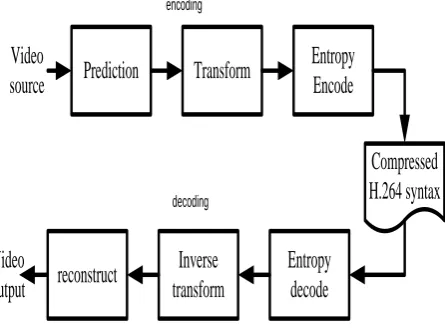
The complete operation of video compression is dependent on code that usually consists of an encoder and a decoder. Fig. 1 shows the operation carried out in video compression, where the compression of the data is performed by an encoder for storage or transmission while decompression of data is carried out in client-side. From the Fig.1, it can be seen that decoding operations is just a reverse of the encoding operation and for which reason majority of the existing study is focused on encoder design.
Prediction
Transform
Entropy
Encode
Compressed
H.264 syntax
Entropy
decode
Inverse
transform
reconstruct
Video
source
Video
output
encoding
decoding
Fig. 1. Block Diagram of Video Encoder and Decode
o
Basic Characteristics of Codec
Video communication should characterize with various parameters.
Throughput: this completely depends on
Copyright © 2015 IJECCE, All right reserved
68
and error-correction coding overhead present in the transmission system. It should be as high as possible.
Distortion in decoded video: Distortion primarily
depends on channel errors introduced during transmission or storage. At the decoding process, distortion results poor in quality. However, the distortion can be avoided by error control coding techniques.
Delay: Delay characteristics are influenced by
many parameters, including startup delay, processing delay, buffering, structural delays of video and channel codecs, and the speed at which data are conveyed through the transmission channel.
Complexity. The complexity of the video codec, protocol stacks, and network. Capacity can be measured in terms of computation, memory capacity, and memory access requirements.
o
Need of Video Compression
Rapid growth in multimedia application created demand for video applications, in terms of bandwidth and speed greater now than it has ever been. The following are four primary drivers:
With the upcoming demands of High-Definition (HD) and Ultra-High Definition (UHD) formats by the user, the supportability of such multimedia formats are less found on generalized player applications.
With the existing rising demands on adoption of Direct-to-Home (DTH) television and web-based streaming application, there is a massive growth for multimedia applications.
With the increasing usage of Video-On-Demand (VoD), there is a demand for storage and transmission in various IP based multimedia application that calls for some effective compression schemes for multimedia.
With increasing adoption of 3G-4G technologies, there is a need to stream the video in smart phones with highest service quality with optimal bandwidth usage.
All these above parameters needs either a compression model that is flexible, high speed and suitable for types of video formats. Each technique has its own advantages and disadvantages.
III.
R
ECENTS
TUDIESA.
Syntax-Based Arithmetic Coding mode (SAC)
In this mode, all VLC coding operations are replaced by syntax-based arithmetic coding operations. Since both VLC and arithmetic coding are lossless coding schemes, the resulting picture quality is not affected, yet the bit rate can be reduced by approximately 5%, due to the more efficient arithmetic codes.
Advanced Prediction mode (AP): This mode allows to use four motion vectors per macroblock, one for each of the four 8X8 luminance blocks. Furthermore, overlapped block motion compensation is used for the luminance macroblocks as in the Unrestricted Motion Vector mode. Use of this mode improves inter picture prediction and yields a significant improvement in subjective picture
quality for the same bit rate by reducing blocking artifacts. B.
PB-Frames mode (PB)
In this mode, the frame structure consists of a P-picture and a B-picture, as illustrated in Figure 1. The quantized DCT coefficients of the B- and P-pictures are interleaved at the macroblock layer such that a P-picture macroblock is immediately followed by a B-picture macroblock. The P-picture is forward predicted from the previously decoded P-picture. The B-picture is bi-directionally predicted from the previously decoded P-picture and the P-picture currently being decoded. The forward and backward motion vectors for a B-macroblock are calculated by scaling the motion vector from the current P-picture macroblock using the temporal resolution of the P- and B-pictures. This motion vector can be enhanced by a delta vector. The delta vector is obtained by performing motion estimation, within a small search window, around the calculated motion vectors. The PB-frames mode can improve the temporal resolution with little bit rate increase. The Internet has been expanding in bandwidth usage at an enormous rate, and Internet video tops the growth demographics In the last fifteen years, there has been a continuous evolution of video and there is no sign that this evolution is at an end. MPEG-2 is started in full format in earlier days, and been overtaken in respect to the degree of achievable compression by H.263, MPEG-4 and in 2003 by H.264.
C.
Discrete Cosine Transform
Copyright © 2015 IJECCE, All right reserved
69
classify each macro block into simple motion or complex motion contents based on the Inter mode's residue block and then according to the classification different mode searching orders with distinct early termination schemes were used. Author claims that algorithm is very simple for both hardware and software implementations without extra computational module.
Anbang et al. [10] have used the technique of weighted signal combination for performing video coding. Using Bitrate and PSNR, the outcome of the study was found to posses a significant performance gain; however, the outcomes were found not to be benchmarked. Yuping et al. [11] have investigated on H.264/AVX to introduce an interpolation filter buffering scheme. The authors have discussed a simple technique where the performances were evaluated using bitrate and PSNR. Deligiannis et al. [12] have adopted hash-based distributed video coding where the performance was evaluated using frame number, frame rates, and PSNR. The outcome of the study was found to show 31% of enhancement compared to existing system. However, there is very less discussion on complexity analysis. Wang et al. [13] have investigated advanced video coding where the authors have introduced the concept of rate-distortion optimization. The outcome that was not benchmarked was evaluated using packet loss and PSNR and was found to enhance perceptual error. Sole et al. [14] have investigated HEVC and introduced a transform coefficient coding. Bit rate and throughput were used to scale the outcomes that exhibited maximized compression efficiency with high throughout. Sullivan et al.. [15] have also carried out the research in a similar direction on 3D video using HEVC. The outcome of the study was measured and evaluated using bitrate with better processing time. Panayides et al.. [16] also carried out the study towards H.264/AVC over mobile WiMax networks. Using Bitrate, delay, and PSNR, the outcomes of the study was analyzed to find maximum retention of video quality.
IV.
E
MERGINGT
RENDSWith the proliferation of video file sharing process in many of the internet applications, owing to large number of existence of the dynamic user, it is essential that an effective video compression technique should be designed and practiced. The prior sections have already highlighted various attempts made by researchers most recently to address the issues of video compression. This section will discuss about some of the unique techniques that have been initiated by the research community for mitigating the issues of video compression and line of research attempts towards enhancement of such techniques are found quite rare in literatures. Hence, we consider such techniques as the emerging trends as there is higher scope of carrying out research work in this area. Following are the brief discussion of some of the evolving research trends.
A.
Analysis of Bandwidth
Bandwidth estimation is one of the most prominent techniques in ascertaining the effectiveness of video
compression algorithms. It was already seen in past that
various research attempts towards adopting
H.264/AVC/MPEG compression standard have claimed to optimize the bandwidth, however, such studies doesn’t explicitly analyze the actual bandwidth consumptions on multiple scenarios of simulations. Extents of such studies are quite less in literature, and hence future researchers should consider estimation of either available bandwidth or end-to-end bandwidth for better formulation of performance parameters of their video compression algorithms.
B.
Inclusion of Deblocking Filter
It was seen from the study that all the existing compression techniques (H.263, H.264, MPEG etc.) adopts JPEG related block-based transform coding scheme for capturing the spatial redundancies. The most recent standard H.264 adopts deblocking filters followed by inverse transform in the encoder and decoder respectively. Basically, the purpose of using deblocking filters is to enhance the luminance and chrominance component individually. Evidence of such work can be seen in the literature of Li et al. [17], Parlak [18], and Chou and Wu [19]. Hence, it can be seen that deblocking filters can be used in multi-fashioned manner for enhancing the video compression techniques. However, the extent of significant research work is quite low in performing scrutiny of using adaptive deblocking filters for video compression in reducing losses at prediction frame edges during intra-prediction. As the availability of studies using deblocking filters is quite narrowed in literature, hence there is a need to perform further investigation in its utility factor.
C.
Power Factor
In the area of video compression, it was seen that majority of the video contents are uploaded; downloaded, shared from mobile device, tablet PC, Smartphones, Laptop, which are usually powered by external battery. Hence, with persistent usage of video based application calls for heavy power drainage from the application resulting in performance degradation of the applications in its other operations too. Hence, it is quite essential that design principle of video compression must consider the power efficiencies during its encoding or decoding process. Some of the significant studies in this direction were carried out by Ji et al. [20] and Ullah et al.. [21]. Hence, it is recommended that the energy factor is one of the important parameters for ensuring optimal performance of video compression. If the researcher is looking for adopting simulation based study and interested in confirming if their video compression algorithm is likely to work in real-time environment, than it is always suggested to adopt energy as performance factor while performing video compression.
V.
R
ESEARCHG
APCopyright © 2015 IJECCE, All right reserved
70
and Table 2), this section will discuss some of the significant research gaps:
A. Diversity in Video Compression
Majority of the study in this direction is quite specific to the assumption being made in this area by the researcher, for which a research question arises that how far the techniques are applicable to real-time scenario. The end-equipment used for video-based applications have different and discrete system and network requirements, for which reason, solution provided by one author may work in one environment but may not work when the environment (especially hardware) variable is changed. In addition, none of the studies have been seen to emphasize about error resiliency, which is one of the most important factors in video transmission over satellites. In addition, assumptions formulation for application was also not effective in the prior studies. For an example, monitoring based video application requires higher channel density with good quality video, while micro-platforms (Tablets, Smartphone’s, etc.) are more inclined toward energy constraint factor for the specific display resolution at which they need to work.
B. Few Standardized / Benchmarked Studies
Majority of the recent studies like Sole et al. [39], Wang et al. [38], Yuping et al. [36], and Anbang et al. [35] have proposed their results without performing any comparative analysis with some standard or potential research papers. Eventually, occurrence of comparative performance analysis is very few in this area of studies except the recent study of Sullivan et al. [40] and Panayides et al. [41]. Hence, less standard and benchmarked studies were seen in the literature posing a narrowed scope and reliability of the outcomes for its technical adoption in future.
C.
Less
Focus
on
Emerging
Trends
Majority of the studies in the area of video compression is highly limited in the viewpoint of applicability. The prior section have discussed about the emerging trends in video compression as bandwidth estimation, inclusion of adaptive deblocking filters, and consideration of energy factor. However, apart from few research attempts in this area, there is no considerable progress or enhancement being done even in presence of HEVC. There is still a scope where rate distortion principle can be further optimized, deblocking filters could be possibly used in reducing losses at prediction frame edges during intra-prediction, the rate of compression could be further optimized using techniques adopted by the authors discussed in emerging trends. An effective study approach using signal processing as well as mathematical principle could be helpful in this direction.
VI.
C
ONCLUSIONThis paper has discusses about some of the significant contribution made by the prior research papers. Majority of the studies were considered from standard international journals. The paper discusses very briefly about the
theoretical studies about the concept of video compression. Different from other survey paper existing, this paper have even reviewed the existing survey paper and found that existing reviews are not up-to-date and furnish very less enriched information about the technical aspect of video compression schemes. Hence, this paper exhibits state-of-art discussion as well as presentation of various techniques adopted by recent research papers and analyzed their outcome effectiveness. The study has also presented emerging trends followed by research gap. Our future direction of the study will be to overcome the research gap mentioned in this paper and evolve up with a technique where video compression could be optimally enhance to give better system and network performance in every aspects.
R
EFERENCES[1] I.E. G. Richardson, “H.264 and MPEG4 Video Compression: Video
Coding for Next Generation Multimedia”, John Wiley and Sons,
2003
[2] N. Parvatham and S. Gopalakrishnan, “A Novel Architecture for an
Efficient Implementation of Image Compression Using 2D-DWT,” Proceedings Third International Conference on Intelligent Systems Modeling and Simulation, pp. 1–5, 2012.
[3] F. M. Bayer, R. Josecintra, “Image Compression via a Fast DCT
Approximation”, IEEE Latin America Transactions, Vol 8, 2010
[4] M. Naccari, F. Pereira, “Advanced H.264/AVC –based perceptual
video coding :Architecture, tools and assessment”, IEEE
Transactions on Circuits and Systems for Video Technology, Vol. 21,Issue. 6,2011
[5] Jiejia, D. Yoon, H.K. Kim, “An Efficient coding of Intra Picture
Predictions Modes for H.264/AVC”, Third International
Conference on Multimedia and Ubiquitious Engineering, pp.49-53,2009
[6] C-U. Jeong, H. Watanabe, “A Modified Parabolic Prediction Based
Fractional PixelMotion Estimation Using Preset Corrector,” IEEE, pp-526-527, 2012
[7] K.Minoo and T. Q. Nguyen “Rate Estimation, using Forward
Adaptive Quantization: H.264 Fast Intra Mode Selection At High Data Rates”, IEEE, 2007
[8] J. Kim, J. Jeong, “Fast Intra Mode Decision Algorithm using the
Sum of Absolute Transformed Differences”, Proceedings of IEEE
International Conference on Digital Image Computing: Techniques and Applications, pp. 653-659, 2011
[9] S.U. Yusuf and M. Ahmad, “A Novel Rate-Based Macroblock
Classification for Fast Mode Decision in H.264 Video Coding” Proceedings of 14th International Conference on Computer and Information Technology, 2011
[10] Z. Anbang, W. Wensheng, C. Huijuan, “Efficient Multiple
Description Scalable Video Coding Scheme Based on Weighted
Signal Combinations”, IEEE-Tsinghua Science And Technology,
Vol.12, No. 1, 2007
[11] W. Yuping, J. Xiangyang, Z. Naiyao, “Improved Adaptive
Interpolation Filter for H.264/AVC”, IEEE-Tsinghua Science And
Technology, Vol.15, No.2, 2010
[12] N. Deligiannis, J. Barbarien, A. Munteanu,
“Side-Information-Dependent Correlation Channel Estimation in Hash-Based
Distributed Video Coding”, IEEE Transactions on Image
Processing, Vol. 21, No. 4, 2012
[13] X.Wang, H. Cui, K. Tang, “Attention-Based Adaptive Intra Refresh
Method for Robust Video Coding”, IEEE-Tsinghua Science And
Technology, Vol.17, No.1, 2012
[14] J. Sole, R. Joshi, N. Nguyen, “Transform Coefficient Coding in
HEVC”, IEEE Transactions on Circuits and Systems for Video
Technology, Vol. 22, No. 12, 2012
Copyright © 2015 IJECCE, All right reserved
71
Topics in Signal Processing, Vol. 7, No. 6, 2013
[16] A. Panayides, Z. C. Antoniou, Y. Mylonas, “High-Resolution,
Low-Delay, and Error-Resilient Medical Ultrasound Video Communication Using H.264/AVC Over Mobile WiMAX
Networks”, IEEE journal of biomedical and health informatics,
Vol. 17, No. 3, 2013
[17] Y.Li, N. Han, C. Chen, “A Novel Deblocking Filter Algorithm In
H.264 for Real Time Implementation”, IEEE-Third International
Conference on Multimedia and Ubiquitous Engineering, 2009
[18] M. Parlak and I. Hamzaoglu, “A Low Power Implementation of
H.264 Adaptive Deblocking Filter Algorithm”, IEEE- Conference
on Adaptive Hardware and Systems, 2007
[19] Y-L Chou, C-B Wu, “A Hardware Sharing Architecture of
Deblocking Filter for VP8 and H.264/AVC Video Coding”, IEEE-2012
[20] W. Ji, J. Liu, M. Chenc, Y. Chen, “Power-efficient video encoding
on resource-limited systems: A game-theoretic approach”, Elsevier- Future Generation Computer Systems, Vol.28, pp.427-436, 2012
[21] S. Ullah, J. J. Ahmad, J. Khalid, “Energy and Distortion Analysis of
Video Compression Schemes for Wireless Video Sensor Networks”, IEEE, 2011.
A
UTHOR’
SP
ROFILEPradeep Kumar N.S.
is a research scholar in Bangalore Institute of Technology,Bangalore., received his BE
(Telecommunication Engineering) from S.J.C.
institute of Technology, Visvesvaraya
Technological University, Belgaum, Karnataka, India, in the year 2004 and completed his M.Tech (Digital Electronics and Communication) from Dayananda Sagar College of Engineering, Bangalore, affiliated to Visvesvaraya Technological University, Belgaum, Karnataka, India, in the year of 2007 and since then he is actively involved in teaching and research and has Eight years of experience in teaching. He is persuing PhD (ECE) from VTU. At present he is working as Assistant Professor in South East Asian college of Engineering and Technology, Bangalore Affiliated to Visveswaraya Technological University. His area of interest is in the field of signal processing, Bio Medical Signal Processing, Antennas and wave propagation, Electromagnetic.