© Central Fisheries Research Institute (CFRI) Trabzon, Turkey and Japan International Cooperation Agency (JICA)
Development of Fingerling Production Techniques in Nursery Ponds for the
Critically Endangered Reba Carp, Cirrhinus ariza (Hamilton, 1807)
Introduction
Cirrhinus ariza (Hamilton, 1807) is an important food fish, which is distributed over Indian Sub-continent (Jhingran, 1991; Talwar and Jhingran, 1991; Rahman, 2005). It is locally known as reba carp, bhagna bata, raik or tatkini, and considered as one of the most important indigenous minor carp species in Bangladesh. The fish is easily recognized by medium-sized silvery scales, the upper body is deep bluish or darkish and the lower body is shiny and silvery. The lateral line has 38 or 39 scales, most of them appearing as a black mark elongated from the base margin of the operculum to the tail during the early stage of life. The black mark becomes shorter and remains between the operculum and the end of the belly during the adult stage (Talwar and Jhingran, 1991; Hussain and Mazid, 2001; Rahman, 2005).
The fish is highly popular to the consumers due to its oily flesh and taste qualities. The natural distributions of reba carp included most of the rivers, small creeks, natural depressions and floodplains of Bangladesh (Kohinoor et al., 1998; Hussain and Mazid, 2001). Reba carp is a water column feeder and omnivore in nature and grows to a maximum size of 40 to 50 cm in length (Rahman, 2005; Felts et al., 1996; Akhteruzzaman et al., 1998). Males and females attain sexual maturity by the end of first year.
The spawning season of reba carp stars in April and ends in August with peak spawning occurring during the rainy months in flowing flood waters (Akhteruzzaman et al., 1998; Hussain and Mazid, 2001). Relative fecundity of reba carp was recorded between 200,000 and 250,000 egg kg-1 body weight of female (Hussain and Mazid, 2001).
During the last 14 years, the population of reba carp has declined considerably due to increased fishing pressure, and various anthropogenic activities leading to siltation, aquatic pollution, and loss of natural habitat for spawning and growth (Akhteruzzaman et al., 1998; Hussain and Mazid, 2001). These factors not only destroyed the breeding grounds but also caused havoc to the availability of brood fish including fry and fingerlings (Hussain and Mazid, 2001). As a result, recently the fish is considered as one of the most endangered species in Bangladesh (IUCN, 1998). To maintain this fish population as well as its conservation and rehabilitation, development of a suitable technology for breeding, and rearing of fry and fingerlings in nursery ponds is urgently needed.
Webber and Riordan (1976) stated that one of the main obstacles in the development of aquaculture is the availability of fry/fingerlings. Growth and survival of fry and fingerlings in nursery ponds depend on stocking density, type and quantity of
M. Aminur Rahman1,*, M. Zaher2, K.M. Azimuddin2 1
Ocean Critters Ranch Inc., 2924 FM 1187, Crowley, Texas-76036, USA.
2
Bangladesh Fisheries Research Institute, Freshwater Station, Mymensingh-2201, Bangladesh.
* Corresponding Author: Tel.: +1.817 4586810; Fax: +1.817 2926279; E-mail: [email protected]
Received 09 April 2008 Accepted 13 May 2009
Abstract
Growth, survival and production performances of Cirrhinus ariza fingerlings were evaluated for 8 weeks in nine earthen nursery ponds having an area of 0.012 ha each with an average depth of 1.0 m. Three stocking densities of hatchlings each with two replications were tested in treatments. Four-day-old hatchling stocked at 0.8 million ha-1 was defined as treatment-1 (T1), 1.0 million ha
-1
as treatment-2 (T2) and 1.2 million ha -1
as treatment-3 (T3), respectively. Hatchlings in all
the experimental ponds were supplemented with wheat flour for the first 7 days, finely ground mustard oilcake for the next 7 days and a mixture of rice bran and mustard oilcake (1:1) for days 15 to 56. Feeding was done at the rate of 15 kg/million hatchling day-1 for the first two weeks, 20 kg for the second two weeks, 25 kg for the third two weeks and 30 kg for the fourth two weeks. The physico-chemical and biological parameters of pond water were within the suitable range for fish culture. Growth in terms of final weight, final length, weight gain, length gain and specific growth rate, and survival of fingerlings was significantly higher in T1 where stocking density were 0.8 million hatchling ha
-1
than those obtained from T2
(1.0 million ha-1) and T3 (1.2 million ha-1), respectively. Feed conversion rate was the lowest in T1 followed by T2 and the
highest in T3 (P<0.05). Gross and net productions of fingerling were higher in T1 than T2 and T3, respectively (P<0.05).
Higher number of fingerlings was produced in T3 than those in T2 and T1 (P<0.05). Even then, consistently higher net
benefits were obtained from T1 than those from T3 and T2. Among the treatments evaluated, 0.8 million hatchling ha-1 (T1)
was the best stocking density considering the highest growth, survival, production and net benefits of the fingerlings of C. ariza in nursery ponds.
fertilizers and supplementary feeds. To obtain maximum economic returns, it would be necessary to stock the ponds at appropriate stocking densities for optimum growth and survival of fingerlings. No work has yet been undertaken on stocking density of reba carp for rearing in nurseries. Good quality fingerlings are needed to establish a successful fish culture package of C. ariza. The present work has therefore been undertaken to develop a practical and economically viable methodology for mass seed production of C. ariza in earthen nursery ponds.
Material and Methods
The present experiment was carried out at the Freshwater Station, Bangladesh Fisheries Research Institute, Mymensingh, Bangladesh. The experiment was conducted for 8 weeks from 15 June to 11 August, 2005 in nine earthen nursery ponds. The ponds were rectangular in shape and the surface area of each pond was 0.012 ha with an average depth of 1.0 meter. The ponds were pump-fed, free from aquatic vegetation, well-exposed to sunlight and had a well designed inlet and outlet system. The ponds were similar in size, shape, depth, basin conformation, contour, and bottom type (sandy-loam soil). After drying, quicklime (CaO, 250 kg ha-1) was spread over
the pond bottom. Ponds were then filled with ground water at a depth of about one meter and a more or less similar depth was maintained for the whole experimental period. Five days subsequent to liming, the ponds were fertilized with organic manure (cattle dung, 2,500 kg ha-1). Seven days after manuring, the pond water was sprayed with dipterex (one ppm) to eradicate harmful insects and predatory zooplankton such as copepods and cladocerans. Hatchlings of reba carp were produced by artificial breeding following the technique of Akhteruzzaman et al. (1998). Three treatments differing in stocking densities of hatchlings viz., 0.8 million ha-1 (treatment 1, T1), 1.0 million ha-1
(treatment 2, T2) and 1.2 million ha-1 (treatment 3, T3)
were employed each of which was replicated. In each treatment, 1 ml aliquots of the larval samples were first counted and then adjusted to the stocking densities. These densities were selected on the basis of the results obtained from the previous studies (Rahman unpub. data). Four-day-old hatchlings having an average length of 0.41±0.06 cm and weight of 0.0004±0.00001 g were then stocked in the experimental ponds. Fifty randomly selected individual hatchlings were sampled for length and weight before stocking.
The hatchlings were not fed for the first day in order to acclimatize them to the new environment. From the second day of stocking, hatchlings were fed twice daily with wheat flour for the first 7 days, finely ground mustard oilcake for the next 7 days and a mixture of rice bran and mustard oilcake (1:1) for days 15 to 56. The rate of feeding was 15 kg/million hatchling day-1 for the first two weeks, 20 kg for the
second two weeks, 25 kg for the third two weeks and 30 kg for the fourth two weeks. The feed was distributed on the pond water surface. In addition, the ponds were manured with cattle dung (1000 kg ha-1) at weekly intervals. Fingerlings were sampled weekly by dragging a fine-meshed (hapa) net for the studies of growth performances.
Physico-chemical parameters of pond water were monitored weekly between 09.00 and 10.00 h. Temperature (ºC) and dissolved oxygen (mg L-1) were determined directly by a digital water quality analyzer (YSI, model 58, USA), pH by a digital pH-meter (Jenway, Model 3020, UK) and transparency (cm) by a Secchi disc and ammonia nitrogen by a HACH water analysis kit (DR 2000, USA). Total alkalinity was measured following the standard method (Stirling, 1985; APHA, 1992).
Quantitative and qualitative estimates of plankton in the experimental ponds were also taken weekly. Ten litres of water, collected from different locations and depths of each pond were filtered through fine-meshed plankton net (25 µm) to obtain a 50 ml sample. The samples were preserved immediately with 5% buffered formalin in plastic bottles. Plankton density was estimated by using a sub-sampling technique. A Sedgwick-Rafter (S-R) cell was used under a calibrated compound microscope for plankton counting. Plankton cells in 10 randomly chosen squares were counted for quantitative estimation using the formula proposed by Rahman (1992).
To estimate the growth of fish, 30 randomly selected fingerlings from each pond were sampled weekly. Growth was studied in terms of increase in length and weight, specific growth rate (SGR) and feed conservation ratio (FCR). Length and weight gain were calculated simply by deducting the mean initial length and weight values from that of the final. SGR, the instantaneous change in weight of fish calculated as the percentage increase in body weight per day over any given time interval (Brown, 1957). The FCR was calculated according to Castell and Tiews (1980).
After 8 weeks of rearing, the fingerlings were harvested by repeated netting, followed by drying the ponds. The live fingerlings were counted and weighed individually. Survival rates were calculated on the basis of the number of fish harvested (no. of fish harvested/no. stocked x 100). Gross production was calculated by multiplying the average final weight of fish by the total number, while net production was estimated by multiplying the average final weight increment of fish by the total number and was expressed as kg/ha.
Table 1. Mean values (± SD) and ranges of water quality parameters of weekly samples over the 8-week experiment
Parameters
Treatments T1
(0.8 million ha-1)
T2
(1.0 million ha-1)
T3
(1.2 million ha-1) Water temperature (°C) 30.84±1.32a
(29.20–32.30)
30.80±1.35a (29.10–32.20)
30.96±1.26a (29.30–32.40)
Transparency (cm) 33.62±3.48c
(30.50–42.50)
44.16±3.89b (38.50–48.50)
52.73±3.35a (45.50–58.50) Dissolved oxygen (mg L-1) 4.84±0.78a
(3.70–6.00)
4.29±0.69b (3.40–5.30)
3.82±0.72c (3.10–4.90)
pH 7.68±0.27a
(7.30–8.10)
7.49±0.22a (7.20–8.00)
7.46±0.25a (7.20–7.90) Total alkalinity (mg L-1) 134.52±25.33a
(88.50–171.50)
130.83±28.50a (65.50–162.50)
129.85±27.78a (70.50–160.50) Ammonia-nitrogen (mg L-1) 0.28±0.19a
(0.01–0.80)
0.32±0.20a (0.01–0.90)
0.35±0.22a (0.01–1.00) Figures in the same row having the same superscript are not significantly different (P>0.05).
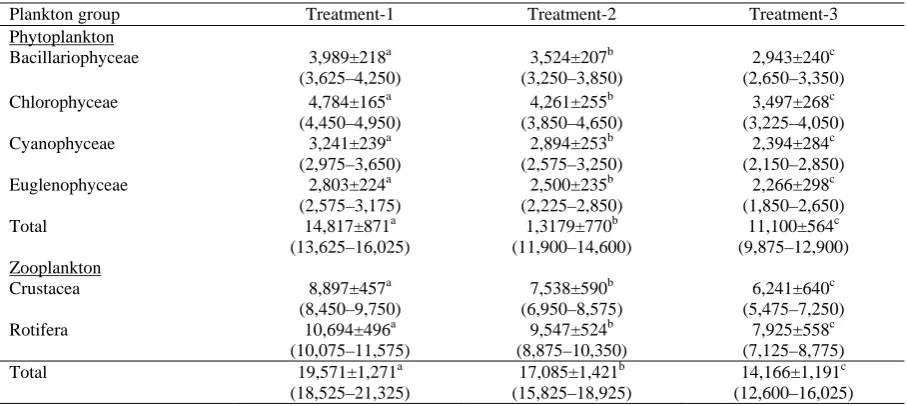
Table 2. Mean values (±SD) and ranges of plankton abundance (cells/L) of pond water of weekly samples over the 8-week
experiment
Plankton group Treatment-1 Treatment-2 Treatment-3
Phytoplankton
Bacillariophyceae 3,989±218a
(3,625–4,250)
3,524±207b (3,250–3,850)
2,943±240c (2,650–3,350)
Chlorophyceae 4,784±165a
(4,450–4,950)
4,261±255b (3,850–4,650)
3,497±268c (3,225–4,050)
Cyanophyceae 3,241±239a
(2,975–3,650)
2,894±253b (2,575–3,250)
2,394±284c (2,150–2,850)
Euglenophyceae 2,803±224a
(2,575–3,175)
2,500±235b (2,225–2,850)
2,266±298c (1,850–2,650)
Total 14,817±871a
(13,625–16,025)
1,3179±770b (11,900–14,600)
11,100±564c (9,875–12,900) Zooplankton
Crustacea 8,897±457a
(8,450–9,750)
7,538±590b (6,950–8,575)
6,241±640c (5,475–7,250)
Rotifera 10,694±496a
(10,075–11,575)
9,547±524b (8,875–10,350)
7,925±558c (7,125–8,775)
Total 19,571±1,271a
(18,525–21,325)
17,085±1,421b (15,825–18,925)
14,166±1,191c (12,600–16,025) Figures in the same row having the same superscript are not significantly different (P>0.05).
significantly heterogeneous and no major departures from normality, a one way analysis of variance (ANOVA) was done followed by Duncan’s New Multiple Range test (Duncan, 1955). All statistical analyses were performed with the aid of a computerized statistical package, ‘Stat View’ version 4.0. Standard deviation in each parameter and treatment was calculated and expressed as ‘mean±SD’. The level for statistical significance was set at 0.05%. A simple cost-benefit analysis was performed to estimate the net benefits from each of the three treatments.
Results
Water Quality and Plankton Monitoring
The results of the physico-chemical parameters over the eight-week nursing of C. ariza fingerlings are summarized in Table 1. The mean water temperatures
in T1, T2 and T3 did not differ significantly (P>0.05).
Mean secchi disc transparency levels were differed significantly (P<0.05), increasing from T1 to T3. The
mean dissolved oxygen (DO) obtained in the morning hours was significantly different (P<0.05), decreasing from T1 to T3. pH decreasedfrom T1 to T3 but did not
differ significantly (P>0.05). Total alkalinity was decreased from T1 to T3; but no significant differences
(P>0.05) were recognized among the treatments. Ammonia-nitrogen contents in T1, T2 and T3 showed
increasing trends but the variations were not statistically significant (P>0.05).
Euglenophyceae in that order. However, the abundance of each group differed significantly (P<0.05) among treatments, increasing from T3 to T1.
The mean abundance of total phytoplankton was significantly higher (P<0.05) in T1 than those in T2
and T3. The zooplankton population consisted of 12
genera including nauplius in two major groups viz., Crustacea and Rotifera. Rotifera were dominant over Crustacea during the entire experiment in all treatments. However, the abundance of Rotifera and Crustacea in T1 was significantly higher (P<0.05) than
those recorded in T2 and T3. Total zooplankton
abundance differed significantly (P<0.05) among the treatments, decreasing from T1 to T3.
Growth, Survival, Food Conversion and Production of Fingerlings
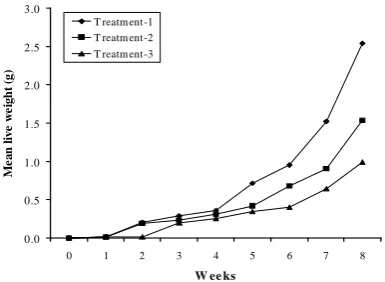
Growth in terms of length and weight of fingerlings at weekly intervals is depicted in Figures 1 and 2. The increase in length and weight was the highest in T1 (0.8 million ha-1) followed by T2 (1.0
million ha-1) and the lowest in T3 (1.2 million ha-1).
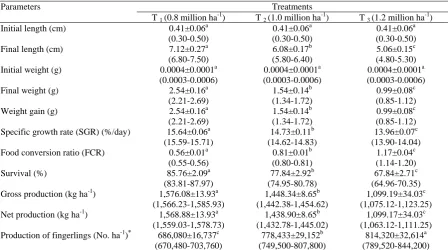
The detailed growth and production performances of fingerlings under different treatments over the 8-week experiment are summarized in Table 3. The initial
length and weight of hatchlings, stocked in all the experimental ponds were the same. The highest increase in length and weight was observed in T1 and
the lowest in T3. However, the mean final length and
weight of fingerlings among different treatments were significantly different (P<0.05). The highest weight and length gains were also found in T1 and the lowest
in T3. Specific growth rate (SGR) in T1 was
significantly higher than T2 and T3. Food conversion
ratio (FCR) was significantly lower in T1 than in T2
and the highest in T3. Therefore, the best SGR and
FCR values were obtained in T1 where the lowest
number of hatchling (0.8 million ha-1) was attained in nursery ponds. The mean survival rate was also the highest in T1 and the lowest in T3 (P<0.05).
The mean gross and net productions (kg ha-1) of fingerlings after 8 weeks of rearing were 1,576.08 and 1,568.88, 1,448.50 and 1438.90, and 1,099.19 and 1,078.19 in T1, T2 and T3, respectively. Production
was the highest in T1 and the lowest in T3. However,
gross and net productions differed significantly (P<0.05) among the three treatments (Table 3). Despite this, significantly higher number of fingerlings per hectare was produced in T3 (814,320)
than those in T2 (778,433) and T1 (686,080) (Table 4).
Total cost of production (Tk/ha) was consistently
0.0 1.0 2.0 3.0 4.0 5.0 6.0 7.0 8.0
0 1 2 3 4 5 6 7 8
Weeks
Me
a
n
l
e
n
g
th
(
c
m
)
Treatment-1 Treatment-2 Treatment-3
Figure 1. Mean length increment of C. ariza fingerlings at different stocking densities during the rearing period of 8 weeks.
0.0 0.5 1.0 1.5 2.0 2.5 3.0
0 1 2 3 4 5 6 7 8
W ee ks
M
e
a
n
live
w
e
igh
t (
g
)
T reatm ent-1 T reatm ent-2 T reatm ent-3
Table 3. Growth performances, survival, feed utilization and production of reba carp (Cirrhinus ariza) fingerlings after 8 weeks of rearing; mean±SD with range in parentheses
Parameters Treatments
T 1 (0.8 million ha
-1
) T 2 (1.0 million ha -1
) T 3 (1.2 million ha -1
)
Initial length (cm) 0.41±0.06a
(0.30-0.50)
0.41±0.06a (0.30-0.50)
0.41±0.06a (0.30-0.50)
Final length (cm) 7.12±0.27a
(6.80-7.50)
6.08±0.17b (5.80-6.40)
5.06±0.15c (4.80-5.30)
Initial weight (g) 0.0004±0.0001a
(0.0003-0.0006)
0.0004±0.0001a (0.0003-0.0006)
0.0004±0.0001a (0.0003-0.0006)
Final weight (g) 2.54±0.16a
(2.21-2.69)
1.54±0.14b (1.34-1.72)
0.99±0.08c (0.85-1.12)
Weight gain (g) 2.54±0.16a
(2.21-2.69)
1.54±0.14b (1.34-1.72)
0.99±0.08c (0.85-1.12) Specific growth rate (SGR) (%/day) 15.64±0.06a
(15.59-15.71)
14.73±0.11b (14.62-14.83)
13.96±0.07c (13.90-14.04) Food conversion ratio (FCR) 0.56±0.01a
(0.55-0.56)
0.81±0.01b (0.80-0.81)
1.17±0.04c (1.14-1.20)
Survival (%) 85.76±2.09a
(83.81-87.97)
77.84±2.92b (74.95-80.78)
67.84±2.71c (64.96-70.35) Gross production (kg ha-1) 1,576.08±13.93a
(1,566.23-1,585.93)
1,448.34±8.65b (1,442.38-1,454.62)
1,099.19±34.03c (1,075.12-1,123.25) Net production (kg ha-1) 1,568.88±13.93a
(1,559.03-1,578.73)
1,438.90±8.65b (1,432.78-1,445.02)
1,099.17±34.03c (1,063.12-1,111.25) Production of fingerlings (No. ha-1)* 686,080±16,737c
(670,480-703,760)
778,433±29,152b (749,500-807,800)
814,320±32,614a (789,520-844,200) Figures in the same row having the same superscript are not significantly different (P>0.05).
*Total number of fingerlings that produced after a nursing period of 8 weeks.
Table 4. Costs and benefits from the nursing of reba carp (Cirrhinus ariza) fingerlings in 1 ha earthen ponds for a rearing period of 8 weeks
Items Treatments
T 1 (Tk.)∗ T 2(Tk.) T 3 (Tk.)
A. Cost
Pond lease (Tk. 30,000.00 ha-1 yr-1) 4,615 4,615 4,615
Lime (Tk. 6.00 kg-1) 1,500 1,500 1,500
Cowdung (Tk. 0.35 kg-1) 2,975 2,975 2,975
Dipterex (Tk. 800.00 kg-1) 6,848 6,848 6,848
Hatchlings (Tk. 10,000.00 million-1) 8,000 10,000 12,000
Feeds:
a. Wheat flour (Tk. 25.00 kg-1) 1,134 1,418 1,701
b. Mustard oilcake (Tk. 12.50 kg-1) 6,300 7,875 9,450
c. Rice bran (Tk. 8.00 kg-1) 3,360 4,200 5,040
Labor (Tk. 70.00 day-1) 7,840 7,840 7,840
Miscellaneous 1,000 1,000 1,000
Total costs 43,572 48,271 52,969
B. Gross benefit
Fingerlings∗∗ 686,080 389,217 407,160
Net benefits (B-A) 642,508 340,946 354,191
∗1 US$ = Tk. 60.00. ∗∗
Price of fingerlings fixed by the Institute was Tk. 1.00/piece (T1) and Tk. 0.50/piece (T2 and T3).
lower in T1 (43,572) than those in T2 (48,271) and T3
(52,969). The highest net benefit (Tk/ha) was obtained in T1 (642,508) followed by T3 (354,191)
and T2 (340,946) in that order.
Discussion
Physico-chemical parameters play a significant role in the maintenance of a healthy aquatic environment and production of natural food
organisms. Growth, feed efficiency and feed consumption of fish are normally governed by environmental factors (Fry, 1971; Brett, 1979). The range of temperature (29.1–32.4°C) in the experimental ponds are within the acceptable range for nursing of fry and fingerlings of warm water fishes that agree well with the findings of Haque et al.
reduction of the plankton population by higher density of fish (Haque et al.,1993; 1994). Dissolved oxygen level was low in ponds stocked with a high density of fish compared to ponds where stocking density was low. Saha et al. (1988), Ahmed (1993), Rahman and Rahman (2003), and Rahman et al. (2005) also reported similar trends of dissolved oxygen in various carp nursery ponds. Fluctuations in DO concentrations might be due to alteration in the rate of photosynthesis caused by altering cloudy and sunny weather of the monsoon and also due to variation in the rate of oxygen consumption by fish and other aquatic organisms (Boyd, 1982). However, the DO level was within the acceptable range for fish culture. The observed pH values agree well with the findings of Kohinoor et al. (1994), Chakraborty et al. (2003), and Rahman et al. (2005) and are within the range of good water quality for rearing of fry/fingerlings in nursery ponds. Total alkalinity levels indicating the productivity of the ponds were medium to high (Bhuiyan, 1970). The findings of the present study are in agreement with those of Islam (2002), Rahman and Rahman (2003), and Rahman et al. (2004, 2005). The level of ammonia-nitrogen recorded from the experimental ponds was lower than that which was reported by Dewan et al. (1991). Kohinoor et al.
(2001) recorded ammonia-nitrogen ranging from 0.01 to 1.55 mg/L in monoculture ponds. However, the present level of ammonia-nitrogen content in the experimental ponds is not lethal to the fish (Kohinoor
et al., 1998; Kohinoor et al., 2001).
Significantly higher plankton abundance was recorded in T1 which might be due to the lower
density of fish than those in T2 and T3. It seems that in
the ponds where stocking density was high, consumption of plankton by the fish was also high. Generally, higher plankton concentrations in pond water normally indicate higher productivity. It was also found in all the ponds that zooplankton abundance was higher than phytoplankton, which might be due to heavy manuring with organic fertilizer (cattle dung). This coincides with the findings of Saha et al. (1988), Haque et al. (1994), Kohinoor et al. (1994; 1997) and Rahman and Rahman (2003) in various carp and barb nursery ponds.
Growth in terms of final length, length gain, final weight, weight gain and specific growth rate of fingerlings of C. ariza was significantly higher in T1
where the stocking density of hatchlings (0.8 million ha-1) was low compared to those of T2 (1.0 million
ha-1) and T3 (1.2 million ha-1) although the same food
was applied at an equal ratio in all the treatments. The causes might include competition for food and habitat due to higher number of fish. Stocking density had previously been observed to have a direct effect on the growth of fish (Haque et al., 1993; 1994; Kohinoor et al., 1994; Islam, 2002; Islam et al., 2002; Rahman and Rahman, 2003; Rahman et al., 2004; 2005). High stocking density of larvae in combination with abundant food in the rearing system might
produce a stressful situation if not from the build-up of metabolites than from competitive interaction (Houde, 1975; Haque et al., 1994; Rahman and Rahman, 2003). FCR values of T1 are the lowest
followed by T2 and T3 in that order (P<0.05). The
FCR values of the present study are lower than those reported by many workers (e.g., Reddy and Katro, 1979; Das and Ray, 1989; Islam, 2002; Islam et al., 2002; Rahman et al., 2005 etc). The causes might be smaller ration size, higher digestibility and proper utilization of feed. Das and Ray (1989) observed increasing trends of FCR values with increasing ration size in the growth trial of Indian major carp (Labeo rohita). Ghosh et al. (1984) found increasing FCR values with increasing ration size by feeding common carp (Cyprinus carpio) with supplementary feeds. De Silva and Davy (1992) stated that digestibility plays an important role in lowering the FCR value by efficient utilization of food. The digestibility in turn, depends on daily feeding rate, its frequency, and the type of feed used (Chiu et al., 1987). However, the lower FCR value in the present study indicates better food utilization efficiency, despite the values increased with increasing stocking densities. Significantly higher survival rate of fingerlings was obtained in T1, where the stocking density was low
compared to those in T2 and T3. The causes for
decreasing survival rates in these treatments were accounted for higher stocking density of hatchlings as well as competition for food and space in the experimental ponds. This agrees well with the findings of Uddin et al. (1988), Saha et al. (1989), Haque et al. (1993; 1994), Kohinoor et al. (1994), Rahman and Rahman (2003) and Rahman et al.
(2005) during fry/fingerling rearing experiments of various indigenous/exotic carp and barb species.
In the present study, significantly higher gross and net productions of fingerlings were obtained from ponds stocked with 0.8 million hatchling ha-1 than those from the ponds stocked with 1.0 and 1.2 million hatchling ha-1, indicating that the growth and percentage of survival decreased with increasing stocking density. The results in the present experiment are very close to those of Saha et al.
(1988) who obtained a gross production of 1385.15 to 1995.60 kg ha-1 by 8 weeks rearing of rohu (Labeo rohita) fingerlings at 0.6 to 0.8 million ha-1 stocking densities. Rahman et al. (2003) also found 1663.48-2476.77 kg ha-1 productions after 8 weeks nursing of local sharpunti (Puntius sarana) hatchlings at stocking densities of 1.25 to 1.75 million ha-1. Similar to the present study, Rahman et al. (2004) obtained a production of 1869.1 kg ha-1 by rearing of Labeo calbasu fingerlings for 8 weeks at a stocking density of 0.8 million hatchlings ha-1. Significantly higher numbers of fingerlings were produced in T3 where the
stocking density was higher than those in T2 and T1.
produced in ponds with 0.8 million hatchling ha-1, substantially increased the net benefits compared to those obtained from the smaller fingerlings produced at higher stocking densities. Similar results were obtained by Rahman et al. (2005) from the fingerling rearing experiments with critically endangered mahseer (Tor putitora) in earthen nursery ponds. Overall, the highest growth, survival, production and benefits of fingerlings were obtained in ponds with 0.8 million hatchling ha-1 compared to the ponds with higher stocking densities. Physico-chemical parameters of pond water during the study were within the acceptable range for nursery management, the growth of fingerlings to a greater extent was dependent on the quality and quantity of food available. However, availability of plankton varied among the ponds, being more abundant in ponds stocked with lower densities. In the present experiment, amount of feeds supplied in different ponds were based on the number of hatchlings stocked and the amount provided per fry was kept at the same level. Hence, the observed low growth at higher stocking densities could be due to less availability of natural food and some unfavourable changes in environmental parameters (Kohinoor et al., 1997). The findings in the present study are in a very close agreement with those reported by Kohinoor
et al. (1994), Rahman and Rahman, (2003) and Rahman et al. (2004, 2005).
Finally, it could be concluded that the growth, FCR, survival, production and net benefits of reba carp fingerlings were inversely related to the stocking densities of hatchling and in all respects 0.8 million hatchling ha-1 showed the highest values compared to higher stocking rates. Hence, stocking density of 0.8 million hatchling ha-1 may be recommended for rearing of C. ariza fingerlings over 8 weeks in single stage nursing. Due to the environmental changes and manmade intervention in aquatic ecosystem, spawning and feeding grounds of this important fishery have been severely degraded. In this situation, production of adequate quality seeds through application of our present findings might immensely be helpful towards the protection of gene pool of reba carp from extinction as well as for its conservation and rehabilitation.
References
Ahmed, Z.F. 1993. Electivity index and dietary overlap of
Catla catla (Ham.) in fertilized, and fed and fertilized ponds of Bangladesh. MSc. Thesis, Mymensingh: Faculty of Fisheries, Bangladesh Agricultural University, 78 pp.
Akhteruzzaman, M., Kohinoor, A.H.M., Islam, M.S. and Modak, P.C. 1998. Observations on the induced breeding of indigenous small fish, Bhagna (Cirrhinus reba Ham.) in Bangladesh. Progress. Agricult., 9(1-2): 281-284.
APHA, 1992. Standard Methods for the Examination of Water and Waste-water. American Public Health Association, 1015 Eighteenth street, N.W. Washington, D.C. 20036, 1134 pp.
Bartlett, M.S. 1937. Some examples of statistical methods of research in agriculture and applied biology. Suppl. J. R. Stat. Soc., 4: 137-170.
Bhuiyan, B.R. 1970. Physico-chemical qualities of some ancient tanks of Sibsagar, Assam. Environmental Health, 12: 129-134.
Brett, J.R. 1979. Environmental factors and growth. In: W.S. Hoar, D.J. Randall and J.R. Brett (Eds.), Fish Physiology, Environmental relations and behavior, Academic Press, New York: 599-677.
Brown, M.E. 1957. Experimental studies on growth. In: M.E. Brown (Ed.). The physiology of Fishes, Academic Press, New York: 361-400.
Boyd, C.E. 1982. Water Quality Management for Pond Fish Culture. Elsevier, The Netherlands, 318 pp.
Castell, J.D. and Tiews, K. (Eds.) 1980. Report of the EIFAC, IUNS and ICES Working Group on the Standardization of Methodology in Fish Nutrition Research, 21-23 March, 1979. EIFAC Tech. Pap., Hamburg, Federal Republic of Germany, 26 pp. Chakraborty, B.K., Miah, M.I., Mirza, M.J.A. and Habib,
M.A.B. 2003. Rearing and nursing of local sharpunti,
Puntius sarana (Hamilton) at different stocking densities. Pakistan J. Biol. Sci., 6(9): 797-800. Chiu, Y.N., Sumagaysay, N.S. and Sastrillo, M.G.S. 1987.
Effect of feeding frequency and feeding rate on the growth and feed efficiency of milkfish, Chanos chanos (Forskal) juvelines. Asian Fish. Sci.,1: 27-31. Das, I. and Ray, A.K. 1989. Growth performance of Indian
major carps Labeo rohita (Ham.) on duckweed incorporated pelleted feed: a preliminary study. J. Inland Fish., 21: 1-6.
De Silva, S.S. and Davy, F.B. 1992. Fish nutrition research for semi-intensive culture system in Asia. Asian Fish. Sci., 5: 129-144.
Dewan, S., Wahab, M.A., Beveridge, M.C.M., Rahman, M.H. and Sarker, B.K. 1991. Food selection, electivity and dietary overlap among planktivorous Chinese and Indian major carp fry and fingerlings grown in extensively managed, rainfed ponds in Bangladesh. Aquacult. Fish. Manage.,22: 277-294. Duncan, D.B. 1955. Multiple range and multiple F-testes.
Biometrics, 11: 1-42.
Felts, R.A., Rajits, F. and Akhteruzzaman, M. 1996. Small indigenous fish species culture in Bangladesh. Integrated Food Assisted Development Project (IFADEP) Technical Brief, 41 pp.
Fry, F.E. 1971. The Effect of environmental factors on the physiology of fish. In: W.S. Hoar, D.J. Randall and J.R. Brett (Eds.), Fish Physiology, Environmental relations and behavior, Academic Press, New York: 1-98.
Ghosh, S.K., Mandal, B.K. and Borthakur, D.N. 1984. Effects of feeding rates on production of common carp and water quality in paddy-cum-fish culture. Aquaculture, 40: 97-101.
Haque, M.Z., Rahman, M.A. and Hossain, M.M. 1993. Studies on the effect of stocking densities on the growth and survival of mrigal (Cirrhinus mrigala) fry in rearing ponds. Bangladesh J. Zool., 21(1): 51-58. Haque, M.Z., Rahman, M.A., Hossain, M.M. and Rahman,
M.A. 1994. Effect of stocking densities on the growth and survival of mirror carp, Cyprinus cerpio var.
specularis in rearing ponds. Bangladesh J. Zool., 22: 109-116.
L. (Sparidae). J. Fish. Biol., 7: 115-127.
Hussain, M.G. and Mazid, M.A. 2001. Genetic improvement and conservation of carp species in Bangladesh. Bangladesh Fisheries Research Institute and International Center for Living Aquatic Resources Management, Bangladesh, 74 pp.
Islam, M.S. 2002. Evaluation of supplementary feeds for semi-intensive pond culture of mahseer, Tor putitora
(Hamilton). Aquaculture, 212: 263-276.
Islam, M.S., Dewan, S., Hussain, M.G., Hossain, M.A. and Mazid, M.A. 2002. Feed utilization and wastage in semi-intensive pond culture of mahseer, Tor putitora
(Ham.). Bangladesh J. Fish. Res., 6: 1-9.
IUCN, Bangladesh 1998. List of threatened animals of Bangladesh. Paper presented in the special workshop on Bangladesh Red Book of Threatened Animals, 22 February 1998, Dhaka, 13 pp.
Jhingran, V.G. 1991. Fish and Fisheries of India, 3rd Edn. Hindustan Publishing Corporation, Delhi, India, 727 pp.
Kohinoor, A.H.M., Haque, M.Z., Hussain, M.G. and Gupta, M.V. 1994. Growth and survival rate of Thai punti,
Puntius gonionotus (Bleeker) spawn in nursery ponds at different stocking densities. J. Asiat. Soc. Bangladesh Sci., 20: 65-72.
Kohinoor, A.H.M., Hossain, M.A. and Hussain, M.G. 1997. Semi-intensive culture and production cost of pabda (Ompok pabda) with rajpunti (Puntius gonionotus) and mirror carp (Cyprinus carpio var. specularis) in mini ponds. Bangladesh J. Zool.,25: 129-133. Kohinoor, A.H.M., Islam, M.L., Wahab, M.A. and Thilsted,
S.H. 1998. Effect of mola (Amblypharyngodonmola
Ham.) on the growth and production of carps in polyculture. Bangladesh J. Fish., 2(2): 111-126. Kohinoor, A.H.M., Wahab, M.A., Islam, M.L. and Thilsted,
S.H. 2001. Culture potentials of mola (Amblypharyngodon mola), chela (Chela cachius) and punti (Puntius sophore) under monoculture system. Bangladesh J. Fish. Res., 5(2): 123-134.
Rahman, A.K.A. 2005. Freshwater fishes of Bangladesh, 2nd ed. Zoological Society of Bangladesh, Department of Zoology, University of Dhaka, Dhaka, 394 pp.
Rahman, M.A. and Rahman, M.R. 2003. Studies on the growth and survival of sharpunti (Puntius sarana
Ham.) spawn at different stocking densities in single stage nursing. Progress. Agricult., 14(1-2): 109-116. Rahman, M.R., Rahman, M.A. and Hussain, M.G. 2004.
Effects of stocking densities on growth, survival and production of calbasu (Labeo calbasu Ham.) in secondary nursing. The Bangladesh Veterinarian, 21(1): 58-65.
Rahman, M.A., Mazid, M.A., Rahman, M.R., Khan, M.N., Hossain, M.A. and Hussain, M.G. 2005. Effect of stocking density on survival and growth of critically endangered mahseer, Tor putitora (Hamilton) in nursery ponds. Aquaculture,249: 275-284.
Rahman, M.S. 1992. Water Quality Management in Aquaculture. BRAC Prokashana, Dhaka, Bangladesh, 84 pp.
Reddy, S.R. and Katro, S. 1979. Growth rate and conversion efficiency of air breathing catfish,
Heteropneustes fossilis in relation to ration size. Aquaculture, 18: 35-50.
Saha, S.B., Gupta, M.V., Hussain, M.G. and Shah, M.S. 1988. Growth and survival of rohu (Labeo rohita
Ham.) fry in rearing ponds at different stocking densities. Bangladesh J. Zool.,16: 119-126.
Saha, S.B., Gupta, M.V., Hussain, M.G., Shah, M.S. and Rahman, M.M. 1989. Effect of different fertilizers on the growth and survival of silver carp (Hypophthalmichthys molitrix Val.) spawn in nursery ponds. Bangladesh J. Zool.,17: 57-67.
Stirling, H.P. 1985. Chemical and Biological Methods of Water Analysis for Aquaculturists. Institute of Aquaculture, University of Stirling, Stirling, 119 pp. Talwar, P.K. and Jhingran, A.G. 1991. Inland fishes of India
and adjacent countries. A.A. Balkema, Rotterdam, 541 pp.
Uddin, M.S., Gupta, M.V. and Barua, G. 1988. Effect of fertilizers on the growth and survival of rohu (Labeo rohita) spawn in nursery ponds. Bangladesh J. Fish., 11: 83-88.