Jalal Solati
1, Abbas Ahmadi
2, Ali-Akbar Salari
3The Effects of a New Derivative of Phencyclidine
on Anxiety- and Depression-Like Behaviors in Mice
Wpływ nowej pochodnej fencyklidyny na występowanie
objawów lęku i depresji u myszy
1 Department of Biology, Islamic Azad University, Karaj Branch, Karaj, Iran 2 Departments of Chemistry, Islamic Azad University, Karaj Branch,Karaj, Iran 3 Young Researchers Club, Islamic Azad University, Karaj Branch, Karaj, Iran
Abstract
Objectives. Phencyclidine and its derivatives display analgesic, stimulant, anticonvulsant effects in animals, due to specific binding sites in the brain. The present study investigated the effects of phencyclidine (PCP) and a new derivative of it (PND) on anxiety- and depression-like behaviors in animal models.
Material and Methods. Phencyclidine and it’s new derivative (PND) were synthesized and administered intra-peritoneally to adult male NMRI mice in doses of 1, 5 and 10 mg/kg. The elevated plus maze (EPM) and forced swimming test (FST), which are useful models for the selective identification of anxiolytic and antidepressant-like effects of drugs, were used in the study.
Results. The results of the study demonstrated that intraperitoneal administration of PND (5 and 10 mg/kg) signifi-cantly increased the percentage of open-arm time (OAT %) and the percentage of open-arm entries (OAE %) in the elevated plus maze in comparison with PCP-treated mice and the saline-treated control group; at those doses PND also significantly decreased immobility times in the forced swimming test in comparison with the control group. However, the PCP-treated group showed less immobility time in the FST in comparison with the PND group.
Conclusions. It seems that intraperitoneal injection of this new derivative of phencyclidine was more effective than phencyclidine and than saline in modulating anxiety, but not in modulating depression-like behaviors in mice
(Adv Clin Exp Med 2011, 20, 5, 559–565).
Key words: phencyclidine, new derivative of phencyclidine, anxiety, depression, NMDA.
Streszczenie
Cel pracy. Fencyklidyna i jej pochodne wykazują działanie przeciwbólowe, pobudzające i przeciwdrgawkowe u zwierząt, z uwagi na specyficzne miejsca wiązania w mózgu. W niniejszym opracowaniu badano wpływ fencykli-dyny (PCP) i jej nowej pochodnej (PND) na zachowania lękowo-depresyjne na modelach zwierzęcych.
Materiał i metody. Fencyklidyna i jej nowa pochodna (PND) zostały zsyntetyzowane i podane dootrzewno-wo dorosłym samcom myszy NMRI w dawkach 1, 5 i 10 mg/kg. W badaniu wykorzystano uniesiony labirynt krzyżowy (EPM) i test wymuszonego pływania (FST), które są przydatnym modelami do selektywnej identyfikacji przeciwlękowego i przeciwdepresyjnego działania leków.
Wyniki. Badanie wykazało, że dootrzewnowe podanie PND (5 i 10 mg/kg) znacznie zwiększyło czas przebywania na otwartych ramionach krzyża (% OAT) oraz liczbę wejść na otwarte ramiona krzyża (% OAE) w teście uniesio-nego labiryntu krzyżowego w porównaniu z myszami, którym podawano PCP i sól fizjologiczną (grupa kontrolna); w tych dawkach PND znacznie skróciła czas bezruchu w teście wymuszonego pływania w porównaniu z grupą kontrolną. Jednak myszy, którym podawano PCP miały krótszy czas bezruchu w FST w porównaniu z myszami, którym podawano PND.
Wnioski. Wydaje się, że dootrzewnowe podanie nowej pochodnej fencyklidyny było bardziej skuteczne niż podanie fencyklidyny i soli w modulowaniu niepokoju, ale nie w modulowaniu zachowań depresyjnych u myszy (Adv Clin Exp Med 2011, 20, 5, 559–565).
Słowa kluczowe: fencyklidyna, nowe pochodne fencyklidyny, niepokój, depresja, NMDA. Adv Clin Exp Med 2011, 20, 5, 559–565
ISSN 1230-025X
ORIgINAl PAPERS
glutamate is the major excitatory neurotrans-mitter in the central nervous system (CNS) of mammals, and exerts its actions via two main types of receptors: ionotropic receptors, which are ligand-gated ion channel receptors that mediate fast responses, and metabotropic receptors, which are g protein-coupled and mediate slower modu-latory responses [1, 2]. Three classes of ionotropic glutamate receptors are distinguished: N-Methyl-D-aspartate (NMDA), α-amino-3-hydroxy-5-methyl-4-isoxazolepropionic acid (AMPA) and Kainate [3]
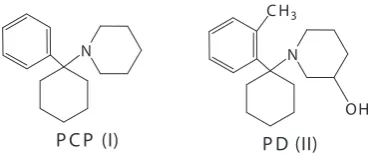
Several studies have shown that as a result of specific binding sites in the brain [4], phencyclidine – 1-(1-phenylcyclohexyl)piperidine, CAS 956-90-1 (PCP, I )– and its derivatives display anxiolytic [5], analgesic [6], stimulant [7], anticonvulsant [8] and behavioral effects [9], which are mediated by various receptors. Several previous studies have identified PCP as a non-competitive antagonist of the NMDA receptor [10]. PCP and other PCP- -like NMDA receptor antagonists have been shown to produce anxiolytic effects [5, 11], and, studies have been shown the antidepressant-like effects of various NMDA receptors antagonists in ani-mal models [3, 12, 13]There are at least three sites where antagonists might block NMDA activation: the NMDA site, the strychnine-insensitive glycine site, and the PCP site [13, 14].
The aim of the present study was to examine the anxiolytic and antidepressant effects of a new derivative of phencyclidine derivative of phency-clidine – 1-(1-[2-ethylphenyl][cyclohexyl])-3-pip-eridinol (PND) on the elevated plus maze (EPM) and forced swimming test (FST). The first experi-ment focussed on the effects of PND on the EPM model of anxiety, and in the second experiment, the effects of PND on the FST model of depression were investigated. The results are compared to the effects of PCP and to the control group.
Material and Methods
The Animals
Adult male NMRI mice from the Pasteur In-stitute of Iran (Tehran, Iran), weighing 30–40 g, were housed in individual polycarbonate cages with a controlled temperature of 24 ± 2°C and a 12:12 h light/dark cycle (lights on at 7:30); they had free access to food and water ad libitum, and were allowed to adapt to the laboratory conditions for at least one week before the tests. Seven animals were used in each experiment. The experimental procedures followed the National Institutes of Health (NIH) guide for the Care and Use of
labo-ratory Animals and the guidelines of the Research Council of the Department of Biology at the Karaj branch of Islamic Azad University.
The Elevated Plus Maze (EPM)
The EPM is a plus-shaped wooden apparatus that elevated to a height of 50 cm and consisted of a central platform (5 cm × 5 cm); two open arms (30 cm × 5 cm) and two enclosed arms (30 cm × 5 cm × 15 cm) opposite to each other with an open roof [15]. For doing anxiety testthe EPM was placed in the center of a quiet dimly-lit room and behaviors of animals in the maze were re-corded by a “blind” observer with a chronometer who sat quietly one meter behind one of the closed arms of the maze. Individual mice were placed in the center of the plus maze, facing one of the open arms, 30 minutes after their respective drug treat-ments. Following behaviors were measured for each animal: (1) the amount of time spent in the open arms, (2) the amount of time spent in the closed arms, (3) the number of entries into the open arms and (4) the number of entries into the closed arms during the five-minute test period. The maze was cleaned with distilled water after each test and an entry was defined as entrance of all four paws in the arm.
In order to calculate the OAT% and OAE%, open-arm activity was quantified as the amount of time that the animal spent in the open arms rela-tive to the total amount of time spent in any arm (open/total × 100), and the number of entries into the open arms was quantified relative to the total number of entries into any arm (open/total × 100) [15–17]. locomotor activity was considered as the total number of closed-arm entries plus the total of open-arm entries [18, 19].
The Forced Swimming
Test (FST)
Drug Synthesis
and Administration
Preparations (Diagram 1)
1-(1-phenylcyclohexyl)piperidine (PCP, I) This compound was prepared according to Maddox et al. 1965 [21], from 1-piperidinocyclo-hexanecarbonitrile and phenyl magnesium bro-mide. The hydrochloride salt of I was prepared using 2-propanol and HCl and was recrystallized from 2-propanol [21].
1-[1-(2-methylphenyl)(cyclohexyl)]-3-piper-idinol (PND, II)
This compound was prepared from nitrile compound and 2-tolyl magnesium bromide (gri-gnard reagent) according to a published method. The hydrochloride salt of it was prepared using 2-propanol and HCl and was recrystallized from 2-propanol in accordance with a method published by Ahmadi et al [22].
The drugs were dissolved in sterile saline and administered intraperitoneally (IP) 30 minutes be-fore the test. All injections were performed with a 1 ml insulin needle at a volume of 50 µl. The con-trol animals received an IP injection of saline.
The Experimental Procedure
Experiment 1 – the Effect of PCP
on Anxiety-Like Behavior
Four groups of mice were used to evaluate the effects of PCP on anxiety. The first group received an IP injection of saline and the
other three
groups
received IP injections of PCP at doses of 1, 5 and 10 mg/kg. Each group then went through the EPM as described above.Experiment 2 – the Effect of PCP
on Depression-Like Behavior
In comparison with a saline control group, three groups of mice received IP injections of PCP (1, 5 and 10 mg/kg). Each group was then submit-ted to the FST as described above.
Experiments 3 and 4
Experiments 3 and 4 focussed on the effect of PND on anxiety-like behavior and on depression-like behavior by following the same procedures as Experiments 1 and 2, but with PND at doses of 1, 5 and 10 mg/kg instead of PCP.
Statistical Analysis
Since data displayed normal distribution and ho-mogeneity of variance, a one-way ANOVA was used to compare the effects of different doses of drugs with the saline control. In the case of significant differenc-es, Tukey’s and Dunnett’s post hoc analyses were per-formed to assess specific group comparisons. Differ-ences between experimental groups with p < 0.05 at each point were considered statistically significant.
Results
The Effect of PCP
on Anxiety-Like Behavior
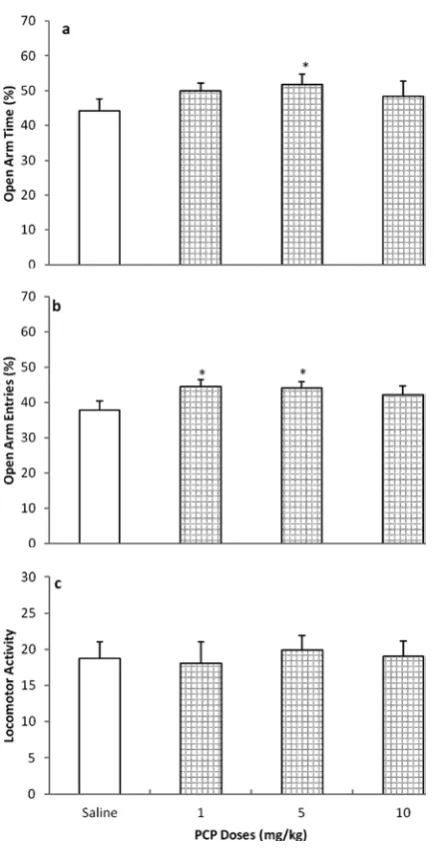
Figure 1 shows the effect of IP injections of the different doses of PCP (1, 5 and 10 mg/kg) on anxiety-like parameters in the EPM test. The one- -way ANOVA showed an increase in OAT % [F (3, 24) = 5.267, p < 0.05] at the dose of 5 mg/kg and in OAE % [F (3, 24) = 6.221, p < 0.05] at the doses of 1mg and 5mg, but no significant change was ob-served in locomotor activity [F (3, 24) = 1.121, p > >0.05], indicating a low anxiolytic-like effect fol-lowing IP administration of PCP to the mice.
The Effect of PCP on
Depression-Like Behavior
The effect of IP injections of PCP on the total duration of immobility in the FST test is shown in Fig. 2. The one-way ANOVA showed that at the doses of 5 and 10 mg/kg, PCP induced a significant reduction in the immobility time in comparison with the control group [F (3, 24) = 9.132, p < 0.05]; but this was not observed at the 1 mg/kg dosage.
The Effect of PND
on Anxiety-Like Behavior
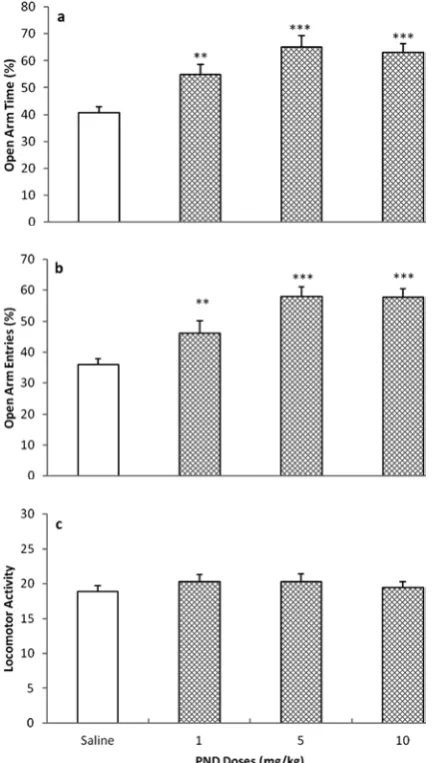
Figure 3 shows the effect of IP injections of the different doses of PND (1, 5 and 10 mg/kg) on anxiety-like parameters in the EPM test. Dosages of 5 and 10 mg/kg increased OAT % [F (3, 24) = 7.552, p < 0.05] and OAE % [F (3, 24) = 6.633, p < 0.05], indi-cating an anxiolytic response to PND in comparison with the control group. No significant changes were observed in locomotor activity [F (3, 24) = 1.052, p >
The structure of PCP (I) and PND (II)
N
OH C H3
P D (II)
N
0.05]. Moreover, the one-way ANOVA revealed that at the doses of 5 and 10 mg/kg, PND significantly decreased the levels of anxiety-related behaviors in comparison with the PCP group: OAT % [F (3, 24) = 6.005, p < 0.05] and OAE % [F (3, 24) = 7.493, p < 0.05], which means that the new derivative of phencyclidine has more impact than phencyclidine in reducing anxiety-like behavior.
The Effect of PND on
Depression-Like Behavior
As shown in Figure 4, a significant decrease in the immobility time in the FST was observed in animals that received PND at dosages of 5 and 10 mg/kg when compared to the control group [F (3, 24) = 4.503, p < 0.05], showing antidepressant ef-fects in mice
Discussion
This study sought to determine whether PND – a new derivative of PCP – is involved in reduc-ing anxiety and/or depression-like behaviors. The present findings indicate that both PCP and PND are associated with reductions in anxiety and de-pression-like behaviors in animal models. The data obtained indicate that IP administration of PCP and PND increases OAT% and OAE%, but not lo-comotive activity, indicating that these chemicals have an anxiolytic-like effect. Moreover, different doses of PCP and PND significantly reduced the immobility time in the FST, indicating antidepres-sant-like effects.
These findings indicate that PCP and its analog induce their anxiolytic and antidepressant-like ef-fects primarily by acting as NMDA receptor antag-onists, blocking the activity of the NMDA receptor [23, 24]. There is clinical evidence implicating the NMDA receptor in various neurological disorders [25]. The anxiolytic and antidepressant-like effects of various antagonists of NMDA receptors have been reported in numerous studies, and NMDA
Fig. 1. Theeffect of different doses of PCP (1, 5 and 10 mg/kg/50 µl, IP) on anxiety-like behavior in the EPM. The test was performed 30 min after injection. Each bar represents means ± SEM (n = 7 mice per group) of a) Open Arm Time %, b) Open Arm Entries % and c) locomotor activity. Significant differences: *p < 0.05 compared to the saline-treated control group
Ryc. 1. Wpływ różnych dawek PCP (1, 5 i 10 mg/ /kg/50 ul, IP) na zachowania lękowe w EPM. Test przeprowadzono 30 min po wstrzyknięciu. Każdy słu-pek oznacza średnią ± SEM (n = 7 myszy w grupie) z a) czas spędzony na ramionach otwartych krzyża, b) wejścia na ramiona otwarte krzyża i c) aktywność ruchowa. Istotne różnice: * p < 0,05 w porównaniu z grupą kontrolną, której podawano sól fizjologiczną
Fig. 2. The effect of PCP (1, 5 and 10 mg/kg/50 µl, IP) on depression-like behavior in the FST. Data are expressed as means ± SEM (n = 7 mice per group). Significant differences: ***p < 0.001 compared to the saline-treated control group
receptor dysfunction appears to have a major role in neurobiological disorders such as anxiety and depression [3, 25–28]. Ketamine is an NMDA re-ceptor antagonist and a derivative of PCP involved in the modulation of emotional behaviors; its pri-mary mechanism is blocking the NMDA receptor at the PCP site within the ionotropic channel [29]. It has been shown that administering ketamine and related NMDA antagonists has anxiolytic and
anti-depressant-like effects in animal models of anxiety and depression, as well as in humans [29, 30].
PCP analogs have been shown to inhibit nico-tinic acetylcholine receptor channels (nAChR) in rats [31, 32]. Recent studies have also shown that PCP has direct effects on serotonin (5-HT) recep-tors and that extracellular 5-HT levels in the brain elevated by systemic administration of PCP [33, 34]. The serotonergic and nicotinic cholinergic systems have been extensively implicated in an ar-ray of behavioral and physiological functions, in-cluding the control of anxiety and depression-like behaviors [19, 35]. Therefore it seems that all of the NMDA glutamatergic system, nicotinic acetyl-choline receptors and serotonin (5-HT) receptors could have a role in modulating the anxiolytic and antidepressant effects of phencyclidine and its de-rivatives.
The results of the current study showed that PND is more effective than PCP in the reduction of anxiety-related behavior. The new PCP deriva-tive administered in this study involved substi-tutions on the phenyl and piperidine rings that increased its electron-donating and changed its hydrophilic and polarity propertiesthat result in enhanced pharmacological activity [22, 36, 37]. It seems that the strong electron-donating prop-erties of the methyl group on the phenyl ring, as well as the hydrophilic and polar properties of the hydroxyl group on the piperidine ring of the PND molecule, facilitate and alter interactions with receptors. However, because of undesirable reac-tions with cationic intermediates, minor decreases in receptor binding could be anticipated. On the other hand, it is possible that structural changes in
Fig. 3. The effect of different doses of PND (1, 5 and 10 mg/kg/50 µl, IP) on anxiety-like behavior in the EPM. The test was performed 30 min after injection. Each bar represents means ± SEM (n = 7 mice per group) of (a) Open Arm Time %, (b) Open Arm Entries % and (c) locomotor activity. Significant differences: **p < < 0.01 and ***p < 0.001 compared to the control group
Ryc. 3. Wpływ różnych dawek PND (1, 5 i 10 mg/ kg/50 ul, IP) na zachowania lękowe w EPM. Test przeprowadzono 30 min po wstrzyknięciu. Każdy słupek oznacza średnią ± SEM (n = 7 myszy w grupie) z a) czas spędzony na ramionach otwartych krzyża, b) wejścia na ramiona otwarte krzyża i c) aktywność ruchowa. Istotne różnice: ** p < 0,01
i *** p < 0,001 w porównaniu z grupą kontrolną
Fig. 4. The effect of PND (1, 5 and 10 mg/kg/50 µl, IP) on depression-like behavior in the FST. Data are expressed as means ± SEM (n = 7 mice per group). Significant differences: *p < 0.05 compared to the con-trol group
PCP during the preparation of PND may affect the interaction of the new derivative with the NMDA receptor, or shift the affinity of the new derivative to receptors like 5-HT or nAChR, whose role in controlling anxiety and depression is well known.
The authors concluded that the results of the present study indicate that IP injection of PND, a new PCP derivative, produce a significant anxiolyt-ic-like effect in comparison to PCP, while its effect on depression-like behavior is less than that of PCP.
References
[1] Pin J, Duvoisin R: The metabotropic glutamate receptors: Structure and functions 1. Neuropharmacology 1995, 34, 1–26.
[2] Javitt D: glutamate as a therapeutic target in psychiatric disorders. Mol Psychiatry 2004, 9, 984–997.
[3] Poleszak E, Wlaz P, Kedzierska E, Nieoczym D, Wróbel A, Fidecka S: NMDA/glutamate mechanism of antide-pressant-like action of magnesium in forced swim test in mice. Pharmacol Biochem Behav 2007, 88, 158–164.
[4] Baba A, Yamamoto T, Kawai N, Yamamoto H, Suzuki T, Moroji T: Behavioral effects of phencyclidine and its major metabolite,(trans) 4-phenyl-4-(1-piperidinyl) cyclohexanol, in mice. Behav Brain Res 1994, 65, 75–81.
[5] Hajikhani R, Solati J, Ahmadi A, Salari A: The Effect of Phencyclidine New Derivatives on Anxiety Behaviors in Rats. Iran J Basic Med Sci 2010.
[6] Ahmadi A, Solati J, Hajikhani R, Onagh M, Javadi M: Synthesis and analgesic effects of 1-[1-(2-methylphenyl) (cyclohexyl)]-3-piperidinol as a new derivative of phencyclidine in mice. Arzneimittel-Forschung 2010, 60, 492.
[7] Mori A, Noda Y, Mamiya T, Miyamoto Y, Nakajima A, Furukawa H: Phencyclidine-induced discriminative stimulus is mediated via phencyclidine binding sites on the N-methyl-aspartate receptor-ion channel complex, not via sigma1 receptors. Behav Brain Res 2001, 119, 33–40.
[8] Geller E, Adler L, Wojno C, Adler M: The anticonvulsant effect of phencyclidine in rats. Psychopharmacology 1981, 74, 97–98.
[9] Olney J, Labruyere J, Wang G, Wozniak D, Price M, Sesma M: NMDA antagonist neurotoxicity: mechanism and prevention. Science 1991, 254, 1515.
[10] Hori T, Subramaniam S, Srivastava L, Quirion R: Behavioral and neurochemical alterations following repeated phencyclidine administration in rats with neonatal ventral hippocampal lesions. Neuropharmacology 2000, 39, 2478–2491.
[11] Porter J, Wiley J, Balster R: Effects of phencyclidine-like drugs on punished behavior in rats. J Pharmacol Exp Ther 1989, 248, 997.
[12] Guimarães F, Carobrez A, Aguiar J, Graeff F: Anxiolytic effect in the elevated plus-maze of the NMDA receptor antagonist AP7 microinjected into the dorsal periaqueductal grey. Psychopharmacology 1991, 103, 91–94.
[13] Plaznik A, Palejko W, Nazar M, Jessa M: Effects of antagonists at the NMDA receptor complex in two models of anxiety. Eur Neuropsychopharmacol 1994, 4, 503–512.
[14] Woolverton W, Balster R: Tolerance to the behavioral effects of phencyclidine: The importance of behavioral and pharmacological variables. Psychopharmacology 1979, 64, 19–24.
[15] Solati J, Asiaei M, Salari A: Prenatal exposure to lps leads to long-lasting physiological consequences in male offspring. Dev Psychobiol 2011, DOI: 10.1002/dev.20568.
[16] Pellow S, Chopin P, File SE, Briley M: Validation of open:closed arm entries in an elevated plus-maze as a mea-sure of anxiety in the rat. J Neurosci Meth 1985, 14, 149–167.
[17] Pellow S: Anxiolytic and anxiogenic drug effects in a novel test of anxiety: are exploratory models of anxiety in rodents valid? Meth Find Exp Clin Pharmacol 1986, 8, 557–565.
[18] Solati J, Zarrindast M, Salari A: Dorsal hippocampal opioidergic system modulates anxiety-like behaviors in adult male Wistar rats. Psychiatry Clin Neurosci 2010, 248, 997.
[19] Zarrindast M, Solati J, Oryan S, Parivar K: Effect of intra-amygdala injection of nicotine and gABA receptor agents on anxiety-like behaviour in rats. Pharmacology 2008, 82, 276–284.
[20] Bourin M, Chenu F, Prica C, Hascoët M: Augmentation effect of combination therapy of aripiprazole and anti-depressants on forced swimming test in mice. Psychopharmacology 2009, 206, 97–107.
[21] Maddox V, Godefroi E, Parcell R: The synthesis of phencyclidine and other 1-arylcyclohexylamines. J Med Chem 1965, 8, 230–235.
[22] Ahmadi A, Khalili M, Abbassi S, Javadi M, Mahmoudi A, Hajikhani R: Synthesis and study on analgesic effects of 1-[1-(4-methylphenyl)(cyclohexyl)] 4-piperidinol and 1-[1-(4-methoxyphenyl)(cyclohexyl)] 4-piperidinol as two new phencyclidine derivatives. Arzneimittel-Forschung 2009, 59, 202–206.
[23] Kapur S, Seeman P: NMDA receptor antagonists ketamine and PCP have direct effects on the dopamine D2 and serotonin 5-HT2 receptors: Implications for models of schizophrenia. Mol Psychiatry 2002, 7, 837–844.
[24] Honey C, Miljkovic Z, MacDonald J: Ketamine and phencyclidine cause a voltage-dependent block of responses to l-aspartic acid. Neurosci lett 1985, 61, 135–139.
[25] Bergink V, van Megen H: glutamate and anxiety. Eur Neuropsychopharmacol 2004, 14, 175–183.
[26] Swanson C, Bures M, Johnson M, Linden A, Monn J, Schoepp D: Metabotropic glutamate receptors as novel targets for anxiety and stress disorders. Nat Rev Drug Dis 2005, 4, 131–144.
[28] Tzschentke T: glutamatergic mechanisms in different disease states: overview and therapeutical implications – an introduction. Amino Acids 2002, 23, 147–52.
[29] Maeng S, Zarate C: The role of glutamate in mood disorders: results from the ketamine in major depression study and the presumed cellular mechanism underlying its antidepressant effects. Current Psychiatry Reports 2007, 9, 467–474.
[30] Berman R, Cappiello A, Anand A, Oren D, Heninger G, Charney D: Antidepressant effects of ketamine in depressed patients. Biol Psychiatry 2000, 47, 351–354.
[31] Fryer J, Lukas R: Noncompetitive functional inhibition at diverse, human nicotinic acetylcholine receptor sub-types by bupropion, phencyclidine, and ibogaine. J Pharmacol Exp Ther 1999, 288, 88.
[32] MJ E: M2 mutations of the nicotinic acetylcholine receptor increase the potency of the non-competitive inhibitor phencyclidine. J Neurosci Res 2000, 61, 44–51.
[33] Martin P, Carlsson M, Hjorth S: Systemic PCP treatment elevates brain extracellular 5-HT: a microdialysis study in awake rats. Neuroreport 1998, 9, 2985.
[34] Svensson T, Mathe J, Andersson J, Nomikos G, Hildebrand B, Marcus M: Mode of action of atypical neurolep-tics in relation to the phencyclidine model of schizophrenia: role of 5-HT2 receptor and -adrenoreceptor antago-nism. J Clin Psychopharmacol 1995, 15, 11S–8S.
[35] Graeff F, Guimarães F, De Andrade T, Deakin J: Role of 5-HT in stress, anxiety, and depression. Pharmacol Biochem Behav 1996, 54, 129–141.
[36] Shulgin A, MacLean D: Illicit synthesis of phencyclidine (PCP) and several of its analogs. Clin Toxicol 1976, 9, 553–560.
[37] Shebley M, Jushchyshyn M, Hollenberg P: Selective pathways for the metabolism of phencyclidine by cytochrome p450 2b enzymes: identification of electrophilic metabolites, glutathione, and N-acetyl cysteine adducts. Drug Metab Dis 2006, 34, 375.
Address for correspondence:
Jalal Solati
Department of Biology
Islamic Azad University, Karaj Branch P.O. Box. 31485-313,
Iran, Karaj
Tel.: +98 261 443 6978 E-mail: [email protected]
Conflict of interest: None declared