© 2013 Siok Wah Lai et al. This is an open access article distributed under the terms of the Creative Commons Attribution License -NonCommercial-ShareAlike Unported License (http://creativecommons.org/licenses/by-nc-sa/3.0/).
Journal of Applied Pharmaceutical Science Vol. 3 (06), pp. 044-051, June, 2013 Available online at http://www.japsonline.com
DOI: 10.7324/JAPS.2013.3607 ISSN 2231-3354
Evaluating the incidence, risk factors and glycaemic control of
new-onset diabetes mellitus in kidney transplant recipients: a single centre
study
Siok Wah Lai
1, Chee Ping Chong
2, Noorizan Abdul Aziz
31
Master in Clinical Pharmacy Candidate, Discipline of Clinical Pharmacy, School of Pharmaceutical Sciences, Universiti Sains M alaysia (USM), 11800 Minden, Penang, Malaysia.
2
Lecturer, Discipline of Clinical Pharmacy, School of Pharmaceutical Sciences, Universiti Sains Malaysia (USM), 11800 Minden, Penang, Malaysia.
3
Lecturer, Faculty of Pharmacy, University Teknologi MARA (UiTM), Selangor, Malaysia.
ARTICLE INFO ABSTRACT
Article history:
Received on: 06/02/2013 Accepted on: 02/03/2013 Available online: 27/06/2013
This study aimed to evaluate the incidence and risk factors for development of post-kidney transplant diabetes mellitus (PTDM) and its glycaemic control in a single centre. Adult kidney transplant recipients (n = 164) under follow-up at Penang Hospital, Malaysia since transplantation (mean follow-up time: 11.04±6.26 years) were retrospectively reviewed. Data were retrieved from year 1984 to 2010. PTDM was defined according to the American Diabetes Association Guideline. Clinical covariates of PTDM were determined by using binary logistic regression analysis. Thirty six patients (22.0%) developed PTDM with a cumulative incidence of 5.5%, 6.7%, 12.2% and 17.7% respectively at 1, 3, 5 and 10 years post-transplantation. Multivariate analysis showed that the number of concurrent diseases in the patients (OR = 2.26, p = 0.007) and fasting blood sugar (FBS) level at 6 months post-transplant (OR = 4.10, p = 0.001) were independent predictors of PTDM. The mean FBS level at the time of diagnosis for PTDM was 11.21±5.57 mmol/L. Treatments with anti-diabetic drug(s) were given and the FBS levels were under controlled (mean value of 6.50±1.14 mmol/L) at six months after the PTDM diagnosis. Close monitoring of blood sugar level particularly early after kidney transplantation is necessary for the detection of PTDM.
Key words:
Post-kidney transplantation, diabetes mellitus, risk factors, glycaemic control.
INTRODUCTION
Over the past three decades, kidney transplantation has become the treatment of choice for many end-stage kidney failure patients, due to improved short- and long-term survival benefits over dialysis treatment (Kälble et al., 2009). The establishment of transplantation has been made possible by the introduction of immunosuppressant therapy (NICE, 2004). However, evidence demonstrates that post-transplant diabetes mellitus (PTDM) is an increasingly common complication of kidney transplantation
(Cosio et al., 2001). PTDM increases the risk of graft- related complications such as graft rejection, reduced graft
function, graft loss and infection (Miles et al., 1998; Roth
et al.,1989) and reduces the survival of transplant recipients (Jindal and Hjelmesaeth, 2000; Kasiske et al., 2003).
.
* Corresponding Author
Chee Ping Chong, Discipline of Clinical Pharmacy, School of Pharmaceutical Sciences, Universiti Sains Malaysia (USM), 11800 Minden, Penang, Malaysia.TeL: +6 012 534 2685; Fax: +6 04 657 0017.
The differing incidence of new-onset diabetes after transplantation in patients of different ethnicity may reflect differential pharmacokinetics and diabetogenic effects of immunosuppressive agents (Soule et al., 2005). For instance, African Americans require 37% higher doses of tacrolimus to achieve comparable blood concentrations compared with whites. Hence, African Americans may expose to a higher diabetogenic effects of Tacrolimus (ADA, 2003; Kasiske et al., 1996). Other risk factors for developing PTDM were older age (Boudreaux et al., 1987), family history (Hjelmesaeth et al., 1997), hepatitis C infection (Kasiske et al., 2003), increasing HLA mismatches (Kasiske et al., 2003), obesity (BMI ≥ 30kg/m2) (Boudreaux et al., 1987; Cosio et al., 2001; Jawad and Rizvi, 2000), donor source (Boudreaux et al., 1987; Sumrani et al., 1991), acute rejection (Al-Uzri A et al., 2001; Cosio et al., 2001; Hjelmesaeth et al., 1997;
Rao et al., 1992; Roth et al., 1989; Sumrani et al., 1991; von
Kiparski A et al., 1990), the type of immunosuppressive agents used to prevent and treat rejection (Cosio et al., 2001; Hjelmesaeth et al., 1997; Rao et al., 1992; Roth et al., 1989; Sumrani et al., 1991; Vesco et al., 1996; Yoshimura et al., 1988) and the dose of corticosteroids (Hjelmesaeth et al., 1997; Jawad and Rizvi, 2000; Kasiske et al., 2003; Pirsch et al., 1997).
Currently, there is limited documentation on PTDM risk in the Asian population, particularly among the multiple ethnic groups of Malay, Chinese and Indian in country like Malaysia. This study was therefore aimed to evaluate the incidence and risk factors that pre-dispose kidney transplant patients to the development of PTDM according to the Asian population. This identification will provide an insight into how risk profiling and management of kidney transplant recipients could be improved to avoid or delay the development of diabetes mellitus after transplantation. This study also sought to assess the glycaemic control of PTDM patients in a single centre including the prescribed drug regimens.
METHODS
This was a retrospective single centre study based at the Haemodialysis Unit, Penang Hospital, Malaysia. The study population was all kidney transplant patients aged over 18 years old who were under follow up at Penang Hospital since their transplantation. Patients’ data were retrieved from 30th
April 1984 to 30th June 2010. Patients with graft failure or death within 1 year post-transplant, multi-organ transplant recipients, patients who had a diagnosis of diabetes mellitus prior to transplant (either as native kidney disease or co-morbidity) and those with incomplete medical records were excluded. Data were collected from patients’ medical record at Hemodialysis Unit. This study has granted ethics approval from Research and Ethics Committee of Ministry of Health Malaysia.
For each studied subject, the following clinical characteristics were considered possible risk factors for development of PTDM: age at transplant, gender, race, weight and serum creatinine, dialysis prior to transplant, type of donor (living/
cadaveric), Hepatitis C antibody (HCV) status at time of transplant, acute rejection post-transplant, dialysis dependent first week post-transplant, trough levels of calcineurin inhibitors (cyclosporine and tacrolimus), number of concurrent diseases and presence or absence of hypertension. As information on family history of diabetes, numbers of human leukocyte antigen mismatches and hematuria or proteinuria post-transplant were not systematically documented in the patient medical records, these variables were not considered in the study. Besides, the date of diagnosis of PTDM, anti-diabetic drugs that prescribed, levels of fasting blood glucose (FBS) since time of transplant were also assessed. However, the random blood sugar and glycated haemoglobin (HbA1c) level were not assessed as these tests were not routinely performed among the patients.
Definition of PTDM
PTDM was defined as a random (any time of day without regard to time since last meal) plasma glucose concentration ≥ 200 mg/dL (11.1 mmol/L) or a fasting (no caloric intake for 8 hours) plasma glucose ≥ 126 mg/dL (7.0 mmol/L), confirmed upon repeat testing on a different day, as recommended by the American Diabetes Association (ADA). (ADA, 2003).
Target for control of PTDM
Currently, there is no specific mention on the target for control of PTDM. The natural progression of diabetes post kidney transplantation resembles that of Type 2 diabetes because of the insidious onset and patients may be asymptomatic for years before the symptoms become clinically evident (Kasiske et al., 2003). Hence, glycemic recommendations for adults with Type 2 diabetes mellitus (according to the ADA) will be used as the target for control of PTDM (ADA, 2003). These target of control include HbA1C < 7.0%, fasting plasma glucose 70–130 mg/dl (3.9–7.2 mmol/L) and random blood glucose < 180 mg/dl (< 10.0 mmol/L).
Statistical analysis
The collected data were entered into SPSS® version 18.0 for analysis. Results were expressed as mean ± standard deviation (SD) or as a percentage. Mean values in the PTDM and no PTDM group were compared using Students t-test (or by Mann-Whitney U test if the data were not normally distributed). Categorical variables were compared using chi-square test. Subsequently, clinical variables of interest were included in binary logistic regression analysis to compute adjusted odds ratios, 95% confidence intervals (CI) and p values. All the variables were further entered into a multivariate analysis. Statistical significance was determined by a p value of less than 0.05.
RESULTS
Demographic &Transplant Characteristics
excluded due to the following reasons: diabetes mellitus prior to transplant (n = 11), follow-up in another centre (n = 2) or with missing information (n = 5).The analysis was then performed in 164 patients.
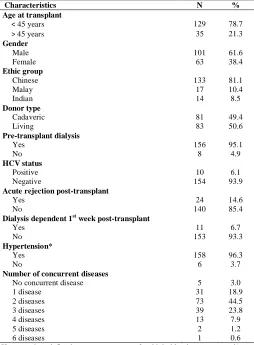
A summary of demographic profiles and relevant transplant characteristics is presented in Table 1. Majority of patients consist of male (61.6%) and Chinese individuals (81.1%). About 80% of the patients were aged below 45 years old at transplantation. The year of post-transplantation in the studied patients were ranged from 0.43 (156 days) to 28.2 years with a mean of 11.04±6.26 years. There were small number of patients presented with acute rejection after transplantation (14.6%) and 6.7% of them had delayed graft function as defined by the requirement for hemodialysis in the first week post-transplant. About 96% of the patients had hypertension and majority of them (97%) had at least one concurrent disease at the last follow-up. The mean number of concurrent diseases was 2.21±1.02. The common concurrent diseases among the patients were hypertension (78.5%), hyperlipidemia (56.0%), hyperuricemia (11.5%), ischemic heart disease (5.5%), gastritis (4.5%), bronchial asthma (4.0%), pulmonary tuberculosis (3.5%), anaemia (3.0%), hepatitis B (3.0%) and hepatitis C (2.5%).
Table. 1: Patient and transplant characteristics.
Characteristics N %
Age at transplant
< 45 years 129 78.7
> 45 years 35 21.3
Gender
Male 101 61.6
Female 63 38.4
Ethic group
Chinese 133 81.1
Malay 17 10.4
Indian 14 8.5
Donor type
Cadaveric 81 49.4
Living 83 50.6
Pre-transplant dialysis
Yes 156 95.1
No 8 4.9
HCV status
Positive 10 6.1
Negative 154 93.9
Acute rejection post-transplant
Yes 24 14.6
No 140 85.4
Dialysis dependent 1st week post-transplant
Yes 11 6.7
No 153 93.3
Hypertension*
Yes 158 96.3
No 6 3.7
Number of concurrent diseases
No concurrent disease 5 3.0
1 disease 31 18.9
2 diseases 73 44.5
3 diseases 39 23.8
4 diseases 13 7.9
5 diseases 2 1.2
6 diseases 1 0.6
*Hypertension defined as any treatment for high blood pressure and/or a systolic value > 140 mmHg or diastolic value > 90 mmHg within 2 years post-transplant.
Incidence and Characteristics of PTDM
PTDM was diagnosed in 36 (22.0%) of 164 patients after kidney transplantation (Table 2). The mean age at transplant for the PTDM group was significantly higher than those without PTDM. Besides, patients who developed PTDM had significantly higher FBS at 6 months post-transplant and number of concurrent diseases as compared to those without PTDM.
After transplantation, all PTDM patients were prescribed with prednisolone. One-third of them were started on tacrolimus while 66.7% were given cyclosporine as immunosuppressive treatment. Two patients were switched from cyclosporine to tacrolimus prior to PTDM development. Once PTDM was developed, one patient was switched from tacrolimus to cyclosporine but this did not result in resolution of PTDM. None of the PTDM cases involved discontinuation of calcineurin inhibitor. The time of diagnosis of PTDM were ranged from 0.16 years (59 days) to 15.8 years with a mean of 5.4±4.6 years after transplantation (Figure 1). The cumulative incidences of PTDM after 1, 3, 5 and 10 years post-transplant were 5.5%, 6.7%, 12.2% and 17.7%, respectively. Overall cumulative incidence of PTDM was 22.0% after 15.8 years. Development of PTDM showed fastest growth within first year post-transplant.
Fig. 1: Cumulative Incidence of PTDM over Time, Years Post-transplant.
Clinical Variables associated with PTDM
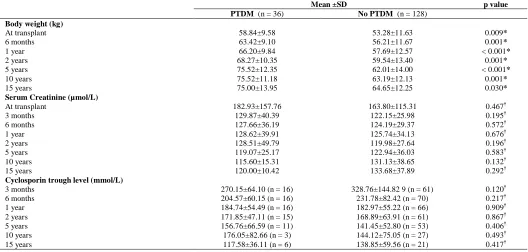
Overall, the mean body weight of patients with PTDM at any time point following transplantation was significantly higher than patients without PTDM (Table 3). However, there was no difference found between the two groups on the serum creatinine levels at any time point post-transplantation. Comparisons of calcineurin inhibitor (cyclosporine and tacrolimus) trough levels between these two groups of patients found similar trend with no significant differences throughout the study period.
Table. 2: Characteristics of the patients with PTDM and without PTDM.
Demographic data PTDM, n (%) No PTDM, n (%) p value
Number of patients 36 (22.0%) 128 (78.0%)
Mean age at transplant 41.5±11.1 34.0±9.8 < 0.001†
FBS 6 months post-transplant, mmol/L 5.97±1.70 4.89±0.54 0.001†
Mean no. of concurrent disease 2.53±1.082 2.12±0.985 0.032†
Gender
Male 26 (72.2%) 75 (58.6%) 0.137‡
Female 10 (27.8%) 53 (41.4%)
Ethic group
Chinese 28 (77.8%) 105 (82.0%) 0.097‡
Malay 2 (5.6%) 15 (11.7%)
Indian 6 (16.6%) 8 (6.3%)
Donor type
Cadaveric 20 (55.6%) 61 (47.7%) 0.402‡
Living 16 (44.4%) 67 (52.3%)
Pre-transplant dialysis
Yes 34 (94.4%) 122 (95.3%) 0.831‡
No 2 (5.6%) 6 (4.7%)
HCV status
Positive 1 (2.8%) 9 (7.0%) 0.346‡
Negative 35 (97.2%) 119 (93.0%)
Acute rejection post-transplant
Yes 5 (13.9%) 19 (14.8%) 0.886‡
No 31 (86.1%) 109 (85.2%)
Dialysis dependent 1st week post-transplant
Yes 5 (13.9%) 6 (4.7%) 0.051‡
No 31 (86.1%) 122 (95.3%)
Hypertension*
Yes 35 (97.2%) 123 (96.1%) 0.750‡
No 1 (2.8%) 5 (3.9%)
Prednisolone treatment
Yes 36 (100%) 126 (98.4%) 0.450‡
No 0 (0%) 2 (1.6%)
Cyclosporin treatment
Yes 24 (66.7%) 97 (75.8%) 0.272‡
No 12 (33.3%) 31 (24.2%)
Tacrolimus treatment
Yes 12 (33.3%) 29 (22.7%) 0.191‡
No 24 (66.7%) 99 (77.3%)
*Hypertension defined as any treatment for high blood pressure and/or a systolic value > 140 mmHg or diastolic value > 90 mmHg within 2 years post-transplant. †Mann-Whitney U Test ‡Chi-square Test
Table. 3: Clinical variables of the patients at different periods of post-transplantation.
Mean ±SD p value
PTDM (n = 36) No PTDM (n = 128)
Body weight (kg)
At transplant 58.84±9.58 53.28±11.63 0.009*
6 months 63.42±9.10 56.21±11.67 0.001*
1 year 66.20±9.84 57.69±12.57 < 0.001*
2 years 68.27±10.35 59.54±13.40 0.001*
5 years 75.52±12.35 62.01±14.00 < 0.001*
10 years 75.52±11.18 63.19±12.13 0.001*
15 years 75.00±13.95 64.65±12.25 0.030*
Serum Creatinine (µmol/L)
At transplant 182.93±157.76 163.80±115.31 0.467†
3 months 129.87±40.39 122.15±25.98 0.195†
6 months 127.66±36.19 124.19±29.37 0.572†
1 year 128.62±39.91 125.74±34.13 0.676†
2 years 128.51±49.79 119.98±27.64 0.196†
5 years 119.07±25.17 122.94±36.03 0.583†
10 years 115.60±15.31 131.13±38.65 0.132†
15 years 120.00±10.42 133.68±37.89 0.292†
Cyclosporin trough level (mmol/L)
3 months 270.15±64.10 (n = 16) 328.76±144.82 9 (n = 61) 0.120†
6 months 204.57±60.15 (n = 16) 231.78±82.42 (n = 70) 0.217†
1 year 184.74±54.49 (n = 16) 182.97±55.22 (n = 66) 0.909†
2 years 171.85±47.11 (n = 15) 168.89±63.91 (n = 61) 0.867†
5 years 156.76±66.59 (n = 11) 141.45±52.80 (n = 53) 0.406†
10 years 176.05±82.66 (n = 3) 144.12±75.05 (n = 27) 0.493†
Drug Management of PTDM
Among the patients who developed PTDM, 61.1% (n = 22) required either single or multiple oral agents for treatment and 16.7% (n = 6) required insulin therapy. Meanwhile, 13.9% (n = 5) of the patients were on combination therapy of oral agents and insulin. PTDM resolved in 8.3% (n = 3) of the cases, as defined as discontinuation of oral agents or insulin therapy. Types of anti-diabetic agents that prescribed to PTDM patients are shown in Table 5.
Table. 5: Types of anti-diabetic agents prescribed to PTDM patients at last follow-up.
Type of anti-diabetic agent n % Biguanide
Metformin 21 42.0
Sulphonylurea
Gliclazide 14 28.0
Glibenclamide 1 2.0
Dipeptidyl peptidase-4 Inhibitor
Sitagliptin 1 2.0
Alpha-glucosidase Inhibitor
Acarbose 1 2.0
Insulin
Humulin R 1 2.0
Humulin 30/70 10 20.0
Humulin N 1 2.0
Blood Sugar Monitoring
The average value for FBS at the time of diagnosis for patients with PTDM was 11.21±5.57 mmol/L. For recipients without PTDM, their FBS levels were well controlled since
transplantation, with fluctuations at mean of 4.95±0.76 mmol/L. For patient with PTDM, the FBS were under controlled at six months after the PTDM diagnosis with the mean value of 6.50±1.14 mmol/L. The average value of FBS at 1, 3, 5 and 10 years post-transplant were 6.78±1.83 mmol/L, 6.15±1.17 mmol/L, 6.36±2.12 mmol/L and 7.10±0.92 mmol/L respectively.
DISCUSSION
In this study, PTDM was found in 22.0% of kidney transplant recipients and the 1, 3 and 5 years cumulative incidence were 5.5%, 6.7% and 12.2% respectively. Recent studies using similar criteria for diagnosing PTDM as per ADA guidelines showed a higher 1 year cumulative incidence of PTDM which ranged from 7.0% to 19.0% (Chien et al., 2008; Gourishankar et al., 2004; Kiberd et al., 2006; Roland et al., 2008). Indeed, a similar research conducted at Singapore also revealed higher cumulative incidence of PTDM than the present study, which was 15.8%, 22.8% and 24.5% at 1, 3, and 5 years following transplantation (Bee et al., 2011). Nevertheless, both studies showed similar trend whereby the development of PTDM demonstrated fastest growth within the first year post-transplantation.
The average time (mean 5.4±4.6 years) to PTDM diagnosis in this study was longer as compared to findings from other countries (Koselj et al., 2002; Sharma et al., 2003). A single center study conducted in Slovenia revealed that the diagnosis of
Tacrolimus trough level (mmol/L)
3 months 10.5±1.7 (n = 9) 8.7±3.4 (n = 26) 0.134†
6 months 8.5±2.2 (n = 10) 7.81.6 (n = 28) 0.341†
1 year 6.9±2.5 (n = 12) 6.8±1.8 (n = 22) 0.882†
2 years 5.4±1.3 (n = 10) 6.1±2.0 (n = 14) 0.304†
5 years 5.3±1.3 (n = 7) 6.1±1.8 (n = 7) 0.319†
*Student t-test †
Mann-Whitney U test
Table. 4: Predictors of PTDM defined by univariate analysis & multivariate analysis.
Variable Odds Ratio 95% CI p value
Univariate analysis results
Age at transplant 1.07 1.03-1.11 < 0.001
Gender
Female 0.54 0.24-1.22 0.141
Male reference
Race
Chinese 0.36 0.11-1.11 0.075
Malay 0.18 0.029-1.09 0.062
Indian reference
Dialysis dependent 1st week post-transplant
No 0.31 0.087-1.07 0.063
Yes reference
Tacrolimus treatment
No 0.59 0.26-1.31 0.194
Yes reference
No. of concurrent diseases 1.48 1.03-2.13 0.036
FBS 6 months post-transplant 3.64 1.80-7.36 < 0.001
Weight(kg) at transplant 1.04 1.01-1.08 0.011
Multivariate analysis results*
No. of concurrent diseases 2.26 1.25-4.09 0.007
FBS 6 months post-transplant 4.10 1.78-9.45 0.001
PTDM was established at a mean of 5.6 months post-transplantation (mean follow-up after post-transplantation was 8.6 years) (Koselj et al., 2002). Another single center study from India which involved a mean observation period of 3.7 years post-transplant found that the mean time of presentation to PTDM was 7.56 months (Sharma et al., 2003). The longer observation period (mean 11.04 years) in the present study may explain the dissimilar of the PTDM onset time with the above mentioned studies. Besides, this study showed that PTDM can develop at any time, even after 10 years following transplantation. Indeed, studies which examining PTDM rates over longer periods revealed that the risk for development of PTDM increases continuously with time from transplantation (Cosio et al., 2001; Driscoll, 2007).
Early detection and appropriate treatment of transplant recipients who developed PTDM can eliminate the long term consequences of the condition (Davidson and Wilkinson, 2004). Early detection could be done by identifying the potential risk factors for PTDM. Multivariate analysis in this study found that occurrence of concurrent diseases was an independent predictor of PTDM. To the best of our knowledge, there is no study which identifies the association between PTDM and number of concurrent diseases. However, there is evidence which suggested that patients with components of the metabolic syndrome (hypertriglyceridemia, hypertension, and hyperuricemia) may have a higher tendency of developing PTDM (Davidson and Wilkinson, 2004). FBS level at first 6 months post-transplant was another independent predictor of PTDM observed in this study. Further, recipients who developed PTDM found to have significant higher FBS level at first 6 months post-transplant than those without PTDM. These findings are consistent with other studies that reported the predictive value of plasma glucose levels in the early period of post-transplant for PTDM (Cosio et al., 2005; Joss et al., 2007). Cosio et al. analysed a database of 490 adult kidney transplant recipients from America and showed that development of hyperglycaemia during the first week post-transplant was statistically the strongest predictor of PTDM at one year (Cosio et al., 2005). Joss et al.found that random blood glucose level at day 7 after transplantation independently predicted development of PTDM (Joss et al., 2007). Hence, frequent blood glucose monitoring particularly during the early period of post-transplant is crucial for the detection of PTDM.
Ageing has consistently been shown to be a risk factor for PTDM, especially in patients over the age of 40 (Boudreaux et al., 1987; Sumrani et al., 1991). This is perhaps not surprising considering the influence of age on the incidence of diabetes mellitus in the general population (Fletcher et al., 2002).Although the mean age at transplant was significantly higher in patients with PTDM compared with those without PTDM in the present study, the multivariate analysis was unable to detect any significant relationship between age and development of PTDM. The relative small sample size may explain this non-significant finding. Besides, gender found to has no significant effect on the risk of diabetes after transplantation. This is in agreement with a study
done by Baum et al., which reported that gender did not statistically affect the development of PTDM (Baum et al., 2002).
Conflicting evidence exists regarding the association of body weight with PTDM. Weight has been shown to be associated with the development of diabetes after transplantation in most studies (Cosio et al., 2002; Kasiske et al., 1996; Roth et al., 1989; Sumrani et al., 1991). Conversely, some studies found a weak association between the PTDM with either body weight or body mass index (BMI) (Hathaway et al., 1994; Soule et al., 2005). Indeed, according to the International Consensus Guidelines on PTDM (Davidson et al., 2004), intra-abdominal fat or waist-to-hip ratio may be the more important indices for PTDM than body weight or BMI. In this study, the mean body weight of patients that developed PTDM was significantly higher than the non-PTDM group. Nevertheless, weight did not showed to be a predictor of PTDM based on the multivariate analysis. The association of BMI with PTDM was not able to be evaluated in the present study as the height of each patient was not documented in the medical record. Besides, data on intra-abdominal fat and waist-to-hip ratio were also not available in the patient record.
Research findings from Western countries have revealed the role of ethnicity in the development of PTDM (Benhamou et al., 2002; Miles et al., 1998; Vesco et al., 1996). The present study showed contradict result where there was no significant different in the incidence of PTDM among the 3 studied ethnic groups. There was also no association between ethnic background and PTDM development. However, the small sample size of Malay and Indian patients as compared to the Chinese in the studied population is one of the limitations of this study.
Several studies showed that transplantation with a cadaveric kidney, as compared with a living donor kidney, were associated with increased development of diabetes after transplantation (Boudreaux et al., 1987; Kasiske et al., 2003; Sumrani et al., 1991). Whereas in this study, the donor type of transplanted kidney was not associated with PTDM. A clear biologic explanation for the increased risk conveyed by cadaveric donor transplant for developing PTDM is still unknown. Nevertheless, based on the findings from previous studies, it is reasonable to assume that individuals without a potential living donor should be identified as higher risk for developing PTDM during the transplant work-up process and should be educated and cautiously monitored and managed (Boudreaux et al., 1987; Kasiske et al., 2003; Sumrani et al., 1991).
Hepatitis C infection was previously found to be a
The occurrence of one or more acute rejection episodes were independently predictive of PTDM development based on a previous research (Marin et al., 2005). This is likely due to the exposure of short term high dose steroid during acute rejection episodes that subsequently precipitates hyperglycaemia. Few studies have shown an association between pulse steroid therapy and the onset of PTDM (Vesco et al., 1996; von Kiparski A et al., 1990). Furthermore, the diabetogenic effects of corticosteroids are known to be dose-related (Hjelmesaeth et al., 1997). However, the present study failed to detect any association between occurrence of acute rejection and the development of PTDM since only very small number of the patients had rejection after transplant.
Several studies have revealed a strong link between the types of immunosuppression regimens with the development of PTDM. For instance, tacrolimus was reported to be up to five times more diabetogenic than cyclosporine (Kasiske et al., 2003; Knoll and Bell, 1999; Koselj M et al., 2002; Vincenti et al., 2002). In this study, no significant different were observed between PTDM and non-PTDM group with regards to the type of immunosuppressive agents used. Additionally, there was no association between trough levels of cyclosporine or tacrolimus at any time point following transplant and development of PTDM. These findings were comparable to a study conducted by Gourishankar et al. which found no association between therapy of calcineurin inhibitors and development of diabetes after transplant. Gourishankar et al. comment that trough monitoring may not be the ideal surrogate marker of calcineurin inhibitor exposure as compared to abbreviated area under the curve (AUC) or peak monitoring (Gourishankar et al., 2004). As both the AUC and peak monitoring were not performed in the studied centre, the impact of these monitoring parameters could not be evaluated.
To date, there is limited data on the glycaemic control of PTDM. A slightly higher percentage of patients (10.5%) was reported to have PTDM resolved in Gourishankar et al. study (Gourishankar et al., 2004) as compared to 8.3% in the present study. This study also revealed that glycaemic control of PTDM was well after six months post diagnosis by using drug therapy.
Strengths and limitations
The present study significantly found that the number of concurrent diseases is a risk factor for PTDM which has not been reported previously. However, this was a retrospective study that might have sampling bias and errors which depend on completeness and the quality of existing records. This study confines to a single center and involved a relatively small sample size. Patient sample was not homogenous in terms of ethnicity as majority of them were Chinese. Hence, it may not generally represent other ethnic groups in Malaysia.
CONCLUSION
Two clinical variables were found to be independently associated with the onset of PTDM, which were occurrence of one or more concurrent diseases and the patient FBS at 6 months
post-transplant. Practitioners should always be emphasized on this condition and aggressive monitoring of blood glucose early after transplantation is necessary.
ACKNOWLEDGEMENT
The author(s) would like to thank the Director of Health Malaysia for permission to publish this paper. This study was supported by a fund from the intensive grant granted by Universiti Sains Malaysia.
CONFLICTS OF INTEREST
All the authors have no conflict of interest in connection with this paper.
REFERENCES
ADA. American Diabetes Association. Report of the expert committee on the diagnosis and classification of diabetes mellitus. Diabetes Care. 2003;26:S5-S20.
Al-Uzri A, Stablein DM, A Cohn R. Posttransplant diabetes mellitus in pediatric renal transplant recipients: A report of the North American Pediatric Renal Transplant Cooperative Study (NAPRTCS). Transplantation. 2001;72:1020-1024.
Baum CL, Thielke K, Westin E, Kogan E, Cicalese L, Benedetti E. Predictors of weight gain and cardiovascular risk in a cohort of racially diverse kidney transplant recipients. Nutrition. 2002;18:139-146.
Bee YM, Tan HC, Tay TL, Kee TYS, Goh SY, Kek PC. Incidence and risk factors for development of new-onset diabetes after kidney transplantation. Ann Acad Med Singapore. 2011;40:160-167.
Benhamou PY, Penfornis A. Natural history, prognosis, and management of transplantation-induced diabetes mellitus. Diabetes Metab. 2002;28:166-175.
Bloom RD, Rao V, Weng F, Grossman RA, Cohen D, Mange KC. Association of hepatitis C with posttransplant diabetes in renal transplant patients on tacrolimus. J Am Soc Nephrol. 2002;13:1374-1380.
Boudreaux JP, McHugh L, Canafax DM, Ascher N, Sutherland DE, Payne W, Simmons RL, Najarian JS, Fryd DS. The impact of cyclosporine and combination immunosuppression on the incidence of posttransplant diabetes in renal allograft recipients. Transplantation. 1987;44:376-381.
Chien YS, Chen YT, Chuang CH, Cheng YT, Chuang FR, Hsieh H. Incidence and risk factors of new-onset diabetes mellitus after renal transplantation. Transplant Proc. 2008;40:2409-2411.
Cosio FG, Pesavento TE, Osei K, Henry ML, Ferguson RM. Post-transplant diabetes mellitus: increasing incidence in renal allograft recipients transplanted in recent years. Kidney Int. 2001;59:732-737.
Cosio FG, Pesavento TE, Kim S, Osei K, Henry M, Ferguson RM. Patient survival after renal transplantation: IV. Impact of post-transplant diabetes. Kidney Int. 2002;62:1440-1446.
Cosio FG, Kudva Y, van der Velde M, Larson TS, Textor SC, Griffin MD, Stegall MD. New onset hyperglycemia and diabetes are associated with increased cardiovascular risk after kidney transplantation. Kidney Int. 2005;67:2415-2421.
Davidson JA, Wilkinson A. New-Onset Diabetes After Transplantation 2003 International Consensus Guidelines : an endocrinologist's view. Diabetes Care. 2004;27:805-812.
DCCT Research Group. The Diabetes Control and Complications Trial Research Group. The effect of intensive treatment of diabetes on the development and progression of long-term complications in insulin-dependent diabetes mellitus. N Engl J Med. 1993;329:977-986.
Fletcher B, Gulanick M, Lamendola C. Risk factors for type 2 diabetes mellitus. J Cardiovasc Nurs. 2002;16:17-23.
Gourishankar S, Jhangri GS, Tonelli M, Wales LH, Cockfield SM. Development of diabetes mellitus following kidney transplantation: a Canadian experience. Am J Transplant. 2004;4:1876-1882.
Hathaway DK, Tolley EA, Blakely ML, Winsett RP, Gaber AO. Development of an index to predict post-transplant diabetes mellitus. Clin Transplant. 1994;7:330-338.
Hjelmesaeth J, Hartmann A, Kofstad J, Stenstrøm J, Leivestad T, Egeland T, Fauchald P. Glucose intolerance after renal transplantation depends upon prednisolone dose and recipient age. Transplantation. 1997;64:979-983.
Jawad F, Rizvi SA. Posttransplant diabetes mellitus in live-related renal transplantation. Transplant Proc. 2000;32:1888.
Jindal RM, Hjelmesaeth J. Impact and management of posttransplant diabetes mellitus. Transplantation. 2000;70:S58-S63.
Joss N, Staatz CE, Thomson AH, Jardine AG. Predictors of new onset diabetes after renal transplantation. Clin Transplant. 2007;21:136-143.
Kälble T, Alcaraz A, Budde K, Humke U, Karam G, Lucan M,
Nicita G, Süsal C. Guidelines on renal transplantation. Arnhem: European Association of Urology; 2009.
Kasiske BL, Guijarro C, Massy ZA, Wiederkehr MR, Ma JZ. Cardiovascular disease after renal transplantation. J Am Soc Nephrol. 1996;7:158-165.
Kasiske BL, Snyder JJ, Gilbertson D, Matas AJ. Diabetes mellitus after kidney transplantation in the United States. Am J Transplant. 2003;3:178-185.
Kiberd M, Panek R, Kiberd BA. New onset diabetes mellitus post-kidney transplantation. Clin Transplant. 2006;20:634-639.
Knoll GA, Bell RC. Tacrolimus versus cyclosporin for immunosuppression in renal transplantation: meta-analysis of randomised trials. BMJ. 1999;318:1104-1107.
Koselj M, Koselj-Kajtna M, Kveder R, Kandus A. Posttransplant diabetes mellitus: a serious complication of immunosuppression in renal allograft recipients. Transplant Proc. 2002;34:3003-3004.
Marin M, Renoult E, Bondor CI, Kessler M. Factors influencing the onset of diabetes mellitus after kidney transplantation: a single French center experience. Transplant Proc. 2005;37:1851-1856.
Miles AMV, Sumrani N, Horowitz R, Homel P, Maursky V, Markell MS, Distant DA, Hong JH, Sommer BG, Friedman EA. Diabetes mellitus after renal transplantation: as deleterious as non-transplant-associated diabetes? Transplantation. 1998;65:380-384.
Montori VM, Basu A, Erwin PJ, Velosa JA, Gabriel SE, Kudva YC. Posttransplantation diabetes: a systematic review of the literature. Diabetes Care. 2002;25:583-592.
NICE. National Institute for Clinical Excellence. Immunosuppressive therapy for renal transplantation in adults. London: National Health Service; 2004.
Pirsch JD, Miller J, Deierhoi MH, Vincenti F, Filo RS. A comparison of tacrolimus (FK506) and cyclosporine for immunosuppression after cadaveric renal transplantation. FK506 Kidney Transplant Study Group. Transplantation. 1997;63:977-983.
Rao M, Jacob CK, Shastry JC. Post-renal transplant diabetes mellitus--a retrospective study. Nephrol Dial Transplant. 1992;7:1039-1042.
Roland M, Gatault P, Doute C, Büchler M, Al-Najjar A, Barbet C, Chatelet V, Marlière JF, Nivet H, Lebranchu Y, Halimi JM. Immunosuppressive medications, clinical and metabolic parameters in new-onset diabetes mellitus after kidney transplantation. Transpl Int. 2008;21:523-530.
Roth D, Milgrom M, Esquenazi V, Fuller L, Burke G, Miller J. Posttransplant hyperglycemia. Increased incidence in cyclosporine-treated renal allograft recipients. Transplantation. 1989;47:278-281.
Sharma RK, Prakash R, Jeloka T, Gupta A, Gulati S, Sharma AP, Bhandari M, Kumar A. Posttransplant diabetes mellitus in renal transplant recipients-a single-center experience. Transplant Proc. 2003;35:266-267.
Soule JL, Olyaei AJ, Boslaugh TA, Busch AM, Schwartz JM, Morehouse SH, Ham JM, Orloff SL. Hepatitis C infection increases the risk of new-onset diabetes after transplantation in liver allograft recipients. Am J Surg. 2005;189:552-557.
Sumrani NB, Delaney V, Ding ZK, Davis R, Daskalakis P, Friedman EA, Butt KM, Hong JH. Diabetes mellitus after renal transplantation in the cyclosporine era--an analysis of risk factors. Transplantation. 1991;51:343-347.
UKPDS Group. UK Prospective Diabetes Study Group. Intensive blood-glucose control with sulphonylureas or insulin compared with conventional treatment and risk of complications in patients with type 2 diabetes (UKPDS 33). Lancet. 1998;352:837-853.
Vesco L, Busson M, Bedrossian J, Bitker MO, Hiesse C, Lang P. Diabetes mellitus after renal transplantation: characteristics, outcome, and risk factors. Transplantation. 1996;61:1475-1478.
Vincenti F, Jensik SC, Filo RS, Miller J, Pirsch J. A long-term comparison of tacrolimus (FK506) and cyclosporine in kidney transplantation: evidence for improved allograft survival at five years. Transplantation. 2002;73:775-782.
von Kiparski A, Frei D, Uhlschmid G, Largiader F, Binswanger U. Post-transplant diabetes mellitus in renal allograft recipients: a matched-pair control study. Nephrol Dial Transplant. 1990;5:220-225.
Yoshimura N, Nakai I, Ohmori Y, Aikawa I, Fukuda M, Yasumura T, Matsui S, Hamashima T, Oka T. Effect of cyclosporine on the endocrine and exocrine pancreas in kidney transplant recipients. Am J Kidney Dis. 1988;12:11-17.
How to cite this article: