Research Article
SYNTHESIS OF POLY (L-LACTIC ACID) BY EHYDROPOLYCONDENSATION, DETERMINATION
OF SEQUENCE BY
13C NMR METHOD
ASUTOSH KUMAR PANDEY
Oriental University, Indore 452001 India. Emai
Received: 19 Dec 2011, Revised and Accepted: 16 Jan 2012
ABSTRACT
The proposed work was undertaken to synthesize high molecular weight PLA by direct polycondensation to find its better applicability in fiber application, packaging material and commodity. However, it was reported that it was very difficult to obtain high molecular weight PLA by direct polycondensation because of equilibrium between free acids, water and polyesters causing difficulty in removing water as a by-product. The effect of various solvents (polar and non polar) and reaction temperatures were also investigated. In this contribution, the influence of process variables on the molecular weight of PLA synthesized by direct polycondensation will be highlighted. We report the use of high-resolution 13C-NMR (125
MHz) spectroscopy to identify the sterosequence distribution and determine stereo specific preference for L-lactic acid addition during tin chloride dihydrate (SnCl2.2H2O) catalyzed polymerization, and effect of various specific polymerization conditions such as temperature, duration of reaction
and the nature of solvents.
Keyword: Sequence analysis, PLA, 13C, Hexeds, Dehydropolycondensation
INTRODUCTION
In recent years, poly (L-lactic acid) (PLA) has attracted tremendous attention among commonly used commodity plastic as an environmentally friendly biodegradable polymer suitable for large-scale application due to its good transparency, mechanical strength and safety.1-2 PLA is not only used in medical applications but also in
packaging, consumer goods and many other article of short-term use.3 For fiber application, the molecular weight of poly (L-lactic
acid) needs to be relatively high in order to the mechanical properties to be acceptable. Among all biodegradable polymers reported in the literature, poly (lactic acid) (PLA) has been acknowledged for the use of packaging material and commodity because of its excellent properties.
The high molecular weight PLA is achieved through the ring opening polymerization of lactide. Several steps are included the production and isolation of intermediate lactide which results high process costs of synthesizing and purifying lactide. However lactide production is relatively complicated and expensive. PLA has been restricted to medical applications such as suture materials. Therefore, alternate polymerization routes for lactic acid are thus of considerable interest.
The main focus of the work is to remove by-product water efficiently and synthesize high-molecular-weight PLA by direct polycondensation to find its better applicability in packaging and commodity. However, it was reported that it was very difficult to obtain high-molecular-weight PLA by direct polycondensation because of equilibrium between free acids, water and polyesters causing difficulty in removing water as a by-product.4 The
breakthrough for direct process is attributed to overcome the three subjects, i.e. kinetic control, suppression of depolymerization and efficient removal of water.
Poly (hydroxyl carboxylic acid) has been prepared by ring opening polymerization of lactide in presence of aluminum silicate.5
Transesterification of aromatic diesters forming derivatives with glycols in the presence of metal catalysts have been reported and synthetic zeolites have been used for removal of metal catalysts. Finally the product has been further polymerized in presence of Me3PO4 and Sb2O3. There are few literature reports where molecular
sieves of various pore sizes have been used in dehydropolycondensation reactions by raising temperature as well as vacuum.6 The polymer yield varied from 70 to 78 %.7 The other
catalysts such as SnO, Sn powder and trifluoro methanesulphonate did not show any increase in Mv of PLA with 3A0 molecular sieves
because it is an irreversible process where molecular sieve will get
saturated as polymerization proceeds even though molecular sieves are the most effective drying agent to reduce the dissolved water contents in organic solvents
Lactic acid possesses one asymmetric carbon and exists in two configurations R and S. The lactic acid with S configuration is referred to as L-lactic acid in comparison with L-glyceraldehyde. Poly (lactide) polymer is formed by ring opening polymerization of lactic acid cyclic dimers (lactide), which exist as the RR, SS or RS configuration. High purity RR and SS lactide are known to polymerize to stereoregular (isotactic), poly (D, L-lactide) and poly (L-lactide) respectively.
A number of physical properties of PLA are linked to its stereosequence distribution. Pure isotactic poly (L-lactide) crystallizes at a faster rate and to a larger extent than when L-lactide is polymerized with small amounts of either D-lactide or meso-lactide. Hence the isotactic S-length distribution may be linked to the crystallization properties. Poly (lactide) with equal amount of R and S stereogenic centers which has not undergone any transesterification or racemization reaction. All the stereosequence pairs of R and S stereo configuration e.g. –RRSSSS, -RSSRR, -RRRSSS etc. and an unpaired sequence like –SSSSRS, -SSRSSR have been observed. If the polymerization process is truly random, the stereoseqence distribution will be predicted by pair wise Bernoullian statistics. The fraction of R configuration in PLA can be determined by saponification followed by separation. The quantity of R-lactic acid can be obtained by HPLC or measurements of optical activity. Recently, Kasperczyk8 could quantify the syndiotactic
preference for solution polymerization of D.L-lactide with lithium tert.-butoxide by using 13C-NMR and determined the coefficient of
probability of isotactic addition is equal to 0.24 and coefficient of probability for syndiotactic addition is equal to 0.76.
The high molecular weight PLA by direct polycondensation to find its better applicability in fiber application, packaging material and commodity. It was reported that it was very difficult to obtain high molecular weight PLA by direct polycondensation because of equilibrium between free acids, water and polyesters causing difficulty in removing water as a by-product. The effect of various solvents (polar and non polar) and reaction temperatures were also investigated. In this contribution, the influence of process variables on the molecular weight of PLA synthesized by direct polycondensation will be highlighted. The use of high-resolution 13
C-NMR (125 MHz) spectroscopy to identify the sterosequence distribution and determine stereo specific preference for L-lactic acid addition during tin chloride dihydrate (SnCl2.2H2O) catalyzed
polymerization, and effect of various specific polymerization
43 conditions such as temperature, duration of reaction and the nature
of solvents.
MATERIALS AND METHOD
L-lactic acid was obtained from Purac (United States) as an 88 % aqueous solution and was used without further purification. Tin chloride dehydrates (SnCl2.2H2O) from Aldrich (United States) were
used as such without any further purification.
With a quartz reactor vessel equipped with a Dean-Stark-type condenser, the solution polymerization was carried out by varying the polymerization time, the amount of catalyst and kind of catalyst including stannous compounds, SnCl2.2H2O, in argon atmosphere. An
aqueous solution of L-Lactic acid (88 %) was azeotropically dehydrated with xylene for 5 h at reflux temperature without any catalyst. After the removal of water in the trap of the Dean-Stark condenser, the reaction vessel was cooled to 50 0C, the required
amount of catalyst was added and this was followed by slow heating of the reaction mixture to the refluxing temperature of the solvent under mild stirring with the help of magnetic stirring bar. The reaction time was 5h. The reaction mixture was cooled to room temperature, and 50 mL of chloroform was added to dissolve the resultant mixture. The resultant solution was poured into 200 mL of n-hexane for the precipitation of the polymer. The polymer was collected by filtration and further purified repeated dissolution and precipitation. PLA oligomer was prepared, fully characterized and was used as a starting material for post polymerization. . The resultant mixture containing prepolymer, catalyst and solvent was polymerized at different temperature 145, 155, 165 and 190 0C for
different time 1-5, 15, h using the Dean-Stark trap in inert atmosphere. After the required polymerization time, the following steps were the same as for the above-mentioned method.
Experimental Part
Molecular weights:Molecular weights (relative, Mn and Mw) and
polydispersity (Mw/Mn) were determined with respect to
polystyrene standards by size exclusion chromatography on a Thermo Finnigan Spectra Series AS300 machine at 25 0C by eluting
PLA solutions of 10 mg/ mL concentration in CHCl3, with toluene as
internal standard, through a series of five µ-Styragel columns of pore sizes 105, 104, 103, 500, and 100 A0 respectively, and length 30 cm
each. CHCl3 was used as the mobile phase (flow rate 1 mL/ min) and
a refractive index detector (Spectra Series RI-150) was used for detection of different molecular weight fractions. Molecular weights were calculated with respect to polystyrene calibration
Quantitative 13C-NMR spectroscopic analysis: For NMR
measurements, the samples were dissolved in Chloroform-d in 5 mm dia. NMR tubes at room temperature. The chemical shifts in parts per million (ppm) were reported up field with reference to internal standard chloroform-d at 7.25 ppm. The sample concentration for
13C NMR measurements was 10 % by weight. Proton decoupled 13C
NMR spectra with NOE were recorded on a Bruker DRX 500 MHz NMR spectrometer working at 125.577 MHz for carbon-13. CDCl3
served as solvent and TMS as internal standard for all 13C-NMR
measurements. Relative peak areas were proportional to the number of carbon atoms. Peak areas were calculated by deconvolution method using WIN-NMR software.
Thermal analysis: Differential scanning calorimetric (DSC) measurements were made on a Perkin-Elmer thermal analyzer model DSC-7 in a nitrogen atmosphere. The measurements were run from –40 to 200 0C at a heating rate of 10 0C/ min and a cooling rate
of 100 0C/ min. The glass transition temperature (Tg) and the
crystallinity data were recorded from the second and first heating curves, respectively. Crystallinity values for different polymers were calculated from the heat of fusion. By integrating the normalized area of the melting endotherm, determining the heat involved, and rating it to the reference 100 % crystalline polymer (93.6 J/ g),3 the
relative crystallinity of the polymer was assessed. In the present work, the relative degree of crystallinity is referred to as crystallinity, and Tm is the melting temperature.
X-ray analysis: Wide-angle X-ray scattering (WAXS) pattern of the samples was obtained in reflection mode using a Rigaku Dmax 2500 diffractometer and Ni filtered copper radiation. The sample was scanned in the range 2θ = 10 – 350 and the generator was operated
at 40 kV and 150 mA. The FWHM of the 110 peak was determined by peak fitting software available with the Rigaku diffractomete.
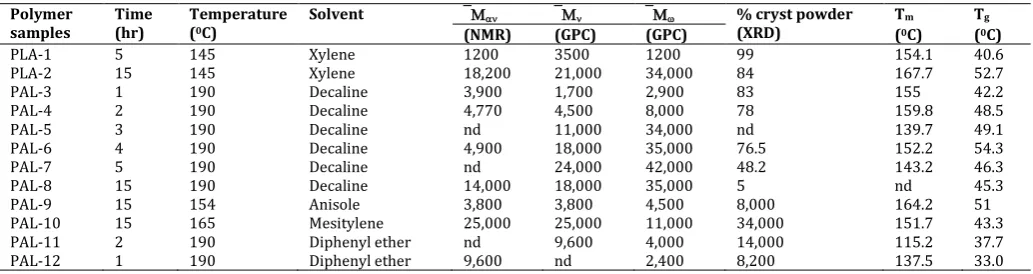
Table 1: The Kinetic and thermodynamic parameters changes and its effects Polymer
samples Time (hr) Temperature (0C) Solvent Μ(NMR) αν Μ(GPC) ν Μ(GPC) ω % cryst powder (XRD) T(0mC) T(0gC)
PLA-1 5 145 Xylene 1200 3500 1200 99 154.1 40.6 PLA-2 15 145 Xylene 18,200 21,000 34,000 84 167.7 52.7 PAL-3 1 190 Decaline 3,900 1,700 2,900 83 155 42.2 PAL-4 2 190 Decaline 4,770 4,500 8,000 78 159.8 48.5 PAL-5 3 190 Decaline nd 11,000 34,000 nd 139.7 49.1 PAL-6 4 190 Decaline 4,900 18,000 35,000 76.5 152.2 54.3 PAL-7 5 190 Decaline nd 24,000 42,000 48.2 143.2 46.3 PAL-8 15 190 Decaline 14,000 18,000 35,000 5 nd 45.3 PAL-9 15 154 Anisole 3,800 3,800 4,500 8,000 164.2 51 PAL-10 15 165 Mesitylene 25,000 25,000 11,000 34,000 151.7 43.3 PAL-11 2 190 Diphenyl ether nd 9,600 4,000 14,000 115.2 37.7 PAL-12 1 190 Diphenyl ether 9,600 nd 2,400 8,200 137.5 33.0
RESULT AND DISCUSSIONS
The prepolymer (PLA-1) was prepared by dehydropolycondensation using xylene as a diluent and tin chloride dehydrate (SnCl2.2H2O) as a
catalyst. With a quartz reactor vessel equipped Dean-Stark-type condenser, 20 gm of 88 % L-LA was azeotropically dehydrated with 40 mL of xylene for 5h at the reflux temperature. Thereafter, the polymerization was carried out at 145 0C for another 5h, where the
concentration of monomer 20gm/40mL and the amount of catalyst was 0.2%. The weight average molecular weight (Mw) was found to
be 3500 PLA-1 and used as starting material for post polymerization. Molecular weight determination:Table 1 shows the effect of catalyst concentration (SnCl2.2H2O) on conversion and molecular weight of PLA.
The polymerization was carried out at 145 0C for 15 h where the
concentration of PLA oligomers was 4g/10mL The catalyst
concentration of SnCl2.2H2O was varied keeping all other parameters
constant.
Table 1 showed the effect of solvents i.e. polar and nonpolar solvents. The solvent decaline at 190 0C showed the high molecular weight Mn
18,000 andMw 35,000 (PLA-8). In presence of diphenyl ether (polar
solvent) in 2 h the molecular weight was obtained Mn 4000 and Mw
14,000. After 2 h polymerization in diphenyl ether gives colored polymer. The solvent mesitylene at 165 0C, showed the molecular
weight Mn 11,000 and Mw 35000 and the PDI was 3.0 and anisole
shows the number average molecular weight 4,500 and weight average molecular weight 8,000 at 155 0C.
The reaction time for PLA-9 to PLA-10 was 15 h. Table 1 shows the effect of time in a solvent (decaline) at very high temperature 190 0C.
44 obtained in case of PLA-7. The molecular weight increased from PLA-3
to PLA-7 and decreased thereafter in PLA-8 due to backbiting reaction. Thermal characterization: Result of thermal characterizations is shown in Table 1. The values of Tg and Tm followed the similar trend like
molecular weight. The maximum values of Tg and Tm are 52.9 and
167.7 0C. Table 1 shows the maximum Tg and Tm valuesare 46.3.0
and 143.2 0C (PLA-7). The glass transition temperature (Tg) of the
polymers varied from 33 to 52.7 0C. The melting temperature (Tm)of
the polymers varied from 115.7 to 167.7 0C. The degree of
crystallinity was calculated from powder XRD, the values are tabulated in Table1, Typically, the degree of crystallinity was found between 83% to 78 % except in case of PLA-3 and PLA-4, which were abnormally low. These could be due to racemization of L-LA to D-LA and its copolymerization.
Stereosequence determination of poly (L-lactic acid) by 13C NMR:
The 13 C spectra of four representatives PLA samples are 1
PLA-2, used, and is also shown in Figure 1 The 13C NMR spectra of the
polymer are shown in Figure 2 to 6. The carbonyl region exhibited several lines, which correspond to hexads resulting addition of enantiomers of L-lactic acid molecule.
In the NMR spectra of PLA, the observed resonance can be assigned to stereosequence combinations in the polymer. The assignments are designated as various combinations of “i” isotactic pairwise relationships (-RR and -SS) and “s” syndiotactic pairwise relationships (-RS and-SR). In the NMR spectra, the diads -RR- and –SS- are indistinguishable and would have identical chemical shifts as–RS- and –SR. For stereosequence sensitivity of length n, there is (n-1) 2 possible
combination of pair wise relationship that can be observed in the NMR spectra. For example there are 22 =4 possible combination
for triads, 23 =8 possible combination for tetrads, and 25= 32
possible combination for hexads and so on. Often, due to either insufficient resolution, overlap of chemical shifts, or probability of stereo sequence formation, not all the possible streosequence combination is observed in the NMR spectra.
In the case of the carbonyl resonance, Kasperczyk8 has reported
hexads stereo sequence assignments for poly (D, L-lactide). The carbonyl resonance in 13C spectrum indicates more than five distinct
peaks. For poly (D, L-lactic acid) only five out of eight possible peaks (stereo sequences) are expected for tetrad sensitivity, seven out of 16 for pentad sensitivity, eleven out of 32 for hexads sensitivity, fifteen out of 64 for heptads sensitivity and twenty three out of 128 possible peaks for octads sensitivity. Hence, there are more than three distinct regions is shown in Figure 1, which imply same as hexad labeled as A, B and C with the low field that peak A and the high field peak C. A is a single peak which corresponds to siiii and also predominantly isotactic (iiiii), which appear in the region from 169.48- 169.58 ppm. The peak B of PLA appeared from 169.22-169.48 ppm, which may be attributed due to (iiisi, iisii+ sisii+ sisis and isiii). The peak of PLA appeared from 199.04-169.20 ppm, which may be attributed due to isisi. The carbonyl resonance of poly (L-lactic acid) implies that the stereosensitivity is greater than pentads and is most likely to be hexads. However, due to larger number peaks observed, many of them with significant overlap, conclusive assignments of the peaks to hexad stereosequences were difficult. The experimental value of carbonyl regions is somewhat closely matched to the theoretical values of hexad sequences.
Table 2: 13C NMR carbonyl assignments of poly (L-lactic acid) prepared from L-lactic acid in xylene
PLA-1 PLA-2
Carbonyls regions (ppm) Observed value Carbonyls regions (ppm) Observed value
169.33 0.034 169.24 0.014
169.57 0.932 169.41 0.023
169.70 0.033 169.57 0.963
nd: not detected
The theoretical values calculated according to Bernoullian pair-addition statistics somewhat slightly closer with experimental values rather than to Bernoullian single-addition statistics. The chemical shifts are concentration-dependent and also configuration-dependent. The patterns of carbonyl groups for lactic acid stereocopolymer (PLA) show similarity with predominantly isotactic PLA.
The area percentage of PLA polymers (PLA-1, PLA-2), which were deconvoluted and calculated quantitatively by using WIN NMR software was shown in Table 2. The stereosequence of PLA-1 is rich in isotactic hexads. The stereosequence of PLA-2 increased the isotactic hexads in comparison with PLA-1. However, in presence of
β-zeolite (PLA-1), the molecular weight increased ten folds but the stereosequences remained as such, the molecular weight increased further (Mw = 34000) and the stereosequence of isotactic hexads
decreased subsequently. There are no patterns for syndiotactic and atactic stereosequences. Some peaks appeared at the lower field, which may be attributed due to some incorporation of syndiotactic groups (s) in the isotactic hexad sequences. The increase in the dehydropolycondensation polymerization reaction time affects the stereosequences of PLA polymer.
It is necessary to derive the equations, which describe such processes. In the studied polymerizations of L-lactic acid is used. It is possible to assume that the probabilities of enantiomers addition to the growing chain terminated with the same enatiomer are equal PLL/LL=PDD/DD = pi, Because PDD/DD+PLL/PDD=1 and PLL/LL+PDD/LL=1, the
probabilities of the enantiomer addition to the growing chain terminated with opposite enantiomers are equal too, e.g. PLL/DD=PDD/LL= P2.
Diads: (i) = p13 + 2.5 p12p2 + 2 p1p22 + 0.5p23 (1)
(s) = 0.5 p12p2+ p1p22+ 0.5p23 (2)
triads: (ii) = p13+ 2p12p2 + p1p22 (3)
(is)= (si) = 0.5 p12p2 + p1p22 + 0.5p23 (4)
tetrads: (iii) = p13 + 1.5p12p2 + 0.5p1p22 (5)
(iis ) = (sii) = 0.5 p12p2 + 0.5p1p22 (6)
(isi) = 0.5p12p2 + p1p22 + 0.5p23 (7)
(sis) = 0.5p1p22 + 0.5p23 (8)
pentads: (iiii) = p13 +p12p2 (9)
(iiis) = (iisi) = (isii) = (siii) = 0.5p12p2 +0.5p1p22 (10)
hexads: (iiiii) = p13 + 0.5p12p2 (11)
(iiiis) = (siiii) = (iisii) = 0.5p12p2 (12)
(iiisi) = (isiii) = 0.5p12p2 + 0.5p1p22 (13)
(iisis) = (siiis) = (sisii) = 0.5 p1p22 (14)
(isisi) = 0.5p1p22+0.5p23 (15)
(sisis) = 0.5p23 (16)
From the equations presented above using intensities of signals in the
13C NMR spectrum, the coefficient probabilities p1 and p2 were
45
ppm
Fig. 1: 13C NMR spectra (500 MHz) around carbonyl (ester), carbonyl (acid) and carbonyl (lactide) areas of PLA oligomers (a) PLA-1 and
(b) PLA- 2
The results suggested a possibility of non Bernoullian statistics and stereoselection during the dehydropolycondensation polymerization of L-lactic acid in presence of tinchloride dihydrate (SnCl2. 2H2O).
Assuming these carbonyl carbon atoms are sensitive to hexad as suggested by Bero et al 9, the three broad bands received the
following assignments (Figure 2 to Figure 4) and (Table 3 and, 4), (band B and A) covering the 169.5-169.7 ppm range included iiiii, iiiis, siiii, siiis, iisis, isiii hexads, (A and B) covering the 169.1-169.2 ppm range corresponded to isisi hexads. ( band B and C) covering the range 169.2-169.4 ppm included iiiss, iisii, sisii, sisis, iisis, isiii hexads.
D,D + L,L (p1 =1, p2 = 0) ...LLLLLL… + ….DDDDD…. isotactic D,D + L,L (p1= p2 = 0.5) …….LLLDDLLLLDDD….
“Predominantly isotactic” D,D + L,L (p1 = 0, P2 = 1) ……LLDDLLDDLLDD…
disyndiotactic
Scheme 4.1
In the 13C NMR spectra of PLA shown in Table 2, the appearance of
169.3 ppm may be attributed due to hexads, the calculated coefficients of probability count to be p1 varies from 0.48-0.58
where as p2 varies from 0.42-0.52. The obtained results are due to
variation of reaction time keeping all other reaction parameter unaltered. This indicates that the preference in incorporation of D and L, L-enantiomers addition to the growing chain and leading to an enhanced contribution of disyndiotactic segments in poly lactic acid molecules.
Effect of reaction time at higher temperature:When the solvent was changed from xylene to decaline, the molecular weight increased from 29,000 to 35,000 at the same polymerization time (15 h) as shown in Table 1. Figure 2 and Table 3 showed the dehydropolycondensation of L-lactic acid prepolymer using decaline as a solvent using at various reaction times. The maximum molecular weights i.e. Mn, Mw and molecular weight distributions
were obtained by GPC measurement. The values of Mn, Mw and PDI
46 was obtained by deconvolution and the calculated value was 0.88
instead of 0.38 for Bernollian pair-addition and A/C parts does not match with Bernoullian pair-addition. The isotactic sequences decreased as the reaction time increased. As the reaction time varied to 1–2 h, the syndiotactic groups were incorporated in isotactic hexads and also some syndiotactic sequences were preferred. The isotactic sequence values were changed from 0.978 to 0.880. The sequence values are also supported by degree of crystallinity measured by XRD, melting point Tm values as shown in Table 1 the
maximum molecular weight (42,000 i.e. PLA-7) as the reaction progresses up to 5 h.
Effect of solvents: Table 4 depicts the dehydropolycondensation of L-lactic acid in presence of β-zeolite at various solvents. When the reaction was carried out in presence of diphenyl ether at 1 h, the isotactic hexad values decreased dramatically in comparison with PLA-11. As the reaction time increased from 1h to 2h, the isotactic hexads decreased further. The effect of solvents (polar and non polar) has played an important role during polymerization process in non polar solvents, the probability of higher isotactic hexad sequences were predominant over polar solvents. The polymerization reactions were further carried out for longer reaction period and found out that color of the polymeric mass changed from brown to dark brown in color. The sequences of these materials have not studied.
The polymerization reaction was carried in anisole (at 154 0C for 15 h
i.e. PLA-9), the isotactic hexad sequence value was reasonably better along with some syndiotactic sequences. Similar polymerization was
carried out in mesitylene (at 165 0C for 15 h, i.e. PLA-10), showed
mostly isotactic hexad addition and absence of syndiotactic and atactic sequences. The results focused that even at low reaction temperature (165 0C and 145 0C), non-polar solvents preferred isotactic addition
than the polar solvents. However, more and more syndiotactic groups incorporated in to the isotactic sequences therefore; there are various kind of isotactic hexads along with syndiotactic hexads. The discrepancies were regarded as evidences for deviation from the pair addition Bernoullian statistics. In this case, the best fit was obtained for pi = 0.72 in agreement with the steroselectivity in favor of isotactic
enchainment of L-lactic acid units were observed.
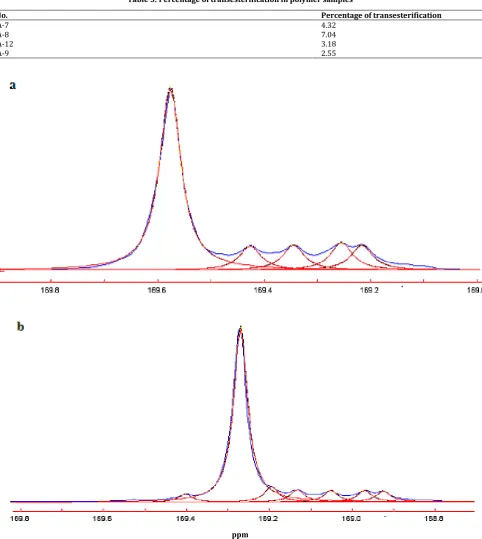
Further, it was observed that transesterification reaction occurred after 5 h reaction time and there was no substantial transesterification below 5 h reaction time even if the reaction temperature was 180 0C. Figure 5 and Table 5 showed the 13C-NMR
spectra of PLA-11 and PLA-12 in presence of diphenyl ether prepared at 190 0C. Transesterification facilitated at faster rate and
results were tabulated in Table 5.
Figure 6 showed the 13C NMR spectra of PLA-9 and PLA-10 at two
different solvents i.e. polar solvent (anisole) and non-polar solvent (mesitylene) using same catalyst and reaction temperature. Transesterification in a polar solvent (anisole) is faster than that of nonpolar solvent (mesitylene).
Table 3: 13 C NMR carbonyl assignments of poly (L-lactic acid) prepared from L-lactic acid in decaline
PLA-3 PLA-4 PLA-5 PLA-6 PLA-7 PLA-8
Carbony ls regions (ppm)
Observe
d value Carbonyls regions (ppm)
Observe
d value Carbonyls regions (ppm)
Observe
d value Carbonyls regions (ppm)
Observe
d value Carbonyls regions (ppm)
Observe
d value Carbonyls regions (ppm)
Observe d value
47
ppm
Fig. 2: 13C NMR spectra (500 MHz) around carbonyl (ester), carbonyl (acid) and carbonyl (lactide) areas of PLA oligomers (a) PLA-3 and
(b) PLA-4
In case of methine resonance, higher degree of overlaps of the peaks made conclusive assignments difficult but hexads stereosensitvity is probable. In some instances, however depending on the experimental condition new lines were found to broaden the fine structure in the methine resonances, whose stereo dependence were in terms of hexads, on the basis of Bero’s assignments.9 The new
lines observed at 69.95 ppm, 68.95 and 68.86 ppm were respectively assigned to iss, sss, ssi tetrads, where one can find successive syndiotactic (‘s”) diads, a feature could not result from the pair addition mechanism only. The theoretically forbidden “SS” sequences reported earlier and ascribed to intermolecular transesterification occurring during the polymerization.10 A
significantly higher level of noise is apparent in the spectrum, and this makes quantification somewhat difficult. The racemization reactions are mostly due to dynamic equilibrium of ester interchange reactions occurring between the polymer chains. During the ester interchange reactions, there are two ways in which the ester linkages between successive lactic acid units can cleave and reform. One is acyl-oxygen cleavage, which does not involve the chiral carbon in question. The other is alkyl-oxygen cleavage, in
which the covalent bond between oxygen and the chiral carbon breaks and subsequently reforms; this results in an inversion of the configuration. The change from L-LA (the L- form) to the D, L form in presence of the catalyst partially through racemization has been observed with DSC and XRD. The strong proton acid assists with the breaking of ester bond through typical carbon-oxygen bond breaking.
The results of PLA-7 and PLA-8 in Table 3 indicate that reaction time increased at same reaction temperature (195 0C), the probability of
alkyl-oxygen cleavage increased, and this resulted in the formation of inverted configuration. PLA-8 showed less probability of alkyl-oxygen bond cleavage in comparison with PLA-10 irrespective of same reaction time (15 h).
48
ppm
Fig. 3: 13C NMR spectra (500 MHz) around carbonyl (ester), carbonyl (acid) and carbonyl (lactide) areas of PLA oligomers (a) PLA-5 and
(b) PLA-6.
ppm
Fig. 4: 13C NMR spectra (500 MHz) around carbonyl (ester), carbonyl (acid) and carbonyl (lactide) areas of PLA oligomers (a) PLA-7 and
49
Table 4: 13 C NMR carbonyls assignments of poly (L-lactic acid) prepared from L-lactic acid using various solvents
PLA-11 PLA-12 PLA-9 PLA-10
Carbonyls
regions (ppm) Observed value Carbonyls regions (ppm) Observed value Carbonyls regions (ppm) Observed value Carbonyls regions (ppm) Observed value
169.21 0.012 169.12 0.087 169..07 0.025 169.24 0.025 169.24 0.198 169.19 0.116 169.12 0.027 169.42 0.046 169.34 0.058 169.22 0.032 169.20 0.028 169.57 0.929 169.42 0.074 169.30 0.067 169.29 0.067 Nd nd 169.57 0.657 169.43 0.661 169.43 0.774 Nd nd
Nd nd 169.56 0.032 169.55 0.076 Nd nd
Nd nd 169.69 0.003 nd Nd Nd nd
Table 5: Percentage of transesterification in polymer samples
S. No. Percentage of transesterification
PLA-7 4.32
PLA-8 7.04
PLA-12 3.18
PLA-9 2.55
ppm
Fig. 5: 13C NMR spectra (500 MHz) around carbonyl (ester), carbonyl (acid) and carbonyl (lactide) areas of PLA oligomers (a) PLA-11 and
50
ppm
Fig. 6: 13C NMR spectra (500 MHz) around carbonyl (ester), carbonyl (acid) and carbonyl (lactide) areas of PLA oligomers (a) PLA-9 and
(b) PLA- 10.
Table 6: Experimental relative intensities of various regions in the C=O 13C pattern of PLA stereocopolymers shown in Figure 4.14 to
Figure 4.18
Polymer samples 169.04-169.2
Observed value (syndiotactic)
169.22-169.48 Observed value (heterotactic)
169.48-169.70 Observed value (isotactic)
PLA-1 Nd 0.034 0.965
PLA-2 Nd 0.037 0.963
PLA-3 Nd 0.022 0.978
PLA-4 0.055 0.037 0.909
PLA-5 0.136 0.151 0.712
PLA-6 0.078 0.159 0.798
PLA-7 0.092 0.132 0.775
PLA-8 0.338 0.661 nd
PLA-9 0.012 0.330 0.657
PLA-10 0.235 0.727 0.032
PLA-11 0.080 0.841 0.076
51
CONCLUSIONS
The carbonyl carbon atoms of L-lactic acid stereo polymers are sensitive to hexads at 125 MHz, when the resolution enhancement techniques were used. It was confirmed that the mechanism of dehydropolycondensation polymerization of L-lactic acid consists primarily addition of repeating units. PLA prepared at various conditions such as using β-zeolite as a desiccant, did not change the stereroesequence. However, we have shown that the configurational structure of the polymers prepared at higher temperature are more complicated because of transesterification and redistribution at the ester bond under the experimental conditions. Other chemical reactions, such as the attack of polymer chain ester bond by active centers, might contribute to the configurational rearrangement and might be configuration dependent too. The more transesterification was observed in polar solvents in comparison to non-polar solvents. Polymer PLA prepared with SnCl2.2H2O exhibits lower transesterification values
in comparison with other reported catalysts in the literature. A stereospecificity favoring long isotactic block was detected. Increasing temperature and reaction time favors transesterification and thus, randomization of stereosequences. The maximum transesterification value was obtained in case of
PLA-8. The structure property relationship of PLA can be tailor-made by choosing different dehydropolycondensation reaction parameters even if using L-lactic acid as starting materials.
REFERENCES
1. Liggat, J. J. PCT Int. Appl. WO 942870 1994.
2. Shymroy, S.; Garnaik, B.; Sivaram, S, Journal of polymer Science Part-A, 2004 (43) 2164-2177.
3. Vert, M.; Sehwarch, G.; Coudane, J. Macromol. Sci. Pure Appl. Chem, 1995 (A32) 787-796.
4. Mitsui Toatsu Chemicals, Inc.; Enomoto, K.; Ajioka, M.; Yamaguchi. A.USP 5310865, 1994.
5. Norio, Y.; Toshikazu, M.; Nobuko, T.; Yoruzu, Y. PCT Int, Appl. WO 9712926, 1997.
6. Enomoto, K.; Ajioka. M.; Yamaguchi, A, USP. 5310,86, 1994. 7. Kim, K.W.; Woo, S. I, Macromol. Chem. Phys, 2002, (203)
2245-2250.
8. Kasperszyk, J.E, Macromolecule1995 (28) 3937-3939. 9. Bero, M.; Kasperszyk, J.E.; Jedlinsky, Z, J. Makromol. Chem,
1990, (191) 22-2308.