Arash Zare Sadeghi1,2, Amir Homayoun Jafari2*, Mohammad Ali Oghabian1,2, Hamid Reza Salighehrad1, Seyed Amir Hossein Batouli2, Samira Raminfard2,3, Hamed Ekhtiari2
Research Paper: Changes in Effective Connectivity Network
Patterns in Drug Abusers, Treated With Different Methods
Introduction: Various treatment methods for drug abusers will result in different success rates. This is partly due to different neural assumptions and partly due to various rate of relapse in abusers because of different circumstances. Investigating the brain activation networks of treated subjects can reveal the hidden mechanisms of the therapeutic methods.
Methods: We studied three groups of subjects: heroin abusers treated with abstinent based therapy (ABT) method, heroin abusers treated with Methadone Maintenance Therapy (MMT) method, and a control group. They were all scanned with functional magnetic resonance imaging (fMRI), using a 6-block task, where each block consisted of the rest-craving-rest-neutral sequence. Using the dynamic causal modeling (DCM) algorithm, brain effective connectivity network (caused
by the drug craving stimulation) was quantified for all groups. In this regard, 4 brain areas were selected for this analysis based on previous findings: ventromedial prefrontal cortex (VMPFC), dorsolateral prefrontal cortex (DLPFC), amygdala, and ventral striatum.
Results: Our results indicated that the control subjects did not show significant brain activations after craving stimulations, but the two other groups showed significant brain activations in all 4 regions. In addition, VMPFC showed higher activations in the ABT group compared to the
MMT group. The effective connectivity network suggested that the control subjects did not have any direct input from drug-related cue indices, while the other two groups showed reactions to
these cues. Also, VMPFC displayed an important role in ABT group. In encountering the craving
pictures, MMT subjects manifest a very simple mechanism compared to other groups.
Conclusion: This study revealed an activation network similar to the emotional and inhibitory control networks observed in drug abusers in previous works. The results of DCM analysis
also support the regulatory role of frontal regions on bottom regions. Furthermore, this study
demonstrates the different effective connectivity patterns after drug abuse treatment and in this
way helps the experts in the field.
A B S T R A C T
Key Words:
Dynamic causal
modeling, Functional
magnetic resonance imaging, Abstinent based therapy, Methadone maintenance therapy Article info: Received: 19 Sep 2016
First Revision: 26 Oct. 2016 Accepted: 10 Feb. 2017
1. Department of Medical Physics and Biomedical Engineering, School of Medicine, Tehran University of Medical Sciences, Tehran, Iran. 2. Department of Nouroimaging and Analysis, Imam Khomeini Hospital Complex, Tehran University of Medical Sciences, Tehran, Iran.
3. Department of Neurosciences and Addiction Studies, School of Advanced Technologies in Medicine, Tehran University of Medical Sciences, Tehran, Iran.
* Corresponding Author:
Amir Homayoun Jafari, PhD
Address: Department of Nouroimaging and Analysis, Imam Khomeini Hospital Complex, Tehran University of Medical Sciences, Tehran, Iran. Tel:+98 (912) 3504106
E-mail: [email protected]
CrossMark
Citation:ZareSadeghi, A., Jafari, A. H., Oghabian, M. A., Salighehrad, H. R., Batouli, S. A. M., Raminfard, S., et al. (2017). Changes in Effective Connectivity Network Patterns in Drug Abusers, Treated With Different Methods. Journal of Basic and Clinical Neuroscience, 8(4), 285-298. https://doi.org/10.18869/NIRP.BCN.8.4.285
:
: https://doi.org/10.18869/NIRP.BCN.8.4.285 Use your device to scan
1. Introduction
he neurocognitive process of drug craving in chronic drug abusers has been studied before and the brain regions involved in this process are well recognized (Wilson, Say-ette, & Fiez, 2004; Sutherland, McHugh, Pariyadath, & Stein, 2012;Tang, Fellows, Small, & Da-gher, 2012; Yalachkov, Kaiser, Naumer, 2012). Previ -ous studies have reported the key role of the amygdala
and prefrontal cortex in the cue-induced craving process (Bechara, Damasio, Damasio, & Lee, 1999). When ex -posed to drug cues, the brain regions, such as ventromedial
prefrontal cortex (VMPFC) (Ben-Shahar, et al. 2013),
dor-solateral prefrontal cortex (DLPFC) (Wilson et al. 2004; George and Koob 2013;Hayashi, Ko, Strafella, & Dagher, 2013;Batista, Klauss, Fregni, Nitsche, & Nakamura-Pa-lacios, 2015), ventral striatum (Naqvi and Bechara 2009), and amygdala (Bechara, Damasio, & Damasio, 2003) dis-play activation in different drug dependents.
The associated brain regions do not act alone but work as parts of hidden networks. The recent studies have tried
to find out and quantify these networks (Chase, Eickhoff, Laird, & Hogarth 2011;Sutherland et al., 2013). The
existing interactions between brain regions (nodes) can be passive or active; the passive type is called functional
connectivity and the active one effective connectivity. Ef-fective connectivity follows the theory of causality (Pearl, 2009). The causality in brain networks has been studied before, but the drug craving networks have been inves-tigated in a few studies (Ray, Haney, Hanson, Biswal, & Hanson, 2015). Based on some studies, chronic drug use can change the pattern of brain activation networks
in drug dependents when exposing to drug cues (Goudri-aan, de Ruiter, Van Den Brink, Oosterl(Goudri-aan, & Veltman 2010;Janes, et al. 2010;Ma, et al, 2011;Lu, et al., 2012; Cisler, et al., 2013;Ding and Lee 2013a;Ding and Lee 2013b;Yang, et al., 2014). Furthermore, the regulatory effect of cortex on subcortical regions has already been
proven, and their interactions follow a causal network pattern (Bechara, et al., 2001).
The causal networks can be quantified using different methods. Some methods address just the existence of the networks, but some other seek deeper to find more de
-tails. Two interesting issues in these networks are first
how regions affect each other and second how they af-fect the relation among the regions. These networks can
be quantified using effective connectivity measurement
methods such as Structural Equation Modeling (SEM)
(McLntosh & Gonzalez-Lima 1994;Buchel, 1997;
As-ity modeling (GCM) (Roebroeck, Formisano, Goebel, 2005;Wang, Chen, Bressler, & Ding. 2007;Sato, et al., 2010), and dynamic causal modeling (DCM).
We hypothesized that the fronto-amygdalar regulation is
complex and not only the prefrontal regions such as VMP
-FC and DLP-FC have reciprocal modulatory effects on the
amygdala, but also they have indirect causal effects. The differences in the effective connectivity networks were investigated between the following three groups in our study: one group included subjects with no history of drug dependence as the control group, one group included sub-jects who were successfully treated drug abuse with Meth-adone Maintenance Therapy (MMT), and the last group included subjects who were successfully treated drug abusers with Abstinence Based Therapy (ABT) method.
2. Methods
The Ethics Committee of Tehran University of Medical Sciences approved the study protocol and consent form. Before scanning, the imaging procedure was described for all subjects and their written informed consents were obtained. After scanning, a counseling procedure was done for each subject to check for any probable adverse effect on the subject’s mental health, after presentation of drug-related cues.
2.1. Participants
Three study groups, each including 20 male subjects, were scanned. One group included subjects (with at least 3 months of opiate abstinence) who were successfully
treated by MMT based method; the second group (with
at least 3 months of opiate abstinence) included subjects
who were successfully treated by ABT based method;
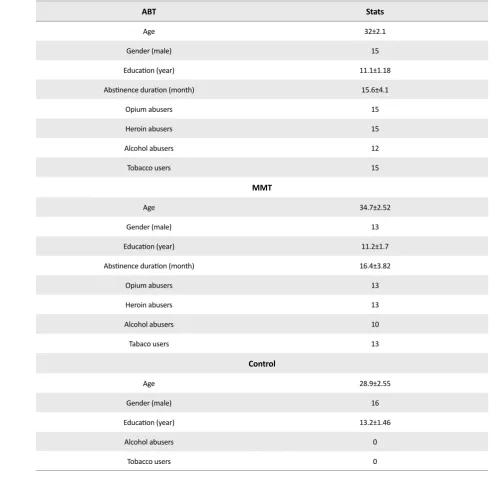
and the third group comprised control subjects age-matched with two other groups, who did not have any history of drug abuse. The demographic characteristics of the three groups are presented in Table 1.
2.2. Functional magnetic resonance imaging task
The task was a block design task containing 6 consecu-tive runs. Each run included one rest block of 24 s length (a cross was shown), one block of 24 s length as neutral (4 images not related to heroin, each for 6 s, were shown to the subject), a second rest block, and a block of 24 s length as craving stimuli (4 images related to heroin, each for 6 s, were shown to the subject). The images (24 heroin-related and 24 neutral) were selected from International Affective
Picture System (Lang, Bradley, & Cuthbert, 2005). The structure of the task is displayed in Figure 1.
2.3. Functional magnetic resonance imaging data acquisition
Functional images were acquired with an Avanto 1.5T
scanner (Siemens, Germany) with 8 channel head coil. The T2*-weighted images were acquired with TR=3000 ms,
TE=50 ms, flip angel=90°, voxel size of 3×3×3 mm3, and matrix size of 64×64. Each volume was composed of 36 slic
-es which covered the whole brain in axial direction. Struc
-tural image was acquired with the following specification: T1-weighted with TR=1910, TE=3.55 ms, flip angel=30°, voxel size of 1×1×1 mm3, and matrix size of 256×256. The
stimuli were presented using MR compatible goggles.
2.4. Preprocessing
FSL5 (Jenkinson, Beckmann, Behrens, Woolrich, Smith, 2012) MCFLIRT (Jenkinson & Smith 2001; Jen-kinson, Bannister, Brady, & Smith, 2002) was used to
correct the EPI images for the head motion. Slice timing
correction was done using interleaved order, high-pass
temporal filtering was done with the size of 96 s to re -move the signal trend, a 3D Gaussian kernel with the size
of 5 mm FWHM was used to smooth the functional im -ages, and for group comparison the intensity normaliza-tion was done as the last part of the preprocessing step.
2.5. Data analysis
The purpose of this study was not to examine the be -tween group differences with regard to regional acti-vations, so we did only within group analyses. Using
FLAME (FMRIB’s Local Analysis of Mixed Effects), we included all 4 possible contrasts; i.e., craving, neu -tral, craving>neu-tral, and neutral>craving. Based on the results, only the craving>neutral contrast supports the idea of stronger activation during watching craving cues vs. watching neutral images.
2.6. Time-series extraction
According to our neuroscientific hypothesis, we chose 4 regions of interests (ROIs): VMPFC, DLPFC, ventral
striatum, and amygdala. These regions have been shown
to be active during a drug craving task. First we made a
mask for each region in MNI space, then using transfor-mation matrices, the masks were resliced and registered
to each subject’s EPI images. These matrices were calcu -lated during registration in preprocessing step
(standar-d2example_func.mat) and applied using the ApplyXFM tool in FSL5. The greatest eigenvariate of the voxels in
each region was used as the time-series of the ROI. The
extraction of eigenvariates from the time series across
the voxels within each ROI was done using a singular
value decomposition (SVD) method (Alter, Brown, Botstein, 2000). We used SPM121 Eigenvariate Tool for
achieving this purpose.
2.7. Dynamic causal modeling
Effective connectivity means the causal interrelation of
the regions in the brain; however, this relation is in the
neuronal level which cannot be measured by fMRI. Dy-namic causal modeling as an established method to quan-tify the effective connectivity includes 4 connectivity ma-trices which display the strength of interconnections. The
first matrix (A) contains the strength of endogenous links;
these are the interrelations of regions in the absence of any
input, the second matrix (B) contains the strength related
to the effects of inputs on the links between regions, the
third matrix (C) contains the direct strength of links of input effects on the regions and the last matrix (D) shows the strength of nonlinear links, which exerts from regions
on the links connecting other regions. The equation which dominates the relation of these matrices is as follows:
z ̇=f(z,u,θ)=Az+{∑ ujB(j)+∑ ziD(i)}z+Cu
j=1 i=1
m n
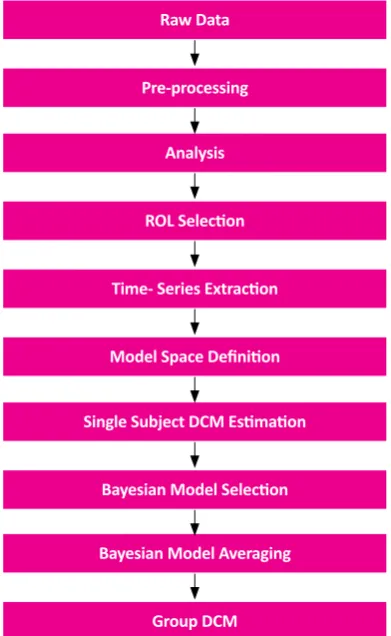
Computing DCM for a group of subjects include some steps, which are shown in the Figure 2. Our model space contained 38 models, which reciprocally connected 4
regions; the craving input emerged to various regions; linear and nonlinear links; and self-inhibitory links. The
diverse models in the model space were used to answer
different neuroscientific questions. Next we estimated all models for each subject to reach the exceedance proba -bility measure for single subject analysis and these mea-sures were used in the Bayesian model selection (BMS)
(Stephan, Penny, Daunizeau, Moran, & Friston, 2009)
process to compare the models. Evidently, comparing single models does not simply provide any useful infor-mation, however, dividing the model space into families with similar features can yield the best result (Penny, et al., 2010). Thus, we divided the models into families
according to their nonlinear links; separating linear and
nonlinear models. Bayesian Model Averaging (BMA)
was used to reach the final model. Also, we used SPM DCM12 Toolbox for computing the DCM network.
3. Results
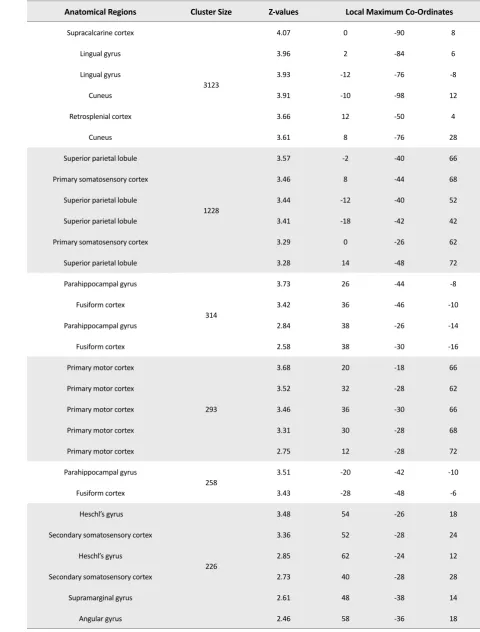
3.1. GLM resultsStatistical analysis of fMRI data of each group was
done using FSL5 and the results indicated activations
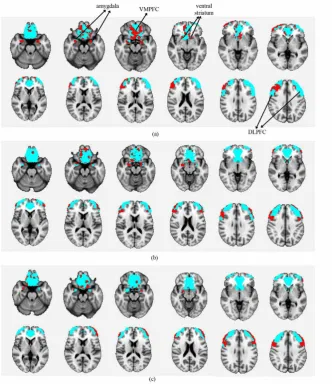
in all regions of interest. Figure 3 depicts the activation
patterns in one of the defined contrasts (craving>neutral)
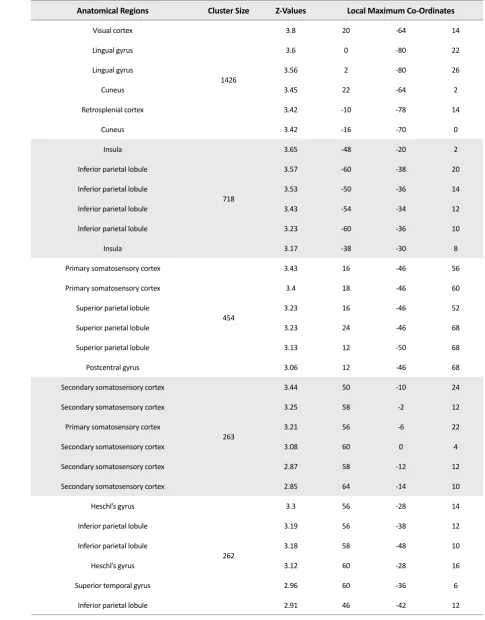
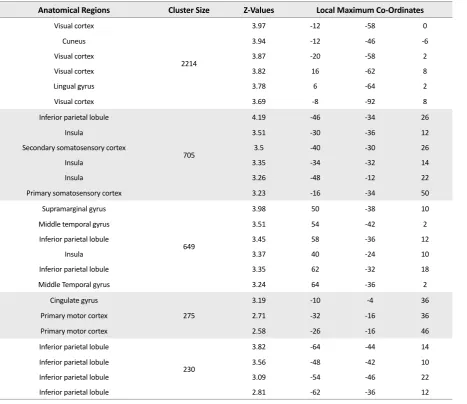
and Tables 2,3, and 4 present the group level results for all study groups (same contrast).
3.2. Dynamic causal modeling results
The time-series of each region was extracted accord -ing to the method introduced in the previous section. The DCM estimation process was done for each model in the
model space and the resulting exceedance probabilities were used in the process of BMS algorithm. Family par
-titioning was done according to the nonlinear links and
using BMA, the final DCM networks for all groups were
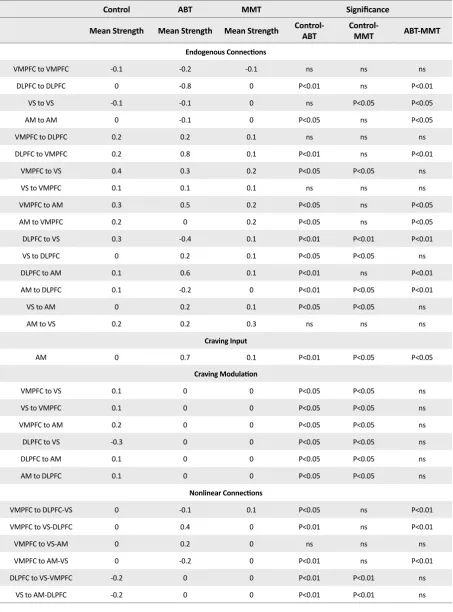
calculated. The BMA results are presented in Table 5. Considering 4 connectivity matrices, this table is divided into 4 sections (highlighted with gray color).
The first section included the endogenous connections or the matrix A, the second section included the matrix B, the third section included matrix C, and the last included matrix D. The first column of the table presents the start
and the end of each connection (for connections which do
not exist in all groups, there are no rows). The next 3 col
-Table 1. The demographic characteristics of the three study groups.
ABT Stats
Age 32±2.1
Gender (male) 15
Education (year) 11.1±1.18
Abstinence duration (month) 15.6±4.1
Opium abusers 15
Heroin abusers 15
Alcohol abusers 12
Tobacco users 15
MMT
Age 34.7±2.52
Gender (male) 13
Education (year) 11.2±1.7
Abstinence duration (month) 16.4±3.82
Opium abusers 13
Heroin abusers 13
Alcohol abusers 10
Tabaco users 13
Control
Age 28.9±2.55
Gender (male) 16
Education (year) 13.2±1.46
Alcohol abusers 0
umns are the mean strength of the named connection for each group. Zero number in the cells represents the lack of that connection in the relevant group. The numbers in these 3 columns represent different meanings with regard
to effective connectivity theory; the change in the vari
-ance of the links starting point will change the vari-ance of the links ending point by the factor of the links mean strength. The sign of the number is directly related to the
correlation of the variance change in two signals; positive
means directly correlated and negative means correlation
Figure 2. The diagram of calculating DCM.
Raw Data
Time- Series Extraction Analysis
Single Subject DCM Estimation
Bayesian Model Averaging Pre-processing
Model Space Definition ROL Selection
Bayesian Model Selection
Group DCM
Figure 1. The task structure. R: represents Rest, C: represents Craving, and N: represents Neutral. There are 6 runs in the task each for 96 seconds.
One run of the task
4×6 Sec 4×6 Sec
Neutral Stimiuli Craving Stimiuli
96s 24s
R N R C R N R C R N R C R N R C
Table 2. The group level activation results in (Craving>Neutral) contrast for ABT group.
Anatomical Regions Cluster Size Z-values Local Maximum Co-Ordinates
Supracalcarine cortex
3123
4.07 0 -90 8
Lingual gyrus 3.96 2 -84 6
Lingual gyrus 3.93 -12 -76 -8
Cuneus 3.91 -10 -98 12
Retrosplenial cortex 3.66 12 -50 4
Cuneus 3.61 8 -76 28
Superior parietal lobule
1228
3.57 -2 -40 66
Primary somatosensory cortex 3.46 8 -44 68
Superior parietal lobule 3.44 -12 -40 52
Superior parietal lobule 3.41 -18 -42 42
Primary somatosensory cortex 3.29 0 -26 62
Superior parietal lobule 3.28 14 -48 72
Parahippocampal gyrus
314
3.73 26 -44 -8
Fusiform cortex 3.42 36 -46 -10
Parahippocampal gyrus 2.84 38 -26 -14
Fusiform cortex 2.58 38 -30 -16
Primary motor cortex
293
3.68 20 -18 66
Primary motor cortex 3.52 32 -28 62
Primary motor cortex 3.46 36 -30 66
Primary motor cortex 3.31 30 -28 68
Primary motor cortex 2.75 12 -28 72
Parahippocampal gyrus
258 3.51 -20 -42 -10
Fusiform cortex 3.43 -28 -48 -6
Heschl’s gyrus
226
3.48 54 -26 18
Secondary somatosensory cortex 3.36 52 -28 24
Heschl’s gyrus 2.85 62 -24 12
Secondary somatosensory cortex 2.73 40 -28 28
Supramarginal gyrus 2.61 48 -38 14
with phase lag of 180°. The last 3 columns of the table present significant statistically meaningful differences
between the groups (top of each column) in that link (the
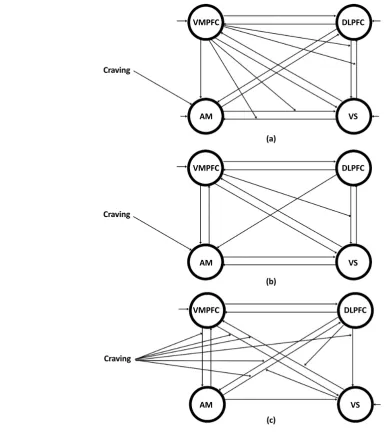
first column). These networks are depicted in Figure 4.
With regard to the effective connectivity network for the control group, the craving input link only modulated the links between the regions, but there was no modu-lation for the other two groups and the input link only
affected the amygdala. In the control group, DLPFC
and amygdala affected ventral striatum but were not
influenced by it. In the ABT group, VMPFC affected amygdala but there was no reverse effect. Finally in the MMT group, the relation from DLPFC to amygdala
was a 1-way connection. Self-inhibitory connections in
the control group were limited to VMPFC and ventral striatum regions. In the MMT group, only VMPFC had
this self-inhibitory effect, while in the ABT group, all re-gions had the self-inhibitory effect. In the control group,
DLPFC affected the connection of ventral striatum to VMPFC, and ventral striatum itself affected the connec
-tion of amygdala to DLPFC. In the ABT group, VMPFC influenced reciprocal connections between DLPFC and
ventral striatum and also the connections between ven-tral striatum and amygdala. In the MMT group, the
non-linear link was from VMPFC to the link from DLPFC to
ventral striatum.
4. Discussion
There are studies addressing the results of various treat-ment methods on drug abusers, but there is no conclusive evidence for superiority of any treatment method over oth-ers (Wang, et al., 2011). In addition, studies have shown Figure 3. Depicting the region-based activation analysis results for three study groups; (a) ABT, (b) MMT, and (c) Control. The blue regions are the ROIs in which the activations were investigated and the red regions are the active parts during the task
Table 3. The group level activation results in (Craving>Neutral) contrast for MMT group.
Anatomical Regions Cluster Size Z-Values Local Maximum Co-Ordinates
Visual cortex
1426
3.8 20 -64 14
Lingual gyrus 3.6 0 -80 22
Lingual gyrus 3.56 2 -80 26
Cuneus 3.45 22 -64 2
Retrosplenial cortex 3.42 -10 -78 14
Cuneus 3.42 -16 -70 0
Insula
718
3.65 -48 -20 2
Inferior parietal lobule 3.57 -60 -38 20
Inferior parietal lobule 3.53 -50 -36 14
Inferior parietal lobule 3.43 -54 -34 12
Inferior parietal lobule 3.23 -60 -36 10
Insula 3.17 -38 -30 8
Primary somatosensory cortex
454
3.43 16 -46 56
Primary somatosensory cortex 3.4 18 -46 60
Superior parietal lobule 3.23 16 -46 52
Superior parietal lobule 3.23 24 -46 68
Superior parietal lobule 3.13 12 -50 68
Postcentral gyrus 3.06 12 -46 68
Secondary somatosensory cortex
263
3.44 50 -10 24
Secondary somatosensory cortex 3.25 58 -2 12
Primary somatosensory cortex 3.21 56 -6 22
Secondary somatosensory cortex 3.08 60 0 4
Secondary somatosensory cortex 2.87 58 -12 12
Secondary somatosensory cortex 2.85 64 -14 10
Heschl’s gyrus
262
3.3 56 -28 14
Inferior parietal lobule 3.19 56 -38 12
Inferior parietal lobule 3.18 58 -48 10
Heschl’s gyrus 3.12 60 -28 16
Superior temporal gyrus 2.96 60 -36 6
different brain activation patterns for treated subjects, how-ever, currently there is no direct study of brain effective connectivity differences between variously treated sub-jects. The effective connectivity estimation can measure the regulatory effects of regions and craving cues on the different parts of the brain network and helps in better un-derstanding of the craving mechanism (Kober, et al., 2010).
We investigated the effective connectivity network in 3 groups. Two groups included successfully treated
drug abusers, with different treatment methods; one with
MMT and the other with ABT. The third group included individuals with no history of drug abuse. The results of the last group helped us provide a basic network for brain effective connectivity pattern, when no prior bias
exist. The networks were estimated between 4 regions
of interest which were mentioned in previous studies.
Studies have indicated that cue exposure increases crav -ing and results in more activities in these regions. These regions are also associated with emotion.
The implication of prefrontal regions in cognitive con-trol (Wrase, et al., 2007;de Greck, et al., 2009) and its
reg-ulatory effect on emotion specific regions like amygdala
and ventral striatum have been already proven (Franklin, et al., 2007; Meda et al., 2009). The resulted networks showed the active role of these regions in the network and by using DCM, the difference of the networks between these 3 groups were depicted numerically and structurally.
4.1. The craving input effect
The differences between the control group and two treated groups indicated that the cue-induced pictures did Table 4. The group level activation results in (Craving>Neutral) contrast for the control group.
Anatomical Regions Cluster Size Z-Values Local Maximum Co-Ordinates Visual cortex
2214
3.97 -12 -58 0
Cuneus 3.94 -12 -46 -6
Visual cortex 3.87 -20 -58 2
Visual cortex 3.82 16 -62 8
Lingual gyrus 3.78 6 -64 2
Visual cortex 3.69 -8 -92 8
Inferior parietal lobule
705
4.19 -46 -34 26
Insula 3.51 -30 -36 12
Secondary somatosensory cortex 3.5 -40 -30 26
Insula 3.35 -34 -32 14
Insula 3.26 -48 -12 22
Primary somatosensory cortex 3.23 -16 -34 50
Supramarginal gyrus
649
3.98 50 -38 10
Middle temporal gyrus 3.51 54 -42 2
Inferior parietal lobule 3.45 58 -36 12
Insula 3.37 40 -24 10
Inferior parietal lobule 3.35 62 -32 18
Middle Temporal gyrus 3.24 64 -36 2
Cingulate gyrus
275
3.19 -10 -4 36
Primary motor cortex 2.71 -32 -16 36
Primary motor cortex 2.58 -26 -16 46
Inferior parietal lobule
230
3.82 -64 -44 14
Inferior parietal lobule 3.56 -48 -42 10
Inferior parietal lobule 3.09 -54 -46 22
not affect the emotion of healthy subjects, but affected amygdala, causing emotional indices in the other groups. To the healthy subjects, these pictures seem as neutral pictures and only modulate some of the links in the
net-work (as perturbations for the task). This finding is in
accordance with previous studies which mentioned the role of amygdala in cue-induced tasks in subjects with a history of drug abuse (Bechara, et al., 1999; Bechara, et al., 2003; Goudriaan, et al., 2010;Chase, et al., 2011; Tang et al., 2012;Ray, et al., 2015).
4.2. The modulatory effect of ventromedial pre-frontal cortex
Studies have already proven the role of prefrontal-stri-atal pathway in the control of craving to drug use (Koob, 2001;Volkow, Fowler, Wang, 2003;Everitt & Robbins, 2005). The lack of control over drug taking is considered
a sign of addiction and is critical in relapse. Frontal brain
regions have an important role in inhibitory control of
this behavior. It has been shown that VMPFC has modu -latory effects on other regions, including amygdale and ventral striatum in the cue-induced craving tasks
(Becha-Figure 4. The DCM network structure for three groups; (a) the final network for ABT group, (b) The final network for MMT group, and (c) The final network for the control group.
Craving Craving
VMPFC
VMPFC
VMPFC AM
AM
AM
DLPFC
DLPFC
DLPFC VS
(a)
(b)
(c)
VS
Table 5. The BMA results. The links with zero strength in the table were not significant in their own groups. The last three columns of the table compare between groups with the P-values used in the test. In these columns “ns” means not significant.
Control ABT MMT Significance
Mean Strength Mean Strength Mean Strength Control-ABT Control-MMT ABT-MMT
Endogenous Connections
VMPFC to VMPFC -0.1 -0.2 -0.1 ns ns ns
DLPFC to DLPFC 0 -0.8 0 P<0.01 ns P<0.01
VS to VS -0.1 -0.1 0 ns P<0.05 P<0.05
AM to AM 0 -0.1 0 P<0.05 ns P<0.05
VMPFC to DLPFC 0.2 0.2 0.1 ns ns ns
DLPFC to VMPFC 0.2 0.8 0.1 P<0.01 ns P<0.01
VMPFC to VS 0.4 0.3 0.2 P<0.05 P<0.05 ns
VS to VMPFC 0.1 0.1 0.1 ns ns ns
VMPFC to AM 0.3 0.5 0.2 P<0.05 ns P<0.05
AM to VMPFC 0.2 0 0.2 P<0.05 ns P<0.05
DLPFC to VS 0.3 -0.4 0.1 P<0.01 P<0.01 P<0.01
VS to DLPFC 0 0.2 0.1 P<0.05 P<0.05 ns
DLPFC to AM 0.1 0.6 0.1 P<0.01 ns P<0.01
AM to DLPFC 0.1 -0.2 0 P<0.01 P<0.05 P<0.01
VS to AM 0 0.2 0.1 P<0.05 P<0.05 ns
AM to VS 0.2 0.2 0.3 ns ns ns
Craving Input
AM 0 0.7 0.1 P<0.01 P<0.05 P<0.05
Craving Modulation
VMPFC to VS 0.1 0 0 P<0.05 P<0.05 ns
VS to VMPFC 0.1 0 0 P<0.05 P<0.05 ns
VMPFC to AM 0.2 0 0 P<0.05 P<0.05 ns
DLPFC to VS -0.3 0 0 P<0.05 P<0.05 ns
DLPFC to AM 0.1 0 0 P<0.05 P<0.05 ns
AM to DLPFC 0.1 0 0 P<0.05 P<0.05 ns
Nonlinear Connections
VMPFC to DLPFC-VS 0 -0.1 0.1 P<0.05 ns P<0.01
VMPFC to VS-DLPFC 0 0.4 0 P<0.01 ns P<0.01
VMPFC to VS-AM 0 0.2 0 ns ns ns
VMPFC to AM-VS 0 -0.2 0 P<0.01 ns P<0.01
DLPFC to VS-VMPFC -0.2 0 0 P<0.01 P<0.01 ns
ra, et al., 1999; Bechara 2005; Lu, et al., 2012; Sladky, et al., 2013). In our study by considering the modulatory
effect of VMPFC on other interregional connections, it
was revealed that in healthy subjects there was no mod-ulatory effects, as they did not have any emotional
re-sponses to craving specific pictures.
However, the VMPFC modulatory effects in ABT group
indicate the important role of this region in drug resistance among these subjects. This group are trained to resist drug
taking and the results reveal that the VMPFC acts as a part
of top neural system, which tries to control the emotional
decisions. This finding is in accordance with the findings
of prior studies on the regulation of negative emotions
(Ochsner & Gross, 2008) and positive emotions (Kim and Hamann, 2007; Delgado, Gillis, Phelps, 2008). They reported the activation of these prefrontal systems and suggested the role of cognition to regulate responses to
affective cues; for example drug cues. In the MMT group, we did not expect to observe any modulatory effect as
the subjects took a dose of methadone and they would seem to have normal behavior when encountering
cue-induced images. The only modulatory effect of VMPFC in this group was observed in the DLPFC-ventral striatum
link, which was not statistically different from the control group who did not have this link (in the control group this
link was not statistically significant).
The importance of DLPFC as a part of prefrontal corti -cal area has been highlighted in previous addictive-cue studies (Goldstein & Volkow, 2002;Wilson et al., 2004; Goldstein, et al., 2007;Volkow, Fowler, Wang, Baler, & Telang, 2009). The neural activity of DLPFC may be
modulated by sensory information, motivational state, and task contingencies (Miller, 2000). In our study, DLP
-FC exhibited an important role in regulatory processing
of cognitive and motivationally relevant information.
In this study, we identified 3 effective connectivity net
-works for 3 different groups, with various structures and links strength. These results can prove the different ef-fects of treatment methods and their underlying
neuro-nal mechanisms. The vast modulatory effect of VMPFC
occur only in ABT group. This effect can prove the in-hibitory role of this brain region in drug craving and also indicate the successful treatment of the subjects in this group, as the main target of this treatment is to train the patients to control their craving. The modulatory effect of
VMPFC in MMT group, in contrast with the other treat
-ment group, is a single effect which can exist because of
the anatomical connections between these regions.
In the control group, the input data did not directly af-fect the regions and only modulates the links. In this net-work, input is on when the craving images are shown and is off in other situations. Thus, the input can be in-terpreted as watching craving-related images and this
exclusive modulatory effect can be the result of subjects’
inattentiveness to these cues. These results cannot prove the superiority of one method over another but at least may help choose the best method for different subjects in various situations.
Acknowledgements
The present paper was extracted from the PhD thesis of the first author in the Department of Medical Physics
and Biomedical Engineering, School of Medicine, Teh-ran University of Medical Sciences.
Conflict of Interest
The authors declared no conflicts of interest.
References
Alter, O., Brown, P. O., & Botstein, D. (2000). Singular value decomposition for genome-wide expression data processing
and modeling. Proceedings of the National Academy of Sciences,
97(18), 10101–6. doi: 10.1073/pnas.97.18.10101
Astolfi, L., Cincotti, F., Mattia, D., Salinari, S., Babiloni, C.,
Basilisco, A., et al. (2004). Estimation of the effective and func-tional human cortical connectivity with structural equation modeling and directed transfer function applied to
high-res-olution EEG. Magnetic Resonance Imaging, 22(10), 1457–70. doi:
10.1016/j.mri.2004.10.006
Batista, E. K., Klauss, J., Fregni, F., Nitsche, M. A., &
Nakamura-Palacios, E. M. (2015). A randomized placebo-controlled trial of targeted prefrontal cortex modulation with bilateral tdcs
in patients with crack-cocaine dependence. International
Jour-nal of Neuropsychopharmacology, 18(12), 66. doi: 10.1093/ijnp/
pyv066
Bechara, A. (2005). Decision making, impulse control and loss of
willpower to resist drugs: A neurocognitive perspective.
Na-ture Neuroscience, 8(11), 1458–63. doi: 10.1038/nn1584
Bechara, A., Damasio, H., & Damasio, A. R. (2003). Role of the
amygdala in decision-making. Annals of the New York
Acad-emy of Sciences, 985(1), 356–9. doi: 10.1111/j.1749-6632.2003.
tb07094.x
Bechara, A., Damasio, H., Damasio, A. R. & Lee, G. P. (1999).
Different contributions of the human amygdala and
ventro-medial prefrontal cortex to decision-making. Journal of
Bechara, A., Dolan, S., Denburg, N., Hindes, A., Anderson, S.
W., & Nathan P. E. (2001). Decision-making deficits, linked to
a dysfunctional ventromedial prefrontal cortex, revealed in
alcohol and stimulant abusers. Neuropsychologia, 39(4), 376-89.
PMID: 11164876
Ben-Shahar, O., Sacramento, A. D., Miller, B. W., Webb, S. M.,
Wroten, M. G., Silva, H. E., et al. (2013). Deficits in ventrome -dial prefrontal cortex group 1 metabotropic glutamate recep-tor function mediate resistance to extinction during protracted withdrawal from an extensive history of cocaine
self-admin-istration. Journal of Neuroscience, 33(2), 495–506. doi: 10.1523/
jneurosci.3710-12.2013
Buchel, C. (1997). Modulation of connectivity in visual pathways by attention: cortical interactions evaluated with structural
equation modelling and fMRI. Cerebral Cortex, 7(8), 768–78.
doi: 10.1093/cercor/7.8.768
Chase, H. W., Eickhoff, S. B., Laird, A. R., & Hogarth, L. (2011).
The neural basis of drug stimulus processing and craving: An
activation likelihood estimation meta-analysis. Biological
Psy-chiatry, 70(8), 785-93. doi: 10.1016/j.biopsych.2011.05.025
Cisler, J. M., Elton, A., Kennedy, A. P., Young, J., Smitherman, S., Andrew James, G., et al. (2013). Altered functional connectiv-ity of the insular cortex across prefrontal networks in cocaine
addiction. Psychiatry Research: Neuroimaging, 213(1), 39–46.
doi: 10.1016/j.pscychresns.2013.02.007
de Greck, M., Supady, A., Thiemann, R., Tempelmann, C.,
Bogerts, B., Forschner, L., et al. (2009). Decreased neural activ -ity in reward circuitry during personal reference in abstinent
alcoholics-A fMRI study. Human Brain Mapping, 30(5), 1691–
1704. doi: 10.1002/hbm.20634
Delgado, M. R., Gillis, M. M., & Phelps, E. A. (2008). Regulating
the expectation of reward via cognitive strategies. Nature
Neu-roscience, 11(8), 880–1. doi: 10.1038/nn.2141
Ding, X., & Lee, S. W. (2013a). Changes of functional and ef -fective connectivity in smoking replenishment on deprived
heavy smokers: a resting-state fMRI study. PLoS ONE, 8(3),
59331. doi: 10.1371/journal.pone.0059331
Ding, X., & Lee, S. W. (2013b). Cocaine addiction related repro -ducible brain regions of abnormal default-mode network functional connectivity: A group ICA study with different
model orders. Neuroscience Letters, 548, 110–4. doi: 10.1016/j.
neulet.2013.05.029
Everitt, B. J., & Robbins, T. W. (2005). Neural systems of rein-forcement for drug addiction: from actions to habits to
com-pulsion. Nature Neuroscience, 8(11), 1481–9. doi: 10.1038/
nn1579
Franklin, T. R., wang, Z., Wang, J., Sciortino, N., Harper, D., Li, Y., et al. (2007). Limbic activation to cigarette smoking
cues independent of nicotine withdrawal: A perfusion fMRI
study. Neuropsychopharmacology, 32(11), 2301–9. doi: 10.1038/
sj.npp.1301371
George, O., & Koob, G. F. (2013). Control of craving by the pre
-frontal cortex. Proceedings of the National Academy of Sciences,
110(11), 4165–6. doi: 10.1073/pnas.1301245110
Goldstein, R. Z., Tomasi, D., Rajaram, S., Cottone, L. A., Zhang, L., Maloney, T., et al. (2007). Role of the anterior cingulate and
medial orbitofrontal cortex in processing drug cues in cocaine
addiction. Neuroscience 144(4): 1153-9.
Goldstein, R. Z., & Volkow, N. D. (2002). Drug Addiction and Its
Underlying Neurobiological Basis: Neuroimaging Evidence
for the Involvement of the Frontal Cortex. American Journal of
Psychiatry, 159(10), 1642–52. doi: 10.1176/appi.ajp.159.10.1642
Goudriaan, A. E., De Ruiter, M. B., Van Den Brink, W., Oost
-erlaan, J., & Veltman, D. J. (2010). Brain activation patterns
associated with cue reactivity and craving in abstinent prob-lem gamblers, heavy smokers and healthy controls: an fMRI
study. Addiction Biology, 15(4), 491–503. doi:
10.1111/j.1369-1600.2010.00242.x
Hayashi, T., Ko, J. H., Strafella, A. P., & Dagher, A. (2013). Dorsolateral prefrontal and orbitofrontal cortex interactions
during self-control of cigarette craving. Proceedings of the
National Academy of Sciences, 110(11), 4422–7. doi: 10.1073/
pnas.1212185110
Janes, A. C., Pizzagalli, D. A., Richardt, S., Frederick, B. deB.,
Chuzi, S., Pachas, G., et al. (2010). Brain reactivity to smok-ing cues prior to smoksmok-ing cessation predicts ability to
main-tain tobacco abstinence. Biological Psychiatry, 67(8), 722–9. doi:
10.1016/j.biopsych.2009.12.034
Jenkinson, M., Bannister, P., Brady, M., & Smith, S. (2002). Im-proved optimization for the robust and accurate linear
reg-istration and motion correction of brain images. NeuroImage,
17(2), 825–41. doi: 10.1006/nimg.2002.1132
Jenkinson, M., Beckmann, C. F., Behrens, T. E. J., Woolrich, M. W., & Smith, S. M. (2012). FSL. NeuroImage, 62(2), 782–790. doi: 10.1016/j.neuroimage.2011.09.015
Jenkinson, M., & Smith, S. (2001). A global optimisation method
for robust affine registration of brain images. Medical Image
Analysis, 5(2), 143–56. doi: 10.1016/s1361-8415(01)00036-6
Kim, S. H., & Hamann, S. (2007). Neural correlates of positive
and negative emotion regulation. Journal of Cognitive
Neurosci-ence, 19(5), 776–98. doi: 10.1162/jocn.2007.19.5.776
Kober, H., Mende-Siedlecki, P., Kross, E. F., Weber, J., Mischel, W., Hart, C. L., et al. (2010). Prefrontal-striatal pathway un
-derlies cognitive regulation of craving. Proceedings of the
Na-tional Academy of Sciences, 107(33), 14811–16. doi: 10.1073/
pnas.1007779107
Koob, G. (2001). Drug addiction, dysregulation of reward,
and allostasis. Neuropsychopharmacology, 24(2), 97–129. doi:
10.1016/s0893-133x(00)00195-0
Laird, A. R., Robbins, J. M., Li, K., Price, L. R., Cykowski, M. D.,
Narayana, S., et al. (2008). Modeling motor connectivity
us-ing TMS/PET and structural equation modelus-ing. NeuroImage,
41(2), 424–36. doi: 10.1016/j.neuroimage.2008.01.065
Lang, P. J., Bradley, M. M., & Cuthbert,B. N. (2005). International Affective Picture System (IAPS): Affective ratings of pictures and
instruction manual. Gainesville: Center for the Study of
Emo-tion & AttenEmo-tion.
Lu, Q., Li, H., Luo, G., Wang, Y., Tang, H., Han, L., & Yao, Z.
(2012). Impaired prefrontal–amygdala effective connectivity is responsible for the dysfunction of emotion process in ma-jor depressive disorder: A dynamic causal modeling study on
MEG. Neuroscience Letters, 523(2), 125–30. doi:
10.1016/j.neu-let.2012.06.058
Ma, N., Liu, Y., Fu, X. M., Li, N., Wang, C. X., Zhang, H., et al.
con-nectivity in drug addicts. PLoS ONE, 6(1), 16560. doi: 10.1371/ journal.pone.0016560
McLntosh, A. R., & Gonzalez-Lima, F. (1994). Structural equa -tion modeling and its applica-tion to network analysis in
func-tional brain imaging. Human Brain Mapping, 2(1-2), 2–22. doi:
10.1002/hbm.460020104
Meda, S. A., Calhoun, V. D., Astur, R. S., Turner, B. M., Ruopp,
K., & Pearlson, G. D. (2009). Alcohol dose effects on brain
cir-cuits during simulated driving: An fMRI study. Human Brain
Mapping, 30(4), 1257–70. doi: 10.1002/hbm.20591
Miller, E. K. (2000). The prefrontal cortex and cognitive control.
Nature Reviews Neuroscience, 1(1), 59–65. doi: 10.1038/35036228
Naqvi, N. H., & Bechara, A. (2009). The hidden island of
ad-diction: the insula. Trends in Neurosciences, 32(1), 56–67. doi:
10.1016/j.tins.2008.09.009
Ochsner, K. N., & Gross, J. J. (2008). Cognitive Emotion
Regu-lation. Current Directions in Psychological Science, 17(2), 153–8.
doi: 10.1111/j.1467-8721.2008.00566.x
Pearl, J. (2009). Causality: Models, reasoning and inference.
Cam-bridge: Cambridge University Press.
Penny, W. D., Stephan, K. E., Daunizeau, J., Rosa, M. J., Fris
-ton, K. J., Schofield, T. M., et al. (2010). Comparing Families
of Dynamic Causal Models. PLoS Computational Biology, 6(3),
1000709. doi:10.1371/journal.pcbi.1000709
Ray, S., Haney, M., Hanson, C., Biswal, B., & Hanson, S. J. (2015). Modeling causal relationship between brain regions within the drug-cue processing network in chronic cocaine
smok-ers. Neuropsychopharmacology, 40(13), 2960–8. doi: 10.1038/
npp.2015.150
Roebroeck, A., Formisano, E., & Goebel, R. (2005). Mapping directed influence over the brain using Granger causality
and fMRI. NeuroImage, 25(1), 230–42. doi:
10.1016/j.neuroim-age.2004.11.017
Sato, J. R., Fujita, A., Cardoso, E. F., Thomaz, C. E., Brammer, M.
J., & Amaro, E. (2010). Analyzing the connectivity between re-gions of interest: An approach based on cluster Granger
cau-sality for fMRI data analysis. NeuroImage, 52(4), 1444–55. doi:
10.1016/j.neuroimage.2010.05.022
Sladky, R., Höflich, A., Küblböck, M., Kraus, C., Baldinger, P.,
Moser, E., et al. (2013). Disrupted effective connectivity be-tween the amygdala and orbitofrontal cortex in social anxiety disorder during emotion discrimination revealed by dynamic
causal modeling for fMRI. Cerebral Cortex, 25(4), 895–903. doi:
10.1093/cercor/bht279
Stephan, K. E., Penny, W. D., Daunizeau, J., Moran, R. J., &
Friston, K. J. (2009). Bayesian model selection for group
studies. NeuroImage, 46(4), 1004–17. doi:
10.1016/j.neuroim-age.2009.03.025
Sutherland, M. T., Carroll, A. J., Salmeron, B. J., Ross, T. J., Hong,
L. E., & Stein, E. A. (2013). Down-regulation of amygdala and
insula functional circuits by varenicline and nicotine in
ab-stinent cigarette smokers. Biological Psychiatry, 74(7), 538–46.
doi:10.1016/j.biopsych.2013.01.03.
Sutherland, M. T., McHugh, M. J., Pariyadath, V., & Stein, E. A. (2012). Resting state functional connectivity in addiction: Les
-sons learned and a road ahead. NeuroImage, 62(4), 2281–95.
Tang, D. W., Fellows, L. K., Small, D. M., & Dagher, A. (2012). Food and drug cues activate similar brain regions: A
meta-analysis of functional MRI studies. Physiology & Behavior,
106(3), 317–24. doi: 10.1016/j.physbeh.2012.03.009
Volkow, N. D., Fowler, J. S., & Wang, G.-J. (2003). The addicted
human brain: Insights from imaging studies. Journal of Clinical
Investigation, 111(10), 1444–51. doi: 10.1172/jci200318533
Volkow, N. D., Fowler, J. S., Wang, G. J., Baler, R., & Telang, F. (2009). Imaging dopamine’s role in drug abuse and addic
-tion. Neuropharmacology 56(Suppl 1), 3-8.
10.1016/j.neurop-harm.2008.05.022
Wang, W., Q. Li, Y. Wang, J. Tian, W. Yang, W. Li, W. et al.
(2011). Brain fMRI and craving response to heroin-related cues in patients on methadone maintenance treatment.
American Journal of Drug and Alcohol Abuse, 37(2), 123-30. doi:
10.3109/00952990.2010.543997
Wang, X., Chen, Y., Bressler, S. L., & Ding, M. (2007). Granger
causality between multiple interdependent
neurobiologi-cal time series: blockwise versus pairwise methods.
Inter-national Journal of Neural Systems, 17(2), 71–8. doi: 10.1142/
s0129065707000944
Wilson, S. J., Sayette, M. A., & Fiez, J. A. (2004). Prefrontal re
-sponses to drug cues: a neurocognitive analysis. Nature
Neuro-science, 7(3), 211–4. doi: 10.1038/nn1200
Wrase, J., Schlagenhauf, F., Kienast, T., Wüstenberg, T., Berm
-pohl, F., Kahnt, T., et al. (2007). Dysfunction of reward processing correlates with alcohol craving in detoxified al
-coholics. NeuroImage, 35(2), 787–94. doi:
10.1016/j.neuroim-age.2006.11.043
Yalachkov, Y., Kaiser, J., & Naumer, M. J. (2012). Functional
neuroimaging studies in addiction: Multisensory drug stimuli
and neural cue reactivity. Neuroscience & Biobehavioral Reviews,
36(2), 825–35. doi: 10.1016/j.neubiorev.2011.12.004
Yang, W., Wang, F., Zhang, Z., Ren, X., Zhang, Z., Li, Y. & Sun,T.
(2014). [Altered effective connectivity of insula in nicotine
ad-diction (Chinese)]. Journal of the Chinese Medical Association,