COMET status and plans
DzmitryShoukavy∗
on behalf of the COMET collaboration
1B.I. Stepanov Institute of Physics, National Academy of Sciences of Belarus,
68 Niezaliežnasci pr., 220072 Minsk, Belarus
Abstract. Lepton Flavour Violation in the charged lepton sector (CLFV) is forbidden in the Standard Model. Therefore, the observation of CLFV process would be clear evidence of physics beyond the Standard Model. The COMET (COherent Muon to Electron Transitions) experiment will measure one of these processes: µN → eN at the Japan Proton Accelerator Research Complex in Tokai, Japan. The COMET experiment will be carried out using a two-staged approach. Phase-I of the experiment is aiming at a signal sensitivity of 3.1× 10⁻¹⁵. Phase-II will use much more intense beam and a more complex transport
system to achieve a single-event sensitivity of 3×10⁻¹⁷. The article gives an
overview of construction and status of the COMET experiment.
1 Introduction
In spite of all the successes of the Standard Model (SM) related to discovery of a Higgs boson at the LHC [1],[2] it is unlikely to be the final theory of fundamental particles and their interactions that could be applicable at all energy scales. Within the framework of the SM still leaves many unanswered questions, notably: there is not any promising dark-matter candidate, no explanation for the observed matter antimatter asymmetry in the Universe, SM does not explain gravity and neutrino masses. These facts demand physics beyond the Standard Model (BSM).
The SM Lagrangian is invariant under a globalU(1)e×U(1)µ×U(1)τlepton field rotation
this leads to massless neutrinos, and all lepton numbers are conserved. On other hand, lepton flavor violation (LFV) in the neutrino sector has been experimentally confirmed with the discovery of neutrino oscillations [3]. The observation of neutrino oscillations imply that neutrinos are massive, and that neutral lepton flavours are not conserved. This fact gives prerequisites for the possibility of charged lepton flavour violation (CLFV).
It should be emphasized that the phenomenon of neutrino oscillations can be explained within the framework of the SM, making its minor modification by entering the mass of the neutrino. However, in this case CLFV processes are extremely suppressed due to the small neutrino mass (Br<10−54). So, if CLFV processes is observed at any higher rate, it will be
clear evidence of BSM physics. It should be noted that BSM scenarios typically give CLFV rate much higher than SM.
This article is dedicated to to the COMET (COherent Muon to Electron Transition) ex-periment [4] – new high-precision exex-periment for searching of CLFV process through the
coherent neutrinoless conversion of a muon to an electron (µ-e conversion) in the field of an aluminium nucleus, with a single event sensitivity of 3×10⁻¹⁷. This is a factor of 104better than the current limit from SINDRUM-II at PSI [5].
2
µ
−
e
conversion and background events
2.1 Event signature
When a negative muon is stopped by some material, it is trapped by an atom, and a muonic atom is formed. After it cascades down energy levels in the muonic atom, the muon is bound in its 1sground state. Within the framework of the SM the following processes are possible: muon decay in orbitµ− → e−νµν¯e or nuclear muon captureµ−N(A,Z) → νµN(A,Z −1).
However, many BSM scenarios can lead to neutrinoless muon capture
µ−N(A,Z)→e−N(A,Z).
This is so called a coherent neutrinoless conversion of muons to electrons. This process violates the conservation of individual lepton flavoursLeandLµ by one unit, but the total
lepton numberL=Le+Lµ+Lτis conserved. The energy of the signal electronEµeis given
by:
Eµe=mµ−Bµ−Erecoil, (1)
wheremµis the muon mass,Bµis the binding energy of the 1s-state muonic atom,Erecoilis
the nuclear recoil energy. SinceErecoilmµ,Eµedepends on the material in which the muon
stops, for example, Eµeis 104.97 MeV for aluminium and Eµe is 94.9 MeV for lead. The
COMET experiment will use an aluminium stopping target. Theµ−econversion is a very attractive process with an experimental point view. Firstly, the energy of the signal electron is above the end-point energy of the free muon decay spectrum (∼52.8 MeV). Secondly, since the event signature is a mono-energetic electron, no coincidence measurement is required.
2.2 Background events
• Cosmic-ray background events
Cosmic rays (CR) will be a background source toµ−econversion signal. CR muons can decay in flight or interact with the materials around the area of the muon-stopping target producing signal-like electrons in the detector region. The COMET experiment will use the Cosmic Ray Veto (CRV) system to protect the region around the detector. The CRV must identify CR muons and provide a rejection power of about 10−4for them.
• Beam-related background events
This type of background event is caused by particles in a beam, such as electrons, pions, muons, and antiprotons. The COMET experiment will operate the proton beam with an extinction rate better than 10−10between pulses that allow to suppress the occurrence of such
background events.
• Intrinsic physics background events
Intrinsic physics background events originate mostly from muons stopped in the muon stop-ping target. Here, the most dangerous background is a muon decay in orbit (DIO) in a muonic atom. As previously mentioned the end-point of the Michel electron spectrum (free muon de-cay) about half the muon rest energy (52.8 MeV) and far from theEµe∼105 MeV conversion
significantly modified by their interaction with the nucleus. This leads to the endpoint of the DIO electron spectrum coincides with the energy of the signal electronEµebut with very
small probability. The background can be suppressed by an ultrahigh momentum resolution of the tracker detector.
3 COMET experiment
The COMET experiment is seeking to measure the coherent neutrinoless conversion of a muon to an electron in the field of an aluminium nucleus, with a single event sensitivity (SES) of 3×10⁻¹⁷ at the Japan Proton Accelerator Research Complex (J-PARC) in Tokai,
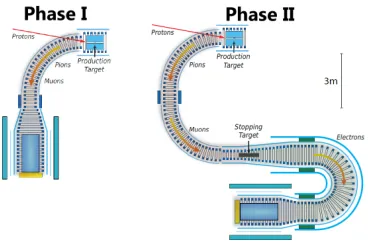
Japan. Here, SES means the minimum value of theµ−econversion rate where the experiment can still expect to observe one signal event during the running time. The COMET experiment will be carried out using a two-staged approach (see Fig.1). The first stage named as COMET
Figure 1.The schematic layout of the COMET experiment.
I is currently under construction at J-PARC. The primary goal of the COMET Phase-I is search for µ−e conversion at the intermediate sensitivity which would be 100-times better than the present limit. The second stage, COMET Phase-II is seeking another 100 improvement the usage much more intense muon beam and full length C-shape transport solenoid. The key parameters of the COMET experiment are summarized in Table 1 and discussed in detail below.
Table 1.Summary of the Phase-I and Phase-II.
Parameter Phase-I Phase-II
Beam power 3.2 kW (8 GeV) 56 kW (8 GeV)
Bending 90◦(beam)+0◦(detector) 180◦(beam)+180◦(detector)
Running time 9.5×10⁶sec. 2×10⁷sec.
Protons on target 3.2×10¹⁹ 8.5×10²⁰ Stopped muons on target 1.5×10¹⁶ 2×10¹⁸
SES 3.1×10⁻¹⁵ 2.6×10⁻¹⁷
target in 100 ns bunches. This leads to a large flux of charged particle at the stopping target of∼200 ns. Since a muon lifetime in aluminium is 864 ns then a pulsed beam in the 1.17µs gap between bunches together with using delayed time window allow to eliminate of prompt beam background events.
The COMET experiment will produce muon beam from the pions decay generated in the collisions of protons with a production target made of graphite for COMET Phase-I, and a tungsten target in II. The proton beam requirements for COMET I and Phase-II differ only in their power requirements (see Table 1). They both require a pulsed of 8 GeV proton beam. The choice of beam energy is driven by requirement of the minimisation the production of antiprotons, production rate of which increases rapidly for proton energies above 10 GeV. Because when antiprotons reach to the detector region, they annihilate on materials releasing a large amount of energy and producing other energetic particles including pions which might produce electrons that could fake a 105 MeV signal. The proton target will be installed within the bore of the capture solenoid and designed to maximise the capture of low energy negative pions produced in the backward direction. The production of low energy pions is of major interest since low energy muons are mostly produced by in-flight decay of them. The low energy muons can be easily stopped in an aluminium target to efficiently produce muonic atoms. Thus, the muon beamline for COMET experiment comprises the pion capture solenoid section and the muon transport solenoid section, as well as a set of matching solenoids. The curved solenoid is using for selection of the electric charge and momentum of beam particles. The center of the helical trajectory of a charged particle in curved solenoids is shifted and the drift (D[m]) is given by
D= θbend qB
p
2 cosθ+ 1 cosθ
!
, (2)
whereqis the charge of the particle,Bis a solenoid field,θbendis the bending angle of the
solenoid, pis the momentum charge of the particle andθ= pT
pL is the pitch angle and pL,pT
are longitudinal and transverse momenta. The drift of the particles with the momentum of interest compensated by an auxiliary field parallel to the drift direction of
Bcomp=
1 qR
p0
2 cosθ0+ 1 cosθ0
!
, (3)
hereRis the the radius of curvature of the curved solenoid and in results the trajectories of charged particles with momentump0and pitch angleθ0are corrected.
3.1 COMET Phase-I
is 0.61. Thus, to achieve the the design single event sensitivity of COMET Phase-I a total number of protons on target (POT) of 3.2×10¹⁹i.e 1.5×10¹⁶stopped muons on target which corresponds to about 150 days is required (see Table 1).
The second configuration has an aim to make direct measurement of potential background for the full COMET experiment using prototypes of the Phase-II straw tracker and the elec-tron calorimeter (ECAL), called StrEcal detector. Prototype version of the StrEcal detector will be install in vacuum and magnetic field of 1 T in place of CyDet. The straw tracker for Phase-I consists of five stations, but possibly more for Phase-II. Each station has four planes; two to measure the xcoordinate and two to measure theycoordinate. The straw tube for Phase-I are 9.8 mm in diameter and 20µm in wall thickness made by an aluminised-Mylar. The operating gas mixture is 50%Ar- 50%C2H6. The specifications for ECAL are
deter-mined by its requirements for Phase-II running, which are an energy resolution of better than 5% at 105 MeV and a cluster position resolution that is better than 1 cm. It will also provide an additional hit position on the electron track trajectory and provide the trigger signals. The ECAL will be built of LYSO crystals which have a 2×2 cm2cross-section and whose length
is 12 cm, corresponding to 10.5 radiation lengths. The basic unit of the ECAL is a 2×2 crystal module. The StrEcal detector will be regarded as a final prototype of the COMET Phase-II detector.
3.2 COMET Phase-II
Phase-II will use the complete C-shaped muon transport solenoid with bend of 180◦ accord-ingly the accuracy of the selection of particles for electric charge and momentum is improved. COMET Phase-II also has an additional 180◦curved solenoids which is used to discard elec-trons that are not of interest (see Fig.1). It allows to transport the signal elecelec-trons from the muon stopping target to the detector section with high efficiency.
The straws for COMET Phase-II are 5 mm in diameter and 12 µm in wall thickness to reach a momentum resolution of better than 150 keV/c. It allows to have enough momentum resolution of electron measurement and the signal and DIO background separation will be clear. During Phase-II the ECAL covers the cross-section of the 50 cm radius detector region and 1920 crystals are needed. The calorimeter is located behind the straw tracker and provides a fast trigger signal if the deposited energy lies within a given range.
It should be noted that the additional improvement of the the design single event sensitiv-ity of COMET Phase-II specified in Table 1 by one order of magnitude using the same beam power are being considered. This improvement requires the optimization of the design of the proton and muon targets as well as the electron spectrometer.
4 COMET preparation status
Figure 2. The COMET collaboration in front of the COMET building in January 2015.
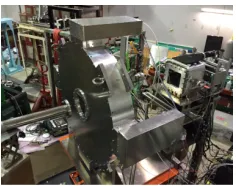
Figure 3. An installation of the transport solenoid in the COMET hall
Figure 4. The construction of CDC was suc-cessfully completed.
Figure 5. The test of the StrECAL prototype at Tohoku university.
5 Conclusion
CLFV rate in the SM with non-zero neutrino mass is small to be observed in experiments. Therefore, any signal is a clear indication of physics beyond of the Standard Model. COMET experiment search is a new high-precision experiment for searching of CLFV process through the coherent neutrinoless conversion of a muon to an electron in the field of an aluminium nucleus, with a single event sensitivity by at least four orders of magnitude over than current limit. The COMET Collaboration will have its detector systems commissioned and tested by the end of JFY 2019, to be ready for the beam which will arrive subsequently. Beam studies in the "B-line" proton beam line which supplies COMET will commence at this time. The full COMET Phase-II will be deployed and running after the completion of Phase-I experiment.
6 Acknowledgement
We acknowledge support from JSPS, Japan; Belarus; NSFC, China; IHEP, China; IN2P3-CNRS, France; CC-IN2P3, France; SRNSF, Georgia; DFG, Germany; JINR; IBS, Korea; RFBR, Russia; STFC, United Kingdom; and Royal Society, United Kingdom
References
[1] G. Aad et al. (ATLAS), Phys. Lett.B716, 1 (2012),1207.7214
[2] S. Chatrchyan et al. (CMS), Phys. Lett.B716, 30 (2012),1207.7235
[3] Y. Fukuda et al. (Super-Kamiokande), Phys. Rev. Lett. 81, 1562 (1998),
hep-ex/9807003
[4] G. Adamov et al. (COMET) (2018),1812.09018