R E S E A R C H
Open Access
Assessing the feasibility of online SSVEP decoding
in human walking using a consumer EEG headset
Yuan-Pin Lin
1,2, Yijun Wang
1,2and Tzyy-Ping Jung
1,2*Abstract
Background:Bridging the gap between laboratory brain-computer interface (BCI) demonstrations and real-life applications has gained increasing attention nowadays in translational neuroscience. An urgent need is to explore the feasibility of using a low-cost, ease-of-use electroencephalogram (EEG) headset for monitoring individuals’EEG signals in their natural head/body positions and movements. This study aimed to assess the feasibility of using a consumer-level EEG headset to realize an online steady-state visual-evoked potential (SSVEP)-based BCI during human walking.
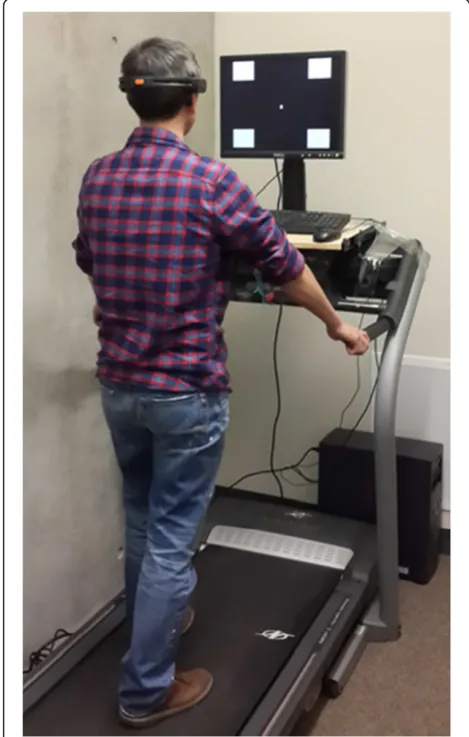
Methods:This study adopted a 14-channel Emotiv EEG headset to implement a four-target online SSVEP decoding system, and included treadmill walking at the speeds of 0.45, 0.89, and 1.34 meters per second (m/s) to initiate the walking locomotion. Seventeen participants were instructed to perform the online BCI tasks while standing or walking on the treadmill. To maintain a constant viewing distance to the visual targets, participants held the hand-grip of the treadmill during the experiment. Along with online BCI performance, the concurrent SSVEP signals were recorded for offline assessment.
Results:Despite walking-related attenuation of SSVEPs, the online BCI obtained an information transfer rate (ITR) over 12 bits/min during slow walking (below 0.89 m/s).
Conclusions:SSVEP-based BCI systems are deployable to users in treadmill walking that mimics natural walking rather than in highly-controlled laboratory settings. This study considerably promotes the use of a consumer-level EEG headset towards the real-life BCI applications.
Keywords:EEG, Consumer-level EEG headset, SSVEP, BCI, Moving humans
Background
Bridging the gap between laboratory brain-computer interface (BCI) demonstrations and real-life applications has gained increasing attention nowadays in translational neuroscience. A recent brain imaging study in mobile humans suggested that the brain switches to a different operating method while humans actively behave, move, walk, and orient in ecologically-valid environments [1]. That is, there might be significant differences in how the brain works in ecologically valid environments versus highly controlled laboratory environments [2,3]. How-ever, studies linking brain dynamics to cognitive func-tions have been majorly devoted to the stationary and
tethered individuals, in which the participants under-went the experiments with highly-controlled settings in laboratories. They were usually instructed to avoid any task-irrelevant head/body movements. The laboratory-oriented research might have a generalizability issue when it is deployed in the real world. Therefore, study-ing the brain dynamics associated with naturalistic hu-man behaviors is of great importance in translational neuroscience.
Promising advances in mobile electroencephalogram (EEG) system have largely progressed in naturalistic brain imaging. Wearing a lightweight mobile EEG head-set allows EEG recording under naturalistic movements. Several previous studies have proved the efficacy of using either experimental prototype [4-6] or consumer-level EEG headsets [7-13], e.g. the MindWave headset (NeuroSky, Inc.) and the Emotiv EEG headset (Emotiv * Correspondence:[email protected]
1Swartz Center for Computational Neuroscience, Institute for Neural
Computation, University of California, San Diego, La Jolla, CA, USA 2Center for Advanced Neurological Engineering, Institute of Engineering in
Medicine, University of California, San Diego, La Jolla, CA, USA
systems, Inc.) in cognitive neuroscience, neuroimaging, and BCI domains. Nevertheless, until recently only scat-tered studies [14-18] employed such mobile brain sens-ing technology to explicitly assess EEG activities while participants freely and actively adapt to and interact with their naturalistic environments. Specifically, De Vos et al. [17] recently demonstrated the feasibility of a mo-bile auditory P300-based BCI system during natural walking. Nevertheless, the obtained BCI performance,i.e., information transfer rate (ITR), needed to be improved to satisfy performance requirement in practical applications.
The steady-state visual-evoked potential (SSVEP)-based BCI has become a popular communication chan-nel that allows users to interact with environments/ external devices due to its ease of use, minimal user training, large number of commands and high ITR [19-21]. However, most of previous works were rooted in the SSVEP correlates of stationary and tethered sub-jects who were instructed to attentively gaze at the visual stimulation and avoid other gross movements. Recently, sparse works which adopted a laboratory-grade EEG de-vice focused on an offline assessment of the SSVEP dy-namics during walking [15,18]. Alternatively to the use of lab-graded headgear, few studies noticed the need of realizing an SSVEP-based BCI using the consumer-level headset [11-13]. Yet, these studies tested the efficacy with highly movement-controlled subjects. No study has reported the test of the consumer EEG headset for actu-ating the online SSVEP-based BCI with natural head/ body positions and movements, i.e., in non-stationary, non-tethered subjects.
The main objective of this study was to assess whether or not a consumer-level headset can be used to perform online SSVEP decoding in human walking. To this end, the subjects were instructed to stand or walk on a speed-controllable treadmill (0.45, 0.89, and 1.34 meters per second (m/s)) in an attempt to initiate different levels of walking locomotion while using the online BCI. As compared to the standing condition, the methods and empirical results of moving subjects could shed the light on principles regarding the utility of a user-friendly and af-fordable commercial EEG headset for implementing real-life BCI applications towards naturalistic environments.
Methods
Participant
Seventeen healthy participants (14 males and 3 females; 22–32 years of age; mean age, 26.76 years) with normal or corrected-to-normal vision participated in this study. They were randomly selected from the student volun-teers at University of California San Diego (UCSD). UCSD Human Research Protections Program approved this study. Each participant read and signed an informed consent before the experiment.
EEG recording
This study employed a 14-channel Emotiv EEG headset that sampled EEG signals at 128 Hz and band-pass fil-tered them between 0.2 and 45 Hz. The electrodes were positioned at AF3, F7, F3, FC5, T7, P7, O1, O2, P8, T8, FC6, F4, F8, and AF4 in accordance with the modified international 10–20 system. In addition, the angular velocities were concurrently recorded by the built-in two-channel gyroscope (Gyro-X: horizontal movement; Gyro-Y: vertical movement) in order to characterize the severity of the head movements during walking. The Emotiv Control Panel software provides visual monitor-ing of the electrode impedance. Once all electrodes had good contacts with the scalp, a laptop (Thinkpad X230, Lenovo Inc.) started to initiate the OpenViBE software [22] for connecting to the Emotiv headset, and then acti-vate the BCILAB toolbox [23] to stream EEG signals for real-time frequency detection of the SSVEP signals.
Treadmill experiment setup
periods of target-shifting were ignored in online SSVEP detection, and data recorded as participants gazed at the fixation cross were only used as baseline control in off-line analysis. Each participant underwent a 4-session ex-periment (in the order of standing 0.45 m/s, 0.89 m/s to 1.34 m/s without randomization) with a minute(s) between-session rest to prevent visual and/or motor fa-tigue. During the rest, the signal qualities of electrodes were re-checked and adjusted via the Emotiv Control Panel. That is, without the need of removing the headset a syringe was used to drip a little more saline solution to the sponges of the electrodes with poor conductivity. The entire experiment for four sessions and between-session rests lasted less than 30 minutes.
Online SSVEP detection
The 14-channel EEG data in the 0.2-45 Hz frequency range (Emotiv default setting) were submitted to the process of frequency detection based on canonical
correlation analysis (CCA) [19,24] which has been proved highly efficient for enhancing the signal-to-noise ratio (SNR) of SSVEP signals [18,19,24]. CCA is a multi-variate statistics method to maximize underlying correl-ation between two given multivariate signalsxandy.To this end, CCA seeks the weight vectors wx and wy to project the input signals intoXandY,respectively, lead-ing to the maximum canonical correlation ρ according to the following equation:
maxWx;Wy ρðX;YÞ ¼
E wT xxyTwy
ffiffiffiffiffiffiffiffiffiffiffiffiffiffiffiffiffiffiffiffiffiffiffiffiffiffiffiffiffiffiffiffiffiffiffiffiffiffiffiffiffiffiffiffiffiffiffiffiffiffiffi E wT
xxxTwx
E wT yyyTwy
h i
r
In this experiment, x refers to then-second EEG sig-nals (n is a self-regulated variable described below), and yrefers to a set of reference signals generated as follows:
y¼
sin 2ð πfnÞ cos 2ð πfnÞ
⋮ sin 2ð πNhfnÞ
cos 2ð πNhfnÞ 2
6 6 6 4
3 7 7 7 5;n¼
1 fs;
2 fs;⋯;
N fs
wherefand fsare the target and sampling frequency,
re-spectively. Nh is the number of harmonics, andNis the number of sampling points. The CCA calculates the ca-nonical correlation between the given EEG signalsxand the reference signalsyat each target frequency. The final decision of SSVEP frequency was made upon the max-imum correlation among the reference signals. This study set the target frequency f as 9, 10, 11 and 12 Hz and theNhas two for generating template signals based on fundamental frequency and second harmonics with respect to the target frequency. Particularly, this study adopted the procedure of self-regulating data length [21] to sequentially accumulate the acquired EEG signals for improving the SNR of SSVEPs. This process used EEG data within several windows ranging from 2 to 8 seconds, with an increment of 0.25, for CCA calculation (e.g., 2, 2.25, 2.5…8 s windows). Only if the detected frequency of the SSVEPs within four consecutive windows matched the target frequency, the detection pipeline would con-sider the target correctly classified. This detection pipeline was similar to the idea used in an adaptive P300 BCI [25]. Otherwise, the target would terminate as an incorrect de-cision. Note that, to eliminate the distraction from online feedback, this study did not present feedback to the sub-jects. The detection accuracy, decision time and ITR [26] were used to evaluate the SSVEP decoding performance. This study also saved the EEG data during the online ex-periments for further offline analysis.
Offline data analyses
The offline analyses aimed to explore the dynamics of the background EEG activity and the SSVEP amplitude acquired by the consumer headset under different walk-ing speeds. The background EEG spectrum in the fixation-cross condition, which can be regarded as base-line power for the SSVEP conditions under each walking speed, was necessary to reveal the underlying brain activity associated with the walking locomotion. In addition, since this study adopted treadmill walking to systematically test the effects of different degrees of head movements on the SSVEPs, it is important to report the intensity and frequency of the head movements. To this end, we applied the spectrum analysis to the 2-channel gyroscope signals (horizontal and vertical axes) along different walking speeds. The detailed steps are described as follows. This study applied a 1 Hz high-pass finite im-pulse response (FIR) filter to the EEG signals to remove low-frequency drifts, resulting in a signal bandwidth of 1 to 45 Hz for the spectral analysis. The 128-point short-time Fourier transform (STFT) with a Hamming window of length 128 samples and 25% overlap was then applied to estimate the EEG spectrogram at a 1 Hz frequency resolution. The grand average power spectral density (PSD) of each channel can be derived for each condition. Note that, to dissociate the reactive SSVEP from the back-ground EEG activities and walking related noises, this study estimated the relative power of SSVEPs by subtract-ing the power spectrum in the fixation-cross condition from those of the SSVEP conditions at each of the walking speeds. In addition, this study calculated the scalp distri-butions of the spectral power to form topographic maps using the EEGLAB toolbox [27]. The spectrogram of the recorded 2-channel Gyro signals was estimated using the same procedure as for EEG data (but without filtering). Lastly, this study employed a paired t-test to access the differences of SSVEP amplitudes and online performance between two walking conditions (standing, 0.45 m/s, 0.89 m/s, and 1.34 m/s).
Results
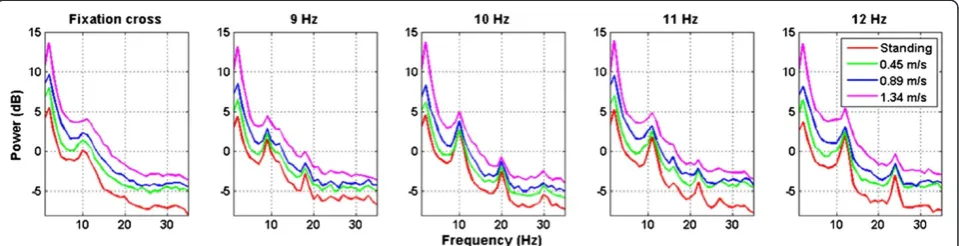
The impacts of walking movements on the EEG spectra Figure 2 shows the averaged PSD of O1 and O2 chan-nels across all subjects. In general, walking locomotion induced wideband noise to the EEG spectra, very likely arising from electrode shift with respect to the scalp and electromyography (EMG) activities from facial, neck, and scalp muscles during walking. This phenomenon led to power lifting proportional to walking speeds. Fast walking especially induced large augmentation of low-frequency power around 2 Hz. In addition, the SSVEP amplitudes under the standing and walking conditions exhibited salient peaks at the fundamental and second harmonics of the flickering frequencies, which appeared to monotonically attenuate as walking speed increased. To estimate SSVEP amplitudes under different walking speeds, this study alleviated the wideband noise by sub-tracting the power in the fixation-cross condition from that of the SSVEPs in the flickering conditions. Figure 3 shows that the SSVEP signals at the O1-O2 pair declined evidently as walking speed increased, leading to signifi-cant amplitude drops (p< 0.05) between standing versus walking (0.45, 0.89, and 1.34 m/s). No significant differ-ences were found between the three walking speeds.
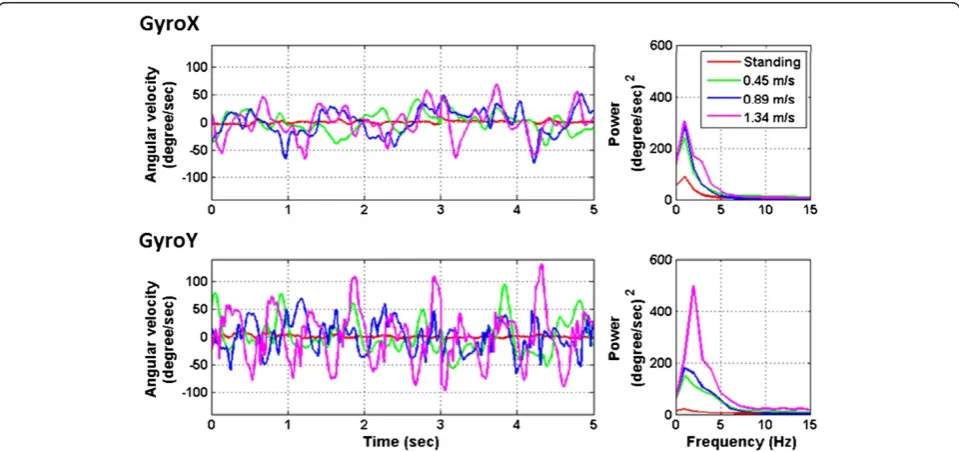
Figure 4 illustrates an example of 2-channel gyroscope time course of a representative subject and averaged spectral profiles of 17 subjects across all conditions along the horizontal (Gyro-X) and the vertical (Gyro-Y) planes associated with walking locomotion under differ-ent walking speeds. As can be seen, compared with the standing condition, the low-frequency power (1 to 5 Hz) of the angular-velocity deviations tended to progressively augment as walking speed increased. Especially, the ver-tical head displacements (Gyro-Y) showed a big jump at 2 Hz while walking at 1.34 m/s. This result could be at-tributed to the fact that natural walking posture was typ-ically accompanied by head bobbing (Gyro-Y) and head swaying (Gyro-X) while fast walking exhibited bigger head bobbing than head swaying.
Figure 5 plots the topographic maps of the relative low-frequency power (1–5 Hz) and the SSVEP am-plitudes (9–12 Hz) (derived from flickering minus fixation-cross) under different walking speeds. As afore-mentioned, the head movements during walking resulted in power increase at frequencies from 1 to 5 Hz. The topographic maps showed that the EEG power augmen-tations, which mainly distributed over the fronto-central areas versus the posterior areas, more and less positively
correlated with the waking speed. Furthermore, the SSVEP maps clearly showed that the induced occipital SSVEP amplitudes tended to be weaker during fast walk-ing. It is worth noting that since the topographic spectrum maps were interpolated on a sparse 14-channel montage with the absence of centro-parietal electrodes, the results did not lead to the implication of spectral changes in the sensorimotor cortex during walking.
The online SSVEP detection performance
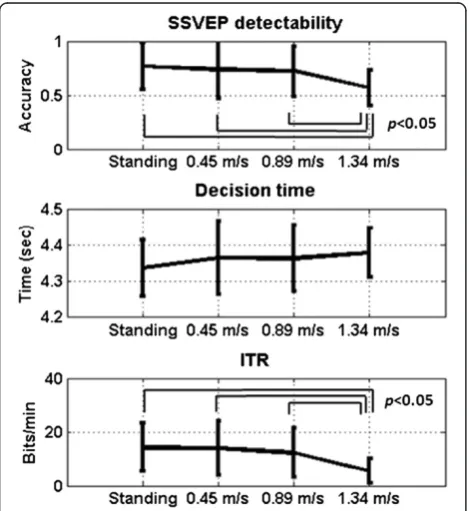
Figure 6 shows the online SSVEP decoding performance in terms of detection accuracy (%), decision time (sec), and ITR (bits/min) at different walking speeds. In gen-eral, the classification accuracy was significantly higher than the chance level (25%) under all conditions. The av-eraged BCI performance progressively decayed as walk-ing speed increased from 0.45 to 1.34 m/s (accuracy: 73.49 ± 26.52%, 71.83 ± 23.17%, 56.57 ± 16.56%; ITR: 14.04 ± 10.10, 12.37 ± 9.19, 5.53 ± 4.57; with the repre-sentation of the mean value plus/minus standard devi-ation), as compared to the standing condition (accuracy: 76.60 ± 21.74%, ITR: 14.38 ± 9.04). The significant drops (p< 0.05) in accuracy and ITR were only found between the 1.34 m/s condition versus the other three conditions. The decision time was found to slightly increase as walk-ing speed increased, but there was no significant differ-ence (p> 0.05) between speeds (standing: 4.34 ± 0.08 s; 0.45 m/s: 4.37 ± 0.10s; 0.89 m/s: 4.36 ± 0.09 s; 1.34 m/s: 4.38 ± 0.07 s).
Figure 3The averaged power of SSVEP signals at O1 and O2 channels across 17 subjects under different walking speeds after alleviating the wideband noise by subtracting the power in the fixation-cross condition from that of the SSVEPs in the flickering conditions.The thin lines indicate the significant difference between speeds (p< 0.05 or < 0.01), whereas the error bars represent the standard error of the SSVEP amplitudes.
Discussion
This study aimed to assess whether or not a consumer-level headset can be used to perform online SSVEP de-coding for users in naturalistic positions, postures and movements. To this end, this study preliminarily tested the validity of an online four-target SSVEP decoding sys-tem outside standard laboratories by using a speed-controlled treadmill experiment that generated different degrees of head movements in moving humans. The on-line performance appeared to decrease as participants switched from standing to walking. A significant drop (p< 0.05) in accuracy and ITR was found during fast walking at 1.34 m/s (c.f.Figure 6). The reason might be
attributed to the fact that the SSVEP amplitude was nega-tively correlated with the walking speed (c.f.Figures 3 and 5). The amplitude of SSVEP has been found to be largely modulated by visual spatial attention [28]. As a conse-quence, the loss of focus could reduce visual attention and thereby lead to the decreased SSVEP amplitude. This very likely happened in treadmill walking. Fast walking obvi-ously initiated rapid head bouncing especially in fast walk-ing (c.f.Figure 4). Such phenomenon was also confirmed by the participants of this study reported somehow more difficult in focusing on the flickering targets during walk-ing, especially at the speed of 1.34 m/s. However, since the treadmill walking protocol adopted in this study did not randomize the walking speeds, we cannot completely rule out the possibility that the visual- or motor-fatigue could also contribute to the SSVEP deterioration. Currently, lit-tle is known about the interference of fatigue on SSVEP amplitude in an SSVEP experiment where multiple ses-sions are separated by inter-session breaks. A further study is needed to address the impact of fatigue on the BCI performance, which might likely happen in real-life applications.
Another interesting finding was that the increase of the gait cadence in our study (up to 1.34 m/s) accom-panied larger head bobbing as well as moderate head swaying, resulting in head movements of 1–5 Hz (c.f. Figure 4). Such head movements inevitably swayed the headset and yielded a corresponding low-frequency power fluctuation spreading over the whole head (c.f. Figure 5), which was analogous to the evidence that gait-related artifacts significantly affected the EEG spectral power in the 1.5-8.5 Hz frequency range during walking (below 1.25 m/s) and running (1.9 m/s) [3]. Such 1– 5 Hz mechanical artifacts produced by head movements during steady walking (tested up to 1.34 m/s in this study) should not affect the SSVEPs (9–12 Hz frequency range). In this regard, methods for movement artifact suppression [3] might not be able to improve the SSVEP detection performance in this study. However, the arti-facts could contaminate other event-related potentials Figure 5The topographical mapping of the relative low-frequency power (1–5 Hz) and SSVEP amplitude (9–12 Hz) (derived from flickering minus fixation-cross) under different walking speeds.The topographic legend indicates the channel locations of the 14-channel Emotiv EEG headset. The units of color bars represent the original EEG power in the dB scale. Note that these 14-channel interpolated maps (with the absence of the centro-parietal electrodes) do not imply spectral changes in the centro-parietal regions during walking.
(ERPs) used in other types of BCIs. For example, P300 waveform is majorly composed of frontal theta (4-7 Hz) and posterior delta activations (<4 Hz) [29]. This gait-related low-frequency contamination could cause a deteri-oration of P300 quality during naturally walking [14,17].
Lastly, one might concern the adopted treadmill-walking protocol prone to constrain the treadmill-walking loco-motion. This study instructed the subjects to hold the hand-grip while walking on the treadmill (c.f. Figure 1). It was not only to insure the subjects’safety while pro-ceeding with fast walking on the moving belt (1.34 m/s), but also to maintain their viewing distances to the display monitor while walking. Such hand-grip holding might re-sult in dissimilar walking locomotion with less body and head movements compared to natural walking patterns in daily life. However, according to the measurements from the gyroscope (c.f.Figure 4), the treadmill-initiated walk-ing locomotion evidently engaged pronounced head movements as compared to a standing posture. Unlike the previously laboratory-oriented BCI demonstrations with stationary subjects, this study was a valuable step towards the transition to real life applications.
Although the empirical results in this study demon-strated the applicability of using the consumer-level Emotiv headset to decode SSVEPs in moving humans, the obtained satisfactory performance might not assure that the headset could be perfectly suitable for all BCI applications. First, given the sparse 14-channel montage, the unavailability of midline and centro-parietal regions might hinder the measurements of good-quality P300 waveforms [14]. Second, the EEG quality measured by the designed saline electrodes highly depends on the moisture level of saline liquid, leading to progressive quality deterioration in a long-term use. Third, unlike the non-prep, dry electrodes [4], the pads of the saline electrodes might meet difficulties in having good con-tacts to hair-covered sites on the scalp. However, despite these potential drawbacks and inferior signal quality compared to medical-/laboratory-grade devices [30], the advantage of ease-to-use still could facilitate the BCI ap-plications for non-critical apap-plications in entertainment and game control.
Future efforts can be devoted to improve the online performance for freely moving humans. Wei et al. [31] recently proposed a new SSVEP detection method, namely differential canonical correlation analysis (dCCA), to im-prove the detectability of high-frequency SSVEPs as com-pared to the standard CCA. Thus, a natural next step is to employ the dCCA to improve the effectiveness of the SSVEP decoding. Another direction is to incorporate the consumer-level EEG headset with a head-mounted display device (presenting visual stimuli) to establish ubiquitous mobile BCI systems in ecologically valid environments.
Conclusions
This study implemented the first online SSVEP decoding system in walking humans using a low-cost, easy-to-use commercial EEG headset, providing principles towards translating laboratory-oriented BCI demonstrations to practical BCI applications in daily life. The empirical re-sults showed that the Emotiv EEG headset enabled SSVEP decoding with ITRs above 12 bits/min during slow walking (below 0.89 m/s). The ITR reported in the present study is comparable to the previous studies with stationary subjects. For example, a four-class SSVEP-based BCI speller using a commercial EEG system ob-tained an average ITR of 13 bits/min across a total of 106 subjects [32]. This study evidently demonstrated that SSVEP-based BCI systems are deployable to users in natural head/body positions and movements rather than in severely restrict movements within highly con-trolled laboratory environments.
Abbreviations
BCI:Brain-computer interface; CCA: Canonical correlation analysis;
dCCA: Differential canonical correlation analysis; EEG: Electroencephalography; ERP: Event-related potential; FIR: Finite impulse response; ITR: Information transfer rate; MPH: Miles per hour; PSD: Power spectral density; SNR: Signal-to-noise ratio; SSVEP: Steady-state visual-evoked potential; STFT: Short-time Fourier transform; m/s: Meters per second; UCSD: University of California San Diego.
Competing interests
The authors declare that they have no competing interests.
Authors’contributions
YPL undertook the data collection, performed the data analysis, interpreted the results, and drafted the manuscript. YW conceived the experiments and helped to analyze data, interpret the results, and revised the manuscript. TPJ helped to interpret the results and revise the manuscript. All authors read and approved the final manuscript.
Acknowledgments
This work was supported by Office of Naval Research (N00014-08-1215), Army Research Office (un-der contract number W911NF-09-1-0510), Army Research Laboratory (under Cooperative Agreement Number W911NF-10-2-0022), and DARPA (USDI D11PC20183). The authors acknowledge Christian Kothe for online programming assistance.
Received: 14 January 2014 Accepted: 22 July 2014 Published: 9 August 2014
References
1. Gramann K, Gwin JT, Ferris DP, Oie K, Jung TP, Lin CT, Liao LD, Makeig S: Cognition in action: imaging brain/body dynamics in mobile humans. Rev Neuroscience2011,22:593–608.
2. McDowell K, Lin CT, Oie KS, Jung TP, Gordon S, Whitaker KW, Li SY, Lu SW, Hairston WD:Real-World neuroimaging technologies.Access, IEEE2013, 1:131–149.
3. Gwin JT, Gramann K, Makeig S, Ferris DP:Removal of movement artifact from high-density EEG recorded during walking and running.J Neurophysiol 2010,103:3526–3534.
4. Chi YM, Wang YT, Wang Y, Maier C, Jung TP, Cauwenberghs G:Dry and noncontact EEG sensors for mobile brain-computer interfaces.IEEE T Neur Sys Reh2012,20:228–235.
5. Wang YT, Wang Y, Jung TP:A cell-phone-based brain-computer interface for communication in daily life.J Neural Eng2011,8:025018. 025015pp. 6. Wang Y, Wang YT, Jung TP:Visual stimulus design for high-rate SSVEP
BCI.Electron Lett2010,46:1057–1058.
Technologies (ICALT), 2010 IEEE 10th International Conference on; 5–7 July 2010. 2010:276–278.
8. Campbell A, Choudhury T, Hu S, Lu H, Mukerjee MK, Rabbi M, Raizada RDS: NeuroPhone: Brain-Mobile Phone Interface using a Wireless EEG Headset. InBook NeuroPhone: Brain-Mobile Phone Interface using a Wireless EEG Headset.City: ACM; 2010:3–8.
9. Bobrov P, Frolov A, Cantor C, Fedulova I, Bakhnyan M, Zhavoronkov A: Brain-computer interface based on generation of visual images.PloS One 2011,6:e20674.
10. Petersen MK, Stahlhut C, Stopczynski A, Larsen JE, Hansen LK:Smartphones Get Emotional: Mind Reading Images and Reconstructing the Neural Sources. InBook Smartphones Get Emotional: Mind Reading Images and Reconstructing the Neural Sources.City: Springer-Verlag; 2011:578–587. 11. Yue L, Xiao J, Teng C, Feng W, Peng Un M, Pui-In M, Mang IV:Implementation
of SSVEP based BCI with Emotiv EPOC. InVirtual Environments Human-Computer Interfaces and Measurement Systems (VECIMS), 2012 IEEE International Conference on; 2–4 July 2012.Tianjin, China: IEEE; 2012:34–37.
12. Choi B, Jo S:A low-cost EEG system-based hybrid brain-computer interface for humanoid robot navigation and recognition.PloS One2013,8:e74583. 13. Guneysu A, Akin HL:An SSVEP based BCI to Control a Humanoid Robot
by using Portable EEG Device. InEngineering in Medicine and Biology Society (EMBC), 2013 35th Annual International Conference of the IEEE; 3–7 July 2013.Osaka, Japan: IEEE; 2013:6905–6908.
14. Debener S, Minow F, Emkes R, Gandras K, de Vos M:How about taking a low-cost, small, and wireless EEG for a walk?Psychophysiology2012, 49:1617–1621.
15. Lin YP, Wang Y, Wei CS, Jung TP:A Mobile Brain-Computer Interface for Freely Moving Humans. InHuman-Computer Interaction, Part V, HCII 2013, LNCS 8008.Edited by Kurosu M. Berlin Heidelberg: Springer; 2013:448–453. 16. Lotte F, Fujisawa J, Touyama H, Ito R, Hirose M, L\ A, \#233, cuyer:Towards
Ambulatory Brain-Computer Interfaces: a Pilot Study with P300 Signals. InBook Towards Ambulatory Brain-Computer Interfaces: a Pilot Study with P300 Signals.City: ACM; 2009:336–339.
17. De Vos M, Gandras K, Debener S:Towards a truly mobile auditory brain-computer interface: exploring the P300 to take away.Int J Psychophysiol 2014,91(1):46–53.
18. Lin YP, Wang Y, Jung TP:A Mobile SSVEP-based Brain-computer Interface for Freely Moving Humans: The Robustness of Canonical Correlation Analysis to Motion Artifacts. Inthe 35th Annual International Conference of the IEEE Engineering in Medicine and Biology Society (EMBC’13); July 3–7. Osaka, Japan: IEEE; 2013:1350–1353.
19. Bin GY, Gao XR, Yan Z, Hong B, Gao SK:An online multi-channel SSVEP-based brain-computer interface using a canonical correlation analysis method.J Neural Eng2009,6:046002. 046006pp.
20. Muller-Putz GR, Pfurtscheller G:Control of an electrical prosthesis with an SSVEP-based BCI.IEEE T Bio-Med Eng2008,55:361–364.
21. Wang Y, Wang R, Gao X, Hong B, Gao S:A practical VEP-based brain-computer interface.IEEE T Neur Sys Reh2006,14:234–240.
22. Renard Y, Lotte F, Gibert G, Congedo M, Maby E, Delannoy V, Bertrand O:L A, #233, cuyer: Openvibe: an open-source software platform to design, test, and use brain–computer interfaces in real and virtual environments. Presence: Teleoper Virtual Environ2010,19:35–53.
23. Delorme A, Mullen T, Kothe C, Acar ZA, Bigdely-Shamlo N, Vankov A, Makeig S:EEGLAB, SIFT, NFT, BCILAB, and ERICA: new tools for advanced EEG processing.Intell Neuroscience2011,2011:10–10.
24. Lin Z, Zhang C, Wu W, Gao X:Frequency recognition based on canonical correlation analysis for SSVEP-based BCIs.IEEE T Bio-Med Eng2006, 53:2610–2614.
25. Jin J, Allison BZ, Sellers EW, Brunner C, Horki P, Wang XY, Neuper C:An adaptive P300-based control system.J Neural Eng2011,8:036006. 26. Wolpaw JR, Birbaumer N, McFarland DJ, Pfurtscheller G, Vaughan TM:
Brain-computer interfaces for communication and control.Clin Neurophysiol 2002,113:767–791.
27. Delorme A, Makeig S:EEGLAB: an open source toolbox for analysis of single-trial EEG dynamics including independent component analysis. J Neurosci Meth2004,134:9–21.
28. Morgan ST, Hansen JC, Hillyard SA:Selective attention to stimulus location modulates the steady-state visual evoked potential.Proc Natl Acad Sci U S A 1996,93:4770–4774.
29. Jones KA, Porjesz B, Chorlian D, Rangaswamy M, Kamarajan C, Padmanabhapillai A, Stimus A, Begleiter H:S-transform time-frequency
analysis of P300 reveals deficits in individuals diagnosed with alcoholism. Clin Neurophysiol2006,117:2128–2143.
30. Duvinage M, Castermans T, Petieau M, Hoellinger T, Cheron G, Dutoit T: Performance of the Emotiv Epoc headset for P300-based applications. Biomed Eng Online2013,12:56.
31. Wei CS, Lin YP, Wang Y, Wang YT, Jung TP:Detection of steady-state visual-evoked potential using differential canonical correlation analysis. Inthe 6th International IEEE/EMBS Conference on Neural Engineering; 6–8 Nov. 2013.San Diego, USA: IEEE; 2013:57–60.
32. Allison B, Luth T, Valbuena D, Teymourian A, Volosyak I, Graser A:BCI demographics: how many (and What Kinds of) people can use an SSVEP BCI?Neural Syst Rehabil Eng, IEEE Transactions2010,18:107–116.
doi:10.1186/1743-0003-11-119
Cite this article as:Linet al.:Assessing the feasibility of online SSVEP decoding in human walking using a consumer EEG headset.Journal of NeuroEngineering and Rehabilitation201411:119.
Submit your next manuscript to BioMed Central and take full advantage of:
• Convenient online submission
• Thorough peer review
• No space constraints or color figure charges
• Immediate publication on acceptance
• Inclusion in PubMed, CAS, Scopus and Google Scholar
• Research which is freely available for redistribution