A FLIPPED GAMIFIED CLASSROOM
Prins Butt
Southampton Solent University
United Kingdom
Abstract
The flipped classroom is a learner-centred pedagogy in which out-of-class activities focus on delivering instruction and in-class activities are repurposed towards problem-based enquiry and group learning. This paper explores the design of one such classroom. The study draws on the results of a survey investigating the perceptions of students and tutors towards the flipped approach and details the findings of a focus group and a flipped gamified classroom for a postgraduate computing course module. The findings suggest that participants favour a flipped and gamified approach where learners are rewarded for progression and have opportunities to collaborate with others. Keywords: flipped classroom, learner-centred pedagogy, gamification, engagement
Background
Recent years have seen a rapid trend towards learner-centred pedagogy. This has in part been driven by technological advances in educational research, but global trends have also been propelling educational reforms. Present reforms are focused on developing problem-solvers and lifelong self-directed learners to meet the challenges of the modern society. Educators have therefore been turning to learner-centred models to address these challenges.
The flipped classroom is a learner-centred pedagogical approach that reverses the traditional roles of in-class instruction and out of class activities. The approach uses video lectures to deliver instruction outside of the class whilst class time is repurposed towards group learning and problem solving. This means that students encounter instructional content before the class, which in turn frees up class time to be utilised for other deeper learning activities. The theoretical basis for the flipped classroom can be found in the learner-centred and social learning theories of Piaget (1967), Bandura (1977) and Vygotsky (1978). There are a growing number of studies investigating the flipped classroom approach although most of these have focused on student perceptions rather than performance, and so little evidence exists on the impact of flipped classrooms on student performance (Goodwin & Miller 2013). Nevertheless, recent studies have found that students generally perceive the flipped classroom approach positively, and that there are
differences in student empowerment (Yujing, 2015) and achievement (Osman, Jamaludin, & Mokhtar, 2014) between a traditional class and a flipped
The Study
The purpose of the study was to investigate the attitudes of students and teachers towards a flipped gamified classroom. The study attempted to address three research questions:
1. What are the perceptions of students and teachers towards a flipped classroom?
2. How can gamification be incorporated into a flipped classroom? 3. Is there a difference between students’ attitudes towards a traditional
and a flipped gamified classroom?
Methodology
The study took place at Southampton Solent University between January and May 2017 and consisted of three stages. Firstly, current perceptions of students and teachers towards the flipped classroom were investigated. Qualitative data regarding the perceptions of participants towards the flipped approach was captured through an online open-ended survey. Stratified sampling was used to select participants with the population divided into two stratums, namely, students and teachers. The resulting data was analysed using thematic analysis (Braun & Clarke, 2006).
The survey was then followed by a focus group tasked with considering the design of a flipped gamified classroom. Convenience sampling was used to select the student participants for the focus group, and thematic network analysis (Attride-Stirling, 2001) was performed on the resulting data.
Finally, the flipped gamified classroom was delivered over a duration of six weeks on a level seven Web Technologies module. The same cohort of students from the focus group was sampled. Prior to the flipped gamified classroom approach, the delivery model for the Web Technologies module revolved around practically based two-hour tutor led sessions. The delivery model was modified so that videos and notes related to each session were made available prior to the session. Activities were also made available for completion outside of sessions using a gamified environment in the form of Code Academy. Each session was refocused on student demonstrations and student led activities related to the module assessment. Quantitative data was captured through a questionnaire consisting of three Likert scales related to engagement (behaviour), understanding (cognition) and feelings (affect).
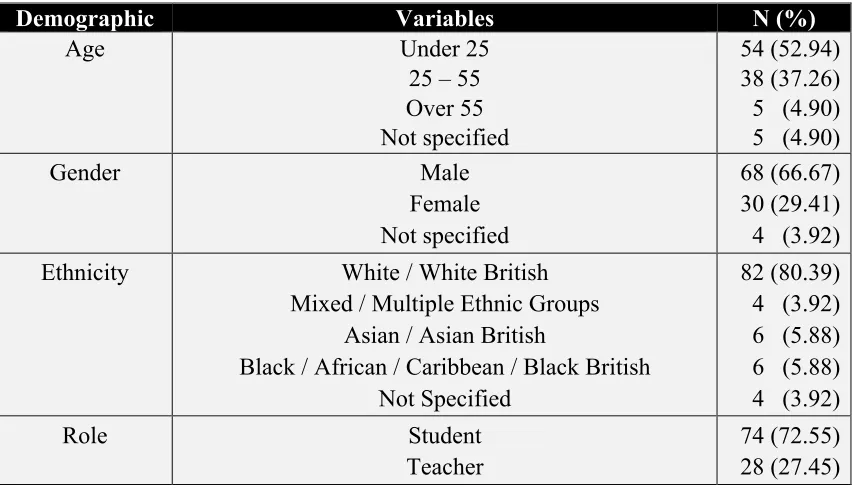
The Survey: Participants
Table 1
Demographic Data of Participants
Demographic Variables N (%)
Age Under 25
25 – 55 Over 55 Not specified
54 (52.94) 38 (37.26) 5 (4.90) 5 (4.90)
Gender Male
Female Not specified
68 (66.67) 30 (29.41) 4 (3.92)
Ethnicity White / White British
Mixed / Multiple Ethnic Groups Asian / Asian British
Black / African / Caribbean / Black British Not Specified
82 (80.39) 4 (3.92) 6 (5.88) 6 (5.88) 4 (3.92)
Role Student
Teacher
74 (72.55) 28 (27.45)
The sample included teachers and students from a range of disciplines. Amongst the teacher respondents, there were 18 (~64%) males and 8 (~29%) females with the remaining specifying no gender. Whilst none of the teachers taught exclusively at the postgraduate level, at least 50% of the teachers taught at the undergraduate level, ~25% taught at both undergraduate and
postgraduate levels and 11% taught at the foundation, undergraduate and postgraduate levels.
Amongst the student respondents, there were 50 (~68%) students who identified themselves as male and 22 (~30%) as female with the remaining specifying no gender. A majority (~70%) of the students were studying an undergraduate course with the remaining studying a foundation course (~14%) or a master course (~16%).
The Survey: Students’ Perception
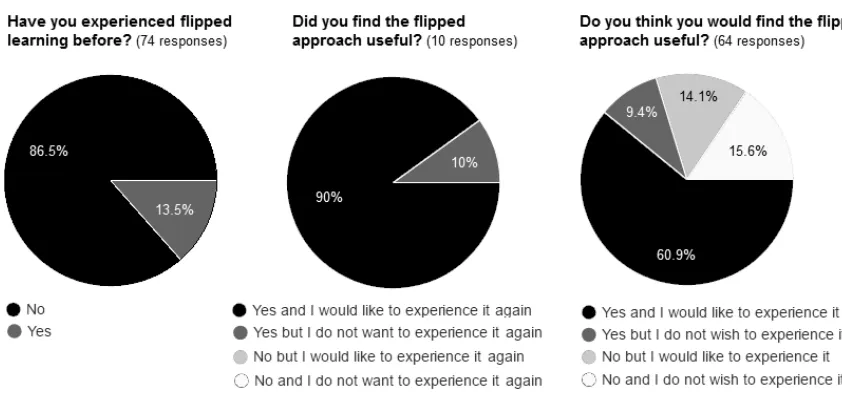
Only 13.5% of the student respondents had experienced a flipped approach to learning as illustrated in Figure 1. However, all of these students found the approach useful, with ~90% indicating that they wished to experience it again.
Figure 1. Students’ experience and attitudes towards the flipped approach.
Students in this latter group expressed uncertainty as to the implications of the approach and raised concerns regarding access and support as well as value for money:
“I go to university to get lectured and taught by someone, if I wanted to have lectures online I wouldn’t bother going to university and use online courses.” Student 23
“I don't pay 9k a year for a YouTube experience ;)” Student 13
Interestingly, only 10% of students who had experienced this approach indicated they did not wish to experience it again despite finding it useful. These students expressed a different set of concerns relating to stability. They had either grown accustomed to current approaches or were in the final stages and hence wary of experimentation:
“Finishing this year so ready to move on from uni” Student 12
“The current method works fine and I would rather stick to what I already know this far into the year.”
Student 55
Students that had experienced flipped learning and wished to experience it again cited a variety of reasons for their preference. These included the ability to seek support and build up confidence in tackling difficult tasks as well as gaining deeper understanding:
“I never liked homework and sometimes it is hard to learn by yourself, but with someone to help you with your problem it may be easier to understand the subject at later stages instead of copying work from different sources on the internet and not understanding how it works.” Student 63
An analysis of the responses of the students on the benefits and limitations of a flipped approach identified several themes. Developing a deeper
understanding of concepts and their application was cited by ~38% of the students as a perceived benefit of the flipped approach. Having autonomy to determine the pace of activity and being better prepared prior to sessions were also cited as benefits by ~26% of the students. The responses also revealed a propensity for utilising the expertise of the teacher, with ~26% indicating the opportunity to access and engage in dialogue as additional benefits.
Furthermore, ~16% of the students believe the approach leads to a more inclusive environment, introduces novelty and encourages greater practical application.
The flipped approach, however, is not without its perceived challenges. The responses indicate that ~47% of the students feel that a lack of prior
preparation, unavailability of support outside class and unsuitable technology at home could result in them being unable to participate in class activities. Students are concerned about progression in the class with ~27% suggesting that a lack of structure and contribution in the class could hinder progress. Motivation related challenges are a concern for ~30% of the students who feel that the approach may diminish incentives, reduce challenge and stifle interest in the subject matter.
The Survey: Teachers’ Perceptions
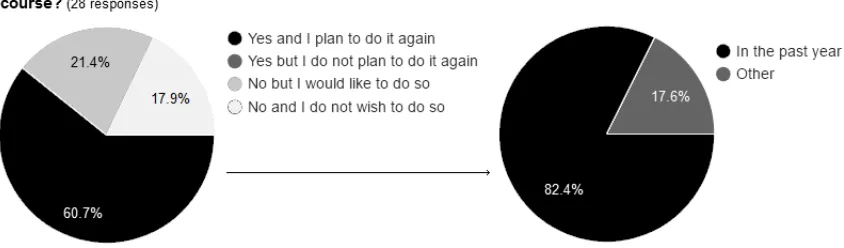
In the case of the teachers, ~61% of the teachers had utilised flipped learning with ~82% having done so in the past year as illustrated by Figure 2.
Figure 2. Teachers’ experience and attitudes towards the flipped approach.
“To encourage more student engagement through taking ownership of their own learning, i.e. reading around the subject and preparing for it and also to encourage a different type of engagement in the class room. I also used this when I introduced a new model not previously covered in the teaching.” Teacher 27
“Because I feel that it maximises the opportunity for students to practice the 'intellectual bit' of what we are doing (be it analysis, critical thinking etc)” Teacher 19
Each of the teachers that had utilised the flipped approach indicated that it had been beneficial and that they planned to utilise the approach again in the future. However, when asked what barriers or challenges they encountered when flipping, some indicated that not all students prepared adequately:
“The students need to do preparation for the session this is built in to the class plan but not all students prepare sufficiently.” Teacher 3
“Some students do not take time at their home to learn the things we want them to learn.”
Teacher 5
Similar concerns were raised by teachers who had not experienced the flipped approach and did not wish to do so. This group of teachers expressed
concerns regarding student preparation and felt that the approach would require too much time to develop suitable resources:
“The resources take time (that I don't have) to prepare and I'm concerned about the quality of the learning.” Teacher 11
The final group of teachers that made up ~21% of the sample had not
experienced flipped learning but expressed an interest in applying the flipped approach. This group shared similar motivations as others who had adopted the flipped approach in that they were interested in better engaging students and encouraging deeper learning:
“Interested in trying new ideas which may encourage deeper learning.” Teacher 12
“To create better engagement and encourage learner autonomy.” Teacher 13
The Survey: Summary
Where this approach has been taken, it has typically resulted in a desire for further utilisation. However, students and teachers alike have expressed concerns, primarily regarding the motivation to complete tasks outside of class and being adequately prepared to engage in class activities. These concerns support a need to address student motivation. Games are powerful
motivational mediums that can be effective pedagogical tools, and so there is arguably a case for the use of games or game mechanics to address at least the motivational concerns raised by the students and teachers.
The Focus Group
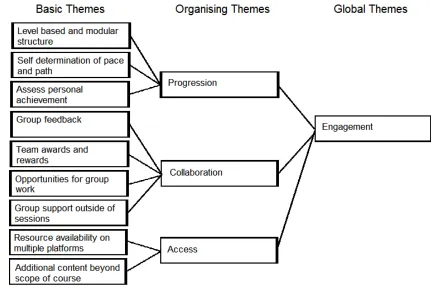
A total of six computing students studying four difference master conversion courses took part in the focus group. All six participants studied a common master module in Web Technologies and were selected using convenience sampling. The focus group was presented with a proposal for a flipped gamified classroom and questioned on its makeup. The response data from the focus group was then analysed using thematic network analysis as illustrated in Figure 3.
Figure 3. Thematic network derived from focus group data.
The results indicate that the students preferred a modular approach that
Furthermore, the students preferred resources that could be accessed using multiple platforms and allowed exploration beyond the scope of the course.
The Flipped Gamified Classroom: Design
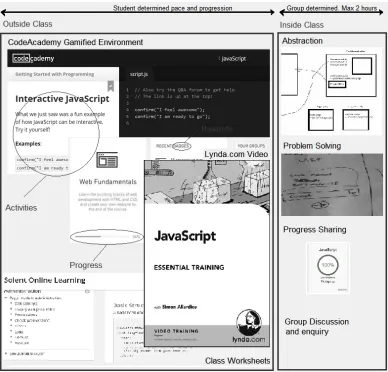
A flipped classroom was then designed based on the outcomes of the focus group and informed by the COCO framework (Butt & Wills, 2015) as
illustrated in Figure 4. Whilst this framework has been devised for evaluating collaborative serious games, it can be used to inform the design of gamified collaborative learning environments.
Figure 4. Flipped classroom design.
The flipped gamified classroom was designed for the Web Technologies module which is a common module taken by students studying computing master conversion courses at Southampton Solent University. The module is practically based and introduces students to a range of web related
technologies.
module. The environment utilises a range of game mechanics to gamify the learning experience including points, badges, progression bars, profiles, performance charts and groups. The environment also allows the sharing of progress. Suitable instructional units in Code Academy were then mapped to carefully selected videos from Lynda.com – a large and popular resource of training videos – and made available through the university’s virtual learning environment along with class notes and work sheets. In-class activities were then focused on sharing progress, group discussion and problem solving with the Web Technologies module assessment brief used to guide activities.
The Flipped Gamified Classroom: Results and Analysis
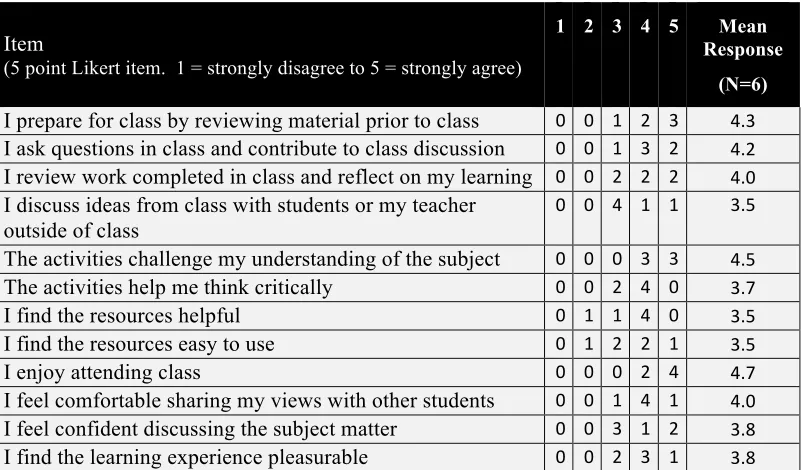
The flipped gamified classroom was introduced mid-way through the teaching period for the Web Technologies module for a six-week period. Table 2 details the results of a questionnaire completed by the students at the start of this period.
Table 2
Student Attitudes at the Start of the Flipped Gamified Classroom
Item
(5 point Likert item. 1 = strongly disagree to 5 = strongly agree)
1 2 3 4 5 Mean Response
(N=6)
I prepare for class by reviewing material prior to class 0 0 1 2 3 4.3 I ask questions in class and contribute to class discussion 0 0 1 3 2 4.2 I review work completed in class and reflect on my learning 0 0 2 2 2 4.0 I discuss ideas from class with students or my teacher
outside of class
0 0 4 1 1 3.5
The activities challenge my understanding of the subject 0 0 0 3 3 4.5 The activities help me think critically 0 0 2 4 0 3.7
I find the resources helpful 0 1 1 4 0 3.5
I find the resources easy to use 0 1 2 2 1 3.5
I enjoy attending class 0 0 0 2 4 4.7
I feel comfortable sharing my views with other students 0 0 1 4 1 4.0 I feel confident discussing the subject matter 0 0 3 1 2 3.8 I find the learning experience pleasurable 0 0 2 3 1 3.8
The results indicate the attitudes of the students before the flipped gamified classroom. They suggest that the students are generally motivated and engaged in their learning and comfortable asking questions in class and contributing to discussion. They also enjoy attending class and believe the activities challenge their understanding of the subject matter. However, only ~67% of the students felt confident discussing the subject matter and ~67% thought the resources were helpful. Furthermore, only ~33% of the students discussed ideas from class with students or the teacher outside of class.
Table 3
Student Attitudes at the End of the Flipped Gamified Classroom
Item
(5 point Likert item. 1 = strongly disagree to 5 = strongly agree)
1 2 3 4 5 Mean Response
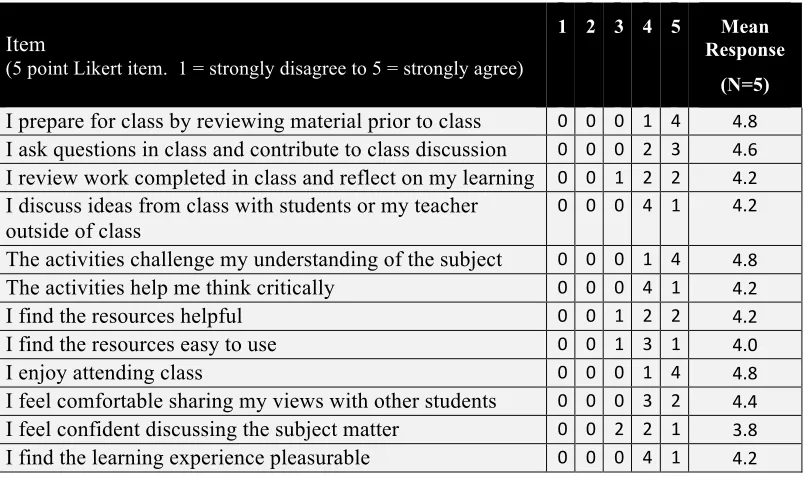
(N=5) I prepare for class by reviewing material prior to class 0 0 0 1 4 4.8 I ask questions in class and contribute to class discussion 0 0 0 2 3 4.6 I review work completed in class and reflect on my learning 0 0 1 2 2 4.2 I discuss ideas from class with students or my teacher
outside of class
0 0 0 4 1 4.2
The activities challenge my understanding of the subject 0 0 0 1 4 4.8 The activities help me think critically 0 0 0 4 1 4.2
I find the resources helpful 0 0 1 2 2 4.2
I find the resources easy to use 0 0 1 3 1 4.0
I enjoy attending class 0 0 0 1 4 4.8
I feel comfortable sharing my views with other students 0 0 0 3 2 4.4 I feel confident discussing the subject matter 0 0 2 2 1 3.8 I find the learning experience pleasurable 0 0 0 4 1 4.2
The results of Table 3 show that 100% of the students agreed or strongly agreed that they prepared for class by reviewing material prior to class, discussed ideas with students or the teacher outside of class and felt the activities helped them think critically compared to ~83%, ~33% and ~67% respectively at the start. Additionally, 100% of the students agreed or strongly agreed that they found the learning experience pleasurable compared to ~67% at the start. Whilst these results may seem encouraging they are obscured by the fact that only five out of the six students completed the second
questionnaire. As the samples are too small for reliable statistical inference to be made it can be concluded that the skew in the data is at least partly
attributable to a difference in the sample sizes.
Discussion
This study investigated the attitudes of students and teachers towards a flipped gamified classroom. Whilst the study is limited by small sample sizes and no generalisations can be made beyond the scope of this study, some interesting observations can be made. Firstly, the study considered the perceptions of students and teachers towards a flipped classroom. The findings revealed that most of the students and teachers viewed the flipped classroom favourably and even more so where they had previous experience of this approach. This is consistent with other recent studies, which have reported similar findings.
of game elements that encouraged progression, collaboration and access present the best opportunity for harnessing student motivation in a flipped classroom.
Finally, this study investigated if there was a difference between students’ attitudes towards a traditional classroom and a flipped gamified classroom. Whilst the findings were inconclusive, they do present a case for further investigation. Future research should consider student attitudes and the impact on student performance and outcome achievement in a flipped gamified
classroom.
Acknowledgements
I would like to thank each of the participants who took part in this study.
References
Attride-Stirling, J. (2001). Thematic networks: An analytic tool for qualitative research. Qualitative Research, 1(3), 385-405.
Bandura, A. (1977). Social learning theory. Englewood Cliffs, NJ: Prentice-Hall.
Braun, V., & Clarke, V. (2006). Using thematic analysis in psychology. Qualitative Research in Psychology, 3(2), 77-101.
Butt, P., & Wills, G. (2015, July). Encouraging student engagement with collaborative serious games: The COCO framework. In L. Morris & C. Tsolakidis (Eds.), Proceedings International Conference on Information Communication Technologies in Education (ICICTE) 2015 (pp. 61-70). Kos, Greece.
Goodwin, B., & Miller, K. (2013). Evidence on flipped classrooms is still coming in. Educational Leadership, 70(6), 78-80.
Osman, S. Z. M., Jamaludin, R., & Mokhtar, N. E. (2014). Flipped classroom and traditional classroom: Lecturer and student perceptions between two learning cultures, a case study at Malaysian Polytechnic. International Education Research, 2(4), 16-25.
Piaget, J. (1967). Six psychological studies. New York, NY: Random House. Vygotsky, L. S. (1978). Mind in society: Development of higher psychological
processes. Cambridge, MA: Harvard University Press.
Yujing, N. (2015). Influence of flipped classroom on learner's empowerment – A study based on English writing courses in China. Journal of Literature, Languages and Linguistics, 12, 1-7.
Author Details Prins Butt