THE USE AND EFFECT OF COMIC BOOK READING ON THE READING ATTITUDES AND READING HABITS OF GREEK (TYPICALLY DEVELOPED AND DYSLEXIC) EFL LEARNERS IN A MIXED ABILITY EFL CLASSROOM
ATHANASIA – IOANNA KARADIMA
A thesis submitted in partial fulfillment of the requirements
of the University of Bolton
for the degree of Master of Philosophy (Innovation) in Special Needs
TABLE OF CONTENTS
ABSTRACT vi
QUOTE vii
DEDICATION viii
ACKNOWLEDGEMENT ix
INTRODUCTION 1
Rationale 1
Motivation of the Study 4
Description of the Thesis 5
Chapter 1: REVIEW OF THE LITERATURE
6
1 – READING AND LITERACY 7
1.1 Overview of Reading and Literacy 7 1.2 Dyslexia and Its Implications for Reading 9
1.2.1 Dyslexia as a 'Gift' 9
1.2.2 Difficulty to Distinguish Dyslexia from Difficulties Presented when Learning an L2
10 1.3 Mixed Ability Classroom – Inclusion 11 1.4 EFL Teaching and Learning in Greece 12
1.5 Reading for Pleasure 14
1.6 Flow Experience 15
1.7 Aliteracy 15
1.8 Extensive Reading 16
1.8.1 Benefits of Extensive Reading 18 2 – TRANSFER OF L1-L2 SKILLS AND ATTITUDES 19
2.1 L1-L2 Transfer of Skills 19
2.1.1 Theories and Hypotheses of L1-L2 Skill Transfer 20 2.1.2 L1-L2 Skill Transfer Theories and Hypotheses for
Dyslexic Learners 20
2.2 L1-L2 Transfer of Attitudes 20
3 – READING ATTITUDES, MOTIVATION AND READING HABITS 21 3.1 Reading Attitude Definitions and Theories 22 3.2 Implications of Reading Attitudes on Successful Reading 23 3.2.1 Attitude and Reading in the L2 24
3.3 Motivation 25
3.4 Reading Habits 26
3.4.1 Definitions of (Positive) Reading Habits 26
3.4.2 Interest 27
3.4.2.1 Dyslexia and Interest 28 3.4.3 Time and Quantity of Reading 29 3.4.4 Book Choice and Book Ownership 30 3.4.5 Library and Bookstore Visits 30
4 – VISUALS AND VISUAL LITERACY 31
4.1 Definitions of Visual Literacy 32 4.2 Paivio's Dual Coding Theory (DCT) 32 4.3 The Benefits of Visuals in Reading 33
5 – COMIC BOOKS 34
5.1Comics’ Definitions and Features
5.2 The Benefits of Using and Reading Comics 35 34 5.2.1 Benefits of Comic Book Reading in the L2 and
for the L2
36 5.3 Comic Books, Attitudes and Motivation 37 5.4 Comic Books and Reading Habits 38 5.5 Comic Book Reading Could Lead to the Reading of More Advanced and Demanding Texts
38 6 – INFLUENCES ON READING ATTITUDES AND READING
HABITS 39
6.1 Parental Influence on Reading Attitudes 39 6.2 Parental Influence on Reading Habits 40 6.3 Teacher Influence on Reading Attitudes 40 6.4 Teacher Influence on Reading Habits 41
6.5 Peer Influence 41
7 – RESEARCH HYPOTHESES AND QUESTIONS 42
Chapter 2: METHODOLOGY 43
1 – METHODS 43
1.1 (Multiple) Case Study Method 43
1.2 Action Research 44
2 – RESEARCH TOOLS 45
2.1 Data Collection Tools 46
2.1.1 Interviews 46
2.1.1.1 Pre-Semi-Structured / Focused Interviews 47 2.1.1.1.a Parents 47 2.1.1.1.b Students 47 2.1.1.1.c Teacher 47 2.1.1.2 Focus Group Interviews – Literature Circle
Discussion Groups
47 2.1.2 Elementary Reading Attitude Survey (ERAS)
McKenna and Kear, 1990 49 2.1.3 Participant Observations and Field Notes 49 2.1.4 Post-Targeted Questionnaires 50
2.1.4.1 Parents 50
2.1.4.2 Students 50
2.1.4.3 Teacher 51
2.2 Selection of Teaching Materials 51
2.2.1 Comics Utilized 51
2.2.2 Temporary Comic Book Borrowing Library 52
3 – PROCEDURE 52
3.1 Sampling 52
3.1.1 School Sampling 52
3.1.2 Participant Sampling 53
3.2 L2 Considerations 53
3.3 Ethical Issues and Considerations 53
3.5 Timeline and Procedure Description 55
4 – DATA ANALYSIS 57
4.1 Description of Analysis Process 58 4.1.1 Quantitative Data Analysis 58 4.1.2 Qualitative Data Analysis 59
Chapter 3: ANALYSIS 60
3.1 Initial Representation of Students' Reading Attitudes and Habits
60 3.1.1 Pre-Semi Structured / Focused Interviews 60 3.1.1.1 Reading Attitudes 62 3.1.1.2 Reading Habits 67 3.1.1.2.a Amount of Books and Time Spent
Pleasure Reading and Preferences 68 3.1.1.2.b Bookstores / Libraries / Book
3.1.1.2.c Reading Comic Books 69 68
3.2 Student Case Studies 71
3.2.1 Case 1 – Student1 71
3.2.1.1 ERAS and Pre-Interviews 72 3.2.1.2 Discussion Groups 73 3.2.1.3 Post-Questionnaires 76
3.2.2 Case 2 – Student4 77
3.2.2.1 ERAS and Pre-Interviews 77 3.2.2.2 Discussion Groups 79 3.2.2.3 Post-Questionnaires 81
3.2.3 Case 3 – Student3 82
3.2.3.1 ERAS and Pre-Interviews 83 3.2.3.2 Discussion Groups 85 3.2.3.3 Post-Questionnaires 87
3.2.4 Case 4 – Student8 88
3.2.4.1 ERAS and Pre-Questionnaires 88 3.2.4.2 Discussion Groups 90 3.2.4.3 Post-Questionnaires 92 3.3 Classroom Discussion Groups, Observations and
Field Notes
93
3.3.1 Comic Book 1 Pt.1 94
3.3.2 Comic Book 1 Pt.2 97
3.3.3 Comic Book 2 Pt.1 99
3.3.4 Comic Book 2 Pt.2 101
3.3.5 Comic Book 3 Pt.1 103
3.3.6 Comic Book 3 Pt.2 104
3.3.7 Comic Book 4 Pt.1 107
3.3.8 Comic Book 4 Pt. 2 109
3.4 Perceived Effects Derived from Post-Targeted Questionnaires
111
Chapter 4: DISCUSSION 117
4.2 Research Question 2 118 4.3 Research Question 3 (and Research Hypotheses b and c) 120
4.3.1 Reading Attitudes 120
4.3.2 Reading Habits 122
4.3.3 Other Skills and Findings 124 4.3.3.1 Vocabulary and Oral Skills 124 4.3.3.2 Reading Speeds 124 4.3.3.3 Reading Comprehension 125 4.3.3.4 Mental Schemata 125
4.3.3.5 Influences 126
4.3.3.6 Transfer
4.3.3.7 Interest 127
Chapter 5: CONCLUSION 129 128
5.1 Pedagogical Implications 130
5.1.1 Comic Book Reading 130
5.1.2 (Comic Book) (Extensive) Silent Reading 130 5.1.3 Literature Circle Discussion Groups 131 5.1.4 (Comic Book) Borrowing Library 132
5.2 Limitations 133
5.2.1 Methodological Limitations 133
5.2.2 Other Limitations 134
5.3 Suggestions for Future Studies and Research 135
5.4 Final Considerations 136
List of References 138
Appendices 159
List of Tables
Table 1: Contents and Structure of Literature Review 6 Table 2: Data Collection Tools and Teaching Materials 45
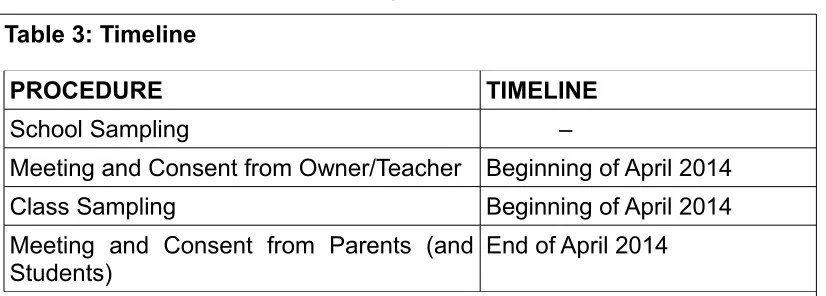
Table 3: Timeline 54
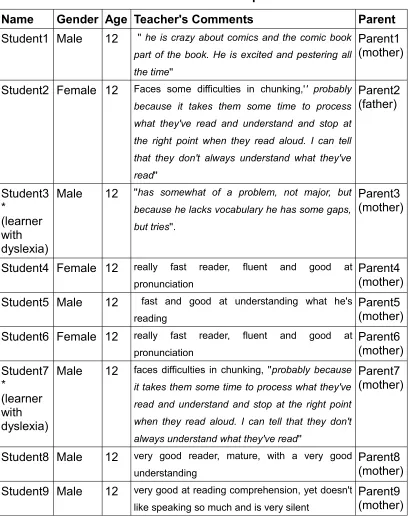
Table 4: Data Collection Tools and their Analysis Tools 57 Table 5: An Introduction of the Students and Parents 61
Table 6: An Overview of Students' ERAS Scores 62
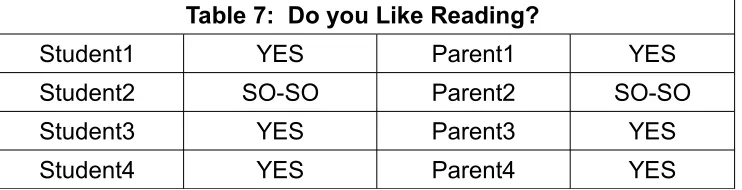
Table 7: Do you like reading? 62
Table 8: Parents: Do you believe your child likes reading? – Students: Do you like reading?
63
Table 9: Do you believe you are a good reader? 65 Table 10: Students: Do you believe you have reading difficulties? – Parents: Do you believe your child has reading difficulties?
66
Table 11: Amount of Books and Time Spent Pleasure Reading and
Table 12: Comic Reading Habits 70
Table 13: Case 1 – Student1 71
Table 14: Case 2 – Student4 77
Table 15: Case 3 – Student3 82
Table 16: Case 4 – Student8 88
Table 17: Did you enjoy the comic book reading process? On a scale of 1 to 5, with 5 being the most and 1 being the least, how much did you enjoy it?
111
Table 18: Did you enjoy the comic book borrowing library? On a scale of 1 to 5, with 5 being the most and 1 being the least, how much did you enjoy it?
112
Table 19: Do you enjoy reading more? – Do you enjoy reading in English more?
115
ABSTRACT
A limitation of (EFL) teaching, especially in the Greek context and in a mixed ability classroom, is not only that pleasure reading is somewhat marginalized, but, most importantly the significance of reading attitudes and subsequent reading habits, generally, are not factored.
This study reports on an investigation of 9 Greek, dyslexic and typically developed, EFL learners' (L2) reading attitudes and habits within a mixed ability EFL classroom, aiming at identifying the perceived effect(s) that the use and reading of comic books had on them.
A case study method was employed whereby multiple tools of data collection were used across 6 weeks during Spring 2014. Tools included: McKenna and Kear's (1990) Elementary Reading Attitude Survey (ERAS), Semi-Structured, Focused Interviews, Targeted Questionnaires, Field Notes derived from Participant Observations, and Focus Group-like Literature Circle Discussion Groups. The data were analyzed descriptively using SPSS (quantitative data) and content analysis (qualitative data).
Findings suggest that participants, dyslexic and typical, held mostly positive, yet, utilitarian views of English reading and learning, and did not generally engage in English pleasure reading, despite mostly liking reading and learning English. Moreover, by the end of the study, extensive comic reading was shown to be an effective means by which to engage learners in reading and reading-related practices, such as active participation in Literature Circle Discussion Groups and a comic book borrowing library. Additional findings indicate that most participants were gradually more interested, enthusiastic, willing and dynamic in their participation, providing longer, more accurate responses as the study progressed. Upon completion of the study, practically all students, as well as their parents and EFL teacher supported witnessing some beneficial effect on the students' reading attitudes and habits.
The data lends itself to the conclusion that extensive comic reading and comic-related reading practices may be of benefit to developing positive reading attitudes and habits to English reading, as well as numerous other skills, indirectly and/or directly, effected and enhanced via the procedures (reading speeds, comprehension, oral and vocabulary skills and positive group dynamics).
'' And what is the use of a book,'' thought
Alice,''without pictures or conversation?''
DEDICATION
To my Family,
ACKNOWLEDGEMENTS
I would like to take this moment to thank my parents, Christos and Lisa, for instilling in me the love of learning and education and being beside me every step of the way. You have always believed in me and have inspired me to pursue my dreams and aspirations. You are wonderful parents and beautiful people.
To my sisters, Sofia and Pam, I am so honored to have the best sisters and friends anyone could ask for. You inspire and motivate me. Thank you for your support, understanding and love.
I would like to wholeheartedly thank my supervisor, Dr. Angeliki Triantafyllaki. I wish I had met you sooner. I am so unbelievably grateful for all your support, advice, guidance, effort, kindness and patience. I couldn't have done this without you. You were a blessing.
Special thanks to Dr. David Kitchener, for all his advice and support throughout this process, even from afar.
To Mrs. Eleni Kambadaki, your faith in me and kindness is what made this study happen. You are an amazing person and a wonderful teacher. I am lucky to have met you. Thank you for everything.
Thank you to Mrs. Sissy Eufthmiadou for all her help and kindness.
To the parents and students partaking in this study, thank you for being so gracious and supportive. People and students like you are who inspire me as a teacher.
INTRODUCTION Rationale
In Greece, English is taught as a second/foreign language, with a primary focus on the development of the language skills of its learners, and not so much taking into account what and how they feel towards learning. A likely reason for this could be that English learning is primarily taken up for extrinsic reasons, either from family and/or societal prerequisites and pressures, in order to enhance opportunities in future academic and professional spheres whether in Greece or abroad.
Globalization mandates that Greek learners use English in their daily lives, from watching television and movies, to music and the ever-growing use of social media. English has become so intertwined in modern Greek culture and life, that there is even a term that recently surfaced, coined Greeklish, where Greeks use the Latin alphabet to write texts in Greek by relating the English alphabet to Greek alphabet letter sounds.
Although seemingly trivial, this is an important indication that Greeks are not only using, but also 'reading' more English, creating all the more of a necessity to be literate and skilled in their use and knowledge of the English language and its various applications. Engaging in authentic texts, however, has not been of primary focus in EFL education in Greece. In most situations, course book material focusing on linguistic, grammatical and vocabulary skills are adhered to religiously. As such, most EFL learners have come into contact with the language in more sterile and uninspiring teaching and learning settings.
Stemming from this, reading should not merely be considered a sterile activity solely associated with mandatory (school) work. In fact, it has been claimed that reading for pleasure has numerous positive effects ranging from reading rates and comprehension, vocabulary increase, to the improvement of reading attitudes and elevated feelings of self-esteem (Javid and Al-Khairi, 2011), in the L1 and L2 for typical and dyslexic learners alike.
It is important, moreover, to foster positive reading attitudes and good reading habits, especially in terms of pleasure reading, as a growing detachment towards and limited engagement in reading, not due to lack of skill, but rather because of one's choice to not engage in the activity, has led contemporary generations to be characterized as not illiterate, but, indeed, aliterate. Studies have, indeed, shown that secondary level students also have been losing interest in reading due to negative attitudes, low levels of motivation and the effect of videos and computer games (Olufowobi et al, 2011).
An effective means by which one could deflect the negative impacts of aliteracy and advance (pleasure) reading is extensive reading either or both in the L1 and L2. Extensive reading is defined as '' quantitative reading in the second language (l2) for a lengthy period of time for personal pleasure without the addition of productive tasks to follow-up language work''. This is unlike most reading practices and activities commonly used in the regular and/or L2 classroom (Hafiz and Tudor,1989 in Ro, 2013) as the main goal of extensive, pleasure reading is not deliberate, but indeed it focuses on incidental learning and on meaning-focused exercises that aid in ''gaining content matter knowledge, skill improvement and enjoyment''(Grabe and Stoller,2002;Nation, 2007 in Ro, 2013). In other words, as positive reading attitudes enhance reading motivation, they also likely lead to the desire to continue pursuing reading, ultimately leading to the creation of good reading habits (in Yamashita, 2013).
the time s/he participates in the activity, directly translating into whether or not and to what extent a habit is also created. Good reading habits, however, as well as positive reading attitudes will not be formed if the learner is not interested; the significance of interest being that when someone is genuinely interested in an activity and/or topic, they are far more likely to return to it regularly and divulge more time and effort in its practice. It is important, if not vital, as such to ignite learners' interest as well as to cater to their interests whenever and to whatever extent possible in order to aid in the fostering of positive (reading) attitudes and habits.
To this end, the current investigation introduces English comic book reading to an EFL class of 9 Greek EFL students, in order to study their effect on their reading attitudes and habits. Generally speaking, comics are appealing to readers of practically any age or level, since they contain realistic displays of dialogue and culture (Davis, 1997 in Drolet, 2010), and are widely accessible reading materials, since the visual messages are accompanied and assisted by short and simple pieces of text (Tiemensma,2009), written in mostly the authentic and colloquial language of everyday conversation. Moreover, comics could be considered a stepping stone for more complex, advanced reading (Cary, 2004 in Jones, 2010; Krashen,1993 in Javid and Al-Khairi, 2011).Yet, although relevant studies of comic book reading and motivation have been conducted by Norton (2003) and Versaci (2001), fewer studies have focused on comic book reading with ELF dyslexic and mixed ability learners, and none have as yet been conducted in the Greek context of EFL teaching and learning.
Put more simply, the difficulties learners face in L2 learning can not only easily mask dyslexic symptoms, but also, be confused for dyslexia
This study aims to address these gaps in the literature by investigating (L2) reading attitudes and habits via the use and reading of comics. The study takes place in an EFL school in Athens with 9 Greek EFL students, 7 typical and 2 dyslexic, participating in a voluntary, post-typical EFL class, extensive comic book reading workshop of sorts, for 4 weeks.
Motivation of the study
On a more personal note, being both a native speaker of English and an English teacher this research was of genuine interest to my teaching practice. As a foreign language teacher, I have indicated gaps in the curriculum and teaching methods in terms of reading and pleasure reading, as EFL teaching is primarily focused on the development of vocabulary and grammar skills. This takes on additional significance when considering that learners' attitudes and interests are not generally accounted for in (L2) reading and learning. As such, learners are at risk of becoming passive and uninspired in their learning, especially dyslexic learners, with likely lifelong and far-reaching effects on their skill, attitudes and habits.
For a long time I have felt uncomfortable with such realizations in my practice, and consider it my responsibility to adapt my teaching to accommodate my learners' needs, learning styles and preferences in order for them to reach their fullest potential, by integrating more innovative practices and materials into my lessons.
As such, having been an avid reader of comics throughout my life and development as a reader myself, it was significant to me to investigate their use and the effect on others, most importantly, of emerging EFL typical and dyslexic readers, possibly igniting within them the love and appreciation of both the comic book genre itself, but also, and maybe even more importantly, the motivation to continue in their pursuit of reading in general.
reading habits is the motivating force behind not only this study, but also my teaching philosophy and practice.
Description of the Thesis
This thesis continues in 5 further chapters. Chapter 1, provides an overview of the representative research in the related fields of the study, with sections covering reading and literacy, reading attitudes, motivation and habits and L1-L2 transfer of skills and attitudes, as well as visuals, comic book reading and influences on reading attitudes and habits, and their subsequent benefits and implications. Chapter 2 presents the methodology used in terms of rationale, design and procedures. Chapter 3 reports on the findings of the study in accordance to the research hypotheses and questions. Chapter 4 provides an interpretation and discussion of the findings, while, Chapter 5, the Conclusion discusses teaching and learning implications, suggestions for future research and the study's limitations.
CHAPTER 1 – REVIEW OF THE LITERATURE
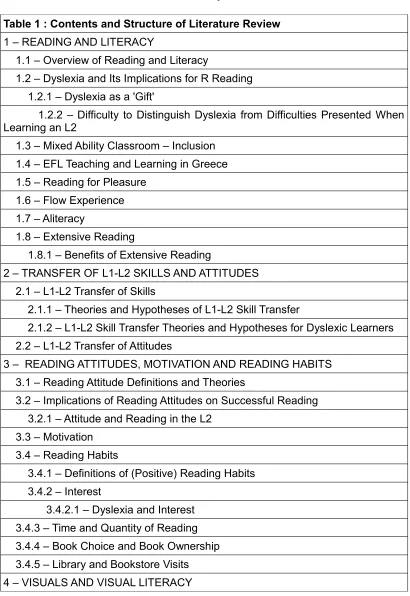
This chapter will present a review of the literature. It is separated into 6 broader categories, and subsequently divided into smaller and more specific and detailed sub-sections, as indicated by Table 1:
Table 1 : Contents and Structure of Literature Review
1 – READING AND LITERACY
1.1 – Overview of Reading and Literacy
1.2 – Dyslexia and Its Implications for R Reading 1.2.1 – Dyslexia as a 'Gift'
1.2.2 – Difficulty to Distinguish Dyslexia from Difficulties Presented When Learning an L2
1.3 – Mixed Ability Classroom – Inclusion 1.4 – EFL Teaching and Learning in Greece 1.5 – Reading for Pleasure
1.6 – Flow Experience 1.7 – Aliteracy
1.8 – Extensive Reading
1.8.1 – Benefits of Extensive Reading
2 – TRANSFER OF L1-L2 SKILLS AND ATTITUDES 2.1 – L1-L2 Transfer of Skills
2.1.1 – Theories and Hypotheses of L1-L2 Skill Transfer
2.1.2 – L1-L2 Skill Transfer Theories and Hypotheses for Dyslexic Learners 2.2 – L1-L2 Transfer of Attitudes
3 – READING ATTITUDES, MOTIVATION AND READING HABITS 3.1 – Reading Attitude Definitions and Theories
3.2 – Implications of Reading Attitudes on Successful Reading 3.2.1 – Attitude and Reading in the L2
3.3 – Motivation 3.4 – Reading Habits
3.4.1 – Definitions of (Positive) Reading Habits 3.4.2 – Interest
4.1 – Definitions of Visual Literacy 4.2 – Paivio's Dual Coding Theory (DCT) 4.3 – The Benefits of Visuals in Reading 4.4 – Visuals and Dyslexia
5 – COMIC BOOKS
5.1 – Comics’ Definitions and Features
5.2 – The Benefits of Using and Reading Comics
5.2.1 – Benefits of Comic Book Reading in the L2 and for the L2 5.3 – Comic Books, Attitudes and Motivation
5.4 – Comic Books and Reading Habits
5.5 – Comic Book Reading Could Lead to the Reading of More Advanced and Demanding Texts
6 – INFLUENCES ON READING ATTITUDES AND READING HABITS 6.1 – Parental Influence on Reading Attitudes
6.2 – Parental Influence on Reading Habits 6.3 – Teacher Influence on Reading Attitudes 6.4 – Teacher Influence on Reading Habits 6.5 – Peer Influence
7 – RESEARCH HYPOTHESES AND QUESTIONS
1 – READING AND LITERACY
This section discusses aspects relating to literacy and various forms of reading, including extensive and pleasure reading, and their benefits, as well as dyslexia and the implications it has on reading skills, performance and experiences, in the L1 and L2. Furthermore, mixed and ability classrooms and inclusion, as well as EFL teaching and learning contexts in Greece are presented.
1.1 Overview of Reading and Literacy
The importance of reading lies in the fact that as a skill it is critical to the development and ultimate ''attainment of literacy '' as disclosed by Olufowobi et al (2011). In fact, reading is the very bedrock of literacy. However, before one can discuss the significance of reading as a part of literacy, we must first define it.
Nations Educational, Scientific and Cultural Organization (UNESCO), adds that literacy entails one's ''ability to identify, understand, interpret, create, communicate, compute and use printed and written materials associated with varying contexts'' (Olufowobi et al, 2011). Having such skill learners can access and expand the realms of their thought and learning, and gain a deeper understanding of various forms and ways of life, thought and behaviors.
As Wang (2000) has supported, a child's development of literacy is a determining factor in its achievement of both reading and writing (in Parker, 2004), displaying once more the significant role literacy plays in a learner's development and success. Reading, however, in specific, as defined by Venkateswaran (1995), is a ''psycholinguistic process by which the reader reconstructs a message, which has been encoded by a writer.'' It is furthermore, considered an interactive process, combining '' background knowledge, conceptual abilities and learning strategies'' (in Javid and Al-Khairi, 2011).
This study is primarily concerned with reading in the second/foreign language. A gap in the literature on the influence of L1 literacy and L2 reading has been displayed until relatively recently, when studies such as Bernhardt (2005) and Koda (2005;2007 in Jiang, 2011), claimed an important influence of L1 literacy skills and knowledge on the subsequent development of L2 reading. Additionally, when learners are competent readers, in the L1, they possess knowledge of numerous aspects related to reading, allowing the application of such skills and subsequently developing similar abilities and vast a knowledge base in an L2, respectively (Moll,1994; Peregoy and Boyle,2000 in Jiang, 2011).
1.2 Dyslexia and Its Implications for Reading
However, not all readers are as successful, as numerous factors can pose difficulties, ultimately affecting their literacy levels and acquisition. Such is the case of dyslexic learners.
Defining dyslexia is no easy task, since there are more than one definitions, most of which are deficit-centered, yet,'' there are many definitions of dyslexia but no consensus […] 'dyslexia' is not one thing but many'' (Rice and Brooks, 2004 in Elliott and Gibbs, 2008). It would be preferred, therefore, to be defined as Reid(2009) has: as ''a processing difference, often characterised by difficulties in literacy acquisition affecting reading, writing and spelling. It can also have an impact on cognitive processes such as memory, speed of processing, time management, co-ordination and automaticity. There may be visual and/or phonological difficulties and there are usually some discrepancies in educational performances. There will be individual differences and individual variation''. Another more accommodating and palatable definition of dyslexia is by Crombie (2002a), who chose to focus not so much on the deficits and difficulties entailed by dyslexia, but, in fact, on the various adaptations and accommodations which can be made to better aid such learners:
Dyslexia is a difficulty with literacy which results in a person requiring a set of accommodations to be made to enable them to demonstrate their abilities. Accommodations can be defined as a set of enabling arrangements that are put in place to ensure that the dyslexic person can demonstrate their strengths and abilities and show attainment (in Clark, 2003 in Reid, 2009).
1.2.1 Dyslexia as a 'Gift'
On the other hand, and on a similar note with Crombie (2002a), it has been supported that dyslexia is a 'gift' of sorts, since it is supported that '' the mental function that causes dyslexia is a gift in the truest sense of the word: a natural ability, a talent. It is something special that enhances the individual''.
and ''a product of thought and a special way of reacting to the feeling of confusion'' (Davis and Braun,1997). In reality, such a claim bares some validity for a number of renowned individuals are dyslexic and have excelled in their respective fields.
1.2.2 Difficulty to Distinguish Dyslexia from Difficulties Presented When Learning a L2
Although, there has been growing interest in the field of L2/ESL learning, it is generally accepted that there is only some international literature and research done in terms of L2 learning and dyslexia as well as in L2 reading and dyslexia (Wydell and Butterworth,1999 in Ghonsooly and Javadian,2010; Peer and Reid,2000 in Helland and Kaasa,2005; Ho and Fong,2005). A statement further supported by the fact that in terms of dyslexia diagnostic testing there is yet an ''assessment tool for L2 skills in dyslexia'' (Helland and Kaasa, 2005).
This, in turn, makes distinguishing dyslexia and common difficulties learners face in foreign language a challenge, for, as Hall(2001) supports ''SpLD/dyslexia is hard to identify in children learning English as a second language as there is a high risk of either attributing a learner's difficulties to second language acquisition, or schools not recognising a child's underlying abilities...'', and vice versa. In other words, difficulties learners display in L2 learning can easily mask and/or be confused with dyslexic traits.
It is of particular interest to the study, which comprised of two dyslexic EFL learners, to investigate their reading attitudes and habits in relation to mostly extracurricular, pleasurable reading. Furthermore, as this study is focused on both typical and dyslexic students in an EFL classroom who also differ on many other aspects, is by definition a mixed abilities and inclusive classroom, the following section outlines its definition and parameters.
1.3 Mixed Ability Classroom – Inclusion
'' Every class we ever teach is mixed ability'', states Richards(1998), since every learner is unique in their skills, learning style and preferences, linguistic background, knowledge and experiences, and brings something different to the classroom community mosaic (in Xanthou and Pavlou, 2010).
In fact, whether L1 or L2, a mixed ability classroom, as the one in this study, has been defined by Bremmer (2008): '' a mixed ability class does not just consist of a range of abilities but also a range of learning styles and preferences. All pupils will show strengths at different times depending on the topic being studied and the learning style being used […] All classes even those that have been set are mixed ability to a certain level'' (in Xanthou and Pavlou, 2010), whether they have learners with learning difficulties or not. As such, this displays the notion of equality and camaraderie in learning, where all students have an opportunity to equally participate, contribute and develop as learners in skill, self-esteem and accomplishment. This position further negates the segregation, official or otherwise, that exists in the classroom, not only between learners with difficulties and typical, but also between more motivated and more reluctant participants, the quicker and slower attainers, and the more or less skilled.
Salli-Copur(2005) (in Xanthou and Pavlou, 2010).
Multilevel, mixed ability classes can develop learners as the adaptations used could be of benefit to all learners as they develop their learning styles to accommodate all the learners, thus becoming more independent in their learning as well as building solid partnerships in the classroom. That is, students can learn from each others' strengths and weaker points, and learn compensation skills and strategies from one another, creating learning communities based on peer acceptance and peer learning (Xanthou and Pavlou, 2010).
As the theory above indicates, the class sampled and participating in this study is a mixed ability, inclusive classroom in more than one sense, since the students vary in language ability, level of fluency and gender, and two learners are dyslexic. Additionally, upon analysis of the data, the variation between students also extends to differing English learning motivations and reading attitudes, habits and preferences.
Since the study is based in Greece and the Greek EFL teaching and learning curriculum, the following section presents some of its main considerations.
1.4 EFL Teaching and Learning in Greece
Greece depends on a mostly tourism-based economy; as such, the vast majority of its citizens speak English to some level. The younger generations, much more so, due to the influence and use of the media and social media are indirectly coming into contact with English, but also being direct learners of English as their second/foreign language, in both the public school system and private EFL tutoring institutions.
primary/elementary school. Now, more innovative approaches are being applied and English is being taught in public schools as early as first and second grade.
On the other hand, in the private sector in Greece, on average, children begin learning English as a second/foreign language in the third grade of primary/elementary school. In most private EFL tutoring schools, teaching has taken a mostly utilitarian form. One of the primary objectives of such teaching, in most cases, is to teach the foreign language to levels of proficiency, in order to qualify for English level certification exams; an objective also enforced by parents. As such, the motivation behind EFL learning in Greece is mostly extrinsic, for practical reasons, such as employment requirements. Proof of this is the extensive focus on the development of grammatical and syntactical skills, as well as vocabulary, via the use of companions and dictionaries.
Some, more innovative EFL schools have begun integrating more communicative, and even, multimodal and multisensory techniques and tools for EFL teaching, so as to not only teach English as a skill, but also acquaint its learners with its culture and people. Also, EFL publication houses in Greece are designing books and accompanying materials that are attempting to develop more than EFL learners' language-based skills, by including a wide array of topics of interest and importance, project-based learning, the use of the Internet, multimedia and interactive white boards; approaches also beginning to be adopted and applied in the Greek public school system's EFL classes as well. Therefore, teaching English as an FL/L2 in Greece in accordance with European Union regulations and standards, in the private and public school system's English courses, is gradually expanding from simply knowing the language to developing knowledge about both the structure and function of the language in different social and communicative contexts. That is, integrating linguistic awareness, inter-cultural awareness, as well as interlocutory skills.
book reading on the reading attitudes of Greek learners, both typical and dyslexic. Comic book reading could be a complementary tool for the advancement of both habits and attitudes, as well as skills, if used as additional materials in the class, as extracurricular reading or the basis of projects or research, the topic of discussion, etc. or should they officially be integrated in some manner in course books, in either or both sectors.
For details and additional information, one could advise ''The New School/New Curriculum '' initiative brought forth in Greece since 2007, in a joint effort of the Greek Ministry of Education, the Greek Pedagogical Institute and the European Union, which proposes a common and uniform curriculum which is to be used as a tool for the systematic teaching and learning of the FL as a medium of culture, as its main objective is to prepare learners to function in the modern polyglot and multicultural society and foster intercultural awareness. As such, it clearly outlines what is to be achieved and learned at each level of foreign language education without specifying how. Thus, it allows for some freedom of interpretation according to individual and unique class and student needs. More information could be found in Appendix 11.
1.5 Reading for Pleasure
Reading as both a skill and activity has long been of importance and interest to research. As a skill it is not only useful, but necessary. So is its enjoyment. An important aspect of this study, as it investigates the use and effects of a pleasurable reading form in a somewhat extracurricular setting on the reading attitudes and habits of dyslexic and typical EFL readers.
study by Ogle et al (2003), has found that pleasure reading, especially of fiction, could be deemed an indicator of one's reading attainment and achievement. Their finding is based on the logic that when a reader engages in extracurricular reading, they will consequently employ their various reading skills and strategies much more, and in turn, advance their reading ability compared to students who do not read for pleasure (in Donaldson, 2010).
Pleasure reading is both the product and the influencer of positive feelings readers experience prior, during and after their reading. This is significant to this study since it is investigating pleasurable, comic book reading in an after-school reading workshop of sorts, not directly related to academic-related reading.
1.6 Flow Experience
Reading can be such pleasurable an experience and activity that the reader can become so engrossed and mesmerized, in their reading and the imaginary (or not) worlds and characters described, that they can lose their notion of time, space and even self.
This experience has been coined by Csikszentmihalyi (1987) (in Wigfield,1997 in Covert, 2009) as the ''Flow Experience'', which could forge avid, devoted readers, supported by Nakamura and Csikszentmihalyi(2002), as readers become eager to return to such a pleasurable state.
Flow experience is important to this study as it seeks to investigate the undercurrents of reading attitude and reading habit, and flow is a significant part of pleasure reading. Also, it could be a factor which could cause a reader to approach and continue pursuing reading, much more so in the L2 and for dyslexic learners which are the focus of the research.
1.7 Aliteracy
Such limited engagement in reading, nee for pleasure, has caused contemporary generations to be characterized as not illiterate, but, indeed, aliterate.
The Merriam-Webster dictionary has defined aliteracy as '' the quality or state of being able to read but uninterested in doing so''; while, Olufowobi et al (2011) have claimed that it is ''a reading problem which occurs when reading ability can no more be matched by reading desire''. That is, a person is considered literate in terms of ability but reading, as pertinent to this study, is considered a strenuous and/or uninteresting activity, a mandatory task or chore and not pleasurable, interesting and/or meaningful.
This uninterested demeanor does not merely relate to extracurricular, pleasure reading, but could also be translated to academic reading, as studies have indicated that secondary level students have been losing interest in reading due to negative attitudes, low levels of motivation and the effect of videos and computer games (Olufowobi et al, 2011). In other words, individuals are able to read, but choose not to in order to partake in other activities.
The notion of aliteracy is of importance to the study, although not examined in particular, as it may be an additional indicator of reading habits and attitudes, in terms of whether or not the participants in their free time choose to read for pleasure or engage in some other activity. The same issue was investigated in terms of their parents and teacher.
1.8 Extensive Reading
Pleasure reading should not be solely considered an extracurricular activity, for its benefits extend beyond merely bringing pleasure as a pass-time to the reader. It should, and does in some cases, have a place within the curriculum mostly via Extensive Reading programs. This study could be considered an extensive reading program of sorts, as it is grounded in many of the practice's theoretical and practical underpinnings.
vocabulary and improvement of spelling, grammar and various other linguistic skills (in Yamashita, 2013). Indeed, in theory, Extensive Reading or ER has claimed benefits including the promotion of positive reading habits, increase of vocabulary and improvement of knowledge of structure, and fostering of the enjoyment of reading. (Richards and Schmidt 2002 in Yamashita, 2013).
Hafiz and Tudor (1989) have defined ER as ''quantitative reading in the second language for a lengthy period of time for personal pleasure without the addition of productive tasks to follow-up language work'', unlike most reading practices and activities commonly used in the regular and/or L2 classroom (in Ro,2013) as its main goal is not deliberate, but incidental learning (Grabe and Stoller, 2002 in Ro, 2013), and on meaning-focused exercises that aid in ''gaining content matter knowledge, skill improvement and enjoyment'' (Nation, 2007 in Ro,2013).
Day and Bamford (2002), have outlined the basic parameters of extensive reading, according to whom the texts used are supposed to be accessible and widely varied in topic, while students both choose their materials and do as much reading as possible. Reading, moreover, is faster in pace, individual and silently conducted, its purpose being enjoyment, gaining information and/or deriving an understanding of the text. As such, reading is done mostly for pleasure and less for strict academic purposes. In turn, it is continued reading and individual responses to the texts that are focused on rather than the provision of correct answers (Yamashita,2013).
1.8.1 Benefits of Extensive Reading
Indeed, numerous studies, a detailed overview of which could be found in the work of Yamashita (2008;2013) and Javid and Al-Khairi (2011), have clearly demonstrated the various advantages of ER to the reader in both the L1 and L2 contexts.
Some of the most prominent benefits for ER participants being the improvement of reading comprehension, reading speeds and reading fluency , as well as an increase in vocabulary (Yamashita,2008;2013). Moreover, enhancements of both writing and grammar skills have been presented. Gains have also been claimed in terms of forming positive reading habits and in the affective domain of reading, since participants no longer fear neither evaluation nor peer and/or teacher criticism, it could be seen as promoting positive reading attitudes, increasing motivation to continue reading, sometimes even more demanding materials, promoting schema activation and use and improving comprehension (Yamashita, 2013). Concerning the L2, Extensive Reading has been suggested to aid in general L2 proficiency, as well as in a collection of various L2 skills.
2 – TRANSFER OF L1-L2 SKILLS AND ATTITUDES
In this section the issue of transfer is discussed. Transfer either of skill or attitude, or both, is of importance to this study, not because it is a phenomenon extensively investigated, but it is not unlikely that some level of transfer, negative or positive, could have some implications on the participants' reading attitude and habits in the L1 and L2. Furthermore, it could be suggested that beneficial effects of extensive comic book pleasurable reading could be affected by L1 attitudes and/or skills; or reversely, more positive (or negative) attitudes and/or skills in the L2 could similarly impact the L1.
2.1 L1-L2 Transfer of Skills
It has been supported that skills in one's native language, could have a profound effect on the acquisition of an L2, as various skills and their difficulties thereby, are subject to transfer from one language to another and, frequently, vice versa (Verhoeven,1991 in Butler and Hakuta,2004).
In terms of reading, the development of L1 reading ability affects the parallel ability and process in the L2. As such, weaker skills in the L1 could somewhat inhibit L2 proficiency. In fact, as supported by Chodkiewicz (1986), it is likely that weaker readers in the L1 perform weaker in L2 reading as well, whereas more skilled L1 readers can apply their effective skills and strategies of L1 reading to successfully read in the L2. Yet, transfer of skills, weak or strong, is not only evident from one's mother tongue to their second language; but, also vice versa (in Nijakowska, 2010); while, skill transfer should not only be viewed as solely negative towards the L2, often called Interference, but could, indeed, also be positive in its influence, the process termed Facilitation (Verhoeven 1991;1994 in Butler and Hakuta,2004).
2.1.1 Theories and Hypotheses of L1-L2 Skill Transfer
These positions owe their backbone to the various theories and hypotheses that govern skill transfer between L1 and L2. Namely, the Linguistic Interdependence Hypothesis, supports that literacy in the L1 could advantage the development of L2 reading skills, for there are certain similarities between L1 and L2 language skills, which are, in turn, interdependent (Jiang, 2011).
Supporting this are Bernhardt and Kamil (1995), who state that L2 reading performance is interconnected and, thus, affected by L1 reading performance (in Jiang,2011). Additionally, Moll (1994) and Peregoy and Boyle (2000), feel that when learners are literate in their native language, they will have created a database of knowledge and skills which could affect their L2 literacy skills, for, once a learner has developed a certain skill set in one language, it is readily available for use and application in another (in Jiang, 2011).
2.1.2 L1-L2 Skill Transfer Theories and Hypotheses of Dyslexic Learners
Similar theories and hypotheses could be found in relation to the skill transfer among dyslexic learners.
Specifically related to reading, Oren and Breznitz (2004)'s Central Deficit Hypothesis, finds that learners with reading difficulties in one language will present similar problems in the L2 (in Ghonsooly and Javadian, 2010); while learners presenting phonological deficits, regardless of language, are likely to display dyslexic tendencies in all languages, according to the Psycholinguistic Grain Size Theory (PGST) by Ziegler and Goswami (2005).
2.2 L1 -L2 Transfer of Attitudes
Transfer between the L1 and the L2; however, does not solely exist in terms of skills. A transfer of attitudes can also be witnessed between learners' first and second language, and in some cases, vice versa.
learning and/or reading in their mother tongue, it could translate to the coveting of similarly negative attitudes in a second language. On the other hand, the presence of negative attitudes in a second language could have a reverse, domino effect on L1 attitudes. Indeed, research has shown that difficulties in L1 language skills could be the cause of low-motivation and high levels of anxiety when learning a L2 (Sparks and Ganshow,1991;Sparks et al,2008 in Csizer, Kormos and Sarkadi, 2010).
A position like this gives way to the notion that once a negative attitude has begun to form it is a lot more likely to fossilize than be reversed. Similarly, if a learner holds a positive stance toward reading in the L1, they will, most likely, retain it in L2 reading. Such a perception is hopeful, since students with positive L1 reading attitudes can improve their L2 reading attitudes, exactly because they initially possess a positive reading outlook and accept the benefits of the activity.
Likewise, if a learner caters a negative L1 reading attitude, it not only affects L2 reading attitude, but, it also negatively influences one's involvement in pleasure reading and the formation of positive reading habits. (Yamashita, 2004). The existence and importance of such a transfer is highlighted by McCaughlin (1987) (in Butler and Hakuta, 2004) who claim that this relationship is '' bi-directional those who have positive attitudes may attain higher achievement, and higher achievement also contributes to a more positive attitude.'' In other words, positive attitudes could lead to better language and skill acquisition, and vice versa.
This study is not directly measuring attitudinal and/or skill transfer; however, as it could be a parameter at play, it is important to factor it and its implications.
3 – READING ATTITUDES, MOTIVATION AND READING HABITS
one's attitude, as well as ability, ultimately leads to their success (in Mihandoost et al, 2011).
3.1 Reading Attitude Definitions and Theories
Being such a subjective a matter, attitude is complicated to define, for it is believed to be a mental construction unable to be calculated exactly numerically, but instead, to be derived via qualitative means (Harris and Sipay,1990 in Partin and Gilespie-Hendricks, 2002).
Thus, attitude is not something easily and readily quantifiable, allowing quite some leeway for interpretation. Others, however, find reading attitudes, specifically, to be a ''complex theoretical construct'' (Yamashita, 2004), the variables of which are difficult to not only measure, but to be utilized in instruction (Athey,1985 in McKenna and Kear,1990). Just as every learner is unique, their attitudes and motivation are also as unique and diverse. Therefore, to come to a consensus or overarching, all-inclusive definition is no easy task.
Yet, attempts have been made as in the case of Alexander and Filler (1976), stating that reading attitude is ‘‘A system of feelings related to reading which causes the learner to approach or avoid a reading situation'' (in Fradley, 2007). Similarly, Smith (1990) defined reading attitude '' as a state of mind, accompanied by feelings and emotions, that make reading more or less probable'' (in Kush and Watkins, 1996).
3.2 Implications of Reading Attitudes on Successful Reading
As this study is particularly concerned with the EFL students' reading attitudes it is important to also outline what they constitute.
Reading attitudes, as such, have been claimed to be the derivatives of numerous variables, the most significant of which are highlighted by McKenna, Kear and Ellsworth (1995), as being the overall beliefs and views a reader holds about reading's outcomes, as well as their motivations and meeting others' expectations. Finally, they are a product of readers' unique and specific reading experiences. However, a study by Cramer and Castle(1994) has demonstrated the necessity to develop a more systematic research framework of the affective variables of reading (in Partin and Gillespie-Hendricks, 2002).
Attitudes towards reading, as indicated by Tunnell et al (1991), are as significant to reading as the reader's very ability to read (in Partin and Gillespie-Hendricks, 2002). The significance of reading on the successful development of reading skills has now been supported by research (Lazarus and Callahan,2000 in Parker, 2004; Lipson and Wixson,1986; Williams,1994; in Kush and Watkins,1996).
According to Walberg and Tsai (1983;1985) the main factors correlating positive reading attitudes, reading skill and success are considered to be the belief that reading itself is a meaningful and important skill and activity, as well as the enjoyment of reading. Moreover, possessing a positive self-image and self-esteem as a reader in correlation with having both a verbally stimulating and repeated verbal interaction at home are also central factors (in Partin and Gillespie-Hendricks, 2002).In essence, the very success of instruction and the development of lifelong reading interest and skills are apparently directly influenced by (positive) reading attitudes (Kush and Watkins,1996; Mihandoost, 2011).
The results of a study by Conlon et al (2006), with 190 elementary level students, have also shown a correlation between reading attitude and reading skills such as word recognition, reading comprehension and spelling skills (in Donaldson, 2010); while Russ (1989) concluded that exceptional reading performance was the result of highly positive reading attitudes (in Partin and Gillespie-Hendricks, 2002).
However, it should be noted, that even for students with learning difficulties or poor readers, who generally possess weaker reading skills and experience some degree of frustration, reading is not always considered an activity they dislike and many weaker readers hold a positive reading attitude (Russ,1989 in Kush and Watkins,1996); despite studies supporting the opposite (Lazarus and Callahan,2000 and Polychroni et al,2006 in Mihandoost, 2011). This, once again underlines the subjectivity of reading attitudes.
Reading attitude is, therefore, significant to the development, attainment and achievement of learners with possible lifelong effects.
3.2.1 Attitude and Reading in the L2
Researchers have long been interested in examining the correlation between attitudes, motivation and reading in the second language (L2), as well (Eskey,1986; Grabe,2009; Grabe and Stoller,2011 in Komiyama, 2013).
The theory behind L2 reading attitudes developed by Day and Bamford (1998),involves differing variables,including the readers' attitude to L1 reading itself, reading experiences in the L2 and attitudes towards the L2 in question, be it the language overall, its users and/or culture (in Sani and Zain, 2011), as well as the parameters of the L2 classroom. Hence, learners are most likely to hold more favorable reading attitudes in their first language in comparison to the foreign/second language there are learning to read in (Sani and Zain, 2011). A likely reason is that reading in the L1 is difficult and demanding in its own right, and much more when learning another language. Another possible reason could be that L2 reading is mostly done for language learning purposes only, and not so much as an enjoyable extracurricular activity.
effect on the participating students, is an important parameter that will be investigated in the study.
3.3 Motivation
Reading attitude, however, is considered a part of the overarching notion of reading motivation, as signified by Sainsbury and Schagen (2004) (in Fradley, 2007). Reading attitude and motivation are interrelated notions and possess a two-way connection, since reading attitude affects motivation to read, and vice versa, while both affect reading as a skill and habit.
Guthrie and Wigfield (2000) defined motivation in general as ''what activates behavior'' (in Seitz, 2010); while others find reading motivation to be one's perception of themselves as a reader and the their perception of reading's value (Gambrell et al,1996), echoed by Eccles et al,(1998) who considered it as the driving force behind readers' choice to engage and persist in their reading (in Mihandoost et al, 2011).
Put more simply, reading motivation is critical to the successful engagement of readers in the reading procedure since it activates their desire to read and persist. Ford (1992) also points out, that motivation is related to readers' value and perception of success in a reading situation. That is, people are more motivated to work towards a given goal when they believe it to be of value to them and within their capacity. This notion translates into readers not being motivated to engage or maintain their reading if the subject matter and/or material is not of value to them or if they find it too difficult (in Donaldson, 2010).
Therefore, the more motivated readers are initially and throughout, the more likely they are to purposefully engage in reading, as well as any reading related activity, such as book talk, and maintain an interest to continue pursuing reading in various forms or genres. Reading motivation, thus, leads to the fostering and exhibiting of positive reading attitudes and the developing of positive reading habits, for readers will have increased the amount of reading done, will more effectively utilize reading strategies and will have gained a better understanding of texts (Komiyama, 2013).
better comprehend readers' incentives, reading attitudes and habits, and how to improve and/or maintain them. How motivated or not, a learner is to participate in reading, especially extracurricular, is important to the study in order to draw better conclusions on the participants' attitudinal and habitual makeup prior, during and post the study, to the extent possible.
3.4 Habits
As signified above, reading attitudes are significant in the formation of positive reading habits, and vice versa. As such, habits can also indicate and influence reading attitudes and motivation to read. When someone covets a specific attitude towards something, it directly translates into whether or not and to what extent, a given habit is also created. Habits, like attitudes, are difficult to alter or break once formed. They, too, are subject to fossilization.
3.4.1 Definitions of Reading Habits
Simply put, when an action is repeatedly and consistently completed it could be regarded as a habit.
Reading habits, specifically, have been defined by Sangkaeo (1999) as a behavior ‘’which expresses the likeliness of reading and tastes of reading'' (in Annamalai and Muniandy, 2013); while, Shen (2006) found that reading habits are simply a display of ''how often, how much, and what the readers read'' (in Annamalai and Miniandi,2013). Similarly, Wagner (2002) considered them as ''the amount of materials being read, the frequency of reading as well as the average time spent on reading''. Therefore, a good reading habit refers to the activity in which a reader repeatedly and voluntarily partakes.
A good reading habit, moreover, is significant to the development of one's personality and mental capacity, as claimed by Grabe and Stoller (1997), since it is considered a major contributing factor in sound intellectual development and the ultimate achievement of language proficiency (in Annamalai and Muniandy, 2013). An additional benefit is that it could improve reading skills, especially of young readers (Bignold, 2003 in Chettri and Rout, 2013).
cumulative process, or product, of fluency, automaticity (Morris et al,2006) and accuracy (Schwanenflugel et al,2004); as well as English proficiency (Renandya,2007; Akyay and Ogeyik,2009) in terms of skill (in Iftani, 2012). Numerous contributing variables are also derived from the affective domain such as the positive experiences which stem from having had a positive attitude toward reading (Park,2006 in Iftani, 2012) and having a strong motivation to read (Jamnik,2005 in Iftani, 2012). If one has positive reading experiences in the L1 and/or L2, they are more likely to develop a positive reading attitude and more motivation to read, which will probably lead to the development of more positive reading habits.
Additionally, consciously and avidly reading in vast amounts claimed by Park(2006), Renandya (2007) and Akyay and Ogeylik (2009)(in Iftani, 2012), as well as engaging in exciting reading practices are indicators of (positive) reading habit. The more a student reads and partakes in pleasurable reading activities, the higher the likelihood that they posses good reading habits. Additionally, personally selecting reading materials (Jamnik,2005 in Iftani, 2012), habitual after-school reading (Adetunji and Oladeji,2007), and teacher modeling (Park,2006) (in Iftani, 2012), are supported to contribute to the development of the good habits of readers.
However, it is the very interest in a topic that ignites one's curiosity and willingness to engage in habitual reading. When someone is genuinely interested in an activity and/or topic, they are far more likely to return to it regularly and divulge more time and effort in its practice.
3.4.2 Interest
The role of interest is two-fold, as it is considered both a principal predictor and influencer of one's motivation to engage in reading, especially pleasure reading; while it is also key to the development of good reading attitudes and habits, or not. The notion and importance of interest in reading, is presented in this section.
It has been claimed that when student interest is considered in the selection of readers and reading materials, it is more beneficial than merely focusing on the level of language of the learners and the readability of the material itself, since an interested reader can often surpass their level of language and overcome any difficulties they may face. This position is further claimed by Worthy(1996) who supported that focus solely on level and the provision of lower-grade reading materials seems to have an adverse affect on the formation of positive reading attitudes, motivation and habits (in Seitz, 2010). When students recognize that the reading materials are very easy reading for their level, it can have a demoralizing effect; which, in turn, can lead to the development of negative reading attitudes and habits and the loss of interest in reading.
As Fink (1995) further stated, even dyslexic readers, when voluntarily reading materials of value and interest to them have managed to better their reading skills (in Mihandoost et al, 2011). A study by Hidi and Harackiewicz (2000) supports these statements, having indicated that children and adults alike, are far more likely to be more attentive, persistent, and gain more knowledge when their individual interests are considered, as the provision of choices, however ''seemingly trivial and instructionally irrelevant'' both affects and increases involvement and interest. The more, therefore, readers are interested in what is being read the more time and effort they'll invest in it and the more likely they'll be to return to it.
All in all, it can be derived that interest is vital in the fostering of motivation and positive reading attitudes as well as good reading habits, which is the focus of this study.
3.4.2.1 Dyslexia and Interest
As interest is significant in the development of positive reading attitudes and good reading habits, in both the L1 and L2; the same effect could be noticed in dyslexic learners.
both reading attitudes and habits, but it could also have a direct influence on the improvement of skill and language acquisition of learners with reading difficulties. If dyslexic learners read materials that are meaningful and interesting to them, they too would be more willing to practice and develop the necessary skills to understand and successfully partake in it, possibly surpassing their level of skill and proficiency and/or overcoming some of their reading difficulties.
When discussing dyslexic readers it is important that interest is considered in lesson design, as well as in the choice of teaching and reading materials, in order to better cater to their unique needs, keep them motivated in not only reading, but learning overall so that they benefit and advance to the best of their abilities and become successful learners throughout their lives. This study seeks to investigate whether or not and to what extent the use of supplementary reading materials, such as comic books, can affect their stance and reading practices.
3.4.3 Time and Quantity of Reading
A learner's interest in reading, however, is claimed by Cleary (1972) to be ''determined by the considerable extent of the amount and intensity of pursuing the reading activity'' (in Annamalai and Muniandy, 2013). Put more simply, the amount of time allocated to reading and the quantity of materials must also be considered whilst discussing the development of (good) reading habits.
Researchers, such as Mullis and Jenkins (1990) and Richeck et al (1996) (in Mihandoost, 2011), have posited that attitudes influence ultimate reading success by increasing or decreasing the amount of time a reader is involved in reading practices. The amount of time a learner reads affects one's attitude and, in turn, influences the reading motivation and success of the learner (Beck,1977 in Mihandoost et al, 2011).
(Cunningham and Stanovich, 2001). As such, the more a student reads, the better s/he reads in the L1 (Anderson et al,1988) and the L2 (Elley,1991 in McQuillan, 2013).
Unfortunately, research has indicated that during the course of a reader's life, the amount s/he reads gradually decreases, as evident by the 2007 National Study of Endowment for the Art in Covert (2009), supporting that 15-24 year-olds are only reading about 8-9 minutes a day on average, whereas learners are said to need at least fifteen minutes of reading a day (Calkins, 2001 in Covert, 2009).
This study sought to derive some understanding of the participants' prior experiences with reading and habits, and to better understand some of the effects the study apparently had.
3.4.4 Book Choice and Book Ownership
Similarly, book choice and ownership could be indicative of (positive) reading habits, as having a choice of reading materials and then, subsequently, owning them allows the reader to develop a sense of ownership, fulfillment, control and confidence which can have positive effects on their reading attitudes and motivation to read.
A study on book selection by Lesesne (2006) supports that it increases learners' motivation to read more (in Covert, 2009),also shown by Mullis et al, (2007). Additional support is provided by Teaneck (2007), who observed a significant relationship between the amount of books at home and the child's development as a reader (in Morni and Sahari, 2013).
In relation to this study, comic book readers not only are considered owners, but also comic book collectors and fan club members (COMIC2007:5 in Tiemensma, 2009). Therefore, comic book readers could possess more positive reading attitudes and habits, since they are motivated to read and continue reading, and they invest time, effort and money to it, with mostly lifelong effects. Therefore, book choice and book ownership could be predictors and indicators of reading attitude and habits.
3.4.5 Library and Bookstore Visits
access to material that they want to read'', another significant influencer and part of both positive reading attitudes and habits emerges: that of frequenting libraries and bookstores, be it public or in the classroom/school (in Partin and Gillespie-Hendricks, 2002).
Kubis (1996) (in Partin and Gilespie-Hendricks,2002) and Strommen and Mates (2004) (in Covert, 2009), reported that readers who have been taken to libraries or bookstores and who are owners of library membership cards, have more positive reading attitudes as they have been exposed to and have established positive reading habits in the form of rituals via the regular interaction with others on, with and around books.
Covert (2009)'s study also lends support to these positions, claiming that 100% of her ten participating students who loved reading also frequent libraries and/or bookstores. Being, therefore, being in contact with and around books and reading, allows emerging readers to develop a deeper, more favorable appreciation of reading. Having witnessed others, actively seek additional reading either borrowing from school, personal and/or public libraries, exchanging reading materials among themselves, as well as purchasing books and/or gifting, aids in this appreciation.
4 – VISUALS AND VISUAL LITERACY
Of both interest and importance to this study is the use of comic books; that is, the simultaneous use of text and visuals.
4.1 Definitions of Visual Literacy
It has been claimed that images, rather than words, are what carry the deepest of meanings (Barry,1997) and, being skilled in the decoding and interpretation of their messages is what we have now come to accept as visual literacy (in Tiemensma, 2009).
Among the definitions of visual literacy, two are claimed to be the most valid and conclusive; one, being that of the International Visual Literacy Association in Debes (1969) (in Tillman, 2012) and echoed by Yeh and Lohr(2010)(in Tillman, 2012) that it is, ''the learned knowledge and skills needed to accurately understand, interpret, and analyze visual messages and create visual messages''. The other expressed by Aanstoos (2003) stated that it is, ''the ability to recognize and understand ideas conveyed through visible actions or images, as well as to be able to convey ideas or messages through imagery'' (in Nicholas, 2007). The main idea of visual literacy is that it is one's ability to recognize, decode, interpret, comprehend and express ideas and/or messages by using or creating various forms of visuals.
Images in relation to text have their own sets of functions, the five major being: Representation, in which the visuals either repeat the content of the text or significantly overlap it; Organization, where visuals aid in the coherence of the text, and Interpretation, during which the images solidify the text's data. Additionally, during Transformation, the images focus on the vital aspects of the text and represent it in a more memorable manner; lastly, Decoration, in which visuals are utilized aesthetically to ignite interest (Liu, 2004).
4.2 Paivio's Dual Coding Theory (DCT)
The main theory positing the importance of text and visuals is the Dual Coding Theory or DCT, by Paivio (1971) (in Liu, 2004).