The Thirty-Third AAAI Conference on Artificial Intelligence (AAAI-19)
Response Generation by Context-Aware Prototype Editing
Yu Wu,
†Furu Wei,
‡Shaohan Huang,
‡Yunli Wang,
†Zhoujun Li,
†∗Ming Zhou
‡ †State Key Lab of Software Development Environment, Beihang University, Beijing, China‡Microsoft Research, Beijing, China
{wuyu,wangyunli,lizj}@buaa.edu.cn{fuwei, shaohanh, mingzhou}@microsoft.com
Abstract
Open domain response generation has achieved remarkable progress in recent years, but sometimes yields short and unin-formative responses. We propose a new paradigm, prototype-then-edit for response generation, that first retrieves a pro-totype response from a pre-defined index and then edits the prototype response according to the differences between the prototype context and current context. Our motivation is that the retrieved prototype provides a good start-point for gen-eration because it is grammatical and informative, and the post-editing process further improves the relevance and co-herence of the prototype. In practice, we design a context-aware editing model that is built upon an encoder-decoder framework augmented with an editing vector. We first gener-ate an edit vector by considering lexical differences between a prototype context and current context. After that, the edit vector and the prototype response representation are fed to a decoder to generate a new response. Experiment results on a large scale dataset demonstrate that our new paradigm sig-nificantly increases the relevance, diversity and originality of generation results, compared to traditional generative models. Furthermore, our model outperforms retrieval-based methods in terms of relevance and originality.
Introduction
In recent years, non-task oriented chatbots focused on re-sponding to humans intelligently on a variety of topics, have drawn much attention from both academia and industry. Ex-isting approaches can be categorized into generation-based methods (Shang, Lu, and Li 2015; Vinyals and Le 2015; Serban et al. 2016; Sordoni et al. 2015; Serban et al. 2017) which generate a response from scratch, and retrieval-based methods (Hu et al. 2014; Lowe et al. 2015; Yan, Song, and Wu 2016; Zhou et al. 2016; Wu et al. 2017) which select a response from an existing corpus. Since retrieval-based approaches are severely constrained by a pre-defined index, generative approaches become more and more popular in re-cent years. Traditional generation-based approaches, how-ever, do not easily generate informative responses, which is referred to as “safe response” problem (Li et al. 2016a).
To address this issue, we propose a new paradigm, prototype-then-edit, for response generation. Our
motiva-∗
Corresponding Author
Copyright c2019, Association for the Advancement of Artificial Intelligence (www.aaai.org). All rights reserved.
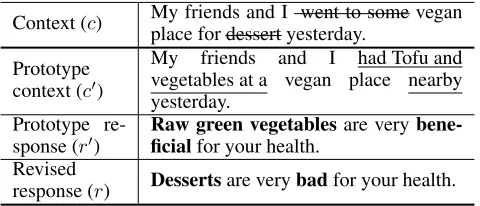
Context (c) My friends and I went to some vegan place for dessert yesterday.
Prototype context (c0)
My friends and I had Tofu and vegetables at a vegan place nearby yesterday.
Prototype re-sponse (r0)
Raw green vegetablesare very bene-ficialfor your health.
Revised
response (r) Dessertsare verybadfor your health.
Table 1: An example of context-aware prototypes editing. Underlined words mean they do not appear in the original context, while words with strikethrough mean they are not in the prototype context. Words in bold represent they are modified in the revised response.
tions include: 1) human-written responses, termed as “pro-totypes response”, are informative, diverse and grammatical which do not suffer from short and generic issues. Hence, generating responses by editing such prototypes is able to alleviate the “safe response” problem. 2) Some retrieved prototypes are not relevant to the current context, or suffer from a privacy issue. The post-editing process can partially solve these two problems. 3) Lexical differences between contexts provide an important signal for response editing. If a word appears in the current context but not in the prototype context, the word is likely to be inserted into the prototype response in the editing process.
Inspired by this idea, we formulate the response genera-tion process as follows. Given a conversagenera-tional contextc, we first retrieve a similar contextc0and its associated response
decoder language model could remember the collocation of “desserts” and “bad for health”, so as to replace “beneficial” with “bad” in the revised response. The new paradigm does not only inherits the fluency and informativeness advantages from retrieval results, but also enjoys the flexibility of gen-eration results. Hence, our edit-based model is better than previous retrieval-based and generation-based models. The edit-based model can solve the “safe response” problem of generative models by leveraging existing responses, and is more flexible than retrieval-based models, because it does not highly depend on the index and is able to edit a response to fit current context.
Prior work (Guu et al. 2017) has figured out how to edit prototype in an unconditional setting, but it cannot be ap-plied to the response generation directly. In this paper, we propose a prototype editing method in a conditional setting1. Our idea is that differences between responses strongly cor-relates with differences in their contexts (i.e. if a word in prototype context is changed, its related words in the re-sponse are probably modified in the editing.). We realize this idea by designing a context-aware editing model that is built upon a encoder-decoder model augmented with an editing vector. The edit vector is computed by the weighted aver-age of insertion word embeddings and deletion word embed-dings. Larger weights mean that the editing model should pay more attention on corresponding words in revision. For instance, in Table 1, we wish words like “dessert”, “Tofu” and “vegetables” get larger weights than words like “and” and “ at”. The encoder learns the prototype representation with a gated recurrent unit (GRU), and feeds the representa-tion to a decoder together with the edit vector. The decoder is a GRU language model, that regards the concatenation of last step word embedding and the edit vector as inputs, and predicts the next word with an attention mechanism.
Our experiments are conducted on a large scale Chi-nese conversation corpus comprised of 20 million context-response pairs. We compare our model with generative mod-els and retrieval modmod-els in terms of fluency, relevance, diver-sity and originality. The experiments show that our method outperforms traditional generative models on relevance, di-versity and originality. We further find that the revised re-sponse achieves better relevance compared to its prototype and other retrieval results, demonstrating that the editing process does not only promote response originality but also improve the relevance of retrieval results.
Our contributions are listed as follows: 1) this paper pro-poses a new paradigm, prototype-then-edit, for response generation; 2) we elaborate a simple but effective context-aware editing model for response generation; 3) we empiri-cally verify the effectiveness of our method in terms of rele-vance, diversity, fluency and originality.
Related Work
Research on chatbots goes back to the 1960s when ELIZA was designed (Weizenbaum 1966) with a huge amount of
1
Conditional setting means the editor should consider the con-text (dialogue history) except in a response itself in the revision. Editor only considers a sentence itself in the unconditional setting.
hand-crafted templates and rules. Recently, researchers have paid more and more attention on data-driven approaches (Ritter, Cherry, and Dolan 2011; Ji, Lu, and Li 2014) due to their superior scalability. Most of these methods are classified as retrieval-based methods (Ji, Lu, and Li 2014; Yan, Song, and Wu 2016) and generation methods (Li et al. 2016b; 2017; Zhou et al. 2017). The former one aims to se-lect a relevant response using a matching model, while the latter one generates a response with natural language gener-ative models.
Prior works on retrieval-based methods mainly focus on the matching model architecture for single turn conversa-tion (Hu et al. 2014) and multi-turn conversaconversa-tion (Lowe et al. 2015; Zhou et al. 2016; Wu et al. 2017). For the stud-ies of generative methods, a huge amount of work aims to mitigate the “safe response” issue from different per-spectives. Most of work build models under a sequence to sequence framework (Sutskever, Vinyals, and Le 2014), and introduce other elements, such as latent variables (Ser-ban et al. 2017), topic information (Xing et al. 2017), and dynamic vocabulary (Wu et al. 2018) to increase re-sponse diversity. Furthermore, the reranking technique (Li et al. 2016a), reinforcement learning technique (Li et al. 2016b), and adversarial learning technique (Li et al. 2017; Xu et al. 2017) have also been applied to response gen-eration. Apart from work on “safe response”, there is a growing body of literature on style transfer (Fu et al. 2018; Wang et al. 2017) and emotional response generation (Zhou et al. 2017). In general, most of previous work generates a response from scratch either left-to-right or conditioned on a latent vector, whereas our approach aims to generate a re-sponse by editing a prototype. Prior works have attempted to utilize prototype responses to guide the generation cess (Song et al. 2016; Pandey et al. 2018), in which pro-totype responses are encoded into vectors and feed to a de-coder along with a context representation. Our work differs from previous ones on two aspects. One is they do not con-sider prototype context in the generation process, while our model utilizes context differences to guide editing process. The other is that we regard prototype responses as a source language, while their works formulate it as a multi-source seq2seq task, in which the current context and prototype re-sponses are all source languages in the generation process.
Recently, some researches have explored natural language generation by editing (Guu et al. 2017; Liao et al. 2018). A typical approach follows a writing-then-edit paradigm, that utilizes one decoder to generate a draft from scratch and uses another decoder to revise the draft (Xia et al. 2017). The other approach follows a retrieval-then-edit paradigm, that uses a Seq2Seq model to edit a prototype retrieved from a corpus (Guu et al. 2017; Li et al. 2018; Cao et al. 2018). As far as we known, we are the first to leverage context lexical differences to edit prototypes.
Background
sentencexby editing the prototypex0. The general frame-work is built upon a Seq2Seq model with an attention mech-anism, which takes x0 andx as source sequence and
tar-get sequence respectively. The main difference is that the generative probability of a vanilla Seq2Seq model isp(x|x0)
whereas the probability of the edit model isp(x|x0, z)where z is an edit vector sampled from a pre-defined distribution like variational auto-encoder. In the training phase, the pa-rameter of the distribution is conditional on the context dif-ferences. We first defineI = {w|w ∈ x∧w /∈ x0} as an insertion word set, wherewis a word added to the proto-type, andD={w0|w0 ∈x0∧w0 ∈/ x}is a deletion word set, wherewis a word deleted from the prototype. Subsequently, we compute an insertion vector~i=P
w∈IΨ(w)and a dele-tion vectord~= P
w0∈DΨ(w0)by a summation over word
embeddings in two corresponding sets, whereΨ(·)transfers a word to its embedding. Then, the edit vectorzis sampled from a distribution whose parameters are governed by the concatenation of~iandd~. Finally, the edit vector and output of the encoder are fed to the decoder to generatex.
For response generation, which is a conditional setting of text editing, an interesting question raised, that is how to generate the edit by considering contexts. We will introduce our motivation and model in details in the next section.
Approach
Model Overview
Suppose that we have a data setD = {(Ci, Ri)}Ni=1. ∀i,
(Ci, Ri)comprises a contextCi= (ci,1, . . . , ci,l)and its re-sponseRi = (ri,1, . . . , ri,l), whereci,j is thej-th word of the contextCi andri,j is thej-th word of the responseRi. It should be noted thatCi can be either a single turn input or a multiple turn input. As the first step, we assumeCi is a single turn input in this work, and leave the verification of the same technology for multi-turn response generation to future work. Our full model is shown in Figure 1, consisting of a prototype selectorSand a context-aware neural editor
E. Given a new conversational contextC, we first useSto retrieve a context-response pair(Ci, Ri) ∈ D. Then, the editorEcalculates an edit vectorzi = f(Ci, C)to encode the information about the differences betweenCiandC. Fi-nally, we generate a response according to the probability ofp(R|zi, Ri). In the following, we will elaborate how to design the selectorSand the editorE.
Prototype Selector
A good prototype selectorS plays an important role in the prototype-then-edit paradigm. We use different strategies to select prototypes for training and testing. In testing, as we described above, we retrieve a context-response pair (C0, R0)from a pre-defined index for contextC according to the similarity ofCandC0. Here, we employ Lucene2to construct the index and use its inline algorithm to compute the context similarity.
2
https://lucenenet.apache.org/
Now we turn to the training phase. ∀i,(Ci, Ri), our goal is to maximize the generative probability of Ri by select-ing a prototype (C0
i, R0i) ∈ D. As we already know the ground-truth responseRi, we first retrieve thirty prototypes
{(Ci,j0 , R0i,j)}20
j=1based on the response similarity instead of
context similarity, and then reserve prototypes whose Jac-card similarity to Ri are in the range of[0.3,0.7]. Here, we use Lucene to index all responses, and retrieve the top 20 similar responses along with their corresponding contexts forRi. The Jaccard similarity measures text similarity from a bag-of-word view, that is formulated as
J(A, B) = |A∩B|
|A∪B|, (1)
whereAandB are two bags of words and| · |denotes the number of elements in a collection. Each context-response pair is processed with the above procedure, so we obtain enormous quadruples{(Ci, Ri, Ci,j0 , R0i,j)
Mi j=0}
N
i=1after this
step. The motivation behind filtering out instances with Jac-card similarity<0.3is that a neural editor model performs well only if a prototype is lexically similar (Guu et al. 2017) to its ground-truth. Besides, we hope the editor does not copy the prototype so we discard instances where the proto-type and groundtruth are nearly identical (i.e. Jaccard simi-larity>0.7). We do not use context similarity to construct parallel data for training, because similar contexts may cor-respond to totally different responses, so-called one-to-many phenomenon (Li et al. 2016a) in dialogue generation, that impedes editor training due to the large lexicon gap. Ac-cording to our preliminary experiments, the editor always generates non-sense responses if training data is constructed by context similarity.
Context-Aware Neural Editor
A context-aware neural editor aims to revise a prototype to adapt current context. Formally, given a quadruple (C, R, C0, R0) (we omit subscripts for simplification), a context-aware neural editor first forms an edit vectorz us-ingC andC0, and then updates parameters of the genera-tive model by maximizing the probability ofp(R|z, R0). For
testing, we directly generate a response after getting the edi-tor vecedi-tor. In the following, we will introduce how to obtain the edit vector and learn the generative model in details.
Edit Vector Generation For an unconditional sentence editing setting (Guu et al. 2017), an edit vector is randomly sampled from a distribution because how to edit the sentence is not constrained. In contrast, we should take both ofCand
C0 into consideration when we revise a prototype response
R0. Formally, R0 is firstly transformed to hidden vectors
{hk|hk =
− →
hk⊕
←− hk}
nj
k=1through a biGRU parameterized
as Equation (2).
− →
hj =fGRU(
− →
hj−1, r0j);
←−
hj=fGRU(
←−
hj+1, rj0) (2)
whererj0 is thej-th word ofR0.
Then we compute a context diff-vectordif fcby an atten-tion mechanism defined as follows
dif fc= X
w∈I
βwΨ(w)⊕ X
w0∈D
1
h
h
2h
3h
LAttention
' 1
i
h
h
i'
Index
Input
Prototype response: Raw green vegetables are very beneficial for your health.
Prototype context: My friends and I had Tofu and vegetables at a vegan place nearby yesterday.
Current context: My friends and I went to some vegan place for dessert yesterday.
Edit Vector
' 1
r '
2
r '
3
r '
L
r
A
tt
n
e
tio
n
In
se
rt
w
o
rd
s
D
el
et
e
w
or
ds
A
ttn
et
io
n
(a) Prototype Selector (b) Neural Editor
Source:
Figure 1: Architecture of our model.
where⊕is a concatenation operation,I={w|w∈C∧w /∈ C0}is a insertion word set, andD={w0|w0∈C0∧w0∈/ C}
is a deletion word set. dif fc explicitly encodes insertion words and deletion words fromCtoC0.βwis the weight of a insertion wordw, that is computed by
βw=
exp(ew) P
w∈Iexp(ew)
, (4)
ew=vβ>tanh(Wβ[Ψ(w)⊕hl]), (5) wherevβandWβare parameters, andhlis the last hidden state of the encoder.γw0is obtained with a similar process:
γw0 =
exp(ew0)
P
w0∈Dexp(ew0)
, (6)
ew0 =vγ>tanh(Wγ[Ψ(w0)⊕hl]), (7)
We assume that different words influence the editing pro-cess unequally, so we weighted average insertion words and deletion words to form an edit in Equation 3. Table explains our motivation as well, that is “desserts” is much more im-portant than “the” in the editing process. Then we compute the edit vectorzby following transformation
z=tanh(W·dif fc+b), (8) whereWandbare two parameters. Equation 8 can be re-garded as a mapping from context differences to response differences.
It should be noted that there are several alternative ap-proaches to computedif fcandzfor this task, such as apply-ing memory networks, latent variables, and other complex network architectures. Here, we just use a simple method, but it yields interesting results on this task. We will further illustrate our experiment findings in the next section.
Prototype Editing We build our prototype editing model upon a Seq2Seq with an attention mechanism model, which integrates the edit vector into the decoder.
The decoder takes{hk} nj
k=1 as an input and generates a
response by a GRU language model with attention. The hid-den state of the decoder is acquired by
h0j=fGRU(h0j−1, rj−1⊕zi), (9)
where the input ofj-th time step is the last step hidden state and the concatenation of the (j −1)-th word embedding and the edit vector obtained in Equation 8. Then we com-pute a context vectorci, which is a linear combination of
{h1, . . . , ht}:
ci= t X
j=1
αi,jhj, (10)
whereαi,jis given by
αi,j =
exp(ei,j) Pt
k=1exp(ei,k)
, (11)
ei,j=v>tanh(Wα[hj⊕h0i]), (12)
wherevandWαare parameters. The generative probability distribution is given by
s(ri) =sof tmax(Wp[ri−1⊕h0i⊕ci] +bp), (13)
whereWpandbpare two parameters. Equation 11 and 13 are the attention mechanism (Bahdanau, Cho, and Bengio 2015), that mitigates the long-term dependency issue of the original Seq2Seq model. We append the edit vector to every input embedding of the decoder in Equation 9, so the edit information can be utilized in the entire generation process. We learn our response generation model by minimizing the negative log likelihood ofD
L=−
N X
i=1
l X
j=1
logp(ri,j|zi, R0i, ri,k<j). (14)
We implement our model by PyTorch 3.We employ the Adam algorithm (Kingma and Ba 2015) to optimize the ob-jective function with a batch size of128. We set the initial learning rate as0.001and reduce it by half if perplexity on validation begins to increase. We will stop training if the perplexity on validation keeps increasing in two successive epochs. .
3
Experiment
Experiment setting
In this paper, we only consider single turn response gener-ation. We collected over 20 million human-human context-response pairs (context only contains 1 turn) from Douban Group 4. After removing duplicated pairs and utterance longer than 30 words, we split 19,623,374 pairs for train-ing, 10,000 pairs for validation and 10,000 pairs for testing. The average length of contexts and responses are 11.64 and 12.33 respectively. The training data mentioned above is used by retrieval models and generative models.
In terms of ensemble models and our editing model, the validation set and the test set are the same with datasets prepared for retrieval and generation models. Besides, for each context in the validation and test sets, we select its prototypes with the method described in Section “Proto-type Selector”. We follow Song et al. (2016) to construct a training data set for ensemble models, and construct a training data set with the method described in Section “Pro-totype Selector” for our editing models. We can obtain 42,690,275 (Ci, Ri, Ci0, R0i) quadruples with the proposed data preparing method. For a fair comparison, we randomly sample 19,623,374 instances for the training of our method and the ensemble method respectively. To facilitate fur-ther research, related resources of the paper can be found at https://github.com/MarkWuNLP/ResponseEdit.
Baseline
S2SA: We apply the Seq2Seq with attention (Bahdanau, Cho, and Bengio 2015) as a baseline model. We use a Py-torch implementation, OpenNMT (Klein et al. 2017) in the experiment.
S2SA-MMI: We employed the bidirectional-MMI de-coder as in (Li et al. 2016a). The hyperparameterλis set as 0.5 according to the paper’s suggestion. 200 candidates are sampled from beam search for reranking.
CVAE: The conditional variational auto-encoder is a pop-ular method of increasing the diversity of response genera-tion (Zhao, Zhao, and Esk´enazi 2017). We use the published code at https://github.com/snakeztc/NeuralDialog-CVAE, and conduct small adaptations for our single turn scenario.
Retrieval: We compare our model with two retrieval-based methods to show the effect of editing. One is Retrieval-defaultthat directly regards the top-1 result given by Lucene as the reply. The second one is Retrieval-Rerank, where we first retrieve 20 response candidates, and then employ a dual-LSTM model (Lowe et al. 2015) to com-pute matching degree between current context and the can-didates. The matching model is implemented with the same setting in (Lowe et al. 2015), and is trained on the training data set where negative instances are randomly sampled with a ratio ofpos:neg= 1 : 9.
Ensemble Model: Song et al (2016) propose an ensem-ble of retrieval and generation methods. It encodes current context and retrieved responses (Top-k retrieved responses
4
https://www.douban.com/group Douban is a popular forum in China.
are all used in the generation process.) into vectors, and feeds these representations to a decoder to generate a new response. As there is no official code, we implement it care-fully by ourselves. We use the top-1 response returned by beam search as a baseline, denoted as Ensemble-default. For a fair comparison, we further rerank top 20 generated results with the same LSTM based matching model, and de-note it asEnsemble-Rerank. We further create a candidate pool by merging the retrieval and generation results, and rerank them with the same ranker. The method is denoted asEnsemble-Merge.
Correspondingly, we evaluate three variants of our model. Specifically,Edit-defaultandEdit-1-Rerankedit top-1 sponse yielded by Retrieval-default and Retrieval-Rerank re-spectively. Edit-N-Rerankedits all 20 responses returned by Lucene and then reranks the revised results with the dual-LSTM model. We also merge edit results of Edit-N-Rerankand candidates returned by the search engine, and then rerank them, which is denoted asEdit-Merge. In prac-tice, the word embedding size and editor vector size are 512, and both of the encoder and decoder are a 1-layer GRU whose hidden vector size is 1024. Message and response vocabulary size are 30000, and words not covered by the vocabulary are represented by a placeholder $UNK$. Word embedding size, hidden vector size and attention vector size of baselines and our models are the same. All generative models use beam search to yield responses, where the beam size is 20 except S2SA-MMI. For all models, we remove $UNK$ from the target vocabulary, because it always leads to a fluency issue in evaluation.
Evaluation Metrics
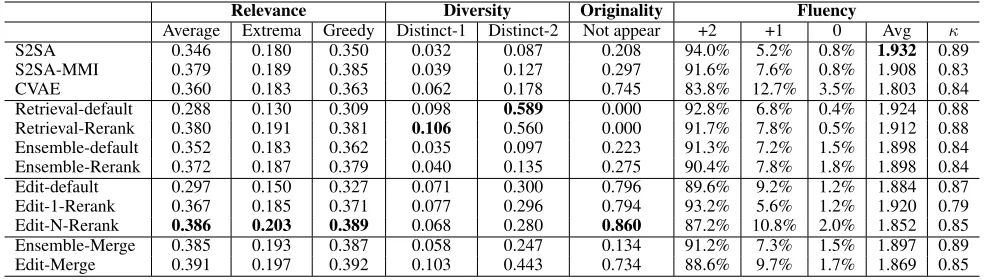
Table 2: Automatic evaluation results. Numbers in bold mean that improvement from the model on that metric is statisti-cally significant over the baseline methods (t-test, p-value<0.01). κdenotes Fleiss Kappa (Fleiss 1971), which reflects the agreement among human annotators.
Relevance Diversity Originality Fluency
Average Extrema Greedy Distinct-1 Distinct-2 Not appear +2 +1 0 Avg κ S2SA 0.346 0.180 0.350 0.032 0.087 0.208 94.0% 5.2% 0.8% 1.932 0.89 S2SA-MMI 0.379 0.189 0.385 0.039 0.127 0.297 91.6% 7.6% 0.8% 1.908 0.83 CVAE 0.360 0.183 0.363 0.062 0.178 0.745 83.8% 12.7% 3.5% 1.803 0.84 Retrieval-default 0.288 0.130 0.309 0.098 0.589 0.000 92.8% 6.8% 0.4% 1.924 0.88 Retrieval-Rerank 0.380 0.191 0.381 0.106 0.560 0.000 91.7% 7.8% 0.5% 1.912 0.88 Ensemble-default 0.352 0.183 0.362 0.035 0.097 0.223 91.3% 7.2% 1.5% 1.898 0.84 Ensemble-Rerank 0.372 0.187 0.379 0.040 0.135 0.275 90.4% 7.8% 1.8% 1.898 0.84 Edit-default 0.297 0.150 0.327 0.071 0.300 0.796 89.6% 9.2% 1.2% 1.884 0.87 Edit-1-Rerank 0.367 0.185 0.371 0.077 0.296 0.794 93.2% 5.6% 1.2% 1.920 0.79 Edit-N-Rerank 0.386 0.203 0.389 0.068 0.280 0.860 87.2% 10.8% 2.0% 1.852 0.85 Ensemble-Merge 0.385 0.193 0.387 0.058 0.247 0.134 91.2% 7.3% 1.5% 1.897 0.89 Edit-Merge 0.391 0.197 0.392 0.103 0.443 0.734 88.6% 9.7% 1.7% 1.869 0.85
Table 3: Human side-by-side evaluation results. If a row is labeled as “a v.s.b”, the second column, “loss”, means the ratio of responses given by “a” are worse than those given by“b”.
Loss Tie Win κ Ed-Default v.s. R-Default 23.6 41.2 35.2 0.54 Ed-Default v.s. Ens-Default 29.4 47.8 22.8 0.59 Ed-1-Rerank v.s. R-Rerank 29.2 45.3 25.5 0.60 Ed-N-Rerank v.s. Ens-Rerank 24.9 42.1 33.0 0.55 Ed-N-Rerank v.s. R-Rerank 25.2 44.8 30.0 0.62
Evaluation Results
Table 2 shows the evaluation results on the Chinese dataset. Our methods are better than retrieval-based methods on em-bedding based metrics, that means revised responses are more relevant to ground-truth in the semantic space. Our model just slightly revises prototype response, so improve-ments on automatic metrics are not that large but significant on statistical tests (t-test, p-value<0.01). Two factors are known to cause Edit-1-Rerank worse than Retrieval-Rerank. 1) Rerank algorithm is biased to long responses, that poses a challenge for the editing model. 2) Despite of better proto-type responses, a context of top-1 response is always greatly different from current context, leading to a large insertion word set and a large deletion set, that also obstructs the revision process. In terms of diversity, our methods drop on distinct-1 and distinct-2 in a comparison with retrieval-based methods, because the editing model often deletes spe-cial words pursuing for better relevance. Retrieval-Rerank is better than retrieval-default, indicating that it is necessary to rerank responses by measuring context-response similarity with a matching model.
Our methods significantly outperform generative base-lines in terms of diversity since prototype responses are good start-points that are diverse and informative. It demonstrates that the prototype-then-editing paradigm is capable of ad-dressing the safe response problem. Edit-Rerank is better than generative baselines on relevance but Edit-default is not, indicating a good prototype selector is quite important to our editing model. In terms of originality, about 86%
re-vised response do not appear in the training set, that sur-passes S2SA, S2SA-MMI and CVAE. This is mainly be-cause baseline methods are more likely to generate safe re-sponses that are frequently appeared in the training data, while our model tends to modify an existing response that avoids duplication issue. In terms of fluency, S2SA achieves the best results, and retrieval based approaches come to the second place. Safe response enjoys high score on fluency, that is why S2SA and S2SA-MMI perform well on this met-ric. Although editing based methods are not the best on the fluency metric, they also achieve a high absolute number. That is an acceptable fluency score for a dialogue engine, indicating that most of generation responses are grammat-ically correct. In addition, in terms of the fluency metric, Fleiss’ Kappa (Fleiss 1971) on all models are around 0.8, showing a high agreement among labelers.
Compared to ensemble models, our model performs much better on diversity and originality, that is because we regard prototype response instead of the current context as source sentence in the Seq2Seq, which keeps most of content in prototype but slightly revises it based on the context differ-ence. Both of the ensemble and edit model are improved when the original retrieval candidates are considered in the rerank process.
Regarding human side-by-side evaluation, we can find that Edit-Default and Edit-N-rerank are slightly better than Retrieval-default and Retrieval-rerank (The winning exam-ples are more than the losing examexam-ples), indicating that the post-editing is able to improve the response quality. Ed-Default is worse than Ens-Ed-Default, but Ed-N-Rerank is bet-ter than Ens-Rerank. This is mainly because the editing model regards the prototype response as the source lan-guage, so it is highly depends on the quality of prototype response.
Discussions
Table 4: Model ablation tests. Full model denotes Edit-N-Rerank. del” means we only consider insertion words. “-ins” means we only consider deletion words. “-both” means we train a standard seq2seq model from prototype response to revised response.
Average Extrema Greedy Dis-1 Dis-2 Originality Full 38.6 20.3 38.9 0.068 0.280 86.0 - ins 34.2 17.9 34.8 0.067 0.286 85.1 - del 34.0 17.6 34.6 0.065 0.278 86.3 -both 32.8 16.9 33.7 0.067 0.282 85.4
indicating that the edit vector is crucial for response rele-vance. Diversity and originality do not decrease after the edit vector is removed, implying that the retrieved prototype is the key factor for these two metrics. According to above observations, we conclude that the prototype selector and the context-aware editor play different roles in generating responses.
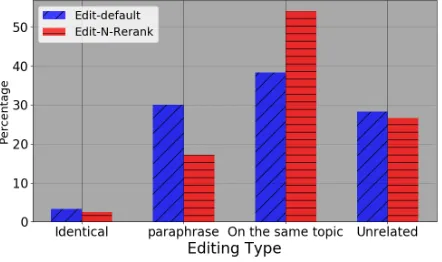
Editing Type Analysis It is interesting to explore the se-mantic gap between prototype and revised response. We ask annotators to conduct 4-scale rating on 500 randomly sampled prototype-response pairs given by Edit-default and Edit-N-Rerank respectively. The 4-scale is defined as: iden-tical, paraphrase, on the same topic and unrelated.
Figure 2: Distribution across different editing types.
Figure 2 provides the ratio of four editing types defined above. For both methods, Only2%of edits are exactly the same with the prototype, that means our model does not downgrade to a copy model. Surprisingly, there are30% revised responses are unrelated to prototypes. The key fac-tor for this phenomenon is that the neural edifac-tor will rewrite the prototype when it is hard to insert insertion words to the prototype. The ratio of “on the same topic” response given by Edit-N-rerank is larger than Edit-default, revealing that “on the same topic” responses might be more relevant from the view of a LSTM based reranker.
Case Study We give two examples to show how our model works in Table 5. The first one is that our model edits a prototype response with word substitutions. Current context is talking about “clean tatoo”, but the prototype discusses “clean hair”, leading to an irrelevant prototype response.
Af-Table 5: Case Study. Examples are given by Edit-default and Edit-Rerank. Chinese utterances are translated to English here.
Context Is there any way to get all tattoos clean?
Prototype context
Is it possible to clean your hair by applying the medicine?
Prototype
response After wiping it, hair is much cleaner. Revised
response
After wiping it, most of tattoos will be cleaned.
Context I often eat spice noodles.
Prototype context
When I lived in Taiwan, I often eat spicy Noodles and braised pork rice.
Prototype
response I also love braised pork rice. Revised
response I also love it.
ter the word substitutions, the revised response becomes ap-propriated for the current context. The second case gives an example of word deletion, where a phrase “braised pork rice” is removed from the response. The phrase “braised pork rice” does not appear in the current context, so it be-longs to the deletion word set D. According to our ob-servation, function words and nouns are more likely to be added/deleted. This is mainly because function words, such as pronoun, auxiliary, and interjection may be substituted in the paraphrasing. In addition, a large proportion of con-text differences is caused by nouns substitutions, thus we ob-serve that nouns are added/deleted in the revision frequently.
Conclusion
We present a new paradigm, prototype-then-edit, for open domain response generation, that enables a generation-based chatbot to leverage retrieved results. We propose a simple but effective model to edit context-aware responses by tak-ing context differences into consideration. Experiment re-sults on a large-scale dataset show that our model outper-forms traditional methods on some metrics. In the future, we will investigate how to jointly learn the prototype selec-tor and neural ediselec-tor.
Acknowledgments
Yu is supported by AdeptMind Scholarship and Microsoft Scholarship. This work was supported in part by the Nat-ural Science Foundation of China (Grand Nos. U1636211, 61672081, 61370126), Beijing Advanced Innovation Cen-ter for Imaging Technology (No.BAICIT-2016001) and Na-tional Key R&D Program of China (No.2016QY04W0802).
References
Bahdanau, D.; Cho, K.; and Bengio, Y. 2015. Neural ma-chine translation by jointly learning to align and translate.
Cao, S. Z.; Li, W.; Wei, F.; and Li, S. 2018. Retrieve, rerank and rewrite: Soft template based neural summarization. In
ACL, volume 2, 3.
Fleiss, J. L. 1971. Measuring nominal scale agreement among many raters.Psychological bulletin76(5):378. Fu, Z.; Tan, X.; Peng, N.; Zhao, D.; and Yan, R. 2018. Style transfer in text: Exploration and evaluation. InAAAI 2018. Guu, K.; Hashimoto, T. B.; Oren, Y.; and Liang, P. 2017. Generating sentences by editing prototypes. CoRR
abs/1709.08878.
Hu, B.; Lu, Z.; Li, H.; and Chen, Q. 2014. Convolutional neural network architectures for matching natural language sentences. InNIPS, 2042–2050.
Ji, Z.; Lu, Z.; and Li, H. 2014. An information re-trieval approach to short text conversation. arXiv preprint arXiv:1408.6988.
Kingma, D., and Ba, J. 2015. Adam: A method for stochas-tic optimization.ICLR.
Klein, G.; Kim, Y.; Deng, Y.; Senellart, J.; and Rush, A. M. 2017. Opennmt: Open-source toolkit for neural machine translation. InProc. ACL.
Li, J.; Galley, M.; Brockett, C.; Gao, J.; and Dolan, B. 2016a. A diversity-promoting objective function for neural conversation models. InNAACL, 2016, 110–119.
Li, J.; Monroe, W.; Ritter, A.; Jurafsky, D.; Galley, M.; and Gao, J. 2016b. Deep reinforcement learning for dialogue generation. InEMNLP 2016, 1192–1202.
Li, J.; Monroe, W.; Shi, T.; Ritter, A.; and Jurafsky, D. 2017. Adversarial learning for neural dialogue generation.
EMNLP.
Li, J.; Jia, R.; He, H.; and Liang, P. 2018. Delete, retrieve, generate: A simple approach to sentiment and style transfer.
NAACL.
Liao, Y.; Bing, L.; Li, P.; Shi, S.; Lam, W.; and Zhang, T. 2018. Incorporating pseudo-parallel data for quantifiable sequence editing.arXiv preprint arXiv:1804.07007. Liu, C.-W.; Lowe, R.; Serban, I. V.; Noseworthy, M.; Char-lin, L.; and Pineau, J. 2016. How not to evaluate your di-alogue system: An empirical study of unsupervised evalua-tion metrics for dialogue response generaevalua-tion.EMNLP. Lowe, R.; Pow, N.; Serban, I.; and Pineau, J. 2015. The ubuntu dialogue corpus: A large dataset for research in un-structured multi-turn dialogue systems.SIGDIAL.
Pandey, G.; Contractor, D.; Kumar, V.; and Joshi, S. 2018. Exemplar encoder-decoder for neural conversation genera-tion. InACL, volume 1, 1329–1338.
Ritter, A.; Cherry, C.; and Dolan, W. B. 2011. Data-driven response generation in social media. InEMNLP, 583–593. Serban, I. V.; Sordoni, A.; Bengio, Y.; Courville, A. C.; and Pineau, J. 2016. End-to-end dialogue systems using gen-erative hierarchical neural network models. InProceedings of the Thirtieth AAAI Conference on Artificial Intelligence, February 12-17, 2016, Phoenix, Arizona, USA., 3776–3784. Serban, I. V.; Sordoni, A.; Lowe, R.; Charlin, L.; Pineau, J.; Courville, A. C.; and Bengio, Y. 2017. A hierarchical latent
variable encoder-decoder model for generating dialogues. In
AAAI, 3295–3301.
Shang, L.; Lu, Z.; and Li, H. 2015. Neural responding machine for short-text conversation. InACL 2015.
Song, Y.; Yan, R.; Li, X.; Zhao, D.; and Zhang, M. 2016. Two are better than one: An ensemble of retrieval-and generation-based dialog systems. arXiv preprint arXiv:1610.07149.
Sordoni, A.; Galley, M.; Auli, M.; Brockett, C.; Ji, Y.; Mitchell, M.; Nie, J.; Gao, J.; and Dolan, B. 2015. A neural network approach to context-sensitive generation of conversational responses. InNAACL 2015, 196–205. Sutskever, I.; Vinyals, O.; and Le, Q. V. 2014. Sequence to sequence learning with neural networks. InAdvances in neural information processing systems, 3104–3112. Vinyals, O., and Le, Q. 2015. A neural conversational model. arXiv preprint arXiv:1506.05869.
Wang, D.; Jojic, N.; Brockett, C.; and Nyberg, E. 2017. Steering output style and topic in neural response genera-tion. InEMNLP 2017, 2140–2150.
Weizenbaum, J. 1966. Eliza: a computer program for the study of natural language communication between man and machine. Communications of the ACM9(1):36–45.
Wu, Y.; Wu, W.; Xing, C.; Zhou, M.; and Li, Z. 2017. Sequential matching network: A new architecture for multi-turn response selection in retrieval-based chatbots. InACL 2017, 496–505.
Wu, Y.; Wu, W.; Yang, D.; Xu, C.; and Li, Z. 2018. Neural response generation with dynamic vocabularies. In AAAI 2018.
Xia, Y.; Tian, F.; Wu, L.; Lin, J.; Qin, T.; Yu, N.; and Liu, T. 2017. Deliberation networks: Sequence generation beyond one-pass decoding. InNIPS 2017, 1782–1792.
Xing, C.; Wu, W.; Wu, Y.; Liu, J.; Huang, Y.; Zhou, M.; and Ma, W.-Y. 2017. Topic aware neural response generation. InAAAI, volume 17, 3351–3357.