The Thirty-Third AAAI Conference on Artificial Intelligence (AAAI-19)
An Open-World Extension to Knowledge Graph Completion Models
Haseeb Shah,
1Johannes Villmow,
2Adrian Ulges,
2Ulrich Schwanecke,
2Faisal Shafait
1 1National University of Science and Technology, Pakistan2RheinMain University of Applied Sciences, Germany {hshah.bese15seecs, faisal.shafait}@seecs.edu.pk {johannes.villmow, adrian.ulges, ulrich.schwanecke}@hs-rm.de
Abstract
We present a novel extension to embedding-based knowl-edge graph completion models which enables them to per-form opworld link prediction, i.e. to predict facts for en-tities unseen in training based on their textual description. Our model combines a regular link prediction model learned from a knowledge graph with word embeddings learned from a textual corpus. After training both independently, we learn a transformation to map the embeddings of an entity’s name and description to the graph-based embedding space. In experiments on several datasets including FB20k, DBPe-dia50k and our new dataset FB15k-237-OWE, we demon-strate competitive results. Particularly, our approach exploits the full knowledge graph structure even when textual descrip-tions are scarce, does not require a joint training on graph and text, and can be applied to any embedding-based link predic-tion model, such as TransE, ComplEx and DistMult.
1
Introduction
Knowledge graphs are a vital source for disambiguation and discovery in various tasks such as question answering (Fer-rucci et al. 2010), information extraction (Dong et al. 2014) and search (Singhal 2012). They are, however, known to suf-fer from data quality issues (Paulheim 2017). Most promi-nently, since formal knowledge is inherently sparse, relevant facts are often missing from the graph.
To overcome this problem,knowledge graph completion (KGC) orlink prediction strives to enrich existing graphs with new facts. Formally, a knowledge graphG ⊂E×R×E
consists of facts or triples (head, rel, tail), where E and
R denote finite sets of entities and relations respectively. Knowledge graph completion is targeted at assessing the probability of triples not present in the graph. To do so, a common approach involves representing the entities and relations in triples using real-valued vectors called embed-dings. The probability of the triple is then inferred by ge-ometric reasoning over the embeddings. Embeddings are usually generated by learning to discriminate real triples from randomly corrupted ones (Nickel et al. 2016; Shi and Weninger 2017b; Trouillon et al. 2016).
A key problem with most existing approaches is that the plausibility of links can be determined for known entities
Copyright c2019, Association for the Advancement of Artificial Intelligence (www.aaai.org). All rights reserved.
only. For many applications, however, it is of interest to in-fer knowledge about entities not present in the graph. Imag-ine answering the question “What is German actress Ju-lia Lindigknown for?”, whereJulia Lindigis not a known entity. Here, information can be inferred from the ques-tion, typically using word embeddings (Mikolov et al. 2013; Pennington, Socher, and Manning 2014; Peters et al. 2018). Similar to entity embeddings, these techniques represent words with embedding vectors. These can be pre-trained on text corpora, thereby capturing word similarity and seman-tic relations, which may help to predict the plausibility of the triple(J ulia Lindig, starred in, Lola Rennt). This chal-lenge is known as open-world (or zero-shot) KGC. To the best of our knowledge, few open-world KGC models have been proposed so far, all of which are full replacements for regular KGC models and require textual descriptions for all entities (Xie et al. 2016; Shi and Weninger 2017a).
In this paper, we suggest a different approach, namely to extend existing KGC models with pre-trained word em-beddings. Given an new entity, we aggregate its name and description into a text-based entity representation. We then learn a transformation from text-based embedding space to graph-based embedding space, where we can now apply the graph-based model for predicting links. We show that this simple approach yields competitive results, and offers two key benefits: First, it is independent of the specific KGC model used, which allows us to use multiple different link prediction models from which we can pick the best one. Second, as training on the graph structure happens indepen-dently from training on text, our approach can exploit the full-scale knowledge graph structure in situations where tex-tual information is scarce because learning the transforma-tion is robust even for such situatransforma-tions. We coin our approach OWE for Open World Extension and combine it with several common KGC models, obtaining TransE-OWE, DistMult-OWE, and ComplEx-OWE.
We demonstrate competitive results on common datasets for open-world prediction, and also introduce a new dataset called FB15k-237-OWE, which avoids bias towards long textual descriptions and trivial regularities like inverse re-lations. The code and the new FB15k-237-OWE dataset are available online1.
1
2
Related Work
Knowledge Graph Completion Interest in KGC has in-creased in the past few years, with a focus on embedding-based methods. A concise survey of earlier works such as NTN (Socher et al. 2013) and TransE (Bordes et al. 2013) is provided by (Nickel et al. 2016). TransE has been re-cently complemented by other models like DistMult (Yang et al. 2014), ComplEx (Trouillon et al. 2016), ProjE (Shi and Weninger 2017b) and RDF2Vec (Ristoski and Paulheim 2016).
A common approach is to estimate the probabil-ity of triples (head, rel, tail) using a scoring function
φ(uhead, urel, utail), whereux denotes the embedding of
entity/relationxand is a real-valued or complex-valued vec-tor.φdepends on the model and varies from simple trans-lation (Bordes et al. 2013) over bilinear forms (Yang et al. 2014) to complex-valued forms (Trouillon et al. 2016). Training happens by randomly perturbing triples in the graph and learning to discriminate real triples from per-turbed ones, typically by using negative sampling.
Word Embeddings Embedding-based representations of text have become a common approach in natural language processing (Goldberg 2016). They represent terms, sen-tences or documents in form of a vector. Word embed-dings are known to capture term similarities and seman-tic relations (Mikolov et al. 2013; Pennington, Socher, and Manning 2014). Word embeddings can also include sub-word information for out-of-training-vocabulary generaliza-tion (Bojanowski et al. 2017; Peters et al. 2018), and have been combined with anchor and link information obtained from Wikipedia to produce entity-specific embeddings (Ya-mada et al. 2016).
Text-Enhanced Knowledge Graph Completion While the knowledge graph completion models described above leverage only the triple structure of the graph, some ap-proaches combine text information with the graph infor-mation. Some of these approaches regularize word em-beddings based on semantic information, for example, by adding synonym and other relations from WordNet to the training set of contextual term pairs (Faruqui et al. 2015; Yu and Dredze 2014) or by modelling relations like syn-onyms with translations (Xu et al. 2014). These methods, however, are not targeted at KGC.
Closer to our work are actual KGC models that em-ploy text information, such that for entities scarcely linked in the graph, extra information can be drawn from text. (Socher et al. 2013; Wang and Li 2016) use averaged pre-trained word vectors (CBOW) as entity descriptions for ge-ometric reasoning with affine mappings. (Xu et al. 2017) tests different aggregation functions for word embeddings (CBOW, LSTMs, attentive LSTMs) and proposes learning an entity-wise linear interpolation between graph-based and text-based embedding, which is combined with a transla-tional KGC model. (Toutanova and Chen 2015) enhance KGC with a large set of relations extracted from dependency parses on a text corpus, and formulate a joint loss func-tion for text-based and graph-based inputs. However, none
of these works address the open-world setting that we target in this paper.
Only few other works address open-world KGC. Description-Embodied Knowledge Representation Learning (DKRL)(Xie et al. 2016) uses a joint training of graph-based embeddings (TransE) and text-based embeddings while reg-ularizing both types of embeddings to be aligned using an additional loss. ConMask (Shi and Weninger 2017a) is a text-centric approach where text-based embeddings for head, relation and tail are derived by an attention model over names and descriptions, and the triple(h, r, t)is scored by a pairwise matching of the embeddings, followed by a soft-max regression. In contrast to these approaches, we train graph and text embeddings independently. This comes with two benefits: First, our approach can fully leverage knowl-edge graphs with incomplete or scarce textual descriptions. Second, it is applicable to any embedding-based link predic-tion model such as TransE, DistMult and ComplEx.
3
Approach
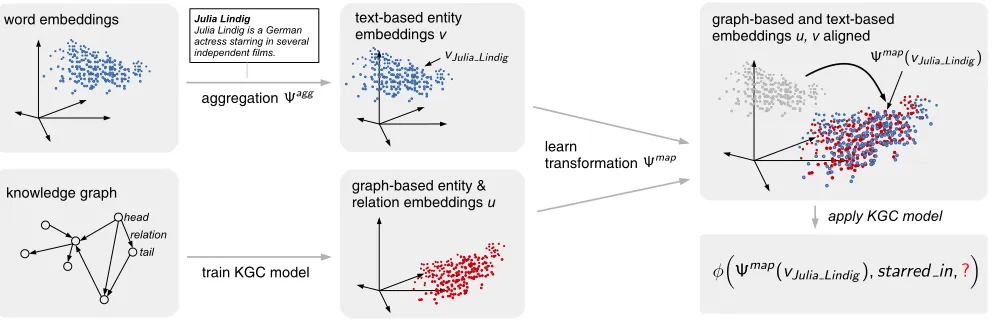
Our approach starts with a regular link prediction model (in the following also referred to as thegraph-basedmodel) as outlined in Section 2 and visualised in Fig. 1. The model scores triples(h, r, t):
score(h, r, t) =φ(uh, ur, ut) (1)
whereuxdenotes the embedding of entity/relationx.
Typ-ically,ux∈Rd, but other options are possible. For example,
in ComplEx (Trouillon et al. 2016), ux is complex-valued
(ux∈ Cd).φis a scoring function that depends on the link
prediction model and will be adressed in more detail in Sec-tion 3.1.
Closed-world Link Prediction Closed-world link predic-tion involves predicting facts about entities on which the link prediction model is trained on. For tail prediction, head and relation are given and the objective is to predict the tail en-tity with the highest score. This is done by calculating the score of the(h, r)pair with everyt∈E.
tail∗= arg max
t∈E score(h, r, t) (2)
Similarly, for head prediction, the score of(r, t)is calculated with everyh∈E:
head∗= arg max
h∈E score(h, r, t) (3)
For the remaining part of the paper, we will only discuss the task of tail prediction. The same concepts can be applied to the task of head prediction.
Open-world Extension Open-world link prediction in-volves predicting facts about entities that the link predic-tion model was not trained on. Our contribupredic-tion lies in extending the above graph-based model to perform open-world link prediction. We assume an unseen head entity
word embeddings text-based entity
embeddingsv
knowledge graph head
tail relation
aggregation
train KGC model
graph-based entity &
relationembeddingsu
Julia Lindig
Julia Lindig is a German actress starring in several independent films.
learn transformation
graph-based and text-based
embeddingsu, v aligned
apply KGC model
Figure 1: Our approach first trains a KGC model on the graph without using textual information (bottom left). For every entity we can obtain a text-based embeddingvby aggregating the word embeddings for tokens in the name and description (top left). A transformationΨmapis learned on the training entities to mapvto the space of graph-based embeddings (right). The learned mapping can then be applied to unknown entities, thus allowing the trained KGC model to be applied.
Glove) pre-trained on a text corpus are then used to trans-form the sequence of tokensWinto a sequence of embed-dings (vw1, vw2, ..., vwn). This sequence of embeddings is
then aggregated with a functionΨaggto obtain a text-based embedding of the head entityvh∈Rd
0
:
vh:= Ψagg
vw1, vw2, ..., vwn
(4)
Since text-based and graph-based embeddings are trained independently on different information sources, we cannot expect them to match. Therefore, a transformation Ψmap
is learned from text-based embedding space to graph-based embedding space such thatΨmap(v
h)≈uh. Then we score
triples with the unseen head entity by applying the graph-based model from Equation 1 with the mapped text-graph-based head description:
score(h, r, t) =φΨmap(vh), ur, ut
(5)
The single steps of our model are outlined in more detail in the following.
3.1
Link Prediction Models
Since our approach is independent of the specific link pre-diction model used, we test three commonly used models in this work:
1. TransE:φ(uh, ur, ut) =−||uh+ur−ut||2
2. DistMult:φ(uh, ur, ut) =huh, ur, uti
3. ComplEx:φ(uh, ur, ut) =Re(huh, ur, uti)
Note that the first two use real-valued embeddings, while ComplEx uses complex-valued embeddings (where u =
Re(u)−i·Im(u)denotes the complex conjugate of embed-dingu). All models are trained using their original loss func-tions and validated using closed-world validation data.
3.2
Word Embeddings and Aggregation
We use pre-trained word embeddings trained on large text corpora. Since the number of entities in the datasets used is limited and we found overfitting to be an issue, we omit any refinement of the embeddings. We tested 200-dimensional Glove embeddings (Pennington, Socher, and Manning 2014) and 300-dimensional Wikipedia2Vec embeddings (Yamada et al. 2016).
Note that Wikipedia2Vec embeddings contain phrase em-beddings, which we use as an embedding for entity names (like ”Julia Lindig”). If no phrase embedding is available, we split the name into single tokens and use token-wise em-beddings. If no embedding is available for a token, we use a vector of zeros as an “unknown” token.
To aggregate word embeddings to an entity embed-ding (function Ψagg, Equation 4), approaches in the
liter-ature range from simple averaging (Pennington, Socher, and Manning 2014) over Long Short Term Memory Networks (LSTMs) (Xu et al. 2017) to relation-specific masking (Shi and Weninger 2017a). We use averaging as an aggregation function. Here, the word embedding vectors are averaged to obtain a single representative embedding. To prevent over-fitting, we apply dropout during training, i.e. embeddings of some words are randomly replaced by the unknown token before averaging.
3.3
Transformation Functions
The key to open-world prediction is the mapping from text-based entity embeddingsveto graph-based onesue. Several
different transformation functionsΨmapcan be learned for this task. In this paper, we discuss three options:
Affine Here,Ψmapis an affine functionΨmap(v) =A·v+ b. For ComplEx, separate matrices and vectors are trained just like above:Ψmap(v) = (A·v+b) +i·(A0·v+b0)
MLP Ψmapis a four layer Multi-Layer Perceptron (MLP) with ReLU activation functions. The output layer is affine. We did not perform an extensive hyperparameter search here.
To train the transformations, first a link prediction model is trained on the full graph, obtaining entity embeddings
u1, ..., un. We then choose all entitiesei1, ..., eim with
tex-tual metadata (names and/or descriptions), and extract text-based embedding vi1, ..., vim for them using aggregation
(see above). Finally,Ψmapis learned by minimizing the loss function
L(Θ) =
m X
k=1
Ψ
map
Θ (vik)−uik
2 (6)
using batched stochastic gradient descent, whereΘdenotes the parameters ofΨmap (e.g., the weight matrices and bias
vectorsA, b). For ComplEx, the above loss is summed for real and imaginary parts, and training happens on the sum. We apply no fine-tuning, neither on the graph nor on the text embeddings.
4
Experiments
In this section, we study the impact of our model’s param-eters (Ψagg,Ψmap, text embeddings) on prediction perfor-mance. We also provide mappings of selected open-world entities, and compare our results with the state-of-the-art.
Number of Triples
Dataset |E| |R| Train Valid Test
FB15k / FB20k 14,904 1,341 472,860 48,991 57,803 DBPedia50k 24,624 351 32,388 123 2,095 FB15k-237-OWE 12,324 235 242,489 12,806
-Table 1: Dataset statistics for closed-world link prediction.
Head Pred. Tail Pred.
Dataset |Eopen| Valid Test Valid Test
FB20k 5,019 - 18,753 - 11,586
DBPedia50k 3,636 55 2,139 164 4,320 FB15k-237-OWE 2,081 1,539 13,857 9,424 22,393
Table 2: Dataset statistics for open-world link prediction.
Eopenis the set of novel entities not in the graph. Note that
the corresponding closed-world training set is used for train-ing the open-world models.
4.1
Datasets
Closed-world KGC tasks are commonly evaluated on Word-Net and Freebase subsets, such as WN18, WN18RR,
FB15k, and FB15k-237. For open-world KGC, the follow-ing datasets have been suggested: (Xie et al. 2016) intro-duced FB20k, which builds upon the FB15k dataset by adding test triples with unseen entities, which are selected to have long textual descriptions. (Shi and Weninger 2017a) introduced DBPedia50k and DBPedia500k datasets for both open-world and closed-world KGC tasks.
However, the above datasets display a bias towards long textual descriptions: DBpedia50k has an average description length of 454 words, FB20k of 147 words. Also, for neither of the datasets precautions have been taken to avoid redun-dant inverse relations, which allows models to exploit trivial patterns in the data (Toutanova and Chen 2015). To over-come these problems, we introduce a new dataset named FB15k-237-OWE. FB15k-237-OWE is based on the well-known FB15K-237 dataset, where redundant inverse rela-tions have been removed. Also, we avoid a bias towards en-tities with longer textual descriptions: Test enen-tities are uni-formly sampled from FB15K-237, and only short Wikidata descriptions (5 words on average) are used.
In the following section, the sampling strategy for FB15k-237-OWE is briefly outlined: For tail prediction test set, we start with FB15K-237 and randomly pick heads (by uniform sampling over all head entities). Each picked headxis re-moved from the training graph by moving all triples of the form(x,?, t)to the test set and dropping all triples of the form(?,?, x)iftstill remains in the training set after these operations. Similarly, a head prediction test set is prepared from the set of dropped triplets which satisfy the conditions to be in head prediction test set i.e. head must be represented in training set while tail must not be represented. The dataset also contains two validation sets: A closed-world one (with random triples picked from the training set) and an open-world one (with random triples picked from the test set).
We evaluate our approach on DBPedia50k, FB20k, and the new dataset FB15k-237-OWE. Statistics of the datasets are highlighted in Table 1 and Table 2.
4.2
Experimental Setup
We perform multiple runs using different KGC models, transformation types, training data, and embeddings used. For each run, both KGC model and transformation Ψmap
are trained on the training set: the KGC model without using any textual information and the transformation using entity names and descriptions. We manually optimize all hyperpa-rameters on the validation set. Due to the lack of an open-world validation set on FB20k, we randomly sampled 10% of the test triples as a validation set.
Performance Measures Performance figures are com-puted using tail prediction on the test sets: For each test triple
(h, r, t)with open-world headh /∈E, we rank all known en-titiest0 ∈E by their scoreφ(h, r, t0). We then evaluate the ranks of the target entitiestwith the commonly used mean rank (MR), mean reciprocal rank (MRR), as well as Hits@1, Hits@3, and Hits@10.
Note that multiple triples with the same head and relation but different tails may occur in the dataset:
DBPedia50k FB15k-237-OWE FB20k
Model H@1 H@3 H@10 MRR H@1 H@3 H@10 MRR H@1 H@3 H@10 MRR
Target Filt. Base. 4.5 9.7 23.0 11.0* 6.4 14.2 23.3 12.7 17.5 32.1 41.2 27.2
DKRL - - 40.0 23.0 - - -
-ConMask 47.1 64.5 81.0 58.4* 21.5 39.9 45.8 29.9 42.3 57.3 71.7 53.3
Cmplx-OWE-200 49.0 62.3 73.6 57.7 29.1 41.0 52.7 37.3 44.2 55.9 68.2 52.3 Cmplx-OWE-300 51.9 65.2 76.0 60.3 31.6 43.9 56.0 40.1 44.8 57.1 69.1 53.1
Table 3: Comparison with other open-world KGC models on tail prediction. Note that we used the same evaluation protocol with target filtering as in ConMask. The asterisk (*) denotes that the result differs from the one published, because the MRR is calculated differently.
when evaluating triple (h, r, ti) we remove all entities
t1, ..., ti−1, ti+1, ..., tp from the result list . All results
(ex-cept MRR(raw)) are reported with this filtered approach. Note also that when computing the MRR, given a triple
(h, r, ti) only the reciprocal rank of ti itself is evaluated
(andnot the best out oft1, ..., ti, ..., tp, which would give
better results). This is common when evaluating KGC mod-els (Bordes et al. 2013) but differs from ConMask’s eval-uation code, which is why one result in Table 3 differs from (Shi and Weninger 2017a) (see the (*) mark).
Note also that (Shi and Weninger 2017a) add a second filtering method called target filtering: When evaluating a test triple(h, r, t), tailst0 are only included in the ranked result list if a triple of the form(?, r, t0)exists in the train-ing data, otherwise it is skipped. We found this to improve quantitative results substantially, but it limits the predictive power of the model because tails can never be linked vianew relations. Therefore, we use target filtering only when com-paring with the ConMask and DKRL models from (Shi and Weninger 2017a) (Table 3).
Implementation Details For training TransE and Dist-Mult, we use the OpenKE framework2 which provides im-plementations of many common link prediction models. For closed-world graph embedding, we use both OpenKE and our own implementation after validating the equivalence of both.
For training the transformationΨmap, we used the Adam optimizer with a learning rate of10−3and batch size of128.
For DBPedia50k we use a dropout of 0.5, while for FB20k and FB15k-237-OWE we use no dropout. The embedding used is the pretrained 300 dimensional Wikipedia2Vec em-bedding and the transformation used is affine unless stated otherwise.
4.3
Comparison with State of the Art
We first compare our model ComplEx-OWE with other open-world link prediction models in Table 3. For a fair comparison, all the results are evaluated using target filter-ing. For all models and all datasets, 200-dimensional Glove embeddings were used, except for the Complex-OWE300, which uses 300-dimensional Wikipedia2Vec embeddings.
2
OpenKE framework: https://github.com/thunlp/OpenKE
The effect of different embeddings will be studied further in Section 4.5.
The results for Target Filtering Baseline, DKRL and Con-Mask were obtained by the implementation provided by (Shi and Weninger 2017a). The Target Filtering Baseline is eval-uated by assigning random scores to all targets that pass the target filtering criterion. DKRL uses a two-layer CNN over the entity descriptions. ConMask uses a CNN over the entity names and descriptions along with the relation-based atten-tion weights.
It can be seen from Table 3 that our best model, ComplEx-OWE300, performs competitively when compared to Con-Mask. On DBPedia50k, our model performs best on all met-rics except Hits@10. On FB20k it is outperformed by a small margin by ConMask but performs better on Hits@1. On FB15k-237-OWE our model outperforms all other mod-els significantly. We believe that this is due to FB15k-237-OWE having very short descriptions. ConMask generally re-lies on extracting information from the description of en-tities with its attention mechanism, whereas our model re-lies more on extracting information from the textual cor-pus that the word embedding were trained on. This enables our model to provide good results without relying on having long descriptions.
4.4
Analysis of Different Link Prediction Models
and Transformations
Our OWE extension for open-world link prediction can be used with any common KGC model. Therefore, we eval-uate three commonly used options, namely TransE, Dist-Mult, and ComplEx. Results are displayed in Table 4: All
MRR HITS@
Model Filt. Raw 1 3 10
TransE-OWE 28.7 22.9 21.9 31.7 41.0 DistMult-OWE 34.4 25.7 26.6 37.7 49.2
ComplEx-OWE 35.2 26.1 27.8 38.6 49.1
20 30 40 50 60 70 80 90 100
descriptions removed (%)
0 10 20 30 40 50
accur
acy
(%)
HITS@10 (Wikipedia2Vec) MRR (Wikipedia2Vec) HITS@10 (Glove) MRR (Glove) baseline(HITS@10)
12,127 14,718
16,278
17,430 vocabulary size
20 30 40 50 60 70 80 90 100
descriptions+names removed (%)
0 10 20 30 40 50
accur
acy
(%)
HITS@10 (Wikipedia2Vec) MRR (Wikipedia2Vec) baseline(HITS@10)
433 2,810 5,939
10,491
14,598 vocabulary size
(a) Scarce Entity Descriptions (b) Scarce Entity Metadata (Names and Descriptions)
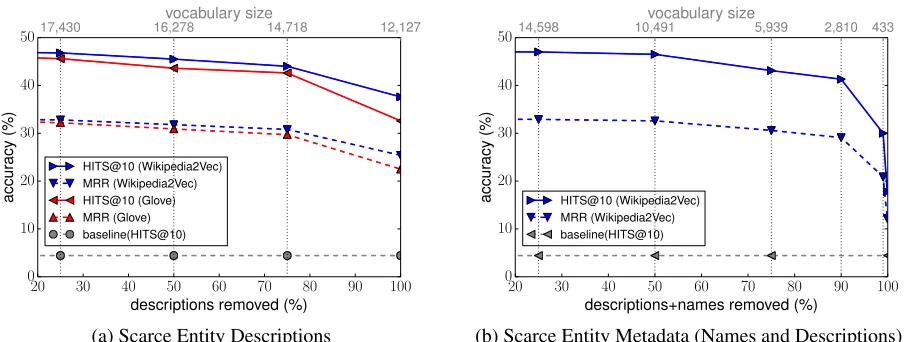
Figure 2: Performance on FB15k-237-OWE with ComplEx-OWE-300 without target filtering when dropping (a) the entity descriptions or (b) both descriptions and names. The x-axis shows the amount of textual data removed. Even for scarce textual data, learning the transformationΨmapis robust.
MRR HITS@
Transformation Filt. Raw 1 3 10
Linear 33.2 25.2 26.1 36.4 46.5 Affine 35.2 26.1 27.8 38.6 49.1
MLP 32.2 24.7 25.0 35.3 45.6
Table 5: Comparison of different transformation functions with ComplEx-OWE-300 on the FB15k-237-OWE dataset without target filtering.
three models are trained with embedding dimensionality
d = 300 on the closed-world dataset. For text
embed-dings, Wikipedia2Vec embeddings of the same dimension-ality were used. It can be seen that the performance on the open-world setting matches the expressiveness of the mod-els: ComplEx-OWE with its ability to model even asym-metric relations yields the best results, while the symasym-metric DistMult-OWE achieves a similar performance.
We also test different transformation functionsΨmap as
illustrated in Table 5. It can be observed that quite simple transformations achieve the strong results: The best perfor-mance is achieved by the affine transformation with49.1% HITS@10 by a margin of 2–4 percent.
4.5
Text Embeddings and Robustness To Missing
Entity Metadata
In some cases, the knowledge graph may lack textual meta-data (both the name and description) for some or all of its en-tities. Other models like ConMask and DKRL are dependant on textual descriptions, e.g. ConMask uses attention mech-anisms to select relation-specific target words from long texts. Therefore, ConMask and DKRL would require com-pletely dropping triples without metadata and be unable to learn about the link structure of such entities as they use joint training. However, in our approach, we have to drop
such entities only during the phase where the transformation
Ψmapis learned, while the link prediction model can still be
learned on the full graph.
To demonstrate the robustness of our approach to missing entity meta-data, we re-evaluate accuracy when randomly dropping metadata for training entities. Fig. 2 outlines the performance for two scenarios:
• Dropping descriptions: We remove only the textual de-scriptions for a varying percentage of randomly selected entities (between20% to100%). The names of these enti-ties are not removed and therefore, we still trainΨmapon
them.
• Dropping all meta-data: We randomly select entities and remove both their descriptions and names, effectively removing these entities from the training set altogether when trainingΨmap.
We also included a baseline experiment to simulate an un-successful learning ofΨmap. In this baseline, when
evalu-ating a test triple, we replace its head by the embedding of another random head from the training data. Note that this baseline still gives some reasonable hits for triples where therelationis a strong indicator. For example, if we have a triplet(X, time zone,?): Even if the headX is unknown, a model can achieve reasonable accuracy by simply ”guess-ing” time zones as tails.
Test Triple Head Description Top 4 Nearest Neighbors Top 4 Predictions
(Bram Stoker,
/people/person/profession,
Writer)
Irish novelist and short story writer, best known today for his 1897 Gothic novel Drac-ula
1. Ursula K. Le Guin 2. Charles Stross 3. Larry Niven 4. Kurt Vonnegut
1. Writer
2. England
3. United Kingdom 4. Author
(Parma, /.../country,
Italy)
Italian comune 1. Essen 2. Mantua 3. Bergamo 4. Siena
1. Portugal 2. Netherlands 3. Germany
4. Italy
(Bachelor of Science, /.../institution,
Kingston University)
Academic degree 1. Masters Degree 2. Doctoral Degree 3. Bachelor of Arts 4. Master of Arts
1. Harvard Law School 2. Wesleyan University 3. Panjab University 4. Baylor University
32. Kingston University
(Amtrak,
/.../headquarters.../citytown,
Washington DC)
Intercity rail operator in the United States
1. AT&T
2. Southwest Airlines 3. Starbucks
4. Delta Airlines
1. Dublin 2. New York City 3. United States Dollar 4. Charlotte
72. Washington DC
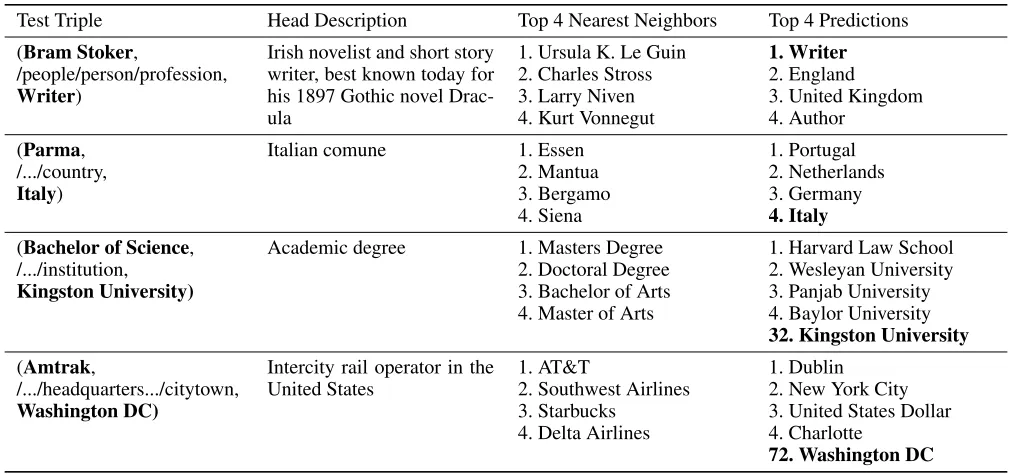
Table 6: Selected results on FB15k-237-OWE. For each test triple (Column 1), the head’s name and description (Column 2) is mapped to graph-based embedding space. The nearest training entities in that space (Column 3) indicate a good semantic match. The model predicts reasonable tails, in the first two cases successfully, in the others not.
In Fig. 2b, we remove not only descriptions but also en-tity names. Even in this case, learning is robust. If half of the
12,324training entities are removed, the drop in accuracy is less than1%. Only when removing90% of training data (leaving123training entities), performance starts to deteri-orate significantly. This highlights the ability of our model to learn from a limited amount of training data, when it is important to be able to train the KGC model itself onallthe entities.
4.6
Selected Results
Finally, we inspect sample prediction results for ComplEx-OWE-300 in Table 6. Besides the final prediction, we also test whether our transformation from text-based to seman-tic space is successful: For each test triple, we represent the open-world head entity by its text-based embeddingvhead,
match it to a graph-based embeddingΨmap(v
head), and
es-timate the nearest neighbor entities in this space. We use the Euclidean distance on the real part of the ComplEx embed-dings, but found results to be similar for the imaginary part. If the transformation works well, we expect these nearest neighbors to be semantically similar to the head entity. This is obviously the case: ForBram Stoker(the author of Drac-ula), the nearest neighbors are other authors of fantasy lit-erature. ForParma, the neighbors are cities (predominantly in Italy). For Bachelor of Science, the model predicts ap-propriate entities (namely, Universities) but – even though we apply filtering – the predictions are not rewarded. This is because the corresponding triples, like(Bachelor of Sci-ence, /.../institution, Harward Law School), are missing in the knowledge graph.
5
Conclusion
In this work, we have presented a simple yet effective ex-tension to embedding-based knowledge graph completion models (such as ComplEx, DistMult and TransE) to per-form open-world prediction. Our approach – which we named OWE – maps text-based entity descriptions (learned from word embeddings) to the pre-trained graph embedding space. In experiments on several datasets (including the new FB15K-237-OWE dataset we introduced in this work), we showed that the learned transformations yield semantically meaningful results, that the approach performs competitive with respect to the state of the art, and that it is robust to scarce text descriptions.
An interesting direction of future work will be to com-bine our model with approaches like ConMask (Shi and Weninger 2017a), which (1) exploit more complex aggrega-tion funcaggrega-tions and (2) use relaaggrega-tion-specific attenaggrega-tion/content masking to draw more precise embeddings from longer de-scriptions.
Acknowledgements
This work was partially funded by the German Federal Ministry of Education and Research (Program FHprofUnt, Project DeepCA / 13FH011PX6) and the German Academic Exchange Service (Project FIBEVID / 57402798).
References
Bordes, A.; Usunier, N.; Garcia-Duran, A.; Weston, J.; and Yakhnenko, O. 2013. Translating Embeddings for Mod-eling Multi-relational Data. InAdv. in Neural Information Processing Systems, 2787–2795.
Dong, X. L.; Gabrilovich, E.; Heitz, G.; Horn, W.; Lao, N.; Murphy, K.; Strohmann, T.; Sun, S.; and Zhang, W. 2014. Knowledge Vault: A Web-Scale Approach to Probabilistic Knowledge Fusion. InProc. KDD, 601–610.
Faruqui, M.; Dodge, J.; Jauhar, S. K.; Dyer, C.; Hovy, E. H.; and Smith, N. A. 2015. Retrofitting Word Vectors to Se-mantic Lexicons. InNAACL HLT, 1606–1615.
Ferrucci, D.; Brown, E.; Chu-Carroll, J.; Fan, J.; Gondek, D.; Kalyanpur, A. A.; Lally, A.; Murdock, J. W.; Nyberg, E.; Prager, J.; Schlaefer, N.; and Welty, C. 2010. Building Watson: An Overview of the DeepQA Project.AI Magazine 31(3):59–79.
Goldberg, Y. 2016. A Primer on Neural Network Models for Natural Language Processing. J. Artif. Int. Res.57(1):345– 420.
Mikolov, T.; Sutskever, I.; Chen, K.; Corrado, G.; and Dean, J. 2013. Distributed representations of words and phrases and their compositionality.CoRRabs/1310.4546.
Nickel, M.; Murphy, K.; Tresp, V.; and Gabrilovich, E. 2016. A Review of Relational Machine Learning for Knowledge Graphs.Proceedings of the IEEE104(1):11–33.
Paulheim, H. 2017. Knowledge Graph Refinement: A Sur-vey of Approaches and Evaluation Methods. Semantic Web 8(3):489–508.
Pennington, J.; Socher, R.; and Manning, C. D. 2014. Glove: Global Vectors for Word Representation. InProc. EMNLP. Peters, M. E.; Neumann, M.; Iyyer, M.; Gardner, M.; Clark, C.; Lee, K.; and Zettlemoyer, L. 2018. Deep contextualized word representations. InProc. NAACL.
Ristoski, P., and Paulheim, H. 2016. RDF2Vec: RDF Graph Embeddings for Data Mining. InProc. ISWC, 498–514. Shi, B., and Weninger, T. 2017a. Open-World Knowledge Graph Completion. CoRRabs/1711.03438.
Shi, B., and Weninger, T. 2017b. ProjE: Embedding Pro-jection for Knowledge Graph Completion. InProc. AAAI, 1236–1242.
Singhal, A. 2012. Introducing the Knowledge Graph: Things, not Strings. https://googleblog.blogspot.com /2012/05/introducing-knowledge-graph-things-not.html, last retrieved: Aug 2018).
Socher, R.; Chen, D.; Manning, C. D.; and Ng, A. Y. 2013. Reasoning with neural tensor networks for knowledge base completion. InProceedings of the 26th International Con-ference on Neural Information Processing Systems - Volume 1, NIPS’13, 926–934. USA: Curran Associates Inc. Toutanova, K., and Chen, D. 2015. Observed Versus Latent Features for Knowledge Base and Text Inference. In 3rd Workshop on Continuous Vector Space Models and Their Compositionality.
Trouillon, T.; Welbl, J.; Riedel, S.; Gaussier, ´E.; and Bouchard, G. 2016. Complex Embeddings for Simple Link
Prediction. InInt. Conference on Machine Learning, 2071– 2080.
Wang, Z., and Li, J. 2016. Text-enhanced Representation Learning for Knowledge Graph. InProc. International Joint Conference on Artificial Intelligence, 1293–1299.
Xie, R.; Liu, Z.; Jia, J.; Luan, H.; and Sun, M. 2016. Rep-resentation Learning of Knowledge Graphs with Entity De-scriptions. InProc. AAAI, 2659–2665.
Xu, C.; Bai, Y.; Bian, J.; Gao, B.; Wang, G.; Liu, X.; and Liu, T.-Y. 2014. RC-NET: A General Framework for Incorpo-rating Knowledge into Word Representations. InProc. Int. Conf. on Information and Knowledge Management, 1219– 1228.
Xu, J.; Qiu, X.; Chen, K.; and Huang, X. 2017. Knowl-edge Graph Representation with Jointly Structural and Tex-tual Encoding. InProc. Int. Joint Conference on Artificial Intelligence, 1318–1324.
Yamada, I.; Shindo, H.; Takeda, H.; and Takefuji, Y. 2016. Joint Learning of the Embedding of Words and Entities for Named Entity Disambiguation. In Proc. SIGNLL Confer-ence on Computational Natural Language Learning, 250– 259.
Yang, B.; Yih, W.; He, X.; Gao, J.; and Deng, L. 2014. Em-bedding Entities and Relations for Learning and Inference in Knowledge Bases. CoRRabs/1412.6575.