University of Warwick institutional repository: http://go.warwick.ac.uk/wrap
This paper is made available online in accordance with
publisher policies. Please scroll down to view the document
itself. Please refer to the repository record for this item and our
policy information available from the repository home page for
further information.
To see the final version of this paper please visit the publisher’s website.
Access to the published version may require a subscription.
Author(s): Naomi Blundell , Sian Taylor-Phillips , David Spitzer ,
Steven Martin , Ian Forde and Aileen Clarke
Article Title: Elective surgical referral guidelines - background
educational material or essential shared decision making tool? A
survey of GPs' in England
Year of publication: 2011
R E S E A R C H A R T I C L E
Open Access
Elective surgical referral guidelines - background
educational material or essential shared decision
making tool? A survey of GPs
’
in England
Naomi Blundell
1, Sian Taylor-Phillips
2, David Spitzer
3, Steven Martin
2, Ian Forde
4and Aileen Clarke
2*Abstract
Background:To investigate general practitioners’(GPs’) attitudes to guidelines for elective surgical referral in England. To understand their use of guidelines, and attitudes to shared decision making in the referral decision. Methods:A questionnaire was developed which investigated attitudes to and use of guidelines. It was given to a stratified random sample 30% (n = 310) drawn from GP lists of 10 English health districts (primary care trusts (PCTs)). GPs were invited to respond online, by telephone, fax or post. Data were analysed using descriptive statistics and backwards stepwise logistic regression.
Results:Responses were representative of GPs in England, but (despite up to 6 contacts per non-responder) the overall response rate was 41.6% (n =129; with the range across PCTs of 25-61%). Most responding GPs indicated support for referral guidelines but 18% reported that they had never used them. Less than three per cent reported use for most or all referral decisions. The odds of using guidelines decreased with increasing age, with a ten year increase in age associated with halving odds of use (OR = 0.53, 95%CI = 0.29-0.90). Over 50% of GPs wanted good access to electronic guidelines with expert information and advice on guideline availability. Almost all (>89%) GPs agreed with sharing referral decisions with patients. Female doctors (OR = 5.2, 95%CI: 1.02-26.3) were more likely to agree with this than male GPs as were those working in larger compared to small or single handed practices (OR = 5.3, 95%CI: 1.4-19.9). Conclusions:This group of responding GPs was supportive of guidelines but used them in different ways. Referral guidelines should have an educational component for background reading; include key messages for
internalisation and application; and incorporate mechanisms to facilitate accessibility and appropriate shared decision making with patients.
Keywords:Family Practice [MeSH], Primary Health Care [MeSH], Referral and Consultation [MeSH] Surgical Proce-dures, Operative [MeSH], Practice Guidelines [MeSH]
Background
The way general practitioners (GPs) in the UK are expected to provide care has changed considerably in recent years. Hundreds of national and local service frameworks and clinical guidelines have been distributed, in an attempt to improve the quality and evidence base for care and to minimise variation. At the same time, patients are encouraged to take a more active role in their own management, sharing key decisions with their
practitioner to ensure that their care is tailored to their needs and preferences [1].
People are referred from primary to secondary care for a number of different reasons: including diagnosis, reassur-ance, further assessment of a known condition and often specifically for assessment for surgery [2,3]. However until recently, referral guidelines have not incorporated explicit reference to patient preferences, health status or quality of life [4].
One of the key determinants of demand in the NHS remains the GP’s gate keeper role, whereby decisions about referral for further opinion, investigation or treat-ment are taken by GPs [5]. Access to secondary care is
* Correspondence: [email protected]
2
Division of Health Sciences, Warwick Medical School University of Warwick, CV4 7AL, UK
Full list of author information is available at the end of the article
restricted to those whom the primary care practitioner consider appropriate for specialist care. However, there is substantial variation in referral rates in the UK [6]. There is a need to improve the appropriateness of referral for elective surgery and to introduce guidance so that both over- and under- referral are reduced [7].
Evidence suggests that GPs are more likely to use guidelines which are clear, concise, accessible, [8-10] evi-dence-based, from a credible source, [11-13] and relevant to everyday practice. However the evidence that guide-lines alone are effective at changing clinician behaviour is limited [14-18]. Various models, building on the work of Rogers on diffusion of innovations and others [19] have been proposed both to explain why guidelines are not used as they should be and to suggest methods for improving the use of guidelines [20].
However, there are few studies which have investigated in detail the ways in which referral guidelines are used by GPs or the characteristics which affect their use of such guidelines particularly with regards to supporting or con-straining patient choice.
Exploring these issues is timely. In England, health ser-vice reforms are proposed [21] which give GPs their own budgets in a climate of financial austerity, making them responsible for prioritising and commissioning secondary care. Reducing referral to secondary care for elective surgi-cal intervention will be one of the key mechanisms avail-able to GPs for reducing costs.
Primary care for many health care systems is organised similarly internationally [5] and findings are likely to be generalizable more broadly.
In this study, we aimed to use a survey to investigate two key research questions.
1. To what extent are referral guidelines used and what influences this?
2. Is shared decision making in the referral decision viewed as an important principle and what influences this?
Methods
Questionnaire development: an 8-page self-completion questionnaire (Additional file 1: Appendix 1) was devel-oped based on previous research [22] and the knowledge of the research team. An initial draft was tested with ten GPs, who were given a choice of how to provide feedback (either by commenting in writing or by taking part in cog-nitive“think-aloud”pilot interviews, in which they were asked to explain their thoughts as they worked through the questionnaire). Feedback from the pilot was used to revise questions and response options. The final draft of the ques-tionnaire was pilot-tested with a further ten GPs to ensure clarity of language and question-wording, and to ensure that response options were exhaustive and mutually exclu-sive, where applicable.
Elective surgical referral guidelines were defined as “any structured paper or computer-based guide designed to assist those in primary care in making the decision whether or not to refer a patient to another professional where elective surgical intervention is one of the options for intervention.” Factors considered likely to affect use of and attitudes to guidelines were; age, gender, experi-ence and membership of professional bodies. Areas cov-ered in the questionnaire are described below.
Areas covered in questionnaire:
•How and why GPs use guidelines - the role guide-lines play in GPs’everyday practice. (This question was included as a result of pilot interviews).
•Support GPs believe they require for guideline use. (This question was included as a result of pilot interviews).
•Health conditions for which GPs have used, or cur-rently use, referral guidelines, and conditions/topics where GPs believe new guidelines are needed. Response options for both topics consisted of an exhaustive list of common, non-urgent conditions amenable to elective surgical intervention. These were identified as follows. The Department of Health Hos-pital Episode Statistics (HES) data for England [23] were used to identify all conditions where a minimum of 10,000 elective procedures per annum were carried out, and where direct referral to a surgeon could be expected. Only conditions/topics which could be con-sidered non-urgent at the time of surgery were included. The final list included: back pain, prostate problems, osteoarthritis of knee, stress incontinence, varicose veins, inguinal hernia, menorrhagia, cataract, sterilisation, haemorrhoids, osteoarthritis of hip, and infertility.
•Attitudes to patient involvement in decision mak-ing. Three existing alternative measures of GP atti-tudes to patient involvement in decision making were tested with ten GPs in the early stages of the questionnaire development process. Tools tested were the “Sharing” subscale of Krupat’s two-part Patient-Practitioner Orientation Scale [24]; the patient involvement section of Ogden et al’s four-part measure of GPs’ and patients’ beliefs about “patient-centredness” [25] and a tool developed by Elwyn and Edwards to measure the effect of an edu-cational intervention on GP attitudes to shared deci-sion making [26]. At the pilot stage, GPs were asked to comment on the acceptability of the content and language of each measure. Based on these com-ments, the Elwyn and Edwards tool [26] was selected as most suitable for inclusion in the final version of the questionnaire. In the version of this tool used for the survey,
Blundellet al.BMC Family Practice2011,12:92 http://www.biomedcentral.com/1471-2296/12/92
•GPs were presented with a set of nine statements relating to their attitudes towards, and practice of, involving patients in decision making and sharing risk information. They were asked to indicate their level of agreement with each statement on a five point Likert scale, considering their approach to patient involve-ment in decisions regarding elective surgical referral. •A“free text”question asking respondents for further comments they had about referral guidelines for elec-tive surgery. Background data including demographic details; years since qualification; characteristics of prac-tice; and membership of professional organisations.
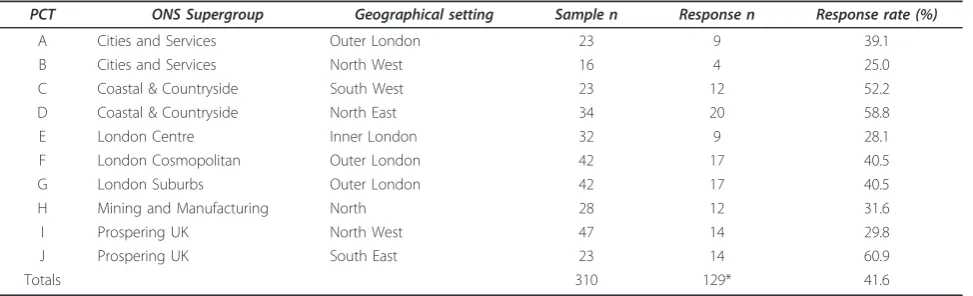
Sampling: the sampling frame was all GPs in England. Since response rates can be low for GPs [27] responding to surveys, difficulties achieving a reasonable response rate were anticipated in planning and sample size calculation. After obtaining multi centre research ethics committee approval, (Scotland MREC; reference MREC/03/0/108), a sample of ten English primary care trusts was selected, broadly reflecting variation described in the Office of National Statistics’(ONS) data on classification of health areas (Table 1). The ONS categorises primary care trusts under eight headings or Supergroups which group together geographic areas according to key characteristics common to the population in that grouping using data on a range of factors including age group distribution, ethnic group distribution, household composition, housing, socio-economic information, employment and dominant industry sector [28]. We randomly selected 10 PCTs, one from each Supergroup with an additional one from each of three Supergroup including “Cities and services,” “Coastal and Countryside”and“Prospering UK”to give a broader regional geographical coverage across England.
Research governance approval was obtained from each of the ten primary care trusts, and lists of practising GPs were requested and received from each. The GP lists of the primary care trusts were cleaned and validated using
the NHS website available at the time [29] and by contacting practices by telephone where discrepancies were identified Lists were stratified into single handed and group GP practices. GPs had to be practising and registered on PCT lists. Locums/temporary workers were therefore excluded. A 30% random sample of GPs, strati-fied by practice size, was drawn from each primary care trust. The sample size was calculated to detect a 20% dif-ference (90% versus 70%) in agreement to dichotomised outcome variables between two groups of GPs. This cal-culation used a significance level of 5%, at 80% power, assuming a 40% response rate.
Survey Methods: the survey was implemented in five stages. Anticipating non-response as a likely problem, measures were taken to enhance response rate at each stage. These are detailed below. Surveys were sent out between August 2005 and January 2006.
Staged implementation of survey to enhance response rate:
•Day 1: Eye-catching individually addressed post-card posted two weeks prior to initial mailing of the questionnaire. Postcard informed GPs about
■study aims and methods
■importance of involvement
■full questionnaire arriving shortly
■alternative methods for participation including online, telephone, fax, post
■Prize draw incentive (for an iPod or a case of champagne)
•Day 14: Questionnaire posted to GPs, with Free-post envelope for return accompanied by an infor-mation letter which reminded GPs about alternative methods for participation
[image:4.595.57.544.574.722.2]•Day 28: Non-responders sent a new copy of the questionnaire, accompanied by a similar letter, a Free-post envelope and an adapted version of the initial eye-catching postcard.
Table 1 Response by PCT
PCT ONS Supergroup Geographical setting Sample n Response n Response rate (%)
A Cities and Services Outer London 23 9 39.1 B Cities and Services North West 16 4 25.0 C Coastal & Countryside South West 23 12 52.2 D Coastal & Countryside North East 34 20 58.8 E London Centre Inner London 32 9 28.1 F London Cosmopolitan Outer London 42 17 40.5 G London Suburbs Outer London 42 17 40.5 H Mining and Manufacturing North 28 12 31.6 I Prospering UK North West 47 14 29.8 J Prospering UK South East 23 14 60.9
Totals 310 129* 41.6
•Day 42 Non-responders sent a further personalised letter, notifying them that a member of the research team might contact them by telephone over the next few weeks and inviting them to take part in the survey by telephone interview. The letter reminded GPs of the various methods for participation (online, tele-phone, fax, post).
• Day 56-70 non-respondents in 5 PCTs were con-tacted 1-2 times by telephone and invited to take part by telephone, online, or fax.
Data handling: GPs choosing to respond using the web were given a unique entry number to complete their ques-tionnaire. This system automatically completes their study database entry. Paper based responses and telephone responses were entered by study staff directly into the database. Data were cleaned. Analysis was undertaken using PASW statistics 17.0. Two dichotomous outcomes were defined as
i) GPs use or never use of referral guidelines and ii) agreement (either‘strongly agree’or‘slightly agree’) with the statement that“sharing decision making with patients is an important principle”versus neutral or “disagree” categories (’neither agree nor disagree’, ‘slightly disagree’, or‘strongly disagree’).
These were explored in backwards stepwise logistic regression analyses with age, gender, GP size, and personal list size as predictor variables. All four predictors were placed in the model, and assessed at each step against cri-teria to remain in the model (p < 0.1). The analysis stopped when all predictors remaining in the model met the criteria. Model evaluation, goodness of fit, and valida-tion of predicted probabilities were calculated using the likelihood ratio test, the Hosmer-Lemeshow test and the c-statistic [30]. The Wald statistic was used to determine whether each independent variable was a significant contributor.
Descriptive statistics are also presented for why and how referral guidelines are used, the additional support required to help make the best use of referral guidelines, and issues with involving patients in referral decisions. Within this, the associations of participant characteristics with responses to three of the questions are presented according to a-priori hypotheses of effects. These hypoth-eses were i) that less experienced GPs are more likely to use guidelines because they are required to by someone else; ii) that less experienced GPs are more likely to state that they use guidelines when encountering difficult/unfa-miliar circumstances; and iii) that younger respondents are more likely to want good access to electronic or inter-net based guidelines. For each hypothesis two-tailed 95%
confidence intervals were calculated for differences between proportions using a version of Wilsons test [31].
Results
Questionnaires were sent to 310 eligible GPs in ten PCTs in England after four GPs were excluded (1 retired, 1 moved to another practice, 2 locum GPs). Of the 310 eligi-ble practitioners, 129 completed the questionnaire from 104 separate GP practices, giving a final response rate of 41.6%. Response rates varied by PCT from 25% to 61% and were lower in urban as compared to rural areas. (Table 1).
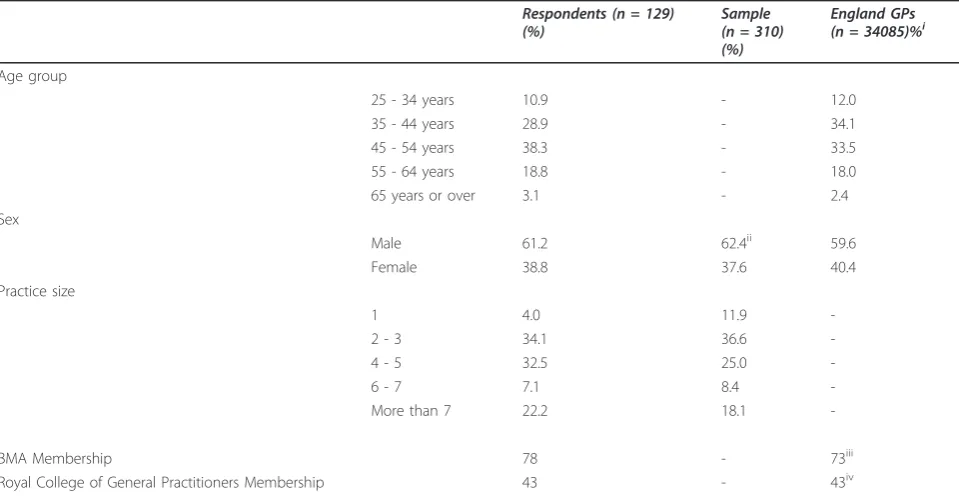
The majority of respondents were male and most were over the age of 45 years, with one quarter reporting that they had been fully qualified for less than ten years (n= 33, 25.8%,) and just over one in ten qualified for 30 or more years. More than three quarters of respondents were members of the British Medical Association (78.1%,n= 100) and about half were members of the Royal College of General Practitioners (43.8%,n= 56). Respondents were representative of the sample, and resembled GPs in Eng-land in terms of age, gender, practice size and membership of professional organisations Single-handed practitioners made up 4% (n =5) of respondents and 12.2% (n= 38) of the sample. (Table 2).
Twenty-three respondents (17.8%) stated that they had never used referral guidelines. Logistic regression analysis showed that although the effect of gender was not signifi-cant. (OR 3.4 95%CI = 0.9-12.7), the odds of using guide-lines decreased with increasing age. A ten year increase in age was associated with halving of odds of use (OR = 0.53, 95%CI = 0.29-0.90). All respondents in the 25-34 year age group reported using referral guidelines, in comparison with 92% in the 35-44year age group, 81% in the 45-54 year age group and 58% in the 55-64 year age group.
The model was a good fit to the data (Hosmer and Lemeshowc2(6) = 5.8, p = 0.45), and model predictions showed good agreement with actual outcomes (c-statistic = 0.749). (Table 3)
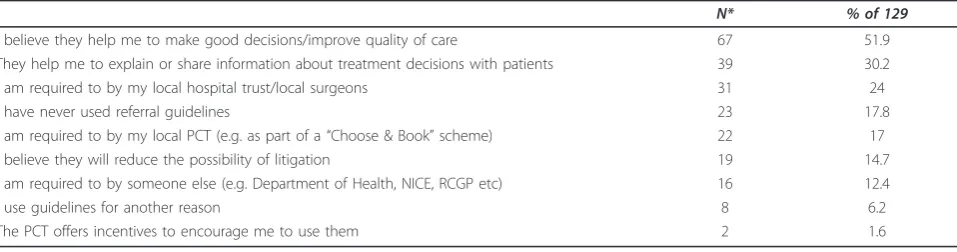
Responses indicated that guidelines were seen posi-tively, and provided useful information for practitioner and patient. Just over a half (51.9%,n= 67) indicated that guidelines helped them to make good decisions, and nearly a third said that they helped them to explain or share information with patients“(30.2%,n= 39). Seven-teen per cent said that they used guidelines (n= 22) because their local NHS organisation (PCT) required it. Only 13% of respondents cited being required to use guidelines by UK national bodies (e.g. National Institute for Health and Clinical Excellence (NICE), Department of Health) as a reason for using them. This differed by experience with 16% (13/79) of respondents with less than 20 years of experience as a GP and just 6% (3/49) of
Blundellet al.BMC Family Practice2011,12:92 http://www.biomedcentral.com/1471-2296/12/92
respondents with 20 or more years’experience cited this reason for using guidelines. However the difference was not significant. (Difference between proportions: 10% (95% CI -2% to 21%)). (Table 4).
GPs indicated that the most important use of referral guidelines was in an educational capacity to provide help or information when their existing knowledge and experience did not provide the solution to a problem. 48.8% (n= 63) of GPs indicated, “I look at guidelines when I encounter difficult/unfamiliar circumstances.” This response was more frequent amongst more recently qualified GPs, with 58.7% (44/75) of those who qualified less than twenty years ago selecting this option, com-pared to 40.4% (19/47) of those with 20 or more years of practice (difference = 18%, 95% CI = 0.1 - 35%).
The second most frequently cited use was again edu-cational: reading a referral guideline“once or twice to improve knowledge about conditions” (41.9%, n= 54). Similarly 34.1% (n = 44) GPs indicated that they read guidelines once or twice and relied on memory in order to apply recommendations to individual patients. Only a very small percentage of GPs 2.3% (n =3) reported that they used guidelines on most or all occasions a referral decision was made. (Table 5).
[image:6.595.58.538.100.348.2]GPs’were questioned about topics or conditions for which they had already used guidelines and also those conditions where they felt new guidelines might be bene-ficial. Three conditions were most commonly highlighted in both categories including lower urinary tract symp-toms (prostate problems), infertility and back pain. Table 2 Respondent characteristics
Respondents (n = 129) (%)
Sample (n = 310) (%)
England GPs (n = 34085)%i
Age group
25 - 34 years 10.9 - 12.0 35 - 44 years 28.9 - 34.1 45 - 54 years 38.3 - 33.5 55 - 64 years 18.8 - 18.0 65 years or over 3.1 - 2.4 Sex
Male 61.2 62.4ii 59.6 Female 38.8 37.6 40.4 Practice size
1 4.0 11.9
-2 - 3 34.1 36.6 -4 - 5 32.5 25.0 -6 - 7 7.1 8.4 -More than 7 22.2 18.1
-BMA Membership 78 - 73iii
Royal College of General Practitioners Membership 43 - 43iv
i. DH General and Personal Medical Services Statistics, England and Wales, 30 September 2004 http://www.dh.gov.uk/en/Publicationsandstatistics/Statistics/ StatisticalWorkAreas/Statisticalworkforce/index.htm accessed 30.03.2006.
ii. Data on sex not available for 3 participating PCTs. iii British Medical Association (personal communication).
iv *RCGP (Royal College of General Practitioners) (personal communication).
Table 3 Logistic regression analysis of whether respondents had ever used referral guidelines
Variable Coefficient B Standard Error
of B
Wald Statistic Degrees of freedom Sig. Odds Ratio Exp(B) 95% C.I. for EXP(B)
Lower Upper
Gender (1 = male, 0 = female)
1.225 .673 3.315 1 .069 3.405 .910 12.730 Age Category .658 .285 5.320 1 .021 1.930 1.104 3.374 Constant -4.397 1.012 18.871 1 .000 .012
a Variable(s) entered on step 1: gender, age, GP practice size, Personal list size. Likelihood ratio testc2
(2) = 12.689, p = 0.002, Cox and Snell R2
= 0.10, Nagelkerke R2
= 0.165, Hosmer and Lemeshowc2
[image:6.595.59.539.633.714.2]More than half of the responding GPs reported that they would like to have good access to electronic guide-lines, a greater proportion of GPs aged under 45 years (66%, 33/50) expressed this preference compared to GPs aged 45 and older (44%, 33/75, difference = 22%, 95%CI: 4-38%). Information about available guidelines and their quality were also thought particularly important. In con-trast, a relatively low proportion of GPs felt they would benefit from more training in how to use guidelines (8.5%,n= 11). (Table 6).
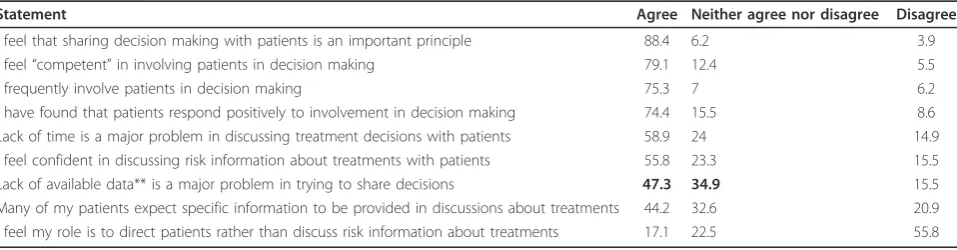
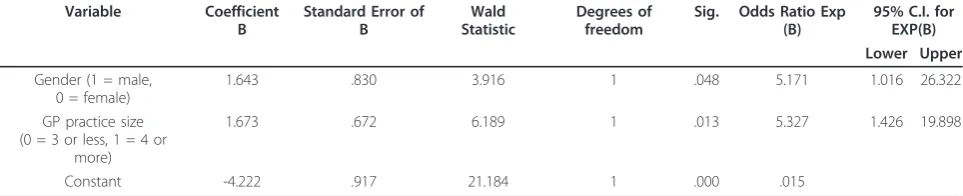
Table 7 shows responses to questions about shared decision making in the referral decision. We grouped together the“agree” category responses. Nearly 90% of GPs agreed that sharing decision making with patients is an important principle (88.4%, n = 114) Logistic regression analysis for respondents’views on the impor-tance of the principle of sharing decision making with patients is shown in Table 8. The model was a good fit to the data (Hosmer and Lemeshow c2 (2) = 1.876, p = 0.39), and model predictions showed good agreement with actual outcomes (c-statistic = 0.723). Two variables remained in the model, gender and practice size. Female GPs (OR = 5.2, 95%CI = 1.02-26.3), and those from practices with more than 3 GPs (OR = 5.3, 95%CI = 1.4-19.9) were more likely to consider sharing decision making important. A large majority, 85.3% (n = 110) said that they involved patients in referral decision making.
Lack of time for involving patients was considered a problem by just under 60% of GPs while lack of avail-able data was not so commonly regarded a problem.
In contrast to their overall support for the concept of shared decision making, and their own assessment of their competence in facilitating this, GPs were less inclined to feelconfidentin their skills in sharing deci-sions with patients. Whilst 81.6% said that they felt com-petentin sharing referral decisions, 59% feltconfidentin sharing such decisions.
Discussion
[image:7.595.59.538.100.226.2]We used a survey to investigate GPs’ attitudes to and use of guidelines for elective surgical referral in England. We anticipated a low response, and used evidence-based strategies to maximise response. Respondents were representative of GPs in England. Participating GPs indi-cated overall support for referral guidelines, but most appeared to use them in an educational capacity and very few (<3%) reported use on most or all of the occasions when a referral decision was made. Younger GPs were more likely to use guidelines than older male GPs. Over 50% of respondents wanted good access to electronic guidelines with expert information and advice on guide-line availability. Topics identified for new guideguide-line devel-opment included lower urinary tract symptoms, infertility and back pain. Almost all GPs (>89%) agreed with shar-ing referral decisions with patients. Female doctors were Table 4 Number and percentage of GPs agreeing with questionnaire statements on why they used referral guidelines
N* % of 129
I believe they help me to make good decisions/improve quality of care 67 51.9 They help me to explain or share information about treatment decisions with patients 39 30.2 I am required to by my local hospital trust/local surgeons 31 24 I have never used referral guidelines 23 17.8 I am required to by my local PCT (e.g. as part of a“Choose & Book”scheme) 22 17 I believe they will reduce the possibility of litigation 19 14.7 I am required to by someone else (e.g. Department of Health, NICE, RCGP etc) 16 12.4 I use guidelines for another reason 8 6.2 The PCT offers incentives to encourage me to use them 2 1.6
[image:7.595.58.538.610.724.2]*GPs were invited to tick more than one option.
Table 5 Number and percentage of GPs agreeing with questionnaire statements on how they used referral guidelines
N* % of 129
I look at guidelines when I encounter difficult/unfamiliar circumstances 63 48.8 I read guidelines once or twice for background education and/or to improve my knowledge of conditions 54 41.9 I read guidelines once or twice and rely on memory in order to apply recommendations to individual patients 44 34.1 I use guidelines in teaching 20 15.5 I use guidelines to help me audit my practice 12 9.3 I look at guidelines in most or all individual patient consultations where a referral might be necessary 3 2.3
Don’t know 2 1.6
Use guidelines in another way 2 1.6
*GPs were invited to tick more than one option.
Blundellet al.BMC Family Practice2011,12:92 http://www.biomedcentral.com/1471-2296/12/92
more likely to agree with this than male GPs as were those working in larger compared to small or single handed practices. This concurs with our findings on the incorporation of patients’preferences into referral guide-lines [32].
A survey is arguably the most appropriate method for consulting a large sample of professionals across a wide geographical area. We ensured that rigorous and compre-hensive processes of questionnaire design, piloting and administration were undertaken, but a brief scoping exer-cise exploring approaches to surveying GPs indicates that difficulties achieving a reasonable response rate should be expected [33]. Previous studies have demonstrated some measures which can help to improve response rates to varying extents, and such measures were rigorously employed in the present study including a prize draw for an iPod or a case of champagne [34].
Bearing in mind likely difficulties achieving a reason-able response rate, perhaps it is not surprising that a majority of our respondents was positive about the use of referral guidelines. They indicated that guidelines helped them make good decisions and/or improve the quality of care, in particular when confronted with a condition with which they were unfamiliar. They also
indicated that they tended to use guidelines as back-ground education.
With a response rate of just over 40 per cent, a reason-able assumption may be that many of the findings described above are only generalizable to a distinct group of GPs, perhaps those“compliers”who make greater use of guidelines than most. If this is the case, this paper potentially over-reports the interest of GPs in referral guidelines and under-reports“under-use”of guidelines. However, given these potential biases, it is of interest that just under one in five still felt able to report that they neverused referral guidelines and only one in forty said that they used guidelines in most referral decisions where these were available.
[image:8.595.58.540.100.264.2]Furthermore, as our respondents are potentially the very practitioners who, at present, make greatest use of guide-lines, and actively seek out guidelines when they need them, they are likely to be the individuals with the experi-ence and insight necessary to influexperi-ence future guideline development decisions. Thus, while our findings cannot necessarily demonstrate the patterns of, and motivation for, guideline usage (or non-usage) amongst all GPs in England, theycaninform and influence the format and content of new guidelines. This is particularly true in Table 6 Support identified by GPs’as helping them make best use of referral guidelines
N* %
Good access to electronic or internet based guidelines 66 51.2 Information telling me what guidelines are available 58 45.0 Expert advice on which are the best available guidelines 55 42.6 Regular updates telling me when new guidelines are produced 45 34.9 Good access to paper based guidelines 36 27.9 Technical support to help me find/access the best online/electronic guidelines 27 20.9 An internet source giving links to electronic guidelines 18 14.0 Technical support to help me USE online/electronic guidelines 16 12.4 General training on how to use guidelines 11 8.5 No support required - I choose not to use referral guidelines 9 7.0
No support required 5 3.9
Other type of support required 3 2.3
*GPs were invited to tick more than one option.
Table 7 Involving patients in the referral decision
Statement Agree Neither agree nor disagree Disagree
I feel that sharing decision making with patients is an important principle 88.4 6.2 3.9 I feel“competent”in involving patients in decision making 79.1 12.4 5.5 I frequently involve patients in decision making 75.3 7 6.2 I have found that patients respond positively to involvement in decision making 74.4 15.5 8.6 Lack of time is a major problem in discussing treatment decisions with patients 58.9 24 14.9 I feel confident in discussing risk information about treatments with patients 55.8 23.3 15.5 Lack of available data** is a major problem in trying to share decisions 47.3 34.9 15.5 Many of my patients expect specific information to be provided in discussions about treatments 44.2 32.6 20.9 I feel my role is to direct patients rather than discuss risk information about treatments 17.1 22.5 55.8
[image:8.595.59.538.598.723.2]relation to the conditions for which new guidelines are needed, and the characteristics of a useful, user-friendly guideline.
We designed specific question in the survey e.g. on how and why guidelines are used de novo using background information, literature, interviews and piloting with GPs. This process should have ruled out uncertainties and ambiguities in questions, but we acknowledge that these questions have not been further tested for their validity and reliability. We did not include analysis of clustering effects in our data since the design effects due to cluster-ing by GP practice was identified as low (e.g. 1.02 for use of referral guidelines).
Recent systematic reviews and studies of organisa-tional behaviour are helpful in interpreting our findings. Our recent systematic review of guidelines for elective surgical referral [14] and a recent Cochrane review [35] indicate that whilst many interventions have been tried, the best method for enhancing use of evidence in refer-rals has still not been clarified. Evidence-based practice guidelines can have small effects although the uptake of evidence may be highly dependent on context [18]. Organisational studies indicate that the process of “uptake” of evidence might better be regarded as a pro-cess of“instrumentalisation”or internalisation [36]. This idea of internalisation fits with our findings of a lack of everyday use of elective surgical referral guidelines, with instead, use of guidelines as a background educational intervention or when difficult or unfamiliar situations occur.
Conclusion
Our findings suggest that GPs consider referral guidelines valuable and would welcome an increase in access and availability of electronic guidelines for the referral decision. However we found that referral guidelines are not gener-ally routinely used in relevant consultations. We therefore recommend redesigning referral guidelines so that they are more useful for the ways in which they appear to be actually used in practice.
- An educational component for background reading - Key messages which can be internalised and applied in the consultation
- Clear indications of where and how shared deci-sion making can be incorporated into referral consultations
- An accessible format to allow for easy location of information at the time of the consultation especially when a difficult or unfamiliar situation occurs.
Ethics approval
A multi-centre research ethics committee approval was obtained for this research (Scotland MREC; reference MREC/03/0/108).
Additional material
Additional file 1: Appendix 1. Copy of GP Questionnaire.
Acknowledgements
We are very grateful to all the GPs who participated in the survey and to their staff who facilitated participation. We are also grateful to our steering group who guided the work.
Funding body
This work was funded by NIHR NCCSDO R&D Programme (Project Reference 08/1310/072). The views expressed here are those of the authors and not necessarily those of the NIHR SDO programme or the Department of Health.
Author details
1Freelance Researcher, Devon, UK.2Division of Health Sciences, Warwick
Medical School University of Warwick, CV4 7AL, UK.3Barts & the London School of Medicine & Dentistry, Queen Mary University of London, E1 2AT, UK.4Department of Epidemiology and Public Health, University College,
London, WC1E 6BT, UK.
Authors’contributions
NB, DS and AC carried out the survey. All authors participated in analysis and drafting of the manuscript and all authors read and approved the final manuscript.
Competing interests
The authors declare that they have no competing interests.
[image:9.595.57.539.112.210.2]Received: 6 December 2010 Accepted: 30 August 2011 Published: 30 August 2011
Table 8 Backwards stepwise logistic regression analysis whether sharing decision making with patients is considered an important principle
Variable Coefficient
B
Standard Error of B
Wald Statistic
Degrees of freedom
Sig. Odds Ratio Exp
(B)
95% C.I. for EXP(B) Lower Upper
Gender (1 = male, 0 = female)
1.643 .830 3.916 1 .048 5.171 1.016 26.322 GP practice size
(0 = 3 or less, 1 = 4 or more)
1.673 .672 6.189 1 .013 5.327 1.426 19.898
Constant -4.222 .917 21.184 1 .000 .015
a. Variable(s) entered on step 1: gender, age, GP size, Personal list size. Likelihood ratio testc2
(2) = 9.65, p = 0.008, Cox and Snell R2
= 0.077, Nagelkerke R2
= 0.162, Hosmer and Lemeshowc2
(2) = 1.876, p = 0.39, c-statistic = 0.723.
Blundellet al.BMC Family Practice2011,12:92 http://www.biomedcentral.com/1471-2296/12/92
References
1. Coulter A:The Autonomous Patient: Ending Paternalism in Medical Care.
London: Stationery Office (for the Nuffield Trust); 2002:128:ISBN 0-11, 703056-2.
2. Rosen R, Florin D, Dixon J:Access to Health Care.Context ReportLondon; King’s Fund; 2001.
3. Gulliford M, Hughes D, Figeroa-Munoz J,et al:Access to Health Care - A Scoping Exercise.King’s College, London. NCCSDO. LSHTM; 2001. 4. Boivin A, Légaré F, Gagnon MP:Competing norms: Canadian rural family
physicians’perceptions of clinical practice guidelines and shared decision-making.J Health Serv Res Policy2008,13(2):79-84.
5. Schoen C, Osborn R, Doty MM, Squires D, Peugh J, Applebaum S:A survey of primary care physicians in eleven countries, 2009: perspectives on care, costs, and experiences.Health Aff (Millwood)2009,28(6):w1171-83, Epub 2009 Nov 2.
6. O’Donnell C:Variation in general practitioner referral rates: what can we learn from the literature?Fam Pract2000,17:462-71.
7. McColl E, Newton J, Hutchinson A:An agenda for change in referral -consensus from general practice.Br J Gen Pract1994,44(381):157-62. 8. Langley C, Faulkner A, Watkins C, Gray S, Harvey I:Use of guidelines in
primary care–practitioners’perspectives.Fam Pract1998,15:105-11. 9. Young JM, Ward JE:Evidence-based medicine in general practice: beliefs
and barriers among Australian GPs.J Eval Clin Pract2001,7:201-10. 10. Coleman P, Nicholl J:Influence of evidence-based guidance on health
policy and clinical practice in England.QualHealth Care2001,10:229-37. 11. Sturmberg JP:Implementing best practice guidelines: the influence of
personal characteristics.J Eval Clin Pract1999,5:223-6.
12. Grilli R, Trisolini R, Labianca R, Zola P:Evolution of physicians’attitudes towards practice guidelines.J Health Serv Res Policy1999,4:215-9. 13. Gupta L, Ward JE, Hayward RS:Clinical practice guidelines in general
practice: a national survey of recall, attitudes and impact.Med J Aust
1997,166:69-72.
14. Clarke A, Blundell N, Forde I, Musila N, Spitzer D, Naqvi S, Browne J:What is the effect of guidelines for referral for elective surgical procedures on appropriateness, health outcomes and costs? A systematic review.
Quality and Safety in Health Care2010,19(3):187-94.
15. Woolf S, Grol R, Hutchinson A,et al:Clinical guidelines: potential benefits, limitations, and harms of clinical guidelines.BMJ1999,318:527e30. 16. Gabbay J, le May A:Evidence based guidelines or collectively
constructed“mindlines?”Ethnographic study of knowledge management in primary care.BMJ2004,329:1013.
17. Worrall G, Chaulk P, Freake D:The effects of clinical practice guidelines on patient outcomes in primary care: a systematic review.CMAJ1997,
156:1705e12.
18. Grimshaw J, Shirran L, Thomas R,et al:Changing provider behavior: an overview of systematic reviews of interventions.Med Care2001,39:II2e45. 19. Rogers EM, Rogers :Diffusion of innovations.4 edition. Free Press, New York;
1995.
20. Cabana MD, R CS, Powe NR, Wu AW, Wilson MH, Abboud PA, Rubin HR:
Why don’t physicians follow clinical practice guidelines? A framework for improvement.JAMA1999,282(15):1458-65.
21. Department of Health:Liberating the NHS: Equity and Excellence.DH
2010.
22. Clarke A, Musila N, van der Meulen J:The REFER Project - Realistic Effective Facilitation of Elective Referral for Elective Surgical Assessment (REFER)., NIHR NETSCC SDO 201008/1310/072.
23. Department of Health’s Hospital Episode Statistics (HES) for the years 2003 -2004 now held by NHS Information Centre: [http://www.ic.nhs.uk/statistics- and-data-collections/hospital-care/hospital-activity-hospital-episode-statistics–hes], Accessed 03.02.10.
24. Krupat E, Rosenkranz SL, Yeager CM, Barnard K, Putnam SM, Inui TS:The practice orientations of physicians and patients: the effect of doctor-patient congruence on satisfaction.Patient Education and Counselling
2000,39:49-59.
25. Ogden J, Ambrose L, Khadra A, Manthri S, Symons L, Vass A,et al:A questionnaire study of GPs’and patients’beliefs about the different components of patient centredness.Patient Education and Counselling
2002,47:223-7.
26. Edwards A, Elwyn G:Involving patients in decision making and communicating risk: a longitudinal evaluation of doctors’attitudes and confidence during a randomized trial.J Eval Clin Pract2004,10:431-7.
27. Buchan H, Lourey E, D’Este C, Sanson-Fisher R:Effectiveness of strategies to encourage general practitioners to accept an offer of free access to online evidence-based information: a randomised controlled trial.
Implement Sci2009,4:68.
28. National Statistics: [http://www.ons.gov.uk/ons/guide-method/classifications/ current-standard-classifications/national-statistics-2001-area-classifications/ cluster-summaries/output-areas/index.html], Accessed 17.11.10. 29. [http://www.nhs.uk/England/AuthoritiesTrusts/Pct/Default.aspx], Accessed
30.03.2006.
30. Hosmer D, Lemeshow S:A goodness-of-fit test for the multiple logistic regression model.Communications in Statistics1980, ,A10:1043-1069. 31. Newcombe RG:Interval Estimation for the Difference Between
Independent Proportions.Comparison of Eleven Methods Statistics in Medicine1998,17:873-890.
32. Musila N, Underwood M, McCaskie AW, Black N, Clarke A, van der Meulen JH:Referral recommendations for osteoarthritis of the knee incorporating patients’preferences.Family Pract2010,1:68-74. 33. Edwards PJ, Roberts I, Clarke MJ, DiGuiseppi C, Wentz R, Kwan I, Cooper R,
Felix LM, Pratap S:Methods to increase response to postal and electronic questionnaires.Cochrane Database of Systematic Reviews2009,3:Art. No.: MR000008, First published online: October 20. 2003.
34. Buchan H, Lourey E, D’Este C, Sanson-Fisher R:Effectiveness of strategies to encourage general practitioners to accept an offer of free access to online evidence-based information: a randomised controlled trial.
Implement Sci2009,4:68.
35. Farmer AP, Légaré F, Turcot L, Grimshaw J, Harvey E, McGowan J, Wolf F:
Printed educational materials: effects on professional practice and health care outcomes.Cochrane Database of Systematic Reviews: Reviews
John Wiley & Sons, Ltd Chichester, UK; 2008,3.
36. Tsoukas H, Vladimourou E:What is organizational knowledge?Journal of Management Studies2001, 38973-993.
Pre-publication history
The pre-publication history for this paper can be accessed here: http://www.biomedcentral.com/1471-2296/12/92/prepub
doi:10.1186/1471-2296-12-92
Cite this article as:Blundellet al.:Elective surgical referral guidelines
-background educational material or essential shared decision making tool? A survey of GPs’in England.BMC Family Practice201112:92.
Submit your next manuscript to BioMed Central and take full advantage of:
• Convenient online submission
• Thorough peer review
• No space constraints or color figure charges
• Immediate publication on acceptance
• Inclusion in PubMed, CAS, Scopus and Google Scholar
• Research which is freely available for redistribution