The Thirty-Third AAAI Conference on Artificial Intelligence (AAAI-19)
Balanced Linear Contextual Bandits
Maria Dimakopoulou,
1Zhengyuan Zhou,
2Susan Athey,
3Guido Imbens
3 1Department of Management Science & Engineering, Stanford University2Department of Electrical Engineering, Stanford University 3Graduate School of Business, Stanford University
[email protected], [email protected], [email protected], [email protected]
Abstract
Contextual bandit algorithms are sensitive to the estimation method of the outcome model as well as the exploration method used, particularly in the presence of rich heterogene-ity or complex outcome models, which can lead to difficult estimation problems along the path of learning. We develop algorithms for contextual bandits with linear payoffs that in-tegrate balancing methods from the causal inference literature in their estimation to make it less prone to problems of esti-mation bias. We provide the first regret bound analyses for linear contextual bandits with balancing and show that our algorithms match the state of the art theoretical guarantees. We demonstrate the strong practical advantage of balanced contextual bandits on a large number of supervised learning datasets and on a synthetic example that simulates model mis-specification and prejudice in the initial training data.
Introduction
Contextual bandits seek to learn a personalized treatment as-signment policy in the presence of treatment effects that vary with observed contextual features. In such settings, there is a need to balance the exploration of actions for which there is limited knowledge in order to improve performance in the future against the exploitation of existing knowledge in or-der to attain better performance in the present (see (Bubeck and Cesa-Bianchi 2012) for a survey). Since large amounts of data can be required to learn how the benefits of alter-native treatments vary with individual characteristics, con-textual bandits can play an important role in making exper-imentation and learning more efficient. Several successful contextual bandit designs have been proposed (Auer 2003), (Li et al. 2010), (Agrawal and Goyal 2013), (Agarwal et al. 2014), (Bastani and Bayati 2015). The existing literature has provided regret bounds (e.g., the general bounds of (Russo and Van Roy 2014), the bounds of (Rigollet and Zeevi 2010), (Perchet and Rigollet 2013), (Slivkins 2014) in the case of non-parametric function of arm rewards), has demonstrated successful applications (e.g., news article recommendations (Li et al. 2010) or mobile health (Lei, Tewari, and Murphy 2017)), and has proposed system designs to apply these al-gorithms in practice (Agarwal et al. 2016).
Copyright c2019, Association for the Advancement of Artificial Intelligence (www.aaai.org). All rights reserved.
In the contextual setting, one does not expect to see many future observations with the same context as the current ob-servation, and so the value of learning from pulling an arm for this context accrues when that observation is used to es-timate the outcome from this arm for a different context in the future. Therefore, the performance of contextual bandit algorithms can be sensitive to the estimation method of the outcome model or the exploration method used. In the initial phases of learning when samples are small, biases are likely to arise in estimating the outcome model using data from previous non-uniform assignments of contexts to arms. The bias issue is aggravated in the case of a mismatch between the generative model and the functional form used for es-timation of the outcome model, or similarly, when the het-erogeneity in treatment effects is too complex to estimate well with small datasets. In that case methods that proceed under the assumption that the functional form for the out-come model is correct may be overly optimistic about the extent of the learning so far, and emphasize exploitation over exploration. Another case where biases can arise oc-curs when training observations from certain regions of the context space are scarce (e.g., prejudice in training data if a non-representative set of users arrives in initial batches of data). These problems are common in real-world settings, such as in survey experiments in the domain of social sci-ences or in applications to health, recommender systems, or education. For example, early adopters of an online course may have different characteristics than later adopters.
accu-rate propensity scores even in small samples. So, even when the reward model is severely misspecified, the learner can use the propensity scores to obtain unbiased estimates of the reward function for each range of values of the context.
We suggest the integration of balancing methods from the causal inference literature (Imbens and Rubin 2015) in on-line contextual bandits. We focus on the domain of on-linear online contextual bandits with provable guarantees, such as LinUCB (Li et al. 2010) and LinTS (Agrawal and Goyal 2013), and we propose two new algorithms,balanced
lin-ear UCB (BLUCB)andbalanced linear Thompson sampling
(BLTS). BLTS and BLUCB build on LinTS and LinUCB re-spectively and extend them in a way that makes them less prone to problems of bias. The balancing will lead to lower estimated precision in the reward functions, and thus will emphasize exploration longer than the conventional linear TS and UCB algorithms, leading to more robust estimates.
The balancing technique is well-known in machine learn-ing, especially in domain adaptation and studies in learning-theoretic frameworks (Huang et al. 2007), (Zadrozny 2004), (Cortes, Mansour, and Mohri 2010). There is a number of recent works which approach contextual bandits through the framework of causality (Bareinboim, Forney, and Pearl 2015), (Bareinboim and Pearl 2015), (Forney, Pearl, and Bareinboim 2017), (Lattimore, Lattimore, and Reid 2016). There is also a significant body of research that leverages balancing for offline evaluation and learning of contextual bandit or reinforcement learning policies from logged data (Strehl et al. 2010), (Dud´ık, Langford, and Li 2011), (Li et al. 2012), (Dud´ık et al. 2014), (Li et al. 2014), (Swaminathan and Joachims 2015), (Jiang and Li 2016), (Thomas and Brunskill 2016), (Athey and Wager 2017), (Kallus 2017), (Wang, Agarwal, and Dud´ık 2017), (Deshpande et al. 2017), (Kallus and Zhou 2018), (Zhou, Athey, and Wager 2018). In the offline setting, the complexity of the historical assign-ment policy is taken as given, and thus the difficulty of the offline evaluation and learning of optimal policies is taken as given. Therefore, these results lie at the opposite end of the spectrum from our work, which focuses on the online setting. Methods for reducing the bias due to adaptive data collection have also been studied for non-contextual multi-armed bandits (Villar, Bowden, and Wason 2015), (Nie et al. 2018), but the nature of the estimation in contextual ban-dits is qualitatively different. Importance weighted regres-sion in contextual bandits was first mentioned in (Agarwal et al. 2014), but without a systematic motivation, analysis and evaluation. To our knowledge, our paper is the first work to integrate balancing in the online contextual bandit setting, to perform a large-scale evaluation of it against direct esti-mation method baselines with theoretical guarantees and to provide a theoretical characterization of balanced contextual bandits that match the regret bound of their direct method counterparts. The effect of importance weighted regression is also evaluated in (Bietti, Agarwal, and Langford 2018), but this is a successor to the extended version of our paper (Dimakopoulou et al. 2017).
We prove that the regret bound of BLTS is
˜
OdpKT1+/ and that the regret bound on BLUCB
is O˜√T dK where d is the number of features in the context,Kis the number of arms andT is the horizon. Our regret bounds for BLTS and BLUCB match the existing state-of-the-art regret bounds for LinTS (Agrawal and Goyal 2013) and LinUCB (Chu et al. 2011) respectively. We provide extensive and convincing empirical evidence for the effectiveness of BLTS and BLUCB (in comparison to LinTS and LinUCB) by considering the problem of multiclass classification with bandit feedback. Specifically, we transform aK-class classification task into aK-armed contextual bandit (Dud´ık, Langford, and Li 2011) and we use 300 public benchmark datasets for our evaluation. It is important to point out that, even though BLTS and LinTS share the same theoretical guarantee, BLTS outperforms LinTS empirically. Similarly, BLUCB has a strong empiri-cal advantage over LinUCB. In bandits, this phenomenon is not uncommon. For instance, it is well-known that even though the existing UCB bounds are often tighter than those of Thompson sampling, Thompson sampling performs better in practice than UCB (Chapelle and Li 2011). We find that this is also the case for balanced linear contextual bandits, as in our evaluation BLTS has a strong empirical advantage over BLUCB. Overall, in this large-scale evalu-ation, BLTS outperforms LinUCB, BLUCB and LinTS. In our empirical evaluation, we also consider a synthetic ex-ample that simulates in a simple way two issues of bias that often arise in practice, training data with non-representative contexts and model misspecification, and find again that BLTS is the most effective in escaping these biases.
Problem Formulation & Algorithms
Contextual Bandit Setting
In the stochastic contextual bandit setting, there is a finite set of arms, a ∈ A, with cardinality K. At every timet, the environment produces (xt, rt) ∼ D, wherext is a d-dimensional context vectorxtandrt= (rt(1), . . . , rt(K)) is the reward associated with each arm inA. The contextual bandit chooses armat∈ Afor contextxtand observes the reward only for the chosen arm,rt(at). The optimal assign-ment for context xt isa∗t = argmaxa{E[rt(a)|xt=x]}. The expected cumulative regret over horizon T is defined
asR(T) ,E
h PT
t=1(rt(a∗t)−rt(at))
i
. At each timet = 1, . . . , T, the contextual bandit assigns arm at to context xt based on the history of observations up to that time,
(xτ, aτ, rτ(aτ))tτ−=11. The goal is to find the assignment rule that minimizesR(T).
Linear Contextual Bandits
Linear contextual bandits rely on modeling and estimating the reward distribution corresponding to each arm a ∈ A
given context xt = x. Specifically the expected reward is assumed to be a linear function of the context xt with some unknown coefficient vector θa,E[rt(a)|xt = x] =
x>θa, and the variance is typically assumed to be constant
Algorithm 1Balanced Linear Thompson Sampling
1: Input: Regularization parameter λ > 0, propensity score thresholdγ∈(0,1), constantα(default is 1)
2: Setθˆa ←null, Ba←null,∀a∈ A
3: SetXa←empty matrix,ra←empty vector∀a∈ A
4: fort= 1,2, . . . , T do
5: if∃a∈ As.t.θaˆ =nullorBa =null then 6: Selecta∼Uniform(A)
7: else
8: Drawθa˜ fromNθa, αˆ 2V(ˆθa)
for alla∈ A
9: Selecta= arg max
a∈Ax >
tθa˜
10: end if
11: Observe rewardrt(a).
12: SetWa←empty matrix
13: forτ ∈ {1, . . . , t}s.t.aτ=ado
14: Computepa(xτ)and setw=max(γ,p1a(xτ))
15: Wa ←diag(Wa, w) 16: end for
17: Xa ←[Xa :x>t ]
18: Ba ←Xa>WaXa+λI
19: ra←[ra:rt(a)]
20: θaˆ ←B−1
a Xa>Wara
21: V(ˆθa)←Ba−1
(ra−Xa>θˆa)>Wa(ra−Xa>θˆa)
22: end for
each armaon the history of observations corresponding to this arm,(Xa, ra) = {(xt, rt(at)),t : at = a}. Thomp-son Sampling (ThompThomp-son 1933), (Scott 2010), (Agrawal and Goyal 2012), (Russo et al. 2018) and Upper Confi-dence Bounds (UCB) (Lai and Robbins 1985), (Auer, Cesa-Bianchi, and Fischer 2002) are two different methods which are highly effective in dealing with the exploration vs. ex-ploitation trade-off in multi-armed bandits. LinTS (Agrawal and Goyal 2013) and LinUCB (Li et al. 2010) are linear con-textual bandit algorithms associated with Thompson sam-pling and UCB respectively.
At timet, LinTS and LinUCB apply ridge regression with regularization parameter λ to the history of observations
(Xa, ra)for each arma∈ A, in order to obtain an estimate
ˆ
θaand its varianceVa(ˆθa). For the new contextxt,θaˆ and its variance are used by LinTS and LinUCB to obtain the con-ditional meanµaˆ (xt) =x>t θaˆ of the reward associated with each arma∈A, and its varianceV(ˆµa(xt)) =x>t V(ˆθa)xt. LinTS assumes that the expected reward µa(xt) associ-ated with arma conditional on the contextxt is Gaussian
N µaˆ (xt), α2
V(ˆµa(xt)), whereαis an appropriately
cho-sen constant. LinTS draws a sampleµa˜ (xt)from the distri-bution of each arma ∈and contextxtis then assigned to the arm with the highest sample,at = argmaxa{µa˜ (xt)}. LinUCB uses the estimateθˆa and its variance to compute upper confidence bounds for the expected rewardµa(xt)of contextxtassociated with each arma∈ Aand assigns the context to the arm with the highest upper confidence bound,
Algorithm 2Balanced Linear UCB
1: Input: Regularization parameter λ > 0, propensity score thresholdγ∈(0,1), constantα.
2: Setθaˆ ←null, Ba←null,∀a∈ A
3: SetXa←empty matrix,ra ←empty vector∀a∈ A
4: fort= 1,2, . . . , T do
5: if∃a∈ As.t.θaˆ =nullorBa=null then 6: Selecta∼Uniform(A)
7: else
8: Selecta= arg max
a∈A
x>tθaˆ +α
q
x>tV(ˆθa)xt
9: end if
10: Observe rewardrt(a).
11: SetWa←empty matrix
12: forτ∈ {1, . . . , t}s.t.aτ=ado
13: Estimatepaˆ (xτ)and setw=max(γ,1pˆ
a(xτ)) 14: Wa←diag(Wa, w)
15: end for
16: Xa ←[Xa :x>t] 17: Ba ←Xa>WaXa+λI
18: ra←[ra :rt(a)] 19: θˆa←Ba−1Xa>Wara
20: V(ˆθa)←Ba−1
(ra−Xa>θaˆ )>Wa(ra−Xa>θaˆ ) 21: end for
at = argmaxanµaˆ (xt) +αpV(ˆµa(xt))
o
, where αis an appropriately chosen constant.
Linear Contextual Bandits with Balancing
In this section, we show how to integrate balancing methods from the causal inference literature in linear contextual ban-dits, in order to make estimation less prone to bias issues.
where the posterior is the one that the algorithm consid-ered at the end of a randomly selected prior time period. The propensity scorepa(xτ) is the fraction of the Monte-Carlo iterations in which arm a has the highest sampled reward, where the arrival time of context xτ is treated as random. For every arm a, the history(Xa, ra, pa) is used to obtain a balanced estimateθˆBLTS
a ofθa and its variance
V(ˆθBLTSa )which produce a normally distributed estimate of
˜
µa∼ N
x>tθˆBLTS
a , α2x>tV(ˆθBLTSa )xt
of the reward of arm
afor contextxt, whereαis a parameter of the algorithm. In BLUCB (Algorithm 2), the observations are weighed by the inverse of estimated propensity scores. Note that UCB-based contextual bandits have deterministic assign-ment rules and conditional on the context the propensity score is either zero or one. But with the standard assumption that the arrival of contexts is random, at every time periodt the estimated probabilitypaˆ (xτ)is obtained by the predic-tion of the trained multinomial logistic regression model on
(xτ, aτ)τt−=11. Subsequently,(Xa, ra,paˆ )is used to obtain a balanced estimateθˆBLUCB
a ofθaand its varianceV(ˆθaBLUCB). These are used to construct the upper confidence bound,
x>tθaˆ +α
q
x>tV(ˆθBLUCBa )xt, for the reward of arm afor contextxt, whereαis a constant. (For some results, e.g., (Auer 2002),αneeds to be slowly increasing int.)
Note thatθˆBLTS
a ,V(ˆθaBLTS)andθˆBLUCBa ,V(ˆθaBLUCB)can be computed in closed form or via the bootstrap.
Weighting the observations by the inverse propensity scores reduces bias, but even when the propensity scores are known it increases variance, particularly when they are small. Clipping the propensity scores (Crump et al. 2009) with some threshold γ, e.g. 0.1 helps control the variance increase. This threshold γ is an additional pa-rameter to BLTS (Algorithm 1) and BLUCB (Algorithm 2) compared to LinTS and LinUCB. Finally, note that one could integrate in the contextual bandit estimation other covariate balancing methods, such as the method of approximate residual balancing (Athey, Imbens, and Wa-ger 2018) or the method of (Kallus 2017). For instance, with approximate residual balancing one would use as weightswa = argminw
(1−ζ)kwk2
2+ζkx¯−X T awk2∞
s.t.P
t:at=awt= 1and0 ≤wt≤n −2/3
a whereζ ∈(0,1) is a tuning parameter, na = PT
t=11{at = a} andx¯ = 1
T
PT
t=1xtand then usewa to modify the parametric and non-parametric model estimation as outlined before.
Theoretical Guarantees for BLTS and BLUCB
In this section, we establish theoretical guarantees of BLTS and BLUCB that are comparable to LinTS and LinUCB. We start with a few technical assumptions that are standard in the contextual bandits literature.
Assumption 1. Linear Realizability:There exist parame-ters{θa}a∈A such that given any contextx,E[rt(a)|x] = x>θa,∀a∈ A,∀t≥0.
We use the standard (frequentist) regret criterion and stan-dard assumptions on the regularity of the distributions.
Definition 1. The instantaneous regret at iteration t is x>tθa∗
t −x >
tθat, where a
∗
t is the optimal arm at iteration
t and at is the arm taken at iteration t. The cumulative
regret R(T) with horizon T is the defined as R(T) =
P>
t=1 x>tθa∗t −x >
tθat
.
Definition 2. We denote the canonical filtration of the
un-derlying contextual bandits problem by {Ft}∞t=1, where
Ft = σ({xs}ts=1,{as}st=1,{rs(as)}ts=1, xt+1): the sigma
algebra1 generated by all the random variables up to and
including iterationt, plusxt+1. In other words,Ftcontains
all the information that is available before making the
deci-sion for iterationt+ 1.
Assumption 2. For eacha∈ Aand everyt≥1:
1. Sub-Gaussian Noise: rt(a) − x>tθa is conditionally
sub-Gaussian: there exists some La > 0, such that
E[es(rt(a)−x>tθa)| F
t−1]≤exp( s2L2a
2 ),∀s,∀xt.
2. Bounded Contexts and Parameters:The contextsxtand
parametersθaare assumed to be bounded. Consequently,
without loss of generality, we can rescale them such that
kxtk2≤1,kθak2≤1,∀a, t.
Remark 1. Note that we make no assumption of the
underlying {xt}∞
t=1 process: the contexts {xt}∞t=1 need
not to be fixed beforehand or come from some sta-tionary process. Further, they can even be adapted to σ({xs}t
s=1,{as}ts=1,{rs(as)}ts=1), in which case they are called adversarial contexts in the literature as the contexts can be chosen by an adversary who chooses a context after observing the arms played and the corresponding rewards. If{xt}∞
t=1 is an IID process, then the problem is known as
stochastic contextual bandits. From this viewpoint, adver-sarial contextual bandits are more general, but the regret bounds tend to be worse. Both are studied in the literature.
Theorem 1. Under Assumption 1 and Assumption 2:
1. If BLTS is run withα=
q
log1
δ
in Algorithm 1, then with
probability at least1−δ,R(T) = ˜O
d
q
KT1+
.
2. If BLUCB is run withα=qlogT K
δ in Algorithm 2, then
with probability at least1−δ,R(T) = ˜O√T dK.
We refer the reader to Appendix A of the supplemental ma-terial of the extended version of this paper (Dimakopoulou et al. 2017) for the regret bound proofs.
Remark 2. The above bound essentially matches the exist-ing state-of-the art regret bounds for linear Thompson sam-pling with direct model estimation (e.g. (Agrawal and Goyal 2013)). Note that in (Agrawal and Goyal 2013), an infinite number of arms is also allowed, but all arms share the same
parameterθ. The final regret bound isO˜d2
√
T1+
. Note
that even though no explicit dependence onKis present in
the regret bound (and hence our regret bound appears as a
1
factor of√Kworse), this is to be expected, as we haveK parameters to estimate, one for each arm. Note that here we
do not assume any structure on theKarms; they are justK
stand-alone parameters, each of which needs to be indepen-dently estimated. Similarly, for BLUCB, our regret bound
isO˜√T dK, which is a factor of √K worse than that
of (Chu et al. 2011), which establishes aO˜√T dregret
bound. Again, this is because a single trueθ∗is assumed in
(Chu et al. 2011), rather thanKarm-dependent parameters.
Of course, we also point out that our regret bounds are not tight, nor do they achieve state-of-the-art regret bounds in contextual bandits algorithms in general. The
lower bound Ω(√dT) is established in (Chu et al. 2011)
for linear contextual bandits (again in the context of a
sin-gle parameter θ for all K arms). In general, UCB based
algorithms ((Auer 2003; Chu et al. 2011; Bubeck and Cesa-Bianchi 2012; Abbasi-Yadkori, P´al, and Szepesv´ari 2011)) tend to have better (and sometimes near-optimal) theoretical regret bounds. In particular, the state-of-the-art
bound of O(√dTlogK) for linear contextual bandits is
given in (Bubeck and Cesa-Bianchi 2012) (optimal up to a
O(logK)factor). However, as mentioned in the
introduc-tion, Thompson sampling based algorithms tend to perform much better in practice (even though their regret bounds tend not to match UCB based algorithms, as is also the case here). Hence, our objective here is not to provide state-of-the-art regret guarantees. Rather, we are motivated to design algorithms that have better empirical performance (com-pared to both the existing UCB style algorithms and Thomp-son sampling style algorithms), which also enjoy the base-line theoretical guarantee.
Finally, we give some quick intuition for the proof. For BLTS, we first show that estimated means concentrate around true mean (i.e. x>tθˆa concentrates around x>tθa). Then, we establish that sampled means concentrate around the estimated means (i.e.x>tθa˜ concentrates aroundx>tθa).ˆ These two steps together indicate that the sampled mean is close to the true mean. A further consequence of that is we can then bound the instantaneous regret (regret at each time stept) in terms of the sum of two standard deviations: one
corresponds to the optimal arm at time t, the other
corre-sponds to the actual selected arm att. The rest of the proof
then follows by giving tight characterizations of these two standard deviations. For BLUCB, the proof again utilizes the first concentration mentioned above: the estimated means concentrate around true mean (note that there is no sampled means in BLUCB). The rest of the proof adopts a similar structure as in (Chu et al. 2011).
Computational Results
In this section, we present computational results that com-pare the performance of our balanced linear contextual ban-dits, BLTS and BLUCB, with the direct method linear con-textual bandit algorithms that have theoretical guarantees, LinTS and LinUCB. Our evaluation focuses on contextual bandits with linear realizability assumption and strong theo-retical guarantees. First, we present a simple synthetic
ex-ample that simulates bias in the training data by under-representation or over-under-representation of certain regions of the context space and investigates the performance of the considered linear contextual bandits both when the outcome model of the arms matches the true reward generative pro-cess and when it does not match the true reward generative process. Second, we conduct an experiment by leveraging 300 public, supervised cost-sensitive classification datasets to obtain contextual bandit problems, treating the features as the context, the labels as the actions and revealing only the reward for the chosen label. We show that BLTS performs better than LinTS and that BLUCB performs better than LinUCB. The randomized assignment nature of Thompson sampling facilitates the estimation of the arms’ outcomes models compared to UCB, and as a result LinTS outper-forms LinUCB and BLTS outperoutper-forms BLUCB. Overall, BLTS has the best performance. In the supplemental ma-terial, we include experiments against the policy-based con-textual bandit from (Agarwal et al. 2014) which is statisti-cally optimal but it is also outperformed by BLTS.
A Synthetic Example
This simulated example aims to reflect in a simple way two issues that often arise in practice. The first issue is the pres-ence of bias in the training data by under-representation or over-representation of certain regions. A personalized policy that is trained based on such data and is applied to the en-tire context space will result in biased decisions for certain contexts. The second issue is the problem of mismatch be-tween the true reward generative process and the functional form used for estimation of the outcome model of the arms, which is common in applications with complex generative models. Model misspecification aggravates the presence of bias in the learned policies.
We use this simple example to present in an intuitive man-ner why balancing and randomized assignment rule help with these issues, before moving on to a large-scale eval-uation of the algorithms in real datasets in the next section.
Consider a simulation design where there is a warm-start batch of training observations, but it consists of contexts fo-cused on one region of the context space. There are three armsA = {0,1,2} and the contextsxt = (xt,0, xt,1)are two-dimensional withxt,j ∼ N(0,1), j ∈ {0,1}. The re-wards corresponding to each arm a ∈ Aare generated as follows;rt(0) = 0.5(xt,0+1)2+0.5(xt,1+1)2+t,rt(1) =
1 +t, andrt(2) = 2−0.5(xt,0+ 1)2−0.5(xt,1+ 1)2+t, wheret ∼ N(0, σ2),σ2 = 0.01. The expected values of the three arms’ rewards are shown in Figure 1.
Figure 1: Expectation of each arm’s reward, E[rt(0)] =
0.5(xt,0+ 1)2 + 0.5(xt,1+ 1)2 (red),E[rt(1)] = 1
(a) Well-specified LinTS
(b) Well-specified LinUCB
(c) Well-specified BLTS
(d) Well-specified BLUCB
Figure 2: Evolution of the arm assignment in the context space for well-specified LinTS, LinUCB, BLTS, BLUCB.
In the warm-start data,xt,0andxt,1are generated from a truncated normal distribution N(0,1) on the interval
(−1.15,−0.85), while in subsequent dataxt,0andxt,1 are drawn fromN(0,1)without the truncation. Each one of the 50 warm-start contexts is assigned to one of the three arms at random with equal probability. Note that the warm-start contexts belong to a region of the context space where the reward surfaces do not change much with the context. There-fore, when training the reward model for the first time, the estimated reward of arma= 2(blue) is the highest, the one of arma= 1(yellow) is the second highest and the one of arma= 0(red) is the lowest across the context space.
We run our experiment with a learning horizon T = 10000. The regularization parameterλ, which is present in all algorithms, is chosen via cross-validation every time the model is updated. The constant α, which is present in all algorithms, is optimized among values 0.25,0.5,1 in the Thompson sampling bandits (the valueα = 1corresponds to standard Thompson sampling, (Chapelle and Li 2011) suggest that smaller values may lower regret) and among values1,2,4 in the UCB bandits (Chapelle and Li 2011). The propensity thresholdγ for BLTS and BLUCB is opti-mized among the values0.01,0.05,0.1,0.2.
Well-Specified Outcome Models In this section, we com-pare the behavior of LinTS, LinUCB, BLTS and BLUCB when the outcome model of the contextual bandits is well-specified, i.e., it includes both linear and quadratic terms. Note that this is still in the domain of linear contextual ban-dits, if we treat the quadratic terms as part of the context.
(a) Mis-specified LinTS
(b) Mis-specified LinUCB
(c) Mis-specified BLTS
(d) Mis-specified BLUCB
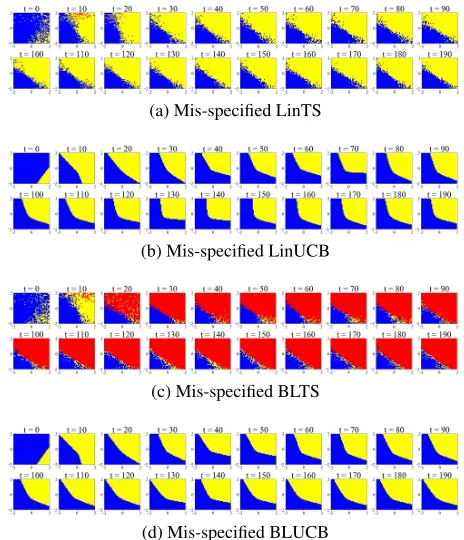
Figure 3: Evolution of the arm assignment in the context space for misspecified LinTS, LinUCB, BLTS, BLUCB.
First, we compare LinTS and LinUCB. Figure 2a shows that the uncertainty and the stochastic nature of LinTS leads to a “dispersed” assignment of armsa= 1anda= 2and to the crucial assignment of a few contexts to arma= 0. This allows LinTS to start decreasing the bias in the estimation of all three arms. Within the first few learning observations, LinTS estimates the outcome models of all three arms cor-rectly and finds the optimal assignment. On the other hand, Figure 2b, shows that the deterministic nature of LinUCB assigns entire regions of the context space to the same arm. As a result not enough contexts are assigned toa = 0and LinUCB delays the correction of bias in the estimation of this arm. Another way to understand the problem is that the outcome model in the LinUCB bandit has biased coefficients combined with estimated uncertainty that is too low to in-centivize the exploration of arm a = 0 initially. LinUCB finds the correct assignment after 240 observations.
Second, we study the performance of BLTS and BLUCB. In Figure 2d, we observe that balancing has a significant im-pact on the performance of UCB, since BLUCB finds the optimal assignment after 110 observations, much faster than LinUCB. This is because the few observations of arma= 0
outside of the context region of the warm-start batch are weighted more heavily by BLUCB. As a result, BLUCB, despite its deterministic nature which complicates estima-tion, is able to reduce its bias more quickly via balancing Figure 2c shows that BLTS is also able to find the optimal assignment a few observations earlier than LinTS.
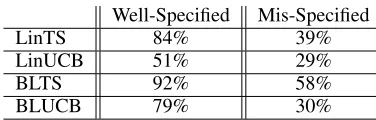
sim-ulations in which LinTS, LinUCB, BLTS and BLUCB find the optimal assignment withinT = 10000contexts for the well-specified case. BLTS outperforms all other algorithms by a large margin.
Mis-Specified Outcome Models We now study the be-havior of LinTS, LinUCB, BLTS and BLUCB when the out-come models include only linear terms of the context and therefore are misspecified. In real-world domains, the true data generative process is complex and very difficult to cap-ture by the simpler outcome models assumed by the learning algorithms. Hence, model mismatch is very likely.
We first compare LinTS and LinUCB. In Figures 3a, 3b, we see that during the first time periods, both bandits as-sign most contexts to arma= 2and a few contexts to arm a= 1. LinTS finds faster than LinUCB the linearly approx-imated area in which arm a = 2is suboptimal. However, both LinTS and LinUCB have trouble identifying that the optimal arm isa = 0. Due to the low estimate ofa = 0
from the mis-representative warm-start observations, Lin-UCB does not assign contexts to arm a = 0 for a long time and therefore, delays to estimate the model ofa = 0
correctly. LinTS does assign a few contexts to arma = 0, but they are not enough to quickly correct the estimation bias of arma = 0either. On the other hand, BLTS is able to harness the advantages of the stochastic assignment rule of Thompson sampling. The few contexts assigned to arm a = 0are weighted more heavily by BLTS. Therefore, as shown in Figure 3c, BLTS corrects the estimation error of arma = 0 and finds the (constrained) optimal assignment already after 20 observations. On the other hand, BLUCB does not handle better than LinUCB the estimation problem created by the deterministic nature of the assignment in the misspecified case, as shown in Figure 3d. The second col-umn of table 1 shows the percentage of simulations in which LinTS, LinUCB, BLTS and BLUCB find the optimal assign-ment withinT = 10000contexts for the misspecified case. Again, BLTS has a strong advantage.
This simple synthetic example allowed us to explain transparently where the benefits of balancing in linear ban-dits stem from. Balancing helps escape biases in the training data and can be more robust in the case of model misspecifi-cation. While, as we proved, balanced linear contextual ban-dits share the same strong theoretical guarantees, this indi-cates towards their better performance in practice compared to other contextual bandits with linear realizability assump-tion. We investigate this further in the next section with an extensive evaluation on real classification datasets.
Well-Specified Mis-Specified
LinTS 84% 39%
LinUCB 51% 29%
BLTS 92% 58%
BLUCB 79% 30%
Table 1: Percentage of simulations in which LinTS, Lin-UCB, BLTS and BLUCB find the optimal assignment within learning horizon of10000contexts
Multiclass Classification with Bandit Feedback
Adapting a classification task to a bandit problem is a com-mon method for comparing contextual bandit algorithms (Dud´ık, Langford, and Li 2011), (Agarwal et al. 2014), (Bietti, Agarwal, and Langford 2018). In a classification task, we assume data are drawn IID from a fixed distri-bution: (x, c) ∼ D, where x ∈ X is the context and c ∈ 1,2, . . . , K is the class. The goal is to find a classi-fierπ : X → {1,2, . . . , K}that minimizes the classifica-tion errorE(x,c)∼D1{π(x)6=c}. The classifier can be seen as an arm-selection policy and the classification error is the policy’s expected regret. Further, if only the loss associated with the policy’s chosen arm is revealed, this becomes a contextual bandit setting. So, at timet, contextxt is sam-pled from the dataset, the contextual bandit selects armat∈ {1,2, . . . , K} and observes rewardrt(at) = 1{at=ct}, wherectis the unknown, true class ofxt. The performance of a contextual bandit algorithm on a dataset withn observa-tions is measured with respect to the normalized cumulative regret, n1Pn
t=1(1−rt(at)).
We use 300 multiclass datasets from the Open Media Li-brary (OpenML). The datasets vary in number of observa-tions, number of classes and number of features. Table 2 summarizes the characteristics of these benchmark datasets. Each dataset is randomly shuffled.
Observations Datasets
≤100 58
>100and≤1000 152 >1000and≤10000 57
>10000 33
Classes Count
2 243
>2and10 48 >10 9
Features Count
≤10 154 >10and ≤100 106
>100 40
Table 2: Characteristics of the 300 datasets used for the ex-periments of multiclass classification with bandit feedback.
We evaluate LinTS, BLTS, LinUCB and BLUCB on these 300 benchmark datasets. We run each contextual bandit on every dataset for different choices of input parameters. The regularization parameter λ, which is present in all algo-rithms, is chosen via cross-validation every time the model is updated. The constant α, which is present in all algo-rithms, is optimized among values0.25,0.5,1in the Thomp-son sampling bandits (Chapelle and Li 2011) and among val-ues1,2,4in the UCB bandits (Chapelle and Li 2011). The propensity thresholdγfor BLTS and BLUCB is optimized among the values0.01,0.05,0.1,0.2. Apart from baselines that belong in the family of contextual bandits with linear realizability assumption and have strong theoretical guar-antees, we also evaluate the policy-based ILOVETOCON-BANDITS (ILTCB) from (Agarwal et al. 2014) that does not estimate a model, but instead it assumes access to an or-acle for solving fully supervised cost-sensitive classification problems and achieves the statistically optimal regret.
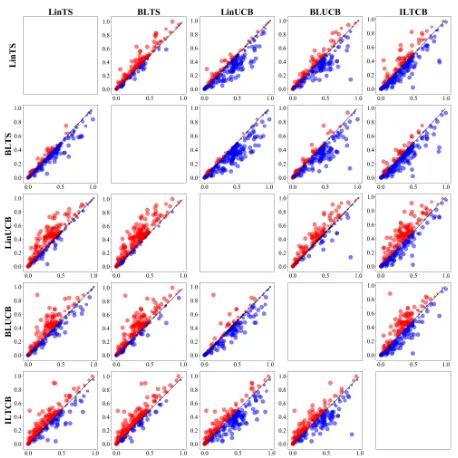
Figure 4: Comparing LinTS, BLTS, LinUCB, BLUCB, ILTCB on 300 datasets. BLUCB outperforms LinUCB. BLTS outperforms LinTS, LinUCB, BLUCB, ILTCB.
LinUCB, BLUCB and ILTCB on the 300 classification datasets. Each point corresponds to a dataset. Thex coordi-nate is the normalized cumulative regret of the column ban-dit and theycoordinate is the normalized cumulative regret of the row bandit. The point is blue when the row bandit has smaller normalized cumulative regret and wins over the col-umn bandit. The point is red when the row bandit loses from the column bandit. The point’s size grows with the signifi-cance of the win or loss.
The first important observation is that the improved model estimation achieved via balancing leads to better practical performance across a large number of contextual bandit in-stances. Specifically, BLTS outperforms LinTS and BLUCB outperforms LinUCB. The second important observation is that deterministic assignment rule bandits are at a disadvan-tage compared to randomized assignment rule bandits. The improvement in estimation via balancing is not enough to outweigh the fact that estimation is more difficult when the assignment is deterministic and BLUCB is outperformed by LinTS. Overall, BLTS which has both balancing and a ran-domized assignment rule, outperforms all other linear con-textual bandits with strong theoretical guarantees. BLTS also outperforms the model-agnostic ILTCB algorithm. We refer the reader to Appendix B of the supplemental material of the extended version of this paper (Dimakopoulou et al. 2017) for details on the datasets.
Closing Remarks
Contextual bandits are poised to play an important role in a wide range of applications: content recommendation in web-services, where the learner wants to personalize recommen-dations (arm) to the profile of a user (context) to maximize
engagement (reward); online education platforms, where the learner wants to select a teaching method (arm) based on the characteristics of a student (context) in order to maxi-mize the student’s scores (reward); and survey experiments, where the learner wants to learn what information or persua-sion (arm) influences the responses (reward) of subjects as a function of their demographics, political beliefs, or other characteristics (context). In these settings, there are many potential sources of bias in estimation of outcome models, not only due to the inherent adaptive data collection, but also due to mismatch between the true data generating process and the outcome model assumptions, and due to prejudice in the training data in form of under-representation or over-representation of certain regions of the context space. To re-duce bias, we have proposed new contextual bandit algo-rithms, BLTS and BLUCB, which build on linear contextual bandits LinTS and LinUCB respectively and improve them with balancing methods from the causal inference literature. We derived the first regret bound analysis for linear con-textual bandits with balancing and we showed linear contex-tual bandits with balancing match the theoretical guarantees of the linear contextual bandits with direct model estimation; namely that BLTS matches the regret bound of LinTS and BLUCB matches the regret bound of LinUCB. A synthetic example simulating covariate shift and model misspecifica-tion and a large-scale experiment with real multiclass classi-fication datasets demonstrated the effectiveness of balanc-ing in contextual bandits, particularly when coupled with Thompson sampling.
Acknowledgments
The authors would like to thank Emma Brunskill for valu-able comments on the paper and John Langford, Miroslav Dud´ık, Akshay Krishnamurthy and Chicheng Zhang for use-ful discussions regarding the evaluation on classification datasets. This research is generously supported by ONR grant N00014-17-1-2131, by the Sloan Foundation, by the “Arvanitidis in Memory of William K. Linvill” Stanford Graduate Fellowship and by the Onassis Foundation.
References
Abbasi-Yadkori, Y.; P´al, D.; and Szepesv´ari, C. 2011. Improved algorithms for linear stochastic bandits. InNIPS.
Agarwal, A.; Hsu, D.; Kale, S.; Langford, J.; Li, L.; and Schapire, R. 2014. Taming the monster: A fast and simple algorithm for contextual bandits.ICML.
Agarwal, A.; Bird, S.; Cozowicz, M.; Hoang, L.; Langford, J.; Lee, S.; Li, J.; Melamed, D.; Oshri, G.; Ribas, O.; Sen, S.; and Slivkins, A. 2016. Making contextual decisions with low tech-nical debt. arXiv preprint arXiv:1606.03966.
Agrawal, S., and Goyal, N. 2012. Analysis of thompson sam-pling for the multi-armed bandit problem. Journal of Machine Learning Research Workshop and Conference Proceedings. Agrawal, S., and Goyal, N. 2013. Thompson sampling for contextual bandits with linear payoffs. ICML.
Athey, S.; Imbens, G. W.; and Wager, S. 2018. Approximate residual balancing: debiased inference of average treatment ef-fects in high dimensions. Journal of the Royal Statistical Soci-ety.
Auer, P.; Cesa-Bianchi, N.; and Fischer, P. 2002. Finite-time analysis of the multiarmed bandit problem.Machine Learning. Auer, P. 2002. Using confidence bounds for exploitation-exploration trade-offs. Journal of Machine Learning Research 3(Nov).
Auer, P. 2003. Using confidence bounds for exploitation-exploration trade-offs.Journal of Machine Learning Research. Bareinboim, E., and Pearl, J. 2015. Causal inference and the data-fusion problem. Proceedings of the National Academy of Sciences.
Bareinboim, E.; Forney, A.; and Pearl, J. 2015. Bandits with unobserved confounders: A causal approach.ICML.
Bastani, H., and Bayati, M. 2015. Online decision-making with high-dimensional covariates.
Bietti, A.; Agarwal, A.; and Langford, J. 2018. A contextual bandit bake-off.arXiv preprint arXiv:1802.04064.
Bubeck, S., and Cesa-Bianchi, N. 2012. Regret analysis of stochastic and nonstochastic multi-armed bandit problems. Foundations and Trends in Machine Learning.
Chapelle, O., and Li, L. 2011. An empirical evaluation of thompson sampling.NIPS.
Chu, W.; Li, L.; Reyzin, L.; and Schapire, R. 2011. Contextual bandits with linear payoff functions. InAISTATS.
Cortes, C.; Mansour, Y.; and Mohri, M. 2010. Learning bounds for importance eeighting.NIPS.
Crump, R. K.; Hotz, V. J.; Imbens, G. W.; and Mitnik, O. A. 2009. Dealing with limited overlap in estimation of average treatment effects.Biometrika96(1):187–199.
Deshpande, Y.; Mackey, L.; Syrgkanis, V.; and Taddy, M. 2017. Accurate inference in adaptive linear models. arXiv preprint arXiv:1712.06695.
Dimakopoulou, M.; Zhou, Z.; Athey, S.; and Imbens, G. 2017. Estimation considerations in contextual bandits.arXiv preprint arXiv:1711.07077.
Dud´ık, M.; Erhan, D.; Langford, J.; and Li, L. 2014. Doubly robust policy evaluation and optimization.Statistical Science. Dud´ık, M.; Langford, J.; and Li, L. 2011. Doubly robust policy evaluation and learning.ICML.
Forney, A.; Pearl, J.; and Bareinboim, E. 2017. Counterfactual data-fusion for online reinforcement learners.ICML.
Huang, J.; Gretton, A.; Borgwardt, K. M.; Scholkopf, B.; and Smola, A. J. 2007. Correcting sample selection bias by unla-beled data.NIPS.
Imbens, G. W., and Rubin, D. B. 2015. Causal Inference in Statistics, Social, and Biomedical Sciences.
Jiang, N., and Li, L. 2016. Doubly robust off-policy value evaluation for reinforcement learning.ICML.
Kallus, N., and Zhou, A. 2018. Policy evaluation and optimiza-tion with continuous treatments.AISTATS.
Kallus, N. 2017. Balanced policy evaluation and learning. arXiv preprint arXiv:1705.07384.
Lai, T., and Robbins, H. 1985. Asymptotically efficient adap-tive allocation rules.Advances in Applied Mathematics. Lattimore, F.; Lattimore, T.; and Reid, M. D. 2016. Causal ban-dits: Learning good interventions via causal inference.NIPS. Lei, H.; Tewari, A.; and Murphy, S. 2017. An actor-critic con-textual bandit algorithm for personalized mobile health inter-ventions. arXiv preprint arXiv:1706.09090.
Li, L.; Chu, W.; Langford, J.; and Schapire, R. 2010. A contextual-bandit approach to personalized news article recom-mendation. WWW.
Li, L.; Chu, W.; Langford, J.; Moon, T.; and Wang, X. 2012. An unbiased offline evaluation of contextual bandit algorithms with generalized linear models. Journal of Machine Learning Research Workshop and Conference Proceedings.
Li, L.; Chen, S.; Kleban, J.; and Gupta, A. 2014. Counterfactual estimation and optimization of click metrics for search engines. arXiv preprint arXiv:1403.1891.
Nie, X.; Tian, X.; Taylor, J.; and Zou, J. 2018. Why adaptively collected data have negative bias and how to correct for it. In-ternational Conference on Artificial Intelligence and Statistics. Perchet, V., and Rigollet, P. 2013. The multi-armed bandit problem with covariates. The Annals of Statistics.
Rigollet, P., and Zeevi, R. 2010. Nonparametric bandits with covariates.COLT.
Russo, D., and Van Roy, B. 2014. Learning to optimize via posterior sampling.Mathematics of Operations Research. Russo, D. J.; Van Roy, B.; Kazerouni, A.; Osband, I.; and Wen, Z. 2018. A tutorial on thompson sampling. Foundations and Trends in Machine Learning.
Scharfstein, D. O.; Rotnitzky, A.; and Robins, J. M. 1999. Ad-justing for nonignorable drop-out using semiparametric nonre-sponse models.Journal of the American Statistical Association 94(448):1096–1120.
Scott, S. 2010. A modern bayesian look at the multi-armed bandit.Applied Stochastic Models in Business and Industry. Slivkins, A. 2014. Contextual bandits with similarity informa-tion.Journal of Machine Learning Research.
Strehl, A.; Langford, J.; Li, L.; and Kakade, S. M. 2010. Learn-ing from logged implicit exploration data. InNIPS.
Swaminathan, A., and Joachims, T. 2015. Batch learning from logged bandit feedback through counterfactual risk minimiza-tion.Journal of Machine Learning Research.
Thomas, P., and Brunskill, E. 2016. Data-efficient off-policy policy evaluation for reinforcement learning. ICML.
Thompson, W. 1933. On the likelihood that one unknown prob-ability exceeds another in view of the evidence of two samples. Biometrika.
Villar, S.; Bowden, J.; and Wason, J. 2015. Multi-armed ban-dit models for the optimal design of clinical trials: benefits and challenges. Statistical Science.
Wang, Y. X.; Agarwal, A.; and Dud´ık, M. 2017. Optimal and adaptive off-policy evaluation in contextual bandits. ICML. Zadrozny, B. 2004. Learning and evaluating classifiers under sample selection bias. ICML.
![Figure 1: Expectation of each arm’s reward, E[rt(0)] =0.5(xt,0 + 1)2 + 0.5(xt,1 + 1)2 (red), E[rt(1)] = 1 (yel-low), E[rt(2)] = 2 − 0.5(xt,0 + 1)2 − 0.5(xt,1 + 1)2 (blue).](https://thumb-us.123doks.com/thumbv2/123dok_us/9678398.1950795/5.612.379.499.600.658/figure-expectation-arm-reward-red-yel-low-blue.webp)