162
Volume-4, Issue-4, August-2014,
ISSN No.: 2250-0758
International Journal of Engineering and Management Research
Available at:
www.ijemr.net
Page Number: 162-167
Optimization of Process Parameter and Experimental Investigation of
MRR on H-13 Die Tool Steel using EDM with Application of Taguchi
Technique
Surender Kumar1, Satpal Kundu2, Ravinder Chaudhary3
1M.Tech Student Shree Krishan Institute Of Engineering and Technology, KKR, Haryana, INDIA
2,3
Assistant Professor, Department of Mechanical Engineering, SKIET, Kurukshetra, Haryana, INDIA
ABSTRACT
H-13 is die tool steel, it have widely applications in the Hot punches and dies for blanking, bending, swaging and forging,Hot extrusion dies for aluminum, cores,ejector pins, inserts, Nozzles for aluminum, tin and lead die casting, Hot shear blades etc. as the H-13 steel has widely applications so it is chosen for the present study. Presents works shows the effect of various process parameters like peak current, Pulse on Time,and Feed rate on Matirial Removal Rate. EDM Drilling and taguchi technique is used for the optimization of response variables.
Keyword-- H-13 Diie tool steel, Edm drilling, peak current, Pulse on Time,and Feed rate, Matirial Removal Rate, taguchi technique
I.
INTRODUCTION
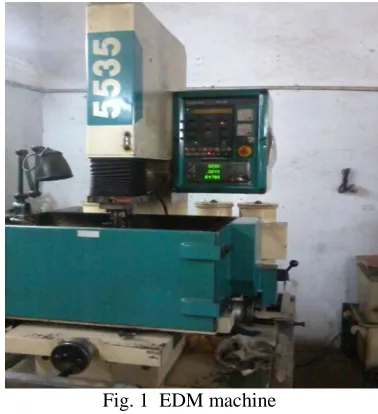
A EDM machine was used as the experimental machine in this study. A Copper Tool with a diameter of 5 mm was used as an electrode to erode a work piece of h-13 Die Tool steel (flat plate). EDM is a non-traditional process based on removing unwanted material in the form of debris from a part by means of a series of recurring electrical discharges (created by electric pulse generators in micro seconds) between a tool called electrode and the work material in the presence of a dielectric fluid (EDM Oil, kerosene and distilled water) .
Fig. 1 EDM machine
EDM is an cost-effective and important method of machining hard and brittle electrically conductive materials. In EDM, since there is no direct contact between the electrode and the workpiece, hence it can eliminate mechanical stresses chatter and vibration problems during machining. All type of conductive material can be machined using EDM irrespectively the hardness of the material. Both tool and work piece are submerged in a dielectric fluid. Kerosene/EDM oil/de-ionized water is very common type of liquid dielectric medium.
II.
LITREATURE REVIEW
163
peak current, Pulse on Time, and Jet pressure on Material Removal Rate. EDM Drilling and L9 orthogonal array taguchi technique is used for the optimization of response variables. Result show that MRR is increase by increasing the peak current, MRR rises by increasing the value of pulse on time and MRR decreased by increasing the jet pressure.
Andad Pandey et. al. (2010) Present
manufacturing industries are facing challenges from these advanced materials viz. super alloys, ceramics, and composites, that are hard and difficult to machine, requiring high precision, surface quality which increases machining cost. To meet these challenges, non-conventional machining processes are being employed to achieve higher metal removal rate, better surface finish and greater dimensional accuracy, with less tool wear. Electric Discharge Machining (EDM), a non-conventional process, has a wide applications in automotive, defense, aerospace and micro systems industries plays an excellent role in the development of least cost products with more reliable quality assurance. Die sinking EDM, Rotating pin electrode (RPE), Wire electrical discharge machining (WEDM), Micro- EDM, Dry EDM, Rotary disk electrode electrical discharge machining (RDE-EDM) are some of the variants methods of EDM. The present paper review the state of the art technology of high-performance machining of advanced materials using Die Sinking edm, wedm, micro-edm, dry edm.
Ashok Kumar et. al. (2014) In this paper, an attempt has been made to machining the En-19 tool steel by using U-shaped copper electrode performe on electrical discharge machine. Where Diameter of U-shaped electrode, Current and Pulse on time are taken as process input parameters and material removal rate, tool wear rate, Overcut on surface of work piece are taken as output parameters. A set of eighteen experiments (Taguchi design )were performed on electronica make smart ZNC electric discharge machine and relationships were developed between input and output parameters. The study indicates that, MRR increased with the discharge current (Ip). As the
pulse duration extended, the MRR decreases
monotonically. In the case of Tool wear rate the most important factor is discharge current then pulse on time and after that diameter of tool. In the case of over cut the most important factor of discharge current then diameter of the tool and no effect on pulse on time.
Kuldeep Ojha et. al. (2011) Electrical discharge machining (EDM) is one of the earliest non-traditional machining processes. EDM process is based on thermoelectric energy between the workpiece and an electrode. Material removal rate (MRR) is an important performance measure in EDM process. Since long, EDM researchers have explored a number of ways to improve and optimize the MRR including some unique experimental concepts that depart from the traditional EDM sparking phenomenon. Despite a range of different approaches, all the research work in this area shares the same objectives of achieving more efficient material removal coupled with a reduction in tool wear and
improved surface quality. The paper reports research on EDM relating to improvement in MRR along with some insight into mechanism of material removal. In the end of the paper scope for future research work has been outlined. Nikhil kumar et. al. (2012) Electrical discharge machining (EDM) is one of the nontraditional machning processes based on thermo electric energy between the workpiece and an electrode. In this process, the material removal is occurred electro thermally by a series of successive discrete discharges between electrode and the workpiece. The performance of the process, to a large extent, depends
on the electrode material, work piece material
manufacturing method of the electrodes. A suitable selection of electrode can reduce the cost of machining. So in this paper Die –Sinker EDM using copper and graphite electrode experiment has been done for optimizing
performance parameters and reducing cost of
manufacturing, finally it is found that a graphite electrode give better performance in certain characteristics but the cost become high for machining so keeping in mind cost and other some characteristics a graphite electrode is more suitabl than copper electrode in case of both MRR and TWR.
Pichai Janmance et. al. (2011) When a depth hole is drilled by EDM, taper is occurred which is not desired in the process. This research was focused on influence of EDM parameters on material removal rate (MRR), electrode wear rate (EWR) and tapered hole of martensitic stainless steel AISI 431. The considered factors consist of electrical current, on-time, duty factor, water pressure and servo rate. The experimental results reveal that MRR increases when increasing of servo rate. The taper of hole increases with increasing of electrical current and servo rate. However, it is reverse proportion to water pressure and duty factor.
Pravin R. Kubade et. al. (2012) This study investigates the influence of EDM parameters on EWR, MRR and ROC while machining of AISI D3 material. The parameters considered are pulse-on time (Ton), peak current (Ip), duty factor (t) and gap voltage (Vg). The experiments were performed on the die-sinking EDM machine fitted with a copper electrode. The experiments planned, conducted and analyzed using Taguchi method. It is found that the MRR is mainly influenced by (Ip); where as other factors have very less effect on material removal rate. Electrode wear rate is mainly influenced by peak current (Ip) and pulse on time (Ton), duty cycle (t) and gap voltage (Vg) has very less effect on electrode wear rate. Peak current (Ip) has the most influence on radial overcut then followed by duty cycle (t) and pulse on time (Ton) with almost very less influence by gap voltage (Vg).
III.
EXPERIMENTATION AND RESULT
ANALYSIS
164
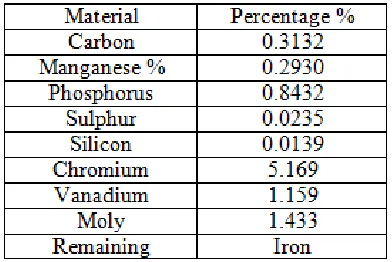
positive. The dielectric fluid used was EDM oil. Various input parameters varied during the experimentation are Pulse on time, Current and Feed rate. The effect of these parameters is studied on Material Removal Rate. The work piece material H-13 die tool steel was used. The chemical compostition of H-13 die tool steel are given in Table 1
Table -1 Chemical Composition of H-13 die tool steel
Taguchi Technique
The Taguchi technique is a powerful design of experiment tool for acquiring the data in a controlled way and to analyze the influence of process variable over some specific variable which is unknown function of these process variables and for the design of high quality systems. This method was been successfully used by researchers in the study of wear behaviour of aluminium metal matrix composites. The aim of this technique is to make the products that are robust with respect to influencing parameters. Taguchi creates a standard orthogonal array to accommodate the effect of several factors on the target value and defines the plan of experiment. The experimental results are analyzed using analysis of means and variance to study the influence of parameters.
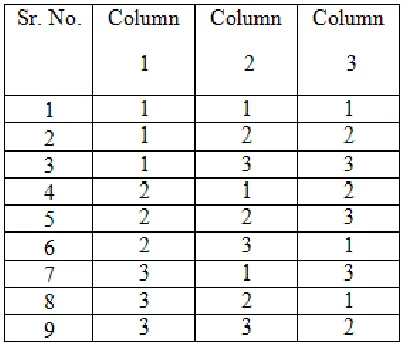
The results for various combinations of parameters were obtained by conducting the experiment as per the orthogonal array L9.
To measure the quality characteristics, the experimental values are transformed into signal to noise ratio. The influence of control parameters such as current, pulse on time, and feed rate on metal removing rate (MRR) has been analysed using signal to noise response table. The control factors are statistically significant in the signal to noise ratio.
Select the quality characteristics
There are three types of quality characteristics in the Taguchi methodology such as:
1) Smaller-the-better 2) Larger-the-better
3) Nominal-the-best
The goal of this research was to analyse and determine maximum MRR. Therefore, a larger the-better quality characteristic was implemented because MRR is
desirable property of material and our objective is to maximum MRR of H-13 die tool steel.
Select noise factor and control factor
From the literature survey, we conclude that current, pulse on time, and feed rate had significant effect on metal removing rate (MRR). These are controllable input factors.
Table 2 shows all Taguchi design parameters and levels. One of the most important considerable attributes of Taguchi parameter design was S/N ratio.
Table 2 Selected Factors and Levels
Select orthogonal array
The selection of Orthogonal array depends on three items in order of priority, viz., the number of factors and their interactions, number of levels for the factors and the desired experimental resolution or cost limitations.
A total of nine experiments were performed based on the run order generated by the Taguchi model. The response for the model is metal removing rate (MRR).
In Orthogonal array, first column is assigned to current, second column is assigned to pulse on time and third column is assigned to feed rate and the remaining columns are assigned to their interactions and errors associated with them.
The objective of model is to maximize the metal removing rate (MRR). The Signal to Noise (S/N) ratio, which condenses the multiple data points within a trial, depends on the type of characteristic being evaluated.
The S/N ratio characteristics can be divided into three categories, viz. „nominal is the best‟, „larger the better‟ and „smaller the better „characteristics. In this study, „larger the better‟ characteristics was chosen to analyze the
165
Table 3 L9 orthogonal array for experiment
Conduct the experiments
The work piece material used was H-13 die tool steel. These specimens were cut in the nine pieces by hacksaw. Metal removing rate (MRR) values were collected with the help of Edm machine. S/N ratio was calculated with the help of following Formula.
S/N (η)= −10𝑙𝑜𝑔1
𝑛 1/𝑦𝑖 2 𝑛
𝑖=1
Where y1, y2...yi are the response of MRR and n is the number of observations.
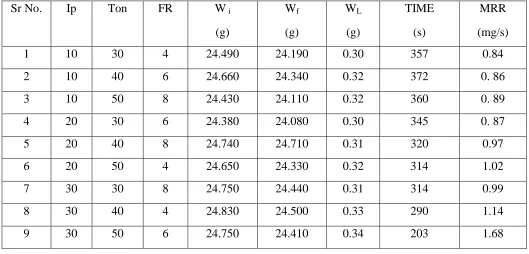
The result of L9 orthogonal array is shown in table 4. The metal removing rate (MRR) of the work pieces obtained by the testing on EDM machine. Three responses were taken from each experiment e.g. R1, R2 and R3 responses for each experiment. The signal-to-noise ratio calculated for the output responses. For MRR, the signal-to-noise ratio should be large e.g. larger the S/N ratio, better will be the MRR.
This table includes the ranks based on the delta statistics, which compares the relative value of the effects. S/N ratio is a response which consolidates repetitions and the effect of noise levels into one data point.
166
Table 4 Result of L9 orthogonal array
Level
I
pT
onFR
1
-1.27888
-0.93711
-0.06810
2
-0.43406
-0.14550
0.66218
3
1.85233
1.22200
-0.45469
Delta 3.13121
2.15910
1.11687
Rank
1
2
s3
Table 5 Response Table for Signal to Noise ratios-Larger is better
30 20 10 2 1 0 -1
50 40 30
8 6 4 2 1 0 -1
Ip
M
ea
n
of
S
N
r
at
io
s
Ton
FR
Main Effects Plot for SN ratios
Data Means
Signal-to-noise: Larger is better
Fig.3 Main Effects Plot for SN ratios
Table 6 RespoSnse Table for Means- Larger is better
30 20 10 1.3 1.2 1.1 1.0 0.9
50 40 30
8 6 4 1.3 1.2 1.1 1.0 0.9
Ip
M
ea
n
of
M
ea
ns
Ton
FR
Main Effects Plot for Means
Data Means
Fig.4 Main Effects Plot for Means
Sr No.
Ip
Ton
FR
W
i(g)
W
f(g)
W
L(g)
TIME
(s)
MRR
(mg/s)
1
10
30
4
24.490
24.190
0.30
357
0.84
2
10
40
6
24.660
24.340
0.32
372
0. 86
3
10
50
8
24.430
24.110
0.32
360
0. 89
4
20
30
6
24.380
24.080
0.30
345
0. 87
5
20
40
8
24.740
24.710
0.31
320
0.97
6
20
50
4
24.650
24.330
0.32
314
1.02
7
30
30
8
24.750
24.440
0.31
314
0.99
8
30
40
4
24.830
24.500
0.33
290
1.14
9
30
50
6
24.750
24.410
0.34
203
1.68
Level
I
pT
onFR
1
0.8633
0.9000
1.0000
2
0.9533
0.9900
1.1367
3
1.2700
1.1967
0.9500
Delta
0.4067
0.2967
0.1867
167
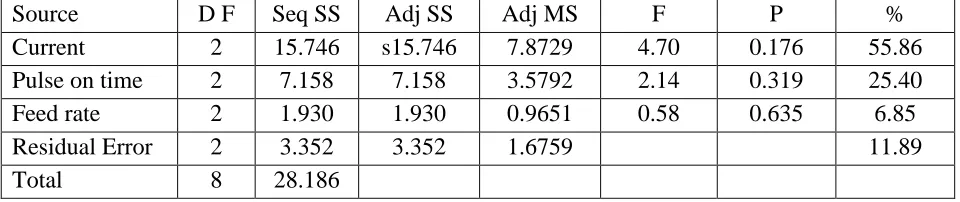
Table .7 Analysis of Variance- MRR
From this ANOVA table, we give the results that following parameters such as current [55.86%], Pulse on time[25.40%] and feed rate [6.85%] which are influencing metal removing rate(MRR). MRR is influenced by current, Pulse on time and feed rate respectively. We know that MRR which is volumetric loss of H-13 die tool steel is highly influenced by current.
The regression equation
MRR(mg/s) = 0.104 + 0.0203 Ip(A) + 0.0148 Ton (μs) - 0.0125 FR(mm)
From the regression equations for MRR, we can conclude that MRR of H-13 die tool steel is directly proportional to current, pulse on time and inversely proportional to feed rate.
Predict optimum opitimization
The optimum value of MRR could be predicated using the following equation:
Predicated MRR = A3+B3+C2-2(Y)
=1.2700+1.1967+1.1367-2(1.02889) =3.6034-2.05778 = 1.5456
PM = 1.5456 which show that parameter we used is with in range of specified machning condition .
IV.
CONCLUSION
The following conclusions are drawn from the experimental study
1. It is observed that MRR increase with increase in the value of T-on (pulse on time).
2. MRR increase with increase in the value of current. 3. MRR decrease with increase in the value of feed rate.
4. The optimunm value for MRR is 1.5456 mg/s.
REFERENCES
[1] Amit, Jonny Garg, Parminder Pal Sing, Ravinder Chaudhary (2013) “Experimental investigation of process parameter on EN-5 Steel using EDM drilling and Taguchi Method”, International Journal of Science Engineering and Technology Research, Vol 2, issue 11, Nov. 2013.
[2] Anand pandey, Shankar Singh (2010) “Current research trends in variants of Electrical Discharge
Machining: A review” ,International Journal of
Engineering Science and Technology vol. 2(6),2010,2172-2191.
[3] Ashok Kumar, Kuldeep Singh Bedi, Karaj Singh Dhillo, Rashpal Singh(2004) “ Experimental investigation of machine parameter for EDM using U-shaped electrode of EN-19 tool steel”, International Journal of Engineering Research And Application (IJERA) Vol 1,issue 4,pp.1674-1684. Kuldeep Ojha, R. K. Garg, K. K. Singh [2011] “ Parametric Optimization of PMEDM Process with Nickel Micro Powder suspended Dielectric & Varying Triangular Shape Electrode on EN -19 Steel ”, Journal of Engineering & Applied Science, vol. 6, pp 152-156.
[4] Nikhil Kumar, Lalit Kumar, Harichand Tewatia, Rakesh Yadav(2012) “ Comparative Study for MRR on die sinking EDM using Electrode of Copper & Graphite” ,International Journal of Advanced Technology & Engineering Research and Studies( IJATER),Vol. II/ Issue I/Oct.-Dec.,2012/148-150.
[5] Pichai Janmance and Apiwat Muttamara(2011) “A study of hole drilling on stainless Steel AISI 431 by EDM Using Brass Tube Electrode” ,International Transaction Il Journal of Engineering of Engineering ,Management & Technologies. Vol 2 no.4.,ISSN 2228-9860.
1. [6] Pravin R. Kubade, V. S. Jadhav (2012) “An
Experimental Investigation of Electrode Wear Rate (EWR), Material Removal Rate (MRR) and Radial Overcut (ROC) in EDM of High Carbon-High Chromium Steel (AISI D3)” ,International Journal of Engineering and Advanced Technology (IJEAT), Volume-1,ISSN: 2249 – 8958.