
Harpenden, Herts, AL5 2JQ
Telephone: +44 (0)1582 763133
Web: http://www.rothamsted.ac.uk/
Rothamsted Research is a Company Limited by Guarantee Registered Office: as above. Registered in England No. 2393175. Registered Charity No. 802038. VAT No. 197 4201 51. Founded in 1843 by John Bennet Lawes.
Rothamsted Repository Download
A - Papers appearing in refereed journals
Bailey, R. A. 1985. Factorial design and Abelian groups. Linear Algebra
and its Applications. 70 (October), pp. 349-368.
The publisher's version can be accessed at:
•
https://dx.doi.org/10.1016/0024-3795(85)90064-3
The output can be accessed at:
https://repository.rothamsted.ac.uk/item/8q104/factorial-design-and-abelian-groups
.
© 1 October 1985, Elsevier Science Inc.
Factorial Design and Abelian Groups
R. A. Bailey
Rothamsted Experimental Station Harper&en, Herts, AL5 2_lQ, U.K.
Submitted by George P. H. Styan
ABSTRACT
The theory of finite Abelian groups is used to simplify the search for, and construction of, factorial designs.
1. INTRODUCTION
The classical theory of symmetrical factorial design, where all treatment factors have the same, prime number of levels [9, 111, was expressed in terms of elementary Abelian groups by Fisher [20,21] and Finney [ 181. Chakravarti
[13] explicitly used the dual group in the case of 2-level factors. More recently, several authors have used general finite Abelian groups to extend the classical theory of factorial design to include the cases where not all treatment factors have the same number of levels and where the number(s) of levels is (are) not necessarily prime: see [l, 4, 7, 16, 17, 25, 26, 30, 311.
Much of this work is concerned with fractional replicates, or with single replicates divided into equal-sized blocks. However, there is increasing inter- est in more complicated block structures, such as row-by-column layouts or multiply nested structures: some important classes of block structure are (ordered by inclusion) the simple orthogonal block structures [32], the poset block structures [2, 5, 8, 38, 391, the orthogonal block structures [5, 38, 391,
and the Tjur block structures [41]. In spite of the statistical overtones of the
word “block,” both the set of plots and the set of treatments may be equipped with a “block structure” of some sort. General block structures therefore provide the natural setting for the decomposition of both the treatment space and the plot space of a factorial experiment. Use of these general block structures makes essential the explicit clarification of the associated vector-space theory. This theory has been developed by several authors, with conflicting terminology and notation. To avoid confusion in the
LINEAR ALGEBRA AND ITS APPLICATIONS 70:349-368 (1985) 349
0 Elsevier Science Publishing Co., Inc., 1985
main part of this paper, the necessary vector-space theory is reviewed in Section 2.
In Section 3 we set some previous design theory in the context of more general block structures. We briefly review how the identification of the sets of treatments and plots with Abelian groups can, for designs defined by group homomorphisms, facilitate the description and examination of confounding patterns. Section 4 contains the main results of this paper. It shows how some group theory, specifically the decomposition of a finite Abelian group into a direct sum of its Sylow subgroups, may be used to simplify many design problems. Thus it suffices to consider Abelian groups of prime-power order. Section 5 specializes these results to fractional replicates and blocked single replicates. For these two cases, it is shown that design problems for general finite Abelian groups may be essentially reduced to similar problems for elementary Abelian groups.
Unless otherwise explained, all theory, terminology, and notation for groups used in this paper may be found in [23]. A similar reference work for factorial design is [27].
2. BLOCK STRUCTURES AND VECTOR-SPACE DECOMPOSITIONS
Let Q be a finite set, let p and u be partitions of Q (that is, equivalence relations on Q, or block systems on Q), and let Z be a set of partitions of Q. We use the following terminology and notation for concepts given in [2, 4, 5, 8, 28, 38, 39, 40, 411:
(1) p is uniform if all classes of p have the same size;
(2) V, denotes the subspace of the real vector space IX” consisting of vectors which are constant on each p-class;
(3) p nests u, or p is coarser than u, or u is finer than p, if every u-class is contained in a p-class (equivalently, if V, < V,);
(4) p A u and p V u are, respectively, the coarsest partition nested by both p and u, and the finest partition which nests both p and a;
(5) p and u are orthogonal if V, n V,$ (I is orthogonal to V,
n
V,$ ~ [equivalently, if, within each (p V u)-class, the size of each (p A u)class is proportional to the product of the sizes of the p-class and u-class containing it] ;(6) ~1 and E are, respectively, the coarsest and finest partitions of Q; (7) if u E C, then W, is the orthogonal complement in V, of all those V, for which p E Z, p # u, and p nests a;
FACTORIAL DESIGN AND ABELIAN GROUPS 351
(9) (Q, Z) is an orthogonal block structure (OBS) if it is a TBS which is
closed under A, which contains ~1. and all of whose partitions are uniform.
THEOREM 1 (see [41]). Zf (Q, Z) is a Tjur block structure, then R a is the orthogonal direct sum of the spaces W, for a in Z.
Three special classes of OBS are of particular interest to us here. The first has been implicitly described by almost every author on factorial design. Let Q=QIX ... x Q2, for some integer n, and let Z be the set of subsets of
{I,2,..., n }. If u E Z, we may identify u with a partition of a by putting o and w’ in the same u-class if and only if oi = w! for all i in u. In particular,
0=~ and {1,2,..., n}=&. Then (Q,X) is an OBS, and the decomposition
@,W, is the usual factorial decomposition of R”, for WC ij is the (space
corresponding to the) main effect of the i th factor, while W, is the interaction of the factors in u for [ul> 2. We call this a complete factorial structure.
The second special class is a generalization of the first. Suppose that s is
apartialorderon{1,...,n}.Asubsetuof{1,...,n}issaidtobeancestraZif
whenever i E u and is j then j E u. Let Z 1. be the set of all ancestral
subsets of { 1,. . . , n}. Then (8,X,) is an OBS. This is called a poset block structure (PBS).
The third special class consists of the group block structures (GBS). Let G
be an Abelian group. If K is a subgroup of G, we define the partition uK of G to be that whose classes are the cosets of K. Then uK A uL = uK n L, uK V uL =u K+Ly a, = p, and a, = E: here we are writing G additively, so that 0
denotes both the identity element of G and the identity subgroup. If Z = { uK: K < G}, then (G, Z) is an OBS.
It is convenient to describe GBS in another way. Every finite Abelian group G has a dual group G* (see [23, §V.S]), consisting of the homomor-
phisms from G into the multiplicative group of the complex numbers. Moreover, G may be expressed (in general, in more than one way) as a direct sum of cyclic groups (gl)@(g,)@ .. . CB (g,), and this gives an explicit form for G *, as Ledermann [29, 32.41 shows. Let ti be the order of g i, and let c be any common multiple of the ti. Then G* = (xl) CB (x2) @ . . . Ed (x,,),
where
Xi( g j) =
g:,c/tt
and 17 is a primitive cth root of unity. Thus if z in G and 9 in G* are equal
where [ , ] is the bilinear form given in [7], namely
For a subgroup K of G, we denote by K o the annihilator of K; that is, K“= {x~G*:x(k)=l for all ~EK}. By Theorems 6.3 and 6.4 of [23, 9V.61, we have G** = G and Koo = K. If H is a subgroup of G*, we define the partition pH of G as follows:
z and z’ are in the same p&ass if and only if
Then pH = uHO so that (G,{ pH: H < G*}) is the same GBS that we de- scribed before, except that the partitions are now labeled by subgroups of G * rather than subgroups of G. It is more convenient for subsequent work to use this second labeling, and we shall write H for pH where no confusion can arise: in particular, we write W,, for W,,.
The group G is sometimes given in the form 52,@ . . . @Cl,,, where the &?, are groups and do not necessarily bear any relationship to the (g j). If x E G*, then x has a unique expression as Citir where <, E QT. Define the subset J(x) of {l,..., n} by J(x)= {i: ti # 0). Thus we have two decom- positions of Rc, one given by the group block structure on G and one given by the complete factorial structure on G. The results of [7] link these two decompositions, and may be stated algebraically as follows.
THEOREM 2. Let H < G*. Then
(a) W, = 0 unless H is cyclic;
(b) if H is cyclic, with generator x, then
(bl) the dimension of W, is equal to cp(lHj), where ‘p is Euler’s function;
3. FACTORIAL DESIGN AND CONFOUNDING
FACTORIAL DESIGN AND ABELIAN GROUPS 353
For reasons given in the discussion in [41], (I’, I’) will usually be an OBS. If a randomization argument is used to justify the assumed linear model (see [3, 32]), then (P, I’) will almost always be a PBS (see [2,8]). If (P, I?) is a PBS with P = P, X . . . x P,,, then P may be given the structure of an Abelian
group in the following canonical way. Identify each Pi with any Abelian
group of order IPil, so that P = P,@ . . . @P,. Each y in I is an ancestral
subset of {I..., n }: for each such y define the subgroup K, of P by
Ky=@{P~:i4y}.IfwedefineaKl as for the group block structure on P,
then uK is the partition corresponding to y.
From now on, we restrict our attention to TBS (P, r) with the property that P may be given the structure of an Abelian group in such a way that every y in I is equal to some uK for K < P. As just shown, this is always possible if (P, r) is a poset block structure: see Example 1. Even for a PBS, the subgroups K may not be the canonical ones just given: see Example 2. Moreover, we do not exclude other TBS with this property, such as some of the Latin-square block structures in [36, 551 (see Example 3) or any subset, closed under V , of the partitions in a PBS (see Example 4).
EXAMPLE 1. Let (P, I?) be the simple orthogonal block structure
((6 rows~6 columns)/6 subplots) (in the notation of [32]). We may put P = (P,> @ (pc> @ (P,>, where P,, P,, and p, have order 6. The subgroups corresponding to CL, rows, columns, rows A columns, and E are P, ( pc) @ ( p,),
(P,) @ (P,), (P,), and 0 respectively.
EXAMPLE 2. Let (P, I’) be the simple orthogonal block structure
((2 superblocks/ blocks/4 plots)). We may put P = (pl) CB (p2), where pi
and p, have order 4, and let P,(2p,) @ (p,),(p,),O be the subgroups
corresponding to p, superblocks, blocks, E respectively.
EXAMPLE 3. Let IPI = 81, and let the nontrivial partitions on P be the rows, columns, and letters of a Latin square A based on the elementary Abelian group G of order 9 (for example, A may be any 9 X 9 square in Table XVI of [22]). This structure is an OBS but not a PBS. By suitably labeling
rows and columns we may put P = G@G and take O@G, G@O and
{(g, - g ) : g E G } to be the subgroups corresponding to rows, columns, and letters respectively.
EXAMPLE 4. As in [37, §4(d)], let P be an a x b X c 3dimensional array
whose only nontrivial partitions are the 2dimensional slices corresponding to main effects of the three coordinates. This is a TBS but not an OBS. Put
tively. The nontrivial partitions correspond to the subgroups P,@F’,, Pi@&, and P,@Ps.
Let T be the set of treatments to be applied to P. In a factorial experiment with n treatment factors, T is naturally T, X . . . X Tn, where Ti
is the set of levels of the ith factor. If each Ti is given an Abelian group structure, then T becomes the Abelian group T,@ . . . @T,,. If ti = IT,j, then the most natural choice for Ti is the cyclic group C,, of order ti, and this is the approach taken in [ 16,26,30,31]. However, there are other possibilities when
ti is not square-free, which are discussed at the end of Section 4.
Any allocation of treatments to plots is simply a function $I : P --, T. A design with plot structure (P, l?), treatment structure (T, A), and allocation + is defined to be isomorphic to a design ((I”, r’); (T’, A’); +‘)) if there exist bijections 8: P + P’, and #: T + T’ such that:
(1) r’= (O(y): Y E P}, where y is regarded as a subset of P X P and O(Y)= {(e(pl),e(p,)):(p,,p,)Ey};
(2) A’= {$(8):8~A}; (3)
+~=~o~oe-~.
Thus isomorphic designs differ only in the labeling of the plots, the treat- ments, and the partitions thereof.
We restrict attention to designs in which $I is a group homomorphism. This includes all design keys as originally defined [7,33, 351; for these designs
(P, r) is a PBS with canonically chosen subgroups, and $I may be specified as a matrix with respect to irredundant generators of T and P. However, more general design keys [34] are not included. Moreover, some designs obtained from group homomorphisms are not isomorphic to any designs constructed by the design-key method.
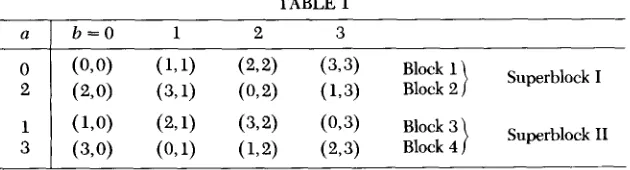
EXAMPLE 5. Let T = T,@T,, where T, = (ti) and ti has order 4 for
i = 1,2. Let (P, r) be as in Example 2. The group homomorphism +: P -+ T
defined by +(ap, + bps) = (a + b)t, + bt, gives the design in Table 1, where
TABLE 1
a b=O 1 2 3
0 (070) (I,I) (2,2) (393) Block 1
2 (2,O) (3,l) (08 (1,3) Block 2 Superblock I
1 (la (231) (3,2) CO,31 Block 3
FACTORIAL DESIGN AND ABELIAN GROUPS 355
the treatment ct, + dt, is shown as (c, d). This design cannot be obtained by
using a design key.
When 9 is a group homomorphism the general theory of dual structures [14, $8.2; 24, §VII.8] shows that there is a dual homomorphism +* : T* + P*
defined by
(G*(X))(P)
=
x(4(~))
for
p
in
P and x
in
T*,
and a dual-type linear transformation $I * : R T + IF8 ’ defined by
(G*(4), =
Q+(p) for p in P and 0 in KIT.For any subgroup H of T *, and any y in I’, the treatment effect W, is said
to be confounded with y if $I,( W,) < W,, and to be superconfounded [ 11
with y if +,( W,) < V,. Define the subset L, of T * by L, = {x E T * : WCx,
is superconfounded with y }. Although previously stated only for simple orthogonal block structures (P, r), the results of [l, 71 apply to the more
general structures considered here and may be summarized as follows.
THEOREMS. If + is a group h omomorphism and H is a subgroup of T *, then
(c) if y E r and K, is the subgroup of P such that y = uK,. then Ly is the subgroup +*-‘(K;) of T*, and the treatments occurring on any y-class of P consist of one or more copies of a coset of Ly in T.
Parts (a) and (b) of Theorem 3 show the power and simplicity of the group homomorphism method of constructing designs and justify the stratum identification rule stated in [35]. However, not all designs based on Abelian groups can be constructed by a design key: those in [17] cannot, in general. The group-theoretical ideas of the present paper may be extended to these more general designs by using the finer decomposition of the W, mentioned at the end of [4], and this is done in a subsequent paper.
Theorem 3(c) shows that the group homomorphism itself may be bypassed, and the design constructed by choosing suitable, and compatible, subgroups
L, and calculating their annihilators. This is the approach given in [l] and the
4. PSEUDOFACTORS AND SYLOW SUBGROUPS
Many authors (for example, Yates [43] and Patterson [33]) have advocated the use of pseudofactors in constructing factorial designs where any t, is not prime. Suppose that ti = TiSi, where T, and si are positive integers greater
than 1. Then the ith factor may be replaced by a pair of pseudofactors with 7;
and s, levels. The set T, is identified with RI x Si, where (R i 1 = 1; and
(Si] = si: any convenient one-one correspondence between the levels of the i th factor and the pairs of levels in Ri X Si may be chosen.
The simplest way of reconciling the straightforward convention of [ 16, 261 (that each T, is identified with a cyclic group) with the flexibility of allowing
each T, to be an arbitrary Abelian group of order t,, is to permit use of pseudofactors, with the convention that each pseudofactor or unchanged factor is represented by a cyclic group. Does such use of pseudofactors make any difference to the designs which may be constructed?
If there are no pseudofactors, T and T * are both isomorphic to Ct, @ . . . @Ct,,. Replacement of the ith pseudofactor by two pseudofactors with
T, and s, levels (where T,S, = tj) has the effect of replacing the direct
summand C,, by C, @C,,. If T, and si are coprime, these two groups are
isomorphic [23, Theorem 1.13.9; and 14, 09.61 and so there is no change in the group structure, and hence no change in the designs produced by the group homomorphism or annihilator methods.
Repeated application of this argument gives the following result.
THEOREMS. Zf each treatment factor is replaced by pseudofactors, each of which has a prime-power number of levels, there being one pseudofactor for each prime which divides the original number of levels, then there is rw
change in the designs constructed by the group homomo rphism OT annihilator methods.
Let Q be the set of primes dividing IT(. By Theorems 7.3, 7.5, 9.5, and
13.9 of [23, §I], or Proposition 9.7.4 of [14], T * has a unique Sylow q-subgroup T,* for each q in Q, and T * is the direct sum Qy E (,T,*.
Moreover, if H is any subgroup of T *, then H = CBQ E QH,, where H, < T,*.
Similar results hold for T, P, P*, and their subgroups [since duals of direct
sums are the direct sums of the duals, there is no ambiguity about the notation T,* for (T4)* = (T *),I. F or each prime q in Q the Sylow q-sub-
groups of T and T * correspond to the treatment q-quotient structure consist -
ing of those factors and pseudofactors whose numbers of levels are powers of
q (see [ 15, $41 for why the term “quotient structure” is more appropriate than
FACTORIAL DESIGN AND ABELIAN GROUPS 357
If y E r, then y corresponds to some subgroup of P. Hence we obtain a partition y, of the plot qquotient structure. If y and S are distinct elements of r, then y, and S, may be equal for some (but not all) values of 9: in particular, y, may be equal to p, or to .sy for some values of 9. Thus the block structure (P,, r,) may be less rich than (P, I?): technically, it is a quotient block structure of (P, r).
Suppose that, for each 9, we have a design for treatment set T, on plot set
Pq. In the case that each design is a fractional or single replicate, with no blocking, Chakravarti [12] suggested combining the separate designs by taking the direct product of the sets of treatments which occur in the separate designs. We may generalize this idea to more complicated designs. For 9 in Q, suppose that +q : P, -+ T, is a treatment allocation (not necessarily a group homomorphism). Since, as sets, P = rIq 6 uPq and T = rIq E uTq, there is a natural way of defining the function + as the direct product of the ~~4:
(G(P)), =
cp,(P,)
for
PE p.
Equivalently, the y-classes of P are all the possible direct products 114 E o B,,
where B, is a y,-class of Pq, and the treatments on nBq are all combinations (allowing for multiplicities) of the treatments on the constituents B,.
An immediate consequence of Theorem V.6.4 of [23] is that the annihila- tor of a direct sum is the direct sum of the annihilators: thus if H < T * then
H o = eQ Ht. This gives our main result.
THEOREM 5. Constructing a design for treatment set T on block structure (P, r) by the group homomorp hism UT annihilator methods is equivalent to constructing such a design for T, on (P,, I?,) for each 9 in Q and then combining these designs.
This shows that, in any search for suitable designs with the complete confounding guaranteed by the group homomorphism method, we may essentially restrict our attention to qdesigns, those in which 1 PI and IT 1 are both powers of the same prime 9. Thus any given treatment structure may be decomposed into its constituent q-quotient structures (which are usually easier to deal with), for any investigation of which fractions, block designs, etc. are possible by the annihilator method. This decomposition was advoc- ated in [35, 571, and could have been used to facilitate the searches for designs in [16, 311.
decomposition I’,@ . . . @ T,, as in Section 2; and define a subgroup H of T *
to be w-heavy if all its nonzero elements have weight at least w. Since the defining contrasts of a fractional replicate are precisely the elements of Lp, a
fraction has resolution w if and only if L, is w-heavy. Chakravarti [12]
pointed out that a fraction has resolution w if and only if each of its constituent qdesigns has resolution w.
The concept of resolution may be usefully generalized to other block structures, because requirements such as “no main effect or twofactor interactinn should be confounded with blocks” are quite common. If w is any function from I to the positive integers E + , we say that a design has
resolution w if, for all y in I, the group Ly is WY-heavy. An easy generali- zation of Chakravarti’s result is:
THEOREMS. Let w be a function fiorn r to H +. A design on (P, l’) has resolution w if and only if each constituent qdesign has resolution w.
The notation used so far is convenient for general theory, but cumbersome for examples. Thus for the remaining examples we denote the treatment factors by A, B, C, . . as usual: there is no harm in identifying these with Xl> x2> x37... . Pseudofactors are shown by appending subscripts to the
corresponding genuine factors. Since T and T * are written additively, it is
logical to write generalized factors in the form exemplified by A +2B + C, rather than the classical AB’C: although this notation is different from that in most of the literature, and takes more space, it has the advantages that it is more consistent with the remaining notation, and that generalized factors such as A + B + C are clearly distinguished from interactions such as W,,,:; my students ‘lave certainly found the additive notation easier to follow. As in [6], the space WcX, is written as [xl.
EXAMPLE 6. Consider a single-replicate 63 design in the block structure
((6 rows X 6 columns)/6 subplots) discussed in Example 1. Let A,, B,, C, and
A,, B,, C, be the pseudofactors with 2 and 3 levels respectively. The con- stituent 2design is for 23 treatments in (2 X 2)/2. In this, the onedimensional
space [A, + B, + C,] is the whole of the 3-factor interaction. For a single replicate, the two one-dimensional spaces +;
‘(
W,,,,) and +; ‘( Wcolumnr ) mustbe different. Hence there can be no single replicate 6” design in (6 x 6)/6 in
which the effects confounded with rows or with columns belong entirely to the Sfactor interaction.
FACTORIAL DESIGN AND ABELIAN GROUPS 359
[B,] and [C,], which are parts of main effects, are then confounded with rows ~columns. In order to have all main effects estimated in the subplots stratum, one would have to use a design with a confounding pattern such as
rows columns rows A columns
2design [A, +
%I
LB, + C,l
[A, + G21
3design [A, + B, + Csl [A,
+%I
[A3+%31~[4+2C,1
Table 1 of [16] is a list of resolution-II single-replicate block designs for asymmetrical factorial structures, with IT I< 56, max(t,) < 7, and n < 5. Table
1 of [31] lists resolution-III fractions (or single-replicate block designs) for asymmetrical factorial structures with IT 1 d 206, max( ti) < 7, and n < 7. In all but three cases, every design with a factor (or factors) at 6 levels may be obtained from another design in the same table by using pseudofactors. The
three exceptions are interesting. The i-replicate 23~4x6 and 24~3~4
designs in [31] are not isomorphic, because their 2-quotient structures are not isomorphic. As we show in Section 5, a resolution-III a-replicate 24 X 4 design may essentially have defining contrasts A + B + C, A + D +2E, B + C + D
+2EorA+B+C+D,A+B+2E,C+D+2E.
[16] contains designs for (a) 23 X 6, (b) 24 X 3, (c) 2’ X 3 X 4, (d) 2 X 4 X 6 in 2 blocks of 24 plots. Design (a), with defining contrast B + C +3D, is not obtainable from design (b), whose defining contrast is A + B + C + D: use of design @) and pseudofactors gives a 23 X 6 design with defining contrast A + B + C +3D, which is of higher resolution than design (a), contrary to the authors’ claims. Similarly, designs (c) and (d) have defining contrasts B + 20 and A + 2 B + 3C respectively: the 22 X 3 X 4 design corresponding to design (d) has defining contrast A + B + 20, and so is better than design (c). The design given for 23 X 4 in 2 blocks of 16 plots is also not of highest possible resolution. However, these mistakes are all corrected in [31].
The question posed at the beginning of this section has not yet been
answered for the case when r, and si are not coprime. Then C,, is not
isomorphic to C,.,@ C,, , so the use of pseudofactors may lead to designs which
are not isomorphic to those obtained without pseudofactors, except when q n Ly = 0 or Ti for every y. Since an elementary Abelian group has more subgroups, of all orders, than any other group of the same order, replacement of a factor with 9’ levels (where 4 is prime) by r pseudofactors gives more flexibility in choice of design, and may make possible designs which cannot be obtained without pseudofactors.
contrasts subgroups L,; one is (A + B + C), confounding [A + B + C] and [2A + 2B + 2C] with I*. The corresponding designs are isomorphic, each comprising the 16 (row, column, letter>triplets of the cyclic 4 x 4 Latin square.
With pseudofactors, there are 36 distinct, but isomorphic, fractions; one of the possible defining contrasts subgroups is (0, A, + B, + C, + C,, A, + B, + C,, A, + A, + B, + B, + C,}. These fractions correspond to the other species of 4 x 4 Latin squares, and so are not isomorphic to the previous fractions.
EXAMPLE 8. The list in [31] shows no a-replicate 2’ X 42 design, because no such resolution-III fraction is available without pseudofactors. Using pseudofactors, there is a resolution-III ;-replicate with defining contrasts A + C, + D,, B + C, + I&., A + B + C, + C, + D, + D,.
EXAMPLE 9. For a 4’ treatment structure, suppose that a resolvable design [27, 511.41 is required in 3 replicates of 4 blocks of 4 plots. Using pseudofactors, and a separate group homomorphism in each replicate, we may take the group Lblocks to be as follows in the 3 replicates:
(I) (6, A, + B,, A, + B,, A, + A, + B, + B,}, (2) {O,A,+B,,A,+B,+Bs,A,+A,+B,},
(3) (9, A, + B, + B,, A, + B,, A, + A, + Bz}>
thus obtaining factorial balance [42]. (This design is isomorphic to one obtainable by the methods of Bose [9] using the finite field of order 4.) Without pseudofactors, 2A + 2B would have to be confounded in every replicate, making its estimation in the plots stratum impossible.
The only disadvantage of using pseudofactors with the same number of levels is one not of practicality but of enumeration: there are no longer straightforward rules, such as those given in Section 5, to determine which structures have fractions of given size and resolution. Likewise, they do not readily lend themselves to the sort of computer search undertaken in [31]. However, if, in any particular practical case, the published tables give no suitable design, it is always worth a little ad hoc investigation to see if pseudofactors can give better designs, as in Examples 8 and 9.
5. HEAVY SUBGROUPS AND DESIGNS OF SPECIFIED RESOLUTION
FACTORIAL DESIGN AND ABELIAN GROUPS 361
of weight makes sense only because, of the many possible ways of expressing
T as a direct sum of cyclic groups, one such expression is distinguished,
corresponding to the treatment factors. We shall call such a group a named group. Correspondingly, if T and T’ are two named groups, with dis-
tinguished direct-sum decompositions T,@ . . . CB T, and T{@ . . . @ TL, re- spectively, we shall call a group homomorphism $ from T to T’ a name homomorphism if, for i = 1,. . . , n, $(T,) is contained in some Tj’ and, for
i # k, $(Ti)n $(Tk)= 0. If Ic/ is also a surjection, we call 4 a name epimor- phism, T’ a name-homomwp hit image of T, and T a name extension of T’;
if 4 is an injection, we call T a name subgroup of T’. (This terminology is consistent with general algebraic usage: see [15].) In factorial terms, if T has
factors with t,, . . . , t, levels and T’ has factors with t;, . . . , t,’ levels respec- tively, this means that T is a name extension of T’ if n > n’ and there is a permutation m of (1,. .., n } such that t[ divides t,cij for i = 1,. . . , n’. For example, the factorial structures 4 X 4 X 8 X 8, 2 X 4 X 4 X 8, and 4 X 8 X 16 are all name extensions of 4 X4 X8, but 2 X4 X4 and 8 X 16 are not. To save cumbersome notation, we write (oj)N for a structure with N factors at qi levels.
THEOREM 7. Let q be a prime number. Then there is a function f4:z+xz++z+ such that T * has a w-heavy subgroup isomorphic to
(C,)” = c4w$B . . (q)f,(we)*
. @C, (e factors) if and only if T is a name extension of
Proof. If (C,)” has a *heavy subgroup isomorphic to (Cq)e, then so
does (C )N+l. Moreover, the wheavy subgroup of (Cq)We generated by E r,..., 1;’ where 5j=X,cjPr,+r e, + Xw(jP1)+2 + . ’ ’ + Xwj and xk generates
the kth C,, is isomorphic to (Cq)e. Thus there is a least integer fq(w, e) such that (C,)” has a w-heavy subgroup isomorphic to (C,)” if and only if N> fq(w, e).
Now let T = T,@ . . . @T,, where q is cyclic of order qel. Then T is a name extension of (q)N if and only if n 2 N. All elementary Abelian sub-
groups of T * are subgroups of a,( T *), which is equal to ei (q ‘,-‘x i);
hence T* has a *heavy subgroup isomorphic to (C,)” if and only if
n 2 f,(w, e). n
To find explicit forms for f,, it suffices to consider the case when T is
elementary Abelian; that is, all factors have q levels. The existence of a w-heavy subgroup H of T * of order q” is equivalent to the existence of a
resolution-w fraction for n factors on q”-” plots. Bose [9] defined m,_ 1(r, q)
ated in a resolution-w fraction on qr plots. It is immediate that f,( w, e) is the smallest value of N such that N < m,_ r( N - e, q).
THEOREM 8. (i) &(2, e) = e + 1;
(ii) f,(3, e) is the least integer N satisfying N < (q”-” - I)/( q - 1); (iii) fa(4, e) is the least integer N satisfying N < 2K-v-1;
(iv) f,(w,l)=w andf,(w,2)= w+/w/qj, where [w/q] is the least integer not less than w/q;
6) f,(w,e+l)~f,(w,e)+[to/21.
Proof. (i): Since T * is not itself 2-heavy, f,(2, e) > e + 1. However, let g = C,g,, where gi generates Pi, and put H= (g)“. Then (N( = (T(/l(g)] = q”/q = q*-i, so H E (Cq)n-l; and H is 2-heavy, because [ oixi, g] z 0 unless Bixi=O. Hence&(2,e)=e+l.
(ii): By Fisher’s result ([20, 211, quoted in this form by Finney [19, 94.10]), m,(r, q) = (qr- l)/(q - 1).
(iii): Bose [9, 351 showed that mJr,2) = 2’-‘.
(iv): Put y = &(w,2). Let H be any w-heavy subgroup of (C,)y of order
q ‘. If H is also (w + I)-heavy, we could delete one of the named generators, contrary to the minimahty of y. Hence H contains an element x of weight w: we may suppose that J(x)= {l,...,w} and x=x1+x2+ ... +x,,. Now let~beanyelementofH\(~)andput~=C~,~i.Forj~{O,1,...,q-1},
let h j = I{ i : 1 < i < w and Ei = j } 1. The minimahty of y shows that .$, f 0 for w + 1< i ,< y. Hence the elements k( jx - 5) of H \ (x > have weights y - hi for jG {O,l,..., q - 1) and ke {1,2,..., q - 1). Thus y - Xj B w for all j, so that y - w 2 max{ A,:0 < j < q - l}, with equality for those families {X,:0< j<q-1) which minimize this maximum. Since X,X, = w, the minimum value of the maximum is [ w/q 1.
(v): Put y = f,(w, e) and x = y + [w/2]. Let H be any w-heavy sub- group of (C,)X of order q” which involves only the first y generators. Put .$= ~~_~+r+ ~~_~+a+ ... +x,, where xk generates the kth C,. Then
(H, 5) is a w-heavy subgroup of (C,)” of order q”+ ‘. n
Explicit forms for f seem much harder to obtain for w > 4 and e > 3 (see [lo]), although values of f,( 20, e) for small e may be calculated by exhaustive methods.
Every Abehan q-group is a direct sum of cyclic q-groups [23, Theorem 1.13.101. Theorem 7 not only gives a necessary and sufficient condition for an Abehan q-group to contain a w-heavy subgroup isomorphic to a given
FACTORIAL DESIGN AND ABELIAN GROUPS 363
necessary condition for an Abehan q-group to contain a wheavy subgroup isomorphic to any given Abelian q-group. This is contained in Theorem 9(a). The sufficiency of this condition in some circumstances [Theorem 9(b)] is obtained by using the following lemma.
LEMMA. Let e,,e,,..., ek be positive integers with e, < e2 < . . . < ek. Put yj = f,(w, ej) for 1< j <k. Let T 3 (C,)yk, with T* = @,!&(xi). For H<T*, define Hi to be {~EH:J(x)~{~,...,~~}}. Zf (i) w=2 or (ii) w = 3 or (iii) w = 4 and q = 2 or (iv) ek = 2, then there exists a w-heavy subgroup H of T * such that Hj is wheavy of order 4’~ for 1~ j < k.
Proof It suffices to assume that ej = j for 1~ j < k. Then the proof of Theorem 8(iv) deals with the case ek = 2. For the other three cases we give an explicit countable sequence Ei, 5s’. . . such that El,. . . , ck are elements of T *
and Hj=(~l,...,~j).
(i): Put tj = x1 + x j+ i.
(ii): Using the work of Fisher [20, 211, put z, = (q” - l)/(q - l)+ 1 and
- n - 1, for positive integers n. Let G, = (xi) and G, =
‘;c:_::;(;.
elements of ‘G, as ni for 1~ i < q”
) for n 2 2. To define_5,i,,r[,“+,,.. . , Exn+,, label the nonzero
n+l-Xn. Then put
5xn+i =
4i + Xzn+ Xz”+ifor l<igrn+i-r,.
(iii): This is similar to (ii), using the work of Bose [9, 55.41. For n > 2 put
=2”-’ +l and X, =x, -n - 1. Let G, = (xr,xs) and G, = ;& Xt,_ > for n > 3. Label the nonzero elements of G, for which /J(n)] is even as ni for 1 ,( i < 2”-l - 1 = X,+i - x,. Then define [,“+, as in (ii). w
This lemma may be true in other cases, but a general proof seems hard to find.
THEOREM 9. Let q be a prime number; w, k, and ek positive integers; el,e2,‘..,ek_I nonnegative integers; and
Cull T a (w, Z?)-candidate
if
T is a name extension ofTt= fi (qj)"("‘.j), j=l
where
F(w, k) =
f,(w,Ek).
for j < k, and E, = ek + ekPl + . . . Then
+ ej. (Zn particular, F(2, j) = ei + Sjk.)
(a) T * has a w-heavy subgroup H isomorphic to fi only if T is a ( w , fi )-candidate;
(b) if T is a (w, fi)-candidate and either (i) w E {2,3} or (ii) w = 4 und q = 2 or (iii) IJr = 2 or (iv) k = 1, then T * has a w-heavy subgroup H isonwrphic to H.
Proof. (a): Let j E {l,..., k }. Then H contains a subgroup D isomor-
phic to (C,,)“J. Let L = {qj-lx: x E D}. Then L = (C,)“J, so Theorem 7 shows that T * has a subgroup isomorphic to (C,) f,(I”, Ed). Since each element of this subgroup has the form qjP1x for some x in T *, it follows that T is a name extension of (qj)f”( t”,E~) . This is true for all j: hence the values of F
given in the statement of the theorem.
(b): Put yj= f,(w,Ej) for j= l,... k. Let U= @y;,(u,), where each U, has order q, and let TJ~ be a generator of (ui)*. When any of conditions (i)-(iv) holds, the lemma shows that we can find a w-heavy subgroup K of U* such that Kj=(C,)“~ for j=l,...,k, where Kj={q~K:J(n)~
{l>...>yj}}. Ch oose a minimal set Dj of generators for Kj such that D,zD k_l c . . . c .D1. Thus ID,\ = ek and IDj \ Dj+ll = ej for 1~ j < k.
Putm(i)=kfor1~i~y,and,forl~j~k-l,putm(i)=jifyj+,<
i < yj. Then T’ has elements gi (1 <i < yl) such that T’= cBtYLl(gi) and g, has order q m(i) . Let xi be a generator of (g,)*. For 5 in Dj \ Dj+l, if E=Ci5jVj put X(5)=Ci5iq m(i)pjxi: thus ~(5) is an element of T * of order
q j. Let H’ be t_he subgroup of T’* generated by { x(E) : 5 E D, }; then H’ is isomorphic to H. Consider the name homomorphism 8 : T’* + U * defined by
FACTORIAL DESIGN AND ABELIAN GROUPS 365
EXAMPLE 10. Let l? = C4@C2 and w = 3. When 9 = 2 we have f,(3,1) =3andf,(3,2)=5,~oT’=(4)~X(2)‘.If U=(2)5wemaytakeK,=(A+
B + C), K = K, = (A + B + C, A + D + E); pulling A, B, and C back to 4level factors (still called A, B, C), we obtain H’ = (A + B + C, 2A + D + E), so that
H’= (0, A + B + C,2A +2B +2C,3A +3B +3C,2A + D + E,
If T = (8) X (4)4 with factors A,. . . , 2, then if 4 maps the generators of T to
th_oseof T’ inorder,wehave +*(A)=2A, +*(B)=B, #*(C)=c, q*(D)= 20, G*(E) = 2E, so that
A single replicate block design in 8 blocks with Lblocks = H confounds the following effects:
[2A+B+C], [6A+B+C+2B+2z] (dimension 2 each),
[4A+2B +2c], [4x+25+2@, [23 +2Cf2D +2E]
(dimension 1 each).
Subgroups H, and H, of T * wiU be called essentially the same if there is a name isomorphism 4 of T such that #*(HI) = H,. Even when T = T’ in Theorem 9, there may be essentially different choices of H. For example, &(3,5) = 9, and there are 5 essentially different 3-heavy subgroups of T *
isomorphic to (C,)5 when T = (2)‘. When T z T’ there are often name epimorphisms I/J~ and 4s from T to T’ such that IC/T( H’) and +g( H’) are essentially different. In Example 10, because every name isomorphism of U which fixes K must fix (A), we obtain an essentially different subgroup of T * by allowing 4 to transpose the first two generators: that is, interchange 2x and B in H. For the same reason, there are two essentially different 3heavy subgroups of T * isomorphic to C@ C, when T = (2)4 X (4).
in the 17 constituent 2designs, 3 constituent 3designs, and 1 constituent 5-design (not counting unblocked single replicates): moreover, 6 elementary 2designs give all the information in the 17 2designs. This way of summariz- ing the list, in addition to being an easy method of finding it, shows that it omits a 2 X 4 X5 design in 2 blocks of 20. Similarly, the 77 resolution-III fractional designs given by Lewis [31] are obtained from 23 2designs, 3 3designs, and other unblocked single replicates; no fewer than 12 designs listed are simply the combination of the unique resolution-III i-replicate of 2” with an unblocked single replicate. Again, 7 elementary 2designs and 3 elementary 3designs contain all the information in the list.
If the lemma is not true for w 2 5, or for w = 4 when 4 is odd, then such dramatic simplifications may not be possible in general. However, Theorem 9 and its proof still give a good strategy for trying to construct designs from quotient elementary designs. Moreover, the first case not covered by Theo- rems 7 and 9(b) has k = 2 and E, = 3, and w = 5 (if q = 2) or w = 4 (if 4 is
odd). For any given prime 9, the corresponding group H of smallest order is
C,Z @ (C,)“. Theorem 9(a) shows that if T has a w-heavy subgroup isomorphic to J%, then ITI is divisible by 9N, where N=2f,(w,l)+[f,(w,3)-fJw,l)]
= f,( w, 3) + f,( w, 1) = f,( w, 3) + w. Calculation shows that f2(5, 3) = 10, while the results of Bose [9, 555.3, 5.51 show that f,(4,3) = 7 and f,(4,3) = 6 for 9 >, 5. Hence IT\ is divisible by 2l”, 311, or 91° for 9 > 5. Thus Theorems 7 and 9(b) suffice for up to 32,767 treatments, which is enough for most practical purposes.
Part of this work was done while the author held a Science Research Council Research Fellowship at the University of Edinburgh.
The author is grateful to H. D. Patterson for his encouragement of this work, and to the referees
fm
their carefil reading and helpful comments.REFERENCES
1 R. A. Bailey, Patterns of confounding in factorial designs, Biometrika 64:597-603 (1977).
2 R. A. Bailey, Distributive block structures and their automorphisms, in Co&Gnu-
torial Mathematics VIII (K. L. McAvaney, Ed.), Lecture Notes in Mathematics 884, Springer, Berlin, 1981, pp. 115-124.
3 R. A. Bailey, A unified approach to design of experiments, J. Aoy. Statist. Sot. Ser. A 144:214-223 (1981).
4 R. A. Bailey, Dual abelian groups in the design of experiments, in Algebraic
FACTORIAL DESIGN AND ABELIAN GROUPS 367 5 6 7 8 9 10 11 12 13 14 15 16 17 18 19 20 21 22 23 24 25 26
It. A. Bailey, Block structures for designed experiments, in Applications of Combinatorics (R. J. Wilson, Ed.), Shiva, Nantwich, 1982, pp. 1-18.
R. A. Bailey, The decomposition of treatment degrees of freedom in quantitative factorial experiments, I. Roy. Statist. Sec. Ser. B 44:63-70 (1982).
R. A. Bailey, F. H. L. Cilchrist, and H. D. Patterson, Identification of effects and confounding patterns in factorial designs, Biometrika 64:347-354 (1977).
R. A. Bailey, C. E. Praeger, C. A. Rowley, and T. P. Speed, Generalized wreath products of permutation groups, Proc. London Math. Sot. 47:69-82 (1983).
R. C. Bose, Mathematical theory of the symmetrical factorial design, Sankhya
8: 107- 166 (1947).
R. C. Bose, Combinatorial problems of experimental design II: Factorial designs, in Combinatorial Mathematics, Optimal Designs and their Applications (J. N.
Srivastava, Ed.), North Holland, Amsterdam, 1980.
R. C. Bose and K. Kishen, On the problem of confounding in general symmetrical factorial design, Sankhya 5:21-36 (1940).
I. M. Chakravarti, Fractional replication in asymmetrical factorial designs and partially balanced arrays, Sankhya 17: 143-164 (1956).
I. M. Chakravarti, Optimal linear mapping of a Bumside group and its applica- tions, Atii o!ei Conoegni Lincei 17:171-181 (1976).
P. M. Cohn, Algebra, Vol. 1, Wiley, Chichester, 1974.
P. M. Cohn, Algebra, Vol. 2, Wiley, Chichester, 1977.
A. M. Dean and J. A. John, Single replicate factorial experiments in generalized cyclic designs: II. Asymmetrical arrangements, J. Roy. Statist. Sot. Ser. B
37:72-76 (1975).
A. M. Dean and S. M. Lewis, A unified theory for generalized cyclic designs, J.
Statist. Plann. Inference 4~13-23 (1980).
D. J. Finney, The fractional replication of factorial arrangements, Ann. Eugen.
12:291-301 (1945).
D. J. Finney, An introduction to the Theory of ExperimentaE Design, Univ. of
Chicago Press, Chicago, 1960.
R. A. Fisher, The theory of confounding in factorial experiments in relation to the theory of groups, Ann. Eugen. 11:341-353 (1942).
R. A. Fisher, A system of confounding for factors with more than two altema- tives, giving completely orthogonal cubes and higher powers, Ann. Evgen.
12:28.%290 (1945).
R. A. Fisher and F. Yates, Statistical Tables for Biological, Agricultural and Medical Research, 6th ed., Oliver and Boyd, Edinburgh, 1963.
B. Huppert, End&he Gruppen I, Springer, Berlin, 1967.
B. Huppert and N. Blackbum, Finite Groups II, Springer, Berlin, 1982.
J. A. John, Generalized cyclic designs in factorial experiments, Biometrika 69:55-63 (1973).
27 P. W. M. John, Statistical Design and Analysis of Experiments, Macmillan, New York, 1971.
28 0. Kempthome, Classificatory data structures and associated linear models, in Statistics and Probability: Essays in Honor of C. R. Rao (G. Kalhanpur, P. R. Krishna& and J. K. Ghosh, Eds.), North Holland, New York, 1982, pp. 397-410.
29 W. Ledermann, Introduction to Group Characters, Cambridge U.P., Cambridge, 1977.
30 S. M. Lewis, The construction of resolution III fractions from generalized cyclic designs, J. Roy. Statist. Sot. Ser. B 41:352-357 (1979).
31 S. M. Lewis, Generators for asymmetrical factorial experiments, J. Statist. Plann. Inference 6:59-64 (1982).
32 J. A. Nelder, The analysis of randomized experiments with orthogonal block structure. I. Block structure and the null analysis of variance, Proc. Roy. Sot. Ser. A 283:147-162 (1965).
33 H. D. Patterson, The factorial combination of treatments in rotation experiments, I. A&c. Sci. 65:171-182 (1965).
34 H. D. Patterson, Generation of factorial designs, J. Roy. Statist. Sot. Ser. B. 38: 175- 179 (1976).
35 H. D. Patterson and R. A. Bailey, Design keys for factorial experiments, Appl. Statist. 27:335-343 (1978).
36 D. A. Preece, R. A. Bailey, and H. D. Patterson, A randomization problem in forming designs with superimposed treatments, Austral. J. Statist. 20:111-125 (1978).
37 D. A. Preece, S. C. Pearce, and J. R. Kerr, Orthogonal designs for threedimen- sional experiments, Biometrika 60:349-358 (1973).
38 T. P. Speed and R. A. Bailey, On a class of association schemes derived from lattices of equivalence relations, in Algebraic Structures and Applications (P. Schultz, C. E. Praeger, and R. P. Sullivan, Eds.), Marcel Dekker, New York, 1982, pp. 55-74.
39 T. P. Speed, R. A. Bailey, C. E. Praeger, and D. E. Taylor, The Analysis of Variance, to appear.
40 T. N. Throckmorton, Structures of classificatory data, Ph.D. Thesis, Iowa State Univ., 1961.
41 T. Tjur, Analysis of variance models in orthogonal designs (with discussion), Internat. Statist. Reo. 5233-81 (1984).
42 F. Yates, Complex experiments, 1. Roy. Statist. Sot. Suppl. 2:181-247 (1935). 43 F. Yates, The Design and Analysis of Factorial Experiments, Imperial Bureau of
Soil Science, Technical Communication 35, 1937.
![Table 1 of [16] is a list of resolution-II single-replicate block designs for](https://thumb-us.123doks.com/thumbv2/123dok_us/8932456.1846964/12.403.41.355.119.161/table-list-resolution-ii-single-replicate-block-designs.webp)
