Compression and Analysis of Image using High
Resolution Grid and Rice Encoding
Vaibhav Jain
Department of Electronics and Communication Engineering, MIT
Mandsaur (M.P.)-458001, India,
Nitin Jain
Department of Electronics and Communication Engineering, MIT
Mandsaur (M.P.)-458001, India,
L.C. Patidar
Department of Electronics and Communication Engineering, MIT
Mandsaur (M.P.)-458001, India,
ABSTRACT
In this paper we have discussed compression and analysis of image using high resolution grid and SPIHT encoding technique. Firstly the original image is converted in to low resolution (less size) image, then quantization and SPIHT encoding, techniques are applied to compress the image. To restore the original image, the compressed image is decompressed (dequantized & decoded) and interpolation techniques using high resolution grid (tukey window and PG algorithm) are applied to achieve high resolution decompressed image. The PSNR of the high resolution decompressed image is high compared to PSNR of low resolution original image. At last we found the compression ratio is directly proportional to PSNR.
Keywords
SPIHT, ROI Compression, MIC, Peak Signal to Noise Ratio (PSNR), Compression Ratio (CR), Tukey-wind, PG algorithm (Papoulis-Gerchberg method).
1.
INTRODUCTION
Image compression is the process of identifying and removing redundant data from images and then encodes it with a lossless or lossy encoder in such a way that the information is represented with less number of bits than the original image. Uncompressed high resolution images take lot of memory. For example, a single small 4″ × 4″ size colour picture, scanned at 300 dots per inch (dpi) with 24 bits/pixel of true colour, will produce a file containing more than 4 megabytes of data. This picture requires more than one minute for transmission by a typical transmission line (64k bit/second ISDN). Therefore large image files remain a major bottleneck in a distributed environment. This problem is generally overcome by various image compression techniques like JPEG compression. From the discussion it is clear that an image compression is essentially a quantization technique. Therefore at the receiver when the image is represented, there will be information loss which affects the overall resolution and clarity of the images. This is a major problem in medical images. With increasing number of medical image acquisition every day, storage, transmission and information preservation in such images has become a huge challenge. In this work we addressed this issue by proposing a novel technique for medical image compression and by showing the efficiency of the same.
Medical images are very sensitive to losses as the details are critical in terms of diagnosis and medical observation. Hence conventional image compression techniques are avoided in medical images. Medical Images need compression in such a way that medically relevant information (called ROI or region of interest) suffers minimum loss.
A variable bit stream coding is adopted for ROI image compression. A ROI coding is simply an image compression
technique where different parts of the images are encoded at different rates, therefore having different compression ratio and PSNR. In a medical image, the area of the image over which the information is present is called ROI. In medical image compression scheme, a ROI can be determined by manual outlining or by segmentation technique. So the approach is to divide an image into regions and then apply encoding with different rates over transformed data of those images. So while encoding ROI part, quantization will consider more distinct levels where as non ROI part should be encoded by considering lesser number of quantization level. The basis of any image compression is quantizing the values of the images and encoding the quantized values with the help of an encoding technique like entropy coding, Huffman coding, zero tree coding, SPIHT and so on. Quantization requires image values to be unique and need to remove the sparse information. Therefore representing the image in the transformed domain is important as against spatial domain as the significance of the pixels in spatial domain are not known and therefore assigning them bits is difficult. Most widely used transformation for the image is wavelet transform. A better choice is to first scale down the image resolution to an acceptable level (say 256x256), Apply compression and store or transmits. At the decoder, the image must be uncompressed and then should be mapped to a high resolution plane (1024x1024) using interpolation technique using Papoulis-Gerchberg method.
2.
PAPER OBJECTIVE
This project is designed to achieve a high resolution image with low memory occupancy from a high resolution image with low memory occupancy, without loss in the image quality. In other words, the input image for this project is a high resolution image. The high resolution image is compressed using the SPIHT Coding. Now the compressed image is converted into a high resolution image by creating a high resolution grid and projecting this compressed image onto the high resolution grid. By using SPIHT Coding is that the image is compressed with minimum loss in quality.
3.
SCOPE OF PROJECT
integration mechanism of frame by frame storage of the processed input images, we can extend the same concept of first compressing and retrieving the same on a higher resolution to even video images. If the same concept of first compressing and retrieving on a high resolution is applied to video images, we can save large memory spaces, due to which the videos can be downloaded as uploaded very fastly. Apart from fast access of the large video file, less storage memory is required so that many such files can be stored in a low memory space.
4.
TECHNICAL APPROACH
The coding of this project is done using Matlab Software. The high resolution input image is compressed to a low resolution image using SPIHT Codes. The compressed low resolution image is to be scaled. In other words, a scaling factor is selected and a new high resolution grid is created which is scaling factor times the dimensions of the low resolution grid. After the high resolution grid is created, now we should determine the new pixel values of each pixel in the high resolution grid. This is done by interpolation i.e. the known values are assigned directly and the unknown values of the pixels are determined by knowing the shift and rotate angles whose relations are explained in the coming sections and applying these shift and rotate angles to the known pixel values. Finally, all the pixel values of the high resolution grid are determined and stored to achieve the high resolution image with superior image quality and low memory occupancy.
5.
PROPOSED WORK
Scale down or resize the image
Apply SPIHT or Quad tree encoding to the sub images or sub band images.
Store number of levels of decomposition in the encoded data.
Decode data using SPIHT decoding Apply Inverse transform
Use Projection technique to scale up the low resolution image to high resolution one.
6.
Image Projection and Interpolation
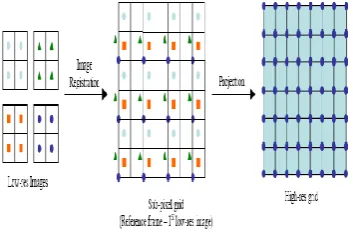
Figure describes the two steps graphically. On the left hand side four low-res images are shown (pixel values at integer pixel only). Motion estimation is used to estimate the pixel positions of the three images with respect to the 1st image. Note that these pixel positions would not be at integer values, but can take any real value. Once this information is calculated accurately, it is possible to project this information on a desired high-resolution grid.
Fig.1 Simple representation of image projection from low resolution image to high resolution image
Before delving into the solution, lets first try to understand what are we trying to achieve. Let’s say we start with a high-resolution image. Then we down sample it (without low-pass filtering). So, we have aliasing in the down sampled images. Now, in real-life we will be given these down-sampled images with aliasing and our goal is to create an HR image from them. So, basically as shown in the figure below, it boils down to finding the lost high-freq components and fixing the aliased low-freq values in the HR image. The Papoulis-Gerchberg algorithm (discussed in more detail below) along with POCS is used to solve this problem. It concentrates mainly on fixing the low-freq components, but it turns out that this algorithm also gives us some high-freq components depending on the information in the LR images.
[image:2.595.333.522.250.415.2]The two steps used to solve this problem are shown below. The detail of each step is given in the following sections.
Fig.2 various operations done on the image before applying P-G Algorithm in step 1
Fig.3various operations done on the image after step 1.
7.
RESULTS & OBSERVATION
[image:2.595.345.521.483.614.2] [image:2.595.81.258.613.729.2]so I use tukey window and pg algorithm to increase PSNR value.
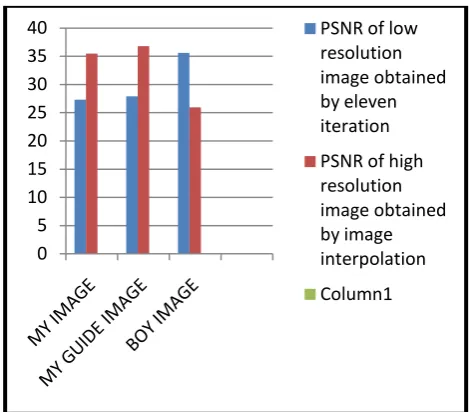
To prove my concept I perform operation on three image as shown in table
Fig.4Graph construct in accordance with result analysis table
Fig.5 My image Decompressed Low Resolution image after 11 iteration
Fig. 6 Comparison between low resolution and high resolution image in terms of PSNR of my image
[image:3.595.309.561.104.464.2]TABLE I
[image:3.595.42.277.122.328.2]Fig.7 My guide Decompressed Low Resolution image after 11 iteration
[image:3.595.54.298.375.541.2]Fig.8 Comparison between low resolution and high resolution image in terms of PSNR of my guide image
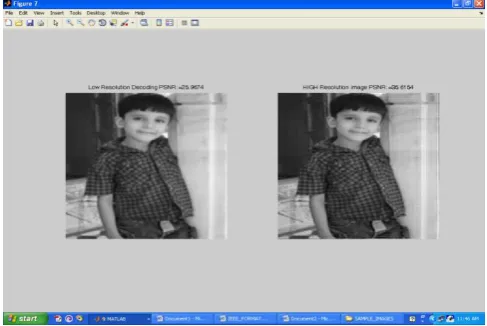
Fig.9 Boy image Decompressed Low Resolution image after 11 iteration
0 5 10 15 20 25 30 35
40 PSNR of low
resolution image obtained by eleven iteration
PSNR of high resolution image obtained by image interpolation
Column1
Name of the image
PSNR of high resolution decompressed image obtained by image interpolation
(db)
PSNR of low resolution decompressed image obtained
by eleven iteration
(db)
My image 35.4982 27.3138
My guide image 36.8207 27.9361
[image:3.595.319.553.587.746.2]Fig.10 Comparison between low resolution and high resolution image in terms of PSNR of boy image
8.
CONCLUSION & FUTURE SCOPE
There have been several techniques for image compression like the most widely adopted JPEG, SPIHT and so on. But the emergence of medical imaging and explode of images in this field has resurfaced the need to tailor made medical image compression techniques that can attain very high compression ratio, without compromising the medical information stored in the images. In this work we developed a two level compression technique. In the first level the image is compressed by rescaling the image to lower resolution, followed by transforming the image with lifting integer wavelets and encoded using SPIHT. At the decoder side, the decompressed image is scaled back to the original resolution using Papoulis-Gerchberg method of image interpolation. Results show a significant performance improvement over JPEG compression. But there are certain performance issues that need to be addressed. Use of the proposed technique introduces redundant colours in the edge of ROI and non ROI region when the compression ratio is high (Such redundancy may lead to misleading diagnosis of the image in automated image processing technique. A future work of the proposed technique will be to remove the extra shade, that appears in the boundary of ROI part. This could be attained using either fuzzy based techniques or by adopting image inpainting techniques.
9.
ACKNOWLEDGMENT
All acclamation to God, who has empowered and enabled us to accomplish the task successfully. First of all we would like to thank our God Almighty who really helps us in every problem during the project. We would like to express our sincere and humble gratitude to Almighty whose blessings, help and guidance has been a real source of all our achievements in our life.
10.
REFERENCES
[1] M.A. Ansari ,R.S. Anand, Recent Trends In Image Compression And Its Application In Telemedicine And Teleconsultation, Xxxii National Systems Conference, Nsc 2008, December 17-19, 2008
[2] Debin Zhao, Y. K. Chan, And Wen Gao, Low-Complexity And Low-Memory Entropy Coder For Image Compression, Ieee Transactions On Circuits And
Systems For Video Technology, Vol. 11, No. 10, October 2001
[3] Ahmed Abu-Hajar And Ravi Sankar, Region Of Interest Coding Using Partial-Spiht, Icassp, 2004, Ieee 2004
[4] Marco Cagnazzo, Sara Parrilli, Giovanni Poggi, And Luisa Verdoliva, Costs And Advantages Of Object-Based Image Coding With Shape-Adaptivewavelet Transform, Hindawi Publishing Corporation Eurasip Journal On Image And Video Processing Volume 2007, Article Id 78323, 13 Pages,Doi:10.1155/2007/78323
[5] Lin Ma, Feng Wu, Debin Zhao, Wen Gao, Siwei Ma, Learning-Based Image Restoration For Compressed Image Through Neighboring Embedding
[6] David Gibson1, Michael Spann And Sandra I Woolley, Diagnostically Lossless 3d Wavelet Compression For Digital Angiogram Video
[7] Emmanuel Christophe, W. A. Pearlman, Three-Dimensional Spiht Coding Of Hyperspectral Images With Random Access And Resolution Scalability, Proceedings Of The 40th Asilomar Conference On Signals, Systems, And Computers, October 29 - November 1, 2006, Pacific Grove, Ca, Usa
[8] D.Vijendra Babu, Dr.N.R.Alamelu, Wavelet Based Medical Image Compression Using Roi Ezw, International Journal Of Recent Trends In Engineering, Vol 1, No. 3, May 2009
[9] M.Tamilarasi, Dr.V.Palanisamy, Fuzzy Based Image Compression On ROI Using Optimized Directional Contourlet Transform, International Journal Of Recent Trends In Engineering, Vol 2, No. 5, November 2009
[10] Marcus Nyström, Jerry D. Gibson, John B. Anderson, Multiple Description Image Coding Using Regions Of Interest
[11] António J. R. Neves, Armando J. Pinho, Lossless Compression Of Microarray Images Using Image-Dependent Finite-Context Models, Ieee Transactions On Medical Imaging, Vol. 28, No. 2, February 2009
[12] Aysegul Cuhadar And Sinan Tasdoken, Multiple, Arbitrary Shape ROI Coding With Zerotree Based Wavelet Coders, Icassp 2003, Ieee-2003
[13] G.R.Suresh, S.Sudha And R.Sukanesh, Performance Evaluation Of Magnetic Resonance Images Coding Using Shape Adaptive Discrete Wavelet Transform, International Journal Of Computer Theory And Engineering, Vol. 1, No. 2, June 2009 1793-8201
[14] Usama S. Mohammed, Walaa M.Abd-Elhafiez, Object-Based Hybrid Image Coding Scheme, Proceedings Of 2010 Ieee 17th International Conference On Image Processing September 26-29, 2010, Hong Kong
[15] D.A. Karras, S.A. Karkanis, D. E. Maroulis, Image Compression of Medical Images Using the Wavelet Transform and Fuzzy c-means Clustering on Regions of Interest
[17]S.M.Park, M.K.Park, M.G.Kang, Super-Resolution Image Construction: A Technical Overview, IEEE signal processing magazine 2003
[18]P. Vandewalle, S. Süsstrunk, M. Vetterli, Super-resolution images reconstructed from aliased images, Proc. SPIE/IS&T Visual Communications and Image Processing Conference, July 2003, Vol. 5150, p. 1398-1405, Lugano, Switzerland.
[19]P. Vandewalle, S. Süsstrunk and M. Vetterli, Double resolution from a set of aliased images, accepted to Proc. IS&T/SPIE Electronic Imaging 2004: Sensors and Camera Systems for Scientific, Industrial, and Digital Photography Applications V, January 2004, Vol. 5301.
[20]K. Hirakawa and T.W. Parks, “Adaptive homogeneity-directed demosaicing algorithm,” IEEE Trans. Image Processing, vol. 14, no. 3, pp. 360–369, March 2005.
[21]M. Irani and S. Peleg, “Improving resolution by image registration,” CVGIP: Graphical Models and Image Processing, vol. 53, pp. 231–239, May 1991.
[22]A. Zomet and S. Peleg, Super-Resolution from Multiple Images having Arbitrary Mutual Information, Boston: Kluwer Academic Publishers, 2001.
[23]S. Farsiu, D. Robinson, M. Elad, and P. Milanfar, “Fast and robust multi-frame super-resolution,” IEEE Trans. Image Processing, October 2004.
[24] H. Stark and P. Oskoui, “High-resolution image recovery from image-plane arrays, using convex projections,” J. of the Optical Society of America, vol. 6, no. 11, pp. 1715– 1726, 1989.
[25] Sumathi Poobal, and G. Ravindran, Arriving at an Optimum Value of Tolerance Factor for Compressing Medical Images, World Academy of Science, Engineering and Technology 24 2006
[26] Chithra, Thangavel, A fast and efficient memory image codec (encoding/decoding) based on all level curvelet transform co-efficients with SPIHT and Run Length Encoding,Recent Advances in Space Technology Services and Climate Change (RSTSCC), 2010
[27] Li Wern Chew, Li-Minn Ang, Kah Phooi Seng, Reduced Memory SPIHT Coding Using Wavelet Transform with Post-Processing,International Conference on Intelligent Human-Machine Systems and Cybernetics, 2009. IHMSC '09.
[28] Zyout, Abdel-Qader,Al-Otum,Embedded ROI coding of mammograms via combined SPIHT and integer wavelet transforms,IEEE International Conference on Electro/Information Technology, 2007.