Volume 2, Issue 5, May 2013
Page 173
ABSTRACT
Concatenative speech synthesis is based on concatenating segments of recorded natural sounding utterances. Most important aspect of Concatenative synthesis is choosing correct unit length. Longer unit length has high naturalness and requires more memory whereas memory size of shorter units is small with less natural output. Another important task in creating speech database is determining endpoints of uttered speech. Our English text-to-speech synthesizer (TTS) using Concatenative synthesis is based on syllable as well as demi syllable as database unit. A new end point detection algorithm is proposed to determine end points of isolated utterances which eliminates stationary background noise and preserves naturalness. MOS test showed proposed method to be 97% intelligible and 86% natural with better accuracy in detecting end points.
Keywords: Endpoint detection algorithm, Concatenative speech synthesis, syllable, demi syllable, TTS and database.
1
INTRODUCTION
Speech synthesis is the automatic generation of speech waveform from input text [1]. This computer based system is able to read any text aloud, whether it is introduced in computer by an operator or scanned and submitted to an optical character recognition (OCR) system. TTS starts with previously stored database of speech units by analysis of training data. During concatenation stored units are placed in proper sequence at runtime. Thus TTS consist of two main tasks: text processing and speech generation. Speech synthesis can be classified into three categories:
1)Formant synthesis
2)Articulatory synthesis
3)Concatenative synthesis
Concatenative speech synthesis is based on concatenation of prerecorded natural sounding utterances [2]. Thus intelligibility and naturalness in synthesized speech is higher as compared to formant and articulatory synthesis. Synthetic speech is generated by a concatenation of speech units stored in a reference database. Stored speech waveforms of various durations are concatenated during speech generation.
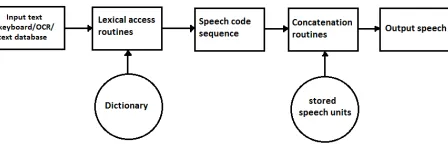
Figure 1 shows block diagram of Concatenative synthesis method.
Figure 1: Concatenative speech synthesis
DATABASE SELECTION FOR
CONCATENATIVE SPEECH SYNTHESIS
WITH NOVEL ENDPOINT DETECTION
ALGORITHM
Rahul Sawant1, H.G Virani 2, Chetan Desai 3
1
Master Student, Department of Electronics and Telecommunication Goa College of Engineering, Goa-India
2
Associate Professor, Department of Electronics and Telecommunication Goa College of Engineering, Goa-India
3Assistant Professor, Department of Electronics and Telecommunication
Volume 2, Issue 5, May 2013
Page 174
Pre-processing of utterances is required in any speech processing application in which silence removal along with endpoint detection is a basic step in recorded utterances for speech synthesis. Endpoint detection aims to distinguish between speech and non-speech parts of an utterance.
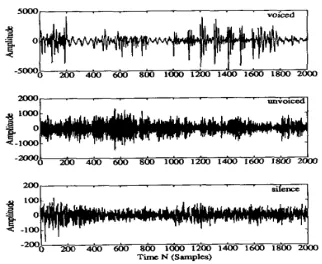
Speech can be divided into following components as shown in Fig.2 (i) silence, where no speech is produced; (ii) unvoiced, in which the vocal cords are not vibrating, so the resulting speech waveform is aperiodic or random in nature and (iii) voiced, in which the vocal cords are tensed and therefore vibrate periodically when air flows from lungs, so resulting waveform is quasi-periodic. Segmentation of waveform into silence, voiced and unvoiced is not perfect and difficult to distinguish between weak, unvoiced sound from silence or weak voiced sound from unvoiced sounds or silence [3]. Hence small error in boundary location can still happen but, usually have no consequence for most applications. A wide incorrect determination of endpoints for an utterance results in
1.Recognition errors
2.Increase in computational task
Figure 2: sound categories
2
DATABASE
SELECTION
Choosing unit length is an important task in Concatenative speech synthesis. A shorter unit length requires less space but sample collecting and labeling becomes more difficult and complex [2]. A longer unit length gives more naturalness, better coarticulation effect and less concatenation points but requires more memory space. Choices of unit for TTS are phonemes, diphones, triphones, demi syllables, syllables and words.
English language has around 40 phonemes which gives great flexibility. The major disadvantage of concatenating such brief sounds is coarticulation, which causes large changes in the articulation and acoustics of phonemes, usually on a scale of one to three phonemes (i.e., coarticulation effects rarely extend beyond three phonemes; e.g., rounded lips during /s/ in “strew”). While diphones have the same duration as phonemes, their storage is much greater: a language with N phonemes has N2 diphones and diphones have inherently more dynamic behavior, requiring storage of more frames/unit than phonemes (many of the latter are steady-state units, needing only one frame to represent each). A database of diphone units is still very feasible, needing only a few thousand frames of spectral data [1].
The number of different syllables in each language is considerably smaller than the number of words, but the size of unit database is usually still too large for TTS systems. For example, there are about 10,000 syllables in English. Unlike with words, the coarticulation effect is not included in stored units, so using syllables as a basic unit is not very reasonable. Demi syllables represent the initial and final parts of syllables. One advantage of demi syllables is that only about 1,000 of them are needed to construct the 10,000 syllables of English. Using demi syllables, instead of phonemes and diphones, requires considerably less concatenation points. Demi syllables take into account of most transitions and large number of coarticulation effects. It also covers a large number of allophonic variations due to separation of initial and final consonant clusters. However, the memory requirements are still quite high, but tolerable. Compared to phonemes and diphones, the exact number of demi syllables in a language cannot be defined. With purely demi syllable based system, all possible words cannot be synthesized properly [2]. With use of both syllable and demi syllable as database unit, size of the database is considerably reduced.
Volume 2, Issue 5, May 2013
Page 175
are composed of syllables and all syllables can be created from demi syllables, thus demi syllables can be used to produce any English word.
Classification of database helps to reduce computational time thus based on vowel nucleus and consonant cluster either side can be expressed as
C0-3V0-2C0-3
4.1DATABASE CREATION
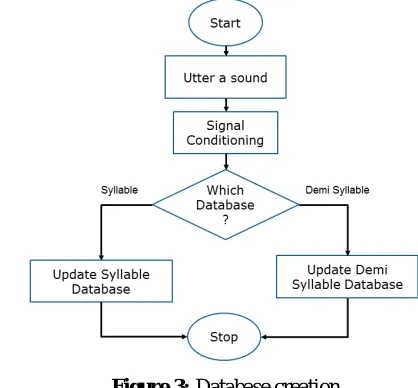
Databse creation consist of training speech which user has to record. Depending on type of unit syllable and demi syllable database is updated. Figure 3 shows flowchart of database creation.
Figure 3: Database creation
3
ENDPOINT
DETECTION
ALGORITHM
Most widely accepted methods for silence removal are Short Time Energy (STE) and Zero Crossing Rate (ZCR). But they have their own limitations in setting up thresholds and working in high noise environments [3, 4]. For past decade many endpoint detection algorithms have been developed for speech recognition based on energy entropy and feature extraction. Very little advancement has been done in developing endpoint detection algorithms in area of speech synthesis. However methods used in recognition are not used in synthesis due to increased computational time.
The specified values of threshold and sample limit are limited to specific utterance and to a particular environment. Change in stationary background noise leads to incorrect determination of endpoints. A minimum of around 10000 sample limit is required in case there is unvoiced speech in utterance to detect correct endpoints. However with present values of 1000 sample limit utterances ending with plural (like drops) and all other utterances having unvoiced samples between voiced ones are not determined as it detects silence for that limit period. Thus end point is detected before actual utterance ends.
Speech signal is a slowly time varying signal, when examined over a sufficiently short period of time (between 5 and 100 msec), its characteristics are fairly stationary; however, over a long periods of time (on the order of 1/5 seconds or more) the signal characteristics change to reflect the different speech sounds being spoken. Usually first 200 msec or more (8820 samples if sampling rate is 44100 samples/sec) of speech recording corresponds to silence (or background noise) because the speaker takes some time to read when recording starts [2].
This algorithm is modification over end point detection algorithm [5] and specifically designed for applications of speech synthesis with isolated utterances. It is based on marking threshold level for silence and retaining only voiced as well as unvoiced segments of speech in time domain. In this paper, algorithm is further modified to separate syllable into initial and final demi syllable.
3.1 ALGORITHM DESCRIPTION
The algorithm described below is in time domain analysis and each uttered sound is recorded at sampling rate of 44100Hz, 16 bit CD quality format. Threshold value is calculated from first 8820 samples (200 msec) of speech by determining amplitude of silence. Thus threshold value calculation is independent of environment. A small increase in amplitude is given to keep threshold value above silence. Sample limit is kept to 10000 limits as said above and speech is recorded for 2 sec (88200 samples) due to increase in sample limit.
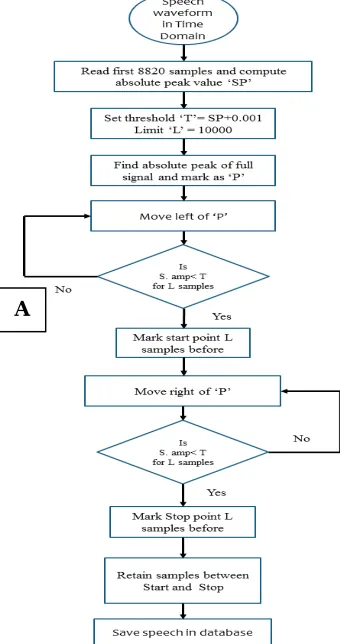
Algorithm is illustrated in flow chart given in figure 4.
Volume 2, Issue 5, May 2013
Page 176
Step2: Read first 8820 samples of full speech and compute absolute peak amplitude. Mark it as silence peak (SP)
Step 3: Set threshold value (T) to SP+0.001 and limit (L) to 10000 samples.
Step 4: Consider full speech and find absolute peak amplitude value. Mark as pointer ‘P’
Step 3: Move down the left hand side of the waveform until it reaches to value ‘T’ consecutively for a range of 10000 samples.
Step 4: Mark this point as the start point where the first of the 10000 consecutive samples start from the side of the peak amplitude.
Step 5: Similarly move down from the right hand side of the waveform until it reaches to value ‘T’ consecutively for a range of 10000 samples.
Step 6: Mark this point as the end point where the first of the 10000 consecutive samples start from the side of the peak amplitude
Step 7: Retain samples between start and stop point.
3.2 MODIFIED ALGORITHM
Splitting the syllable within the vowel creates an initial demi syllable and final demi syllable. These units are used as Concatenative segments in speech synthesizer which has advantage of holding the articulatory information between the phonemes. Also when concatenating the segments between vowel they have the advantage of requiring only a few rules for the smoothing due to the voicing effect of the vowel. It has been found through experimental research the optimum position for cutting within the vowel is 25%.
In modified algorithm we separate syllable into initial and final demi syllable by cutting vowel at 50% and stored in respective database. Provision is also made to store more vowel data for smoothing techniques.
Figure 5 shows modified algorithm
Steps 1-7 remains same as modified endpoint detection algorithm. At the end retained samples from each side are concatenated into one single speech.
Volume 2, Issue 5, May 2013
Page 177
Figure 5: Modified Endpoint Detection Algorithm
4.
SPEECH
SYNTHESIS
PROCESS
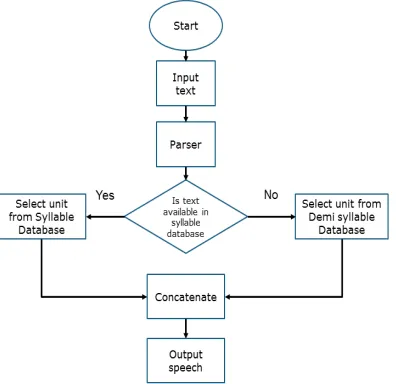
System consists of three main parts: the parser, database and concatenation unit as shown in Fig 6.
Figure 6: Speech synthesis system (after Desai C. [5])
Synthesizer works as follows shown in figure 7
Step 1: Input text is given either by operator or OCR in standard form. Step 2: Parser transcribes the text into the form of stored speech units. Step 3: Checks for transcribed text in syllable or demi syllable list. Step 4: Retrieves corresponding sound file from stored database
Step 5: Concatenate in sequence with addition of suitable silence between words.
Volume 2, Issue 5, May 2013
Page 178
5.
RESULTS
Described algorithm has been tested with database consisting of words from rainbow speech from Dragon natural speaking software. The word and syllable database was recorded in both male and female voice. A sampling frequency of 44100Hz, 16bit CD quality was used for all recordings. All recordings were done normal room with less noise. For the experiment sample limit (L) was set to 10000 samples. Following figures and tables depicts the performance of this algorithm.
Figure 8 shows endpoint detection for female voice and figure 9 for male voice. In both figures degree of accuracy in determining endpoints is close to 100%.
Figure 8: Illustration of endpoint detection for “drops” using female utterance
Figure 9: Illustration of endpoint detection for “drops” using male utterance
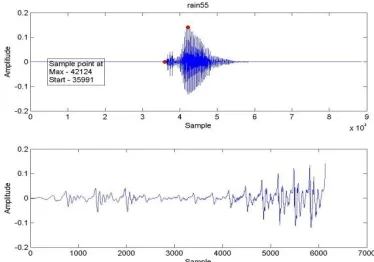
Figure 10 and 11 shows initial and final demi syllables respectively of syllable ‘vi’ using modified end point detection algorithm.
Figure 10: Initial demi syllable of “rain” using modified algorithm
Volume 2, Issue 5, May 2013
Page 179
Table 1 shows number of incorrect determination of endpoints.
Table 1: Overall accuracy of entire database
Number of files
Incorrect
number Accuracy Male Speaker 150 5 96.66%
Female
speaker 150 7 95.33%
MOS Test
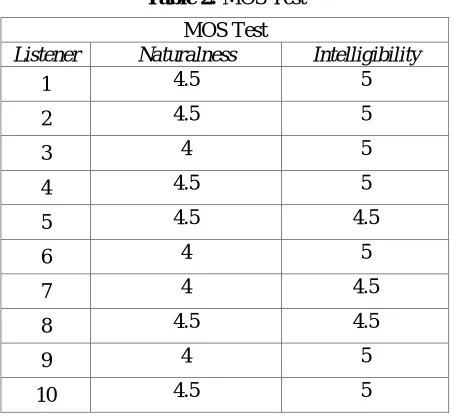
To determine naturalness of the output speech using syllable and demi syllable as database, a MOS test was conducted based on naturalness & intelligibility parameters. A passage from rainbow speech was directly recorded and each syllable constituting that passage was recorded separately. Simple end to end concatenation method was used along with optimal coupling method for waveform smoothing. Both sound files were played to 10 listeners and told to evaluate based on naturalness and intelligibility. Scale of 1 to 5, where 5 is perfect and 1 is not acceptable with freedom to score in between like 1.5, 2.5, 3.5 and 4.5 was used for grading. Table 2 shows MOS score using both algorithms.
Table 2: MOS Test
MOS Test
Listener Naturalness Intelligibility
1 4.5 5
2 4.5 5
3 4 5
4 4.5 5
5 4.5 4.5
6 4 5
7 4 4.5
8 4.5 4.5
9 4 5
10 4.5 5
Results of MOS test shows that synthesized speech is 97% intelligent and 86% natural. Also the developed system has very low error rate.
6.
CONCLUSION
The system is developed for English language as personalized text to speech. Syllable based concatenation was used which reduced the concatenation points and hence minimal distortion. Use of demi syllable reduces database size. Proposed endpoint detection algorithms in this paper are able to detect endpoints much accurately then existing algorithm. It is independent of environment and stationary noise like fans, machines etc. However speaker included noise like lip smacks, heavy breaths, mouth clicks gets included in speech with this algorithm. Such noises are not associated with each utterance and hence few manual adjustments are required.
REFERENCES
[1.]O’ Shaughnessy D, “Speech Communication - Human and Machine”, 2nd ed., University Press, 2001
[2.]Lemmetty S., “Review of Speech Synthesis Technology”, Master’s Thesis, Dept. Of electrical and Communication Engineering, Helsinki University of Technology, 1999.
Volume 2, Issue 5, May 2013
Page 180
[4.]Lingyun Gu, Zahorian S., “A New Robust algorithm for isolated word Endpoint Detection”, Department of Electrical and Computer Engineering, Old Dominion University, Norfolk, USA.
[5.]Desai C., “Development of a personalized integrated speech-to-text cum text-to-speech generator for English language”, Goa college of Engineering, June 2010.
[6.]L. R. Rabiner and B. H. Juang, “Fundamentals of Speech recognition”, Prentice Hall International Inc.
[7.]Pallavi K., Thesis – Development of speech synthesizer for English language, Goa college of Engineering, June 2012.
[8.]Shen Yong and Chen Leimin. Performance comparison of new endpoint detection method in noise environments.