MJLTM, 8 (1), 83-95.
Language Proficiency and Students Behavior in the Classroom: A Comparative Study
. Ronnie Goodwin, Ph.D
Area/West Mishref Kuwait Abdullah
-Gulf University for Science & TechnologyBlock 5, Building 1Mubarak Al
ARTICLE INFORMATION
Original Research Paper Received Nov. 2017 Accepted Jan. 2018
Keywords:
Behavior EFL/ESL Language TESOL Teaching
ABSTRACT
Introduction: The impact of teacher’s proficiency and the modes of second language instruction have long been a subject of debate among researchers. Effective English language instruction continues to be of paramount importance for educationists.
Background: The impact of teacher competence and their level of proficiency on the language have long been debated among scholars. A number of researches advocate that teacher’s competence in ESL (English Second Language) instruction is directly proportional to the student’s acquisition of knowledge. The methods of instruction and activities have a direct influence on the classroom behavior of students in second language classes.
Method: In an attempt to thoroughly understand the student’s perspective on the impact of language proficiency and student behavior in classrooms, a quantitative study was conducted to understand the student’s perception on the topic. A questionnaire was developed aimed at extracting the required information from the participants.
Conclusion: The results clearly indicated that the teacher’s proficiency on the language and the mode of instruction has a direct influence on the progress of ESL students. The results highlighted the need for improvised and effective modes of second language instruction to ensure student learning.
1. Introduction
In today’s contemporary world, an amplified use of English language in all walks of life has increased the vitality of English Second Language (ESL) teachers. English language continues to be the most acceptable and widely used language in business, education, entertainment and hospitality. However, it should be realized that adequately teaching the English language to second language learners requires more than a teacher’s grasp on the language and a lesson plan. More emphasis is being paid on English language instruction due to its vast applications in all fields and an established acceptance.
1.1 Overview: Language Proficiency and Classroom Behavior
Apart from the teaching skills and methods required in effective ESL teaching, more stress is being paid on the teacher skills needed to carry out effective ESL instruction (Hulstijn 1992). Seidlhofer (1999) asserted that a language teacher’s confidence has a direct influence on its students. An English language teacher’s confidence is influenced by the teacher’s own proficiency in the language and command over the instruction methods.
Modern Journal of Language Teaching Methods (MJLTM) ISSN: 2251-6204
www.mjltm.org
MJLTM, 8 (1), 83-95. Therefore, teachers who view themselves weak in English language would have low confidence, and face issues in second language instruction.
2.0 Literature Review
Teaching ESL students can be a daunting task. It requires more than a teacher’s grasp on English language and lesson plans. It should be realized that no major differences exist between the competence and efficiency of English speaking teachers and those who themselves are second language speakers (Nassaji 2003). For a thorough teaching in ESL classes, a teacher must have an adequate proficiency level needed to effectively teach second language English students. Teachers are not likely to carry out effective classes and engage in improvisational teaching if they themselves are not proficient (Medgyes 2001).
A lot of the literature has focused on discussing the problems faced by students studying in a second language, but another important discussion has been on the fact that the students alone do not contribute to this handicapping condition. Majority of the literature emphasizes on the importance of the role of the teachers and that the teachers must be able to understand and recognize the stages of language acquisition each of their students is going through in order to be able to make improvements and modifications for these students (Guglielmi, 2008; Nassaji 2003).
Another discussion synonymous in the literature regarding this topic was regarding how each student is unique and different from the others, which is why, the educators must consider and assess the needs of their students individually and differently. The role of the teachers and the educators must be to facilitate the students and make them as comfortable as possible, as a language barrier can create several problems for the students and have a considerable negative impact on their learning abilities (Guglielmi, 2008; Nassaji 2003). The teachers must encourage the students that are facing a language problem to be straight forward about it rather than making them hesitant or discouraging them. If a student is discouraged once, he or she will always be hesitant in asking a question. Therefore, the teachers must be trained regarding how they must encourage the students facing such problems so that a solution can be worked out for them.
Some studies also presented the idea that a school psychologist must be present in order to assist the teachers for this problem. A school psychologist would be able to help the teachers and educators based on his knowledge regarding data collection, data interpretation, and differences due to socioeconomic, cultural, and ethnic backgrounds (Baker and Markham, 2002). The presence of a psychologist in the school can be something that can help address this problem a great deal. This is because psychologists know individual behaviors better than anyone else, and they know how the students facing such barriers and problems are to be taught effectively. Therefore, the psychologists will be able to guide the teachers at the educational institute or school, regarding the day to day problems they may face and how they are to be addressed.
Another important role the psychologist can play is the assessment of individual students and an evaluation of the problems they face. The most important step for finding a solution to a problem is the correct identification of the problem itself. The psychologist will be better equipped to understand the main problems these students face which will then allow the school or educational administration to better address these problems and find solutions.
3.0 Purpose of the Research
The present research aimed to study the Impact of Language Proficiency on Classroom Behavior in ESL instruction. The study adopted an instruction centered approach rather than the orthodox learner based approach to studying the impacts of teacher’s language proficiency on classroom behavior.
MJLTM, 8 (1), 83-95. To adequately achieve the purpose of the study, ESL students were inquired about their views on the role of instructor and their activities in a TESOL (Teaching English to Speakers of Other Languages) classroom. A thorough analysis was conducted on the students’ response to ascertain their views on instructor’s language proficiency and its impact on classroom behaviors.
4.0 Aims and Objectives of the Study
The following were the main objectives of the study:
To study the role of Teacher’s Language Proficiency and its impact on Classroom Behavior in ESL instruction
To highlight the role of Teachers in Effective ESL Teaching
To adequately understand the behavior of teacher i.e. leadership, leniency, responsibility, anger and dissatisfaction and their impact on student’s performance
To ascertain the role of TESOL activities and their impact on Classroom Behavior of Students
4.1 Background of the Study
Historically, the advancements in English language instruction occurred due to researches in the discipline of applied linguistics. Most of the development took place during the 1960s. Methods of language instruction were proposed by researchers. Soon, these methodologies were adopted in ESL instruction and the paradigm of focus shifted from student centered learning to an instructor centered teaching approach in ESL classroom instruction (Wesche & Paribakht 2000). Some of the earliest methods of instruction in ESL teaching were situational language teaching and Audiolingualism (Richards 2001).
Theory and specialized academic knowledge in Applied Linguistics led to the foundations of new approaches in ESL instruction. Most of these methods were taught in the curriculum of Masters Program in Applied Linguistics. Mostly, the curriculum comprised of courses in language theory, language analysis, teaching practicum and teaching methodology (Bailey 2006). The debate on the relationship between practical knowledge and theory was revived and a consensus was achieved among scholars on effective modes of instruction for the achievement of desired results. The major source of confusion in the debate was a lack of consensus on the importance of pedagogical content knowledge over an effective practical application. Disciplinary knowledge of a subject entails a circumscribed body of theory and knowledge regarded by language teachers as vital to ensuring effective teaching practices (Zoltan 2001).
Teachers tend to gain such knowledge by attending specialized training programs and consistently becoming aware of the improvised methods of teaching. It can be ascertained that most advancements in ESL teaching evolved out of advancements in the field of Linguistics during the 1960s (Richards, Thomas & Farrell 2005). However, in today’s contemporary world, the language of instruction encompasses a broad array of teaching strategies, instruction methods and use of technology.
5.0 Research Questions
The following were the proposed research questions in the study:
1. Does the language proficiency of ESL teachers have an impact on student Learning/Performance in the
classroom?
2. How Important is the role of teachers in ESL instruction?
3. What is the impact of the teacher’s command on the methods of ESL instruction?
4. How do the personal characteristics of an ESL teacher i.e., Leadership, Leniency and Responsibility impact the learning process in ESL classrooms?
MJLTM, 8 (1), 83-95.
6.0 Materials & Methods
In order to adequately answer the proposed research questions; a quantitative methodology was chosen. EFL/ESL students from five primary schools were chosen with low SES scores. Students from Fourth, Fifth and Sixth grades participated in the study.
6.1 Sample
For a thorough analysis of the topic, a total of 547 students were selected from 4th, 5th and 6th grades. The breakdown of students included: 130 students from 4th Grade, 163 students from 5th Grade and 254 students from 6th Grade. The sample comprised of 295 boys and 252 girls considering the population dynamics of the students. A breakdown of the participants is shown in (Figure I & Figure II).
Figure I: Participant Gender Demographics Figure II: Student Educational Level
6.2 Quantitative Analysis
A questionnaire was used to gain an insight on the student’s perceptions of their ESL teachers. The
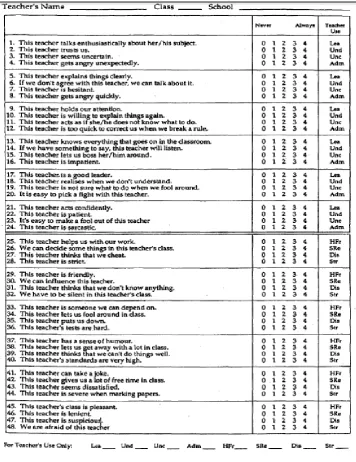
questions were carefully developed to cover the spectrum of the study. A total of 48 questions were developed to be ranked on a Five-point scale i.e. (4) meaning strongly agree, (3) meaning agree, (2) meaning neither agree nor disagree, (1) meaning disagree, and (0) meaning strongly disagree, as shown in Figure III.
Partici pant Gender
, boys, 295, … Partici
pant Gender
, girls, 252, …
Participant Gender
boys
girls
Participant Education Level
Grade 4
Grade 5
Grade 6
MJLTM, 8 (1), 83-95. Figure III: Questionnaire Used in the Study
6.3 Teacher’s Behavior Studied in the Research
The questionnaire was carefully developed to understand their perspective on teacher behavior and its impact on classroom behavior. The following were the behavior categories on the questionnaire.
MJLTM, 8 (1), 83-95.
Behavior Aspect Question #
Strict Behavior 8, 16, 28, 36, 44, 48
Leadership Behavior 1, 2, 9, 17, 21, 33, 40, 45
Helping/Friendly Behavior 6, 10, 18, 22, 25, 29
Understanding Behavior 5, 14, 37, 41, 46
Student Responsibility/Freedom
Behavior 13, 19, 26, 42
Uncertain Behavior 3, 7, 11, 15, 30, 34, 38
Dissatisfied Behavior 20, 23, 27, 31, 39, 43
Admonishing Behavior 4, 12, 24, 32, 35, 47
Table I: Categorical Survey Question Reference
The questionnaire was administered in their native language to avoid any discrepancies in interpretation. The responses for each question were tabulated individually, but the mean value was calculated for each category and analyzed to improve the credibility of the research. The calculation of mean allowed for a thorough interpretation of results and inferences.
7.0 Results
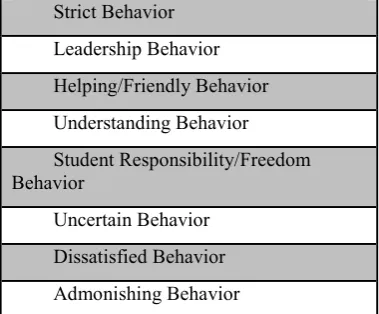
After the administration of the questionnaire on the participants; their responses were carefully recorded and analyzed. The mean for each category was calculated to gain an insight on the cumulative response for each question. The following teacher behavior categories were studied independently and analyzed:
Strict Behavior Leadership Behavior Helping/Friendly Behavior Understanding Behavior Student Responsibility/Freedom Behavior
Uncertain Behavior Dissatisfied Behavior Admonishing Behavior
Table II: Teacher Behavior Categories studied in the Questionnaire
7.1 Data Analysis
The mean of student response was calculated so that a thorough understanding on student’s perspective of teachers could be obtained. The questionnaire attempted to measure the following elements in the study:
1. Strict Behavior
2. Leadership Behavior
3. Helping/Friendly Behavior
4. Understanding Behavior
MJLTM, 8 (1), 83-95.
5. Student Responsibility/Freedom Behavior
6. Uncertain Behavior
7. Dissatisfied Behavior
8. Admonishing Behavior
7.2 Strict Behavior
The category of teacher behavior was the level of strictness the teacher adopted in class. A total of six questions focused on teacher’s strictness. The means calculated of the student’s response were 115.7, 117.5, 51.2, 160.7 and 102.0 responding to the Likert Scale of 4-1. An overview of the mean average of the responses clearly indicated that the majority of the student sample believed that their ESL teachers were quite strict and that they have a short temper. A total of 73 students agreed that they are afraid of their teachers. In a cumulative view, the chosen sample of students had issues with the level of strictness employed by their ESL teachers in class. A graphical representation of the student response is given below.
Figure IV: Student Response to Questions on Strictness
7.3 Leadership Behavior
The leadership abilities of a teacher have a direct impact on student learning. 8 questions on the questionnaire attempted to study the students’ perception of their teacher’s leadership skills. The mean averages of the student’s response were calculated at 210.9, 220.9, 18.3, 47.3 and 49.8. An extreme deviation was observed in the student’s cumulative response. Despite issues with their teacher’s strictness, most of the 4th, 5th and 6th graders believed that their ESL class was pleasant. A vast majority of students agreed that their teacher trusts them. Similarly, most students believed that they can trust their teachers despite evident issues with the teacher’s strictness.
Strict Behavior
This teacher gets angry quickly #8
This teacher is impatient #16
This teacher is strict #28
This teacher's tests are hard #36
This teacher is severe when marking papers #44
We are afraid of this teacher #48
MJLTM, 8 (1), 83-95.
Figure V: Students Response on Teacher Leadership
7.4 Helping/Friendly Behavior
When asked about the altruistic and friendly behavior of their ESL teacher; the students gave a mixed response. Although, most students expressed that they can approach their teacher on issues. However, a total of 28 students believed that they cannot argue with their teachers’ if they do not agree with them. Most participants accepted that their teachers are helpful and do help them when they are faced with issues. The calculated means on Helping/Friendly behavior questions i.e. 219.8, 219.5, 22.8, 40.2 and 44.7 clearly indicate that most students thought their ESL teacher had a friendly and altruistic behavior.
Figure VI: Altruistic/Friendly Behavior
7.5 Understanding Behavior
When inquired about understanding behavior of their teacher, the students seemed to have good knowledge on their teacher’s personality. Approximately 228 participants out of 547 were convinced that their teacher has a sense of humor, is lenient and has the ability to explain things properly. However, 56 students did not feel that
Leadership Behavior
This teacher talks enthusiasticallyabout his/her subject #1 This teacher trusts us #2
This teacher holds our attention #9
This teacher is a good leader #17
This teacher acts confidently #21
This teacher is someone we can depend on #33
This teacher's standards are very high #40
This teacher's class is pleasant #45
Helping/Friendly Behavior
If we don't agree with this teacher,we can talk about it #6
This teacher is willing to explain things again #10
This teacher realises when we don't understand #18
This teacher is patient #22
This teacher helps us with our work #25
This teacher is friendly #29
MJLTM, 8 (1), 83-95. their teacher listens to their issues. Also, a small percentage of the student sample believed that their teacher cannot comprehend jokes.
Figure VII: Understanding Behavior Analysis
7.6 Student Responsibility/Freedom Behavior
When inquired about the level of responsibility and freedom granted by the teacher, most students seemed satisfied with the behavior of their teacher. The calculated averages were 193.5, 181, 61, 71.25 and 40.25. A vast majority of students i.e. 258 students thought they have a voice in their teacher’s class and can provide their input in discussions. Also, most students i.e. 219 students believed that their teacher does not know how to respond when they act up. Overall, most students seemed content with the freedom they enjoy in their language class.
Figure VIII: Student Responsibility/ Freedom Behavior
Understanding Behavior
This teacher is lenient #46
This teacher can take a joke #41
This teacher has a sense of humour #37
If we have something to say, this teacher will listen #14 This teacher explains things clearly #5
Student Responsibility/Freedom Behavior
This teacher gives us a ot of free time in class #42
We can decide some things in this teacher's class #26
This teacher is not sure what to do when we fool around #19
This teacher knows everything that goes on in the classroom #13
MJLTM, 8 (1), 83-95. 7.7 Uncertain Behavior
The students responded in a different fashion when they were asked about the level of uncertainty in their teacher’s behavior. More than 225 students believed that their language teacher knows what to do and is prepared for the class. Only 56 students felt that their teacher is often hesitant during the class. It falls in complete accordance to the results of the strictness behavior of the teacher as 40 students believed that their teacher is not sure of what to do during in the class and can be influenced easily.
Figure IX: Uncertain Behavior of ESL Teachers
7.8 Dissatisfied Behavior
An analysis of the dissatisfied behavior questions on the questionnaire revealed that the language teacher possessed a strong personality. On an average, only 23 students felt that they can cheat, or pick a fight with their teacher. A vast majority i.e. approximately 235 were quite convinced that their language teacher had a strong personality, but was not satisfied.
Figure X: Dissatisfied Behavior
Uncertain Behavior
This teacher seems uncertain #3
This teacher is hesitant #7
This teacher acts as if she/he does not know what to do #11
This teacher lets us boss her/him around #15
We can influence this teacher #30
This teacher lets us fool around in class #34
This teacher lets us get away with a lot in class #38
Dissatisfied Behavior
This teacher seems dissatisfied #43
This teacher thinks that we can't do things well #39
This teacher thinks that we don't know anything #31
This teacher thinks that we cheat #27
It's easy to make a fool out of this teacher #23
It is easy to pick a fight with this teacher #20
MJLTM, 8 (1), 83-95. 7.9 Admonishing Behavior
The questions on admonishing behavior of the teacher allowed us to ascertain the true nature of ESL teachers. A staggering 257 participants believed their teacher has a cool temper and does not get angry easily. While, 229 students thought that the teacher is in control during the class. It clearly implies that despite being in control during the class, ESL teachers manage to maintain a friendly environment. Only a small minority i.e. 18 students thought their teacher was suspicious.
Figure XI: Admonishing Behavior
8.0 Discussion
From an analysis of the results, it can be ascertained that the teacher’s personality plays a major role in determining the true achievement of students in an ESL class. From an analysis of the questionnaire results, it is evident that language learners tend to take the teachers seriously if they have a strong personality and they are proficient in the language. Another fact that can be derived from the results is that the students are more likely to learn English Language if the amount of discussion and sociolinguistic conversations are increased in the class (Appel & Muysken 2006).
Similarly, class participation plays a major role in language learning. The results of the questionnaire clearly reveal that students thought they would benefit from class discussions. Teacher encouragement plays a major role in inducing confidence among students by encouraging participation in classroom activities (Abdo & Breen 2010). In a study conducted by Casteel & Ballantyne (2010), the researchers asserted that verbal participation of students in an ESL class allows them to learn vocabulary of the language.
The results also show that, it is evident that a teachers’ training for ESL instruction is vital in order to induce the desired classroom behavior. ESL training encompasses implementing theoretical knowledge on linguistics in practical settings. Elements of peer teaching and interactive teaching in language instruction have also become common. In a broader perspective, good language instruction requires the teacher’s mastery on a number of competencies and familiarity with the mode of instruction.
Teachers’ that have ESL training also have an impact on their students; therefore language teachers are required to consistently adopt new methods of instructions and receive trainings regarding ESL instructions. Most linguistic experts believe that the trainings for teachers on ESL instructions are vital in order to ensure
Admonishing Behavior
This teacher gets angryunexpectedly #4This teacher is too quick to correct us when we break a rule #12
This teacher is sarcastic #24
We have to be silent in this teacher's class #32
This teacher puts us down #35
This teacher is suspicious #47
MJLTM, 8 (1), 83-95. effective instructions for second language students (Lavender 2002).
It has also been observed that the mode of instruction followed in classrooms and the teacher’s proficiency on English language have a direct impact on the performance of ESL students. Teachers must revise their classroom strategies and incorporate innovation to ensure a smooth transfer of knowledge (Cullen 1994; Snow, Kahmi-Stein & Brinton 2006). In a broader perspective, language proficiency is directly associated to classroom instruction and carrying out targeted exercises for language acquisition among students. Unfortunately, the role of a teacher in ESL instruction continues to be ignored in many TESOL teacher preparatory programs. Therefore, it is important for the education and academic authorities to develop a structure that emphasizes on ESL trainings, which should be made mandatory.
9.0 Conclusion
All in all, from the analysis in the paper, it can be ascertained that the increased use of English language in all avenues of life has increased the importance of English Second Language (ESL) teachers. The English language has been established as an acceptable mode of communication and instruction in today’s competitive world. The vast use of the language continues to advocate the implementation of effective modes of teaching to native speakers and second language instructors.
It should be realized that teaching English language to second language speakers is a complex task. Apart from competence and proficiency in the language, the instructor must possess the required essentials to carry out productive classroom activities. Educators across the world seem to emphasize on the growing need for effective ESL instruction. Similarly, the classroom behavior of students in an ESL class has also become important and more research is being conducted on the subject than ever before.
From the discussion in the paper, it is evident that the teacher has a direct influence on the students in a language class. The desired classroom behaviors can only be achieved if language students feel that their instructor is proficient in the language. Similarly, the confidence of a language teacher is of paramount importance and can affect the academic achievements of the students. There seems to be a consensus on improvising the methods used in second language training. Most educators and researchers believe that an interactional approach should be adopted and student participation should be ensured in classed. On the other hand, regular trainings for ESL teachers should be ensured so that they are familiar with the innovations in teaching and language acquisition.
From a historical perspective, most advancement in English language instruction took place due to numerous studies conducted under the paradigm of applied linguistics. The effective modes of linguistics training were then adopted by ESL teachers. The impact of students in second language classes is vital to understanding the need for contemporary methods in language instruction. Unlike other disciplines, second language instruction requires consistent efforts on part of the instructor to induce the desired response among the students. The methods of instruction adopted by second language teachers have evolved out of research in the area of linguistics and teacher training. In a nutshell, more efforts need to be put in by teachers and educators to devise effective methods of second language instruction so that foreign students can compete in today’s competitive world.
References
1. Abdo, I. B., & Breen, G.-M. (2010). Teaching EFL to Jordanian Students: New Strategies for
Enhancing English Acquisition in a Distinct Middle Eastern Student Population. Creative Education, 1, 39-50.
doi:10.4236/ce.2010.11007
MJLTM, 8 (1), 83-95. 2. Appel, R., & Muysken, P. (2006). Language Contact & Bilingualism. Amsterdam: Amsterdam University Press.
3. Baker, B., & Markham, P. (2002). State School Funding Policies and Limited English Proficient
Students. Bilingual Research Journal, 26(3), 659-680. doi:10.1080/15235882.2002.10162583
4. Bailey, K. M. 2006. Language Teacher Supervision: A Case-Based Approach. New York: Cambridge
University Press.
http://www.cambridge.org/other_files/downloads/esl/fourcorners/Pedagogical_Books/Compe-tence-and-Performance-Combined.pdf
5. Casteel, C., & Ballantyne, K. (Eds.). (2010). Professional Development in Action: Improving Teaching
for English Learners. Washington, DC: National Clearinghouse for English Language Acquisition.
http://www.ncela.gwu.edu/files/uploads/3/PDF
6. Cullen, R. (1994). Incorporating a Language Improvement Component in Teacher Training
Programmes. ELT Journal, 48 (2): 162–72. http://www.cambridge.org/other_files/downloads/esl/fourcorners/
Pedagogical_Books/Competence-and-Performance-Combined.pdf
7. Guglielmi, R. (2008). Native language proficiency, English literacy, academic achievement, and occupational attainment in limited-English-proficient students: A latent growth modeling perspective. Journal of
Educational Psychology, 100(2), 322-342. doi:10.1037/0022-0663.100.2.322
8. Hulstijn, J. H. (1992). Retention of Inferred and Given Word Meanings: Experiments in Incidental
Vocabulary Learning. Vocabulary and Applied Linguistics. pp. 113-125. London: Macmillan.
http://www.teslcanadajournal.ca/index.php/tesl/article/viewFile/1064/883
9. Lavender, S. (2002). Towards a Framework for Language Improvement within Short In-Service Teacher
Development Programmes. Language in Language Teacher Education. pp. 237–50). http://www.cambridge.org
/other_files/downloads/esl/fourcorners/Pedagogical_Books/Competence-and-Performance-Combined.pdf 10. Nassaji, H. (2003). L2 Vocabulary Learning from Context: Strategies, Knowledge Sources, and their Relationship with Success in L2 Lexical Inferencing. TESOL Quarterly. 37. 645-670 . http://www.teslcanad ajournal.ca/index.php/tesl/article/viewFile/1064/883
11. Richards, J. C., & Farrell, T. S. C. (2005). Professional Development for Language Teachers. New
York: Cambridge University Press. http://www.cambridge.org/other_files/downloads/esl/fourcorners
/Pedagogical_Books/Competence-and-Performance-Combined.pdf
12. Richards, J. C. (2001). Beyond Training. New York: Cambridge University Press
13. Seidlhofer, B. (1999). Double Standards: Teacher Education in the Expanding Circle. World English. 18 (2): 233–45. http://www.cambridge.org/other_files/downloads/esl/fourcorners/Pedagogical_Books/Competence-and-Performance-Combined.pdf
14. Snow, M. A., Kamhi-Stein, L. D. & Brinton, D. (2006). Teacher Training for English as a Lingua franca. Annual Review of Applied Linguistics. Vol: 26. pp. 261–81. http://www.cambridge.org/ other_files/ downloads/esl/fourcorners/Pedagogical_Books/Competence-and-Performance-Combined.pdf
15. Wesche, M. B., & Paribakht, T. S. (2000). Reading-Based Exercises in Second Language Vocabulary Learning: An Introspective Study. Modern Language Journal, 84 , 196-213. http://www.teslcanadajournal.ca/ index.php/tesl/article/viewFile/1064/883
16. Zoltan, D. (2001). Motivational Strategies in the Language Classroom. Cambridge: Cambridge
University Press. http://www.cambridge.org/other_files/downloads/esl/fourcorners/Pedagogical_Books/Compet
ence-and-Performance-Combined.pdf