
Vo
l. 2011, 4(4)
Vol. 2011, 4(4)
EARBOOK of
A
NTITRUST and
R
EGULA
TO
RY
S
Prof. Tadeusz Skoczny – Editor-in-Chief, CARS Director Dr. Agata Jurkowska-Gomułka – Editor, CARS Scientific Secretary
Prof. Krzysztof Klincewicz – Editor, University of Warsaw,
Faculty of Management
Ewelina D. Sage, Ph.D. (OXON) – CARS International Co-ordinator
Prof. Andrzej Szablewski – Editor, Technical University in Łódź
Dr. Tomasz Zalega – Editor, University of Warsaw, Faculty of Management
a
dvisoryB
oardProf. Anna Fornalczyk, Chairwoman – Technical University of Łódź;
former President of the Antimonopoly Office
Prof. Stanisław Piątek, Vice-Chairman – University of Warsaw,
Faculty of Management
Prof. Eleanor Fox – New York University, School of Law
Zbigniew Grycan – President of the Supervisory Board
of “Grycan – Lody od pokoleń”
Prof. Janusz Lewandowski – Warsaw University of Technology,
Institute of Heat Engineering
Prof. Johannes Masing – University of Freiburg; judge at the Federal
Constitutional Court in Karlsruhe
Prof. Alojzy Z. Nowak – Dean of the Faculty of Management
of the University of Warsaw
Prof. FranzJürgen Säcker – Free University of Berlin, Institute for German
and European Business, Competition and Regulation Law
Prof. StanisławSołtysiński – Sołtysiński Kawecki & Szlęzak LPP
Prof. Andrzej Sopoćko – University of Warsaw, Faculty of Management;
former President of the Competition and Consumer Protection Office
Prof. Richard Whish – University of London, Kings College
Prof. Marek Wierzbowski – University of Warsaw, Faculty of Law
and Administration; attorney-in-law
Prof. Irena Wiszniewska-Białecka – judge of the General Court
of the European Union
Prof. Anna Zielińska-Głębocka – Univeristy of Gdańsk, Faculty of Economics;
member of the Monetary Policy Council
[further Members of the Advisory Board to be confirmed]
E
ditorialo
fficECentre for Antitrust and Regulatory Studies (CARS) University of Warsaw, Faculty of Management
PL – 02-678 Warszawa, 1/3 Szturmowa St. Tel. + 48 22 55 34 126; Fax. + 48 22 55 34 001
e-mail: [email protected]
CENTRE FOR ANTITRUST AND REGULATORY STUDIES University of Warsaw
Vol. 2011, 4(4)
Y
EARBOOK
of
A
NTITRUST
and
R
EGULATORY
S
TUDIES
Antitrust and Regulation in the Energy Sector
Edited by
Ninth Publication of the Publishing Programme
Copyright by Wydawnictwo Naukowe Wydziału Zarządzania Uniwersytetu Warszawskiego, Warszawa 2010
Language editor: Philip Earl Steele
Cover: Dariusz Kondefer
ISSN 1689-9024
PUBLISHER
University of Warsaw Faculty of Management Press PL – 02-678 Warsaw, 1/3 Szturmowa St.
Tel. (+48-22) 55-34-164
e-mail: jjagodziń[email protected] www.wz.uw.edu.pl
LAYOUT
ELIPSA Publishing House
VOL. 2011, 4(4)
Contents
From the Editors ... 5
Foreword from the President of the European Parliament ... 7
GUEST ARTICLES
MARIUSZ SWORA, Smart Grids after the Third Liberalization Package: Current Developments and Future Challenges for Regulatory Policy in the Electricity Sector ... 9 KRZYSZTOFŻMIJEWSKI, MACIEJ M. SOKOŁOWSKI, The Main Frameworks
of the National Programme for the Reduction of Emissions: Towards the National Programme for Low-Emission Economic Development. The Public Board’s Role ... 23
ARTICLES
BARTŁOMIEJ NOWAK, PAWEŁ GRZEJSZCZAK, Poland’s Energy Security in the Context of the EU’s Common Energy Policy. The Case
of the Gas Sector ... 41 MARIA MORDWA, The Obligation of Strategic Gas Storage Introduced
in Poland as an Example of a Public Service Obligation Relating
to Supply Security: A Question of Compliance with European Law ... 57 JANUSZ LEWANDOWSKI, Cutting Emissions in the Energy Sector:
a Technological and Regulatory Perspective ... 83 MARCIN STOCZKIEWICZ, The Emission Trading Scheme in Polish Law.
Selected Problems Related to the Scope of Derogation from
ALEKSANDER STAWICKI, The Autonomy of Sector-Specific Regulation – Is It Still Worth Protecting? Further Thoughts on the Parallel
Application of Competition Law and Regulatory Instruments ... 115 FILIP M. ELŻANOWSKI, The Duties of the President of the Polish Energy
Regulatory Office in the Context of the Implementing the Third
Energy Package ... 135 MARZENA CZARNECKA, TOMASZ OGŁÓDEK, The Energy Tariff System and
Development of Competition in the Scope of Polish Energy Law ... 151 TADEUSZ SKOCZNY, Consolidation of the Polish Electricity Sector. The
Merger Law Perspective ... 169 ANDRZEJ T. SZABLEWSKI, The Need for Revaluation of the Model
Structure for Electricity Liberalization ... 201
CASE COMMENTS
Which authority is competent to decide when a power company is abusing monopolistic power: the President of the UOKiK or the President of the URE?
Case comment to the judgement of the Supreme Court of April 2, 2009 – ENION S.A.
Commented by ALEKSANDER MAZIARZ ... 225 Are the rights and obligations arising from a license transferable under
Article 40 of the Privatization and Commercialization Act? Case comment to the judgement of the Supreme Court of November 20, 2008 (Ref. No. III SK 13/08)
Commented by ILONA BANKIEWICZAND URSZULA ANTONOWICZ ... 231
BOOK REVIEW
Bożena Borkowska, Regulacja monopolu naturalnego w teorii i praktyce [Regulation of a natural monopoly in theory and practice],
Wydawnictwo Wrocławskiego Uniwersytetu Ekonomicznego, [Publishing House of the Wroclaw University of Economics], Wroclaw 2009, 229 pp.
Reviewed by ANNA FORNALCZYK ... 239
BIBLIOGRAPHY 2007–2010
The editorial board is pleased to present the forthvolume of the Yearbook of Antitrust and Regulatory Studies(YARS 2011, 4(4)), dedicated solely to competition protection and regulation in the energy sector in Poland.
As was the case in our previous issues, we hope that this time, too, our Yearbook will be interesting for our foreign readers. Thus, all the research papers published here are dedicated to the major developments currently underway in the Polish energy sector – an economic sector which for years has been dependent on and under the control of the government. Because of this, recent liberalization and the opening of the energy market in Poland, driven by European Union legislation, cannot bear full fruit all at once. Liberalization of the energy market demands time. It involves a complicated decision-making process, the passage of sector-specific legislation, and massive investments together with various market adaptations, as Professor Buzek aptly observes in his foreword. Moreover, it should be clear that the necessary political involvement does not end with the decision to liberalize or with the completion of the legislative work required to establish a market framework. Indeed, continued political and business involvement is required to create a competitive energy industry in Poland as well as to monitor and regulate the exercise of monopoly powers by independent national regulators. This is why the complexity of market liberalization is of paramount interest to policy makers, and also why the former President of the Energy Regulatory Authority (M. Swora) accepted our invitation to write a guest article on development in the energy sector. His choice was wise and proper: smart grids and smart metering. The second guest article was prepared by representatives of the Public Board of the National Programme for Reduction of Emissions – K. Żmijewski and M. Sokołowski. These experts highlight the key tasks of the Board with regard to the reduction of greenhouse gas emissions in the energy sector, along with its role in the overall process of CO2 reduction in Poland. We are very grateful for these guest articles and their authors’ efforts.
renewable energies, and independent regulation and competition on the energy market. Each of these aspects has an important influence on the competitiveness of the Polish energy sector vis-à-vis other EU Member States. We believe that this alone places our publication in the mainstream of the discussions pursued by Europe’s academics and professionals in the energy and regulatory law field. The present volume opens with articles on energy policy and the legal aspects of energy security in the natural gas sector – specifically, the lack of cooperation among Member States and infrastructural obstacles to a common energy policy for Europe (B. Nowak and P. Grzejszczak) as well as gas storage problems (M. Mordwa). Later on our authors focus on the reduction of greenhouse gas emissions in the energy sector through technological innovations and developments in heat and electricity generators (J. Lewandowski) and through the emission trading scheme and newly established (by EU directives) auctioning general rule (M. Stoczkiewicz). The next section of YARS deals with regulatory, institutional, and jurisdictional concerns. A. Stawicki focuses his research on the autonomy of sector-specific regulation and the relation between energy law and competition law. F. Elżanowski discusses the duties of the ‘Energy Regulator’ in light of the third energy package, and M. Czarnecka and T. Ogłódek focus on tariff creation as a regulatory tool, and its impact on competition. Last but not least, this section of YARS ends with research papers on competition liberalization and successive changes in the Polish electricity sector from the legal perspective (T. Skoczny) and the economic perspective (A. Szablewski) as well.
Aside from these research papers, this volume of YARS also contains two case comments concerning the energy field. Our case commentators present judgements wherein the Supreme Court tackled the question (i) which authority is competent to decide when a power company is abusing monopolistic power: the President of UOKiK or the President of URE? (A. Maziarz), and (ii) whether the rights and obligations arising from a license are transferable under Article 40 of the Privatization and Commercialization Act (I. Bankiewicz, U. Antonowicz)
Finally, this year’s volume of YARS ends with a book review of Bożena Borkowska’s Regulacja monopolu naturalnego w teorii i praktyce [Regulation of a natural monopoly in theory and practice. The reviewer (A. Fornalczyk) recommends the book not only to theoreticians, but also to practitioners engaged in natural monopoly sectors.
The Editorial Board hopes that YARS will become an integral part of legal and economic libraries concerning energy and regulatory issues, and one that will prove especially valued in that it will continue to provide its readers with up-to-date insights into the workings of energy and regulation in Poland. Warsaw, June 2011.
EU energy policy needs to be at the forefront of all our thinking. Although the Community has legislated in the area of energy policy for many years, and evolved out of the founding Treaties themselves, the concept of introducing a comprehensive European energy policy for all Member States is fairly new. Europeans may not understand all the fine details of geo-politics, but they understand when the gas is cut off – and they understand that now is the time for a full European energy policy.
Not surprisingly, it is only recently that the segmented European energy markets are legally being combined together under the name of the internal energy market as a large part of the EU’s energy policy. Although Europe is on the right track, the process of unification is still far from completion. The creation of a solid energy policy and a common energy market (one that would take into consideration all the different views of the Member States) cannot occur all at once, but only over time. This is because it not only has involved a complicated process of political negotiations, decision-making, and the passage of concrete legislation, but also massive market adaptations and investments. Both the European Commission and the European Parliament were strong enthusiasts and supporters of inserting into the Lisbon Treaty an energy article – specifically, one which shall be seen as the main legal basis for action in the sphere of EU energy policy.
The fundamental question that policy makers – both at the EU and national level – shall now be trying to answer is whether an agreement can be reached regarding the need to develop a common European energy policy and whether both internal issues (competitiveness and the EU energy market) as well as external ones (energy security, relations with third countries) should be the core principles underpinning this policy. The answer is ‘yes’, although such a process is difficult and lengthy. Well-functioning energy markets which ensure secure and sustainable energy supplies at competitive prices are fundamental to both economic growth and consumer benefit in the EU.
different domestic energy markets and thus for securing supplies across the EU. Third, the EU’s dependence on external primary energy sources such as gas or oil has been steadily growing – and it will continue to do so. It is clear, therefore, that if the present situation is not tackled within the framework of the Internal Energy Market, this external dependence will have profoundly negative economic and social consequences for the whole of the European Union. Fourth, only a single competitive domestic market (as envisaged within the third energy legislative package) generates the right investment signals, offers fair network access for all potential investors, and thus provides effective incentives to both system operators and generators to invest billions of Euros in infrastructure. Fifth, a competitive and efficient energy market is a precondition for tackling climate change. A well-functioning market will support an effective emission trading mechanism and a renewable energy industry.
The Yearbook of Antitrust and Regulatory Studies (YARS), edited by the Centre for Antitrust and Regulatory Studies (CARS), University of Warsaw, provides a platform for a broader presentation and analysis of the problems and achievements of the Polish antitrust and sector-specific regulations. This special issue of YARS, which focuses on energy policy and regulation, is dedicated to an international audience: as such it is a significant element of the present discussion regarding the development and integration of energy markets in the European Union.
Jerzy Buzek
Smart Grids after the Third Liberalization Package:
Current Developments and Future Challenges for Regulatory Policy
in the Electricity Sector
Mariusz Swora
*CONTENTS
I. Introduction
II. Smart performance of buildings
III. The regulatory framework for smart grids – towards a new model of regulation
IV. Conclusion
Abstract
The smart grid is a concept for the development of power distribution grids that offers great promise for the realization of the ambitious objectives of European Energy Policy. In its Third Energy Liberalization Package, European energy law has introduced the concept of intelligent grids and intelligent metering systems. A new directive of EPBD (energy performance of buildings) is to press ahead with this trend. At the same time work is underway at the European Commission and with European Regulators concerning standardization and the new shape of regulatory policy in the implementation stage. The EU legislation and regulatory policy of the National Regulatory Authorities will have to take into consideration the current trends in the modernization of the networks. Among other things, this means revising the existing regulatory model, and that will have to take into account the performance and output of industry networks.
Résumé
Smart Grid est le concept du développement des réseaux de la distribution de l’électricité, qui donne la chance de réaliser des objectifs de grande importance
* Dr. Mariusz Swora, PhD in Law, assistant at Adam Mickiewicz University in Poznań;
de la perspective des Politiques Européennes de l’Énergie. Le droit européen de l’énergie a introduit, dans son troisième paquet de libéralisation, le concept des réseaux intelligents et des systèmes de compteurs intelligents. La nouvelle directive sur la performance énergétique des bâtiments (EPBD) constitue une continuation de cette tendance. Au même temps, les travaux des la Commission Européenne et des Régulateurs Européens concernant la standardisation et la nouvelle forme des politiques de régulation, sont réalisés. La législation de l’UE et la politique de régulation des autorités réglementaires, doivent prendre en considération les tendances contemporaines de la modernisation des réseaux. Cela signifie, entre autre, une révision du modèle de régulation existant, qui doit prendre en considération la performance et les effets des réseaux de l’industrie.
Classifications and key words: smart grids, smart metering, energy regulation,
output-based regulation.
I. Introduction
In European law today there is no better concept than the smart grid for serving to demonstrate European energy policy in the areas of ensuring security of supply, sustainable development, and promotion of competition1. The development of Smart Grids legislation in the EU up to the adoption of the Third Energy Liberalization Package2 has been extensively discussed in the literature; this article will review the recent developments in this area3. In particular, I will present two important areas of the new legislative and regulatory landscape that was formed following the adoption of the Third Energy Liberalization Package, which includes the energy performance of buildings and regulatory effort seeking to adapt the regulatory policy to the
1 J. Vasconcelos, ‘Survey of Regulatory and Technological Developments Concerning Smart
Metering i the European Union Electricity Market’ (2008) 1 RSCAS Policy Papers 1.
2 Directive 2009/73/EC of the European Parliament and of the Council of 13 July 2009
concerning common rules for the internal market in natural gas and repealing Directive 2003/55/ EC, OJ [1994] L 211/94 (hereafter, new gas directive); Directive 2009/72/EC of the European Parliament and of the Council of 13 July 2009 concerning common rules for the internal market in electricity and repealing Directive 2003/54/EC, OJ [2009] L 211/55 (hereafter, new electricity directive); Regulation (EC) No. 715/2009 of the European Parliament and of the Council of 13 July 2009 on conditions for access to the natural gas transmission networks and repealing Regulation (EC) No. 1775/2005, OJ [2009] L 211/36; Regulation (EC) No. 714/2009 of 13 July 2009 on conditions for access to the network for cross-border exchanges in electricity and repealing Regulation (EC) 1228/2003, OJ [2009] L 211/15; Regulation (EC) No. 713/2009 of 13 July 2009 establishing an Agency for the Cooperation of Energy Regulators, OJ [2009] L 211/1.
3 M. Swora, ‘The intelligent grid: unfinished regulation in the Third EU Energy Package’
requirements posed by the concept of the smart grid. I will go on to argue that, despite the maturity of the smart grid concept, EU legislation still treats smart grid obligations in a quite soft manner. Thus, further development of the smart grid concept needs strong regulatory effort to adopt a new model of regulation – namely, output-based regulation.
II. Smart performance of buildings
The introduction of intelligent grid and intelligent metering systems in the Third Liberalization can be seen as a top-down process, where the European legislator put certain obligations (albeit in very vague language) on Member States. In the directive on the energy performance of buildings (hereafter, EPBD)4, which will be the subject of our analysis in this part of the article, a different approach was presented, one that can be described as a bottom-up approach aimed at stimulating the introduction of intelligent metering systems in places where they should be installed.
A great portion of energy in the EU is consumed by buildings, which are responsible for 40% of energy consumption and 36% of the EU’s CO2 emissions. Taking this into account the EU made the energy performance of buildings a key to achieving its climate and energy objectives (20% reduction of greenhouse gas emissions by 2020 and 20% energy savings by 2020). One of the areas to improve the energy performance of buildings is to empower their ICT (Information and Communication Technologies) – i.e., their Home Area Network (HAN) infrastructure which enables interactions between home appliances and the grid. In a broader perspective this also involves opening the market for new players from the ICT sector, aggregators, ESCOs (Energy Savings Companies) and for the provision of new services for customers (demand response, net metering, etc.). Development of ICTs for energy-smart buildings and districts and integration of renewable energy systems in buildings seem to be one of the main European R&D Objectives in the area of energy efficiency within the European Economic Recovery Plan 2010–20135. It is worth noting that support instruments have also been sharply focused on this purpose in the plans aimed at combating the economic crisis in other Western economies6. Given the contribution of ICT-HAN technologies
4 Directive 2010/31/EU of the European Parliament and of the Council of 19 May 2010 on
the energy performance of buildings, OJ [2010] L 153/13.
5 http://ec.europa.eu/research/industrial_technologies/lists/energy-efficient-buildings_en.html#3 6 S. Ferrey, ‘Restructuring a Green Grid: Legal Challenges to Accommodate New Renewable
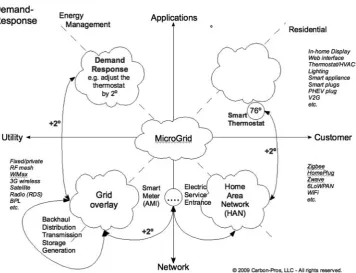
in improving the energy performance of buildings, European legislators included smart metering in the EPBD. A combination of energy efficiency and ICT seems to be very promising in achieving the goals of the EPBD, however, broad introduction of ICT appears to be very difficult considering the different technical condition and age of buildings and uncertainty as to the universal acceptance of this kind of technology in newly constructed buildings and buildings undergoing major renovations. Indeed, this was at the basis of the EPBD’s new regulations, which provide for the rather cautious evolution towards energy-efficient buildings with a complex internal structure of ICT, based on a two-way communication system (hereafter, smart homes), which are a part of the smart grid ecosystem (see Figure 1 below).
Article 8(2) EPBD referred to intelligent metering systems obliging the Member States to “encourage” introduction of such systems whenever a building is constructed or undergoes major renovation. While the word “encourage” in reference to intelligent systems is quite clear, the softer stipulation in this article in fine refers to the installation of active control systems such as automation, control and monitoring systems that aim to save energy, and which the Member States shall encourage only “where appropriate”. Forms of such “encouragement” may include, in particular, free or subsidized technical assistance and advice, direct subsidies, loan schemes or low interest loans, grant schemes, and loan guarantee schemes. EPBD does not constitute a complete list of all possible measures of encouragement. It may be argued how much more effective strictly fiscal instruments like tax relief might be, especially in the case of deploying intelligent metering systems,. According to Article 8(2) this bottom-up approach adopted by the EPBD should be in line with the top-down obligations in Directive 2009/72/EC of the European Parliament and of the Council from July 13, 2009 concerning common rules for the internal market in electricity. It is not entirely clear why European Law did not adopt the similar solutions of Directive 2009/73/EC of the European Parliament and of the Council from July 13, 2009 concerning common rules for the internal market in natural gas. Looking for cross-references it is also advisable to refer to Directive 2006/32/EC, which in Article 13(1) imposes on Member States a conditional and (again) softly expressed condition to ensure that final customers are provided with “individual meters that accurately reflect the final customer’s actual energy consumption and that provide information on actual time of use”7. Directive 2006/32/EC refers to final customers of electricity, natural gas, district heating and/or cooling and domestic hot water, which may lead to the assumption that Member States
7 Directive 2006/32/EC of the European Parliament and of the Council of 5 April 2006 on
should encourage provision of meters for such media. It is worth noting that the directive counts final customers in the context of metering, but it does not resolve the problem of integrating metering systems.
Figure 1. Smart grid ecosystem
Source: http://carbon-pros.com/blog1/2009/07/smart_grid_smart_house.html
According to Article 8(1) of the Directive 2006/32/EC in fine, when a new connection is made in a new building or a building that is undergoing major renovations, as set out in Directive 2002/91/EC (a predecessor of the EPBD), such individual meters shall always be provided8.
With reference to the EPBD, it has to be noted that the term “individual meters” is no longer used in this directive, but it borrows its language from new liberalization directives. Although the EPBD counts only “intelligent metering systems”, it may be argued that some of its provisions refer to
8 Directive 2002/91/EC of the European Parliament and of the Council of 16 December
the broader concept of “intelligent grid”9. Article 6 EPBD opens the way for micro-generation in new buildings, namely for such high efficiency systems as: (a) decentralized energy supply systems based on energy from renewable sources; (b) cogeneration; (c) district or block heating or cooling, particularly where it is based entirely or partially on energy from renewable sources; (d) heat pumps. According to the above Article for new buildings, Member States shall ensure that, before construction starts, the technical, environmental, and economic feasibility of such high-efficiency alternative systems, if available, be considered and taken into account. Also in this case the language of EPBD is somewhat vague, referring to “availability” as well as technical, environmental, and economic considerations.
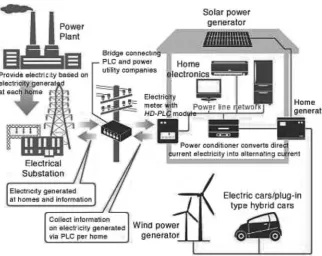
Figure 2. Smart home in a smart grid model
Source: http://hd-plcmag.com/en/feature/smartgrid01.html
It may be argued that European legislation in the EPBD is not conclusive about intelligent metering systems and the intelligent grid. On the other hand, it is difficult to expect strong obligations imposed on the Member States to roll-out existing meters in all types of buildings or to integrate metering of
different media regarding the techno-economic maturity of ICT solutions in this area, privacy concerns, propriety of meters, and other factors. One thing is certain, in the name of energy efficiency the obligation imposed on the Member States is to encourage deployment of intelligent metering systems, allowing them to draw the appropriate measures to fulfill this obligation.
III. The regulatory framework for smart grids – towards a new model
of regulation
In addition to the adoption of new solutions by European legislation, national regulators gathered in the European Regulators’ Group for Energy and Gas (ERGEG) adopted their own framework regarding smart metering and smart grid implementation10. Regulatory effort should be considered a part of the process of implementing liberalization directives and other EU legislation concerning intelligent grids and intelligent metering systems. The work of regulators is carried out alongside intensive standardization work, which aims at the creation of European standards that will enable the interoperability of utility meters (water, gas, electricity, heat) which can raise final customers’ awareness of their actual consumption11. These issues are high on the agenda of European energy regulators primarily because intelligent grid/intelligent metering is the core activity of regulated grid operators. The smart grid is an idea which is a good starting point in changing the regulatory model, but also a change in the network utilities model. This change is well exemplified by J.P. Tomain, who has said: “The traditional model of utility regulation must be replaced with a smarter version – the iUtility. Where the old model encouraged consumption, the new model must encourage conservation. Where the old model fostered economic inefficiency, the new model must foster the efficient use of electricity. Where the old model was content with capital-intensive, centralized power production, the new model must promote distributed, small-scale power production. Where the old model was satisfied with burning dirty fossil fuels, the new model must expand the development,
10 Smart grid issues are also on the agenda of other regional and international organizations
like the Energy Regulators’ Regional Association and International Confederation of Energy Regulators, e.g. ‘A Description of Current Regulatory Practices for the Promotion of Energy Efficiency’, ICER, 21 June 2010, Ref. I10-CC-02-04.
11 ‘Standardization mandate to CEN, CENELEC and ETSI in the field of measuring
production, and consumption of alternative and renewable resources”12. It is obvious that such changes to the ‘DNA’ of the electricity grid need a regulatory response.
The activity of the European regulators towards smart grids should significantly influence the change in the model of regulation. European regulators do not have legislative power, but their advisory voice is heard through their expertise and knowledge about the regulated industry. So far, two main regulatory developments on the European stage are particularly worth noting: consultations on smart grids and on smart metering13. One of the implications arising from the consultation documents, being of upmost importance from the perspective of regulatory policy, is to change the regulation model associated with the change of priorities in the development of the grid operators. According to the ERGEG, output-based regulation of grid industries (hereafter, OBR) shall focus on smart grid benefits and can be done in two ways: 1) by direct regulation, i.e., minimum requirements for certain parameters, and/or 2) by performance-based incentive regulation providing penalties and rewards related to certain criteria and performance indicators14. This concept of regulation goes beyond the traditionally functioning cost-based or incentive-based regulation models. A key element of such a model of regulation is to define the outputs, which are part of the very definition of the efficiency-based and customer-focused element of the smart grid. An important factor that adds an element of uncertainty to such a model is the degree of innovation of solutions defining the performance of network operators.
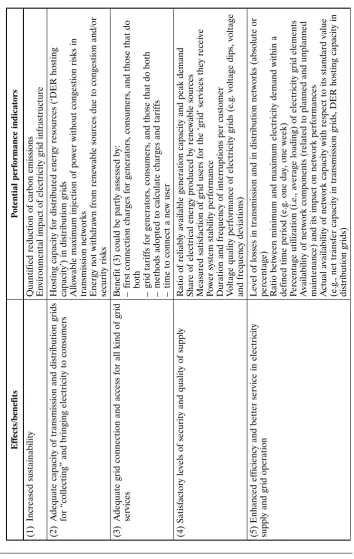
The OBR model focuses on the performance of operators, which is evaluated by performance indicators. While selecting the indicators it should be ensured that they are objectively verifiable. The following are outputs and indicators that have been proposed by ERGEG.
This list of benefits and indicators is a proposal of the European Regulators and currently has no normative value – rather, it is an example of good practice promoted by ERGEG. However, this is the first serious approach to the development of a regulation model that takes into account the concept of the intelligent grid. In analyzing the benefit groups presented by ERGEG it has to be noted that they relate in part to the transnational electricity market and transmission system operators (TSOs).This area is a natural point of
12 J. P. Tomain, ‘Steel in the Ground’: Greening the Grid with the iUtility’ (2009) 39
Environmental Law 951.
13 ERGEG Conclusion Paper on Smart Grid’, Ref: E10-EQS-38-05, ‘An ERGEG Public
Consultation Paper on Draft Guidelines of Good Practice on Regulatory Aspects of Smart Metering for Electricity and Gas’, Ref: E10-RMF-23-03, 10 June 2010.
Table 1. Effects/benefits of smartness and list of potential performance indicators by ERGEG
Effects/benefits
P
otential performance indicators
(1)
Increased sustainability
Quantified reduction of carbon emissions Environmental impact of electricity grid infrastructure
(2)
A
dequate capacity of transmission and distribution grids
for “collecting” and bringing electricity to consumers
Hosting capacity for distributed energy resources (‘DER hosting capacity’) in distribution grids Allowable maximum injection of power without congestion risks in transmission networks Energy not withdrawn from renewable sources due to congestion and/or security risks
(3)
A
dequate grid connection and access for all kind of grid
services
Benefit (3) could be partly assessed by: – first connection charges for generators, consumers, and those that do both – grid tariffs for generators, consumers, and those that do both – methods adopted to calculate charges and tariffs – time to connect a new user
(4) Satisfactory levels of security and quality of supply
R
atio of reliably available generation capacity and peak demand
Share of electrical energy produced by renewable sources Measured satisfaction of grid users for the ‘grid’ services they receive Power system stability performance Duration and frequency of interruptions per customer Voltage quality performance of electricity grids (e.g. voltage dips, voltage and frequency deviations)
(5) Enhanced efficiency and better service in electricity supply and grid operation
L
evel of losses in transmission and in distribution networks (absolute or percentage) Ratio between minimum and maximum electricity demand within a
Effects/benefits
P
otential performance indicators
(6) Effective support of trans-national electricity markets
R
atio between interconnection capacity of one country/region and its
electricity demand Exploitation of interconnection capacity (ratio between mono-directional energy transfers and net transfer capacity), particularly related to maximization of capacity according to the R
egulation on electricity
cross-border exchanges and the congestion management guidelines Congestion rents across interconnections
(7)
Coordinated grid development through common European, regional and local grid planning to optimize transmission grid infrastructure
Benefit (7) could be partly assessed by: – impact of congestion on outcomes and prices of national/regional markets – societal benefit/cost ratio of a proposed infrastructure investment – overall welfare increase, i.e. always running the cheapest generators to supply the actual demand): this is also an indicator for benefit (6) above – time for licensing/authorization of a new electricity transmission infrastructure – time for construction (i.e. after authorization) of a new electricity transmission infrastructure
(8)
Enhanced consumer awareness and participation in the market by new players
Demand side participation in electricity markets and in energy efficiency measures Percentage of consumers on (volunteer) time-of-use / critical peak / real time dynamic pricing Measured modifications of electricity consumption patterns after new (volunteer) pricing schemes Percentage of users available to behave as interruptible load. Percentage of load demand participating in market-like schemes for demand flexibility Percentage participation of users connected to lower voltage levels to ancillary services
Source: ERGEG Conclusion P
aper on Smart Grid, R
reference at the European level and will certainly be of interest to the newly established agency – the Agency for the Cooperation of Energy Regulators (ACER). The problem of implementation of smart grids lies predominantly not at the level of TSOs, but rather at the level of distribution system operators (DSOs). For the national regulatory authorities the ERGEG position can be an important reference point, but it is not binding. It is still too early to demand the adoption of new laws, but once the OBR model becomes everyday practice in the activities of regulators, it should find place in the provisions of the liberalization directives.
Some national regulatory authorities are already developing new methods of regulation. So far, the new model of price control, RIIO (Revenue = Innovation + Incentives + Outputs), has been proposed by British Ofgem. The RIIO is based on the previous price control regime used by Ofgem (RPI-X), but according to its authors better meets the investment and innovation challenge by placing much more emphasis on incentives to drive the innovation needed to deliver the required outputs in terms of improved customer service and smarter grids15. According to Ofgem key features of the RIIO model include:
• Much greater say for network customers in setting out what network companies need to deliver, i.e., renewable developers might want faster connections
• Fast track price controls will be introduced for companies who innovate, deliver good service, and produce well-documented plans setting out how they will invest efficiently for the future. They will be rewarded with higher returns
• Poorly performing companies will face much more intrusive regulation and will face lower returns
• Lengthening price controls from five to eight years will provide more stability
• A stronger incentive regime to encourage more efficient investment and innovation
• The additional option of giving new network companies a greater role in delivering certain large-scale projects where this does not delay delivery. This could open up new sources of finance and encourage innovation • Expansion of the current low carbon networks fund to encourage greater
innovation across gas and electricity networks16.
15 ‘Ofgem reengineers network price controls to meet £32 billion low carbon investment
challenge’ – press release of July 26, 2010; available at: http://www.ofgem.gov.uk/Media/ PressRel/Documents1/JULY%20RPI%20PRESS%20NOTICE.pdf
The British model of price control is certainly an interesting proposal, taking into account the requirements of the smart grid concept. At the moment there is no one common regulatory model which would be a ready-to-use product adoptable by all the European Regulatory Authorities. The Member States are free to choose a regulatory model which best suits local conditions, but they must take into account the current trend in network development, with its focus on the smart grid concept.
In analyzing the ERGEG document on the smart grid, regulators stress the importance of one more priority which should be included when drafting the regulatory policy. The smart grid concept is not only about the energy sector, as it requires the involvement of various stakeholders from the ICT sector, consumer organizations, the construction industry, renewable energy sector, etc. Regulators should therefore play an active role in favouring cooperation among those stakeholders to achieve the targets set for the various smart grid concepts, innovations, and solutions. According to ERGEG the role of regulators should be to facilitate smart grid discussions, hammering out common views, and cooperation among all stakeholders. ERGEG stresses the fact that such cooperation should be “especially devoted to agreeing which smart grid concepts will provide clear and greater net benefits (i.e., the benefits minus any possible additional costs) to network users and to the whole society, to identifying the possible presence of regulatory barriers to such smart grid concepts and to finding the best solutions to remove them”17. Consequently, in the process of implementing the smart grid, regulators must go far beyond their erstwhile relationship with the energy sector, and try to bring together as many smart grid actors as possible. For herein depends the success of a holistic vision for modernizing the electricity grid.
17 ERGEG Conclusion Paper on Smart Grid, p. 11.; networking strategy of Polish energy
regulator can serve as an example of this type of action, which: 1) commissioned preparation of feasibility study on smart metering and initiated a discussion on that subject, 2) finalized signing of Declaration concerning the introduction of smart grid into the Polish power system,
In closing it should be pointed out that the idea of changing the regulatory model is in fact not a purely European phenomenon. The developmental direction of modern industry networks towards smart grids is being widely adopted in many industrialized economies18. One good example is the United States, where the shift in regulatory policy toward taking into consideration the smart grid is described in terms of a transition towards a new regulatory model described as “regulation 3G”, which: “affects the development of the smart grid in many ways. The smart grid requires innovation, collaboration, and technological investment. It promises efficiency, reliability, and smoother working electricity markets. It also promises to transform the industry from sellers of electricity to providers of energy services and products. Regulation 3G also promises to revamp the old regulatory structure into one that is more flexible, market-based, and less prone to capture”19.
IV. Conclusion
Due to the user-centric approach and focus on energy efficiency and sustainable development, the approach to the network industry is changing: a new axiology for grids is being added in the form of sustainable development, security of supply, and promotion of competition. European energy law and policy describes this shift in terms of intelligent metering systems and intelligent grids. Neither concepts are ready-made products, but rather determinants of the direction of future network development, indicating the axiology of the desired changes with the use of modern ICT solutions. At the same time these concepts ought to be regarded as offering the most promising vision of the objectives of European Energy Policy.
This direction has already been reflected in Directive 2006/32/EC and more explicitly in the liberalization package directives. In the post-package legal environment the directive is represented in the bottom-up approach of the EPBD, but once more the obligations regulated in this directive are rather soft. According to Directive 2006/32/EC, one clear obligation of the Member States is to encourage deployment of intelligent metering systems, but countries are free to choose their own proper measures. It should be clear that the EU shall adopt harder measures in the future legislation aimed at the effectiveness of smart grid deployment. The provisions of the Directive 2006/32/EC will have
18 W. Breuer, D. Povh, D. Retzman, Ch. Urbanke, M. Weinhold, ‘Prospects of Smart Grid
Technologies for a Sustainable and Secure Power Supply, available at: http://www.worldenergy. org.documents/p001546.pdf
to change in the future towards clarification of obligations that which this directive put on energy firms in the area of informing customers and frequency of information delivery.
Along with legislation and European Commission efforts focused on standardization, regulators have begun the process of adapting to a new model for the functioning of network industries. One of the important outcomes of these efforts is to propose a new model of regulation based on outputs. The smart grid sets new tasks for regulators, who will have to play a leading role in the introduction of new solutions, offering within their regulatory tools price control models that define performance indicators and measure and reward outputs of regulated industries. This is to significantly include innovation and changes in the management of the modern industry grid. This task requires moving beyond the established model of economic regulation. Success will be achieved if “smart regulators” meet “smart industry” in regulatory policy.
Literature
A Description of Current Regulatory Practices for the Promotion of Energy Efficiency’, ICER, 21 June 2010, Ref. I10-CC-02-04.
‘An ERGEG Public Consultation Paper on Draft Guidelines of Good Practice on Regulatory Aspects of Smart Metering for Electricity and Gas’, Ref: E10-RMF-23-03, 10 June 2010.
Breuer W., Povh D., Retzman D., Urbanke Ch., Weinhold M., ‘Prospects of Smart Grid
Technologies for a Sustainable and Secure Power Supply’(available at: http://www.
worldenergy.org.documents/p001546.pdf).
‘‘ERGEG Conclusion Paper on Smart Grid’, Ref: E10-EQS-38-05, 10 June 2010.
Ferrey S., ‘Restructuring a Green Grid: Legal Challenges to Accommodate New Renewable
Energy Infrastructure’ (2009) 39 Environmental Law.
‘Standardization mandate to CEN, CENELEC and ETSI in the field of measuring instruments for the development of an open architecture for utility meters involving communication protocols enabling interoperability M/441’, European Commission
M/441/EN, Brussels 12th March 2009.
‘Standardization mandate to CEN, CENELEC and ETSI in the field of measuring instruments for the development of an open architecture for utility meters involving
communication protocols enabling interoperability M/441’, Smart meter coordination
group – final report, Version 0.7 – 2009-12-10.
Swora M., ‘The intelligentgrid: unfinished regulation in the Third EU Energy Package’
(2010) 4 Journal of Energy & Natural Resources Law.
Tomain J. P., ‘Steel in the Ground’: Greening the Grid with the iUtility’ (2009) 39
Environmental Law.
Vasconcelos J., ‘Survey of Regulatory and Technological Developments Concerning Smart
Reduction of Emissions: Towards the National Programme for
Low-Emission Economic Development. The Public Board’s Role
Krzysztof
Ż
mijewski
*, Maciej M. Soko
ł
owski
**CONTENTS
I. Introduction
II. The Public Board of the National Programme for the Reduction of Emissions
III. The Board’s tasks IV. The Board’s structure
V. Strategic documents
VI. An era of sustainable development VII. 2011 objectives
VIII. Policy recommendations and results
Abstract
European climate and energy policy will have a great impact on the European and Polish energy markets. Moreover, it will have an influence on broad realms of social and economic activity. This raises the necessity of taking concrete strategic measures, especially on the governmental level. EU climate and energy policy also entails sizeable investment requirements and places important demands on the modernization programme for the energy sector. This spells the need to develop broad dialogue between the government and society.
The above gives the background behind the appointment of the biggest Polish think tank in 2009 – namely, the Public Board of the National Programme for the Reduction of Emissions. In the Polish context the authors herein analyze the European climate and energy package, European Union policy regarding the reduction of emissions, and the Polish efforts taken in this field. The authors also
* Prof. Dr. Krzysztof Żmijewski, Warsaw University of Technology; Secretary General of
the Public Board of the National Programme for the Reduction of Emissions.
** Maciej M. Sokołowski, Executive Director of the Public Board of the National Programme
describe the role of the Public Board of the National Programme for the Reduction of Emissions and its tasks. In conclusion they present policy recommendations and results in the area of fulfilling European obligations and conducting an infrastructural modernization programme in Poland.
Résumé
Les politiques énergie-climat européennes auront un grand impact sur le marché de l’énergie européen et polonais. En plus, elles auront une influence sur les différentes sphères de l’activité sociale et économique. D’ici, la nécessité de réaliser des actions stratégiques spécifiques, surtout au niveau gouvernemental. Les politiques énergie-climat influencent aussi les besoins d’investissement et le périmètre du programme de modernisation dans le secteur de l’énergie. Il est alors nécessaire de promouvoir un vaste dialogue entre le gouvernement et la société.
Les résultats indiqués constituent un arrière-plan pour l’établissement du plus grand “think tank” polonais en 2009 – le Conseil Publique du Programme National de Réduction des Émissions. Dans le contexte polonais, les auteurs analyseront le packet énergie-climat, les politiques de réduction des émissions de l’UE et les actions polonaises réalisées dans ce domaine. Les auteurs décriront aussi le rôle et les tâches du Conseil Publique du Programme National de Réduction des Émissions. Dans la conclusion, ils présenteront les recommandations et les résultats dans le domaine de l’accomplissement des obligations européennes et de l’implantation du programme de modernisation d’infrastructure en Pologne.
Classifications and key words: Emission Trading System, energy, reduction of
emissions, energy market, energy policy, climate and energy package.
I. Introduction
of energy efficiency in the years leading up to 2020. According to assessments carried out by the Ministry of the Economy, the budget for these investment activities is 100 billion Euro by 2030, which fact required that the National Programme and related activities be initiated immediately.
It should be mentioned that although the name of the National Programme was altered from the National Programme for the Reduction of Emissions to the National Programme for Low-Emission Economic Development, the role of the Programme was not changed. It is still a document in which there will be set a primary rules for government activity in the area of meeting European Union climate obligations. Therefore in this article the authors will use “National Programme” both in the context of the National Programme for the Reduction of Emissions (NPRE) and the National Programme for Low-Emission Economic Development (NPLEED).
The National Programme and its proper implementation and realization will require high-scale investments. Their extent and type is presented on the tables below:
Table 1. The Polish Investment Programme
billions € sector
90 100 Electric energy
15 20 Gas
~80 100 Heating and buildings
~80 100 Transport
265 320 by 2030
13.5 per year 16 per year Annually
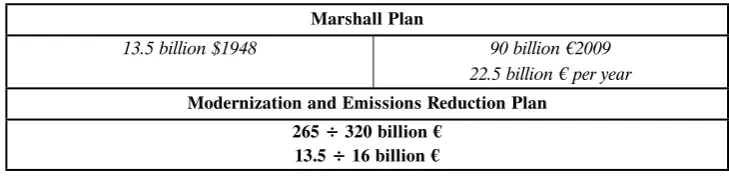
This effort should be compared with the famous Marshall Plan, which was ever so crucial for the European economy, and which embraced many countries for a period of 3.5 years.
Table 2. A New Marshall Plan
Marshall Plan
13.5 billion $1948 90 billion €2009
22.5 billion € per year
Modernization and Emissions Reduction Plan 265 ÷ 320 billion €
The current and predicted situation of the Polish economy suggests that by 2030 Poland will have to face an enormous undertaking in respect of investments that – to a significant degree – will have to be financed from individual funds. This of course does not mean that there will be no scope for the involvement of foreign investors. However, it indicates that it is necessary to realize that these investors will expect a decent return on the capital they have put in (which is generally higher than the costs of instruments such as loans). In other words, as we demonstrate below, Poland needs a huge infrastructure modernization programme.
Meanwhile European Union obligations mean that this programme must simultaneously be a National Programme. As in any great undertaking, a proper diagnosis of the situation must precede any later activities. In this case, the priority is knowledge of the degree of technical depreciation of fixed assets, i.e., knowledge of the degree of the technical exploitation of Poland’s infrastructure. This task can be carried out in four phases:
Firstly, it is necessary to define the primary value of each of the components of the infrastructure in question;
Secondly, we must define (and adopt) a maximum life-span for a given facility; for example, in the case of a coal-based condensation power plant this is 40 years, and these 40 years yield a rate of technical depreciation of
1
⋅100%
40 , i.e. 2.5% p.a.;
Thirdly, 2.5% of the primary value must be added per year; the sum obtained after this is done reflects the actual value of technical depreciation; Fourthly, all current redemptions should be identified and divided by the sum of the primary values of all of the elements of constant assets in a given company, sector, or the economy.
The end result arising out of these calculations illustrates the percentile rate of technical exploitation of infrastructure. If the result is equal to 0% then the infrastructure is new, if it is 100% then it is completely exploited – i.e., there is no guarantee that it will continue to work properly. The algorithm is very simple insofar as a set of assets is inventorized and technical depreciation is calculated and added on a regular basis1.
The fundamental problem that Poland faces is that such inventorization has not been officially carried out.As a result, we are unable to precisely define the level of technical depreciation of the country’s infrastructure. Thus, the need to elaborate and conduct an exacting National Inventorization Programme is exigent.
1 See more M. Kleiber, J. Steinhoff, K. Żmijewski, Manifest desperatów, “Rzecz pospolita”,
II. The Public Board of the National Programme for the Reduction
of
Emissions
The Public Board of the National Programme for the Reduction of Emissions (“the Board”) was announced by the Deputy Prime Minister, Minister of the Economy Waldemar Pawlak on April 23, 2009. It is to support the endeavours of the Polish government in relation to the creation and execution of the National Programme for the Reduction of Emissions.
The Public Board is chaired by the Presidium of the Board and has seventeen Task Forces. Each Task Force has a Chairman, Vice-chairman, and a Secretary. The members of the Task Forces are distinguished authorities in the area of science and technology. They are supported by independent experts: professional consultants and reputable people from the business world. The Presidium of the Board and the Presidents of the Task Forces were nominated on October 28, 2009:
– Prof. Jerzy Buzek – Chairman (President of European Parliament); – Prof. Michał Kleiber – Vice-chairman (President of the Polish Academy
of Science);
– Janusz Steinhoff PhD – Vice-Chairman (former Deputy Prime Minister); – Prof. Krzysztof Żmijewski – Secretary General.
The legal basis for the Board’s operation is the Act of August 8, 1996 on the Council of Ministers2 and Order No. 28 of the Minister of the Economy of October 21, 2009 (“Order No. 28”). According to these regulations the Board is an advisory body to the Minister of the Economy.
The role of the Board’s work is indicated in the rationale for Order No. 28, according to which the Board’s objective is to materially support the Minister of the Economy in his or her activities connected with the development and implementation of the National Emission Reduction Programme. The Board’s activities are expected to lead to effective implementation in Poland of the European Union climate and energy package and of the Industrial Emissions Directive currently under preparation. The budget for investment activities under the programme (continuing until 2030) is estimated by the Ministry of the Economy at € 100 billion, which requires prompt commencement of the Board’s activities. The Board is composed of a voluntary team of outstanding specialists representing science and technology, supported by nongovernmental voluntary advisors (outstanding representatives of the business world), which means that it is the biggest think tank of any quasi-governmental organization. The issue of emission reduction has not only environmental, energy-related and economic dimensions, but also a significant social dimension.
III. The Board’s tasks
The Board’s tasks are regulated in § 2 of Order No. 28, and they are as follows: to develop proposals and concepts for systemic solutions aimed at reducing Poland’s greenhouse gas emissions into the atmosphere, taking into account relevant international commitments of the Republic of Poland as well as European Union legislation, and to participate in the development and appraisal of relevant draft documents. This shall lead to an improvement of economic efficiency, development of low-emission industrial technologies, development of renewable energy sources, and the general directions of the energy sector’s development. These tasks are underlined by the broad range of the Board’s activity, which gives it the opportunity to influence numerous branches of the economy both directly and indirectly in terms of the reduction of emissions in Poland.
The basic tasks set before the Board include:
a) elaboration of road-maps for specific programmes encompassed by the NPRE,
b) elaboration or appraisal of terms of reference for projects prepared and carried out by the government and aimed at reducing emissions, c) appraisal of the compliance of the aforementioned projects with their
terms of reference and appraisal of the execution of these projects, d) preparing opinions of the strategic intentions of the government in
respect to reducing emissions,
e) elaboration of strategic solutions for reducing of emissions.
The mission of the Board is to provide the Deputy Prime Minister responsible for development of the Polish economy with competent, independent, and comprehensive strategic knowledge permitting the constitutional principle of sustainable development to be upheld3. The main aim is optimization of the process to reduce emissions as a basic tool for climate protection. An additional aim is to convince society of the relevance of optimal measures aimed at climate protection. The vision of the Board is to lead to zero-energy development in Poland – pursuant to the guidelines of the Energy Policy.
As its name suggests, the Board is above all to be an advisory body. The fact that it gathers together people from outside the political divides, people who have the highest competences and moral authority, generates synergy and
3 Article 5 of the Constitution of the Republic of Poland: “The Republic of Poland shall
a collective authority with enormous potential in respect to influencing the public – and therefore the decisions made by the government, as well. The second vital function of the Board is to persuade society and politicians to carry out efforts aimed at reducing emissions and ensuring climate protection. The main aim of the Board is to execute its action plan and thereby assist the government in executing the NPRE/NPLEED. A broader aim is to optimize actions undertaken as part of the NPRE/NPLEED.
IV. The Board’s structure
The issue of reducing emissions not only has an ecological, energy-related, and economical dimension, but also a clear social dimension. This is why the Board will also focus its work on non-technical matters, as reflected in the Board’s structure:
Chart 1. The Board’s structure4
Presidium of the Board
MACRO ECOLOGICAL
LEGAL
ENV. IMPACT FINANCIAL
MARKET
ZERO-EMISSION ENGINEERING SOCIAL
SECURITY & FUELS CLIMATE POLICY
SYSTEM SOURCES
GRID
ORG. & MNGMT
TRANSPORT
STRAT. COMMUNIC.
COMMUNITY ACTIONS
EDUCATION & SCIENCE
RES
ENERGY EFFICIENCY
CLEAN TECHN.
Secretariat
CONSTRUCTION & MATTER.
The functioning of the Board is based on the tried-and-tested model of separation of the competences and activities for which the Presidium of the Board (the Chairman of the Board and Chairs of the Working Groups) is responsible from the competences and activities for which the Secretary
General, Secretaries of the Working Groups, and Secretariat of the Board are responsible. This model has been tested in the first phase of Board’s operation and proved successfully.
The Board consists of the Presidium and the 17 listed Working Groups. They are supported by the Secretary of the Board and the Ministry of the Economy’s Department of Energy and Department of Economy Development. The members of the Working Groups are independent experts and authorities from scientific and technical spheres5. As stated in § 3 of Order No. 28, the Board’s members are appointed by the Minister of the Economy from among scientists, entrepreneurs, and representatives of opinion-making circles connected with the energy sector.
The Board is also supported by independent voluntary consultants who formally are not Board members, but are invited by the Chairman to cooperate with the Board when their knowledge and experience may be useful in the fulfillment of the Board’s tasks. They may also participate in the proceedings of the Board. Such non-members shall include in particular: representatives of the public authorities, experts in the fields covered by the Board in its work, and representatives of scientific institutions.
The Board’s activities are mainly carried out by Internet (via emailing) and it is supported by quarterly meetings of the Working Groups. Moreover, cooperation in the Board is complemented by members’ meetings during conferences, debates, and joint discussions. Virtual cooperation with experts acting as consultants is very useful. This is the simplest, cheapest, and most efficient form of cooperation for preparing source materials – reports, policies, White and Green Papers, and above all relevant legislation (ideas and forms of reference).
As underlined in Order No. 28 the Board shall act as a collegial body. In connection with the above-described scope of the Board’s tasks, the Board shall adopt resolutions regarding issues coming within its scope of work. The Board’s resolutions shall be passed by consensus. The Chairman shall direct the proceedings of the Board and shall chair the Board’s sessions. If unanimity cannot be reached, the Chairman may put the issue to a vote; in such a case, the Board resolution shall be taken by a majority of the votes cast by the present and voting members of the Board. In the case of a tie, the Chairman’s vote shall be decisive.
The Board benefits from logistic support provided by the Ministry of the Economy. This support is provided by two departments: the Department of Economic Development and the Department of Energy. Moreover, the Board will try to extend its cooperation with the Polish government by strengthening
5 M.M. Sokołowski, ‘Społeczne wsparcie Rządu, czyli głos ekspertów w kwestii redukcji
cooperation with the Ministry of the Environment and other governmental agendas.
The Board is also supported by an interior body – the Secretariat of the Board, which provides logistics support for the Board’s activity, without which the Board would not be able to operate and fulfill its tasks. The practical experience of the functioning of the Board in 2009–2010 indicates that the Secretariat ensures proper communication between the Board’s members as well as enables consultation of documents. Together this leads to the achievement of goals. The Secretariat also ensures that the Board’s members can present the results of their activity at conferences, meetings, and seminaries. They assure promotion of the Board’s activity.
The Board collaborates with numerous non-governmental organizations on an everyday basis. This cooperation and necessary communication occupies a considerable part of the Secretariat’s work. In this way the Board develops its pro-public activity by encouraging these organizations to cooperate and publically express their opinions during debates and conferences organized with the Board’s help or under the Board’s patronage. The Board plans to develop this cooperation, especially in the context of elaborating the Polish Climate Change Act. Study visits in various countries with similar activities will be a great advantage for Polish concepts and ideas.
Finally, the Board is currently carrying out activities aimed at gaining the support of foreign members of the Board acting on a voluntary basis. We are open to every form of cooperation with foreign experts: secondments of experts, for example from the Task Force in Holland, would be a great advantage. In a similar way the support of foreign experts active in Poland would be of great advantage (as was the case with the Energy Restructuring Group in Poland in the 1990s). The Board also plans to develop its cooperation with European professional expert organizations.
V. Strategic documents
Specific issues of the experts’ analytical activity includes: the scale and means for financing the programme for modernization of the electric energy sector; the means for carrying through the required 15% share of energy from renewable energy sources in the final energy balance (taking into account the heating sub-sector); and the means for limiting growth in CO2 emissions in the transport sector, in order to ensure that the limit of 14% growth in the non-ETS area is not exceeded. It also includes introduction of legislation allowing for timely execution of the National Programme – to wit, the Energy Efficiency Act, the Nuclear Law Act, and the Act on Execution of Strategic Infrastructure Investments of Particular Significance to the Development of the Country. In details it covers issues such as: acceleration of the development of renewable energy sources; liquidation of investment barriers; improvement of the renewable energy sources motivation system; preparation of Poland’s comprehensive position in the face of the challenges posed by the European climate policy; elaboration of underlying guidelines for a national campaign aimed at increasing energy awareness, basic guidelines for a programme aimed at education and development of science (including in particular nuclear and energy efficiency issues), and guidelines for the Clean Coal Technologies Programme.
These issues are described in the above-mentioned catalogue of strategic documentation. The 230-page Green Paper of the National Programme for the Reduction of Emissions is the first example of the Board’s analytical activity6. The Green Paper was elaborated in 2010 and was delivered to the Polish government and its agendas.
The main aims of the Green Paper are defined as identification of problems requiring resolution and tasks requiring execution, together with inventorization of issues for discussion. Additionally, the Green Paper also elaborates the means of achieving the aims in question. For example, it may involve controlling energy demand, changes in respect of sources of energy, and/or technological developments.
The basis for seeking solutions is that of the aim to achieve balance in respect to the basic triad of the following components: economic development (competitiveness), sustainable development (environment), and stable development (security). This context is a vital background for all of the Green Papers chapters, which are gathered in three main areas: “Problems requiring resolution – programmes”, “Tasks to be executed”, “Issues for discussion”. Their frameworks indicate such issues as: preparation of tools for law, finance, and regulation; tariffs and organization; procedures and structures; problems, development of technologies (renewable energy sources, clean coal sources,
nuclear energy, power grid, gas networks, heating networks, sources – system-based and local – energy efficiency, low emissions transport, promotion of innovation); protection of the environment; emissions planning (emissions budget); reduction of emissions; control of emissions; creation of social awareness; ensuring security; diversification of supply (liquefied natural gas, Trans-European Energy Networks, Trans-European Gas Networks); and finally integration of the European markets of emissions, energy, efficiency, and others markets.
Another subject of activity is the creation of social awareness in respect to the issue of demand for energy and means of satisfying the indicated needs, e.g., by means of changes in social behaviour and lifestyle. Such problems are described in the Green Paper in the chapters “Education”, “Information”, “Promotion”, “Dialogue (social consultations)”, “Cooperation” and “Co-responsibility”.
The Board also suggests conducting efforts in the field of concrete campaigns. These are means of executing tasks resulting from European Union energy policy and its obligatory aims. Among these campaigns shall be: re-electrification of rural areas; gasification of the country; sensitization and education of the network; intelligent networks; smart metering; cogeneration and heating; restitution of power; construction of new sources and modernization of existing sources; thermo-refurbishment and certification of buildings; passivization of buildings; decarbonization of transport; and reorganization of transport. These campaigns are correlated with issues for discussion – e.g., the level of Poland’s gasification; the future of coal; directions and areas of development of RES; types of technologies; cooperation with classical energy; road law; green heat – low-emissions heating; the future of nuclear energy; types of technology; management of fuels and waste; organization of the energy efficiency market; organization of the biomass market; certification of “colourful” energy; financing of energy-efficient and zero-emissions investments; and reorganization of passenger and freight transport.

![Fig. 4. CO2 allowance price in 2005–2007 [9].](https://thumb-us.123doks.com/thumbv2/123dok_us/10089310.1995569/91.476.68.408.237.380/fig-co-allowance-price-in.webp)
![Fig. 6. Comparison of the SO2 emission limits for lignite and hard coal [mg/m³] from 2016 on, as per the Regulation of the Minister of the Environment of December 20, 2005 [5] and the Industrial Emissions Directive for “existing” plants.](https://thumb-us.123doks.com/thumbv2/123dok_us/10089310.1995569/93.476.63.422.397.617/comparison-regulation-minister-environment-december-industrial-emissions-directive.webp)
![Table 1. Cost of investments required to construct new capacities if the IED is implemented in 2016 with a definition “combustion plant = stack” [14]](https://thumb-us.123doks.com/thumbv2/123dok_us/10089310.1995569/94.476.71.415.511.620/table-investments-required-construct-capacities-implemented-definition-combustion.webp)
